From: Luke 11:37-41
The Hypocrisy of the Scribes and Pharisees
[37] While He (Jesus) was speaking, a Pharisee asked Him to dine with Him; so He went in and sat at table. [38] The Pharisee was astonished to see that He did not first wash before dinner. [39] And the Lord said to him, "Now you Pharisees cleanse the outside of the cup and of the dish, but inside you are full of extortion and wickedness. [40] You fools! Did not He who made the outside make the inside also? [41] But give for alms those things which are within; and behold everything is clean for you."
**********************
Commentary:
39-52. In this passage (one of the most severe in the Gospel) Jesus determinedly unmasks the vice which was largely responsible for official Judaism's rejection of His teaching--hypocrisy cloaked in legalism. There are many people, who under the guise of doing good, keeping the mere letter of the law, fail to keep its spirit; they close themselves to the love of God and neighbor; they harden their hearts and, though apparently very upright, turn others away from fervent pursuit of God--making virtue distasteful. Jesus' criticism is vehement because they are worse than open enemies: against open enemies one can defend oneself, but these enemies are almost impossible to deal with. The scribes and Pharisees were blocking the way of those who wanted to follow Jesus: they were the most formidable obstacle to the Gospel. Our Lord's invective against the scribes and Pharisees is reported even more fully in chapter 23 of St. Matthew. See the note on Matthew 23:1-39.
[The note on Matthew 23:1-39 states:
1-39. Throughout this chapter Jesus severely criticizes the scribes and Pharisees and demonstrates the sorrow and compassion He feels towards the ordinary mass of the people, who have been ill-used, "harassed and helpless, like sheep without a shepherd" (Matthew 9:36). His address may be divided into three parts: in the first (verses 1-12) He identifies their principal vices and corrupt practices; in the second (verses 13-36) He confronts them and speaks His famous "woes", which in effect are the reverse of the Beatitudes He preached in Chapter 5: no one can enter the Kingdom of Heaven--no one can escape condemnation to the flames--unless he changes his attitude and behavior; in the third part (verses 37-39) He weeps over Jerusalem, so grieved is He by the evils into which the blind pride and hardheartedness of the scribes and Pharisees have misled the people.]
40-41. It is not easy to work out what these verses mean. Probably our Lord is using the idea of cleaning the inside and outside of dishes to teach that a person's heart is much more important than what appears on the surface--whereas the Pharisees got it the wrong way round, as so many people tend to do. Jesus is warning us not to be so concerned about "the outside" but rather give importance to "the inside".
Applying this to the case of alms: we have to be generous with those things we are inclined to hoard; in other words, it is not enough just to give a little money (that could be a purely formal, external gesture); love is what we have to give others--love and understanding, refinement, respect for their freedom, deep concern for their spiritual and material welfare; this is something we cannot do unless our interior dispositions are right.
In an address to young people, Pope John Paul II explains what almsgiving really means: "The Greek word for alms, "eleemosyne", comes from "eleos", meaning compassion and mercy. Various circumstances have combined to change this meaning so that almsgiving is often regarded as a cold act, with no love in it. But almsgiving in the proper sense means realizing the needs of others and letting them share in one's own goods. Who would say that there will not always be others who need help, especially spiritual help, support, consolation, fraternity, love? The world is always very poor, as far as love is concerned" (28 March 1979).
************************
Source: "The Navarre Bible: Text and Commentaries". Biblical text taken from the Revised Standard Version and New Vulgate. Commentaries made by members of the Faculty of Theology of the University of Navarre, Spain. Published by Four Courts Press, Kill Lane, Blackrock, Co. Dublin, Ireland.
Reprinted with permission from Four Courts Press and Scepter Publishers, the U.S. publisher.
Tuesday, October 11, 2005


Monday, October 10, 2005
Gospel for Monday, 28th Week in Ordinary Time
From: Luke 11:29-32
The Sign of Jonah
[29] When the crowds were increasing, He (Jesus) began to say, "This generation is an evil generation; it seeks a sign, but no sign shall be given to it except the sign of Jonah. [30] For as Jonah became a sign to the men of Nineveh, so will the Son of Man be to this generation. [31] The queen of the South will arise at the judgment with the men of this generation and condemn them; for she came from the ends of the earth to hear the wisdom of Solomon, and behold, something greater than Solomon is here. [32] The men of Nineveh will arise at the judgment with this generation and condemn it; for they repented at the preaching of Jonah, and behold, something greater than Jonah is here."
****************************
Commentary:
29-32. Jonah was the prophet who led the Ninevites to do penance: his actions and preaching they saw as signifying that God had sent him (cf. note on Matthew 12:41-42).
[Note on Matthew 12:41-42 states:
41-42. Nineveh was a city in Mesopotamia (modern Iraq) to which the prophet Jonah was sent. The Ninevites did penance (John 3:6-9) because they recognized the prophet and accepted his message; whereas Jerusalem does not wish to recognize Jesus, of whom Jonah was merely a figure. The queen of the South was the queen of Sheba in southwestern Arabia, who visited Solomon (1 Kings 10:1-10) and was in awe of the wisdom with which God had endowed the King of Israel. Jesus is also prefigured in Solomon, whom Jewish tradition saw as the epitome of the wise man. Jesus' reproach is accentuated by the example of pagan converts, and gives us a glimpse of the universal scope of Christianity, which will take root among the Gentiles.
There is a certain irony in what Jesus says about "something greater" than Jonah or Solomon having come: really, He is infinitely greater, but Jesus prefers to tone down the difference between Himself and any figure, no matter how important, in the Old Testament.]
**********************************
Source: "The Navarre Bible: Text and Commentaries". Biblical text taken from the Revised Standard Version and New Vulgate. Commentaries made by members of the Faculty of Theology of the University of Navarre, Spain. Published by Four Courts Press, Kill Lane, Blackrock, Co. Dublin, Ireland.
Reprinted with permission from Four Courts Press and Scepter Publishers, the U.S. publisher.
The Sign of Jonah
[29] When the crowds were increasing, He (Jesus) began to say, "This generation is an evil generation; it seeks a sign, but no sign shall be given to it except the sign of Jonah. [30] For as Jonah became a sign to the men of Nineveh, so will the Son of Man be to this generation. [31] The queen of the South will arise at the judgment with the men of this generation and condemn them; for she came from the ends of the earth to hear the wisdom of Solomon, and behold, something greater than Solomon is here. [32] The men of Nineveh will arise at the judgment with this generation and condemn it; for they repented at the preaching of Jonah, and behold, something greater than Jonah is here."
****************************
Commentary:
29-32. Jonah was the prophet who led the Ninevites to do penance: his actions and preaching they saw as signifying that God had sent him (cf. note on Matthew 12:41-42).
[Note on Matthew 12:41-42 states:
41-42. Nineveh was a city in Mesopotamia (modern Iraq) to which the prophet Jonah was sent. The Ninevites did penance (John 3:6-9) because they recognized the prophet and accepted his message; whereas Jerusalem does not wish to recognize Jesus, of whom Jonah was merely a figure. The queen of the South was the queen of Sheba in southwestern Arabia, who visited Solomon (1 Kings 10:1-10) and was in awe of the wisdom with which God had endowed the King of Israel. Jesus is also prefigured in Solomon, whom Jewish tradition saw as the epitome of the wise man. Jesus' reproach is accentuated by the example of pagan converts, and gives us a glimpse of the universal scope of Christianity, which will take root among the Gentiles.
There is a certain irony in what Jesus says about "something greater" than Jonah or Solomon having come: really, He is infinitely greater, but Jesus prefers to tone down the difference between Himself and any figure, no matter how important, in the Old Testament.]
**********************************
Source: "The Navarre Bible: Text and Commentaries". Biblical text taken from the Revised Standard Version and New Vulgate. Commentaries made by members of the Faculty of Theology of the University of Navarre, Spain. Published by Four Courts Press, Kill Lane, Blackrock, Co. Dublin, Ireland.
Reprinted with permission from Four Courts Press and Scepter Publishers, the U.S. publisher.
Sunday, October 09, 2005
Gospel for the 28th Sunday in Ordinary Time
From: Matthew 22:1-14
The Parable of the Marriage Feast
[1] And again Jesus spoke to them in parables, saying, [2] "The kingdom of heaven may be compared to a king who gave a marriage feast for his son, [3] and sent his servants to call those who were invited to the marriage feast; but they would not come. [4] Again he sent other servants, saying, 'Tell those who are invited, Behold, I have made ready my dinner, my oxen and my fat calves are killed, and everything is ready; come to the marriage feast.' [5] But they made light of it and went off, one to his farm, another to his business, [6] while the rest seized his servants, treated them shamefully, and killed them. [7] The king was angry, and he sent his troops and destroyed those murderers and burned their city. [8] Then he said to his servants, "The wedding is ready, but those invited were not worthy. [9] Go therefore to the thoroughfares, and invite to the marriage feast as many as you find.' [10] And those servants went out into the streets and gathered all whom they found, both bad and good; so the wedding hall was filled with guests.
[11] "But when the king came in to look at the guests, he saw there a man who had no wedding garment; [12] and he said to him, 'Friend, how did you get in here without a wedding garment?' And he was speechless. [13] Then the king said to the attendants, 'Bind him hand and foot, and cast him into the outer darkness; there men will weep and gnash their teeth.' [14] For many are called, but few are chosen."
****************************
Commentary:
1-14. In this parable Jesus reveals how intensely God the Father desires the salvation of all men--the banquet is the Kingdom of heaven--and the mysterious malice that lies in willingly rejecting the invitation to attend, a malice so vicious that it merits eternal punishment. No human arguments make any sense that go against God's call to conversion and acceptance of faith and its consequences.
The Fathers see in the first invitees the Jewish people: in salvation history God addresses himself first to the Israelites and then to all the Gentiles (Acts 13:46).
Indifference and hostility cause the Israelites to reject God's loving call and therefore to suffer condemnation. But the Gentiles also need to respond faithfully to the call they have received; otherwise they will suffer the fate of being cast "into outer darkness".
"The marriage", says St Gregory the Great ("In Evangelia Homiliae", 36) "is the wedding of Christ and his Church, and the garment is the virtue of charity: a person who goes into the feast without a wedding garment is someone who believes in the Church but does not have charity."
The wedding garment signifies the dispositions a person needs for entering the Kingdom of heaven. Even though he belongs to the Church, if he does not have these dispositions he will be condemned on the day when God judges all mankind. These dispositions essentially mean responding to grace.
13. The Second Vatican Council reminds us of the doctrine of the "last things", one aspect of which is covered in this verse. Referring to the eschatological dimension of the Church, the Council recalls our Lord's warning about being on the watch against the wiles of the devil, in order to resist in the evil day (cf. Eph 6:13). "Since we know neither the day nor the hour, we should follow the advice of the Lord and watch constantly so that, when the single course of our earthly life is completed (cf. Heb 9:27), we may merit to enter with him into the marriage feast and be numbered among the blessed (cf. Mt 25:31-46) and not, like the wicked and slothful servants (cf. Mt 25:26), be ordered to depart into the eternal fire (cf. Mt 25:41), into the outer darkness where "men will weep and gnash their teeth'" ("Lumen Gentium", 48).
14. These words in no way conflict with God's will that all should be saved (cf. 1 Tim 2:4). In his love for men, Christ patiently seeks the conversion of every single soul, going as far as to die on the cross (cf. Mt 23:37; Lk 15:4-7). St Paul teaches this when he says that Christ loved us and "gave himself up for us, a fragrant offering and sacrifice to God" (Eph 5:2). Each of us can assert with the Apostle that Christ "loved me and gave himself for me" (Gal 2:20). However, God in his infinite wisdom respects man's freedom: man is free to reject grace (cf. Mt 7:13-14).
************************
Source: "The Navarre Bible: Text and Commentaries". Biblical text taken from the Revised Standard Version and New Vulgate. Commentaries made by members of the Faculty of Theology of the University of Navarre, Spain. Published by Four Courts Press, Kill Lane, Blackrock, Co. Dublin, Ireland.
Reprinted with permission from Four Courts Press and Scepter Publishers, the U.S. publisher.
The Parable of the Marriage Feast
[1] And again Jesus spoke to them in parables, saying, [2] "The kingdom of heaven may be compared to a king who gave a marriage feast for his son, [3] and sent his servants to call those who were invited to the marriage feast; but they would not come. [4] Again he sent other servants, saying, 'Tell those who are invited, Behold, I have made ready my dinner, my oxen and my fat calves are killed, and everything is ready; come to the marriage feast.' [5] But they made light of it and went off, one to his farm, another to his business, [6] while the rest seized his servants, treated them shamefully, and killed them. [7] The king was angry, and he sent his troops and destroyed those murderers and burned their city. [8] Then he said to his servants, "The wedding is ready, but those invited were not worthy. [9] Go therefore to the thoroughfares, and invite to the marriage feast as many as you find.' [10] And those servants went out into the streets and gathered all whom they found, both bad and good; so the wedding hall was filled with guests.
[11] "But when the king came in to look at the guests, he saw there a man who had no wedding garment; [12] and he said to him, 'Friend, how did you get in here without a wedding garment?' And he was speechless. [13] Then the king said to the attendants, 'Bind him hand and foot, and cast him into the outer darkness; there men will weep and gnash their teeth.' [14] For many are called, but few are chosen."
****************************
Commentary:
1-14. In this parable Jesus reveals how intensely God the Father desires the salvation of all men--the banquet is the Kingdom of heaven--and the mysterious malice that lies in willingly rejecting the invitation to attend, a malice so vicious that it merits eternal punishment. No human arguments make any sense that go against God's call to conversion and acceptance of faith and its consequences.
The Fathers see in the first invitees the Jewish people: in salvation history God addresses himself first to the Israelites and then to all the Gentiles (Acts 13:46).
Indifference and hostility cause the Israelites to reject God's loving call and therefore to suffer condemnation. But the Gentiles also need to respond faithfully to the call they have received; otherwise they will suffer the fate of being cast "into outer darkness".
"The marriage", says St Gregory the Great ("In Evangelia Homiliae", 36) "is the wedding of Christ and his Church, and the garment is the virtue of charity: a person who goes into the feast without a wedding garment is someone who believes in the Church but does not have charity."
The wedding garment signifies the dispositions a person needs for entering the Kingdom of heaven. Even though he belongs to the Church, if he does not have these dispositions he will be condemned on the day when God judges all mankind. These dispositions essentially mean responding to grace.
13. The Second Vatican Council reminds us of the doctrine of the "last things", one aspect of which is covered in this verse. Referring to the eschatological dimension of the Church, the Council recalls our Lord's warning about being on the watch against the wiles of the devil, in order to resist in the evil day (cf. Eph 6:13). "Since we know neither the day nor the hour, we should follow the advice of the Lord and watch constantly so that, when the single course of our earthly life is completed (cf. Heb 9:27), we may merit to enter with him into the marriage feast and be numbered among the blessed (cf. Mt 25:31-46) and not, like the wicked and slothful servants (cf. Mt 25:26), be ordered to depart into the eternal fire (cf. Mt 25:41), into the outer darkness where "men will weep and gnash their teeth'" ("Lumen Gentium", 48).
14. These words in no way conflict with God's will that all should be saved (cf. 1 Tim 2:4). In his love for men, Christ patiently seeks the conversion of every single soul, going as far as to die on the cross (cf. Mt 23:37; Lk 15:4-7). St Paul teaches this when he says that Christ loved us and "gave himself up for us, a fragrant offering and sacrifice to God" (Eph 5:2). Each of us can assert with the Apostle that Christ "loved me and gave himself for me" (Gal 2:20). However, God in his infinite wisdom respects man's freedom: man is free to reject grace (cf. Mt 7:13-14).
************************
Source: "The Navarre Bible: Text and Commentaries". Biblical text taken from the Revised Standard Version and New Vulgate. Commentaries made by members of the Faculty of Theology of the University of Navarre, Spain. Published by Four Courts Press, Kill Lane, Blackrock, Co. Dublin, Ireland.
Reprinted with permission from Four Courts Press and Scepter Publishers, the U.S. publisher.
Saturday, October 08, 2005
Gospel for Saturday, 27th Week in Ordinary Time
From: Luke 11:27-28
Responding to the Word of God
[27] As He (Jesus) said this, a woman in the crowd raised her voice and said to Him, "Blessed is the womb that bore You, and the breasts that You sucked!" [28] But He said, "Blessed rather are those who hear the word of God and keep it!"
**************************
Commentary:
27-28. These words proclaim and praise the Blessed Virgin's basic attitude of soul. As the Second Vatican Council explains: "In the course of her Son's preaching she [Mary] received the words whereby, in extolling a Kingdom beyond the concerns and ties of flesh and blood, He declared blessed those who heard and kept the word of God (cf. Mark 3:35; Luke 11:27-28) as she was faithfully doing (cf. Luke 2:19_51)" ("Lumen Gentium", 58). Therefore, by replying in this way Jesus is not rejecting the warm praise this good lady renders His Mother; He accepts it and goes further, explaining that Mary is blessed particularly because she has been good and faithful in putting the word of God into practice. "It was a complement to His Mother on her "fiat", `be it done' (Luke 1:38). She lived it sincerely, unstintingly, fulfilling its every consequence, but never amid fanfare, rather in the hidden and silent sacrifice of each day" ([St] J. Escriva, "Christ Is Passing By", 177). See the note on Luke 1:34-38.
[Note on Luke 1:34-38 states:
34-38. Commenting on this passage John Paul II said: "`Virgo fidelis', the faithful Virgin. What does this faithfulness of Mary mean? What are the dimensions of this faithfulness? The first dimension is called search. Mary was faithful first of all when she began, lovingly, to seek the deep sense of God's plan in her and for the world. `Quomodo fiet?' How shall this be?, she asked the Angel of the Annunciation [...]."
"The second dimension of faithfulness is called reception, acceptance. The `quomodo fiet?' is changed, on Mary's lips, to a `fiat': Let it be done, I am ready, I accept. This is the crucial moment of faithfulness, the moment in which man perceives that he will never completely understand the `how': that there are in God's plan more areas of mystery than of clarity; that is, however he may try, he will never succeed in understanding it completely [...]."
"The third dimension of faithfulness is consistency to live in accordance with what one believes; to adapt one's own life to the object of one's adherence. To accept misunderstanding, persecutions, rather than a break between what one practises and what one believes: this is consistency [...]."
"But all faithfulness must pass the most exacting test, that of duration. Therefore, the fourth dimension of faithfulness is constancy. It is easy to be consistent for a day or two. It is difficult and important to be consistent for one's whole life. It is easy to be consistent in the hour of enthusiasm, it is difficult to be so in the hour of tribulation. And only a consistency that lasts
throughout the whole life can be called faithfulness. Mary's `fiat' in the Annunciation finds its fullness in the silent `fiat' that she repeats at the foot of the Cross" ("Homily in Mexico City Cathedral", 26 January 1979).]
*********************
Source: "The Navarre Bible: Text and Commentaries". Biblical text taken from the Revised Standard Version and New Vulgate. Commentaries made by members of the Faculty of Theology of the University of Navarre, Spain. Published by Four Courts Press, Kill Lane, Blackrock, Co. Dublin, Ireland.
Reprinted with permission from Four Courts Press and Scepter Publishers, the U.S. publisher.
Responding to the Word of God
[27] As He (Jesus) said this, a woman in the crowd raised her voice and said to Him, "Blessed is the womb that bore You, and the breasts that You sucked!" [28] But He said, "Blessed rather are those who hear the word of God and keep it!"
**************************
Commentary:
27-28. These words proclaim and praise the Blessed Virgin's basic attitude of soul. As the Second Vatican Council explains: "In the course of her Son's preaching she [Mary] received the words whereby, in extolling a Kingdom beyond the concerns and ties of flesh and blood, He declared blessed those who heard and kept the word of God (cf. Mark 3:35; Luke 11:27-28) as she was faithfully doing (cf. Luke 2:19_51)" ("Lumen Gentium", 58). Therefore, by replying in this way Jesus is not rejecting the warm praise this good lady renders His Mother; He accepts it and goes further, explaining that Mary is blessed particularly because she has been good and faithful in putting the word of God into practice. "It was a complement to His Mother on her "fiat", `be it done' (Luke 1:38). She lived it sincerely, unstintingly, fulfilling its every consequence, but never amid fanfare, rather in the hidden and silent sacrifice of each day" ([St] J. Escriva, "Christ Is Passing By", 177). See the note on Luke 1:34-38.
[Note on Luke 1:34-38 states:
34-38. Commenting on this passage John Paul II said: "`Virgo fidelis', the faithful Virgin. What does this faithfulness of Mary mean? What are the dimensions of this faithfulness? The first dimension is called search. Mary was faithful first of all when she began, lovingly, to seek the deep sense of God's plan in her and for the world. `Quomodo fiet?' How shall this be?, she asked the Angel of the Annunciation [...]."
"The second dimension of faithfulness is called reception, acceptance. The `quomodo fiet?' is changed, on Mary's lips, to a `fiat': Let it be done, I am ready, I accept. This is the crucial moment of faithfulness, the moment in which man perceives that he will never completely understand the `how': that there are in God's plan more areas of mystery than of clarity; that is, however he may try, he will never succeed in understanding it completely [...]."
"The third dimension of faithfulness is consistency to live in accordance with what one believes; to adapt one's own life to the object of one's adherence. To accept misunderstanding, persecutions, rather than a break between what one practises and what one believes: this is consistency [...]."
"But all faithfulness must pass the most exacting test, that of duration. Therefore, the fourth dimension of faithfulness is constancy. It is easy to be consistent for a day or two. It is difficult and important to be consistent for one's whole life. It is easy to be consistent in the hour of enthusiasm, it is difficult to be so in the hour of tribulation. And only a consistency that lasts
throughout the whole life can be called faithfulness. Mary's `fiat' in the Annunciation finds its fullness in the silent `fiat' that she repeats at the foot of the Cross" ("Homily in Mexico City Cathedral", 26 January 1979).]
*********************
Source: "The Navarre Bible: Text and Commentaries". Biblical text taken from the Revised Standard Version and New Vulgate. Commentaries made by members of the Faculty of Theology of the University of Navarre, Spain. Published by Four Courts Press, Kill Lane, Blackrock, Co. Dublin, Ireland.
Reprinted with permission from Four Courts Press and Scepter Publishers, the U.S. publisher.
Friday, October 07, 2005
Speaking of St Cronan's...
There seems to be something amiss at St Cronan's in its recently publicized "Faith Formation" program. The sequence for receiving the sacraments appears to be out of order - contrary to numerous documens from the Holy See and the Catechism, and in direct opposition to Canon Law:
How is it possible that the norms of the Church are being completely ignored and that someone at St Cronan's is engaged in experimentation with the liturgical rites in a manner which is reminiscent of the revolutionary, hippie days late 60's and early 70's?
This type of inversion of the order of the Sacraments was supposed to have been put to an end many years ago, but I suppose if one proposes baking one's own bread for Holy Mass using recipes which render that matter invalid, then it's not entirely inconceivable that one can ignore other laws, whether they be from the mouth of God directly or from the Church founded and established by His Son, our Lord, Jesus Christ. (note the previous entry regarding CAN's billboard)
--------
In other news, St. Cronan's Liturgy Committee (the same group which proposes invalid matter for the Eucharist some time back) is looking for someone to organize a "Dance Ministry"...See page 3 of the bulletin here (PDF file).
I have been informed that such a person could be found at Immaculate Conception Parish in Dardenne...yes, a "Danced Prayer" Ministry. How sweet!
Faith formation proceeds through ongoing reflection on Baptism and Eucharist, then Reconciliation,...Further reading indicates that the Sacrament of Penance may or may not be received by those in 3rd grade:
It may or may not be the time for the children to receive the sacrament of reconciliation. If the child chooses to receive the sacrament the following might be considered....If the child "chooses" to receive the sacrament? How is it possible for a child NOT to choose to receive the if that same child had previously "chosen" to receive the Holy Eucharist? This is only possible if the child has been misled - which is obvious by the fact that the order of sacramental reception is inverted and a child is made to participate in this.
How is it possible that the norms of the Church are being completely ignored and that someone at St Cronan's is engaged in experimentation with the liturgical rites in a manner which is reminiscent of the revolutionary, hippie days late 60's and early 70's?
This type of inversion of the order of the Sacraments was supposed to have been put to an end many years ago, but I suppose if one proposes baking one's own bread for Holy Mass using recipes which render that matter invalid, then it's not entirely inconceivable that one can ignore other laws, whether they be from the mouth of God directly or from the Church founded and established by His Son, our Lord, Jesus Christ. (note the previous entry regarding CAN's billboard)
--------
In other news, St. Cronan's Liturgy Committee (the same group which proposes invalid matter for the Eucharist some time back) is looking for someone to organize a "Dance Ministry"...See page 3 of the bulletin here (PDF file).
I have been informed that such a person could be found at Immaculate Conception Parish in Dardenne...yes, a "Danced Prayer" Ministry. How sweet!
Nov 8 - The Annual Christ the King Dinner-This Year, Bishop Doran
Credo of the Catholic Laity has once again joined in cooperation with The Catholic Central Union to sponsor:
The Annual Christ the King Dinner.
Tuesday, November 8th 6:30 p.m. at
The Crowne Plaza Hotel (Formerly the Radisson) Clayton
The Speaker: The Most Reverend Thomas G. Doran, Bishop of Rockford Illinois.
Topic: “Qualifications For Entrance into a Catholic Seminary”
Bishop Doran will be introduced by Archbishop Raymond L. Burke.
Bishop Doran is well known for his fidelity to the Magisterium of the Church and his loyalty to the Holy Father.
A native of Rockford, he was ordained in December 1961 and assigned to Theological Studies at the Pontifical Gregorian University in Rome. In 1962 he obtained a Licentiate in Sacred Theology. Father Doran returned to Rome in 1975 to complete his doctorate in Cannon Law. Pope John Paul II appointed him as the eighth bishop of Rockford in 1994.
In September of 2000 the Pope named Bishop Doran a member of the Supreme Tribunal of the Apostolic Signatura. In March 2001 the Holy Father named Bishop Doran a member of the Congregation for the Clergy.
We feel very fortunate to have this distinguished and highly orthodox bishop as our speaker.
Join us for a delicious sit down dinner at the Crowne Plaza 7750 Carondelet Blvd. in Clayton. Free inside parking at the 7777 Bonhomme Parking garage.
Reservations are $20.00 per person payable to:
Credo of the Catholic Laity
C/O Howard Brandt
4386 Honeydew Lane
St. Louis MO. 63128
For more information, please call (314) 894-0357.
Tuesday, November 8th 6:30 p.m. at
The Crowne Plaza Hotel (Formerly the Radisson) Clayton
The Speaker: The Most Reverend Thomas G. Doran, Bishop of Rockford Illinois.
Topic: “Qualifications For Entrance into a Catholic Seminary”
Bishop Doran will be introduced by Archbishop Raymond L. Burke.
Bishop Doran is well known for his fidelity to the Magisterium of the Church and his loyalty to the Holy Father.
A native of Rockford, he was ordained in December 1961 and assigned to Theological Studies at the Pontifical Gregorian University in Rome. In 1962 he obtained a Licentiate in Sacred Theology. Father Doran returned to Rome in 1975 to complete his doctorate in Cannon Law. Pope John Paul II appointed him as the eighth bishop of Rockford in 1994.
In September of 2000 the Pope named Bishop Doran a member of the Supreme Tribunal of the Apostolic Signatura. In March 2001 the Holy Father named Bishop Doran a member of the Congregation for the Clergy.
We feel very fortunate to have this distinguished and highly orthodox bishop as our speaker.
Join us for a delicious sit down dinner at the Crowne Plaza 7750 Carondelet Blvd. in Clayton. Free inside parking at the 7777 Bonhomme Parking garage.
Reservations are $20.00 per person payable to:
Credo of the Catholic Laity
C/O Howard Brandt
4386 Honeydew Lane
St. Louis MO. 63128
For more information, please call (314) 894-0357.
The Power of Prayer
I don't recall where I came across this story, but it was still in my current MSWord documents and after reading it again, I thought I would share it. Many thanks to the person who sent this to me.
=========================
In September 1960, I woke up one morning with six hungry babies and just 75 cents in my pocket. Their father was gone..
The boys ranged from three months to seven years; their sister was two. Their Dad had never been much more than a presence they feared. Whenever they heard his tires crunch on the gravel driveway they would scramble to hide under their beds. He did manage to leave $15 a week to buy groceries.
Now that he had decided to leave, there would be no more beatings, but no food either. If there was a welfare system in effect in southern Indiana at that
time, I certainly knew nothing about it.
I scrubbed the kids until they looked brand new and then put on my best homemade dress. loaded them into the rusty old 51 Chevy and drove off to find a job.
The seven of us went to every factory, store and restaurant in our small town. No luck. The kids stayed crammed into the car and tried to be quiet while I tried to convince whomever would listen that I was willing to learn or do anything. I had to have a job.
Still no luck. The last place we went to, just a few miles out of town, was an old Root Beer Barrel drive-in that had been converted to a truck stop. It was called the Big Wheel. An old lady named Granny owned the place and she peeked out of the window from time to time at all those kids. She needed someone on the graveyard shift, 11 at night until seven in the morning. She paid 65 cents an hour and I could start that night.
I raced home and called the teenager down the street that baby-sat for people. I bargained with her to come and sleep on my sofa for a dollar a night. She could arrive with her pajamas on and the kids would already be asleep. This seemed like a good arrangement to her, so we made a deal.
That night when the little ones and I knelt to say our prayers, we all thanked God for finding Mommy a job. And so I started at the Big Wheel. When I got home in the mornings I woke the baby-sitter up and sent her home with one dollar of my tip money--fully half of what I averaged every night.
As the weeks went by, heating bills added a strain to my meager wage. The tires on the old Chevy had the consistency of penny balloons and began to leak. I had to fill them with air on the way to work and again every morning before I could go home.
One bleak fall morning, I dragged myself to the car to go home and found four tires in the back seat. New tires! There was no note, no nothing, just those beautiful brand new tires.
Had angels taken up residence in Indiana? I wondered.
I made a deal with the local service station. In exchange for his mounting the new tires, I would clean up his office. I remember it took me a lot longer to scrub his floor than it did for him to do the tires.
I was now working six nights instead of five and it still wasn't enough. Christmas was coming and I knew there would be no money for toys for the kids.
I found a can of red paint and started repairing and painting some old toys. Then hid them in the basement so there would be something for Santa to deliver on Christmas morning.
Clothes were a worry too. I was sewing patches on top of patches on the boys pants and soon they would be too far gone to repair.
On Christmas Eve the usual customers were drinking coffee in the Big Wheel. These were the truckers, Les, Frank, and Jim, and a state trooper named Joe. A few musicians were hanging around after a gig at the Legion and were dropping nickels in the pinball machine. The regulars all just sat around and talked through the wee hours of the morning and then left to get home before the sun came up.
When it was time for me to go home at seven o'clock on Christmas morning I hurried to the car. I was hoping the kids wouldn't wake up before I managed to get home and get the presents from the basement and place them under the tree. (We had cut down a small cedar tree by the side of the road down by the dump.) It was still dark and I couldn't see much, but there appeared to be some dark shadows in the car-or was that just a trick of the night?
Something certainly looked different, but it was hard to tell what. When I reached the car I peered warily into one of the side windows. Then my jaw dropped in amazement. My old battered Chevy was filled full to the top with boxes of all shapes and sizes. I quickly opened the driver's side door, crumbled inside and kneeled in the front facing the back seat. Reaching back, I pulled off the lid of the top box. Inside was whole case of little blue jeans, sizes 2-10! I looked inside another box: It was full of shirts to go with the jeans. Then I peeked inside some of the other boxes. There was candy and nuts and bananas and bags of groceries. There was an enormous ham for baking, and canned vegetables and potatoes.
There was pudding and Jell-O and cookies, pie filling and flour. There was a whole bag of laundry supplies and cleaning items. And there were five toy trucks and one beautiful little doll...
As I drove back through empty streets as the sun slowly rose on the most amazing Christmas Day of my life, I was sobbing with gratitude. And I will never forget the joy on the faces of my little ones that precious morning.
Yes, there were angels in Indiana that long-ago December... And they all
hung out at the Big Wheel truck stop....
THE POWER OF PRAYER.
God still sits on the throne, the devil is a liar. You maybe going through a tough time right now or you may know of someone who is, but God is getting ready to bless you in a way that only He can. Let's continue to pray for one another and to thank God for the generosity of His many blessings.
=========================
In September 1960, I woke up one morning with six hungry babies and just 75 cents in my pocket. Their father was gone..
The boys ranged from three months to seven years; their sister was two. Their Dad had never been much more than a presence they feared. Whenever they heard his tires crunch on the gravel driveway they would scramble to hide under their beds. He did manage to leave $15 a week to buy groceries.
Now that he had decided to leave, there would be no more beatings, but no food either. If there was a welfare system in effect in southern Indiana at that
time, I certainly knew nothing about it.
I scrubbed the kids until they looked brand new and then put on my best homemade dress. loaded them into the rusty old 51 Chevy and drove off to find a job.
The seven of us went to every factory, store and restaurant in our small town. No luck. The kids stayed crammed into the car and tried to be quiet while I tried to convince whomever would listen that I was willing to learn or do anything. I had to have a job.
Still no luck. The last place we went to, just a few miles out of town, was an old Root Beer Barrel drive-in that had been converted to a truck stop. It was called the Big Wheel. An old lady named Granny owned the place and she peeked out of the window from time to time at all those kids. She needed someone on the graveyard shift, 11 at night until seven in the morning. She paid 65 cents an hour and I could start that night.
I raced home and called the teenager down the street that baby-sat for people. I bargained with her to come and sleep on my sofa for a dollar a night. She could arrive with her pajamas on and the kids would already be asleep. This seemed like a good arrangement to her, so we made a deal.
That night when the little ones and I knelt to say our prayers, we all thanked God for finding Mommy a job. And so I started at the Big Wheel. When I got home in the mornings I woke the baby-sitter up and sent her home with one dollar of my tip money--fully half of what I averaged every night.
As the weeks went by, heating bills added a strain to my meager wage. The tires on the old Chevy had the consistency of penny balloons and began to leak. I had to fill them with air on the way to work and again every morning before I could go home.
One bleak fall morning, I dragged myself to the car to go home and found four tires in the back seat. New tires! There was no note, no nothing, just those beautiful brand new tires.
Had angels taken up residence in Indiana? I wondered.
I made a deal with the local service station. In exchange for his mounting the new tires, I would clean up his office. I remember it took me a lot longer to scrub his floor than it did for him to do the tires.
I was now working six nights instead of five and it still wasn't enough. Christmas was coming and I knew there would be no money for toys for the kids.
I found a can of red paint and started repairing and painting some old toys. Then hid them in the basement so there would be something for Santa to deliver on Christmas morning.
Clothes were a worry too. I was sewing patches on top of patches on the boys pants and soon they would be too far gone to repair.
On Christmas Eve the usual customers were drinking coffee in the Big Wheel. These were the truckers, Les, Frank, and Jim, and a state trooper named Joe. A few musicians were hanging around after a gig at the Legion and were dropping nickels in the pinball machine. The regulars all just sat around and talked through the wee hours of the morning and then left to get home before the sun came up.
When it was time for me to go home at seven o'clock on Christmas morning I hurried to the car. I was hoping the kids wouldn't wake up before I managed to get home and get the presents from the basement and place them under the tree. (We had cut down a small cedar tree by the side of the road down by the dump.) It was still dark and I couldn't see much, but there appeared to be some dark shadows in the car-or was that just a trick of the night?
Something certainly looked different, but it was hard to tell what. When I reached the car I peered warily into one of the side windows. Then my jaw dropped in amazement. My old battered Chevy was filled full to the top with boxes of all shapes and sizes. I quickly opened the driver's side door, crumbled inside and kneeled in the front facing the back seat. Reaching back, I pulled off the lid of the top box. Inside was whole case of little blue jeans, sizes 2-10! I looked inside another box: It was full of shirts to go with the jeans. Then I peeked inside some of the other boxes. There was candy and nuts and bananas and bags of groceries. There was an enormous ham for baking, and canned vegetables and potatoes.
There was pudding and Jell-O and cookies, pie filling and flour. There was a whole bag of laundry supplies and cleaning items. And there were five toy trucks and one beautiful little doll...
As I drove back through empty streets as the sun slowly rose on the most amazing Christmas Day of my life, I was sobbing with gratitude. And I will never forget the joy on the faces of my little ones that precious morning.
Yes, there were angels in Indiana that long-ago December... And they all
hung out at the Big Wheel truck stop....
THE POWER OF PRAYER.
God still sits on the throne, the devil is a liar. You maybe going through a tough time right now or you may know of someone who is, but God is getting ready to bless you in a way that only He can. Let's continue to pray for one another and to thank God for the generosity of His many blessings.
Gospel for Oct 7, Memorial: Our Lady of the Rosary
From: Luke 11:15-26:
The Kingdom of God and the Kingdom of Satan
(Now Jesus was casting out a demon that was dumb; when the demon had gone out, the man spoke, and the people marvelled.) [15] But some of them said, "He casts out demons by Beelzebul, the prince of demons"; [16] while others, to test Him, sought from Him a sign from Heaven. [17] But He, knowing their thoughts, said to them, "Every kingdom divided against itself is laid waste, and house falls upon house. [18] And if Satan also is divided against himself, how will his kingdom stand? For you say that I cast out demons by Beelzebul. [19] And if I cast out demons by Beelzebul, by whom do your sons cast them out? Therefore they shall be your judges. [20] But if it is by the finger of God that I cast out demons, then the Kingdom of God has come upon you. [21] When a strong man, fully armed, guards his own palace, his goods are in peace; [22] but when one stronger than he assails him and overcomes him, he takes away his armor in which he trusted, and divides his spoil. [23] He who is not with Me is against Me, and He who does not gather with Me scatters."
[24] "When an unclean spirit has gone out of a man, he passes through waterless places seeking rest; and finding none he says, `I will return to my house from which I came.' [25] And when he comes he finds it swept and put in order. [26] Then he goes and brings seven other spirits more evil than himself, and they enter and dwell there; and the last state of that man becomes worse than the first."
************************
Commentary:
14-23. Jesus' enemies remain obstinate despite the evidence of the miracle. Since they cannot deny that He has done something quite extraordinary, they attribute it to the power of the devil, rather than admit that Jesus is the Messiah. Our Lord answers them with a clinching argument: the fact that He expels demons is proof that He has brought the Kingdom of God. The Second Vatican Council reminds us of this truth: The Lord Jesus inaugurated His Church by preaching the Good News, that is, the coming of the Kingdom of God, promised over the ages in the Scriptures [...]. The miracles of Jesus also demonstrate that the Kingdom has already come on earth: "If it is by the finger of God that I cast out demons, then the Kingdom of God has come upon you (Luke 11:20); cf. Matthew 12:28). But principally the Kingdom is revealed in the person of Christ Himself, Son of God and Son of Man, who came `to serve and to give His life as a ransom for many' (Mark 10:45)" (Vatican II, "Lumen Gentium", 5).
The strong man well armed is the devil, who has enslaved man; but Jesus Christ, one stronger than he, has come and conquered him and is despoiling him. St. Paul will say that Christ "disarmed the principalities and powers and made a public example of them, triumphing over them" (Colossians 2:15).
After the victory of Christ the "stronger one", the words of verse 23 are addressed to mankind at large; even if people do not want to recognize it, Jesus Christ has conquered and from now on no one can adopt an attitude of neutrality towards Him: he who is not with Him is against Him.
18. Christ's argument is very clear. One of the worst evils that can overtake the Church is disunity among Christians, disunity among believers. We must make Jesus' prayer our own: "That they may be one; even as Thou, Father, art in Me, and I in Thee, that they may also be one in us, so that the world may believe that Thou hast sent Me" (John 17:21).
24-26. Our Lord shows us that the devil is relentless in his struggle against man; despite man rejecting him with the help of grace, he still lays his traps, still tries to overpower him. Knowing all this, St. Peter advises us to be sober and vigilant, because "your adversary the devil prowls around like a roaring lion, seeking some one to devour. Resist him, firm in your faith" (1 Peter 5:8-9).
Jesus also forewarns us about the danger of being once more defeated by Satan--which would leave us worse off than were before. The Latin proverb puts it very well: "corruptio optimi, pessima" (the corruption of the best is the worst.) And St. Peter, in his inspired text, inveighs against corrupt Christians, whom he compares in a graphic and frightening way to "the dog turning back to his own vomit and the sow being washed and then wallowing in the mire" (cf. 2 Peter 2:22).
***********************
Source: "The Navarre Bible: Text and Commentaries". Biblical text taken from the Revised Standard Version and New Vulgate. Commentaries made by members of the Faculty of Theology of the University of Navarre, Spain. Published by Four Courts Press, Kill Lane, Blackrock, Co. Dublin, Ireland.
Reprinted with permission from Four Courts Press and Scepter Publishers, the U.S. publisher.
The Kingdom of God and the Kingdom of Satan
(Now Jesus was casting out a demon that was dumb; when the demon had gone out, the man spoke, and the people marvelled.) [15] But some of them said, "He casts out demons by Beelzebul, the prince of demons"; [16] while others, to test Him, sought from Him a sign from Heaven. [17] But He, knowing their thoughts, said to them, "Every kingdom divided against itself is laid waste, and house falls upon house. [18] And if Satan also is divided against himself, how will his kingdom stand? For you say that I cast out demons by Beelzebul. [19] And if I cast out demons by Beelzebul, by whom do your sons cast them out? Therefore they shall be your judges. [20] But if it is by the finger of God that I cast out demons, then the Kingdom of God has come upon you. [21] When a strong man, fully armed, guards his own palace, his goods are in peace; [22] but when one stronger than he assails him and overcomes him, he takes away his armor in which he trusted, and divides his spoil. [23] He who is not with Me is against Me, and He who does not gather with Me scatters."
[24] "When an unclean spirit has gone out of a man, he passes through waterless places seeking rest; and finding none he says, `I will return to my house from which I came.' [25] And when he comes he finds it swept and put in order. [26] Then he goes and brings seven other spirits more evil than himself, and they enter and dwell there; and the last state of that man becomes worse than the first."
************************
Commentary:
14-23. Jesus' enemies remain obstinate despite the evidence of the miracle. Since they cannot deny that He has done something quite extraordinary, they attribute it to the power of the devil, rather than admit that Jesus is the Messiah. Our Lord answers them with a clinching argument: the fact that He expels demons is proof that He has brought the Kingdom of God. The Second Vatican Council reminds us of this truth: The Lord Jesus inaugurated His Church by preaching the Good News, that is, the coming of the Kingdom of God, promised over the ages in the Scriptures [...]. The miracles of Jesus also demonstrate that the Kingdom has already come on earth: "If it is by the finger of God that I cast out demons, then the Kingdom of God has come upon you (Luke 11:20); cf. Matthew 12:28). But principally the Kingdom is revealed in the person of Christ Himself, Son of God and Son of Man, who came `to serve and to give His life as a ransom for many' (Mark 10:45)" (Vatican II, "Lumen Gentium", 5).
The strong man well armed is the devil, who has enslaved man; but Jesus Christ, one stronger than he, has come and conquered him and is despoiling him. St. Paul will say that Christ "disarmed the principalities and powers and made a public example of them, triumphing over them" (Colossians 2:15).
After the victory of Christ the "stronger one", the words of verse 23 are addressed to mankind at large; even if people do not want to recognize it, Jesus Christ has conquered and from now on no one can adopt an attitude of neutrality towards Him: he who is not with Him is against Him.
18. Christ's argument is very clear. One of the worst evils that can overtake the Church is disunity among Christians, disunity among believers. We must make Jesus' prayer our own: "That they may be one; even as Thou, Father, art in Me, and I in Thee, that they may also be one in us, so that the world may believe that Thou hast sent Me" (John 17:21).
24-26. Our Lord shows us that the devil is relentless in his struggle against man; despite man rejecting him with the help of grace, he still lays his traps, still tries to overpower him. Knowing all this, St. Peter advises us to be sober and vigilant, because "your adversary the devil prowls around like a roaring lion, seeking some one to devour. Resist him, firm in your faith" (1 Peter 5:8-9).
Jesus also forewarns us about the danger of being once more defeated by Satan--which would leave us worse off than were before. The Latin proverb puts it very well: "corruptio optimi, pessima" (the corruption of the best is the worst.) And St. Peter, in his inspired text, inveighs against corrupt Christians, whom he compares in a graphic and frightening way to "the dog turning back to his own vomit and the sow being washed and then wallowing in the mire" (cf. 2 Peter 2:22).
***********************
Source: "The Navarre Bible: Text and Commentaries". Biblical text taken from the Revised Standard Version and New Vulgate. Commentaries made by members of the Faculty of Theology of the University of Navarre, Spain. Published by Four Courts Press, Kill Lane, Blackrock, Co. Dublin, Ireland.
Reprinted with permission from Four Courts Press and Scepter Publishers, the U.S. publisher.
Thursday, October 06, 2005
"Catholic" Action Network Buys Billboard Space to Promote Homosexuality
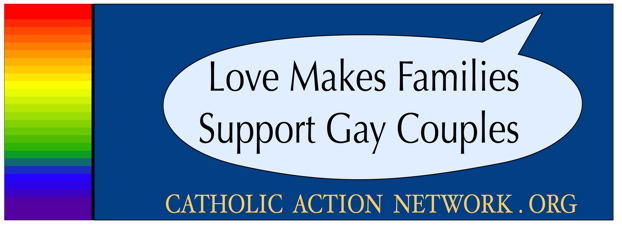
Yes, this group calling itself "Catholic" and composed of professed "Catholics" continues to rebuke God and reject the teachings of the Church. Now Catholic Action Network has purchased billboard space in St. Louis county along Interstate 170 (between Natural Bridge and I-70) to further its dissent and rejection of Church teaching and its perversion of the natural moral law. Apparently CAN and the Holy Families Committee (which was started at St. Cronan's - the Archdiocesan Social Justice Parish) only have enough funds to keep the billboard up through the end of October. Unless, of course, others contribute to their perversion and heresy.
Some history and suggestions (from the website of those who reject the Church, and our Lord):
How the Holy Families group came to beAll emphasis above is mine.
On August 23, 2003, a group of approximately twenty-five people, mostly from St. Cronan’s parish, gathered to discuss the recently released statement from the Congregation for the Doctrine of the Faith, "Considerations Regarding Proposals to Give Legal Recognition to Unions Between Homosexual Persons." This document categorizes same-sex relationships as disordered and states that adoption by same-sex couples "would actually mean doing violence to these children."
As Catholics who disagree with this statement from the Vatican, many in the group expressed the opinion that this is an opportunity for a wide variety of responses: individual, communal (our parish and other parishes), and public (including the media). Many expressed an interest in having some program(s) for the children of the parish that demonstrates our commitment to honoring and blessing diverse families.
As a result, it was proposed that the Holy Families Committee would be established [at St. Cronan's] to address this issue in broad terms and to implement the ideas brought forth at the meeting. Assistance was also offered and was requested at that time from the Catholic Action Network.
Proposed Responses
1. Write a letter directed to the Congregation for the Doctrine of the Faith, the United States Conference of Catholic Bishops, the Archbishop of St. Louis, and the People of the Roman Catholic faith addressing the inaccuracies and injustices of this statement. This letter, along with other correspondence is available for your review.
2. Hold an "Issues and Inspirations" meeting at St. Cronan Church concerning this document. This meeting was conducted at St. Cronan’s parish hall on April 3, 2004. Approximately 50 people attended from various parishes, mostly from St. Cronan’s. The document was explained and the group heard about the personal experiences of gay/lesbian Catholics and Catholic parents. After the discussion, attendees signed a letter to be sent to Archbishop Burke, “Genuine Love, Valuable Families.”
3. Create a physical display, such as tee-shirts (and medallions), of our unity with families of all types. Many suggestions were offered.
4. Celebrate all families, including same sex partners, in a prayer and blessing at a public forum, such as on the steps of the Cathedral. Invite the media so that our prayerful voices as Catholics will be offered in disagreement with this Vatican statement. The group sponsored a vigil on November 9, 2004, on the steps of the Cathedral in solidarity with Soulforce. Over 100 people attended, the largest in the nation, according to Soulforce.
5. Bless all families at St. Cronan's church, perhaps for the Feast of the Holy Family. This blessing is one of many steps that demonstrate to our children that all families are from God. This was done on the Feast of the Holy Family at St. Cronan’s parish in 2003 and every year since then.
6. Raise funds to rent a billboard that supports diverse families. This was done in October, 2005. You can support this effort by attending a reception Reclaiming the Gay Saints (on October 21st) or by ordering a "Love Makes Families" T-shirt from CAN.
7. Have a presence at the Gay Pride celebration in June that demonstrates our Catholic support of diverse families. This is scheduled for June, 2006.
The work begun at this meeting [at St Cronan's] and continued in the two years since then has been the result of the commitment of the Catholic Action Network and the Holy Family Committee members. Please consider joining us in our many upcoming activities.
Many articles and comments were posted here about this deliberate rejection of the Church's teaching by so-called "Catholics" and it must have had, at least, the tacit approval of St. Cronan's pastor, Fr. Gerry Kleba since the founding of the committee occurred on parish property and a notice was published in the parish bulletin.
It appears that the parish (which was not supressed when other parishes were closed), the pastor and other dissidents must feel vindicated and rewarded since they continue to proudly profess that they have been given the distinction of being the "social justice" parish of the Archdiocese. Of course, I suspect that they probably have no fear of any medicinal or corrective action by the Church.
It's truly scandalous that there are those who pervert the word "Catholic" by their actions. It's even more scandalous and revolting that they 'celebrate' the Feast of the Holy Family by perverting it. St. Cronan's appears to be a hotbed of dissent, heresy, and scandal. So is the organization called Catholic Action Network. Immediate corrective action from Church officials to remove this cancer from the Church would certainly be in order.
Vatican Cardinal: Catholic Voters Can Never Be Justified in Voting for Pro-Abortion Politicians
ROME, October 6, 2005 (CWNews.com/LifeSiteNews.com) - The president of the Pontifical Council for Health Care has stated flatly that Catholics cannot, in conscience, support a politician who favors legal abortion.And because he has rejected what the Church teaches and is no longer in communion with the Church, he should not be permitted to engage in scandal and sacrilege by attempting to receive Holy Communion. Archbishop Burke and others have rightly expressed the position of the Church, much to the chagrin of those who are at odds with the Church, whether they be the laity or those of the ordained ministry.
Cardinal Javier Lozano Barragan made his remarks in an interview with the Italian daily La Repubblica. He was responding indirectly to an intervention by Archbishop William Levada during the discussions of the Synod of Bishop. Archbishop Levada-- the American prelate recently chosen by Pope Benedict XVI (bio - news) to be prefect of the Congregation for the Doctrine of the Faith-- had asked other prelates to reflect on the question that had divided the US hierarchy during the 2004 election year: How bishops should respond to Catholic politicians who support abortion.
"A Catholic cannot support a politician who presents abortion as a general norm," said Cardinal Lozano. The Mexican prelate added that "a son of the Church cannot consider himself to be in full communion if he supports what the Church condemns."
More can be read at LifeSiteNews here.
Gospel for Thursday, 27th Week in Ordinary Time
From: Luke 11:5-13
Effective Prayer
[5] And He (Jesus) said to them (the disciples), "Which of you who has a friend will go to him at midnight and say to him, 'Friend, lend me three loaves; [6] for a friend of mine has arrived on a journey, and I have nothing to set before him'; [7] and he will answer from within, 'Do not bother me; the door is now shut, and my children are with me in bed; I cannot get up and give you anything'? [8] I tell you, though he will not get up and give him anything because he is his friend, yet because of his importunity he will rise and give him whatever he needs. [9] And I tell you, Ask, and it will be given to you; seek, and you will find; knock, and it will be opened to you. [10] For every one who asks receives, and he who seeks find, and to him who knocks it will be opened. [11] What father among you, if his son asks for a fish, will instead of a fish give him a serpent; [12] or if he asks for an egg, will give him a scorpion? [13] If you then, who are evil, know how to give good gifts to your children, how much more will the Heavenly Father give the Holy Spirit to those who ask Him!"
*******************
Commentary:
5-10. One of the essential features of prayer is trusting perseverance. By this simple example and others like it (cf. Luke 18:1-7) our Lord encourages us not to desist in asking God to hear us. "Persevere in prayer. Persevere even when your efforts seem barren. Prayer is always fruitful" ([St] J. Escriva, "The Way", 101).
9-10. Do you see the effectiveness of prayer when it is done properly? Are you not convinced like me that, if we do not obtain what we ask God for, it is because we are not praying with faith, with a heart pure enough, with enough confidence, or that we are not persevering in prayer the way we should? God has never refused nor will ever refuse anything to those who ask for His graces in the way they should. Prayer is the great recourse available to us to get out of sin, to persevere in grace, to move God's heart and to draw upon us all kinds of blessing from Heaven, whether for the soul or to meet our temporal needs" (St. John Mary Vianney, "Selected Sermons", Fifth Sunday after Easter).
11-13. Our Lord uses the example of human parenthood as a comparison to stress again the wonderful fact that God is our Father, for God's fatherhood is the source of parenthood in Heaven and on earth (cf. Ephesians 3:15). "The God of our faith is not a distant Being who contemplates indifferently the fate of men--their desires, their struggles, their sufferings. He is a Father who loves His children so much that He sends the Word, the Second Person of the Most Blessed Trinity, so that by taking on the nature of man He may die to redeem us. He is the loving Father who now leads us gently to Himself, through the action of the Holy Spirit who dwells in our hearts" ([St] J. Escriva, "Christ Is Passing By", p. 84).
13. The Holy Spirit is God's best gift to us, the great promise Christ gives His disciples (cf. John 5:26), the divine fire which descends on the Apostles at Pentecost, filling them with fortitude and freedom to proclaim Christ's message (Acts 2). "The profound reality which we see in the texts of Holy Scripture is not a remembrance from the past, from some golden age of the Church which has since been buried in history. Despite the weaknesses and the sins of every one of us, it is the reality of today's Church and the Church in all times. 'I will pray to the Father,' our Lord told His disciples, 'and He will give you another Counsellor to be with you for ever.' Jesus has kept His promise. He has risen from the dead and, in union with the eternal Father, He sends us the Holy Spirit to sanctify us and to give us life" ([St] J. Escriva, "Christ Is Passing By", 12).
************************
Source: "The Navarre Bible: Text and Commentaries". Biblical text taken from the Revised Standard Version and New Vulgate. Commentaries made by members of the Faculty of Theology of the University of Navarre, Spain. Published by Four Courts Press, Kill Lane, Blackrock, Co. Dublin, Ireland.
Reprinted with permission from Four Courts Press and Scepter Publishers, the U.S. publisher.
Effective Prayer
[5] And He (Jesus) said to them (the disciples), "Which of you who has a friend will go to him at midnight and say to him, 'Friend, lend me three loaves; [6] for a friend of mine has arrived on a journey, and I have nothing to set before him'; [7] and he will answer from within, 'Do not bother me; the door is now shut, and my children are with me in bed; I cannot get up and give you anything'? [8] I tell you, though he will not get up and give him anything because he is his friend, yet because of his importunity he will rise and give him whatever he needs. [9] And I tell you, Ask, and it will be given to you; seek, and you will find; knock, and it will be opened to you. [10] For every one who asks receives, and he who seeks find, and to him who knocks it will be opened. [11] What father among you, if his son asks for a fish, will instead of a fish give him a serpent; [12] or if he asks for an egg, will give him a scorpion? [13] If you then, who are evil, know how to give good gifts to your children, how much more will the Heavenly Father give the Holy Spirit to those who ask Him!"
*******************
Commentary:
5-10. One of the essential features of prayer is trusting perseverance. By this simple example and others like it (cf. Luke 18:1-7) our Lord encourages us not to desist in asking God to hear us. "Persevere in prayer. Persevere even when your efforts seem barren. Prayer is always fruitful" ([St] J. Escriva, "The Way", 101).
9-10. Do you see the effectiveness of prayer when it is done properly? Are you not convinced like me that, if we do not obtain what we ask God for, it is because we are not praying with faith, with a heart pure enough, with enough confidence, or that we are not persevering in prayer the way we should? God has never refused nor will ever refuse anything to those who ask for His graces in the way they should. Prayer is the great recourse available to us to get out of sin, to persevere in grace, to move God's heart and to draw upon us all kinds of blessing from Heaven, whether for the soul or to meet our temporal needs" (St. John Mary Vianney, "Selected Sermons", Fifth Sunday after Easter).
11-13. Our Lord uses the example of human parenthood as a comparison to stress again the wonderful fact that God is our Father, for God's fatherhood is the source of parenthood in Heaven and on earth (cf. Ephesians 3:15). "The God of our faith is not a distant Being who contemplates indifferently the fate of men--their desires, their struggles, their sufferings. He is a Father who loves His children so much that He sends the Word, the Second Person of the Most Blessed Trinity, so that by taking on the nature of man He may die to redeem us. He is the loving Father who now leads us gently to Himself, through the action of the Holy Spirit who dwells in our hearts" ([St] J. Escriva, "Christ Is Passing By", p. 84).
13. The Holy Spirit is God's best gift to us, the great promise Christ gives His disciples (cf. John 5:26), the divine fire which descends on the Apostles at Pentecost, filling them with fortitude and freedom to proclaim Christ's message (Acts 2). "The profound reality which we see in the texts of Holy Scripture is not a remembrance from the past, from some golden age of the Church which has since been buried in history. Despite the weaknesses and the sins of every one of us, it is the reality of today's Church and the Church in all times. 'I will pray to the Father,' our Lord told His disciples, 'and He will give you another Counsellor to be with you for ever.' Jesus has kept His promise. He has risen from the dead and, in union with the eternal Father, He sends us the Holy Spirit to sanctify us and to give us life" ([St] J. Escriva, "Christ Is Passing By", 12).
************************
Source: "The Navarre Bible: Text and Commentaries". Biblical text taken from the Revised Standard Version and New Vulgate. Commentaries made by members of the Faculty of Theology of the University of Navarre, Spain. Published by Four Courts Press, Kill Lane, Blackrock, Co. Dublin, Ireland.
Reprinted with permission from Four Courts Press and Scepter Publishers, the U.S. publisher.
Wednesday, October 05, 2005
Abp. Chaput: Reflections on the anniversary of Second Vatican Council’s close
December marks the 40th anniversary of the close of the Second Vatican Council. So these final months of 2005 are a good time to reflect on the needs of the Church in today’s world and our own commitment to Catholic discipleship.Continued....
History is a powerful teacher. While all true ecumenical councils are important in the life of the Church, some failed to achieve their goals. The Council of Florence failed in the 15th century because the Western Church was badly divided and the Greek Church could not accept a union. The Fifth Lateran Council failed in the 16th century because it focused on the wrong issues. It did too little too late to change the conditions that led to the Protestant Reformation.
We need to ask ourselves this fall, as we consider the goals that the Second Vatican Council set for itself: Will history judge it a success or a failure? In opening Vatican II, Blessed Pope John XXIII said that, “the council now beginning rises in the Church like daybreak, a forerunner of most splendid light.” Pope John Paul II, who attended the council as a bishop, spoke many times about “crossing the threshold of hope” and a rebirth of Christian faith in the new millennium.
Gospel for Wednesday, 27th Week in Ordinary Time
From: Luke 11:1-4
The Our Father
[1] He (Jesus) was praying in a certain place, and when He ceased, one of His disciples said to Him, "Lord, teach us to pray, as John taught His disciples." [2] And He said to them, "When you pray, say: `Our Father, hallowed be Thy name. Thy Kingdom come. [3] Give us each day our daily bread; [4] and forgive us our sins, for we ourselves forgive every one who is indebted to us; and lead us not into temptation.'"
******************************
Commentary:
1-4. St. Luke gives us a shorter form of the Lord's Prayer, or Our Father, than St. Matthew (6:9-13). In Matthew there are seven petitions, in Luke only four. Moreover, St. Matthew's version is given in the context of the Sermon on the Mount and specifically as part of Jesus' teaching on how to pray; St. Luke's is set in one of those occasions just after our Lord has been at prayer--two different contexts. There is nothing surprising about our Lord teaching the same thing on different occasions, not always using exactly the same words, not always at the same length, but always stressing the same basic points. Naturally, the Church uses the longer form of the Lord's Prayer, that of St. Matthew.
"When the disciples asked the Lord Jesus, `Teach us to pray', He replied by saying the words of the `Our Father', thereby giving a concrete model which is also a universal model. In fact, everything that can and must be said to the Father is contained in those seven requests which we all know by heart. There is such simplicity in them that even a child can learn them, but at the same time such depth that a whole life can be spent meditating on their meaning. Isn't that so? Does not each of those petitions deal with something essential to our life, directing it totally towards God the Father? Doesn't this prayer speak to us about `our daily bread', `forgiveness of our sins, since we forgive others' and about protecting us from `temptation' and `delivering us from evil?'" ([Pope] John Paul II, "General Audience", 14 March 1979).
The first thing our Lord teaches us to ask for is the glorification of God and the coming of His Kingdom. That is what is really important--the Kingdom of God and His justice (cf. Matthew 6:33). Our Lord also wants us to pray confident that our Father will look after our material needs, for "your Heavenly Father knows that you need them all" (Matthew 6:32). However, the Our Father makes us aspire especially to possess the goods of the Holy Spirit, and invites us to seek forgiveness (and to forgive others) and to avoid the danger of sinning. Finally the Our Father emphasizes the importance of vocal prayer. "`Domine, doce nos orare. Lord teach us to pray!' And our Lord replied: `When you pray say: "Pater noster, qui es in coelis"... Our Father, who art in Heaven...'. What importance we must attach to vocal prayer!" ([St] J. Escriva, "The Way", 84).
1. Jesus often went away to pray (cf. Luke 6:12; 22:39ff). This practice of the Master causes His disciples to want to learn how to pray. Jesus teaches them to do what He Himself does. Thus, when our Lord prays, He begins with the Word "Father!": "Father, into Thy hands I commit My spirit" (Luke 23:46); see also Matthew 11:25; 26:42, 53; Luke 23:34; John 11:41; etc.). His prayer on the Cross, "My God, My God,..." (Matthew 27:46), is not really an exception to this rule, because there He is quoting Psalm 22, the desperate prayer of the persecuted just man.
Therefore, we can say that the first characteristic prayer should have is the simplicity of a son speaking to his Father. "You write: `To pray is to talk with God. But about what?' About what? About Him, about yourself: joys, sorrows, successes, failures, noble ambitions, daily worries, weaknesses! And acts of thanksgiving and petition: and love and reparation. In a word: to get to know Him and to get to know yourself: `to get acquainted!'" ([St] J. Escriva, "The Way", 91).
2. "Hallowed be Thy name": in this first petition of the Our Father "we pray that God may be known, loved, honored and served by everyone and by ourselves in particular." This means that we want "unbelievers to come to a knowledge of the true God, heretics to recognize their errors, schismatics to return to the unity of the Church, sinners to be converted and the righteous to persevere in doing good." By this first petition, our Lord is teaching us that `we must desire God's glory more than our own interest and advantage." This hallowing of God's name is attained "by prayer and good example and by directing all our thoughts, affections and actions towards Him" ("St. Pius X Catechism", 290-293).
"Thy Kingdom come": "By the Kingdom of God we understand a triple spiritual kingdom--the Kingdom of God in us, which is grace; the Kingdom of God on earth, which is the Catholic Church; and the Kingdom of God in Heaven, which is eternal bliss [...]. As regards grace, we pray that God reign in us with His sanctifying grace, by which He is pleased to dwell in us as a king in his throne-room, and that He keeps us united to Him by the virtues of faith, hope and charity, by which He reigns in our intellect, in our heart and in our will [...]. As regards the Church, we pray that it extend and spread all over the world for the salvation of men [...]. As regards Heaven, we pray that one day we be admitted to that eternal bliss for which we have been created, where we will be totally happy" ("ibid.", 294-297).
3. The Tradition of the Church usually interprets the "bread" as not only material bread, since "man does not live by bread alone, but by every word that proceeds from the mouth of God" (Matthew 4:4; Deuteronomy 8:3). Here Jesus wants us to ask God for "what we need each day for soul and body [...]. For our soul we ask God to sustain our spiritual life, that is, we beg Him to give us His grace, of which we are continually in need [...]. The life of our soul is sustained mainly by the divine word and by the Blessed Sacrament of the Altar [...]. For our bodies we pray for what is needed to maintain us" ("St. Pius X Catechism", 302-305).
Christian doctrine stresses two ideas in this petition of the Our Father: the first is trust in Divine Providence, which frees us from excessive desire to accumulate possessions to insure us against the future (cf. Luke 12:16-21); the other idea is that we should take a brotherly interest in other people's needs, thereby moderating our selfish tendencies.
4. "So rigorously does God exact from us forgetfulness of injuries and mutual affection and love, that He rejects and despises the gifts and sacrifices of those who are not reconciled to one another" ("St. Pius V Catechism", IV, 14, 16).
"This sisters, is something which we should consider carefully; it is such a serious and important matter that God should pardon us our sins, which have merited eternal fire, that we must pardon all trifling things which have been done to us. As I have so few, Lord, even of these trifling things, to offer Thee, Thy pardoning of me must be a free gift: there is abundant scope here for Thy mercy. Blessed be Thou, who endurest one that is so poor" (St. Teresa of Avila, "Way of Perfection", Chapter 36).
"And lead us not into temptation": it is not a sin to "feel" temptation but to "consent" to temptation. It is also a sin to put oneself voluntarily into a situation which can easily lead one to sin. God allows us to be tempted, in order to test our fidelity, to exercise us in virtue and to increase our merits with the help of grace. In this petition we ask the Lord to give us His grace not to be overcome when put to the test, or to free us from temptation if we cannot cope with it.
********************************
Source: "The Navarre Bible: Text and Commentaries". Biblical text taken from the Revised Standard Version and New Vulgate. Commentaries made by members of the Faculty of Theology of the University of Navarre, Spain. Published by Four Courts Press, Kill Lane, Blackrock, Co. Dublin, Ireland.
Reprinted with permission from Four Courts Press and Scepter Publishers, the U.S. publisher.
The Our Father
[1] He (Jesus) was praying in a certain place, and when He ceased, one of His disciples said to Him, "Lord, teach us to pray, as John taught His disciples." [2] And He said to them, "When you pray, say: `Our Father, hallowed be Thy name. Thy Kingdom come. [3] Give us each day our daily bread; [4] and forgive us our sins, for we ourselves forgive every one who is indebted to us; and lead us not into temptation.'"
******************************
Commentary:
1-4. St. Luke gives us a shorter form of the Lord's Prayer, or Our Father, than St. Matthew (6:9-13). In Matthew there are seven petitions, in Luke only four. Moreover, St. Matthew's version is given in the context of the Sermon on the Mount and specifically as part of Jesus' teaching on how to pray; St. Luke's is set in one of those occasions just after our Lord has been at prayer--two different contexts. There is nothing surprising about our Lord teaching the same thing on different occasions, not always using exactly the same words, not always at the same length, but always stressing the same basic points. Naturally, the Church uses the longer form of the Lord's Prayer, that of St. Matthew.
"When the disciples asked the Lord Jesus, `Teach us to pray', He replied by saying the words of the `Our Father', thereby giving a concrete model which is also a universal model. In fact, everything that can and must be said to the Father is contained in those seven requests which we all know by heart. There is such simplicity in them that even a child can learn them, but at the same time such depth that a whole life can be spent meditating on their meaning. Isn't that so? Does not each of those petitions deal with something essential to our life, directing it totally towards God the Father? Doesn't this prayer speak to us about `our daily bread', `forgiveness of our sins, since we forgive others' and about protecting us from `temptation' and `delivering us from evil?'" ([Pope] John Paul II, "General Audience", 14 March 1979).
The first thing our Lord teaches us to ask for is the glorification of God and the coming of His Kingdom. That is what is really important--the Kingdom of God and His justice (cf. Matthew 6:33). Our Lord also wants us to pray confident that our Father will look after our material needs, for "your Heavenly Father knows that you need them all" (Matthew 6:32). However, the Our Father makes us aspire especially to possess the goods of the Holy Spirit, and invites us to seek forgiveness (and to forgive others) and to avoid the danger of sinning. Finally the Our Father emphasizes the importance of vocal prayer. "`Domine, doce nos orare. Lord teach us to pray!' And our Lord replied: `When you pray say: "Pater noster, qui es in coelis"... Our Father, who art in Heaven...'. What importance we must attach to vocal prayer!" ([St] J. Escriva, "The Way", 84).
1. Jesus often went away to pray (cf. Luke 6:12; 22:39ff). This practice of the Master causes His disciples to want to learn how to pray. Jesus teaches them to do what He Himself does. Thus, when our Lord prays, He begins with the Word "Father!": "Father, into Thy hands I commit My spirit" (Luke 23:46); see also Matthew 11:25; 26:42, 53; Luke 23:34; John 11:41; etc.). His prayer on the Cross, "My God, My God,..." (Matthew 27:46), is not really an exception to this rule, because there He is quoting Psalm 22, the desperate prayer of the persecuted just man.
Therefore, we can say that the first characteristic prayer should have is the simplicity of a son speaking to his Father. "You write: `To pray is to talk with God. But about what?' About what? About Him, about yourself: joys, sorrows, successes, failures, noble ambitions, daily worries, weaknesses! And acts of thanksgiving and petition: and love and reparation. In a word: to get to know Him and to get to know yourself: `to get acquainted!'" ([St] J. Escriva, "The Way", 91).
2. "Hallowed be Thy name": in this first petition of the Our Father "we pray that God may be known, loved, honored and served by everyone and by ourselves in particular." This means that we want "unbelievers to come to a knowledge of the true God, heretics to recognize their errors, schismatics to return to the unity of the Church, sinners to be converted and the righteous to persevere in doing good." By this first petition, our Lord is teaching us that `we must desire God's glory more than our own interest and advantage." This hallowing of God's name is attained "by prayer and good example and by directing all our thoughts, affections and actions towards Him" ("St. Pius X Catechism", 290-293).
"Thy Kingdom come": "By the Kingdom of God we understand a triple spiritual kingdom--the Kingdom of God in us, which is grace; the Kingdom of God on earth, which is the Catholic Church; and the Kingdom of God in Heaven, which is eternal bliss [...]. As regards grace, we pray that God reign in us with His sanctifying grace, by which He is pleased to dwell in us as a king in his throne-room, and that He keeps us united to Him by the virtues of faith, hope and charity, by which He reigns in our intellect, in our heart and in our will [...]. As regards the Church, we pray that it extend and spread all over the world for the salvation of men [...]. As regards Heaven, we pray that one day we be admitted to that eternal bliss for which we have been created, where we will be totally happy" ("ibid.", 294-297).
3. The Tradition of the Church usually interprets the "bread" as not only material bread, since "man does not live by bread alone, but by every word that proceeds from the mouth of God" (Matthew 4:4; Deuteronomy 8:3). Here Jesus wants us to ask God for "what we need each day for soul and body [...]. For our soul we ask God to sustain our spiritual life, that is, we beg Him to give us His grace, of which we are continually in need [...]. The life of our soul is sustained mainly by the divine word and by the Blessed Sacrament of the Altar [...]. For our bodies we pray for what is needed to maintain us" ("St. Pius X Catechism", 302-305).
Christian doctrine stresses two ideas in this petition of the Our Father: the first is trust in Divine Providence, which frees us from excessive desire to accumulate possessions to insure us against the future (cf. Luke 12:16-21); the other idea is that we should take a brotherly interest in other people's needs, thereby moderating our selfish tendencies.
4. "So rigorously does God exact from us forgetfulness of injuries and mutual affection and love, that He rejects and despises the gifts and sacrifices of those who are not reconciled to one another" ("St. Pius V Catechism", IV, 14, 16).
"This sisters, is something which we should consider carefully; it is such a serious and important matter that God should pardon us our sins, which have merited eternal fire, that we must pardon all trifling things which have been done to us. As I have so few, Lord, even of these trifling things, to offer Thee, Thy pardoning of me must be a free gift: there is abundant scope here for Thy mercy. Blessed be Thou, who endurest one that is so poor" (St. Teresa of Avila, "Way of Perfection", Chapter 36).
"And lead us not into temptation": it is not a sin to "feel" temptation but to "consent" to temptation. It is also a sin to put oneself voluntarily into a situation which can easily lead one to sin. God allows us to be tempted, in order to test our fidelity, to exercise us in virtue and to increase our merits with the help of grace. In this petition we ask the Lord to give us His grace not to be overcome when put to the test, or to free us from temptation if we cannot cope with it.
********************************
Source: "The Navarre Bible: Text and Commentaries". Biblical text taken from the Revised Standard Version and New Vulgate. Commentaries made by members of the Faculty of Theology of the University of Navarre, Spain. Published by Four Courts Press, Kill Lane, Blackrock, Co. Dublin, Ireland.
Reprinted with permission from Four Courts Press and Scepter Publishers, the U.S. publisher.
Tuesday, October 04, 2005
"We Are Church" Exhorts Synod to Accept Heresy?
This group of "Catholics", who seemingly have already abandoned the Church, proposes, among other things, that the "sacrificial" nature of the Holy Eucharist be abandoned...Also, in an effort to demonstrate their disgust with the term "transubstantiation", they state:
insisting upon “transubstantiation" dogma to explain Christ's presence in the Eucharist, as Instrumentum laboris does, triggers and strengthens a magical, materialistic, and legalistic mentality, in which Jesus is seen descending on the altar at the time the priest pronounces the words "This is my body, this is my blood...". That happens at the expense of the invocation of the Holy Spirit, of other holy moments of Eucharist and, obviously, of "convivial" or communal facets.There is much more here if one has the stomach to read it...One can only wonder why they have not been formally excommunicated.
Furthermore, we are more than puzzled by every form of devotion, which is usual in the Eucharistic cult (for example, Eucharistic adoration, processions, etc.) in which the sacralization of Eucharist has a plain role, making an idol of the Eucharist. Many theologians and ministers share this discomfort, but Instrumentum laboris ignores this sensibility.
Priest blasts 'gay' colleagues
Father James Haley of the Diocese of Arlington, Va., the whistle-blower priest whose story has been featured in the Washington Times, is once again speaking out.
It's really quite good and you can read it here.
Father John Trigilio, Jr., PhD, ThD, president of the Confraternity of Catholic Clergy and co-author of Catholicism For Dummies, provided Renew America with a statement, which is an expansion and variation of an op-ed he recently wrote for the New York Daily News.
It's really quite good and you can read it here.
Father John Trigilio, Jr., PhD, ThD, president of the Confraternity of Catholic Clergy and co-author of Catholicism For Dummies, provided Renew America with a statement, which is an expansion and variation of an op-ed he recently wrote for the New York Daily News.
"If theologians and liturgists could misbehave, then why not married couples with regard to contraception? If the laity could [misbehave] that way, then why not the clergy? Sexual misbehavior in seminaries usually coincides with heterodox teaching in the classroom and liturgical abuse in the chapel."Not only should this apply to seminary faculty members, but to all clerics, regardless whether he be a deacon, priest or bishop.
...
Faculty members who dissent from the Magisterium need to be removed.
The First Synod after the Conclave Gets Underway. The Pope Is Being Tested
The élite of the Catholic hierarchy worldwide are meeting again in Rome, half a year after the election of Benedict XVI. And they’re evaluating his first steps, beginning with his cleaning house within the Church
by Sandro Magister
---------------------------
by Sandro Magister
---------------------------
ROMA, October 3 – For three weeks beginning at the start of October, 250 cardinals and bishops from all over the world – the élite of the Catholic hierarchy – are meeting in synod in Rome. They will be dealing with the theme that Benedict XVI has put at the center from the beginning of his pontificate: the Eucharist.Much more here.
An abstract theme? On the contrary. Joseph Ratzinger has been stressing this point for months: it is in the sacrament of the Mass that the Church comes to life; it is here that it has its model, here that it offers itself to the world. He has pointed to the example of Pope Gregory the Great: a great celebrator of the liturgy, a great constructor of civilization.
For Benedict XVI, everything hinges on this. In the homily for the Mass on October 2 in St. Peter’s Basilica, he explained that the opposite of the Eucharist is the devastation of “the Lord’s vineyard”: excluding God from public life in the name of a tolerance which in reality is “hypocrisy,” injustice, “the dominance of power and interests.”
....
Inside the Church, there is uncertainty about who will be named as the new secretary of state, and to other high offices in the curia.
But one important replacement has already taken everyone by surprise: as his successor as head of the Congregation for the Doctrine of the Faith, the pope called an American, William J. Levada, who was part of the U.S. commission charged with remedying the scandal of pedophile priests.
And since his nomination, there have been measures proposed by the bucketful, aimed at cleansing the Church of the “filth” lamented by Ratzinger in the memorable Stations of the Cross last Good Friday.
The first decree signed by the new prefect, Levada, dated May 27, came against an Italian religious, Gino Burresi, 73, founder of the Servants of the Immaculate Heart of Mary.
....
Sunday, October 02, 2005
Gospel for the 27th Sunday in Ordinary Time
From: Matthew 21:33-43
The Parable of the Wicked Tenants
(Jesus told the chief priests and the elders,) [33] "Hear another parable. There was a householder who planted a vineyard, and set a hedge around it, dug a wine press in it, and built a tower, and let it out to tenants, and went into another country. [34] When the season of fruit drew near, he sent his servants to the tenants, to get his fruit; [35] and the tenants took his servants and beat one, killed another, and stoned another. [36] Again he sent other servants, more than the first; and they did the same to them. [37] Afterward he sent his son to them, saying, `They will respect my son.' [38] But when the tenants saw the son, they said to themselves, `This is the heir; come, let us kill him and have his inheritance.' [39] And they took him and cast him out of the vineyard, and killed him. [40] When therefore the owner of the vineyard comes, what will he do to those tenants?" [41] They said to Him, "He will put those wretches to a miserable death, and let out the vineyard to other tenants who will give him the fruits in their seasons."
[42] Jesus said to them, "Have you never read in the scriptures: `The very stone which the builders rejected has become the head of the corner; this was the Lord's doing, and it is marvellous in our eyes'! [43] Therefore I tell you, the Kingdom of God will be taken away from you and given to a nation producing the fruits of it."
****************************
Commentary:
33-46. This very important parable completes the previous one. The parable of the two sons simply identifies the indocility of Israel; that of the wicked tenants focuses on the punishment to come.
Our Lord compares Israel to a choice vineyard, specially fenced, with a watchtower, where a keeper is on the look-out to protect it from thieves and foxes. God has spared no effort to cultivate and embellish His vineyard. The vineyard is in the charge of tenant farmers; the householder is God, and the vineyard, Israel (Isaiah 5:3-5: Jeremiah 2:21; Joel 1:7).
The tenants to whom God has given the care of His people are the priests, scribes and elders. The owner's absence makes it clear that God really did entrust Israel to its leaders; hence their responsibility and the account He demands of them.
The owner used to send his servants from time to time to collect the fruit; this was the mission of the prophets. The second despatch of servants to claim what is owing to the owner--who meet the same fate as the first--refers to the way God's prophets were ill-treated by the kings and priests of Israel (Matthew 23:37; Acts 7:42; Hebrews 11:36-38). Finally he sent his son to them, thinking that they would have more respect for him; here we can see the difference between Jesus and the prophets, who were servants, not "the Son": the parable indicates singular, transcendental sonship, expressing the divinity of Jesus Christ.
The malicious purpose of the tenants in murdering the son and heir to keep the inheritance for themselves is the madness of the leaders in expecting to become undisputed masters of Israel by putting Christ to death (Matthew 12:14; 26:4). Their ambition blinds them to the punishment that awaits them. Then "they cast him out of the vineyard, and killed him": a reference to Christ's crucifixion, which took place outside the walls of Jerusalem.
Jesus prophesies the punishment God will inflict on the evildoers: He will put them to death and rent the vineyard to others. This is a very significant prophecy. St. Peter later repeats to the Sanhedrin: "This is the stone which was rejected by you builders, but which has become the head of the corner" (Acts 4:11; 1 Peter 2:4). The stone is Jesus of Nazareth, but the architects of Israel, who build up and rule the people, have chosen not use it in the building. Because of their unfaithfulness the Kingdom of God will be turned over to another people, the Gentiles, who WILL give God the fruit He expects His vineyard to yield (cf. Matthew 3:8-10; Galatians 6:16).
For the building to be well-built, it needs to rest on this stone. Woe to him who trips over it! (cf. Matthew 12:30; Luke 2:34), as first Jews and later the enemies of Christ and His Church will discover through bitter experience (cf. Isaiah 8:14-15).
Christians in all ages should see this parable as exhorting them to build faithfully upon Christ and make sure they do not fall into the sin of this Jewish generation. We should also be filled with hope and a sense of security; for, although the building--the Church--at some times seem to be breaking up, its sound construction, with Christ as its cornerstone, is assured.
****************************
Source: "The Navarre Bible: Text and Commentaries". Biblical text taken from the Revised Standard Version and New Vulgate. Commentaries made by members of the Faculty of Theology of the University of Navarre, Spain. Published by Four Courts Press, Kill Lane, Blackrock, Co. Dublin, Ireland.
Reprinted with permission from Four Courts Press and Scepter Publishers, the U.S. publisher.
The Parable of the Wicked Tenants
(Jesus told the chief priests and the elders,) [33] "Hear another parable. There was a householder who planted a vineyard, and set a hedge around it, dug a wine press in it, and built a tower, and let it out to tenants, and went into another country. [34] When the season of fruit drew near, he sent his servants to the tenants, to get his fruit; [35] and the tenants took his servants and beat one, killed another, and stoned another. [36] Again he sent other servants, more than the first; and they did the same to them. [37] Afterward he sent his son to them, saying, `They will respect my son.' [38] But when the tenants saw the son, they said to themselves, `This is the heir; come, let us kill him and have his inheritance.' [39] And they took him and cast him out of the vineyard, and killed him. [40] When therefore the owner of the vineyard comes, what will he do to those tenants?" [41] They said to Him, "He will put those wretches to a miserable death, and let out the vineyard to other tenants who will give him the fruits in their seasons."
[42] Jesus said to them, "Have you never read in the scriptures: `The very stone which the builders rejected has become the head of the corner; this was the Lord's doing, and it is marvellous in our eyes'! [43] Therefore I tell you, the Kingdom of God will be taken away from you and given to a nation producing the fruits of it."
****************************
Commentary:
33-46. This very important parable completes the previous one. The parable of the two sons simply identifies the indocility of Israel; that of the wicked tenants focuses on the punishment to come.
Our Lord compares Israel to a choice vineyard, specially fenced, with a watchtower, where a keeper is on the look-out to protect it from thieves and foxes. God has spared no effort to cultivate and embellish His vineyard. The vineyard is in the charge of tenant farmers; the householder is God, and the vineyard, Israel (Isaiah 5:3-5: Jeremiah 2:21; Joel 1:7).
The tenants to whom God has given the care of His people are the priests, scribes and elders. The owner's absence makes it clear that God really did entrust Israel to its leaders; hence their responsibility and the account He demands of them.
The owner used to send his servants from time to time to collect the fruit; this was the mission of the prophets. The second despatch of servants to claim what is owing to the owner--who meet the same fate as the first--refers to the way God's prophets were ill-treated by the kings and priests of Israel (Matthew 23:37; Acts 7:42; Hebrews 11:36-38). Finally he sent his son to them, thinking that they would have more respect for him; here we can see the difference between Jesus and the prophets, who were servants, not "the Son": the parable indicates singular, transcendental sonship, expressing the divinity of Jesus Christ.
The malicious purpose of the tenants in murdering the son and heir to keep the inheritance for themselves is the madness of the leaders in expecting to become undisputed masters of Israel by putting Christ to death (Matthew 12:14; 26:4). Their ambition blinds them to the punishment that awaits them. Then "they cast him out of the vineyard, and killed him": a reference to Christ's crucifixion, which took place outside the walls of Jerusalem.
Jesus prophesies the punishment God will inflict on the evildoers: He will put them to death and rent the vineyard to others. This is a very significant prophecy. St. Peter later repeats to the Sanhedrin: "This is the stone which was rejected by you builders, but which has become the head of the corner" (Acts 4:11; 1 Peter 2:4). The stone is Jesus of Nazareth, but the architects of Israel, who build up and rule the people, have chosen not use it in the building. Because of their unfaithfulness the Kingdom of God will be turned over to another people, the Gentiles, who WILL give God the fruit He expects His vineyard to yield (cf. Matthew 3:8-10; Galatians 6:16).
For the building to be well-built, it needs to rest on this stone. Woe to him who trips over it! (cf. Matthew 12:30; Luke 2:34), as first Jews and later the enemies of Christ and His Church will discover through bitter experience (cf. Isaiah 8:14-15).
Christians in all ages should see this parable as exhorting them to build faithfully upon Christ and make sure they do not fall into the sin of this Jewish generation. We should also be filled with hope and a sense of security; for, although the building--the Church--at some times seem to be breaking up, its sound construction, with Christ as its cornerstone, is assured.
****************************
Source: "The Navarre Bible: Text and Commentaries". Biblical text taken from the Revised Standard Version and New Vulgate. Commentaries made by members of the Faculty of Theology of the University of Navarre, Spain. Published by Four Courts Press, Kill Lane, Blackrock, Co. Dublin, Ireland.
Reprinted with permission from Four Courts Press and Scepter Publishers, the U.S. publisher.
Saturday, October 01, 2005
Gospel for Oct 1, Memorial: St. Therese of the Child Jesus, Virgin & Doctor of the Church
From: Luke 10:17-24
The Seventy Return From Their Mission
[17] The seventy returned with joy, saying, "Lord, even the demons are subject to us in Your name!" [18] And He (Jesus) said to them, "I saw Satan fall like lightning from Heaven. [19] Behold, I have given you authority to tread upon serpents and scorpions, and over all the power of the enemy; and nothing shall hurt you. [20] Nevertheless do not rejoice in this, that the spirits are subject to you; but rejoice that your names are written in Heaven."
Jesus Gives Thanks
[21] In that same hour He rejoiced in the Holy Spirit and said, "I thank Thee, Father, Lord of Heaven and earth, that thou hast hidden these things from the wise and understanding and revealed them to babes; yea, Father, for such was Thy gracious will. [22] All things have been delivered to Me by My Father; and no one knows who the Son is except the Father, or who the Father is except the Son and any one to whom the Son chooses to reveal Him."
[23] Then turning to the disciples He said privately, "Blessed are the eyes which see what you see! [24] For I tell you that many prophets and kings desired to see what you see, and did not see it, and to hear what you hear, and did not hear it."
*************************
Commentary:
20. Our Lord corrects His disciples, making them see that the right reason for rejoicing lies in hope of reaching Heaven, not in the power to do miracles which He gave them for their mission. As He said on another occasion, "On that day many will say to Me, `Lord, Lord, did we not prophesy in Your name, and cast our demons in Your name, and do many mighty works in Your name?' And then will I declare to them, `I never knew you; depart from Me, you evildoers'" (Matthew 7:22-23). In other words, in the eyes of God doing His holy will at all times is more important than working miracles.
21. This passage of the Gospel is usually called our Lord's "hymn of joy" and is also found in St. Matthew (11:25-27). It is one of those moments when Jesus rejoices to see humble people understanding and accepting the word of God.
Our Lord also reveals one of the effects of humility--spiritual childhood. For example, in another passage He says: "Truly, I say to you, unless you turn and become like children, you will never enter the Kingdom of Heaven" (Matthew 18:3). But spiritual childhood does not involve weakness, softness or ignorance: "I have often meditated on this life of spiritual childhood, which is not incompatible with fortitude, because it demands a strong will, proven maturity, an open and firm character [...]. To become children we must renounce our pride and self-sufficiency, recognizing that we can do nothing by ourselves. We must realize that we need grace, and the help of God our Father to find our way and keep it. To be little, you have to abandon yourself as children do, believe as children, beg as children beg" ([St] J. Escriva, "Christ Is Passing By", 10 and 143).
22. "This statement is a wonderful help to our faith," St. Ambrose comments, "because when you read `all' you realize that Christ is all-powerful, that He is not inferior to the Father, or less perfect than He; when you read `have been delivered to me', you confess that Christ is the Son, to whom everything belongs by right of being one in substance [with the Father] and not by grace of gift" ("Expositio Evangelii Sec. Lucam, in loc.").
Here we see Christ as almighty Lord and God, consubstantial with the Father, and the only one capable of revealing who the Father is. At the same time, we can recognize the divine nature of Jesus only if the Father gives us the grace of faith--as He did to St. Peter (cf. Matthew 16:17).
23-24. Obviously, seeing Jesus with one's own eyes was a wonderful thing for people who believed in him. However, our Lord will say to Thomas, "Blessed are those who have not seen and yet believe" (John 20:29). St. Peter, for his part, tells us: "Without having seen Him you love Him; though you do not see Him you believe in Him and rejoice with unutterable and exalted joy. As the outcome of your faith you obtain the salvation of your souls" (1 Peter 1:8-9).
***************************
Source: "The Navarre Bible: Text and Commentaries". Biblical text taken from the Revised Standard Version and New Vulgate. Commentaries made by members of the Faculty of Theology of the University of Navarre, Spain. Published by Four Courts Press, Kill Lane, Blackrock, Co. Dublin, Ireland.
Reprinted with permission from Four Courts Press and Scepter Publishers, the U.S. publisher.
The Seventy Return From Their Mission
[17] The seventy returned with joy, saying, "Lord, even the demons are subject to us in Your name!" [18] And He (Jesus) said to them, "I saw Satan fall like lightning from Heaven. [19] Behold, I have given you authority to tread upon serpents and scorpions, and over all the power of the enemy; and nothing shall hurt you. [20] Nevertheless do not rejoice in this, that the spirits are subject to you; but rejoice that your names are written in Heaven."
Jesus Gives Thanks
[21] In that same hour He rejoiced in the Holy Spirit and said, "I thank Thee, Father, Lord of Heaven and earth, that thou hast hidden these things from the wise and understanding and revealed them to babes; yea, Father, for such was Thy gracious will. [22] All things have been delivered to Me by My Father; and no one knows who the Son is except the Father, or who the Father is except the Son and any one to whom the Son chooses to reveal Him."
[23] Then turning to the disciples He said privately, "Blessed are the eyes which see what you see! [24] For I tell you that many prophets and kings desired to see what you see, and did not see it, and to hear what you hear, and did not hear it."
*************************
Commentary:
20. Our Lord corrects His disciples, making them see that the right reason for rejoicing lies in hope of reaching Heaven, not in the power to do miracles which He gave them for their mission. As He said on another occasion, "On that day many will say to Me, `Lord, Lord, did we not prophesy in Your name, and cast our demons in Your name, and do many mighty works in Your name?' And then will I declare to them, `I never knew you; depart from Me, you evildoers'" (Matthew 7:22-23). In other words, in the eyes of God doing His holy will at all times is more important than working miracles.
21. This passage of the Gospel is usually called our Lord's "hymn of joy" and is also found in St. Matthew (11:25-27). It is one of those moments when Jesus rejoices to see humble people understanding and accepting the word of God.
Our Lord also reveals one of the effects of humility--spiritual childhood. For example, in another passage He says: "Truly, I say to you, unless you turn and become like children, you will never enter the Kingdom of Heaven" (Matthew 18:3). But spiritual childhood does not involve weakness, softness or ignorance: "I have often meditated on this life of spiritual childhood, which is not incompatible with fortitude, because it demands a strong will, proven maturity, an open and firm character [...]. To become children we must renounce our pride and self-sufficiency, recognizing that we can do nothing by ourselves. We must realize that we need grace, and the help of God our Father to find our way and keep it. To be little, you have to abandon yourself as children do, believe as children, beg as children beg" ([St] J. Escriva, "Christ Is Passing By", 10 and 143).
22. "This statement is a wonderful help to our faith," St. Ambrose comments, "because when you read `all' you realize that Christ is all-powerful, that He is not inferior to the Father, or less perfect than He; when you read `have been delivered to me', you confess that Christ is the Son, to whom everything belongs by right of being one in substance [with the Father] and not by grace of gift" ("Expositio Evangelii Sec. Lucam, in loc.").
Here we see Christ as almighty Lord and God, consubstantial with the Father, and the only one capable of revealing who the Father is. At the same time, we can recognize the divine nature of Jesus only if the Father gives us the grace of faith--as He did to St. Peter (cf. Matthew 16:17).
23-24. Obviously, seeing Jesus with one's own eyes was a wonderful thing for people who believed in him. However, our Lord will say to Thomas, "Blessed are those who have not seen and yet believe" (John 20:29). St. Peter, for his part, tells us: "Without having seen Him you love Him; though you do not see Him you believe in Him and rejoice with unutterable and exalted joy. As the outcome of your faith you obtain the salvation of your souls" (1 Peter 1:8-9).
***************************
Source: "The Navarre Bible: Text and Commentaries". Biblical text taken from the Revised Standard Version and New Vulgate. Commentaries made by members of the Faculty of Theology of the University of Navarre, Spain. Published by Four Courts Press, Kill Lane, Blackrock, Co. Dublin, Ireland.
Reprinted with permission from Four Courts Press and Scepter Publishers, the U.S. publisher.
Friday, September 30, 2005
Head of New York Province of Jesuits "Rips" Expected Ban
Apparently, after suffering from a series of narcissistic and other disorders and possibly having delusions of grandeur:
The article can be read here.
I'm certain we will see more "Catholics" and "priests" revolting in the near future. After all, if contraception is acceptable and worthy, in direct defiance of the Church's teaching and the natural law, then by extension, homosexuality and homosexual "priests" are a 'good' that the Church and society must accept...This is too sad, really. But this is to be expected from wayward children when they have been allowed to imbibe from every false novelty that comes along without appropriate corrective and disciplinary action.
A top Jesuit official has been contacting leaders of the Roman Catholic Church to protest a soon-to-be-released Vatican document that is expected to reinforce the teaching that gays are not welcome in the priesthood.My response would be that if one has such a vehement reaction to instructions, directives, and teachings of the Church, then the ECUSA has its arms wide open to ordaining those who suffer both from an intrinsically disordered sexual orientation and a rebellion against the Catholic Church.
Chojnacki [Rev. Gerald Chojnacki, head of the New York Province of the Society of Jesus] said he would be working with the Conference of Major Superiors, which represents leaders of religious orders in the United States including the Jesuits, Franciscans and others, and with bishops to fight "for the opportunity of a gay person to say yes to God's call in celibate service of priesthood and chaste religious life."I wonder how he is so certain that these men are called by God to be priests...Is it the same way in which other confused individuals "think" that God is calling women to the priesthood? I think he has shown his hand prematurely and he doesn't even have a pair to bet on.
Priests in religious orders throughout the country said in interviews that anger is building among their members about the prospect of a ban on gay seminarians.I hate to sound short, but their anger is, most probably, really directed toward themselves. I have no patience with those who wish to promote evil (homosexuality) as a good. While some may not be promoting acts of homosexuality, they cannot justify that the disordered inclination is something to be esteemed, for this would eventually lead, in the end, to a justification for the homosexual act itself. It is impossible to reach the conclusion that deviant and unnatural acts are good and natural IF one has -NOT- lost all sense of truth and reason. Any priest who would go on a "strike" as an act of defiance and rebellion against the Church in this matter is not worthy to call himself a priest and should immediately request to be laicized.
Some have said clergy are considering staging a strike on a Sunday, to show how critical gay priests are to serving the church. Priests who had not disclosed their sexual orientation to parishioners are now thinking about coming out and denouncing the idea of a ban. Others have talked about signing their names to a protest letter to the Vatican.
The article can be read here.
I'm certain we will see more "Catholics" and "priests" revolting in the near future. After all, if contraception is acceptable and worthy, in direct defiance of the Church's teaching and the natural law, then by extension, homosexuality and homosexual "priests" are a 'good' that the Church and society must accept...This is too sad, really. But this is to be expected from wayward children when they have been allowed to imbibe from every false novelty that comes along without appropriate corrective and disciplinary action.
Gospel for Sept 30, Memorial: St. Jerome, Priest & Doctor of the Church
From: Luke 10:13-16
Jesus Condemns Cities For Their Unbelief
(Jesus said,) [13] "Woe to you, Chorazin! woe to you, Bethsaida! for if the mighty works done in you had been done in Tyre and Sidon, they would have repented long ago, sitting in sackcloth and ashes. [14] But it shall be more tolerable in the judgment for Tyre and Sidon than for you. [15] And you, Capernaum, will you be exalted to Heaven? You shall be brought down to Hades.
[16] "He who hears you hears Me, and he who rejects you rejects Me, and he who rejects Me rejects Him who sent Me."
********************************
Commentary:
16. On the evening of the day of His resurrection, our Lord entrusts His Apostles with the mission received from the Father, endowing them with powers similar to His own (John 20:21). Some days later He will confer on Peter the primacy He had already promised him (John 21:15-17). The Pope is the successor of Peter, and the bishops the successor of the Apostles (cf. "Lumen Gentium", 20). Therefore, "Bishops who teach in communion with the Roman Pontiff are to be revered by all as witnesses of divine and Catholic truth [...]. This loyal submission of the will and intellect must be given, in a special way, to the authentic teaching authority of the Roman Pontiff, even when he does not speak "ex cathedra" (Vatican II, "Lumen Gentium", 25).
*******************************
Source: "The Navarre Bible: Text and Commentaries". Biblical text taken from the Revised Standard Version and New Vulgate. Commentaries made by members of the Faculty of Theology of the University of Navarre, Spain. Published by Four Courts Press, Kill Lane, Blackrock, Co. Dublin, Ireland.
Reprinted with permission from Four Courts Press and Scepter Publishers, the U.S. publisher.
Jesus Condemns Cities For Their Unbelief
(Jesus said,) [13] "Woe to you, Chorazin! woe to you, Bethsaida! for if the mighty works done in you had been done in Tyre and Sidon, they would have repented long ago, sitting in sackcloth and ashes. [14] But it shall be more tolerable in the judgment for Tyre and Sidon than for you. [15] And you, Capernaum, will you be exalted to Heaven? You shall be brought down to Hades.
[16] "He who hears you hears Me, and he who rejects you rejects Me, and he who rejects Me rejects Him who sent Me."
********************************
Commentary:
16. On the evening of the day of His resurrection, our Lord entrusts His Apostles with the mission received from the Father, endowing them with powers similar to His own (John 20:21). Some days later He will confer on Peter the primacy He had already promised him (John 21:15-17). The Pope is the successor of Peter, and the bishops the successor of the Apostles (cf. "Lumen Gentium", 20). Therefore, "Bishops who teach in communion with the Roman Pontiff are to be revered by all as witnesses of divine and Catholic truth [...]. This loyal submission of the will and intellect must be given, in a special way, to the authentic teaching authority of the Roman Pontiff, even when he does not speak "ex cathedra" (Vatican II, "Lumen Gentium", 25).
*******************************
Source: "The Navarre Bible: Text and Commentaries". Biblical text taken from the Revised Standard Version and New Vulgate. Commentaries made by members of the Faculty of Theology of the University of Navarre, Spain. Published by Four Courts Press, Kill Lane, Blackrock, Co. Dublin, Ireland.
Reprinted with permission from Four Courts Press and Scepter Publishers, the U.S. publisher.
Thursday, September 29, 2005
Gospel for Sept 29, Feast: Sts. Michael, Gabriel and Raphael, Archangels
From: John 1:47-51
The Calling of the First Disciples (Continuation)
[47] Jesus saw Nathaniel coming to Him, and said to him, "Behold, an Israelite indeed, in whom is no guile!" [48] Nathaniel said to Him, "How do you know me?" Jesus answered him, "Before Philip called you, when you were under the fig tree, I saw you." [49] Nathaniel answered Him, "Rabbi, you are the Son of God! You are the King of Israel! [50] Jesus answered him, "Because I said to you, I saw you under the fig tree, do you believe? You shall see greater things than these." [51] And He said to him, "Truly, truly, I say to you, you will see Heaven opened, and the angels of God ascending and descending upon the Son of Man."
***************************
Commentary:
45-51. The Apostle Philip is so moved that he cannot but tell his friend Nathanael (Bartholomew) about his wonderful discovery (verse 45). "Nathanael had heard from Scripture that Jesus must come from Bethlehem, from the people of David. This belief prevailed among the Jews and also the prophet had proclaimed it of old, saying: `But you, O Bethlehem, who are little to be among the clans of Judah, from you shall come forth for me one who is to be ruler of Israel' (Micah 5:2). Therefore, when he heard that He was from Nazareth, he was troubled and in doubt, since he found that the announcement of Philip was not in agreement with the words of the prophecy" (St. John Chrysostom, "Hom. on St. John", 20, 1).
A Christian may find that, in trying to communicate his faith to others, they raise difficulties. What should he do? What Philip did--not trust his own explanation, but invite them to approach Jesus personally: "Come and see" (verse 46). In other words, a Christian should bring his fellow-men, his brothers into Jesus' presence through the means of grace which He has given them and which the Church ministers--frequent reception of the sacraments, and devout Christian practices.
Nathanael, a sincere person (verse 47), goes along with Philip to see Jesus; he makes personal contact with our Lord (verse 48), and the outcome is that he receives faith (the result of his ready reception of grace, which reaches him through Christ's human nature: verse 49).
As far as we can deduce from the Gospels, Nathanael is the first Apostle to make an explicit confession of faith in Jesus as Messiah and as Son of God. Later on St. Peter, in a more formal way, will recognize our Lord's divinity (cf. Matthew 16:16). Here (verse 51) Jesus evokes a text from Daniel (7:13) to confirm and give deeper meaning to the words spoken by His new disciple.
**************************
Source: "The Navarre Bible: Text and Commentaries". Biblical text taken from the Revised Standard Version and New Vulgate. Commentaries made by members of the Faculty of Theology of the University of Navarre, Spain. Published by Four Courts Press, Kill Lane, Blackrock, Co. Dublin, Ireland.
Reprinted with permission from Four Courts Press and Scepter Publishers, the U.S. publisher.
The Calling of the First Disciples (Continuation)
[47] Jesus saw Nathaniel coming to Him, and said to him, "Behold, an Israelite indeed, in whom is no guile!" [48] Nathaniel said to Him, "How do you know me?" Jesus answered him, "Before Philip called you, when you were under the fig tree, I saw you." [49] Nathaniel answered Him, "Rabbi, you are the Son of God! You are the King of Israel! [50] Jesus answered him, "Because I said to you, I saw you under the fig tree, do you believe? You shall see greater things than these." [51] And He said to him, "Truly, truly, I say to you, you will see Heaven opened, and the angels of God ascending and descending upon the Son of Man."
***************************
Commentary:
45-51. The Apostle Philip is so moved that he cannot but tell his friend Nathanael (Bartholomew) about his wonderful discovery (verse 45). "Nathanael had heard from Scripture that Jesus must come from Bethlehem, from the people of David. This belief prevailed among the Jews and also the prophet had proclaimed it of old, saying: `But you, O Bethlehem, who are little to be among the clans of Judah, from you shall come forth for me one who is to be ruler of Israel' (Micah 5:2). Therefore, when he heard that He was from Nazareth, he was troubled and in doubt, since he found that the announcement of Philip was not in agreement with the words of the prophecy" (St. John Chrysostom, "Hom. on St. John", 20, 1).
A Christian may find that, in trying to communicate his faith to others, they raise difficulties. What should he do? What Philip did--not trust his own explanation, but invite them to approach Jesus personally: "Come and see" (verse 46). In other words, a Christian should bring his fellow-men, his brothers into Jesus' presence through the means of grace which He has given them and which the Church ministers--frequent reception of the sacraments, and devout Christian practices.
Nathanael, a sincere person (verse 47), goes along with Philip to see Jesus; he makes personal contact with our Lord (verse 48), and the outcome is that he receives faith (the result of his ready reception of grace, which reaches him through Christ's human nature: verse 49).
As far as we can deduce from the Gospels, Nathanael is the first Apostle to make an explicit confession of faith in Jesus as Messiah and as Son of God. Later on St. Peter, in a more formal way, will recognize our Lord's divinity (cf. Matthew 16:16). Here (verse 51) Jesus evokes a text from Daniel (7:13) to confirm and give deeper meaning to the words spoken by His new disciple.
**************************
Source: "The Navarre Bible: Text and Commentaries". Biblical text taken from the Revised Standard Version and New Vulgate. Commentaries made by members of the Faculty of Theology of the University of Navarre, Spain. Published by Four Courts Press, Kill Lane, Blackrock, Co. Dublin, Ireland.
Reprinted with permission from Four Courts Press and Scepter Publishers, the U.S. publisher.
Wednesday, September 28, 2005
Gospel for Wednesday, 26th Week in Ordinary Time
From: Luke 9:51-62
The Calling of Three Disciples
[57] As they were going along the road, a man said to Him (Jesus), "I will follow you wherever You go." [58] And Jesus said to him, "Foxes have holes, and birds of the air have nests; but the Son of Man has nowhere to lay His head." [59] To another He said, "Follow Me." But he said, "Lord, let me first go and bury my father." [60] But He said to him, "Leave the dead to bury their own dead; but as for you, go and proclaim the Kingdom of God." [61] Another said, "I will follow You, Lord; but let me first say farewell to those at my home." [62] Jesus said to him, "No one who puts his hand to the plough and looks back is fit for the Kingdom of God."
********************
Commentary:
57-62. Our Lord spells out very clearly what is involved in following Him. Being a Christian is not an easy or comfortable affair: it calls for self-denial and for putting God before everything else. See the notes on Matthew 8:18-22 and Matthew 8:22.
[The notes on Matthew 8:18-22 states:
18-22. From the very outset of His messianic preaching, Jesus rarely stays in the same place; He is always on the move. He "has nowhere to lay His head" (Matthew 8:20). Anyone who desires to be with him has to "follow Him". This phrase "following Jesus" has a very precise meaning: it means being His disciple (cf. Matthew 19:28). Sometimes the crowds "follow Him"; but Jesus' true disciples are those who "follow Him" in a permanent way, that is, who keep on following Him: being a "disciple of Jesus" and "following Him" amount to the same thing. After our Lord's ascension, "following Him" means being a Christian (cf. Acts 8:26). By the simple and sublime fact of Baptism, every Christian is called, by a divine vocation, to be a full disciple of our Lord, with all that that involves.
The evangelist here gives two specific cases of following Jesus. In the case of the scribe our Lord explains what faith requires of a person who realizes that he has been called; in the second case--that of the man who has already said "yes" to Jesus--He reminds him of what His commandment entails. The soldier who does not leave his position on the battlefront to bury his father, but instead leaves that to those in the rearguard, is doing his duty. If service to one's country makes demands like that on a person, all the more reason for it to happen in the service of Jesus Christ and His Church.
Following Christ, then, means we should make ourselves totally available to Him; whatever sacrifice He asks of us we should make: the call to follow Christ means staying up with Him, not falling behind; we either follow Him or lose Him. In the Sermon on the Mount (Matthew 5-7) Jesus explained what following Him involves--a teaching which we find summarized in even the most basic catechism of Christian doctrine: a Christian is a man who believes in Jesus Christ--a faith he receives at Baptism--and is duty bound to serve Him. Through prayer and friendship with the Lord every Christian should try to discover the demands which this service involves as far as he personally is concerned.]
[The notes on Matthew 8:22 states:
22. "Leave the dead to bury their own dead": although this sounds very harsh, it is a style of speaking which Jesus did sometimes use: here the "dead" clearly refers to those whose interest is limited to perishable things and who have no aspirations towards the things that last forever.
"If Jesus forbade him," St. John Chrysostom comments, "it was not to have us neglect the honor due to our parents, but to make us realize that nothing is more important than the things of Heaven and that we ought to cleave to these and not to put them off even for a little while, though our engagements be ever so indispensable and pressing" ("Hom. on St. Matthew", 27).]
We see here the case of the man who wanted to follow Christ, but on one condition--that he be allowed to say goodbye to his family. Our Lord, seeing that he is rather undecided, gives him an answer which applies to all of us, for we have all received a calling to follow Him and we have to try not to receive this grace in vain. "We receive the grace of God in vain, when we receive it at the gate of our heart, and do not let it enter our heart. We receive it without receiving it, that is, we receive it without fruit, since there is no advantage in feeling the inspiration if we do not accept it [...]. It sometimes happens that being inspired to do much we consent not to the whole inspiration but only to some part of it, as did those good people in the Gospel, who upon the inspiration which our Lord gave them to follow Him wished to make reservations, the one to go first and bury his father, the other to go to take leave of his people" (St. Francis de Sales, "Treatise on the Love of God", Book 2, Chapter 11).
Our loyalty and fidelity to the mission God has given us should equip us to deal with every obstacle we meet: "There is never reason to look back (cf. Luke 9:62). The Lord is at our side. We have to be faithful and loyal; we have to face up to our obligations and we will find in Jesus the love and the stimulus we need to understand other people's faults and overcome our own" ([St J. Escriva, "Christ Is Passing By", 160).
*****************************
Source: "The Navarre Bible: Text and Commentaries". Biblical text taken from the Revised Standard Version and New Vulgate. Commentaries made by members of the Faculty of Theology of the University of Navarre, Spain. Published by Four Courts Press, Kill Lane, Blackrock, Co. Dublin, Ireland.
Reprinted with permission from Four Courts Press and Scepter Publishers, the U.S. publisher.
The Calling of Three Disciples
[57] As they were going along the road, a man said to Him (Jesus), "I will follow you wherever You go." [58] And Jesus said to him, "Foxes have holes, and birds of the air have nests; but the Son of Man has nowhere to lay His head." [59] To another He said, "Follow Me." But he said, "Lord, let me first go and bury my father." [60] But He said to him, "Leave the dead to bury their own dead; but as for you, go and proclaim the Kingdom of God." [61] Another said, "I will follow You, Lord; but let me first say farewell to those at my home." [62] Jesus said to him, "No one who puts his hand to the plough and looks back is fit for the Kingdom of God."
********************
Commentary:
57-62. Our Lord spells out very clearly what is involved in following Him. Being a Christian is not an easy or comfortable affair: it calls for self-denial and for putting God before everything else. See the notes on Matthew 8:18-22 and Matthew 8:22.
[The notes on Matthew 8:18-22 states:
18-22. From the very outset of His messianic preaching, Jesus rarely stays in the same place; He is always on the move. He "has nowhere to lay His head" (Matthew 8:20). Anyone who desires to be with him has to "follow Him". This phrase "following Jesus" has a very precise meaning: it means being His disciple (cf. Matthew 19:28). Sometimes the crowds "follow Him"; but Jesus' true disciples are those who "follow Him" in a permanent way, that is, who keep on following Him: being a "disciple of Jesus" and "following Him" amount to the same thing. After our Lord's ascension, "following Him" means being a Christian (cf. Acts 8:26). By the simple and sublime fact of Baptism, every Christian is called, by a divine vocation, to be a full disciple of our Lord, with all that that involves.
The evangelist here gives two specific cases of following Jesus. In the case of the scribe our Lord explains what faith requires of a person who realizes that he has been called; in the second case--that of the man who has already said "yes" to Jesus--He reminds him of what His commandment entails. The soldier who does not leave his position on the battlefront to bury his father, but instead leaves that to those in the rearguard, is doing his duty. If service to one's country makes demands like that on a person, all the more reason for it to happen in the service of Jesus Christ and His Church.
Following Christ, then, means we should make ourselves totally available to Him; whatever sacrifice He asks of us we should make: the call to follow Christ means staying up with Him, not falling behind; we either follow Him or lose Him. In the Sermon on the Mount (Matthew 5-7) Jesus explained what following Him involves--a teaching which we find summarized in even the most basic catechism of Christian doctrine: a Christian is a man who believes in Jesus Christ--a faith he receives at Baptism--and is duty bound to serve Him. Through prayer and friendship with the Lord every Christian should try to discover the demands which this service involves as far as he personally is concerned.]
[The notes on Matthew 8:22 states:
22. "Leave the dead to bury their own dead": although this sounds very harsh, it is a style of speaking which Jesus did sometimes use: here the "dead" clearly refers to those whose interest is limited to perishable things and who have no aspirations towards the things that last forever.
"If Jesus forbade him," St. John Chrysostom comments, "it was not to have us neglect the honor due to our parents, but to make us realize that nothing is more important than the things of Heaven and that we ought to cleave to these and not to put them off even for a little while, though our engagements be ever so indispensable and pressing" ("Hom. on St. Matthew", 27).]
We see here the case of the man who wanted to follow Christ, but on one condition--that he be allowed to say goodbye to his family. Our Lord, seeing that he is rather undecided, gives him an answer which applies to all of us, for we have all received a calling to follow Him and we have to try not to receive this grace in vain. "We receive the grace of God in vain, when we receive it at the gate of our heart, and do not let it enter our heart. We receive it without receiving it, that is, we receive it without fruit, since there is no advantage in feeling the inspiration if we do not accept it [...]. It sometimes happens that being inspired to do much we consent not to the whole inspiration but only to some part of it, as did those good people in the Gospel, who upon the inspiration which our Lord gave them to follow Him wished to make reservations, the one to go first and bury his father, the other to go to take leave of his people" (St. Francis de Sales, "Treatise on the Love of God", Book 2, Chapter 11).
Our loyalty and fidelity to the mission God has given us should equip us to deal with every obstacle we meet: "There is never reason to look back (cf. Luke 9:62). The Lord is at our side. We have to be faithful and loyal; we have to face up to our obligations and we will find in Jesus the love and the stimulus we need to understand other people's faults and overcome our own" ([St J. Escriva, "Christ Is Passing By", 160).
*****************************
Source: "The Navarre Bible: Text and Commentaries". Biblical text taken from the Revised Standard Version and New Vulgate. Commentaries made by members of the Faculty of Theology of the University of Navarre, Spain. Published by Four Courts Press, Kill Lane, Blackrock, Co. Dublin, Ireland.
Reprinted with permission from Four Courts Press and Scepter Publishers, the U.S. publisher.
Tuesday, September 27, 2005
Cardinal Rigali "heckled" at Vilanova University
Rigali hit with some hard-hitting questions at Villanova event
From what I could tell on the news clip I saw, Cardinal Rigali was, in a sense, "ambushed" by a few who were in attendance. Gray referred to "criminal cardinals" and called Cardinal Rigali a "phony".
Another story which may have prompted some of the outbursts dealt with the Archdiocese of Philadelphia removing two nursing-home chaplains who had "inappropriate" physical relationships with teenage boys.
We just need to remember (wink, wink), that homosexuality has nothing to do with it...Just ask Fr. Charles Bouchard, president of Aquinas Institute of Theology - the first of 229 seminaries nationwide to be evaluated over the next nine months in the Vatican investigation. He maintains
"Some" Catholics believe that homosexuality should disqualify men from priesthood, he says? If reports are correct, and the Holy Father states that this is to be the rule, will Bouchard still maintain that it's only "some" Catholics?
VILLANOVA -- Cardinal Justin Rigali spoke about matters related to the higher education of Catholics for 90 minutes, but when it came time for questions from the audience the topic quickly changed. "Where was your caring for human dignity this weekend?" asked Judy Gray of Lafayette Hill.More at the link above.
Gray and two others attended the cardinal’s speech at Villanova University to discuss the church’s reaction to a stinging grand jury report that accused Catholic leaders of protecting abusive priests and providing opportunities for further sexual attacks against young boys.
From what I could tell on the news clip I saw, Cardinal Rigali was, in a sense, "ambushed" by a few who were in attendance. Gray referred to "criminal cardinals" and called Cardinal Rigali a "phony".
Another story which may have prompted some of the outbursts dealt with the Archdiocese of Philadelphia removing two nursing-home chaplains who had "inappropriate" physical relationships with teenage boys.
We just need to remember (wink, wink), that homosexuality has nothing to do with it...Just ask Fr. Charles Bouchard, president of Aquinas Institute of Theology - the first of 229 seminaries nationwide to be evaluated over the next nine months in the Vatican investigation. He maintains
that what Aquinas tried to determine about its applicants was whether they have the capability to live a celibate life.Source (Post-Dispatch)
Whereas some Catholics believe that homosexuality should disqualify men from priesthood, Bouchard said, "We hope to provide evidence that that shouldn't be the case."
"Some" Catholics believe that homosexuality should disqualify men from priesthood, he says? If reports are correct, and the Holy Father states that this is to be the rule, will Bouchard still maintain that it's only "some" Catholics?
Dr. Edward Peters: "Violating conclave secrecy"
Is a cardinal who seriously violates the oath of secrecy regarding papal conclaves excommunicated?
To find out, go to: http://mywebpages.comcast.net/enpeters/blog.htm
To find out, go to: http://mywebpages.comcast.net/enpeters/blog.htm
Gospel for Sept 27, Memorial: St. Vincent de Paul, Priest
From: Luke 9:51-56
Some Samaritans Refuse to Receive Jesus
[51] When the days drew near for Him (Jesus) to be received up, He set His face to go to Jerusalem. [52] And He sent messengers ahead of Him, who went and entered a village of the Samaritans, to make ready for Him; [53] but the people would not receive Him, because His face was set toward Jerusalem. [54] And when His disciples James and John saw it, they said, "Lord, do You want us to bid fire come down from Heaven and consume them?" [55] But He turned and rebuked them. [56] And they went on to another village.
**************************
Commentary:
51. "When the days drew near for Him to be received up": these words refer to the moment when Jesus will leave this world and ascend into Heaven. Our Lord will say this more explicitly during the Last Supper: "I come from the Father and have come into the world; again, I am leaving the world and going to the Father" (John 16:28). By making His way resolutely to Jerusalem, towards His Cross, Jesus freely complies with His Father's plan for His passion and death to be the route to His resurrection and ascension.
52-53. The Samaritans were hostile towards the Jews. This enmity derived from the fact that the Samaritans were descendants of marriages of Jews with Gentiles who repopulated the region of Samaria at the time of the Assyrian captivity (in the eight century before Christ). There were also religious differences: the Samaritans had mixed the religion of Moses with various superstitious practices, and did not accept the temple of Jerusalem as the only place where sacrifices could properly be offered. They built their own temple on Mount Gerizim, in opposition to Jerusalem (cf. John 4:20); this was why, when they realized Jesus was headed for the Holy City, they refused Him hospitality.
54-56. Jesus corrects His disciples' desire for revenge, because it is out of keeping with the mission of the Messiah, who has come to save men, not destroy them (cf. Luke 19:10; John 12:47). The Apostles are gradually learning that zeal for the things of God should not be bitter or violent.
"The Lord does everything in an admirable way [...]. He acts in this way to teach us that perfect virtue retains no desire for vengeance, and that where there is true charity there is no room for anger--in other words, that weakness should not be treated with harshness but should be helped. Indignation should be very far from holy souls, and desire for vengeance very far from great souls" (St. Ambrose, "Expositio Evangelii Sec. Lucam, in loc.").
An RSV footnote after the word "rebuked" in verse 55 points out that other ancient authorities add "and He said `You do not know what manner of Spirit you are of; for the Son of Man came not to destroy men's lives but to save them'". These words appear in a considerable number of early Greek MSS and other versions and were included in the Clementine Vulgate; but they do not appear in the best and oldest Greek codexes and have not been included in the New Vulgate.
*************************
Source: "The Navarre Bible: Text and Commentaries". Biblical text taken from the Revised Standard Version and New Vulgate. Commentaries made by members of the Faculty of Theology of the University of Navarre, Spain. Published by Four Courts Press, Kill Lane, Blackrock, Co. Dublin, Ireland.
Reprinted with permission from Four Courts Press and Scepter Publishers, the U.S. publisher.
Some Samaritans Refuse to Receive Jesus
[51] When the days drew near for Him (Jesus) to be received up, He set His face to go to Jerusalem. [52] And He sent messengers ahead of Him, who went and entered a village of the Samaritans, to make ready for Him; [53] but the people would not receive Him, because His face was set toward Jerusalem. [54] And when His disciples James and John saw it, they said, "Lord, do You want us to bid fire come down from Heaven and consume them?" [55] But He turned and rebuked them. [56] And they went on to another village.
**************************
Commentary:
51. "When the days drew near for Him to be received up": these words refer to the moment when Jesus will leave this world and ascend into Heaven. Our Lord will say this more explicitly during the Last Supper: "I come from the Father and have come into the world; again, I am leaving the world and going to the Father" (John 16:28). By making His way resolutely to Jerusalem, towards His Cross, Jesus freely complies with His Father's plan for His passion and death to be the route to His resurrection and ascension.
52-53. The Samaritans were hostile towards the Jews. This enmity derived from the fact that the Samaritans were descendants of marriages of Jews with Gentiles who repopulated the region of Samaria at the time of the Assyrian captivity (in the eight century before Christ). There were also religious differences: the Samaritans had mixed the religion of Moses with various superstitious practices, and did not accept the temple of Jerusalem as the only place where sacrifices could properly be offered. They built their own temple on Mount Gerizim, in opposition to Jerusalem (cf. John 4:20); this was why, when they realized Jesus was headed for the Holy City, they refused Him hospitality.
54-56. Jesus corrects His disciples' desire for revenge, because it is out of keeping with the mission of the Messiah, who has come to save men, not destroy them (cf. Luke 19:10; John 12:47). The Apostles are gradually learning that zeal for the things of God should not be bitter or violent.
"The Lord does everything in an admirable way [...]. He acts in this way to teach us that perfect virtue retains no desire for vengeance, and that where there is true charity there is no room for anger--in other words, that weakness should not be treated with harshness but should be helped. Indignation should be very far from holy souls, and desire for vengeance very far from great souls" (St. Ambrose, "Expositio Evangelii Sec. Lucam, in loc.").
An RSV footnote after the word "rebuked" in verse 55 points out that other ancient authorities add "and He said `You do not know what manner of Spirit you are of; for the Son of Man came not to destroy men's lives but to save them'". These words appear in a considerable number of early Greek MSS and other versions and were included in the Clementine Vulgate; but they do not appear in the best and oldest Greek codexes and have not been included in the New Vulgate.
*************************
Source: "The Navarre Bible: Text and Commentaries". Biblical text taken from the Revised Standard Version and New Vulgate. Commentaries made by members of the Faculty of Theology of the University of Navarre, Spain. Published by Four Courts Press, Kill Lane, Blackrock, Co. Dublin, Ireland.
Reprinted with permission from Four Courts Press and Scepter Publishers, the U.S. publisher.
Monday, September 26, 2005
A St. Stanislaus Update?
Recently, someone wrote:
A month ago or so, an article appeared in the St. Louis Post Dispatch questioning whether this voting to find a priest may have caused the board members to be automatically excommunicated. Abp. Burke had warned them prior to the vote that they would be excommunicated automatically if the vote occurred.
But being the brave and independent souls that they (the dissident St Stanislaus folk) are, the board members proceeded with the vote, basically ensuring their excommunication. The confused thinking of those in agreement with the board is best summarized by Board member Robert Zabielski who said he didn't believe he was excommunicated. He said, "We've done nothing to break with the church." I suppose what he really meant to say was, "We've done nothing to break with the Church except break with the Church."
The fact is, they broke away from the Church when they refused obedience to the Church and the Archbishop and when they made themselves the final authority in matters which rightly belong to the Archbishop.
Lastly, the schismatic St. Stanislaus group is planning on celebrating the 125th Anniversary of St. Stans on Saturday, October 1st with a Mass of Celebration at 5:00 pm and on Sunday, October 2nd with a Mass of Celebration at 11:00.
It's interesting to note that no priest in the archdiocese is authorized or permitted to celebrate Holy Mass there, yet in less than a week, 2 Masses will be said. Who is the mysterious renegade priest who is coming in to openly defy Archbishop Burke? For this, we must wait and see, I suppose.
Of course, these confused individuals needs our prayers. Repentance is sometimes very difficult - I know full well. I still have difficulties. We should pray for humility and docility in matters such as these. Pride is a tool of the devil and he delights when our pride blinds us.
What's going on over there in Saint Louis with Saint Stanislaus Parish?? An update might be helpful.All I can tell you is that it seems that the group moves closer and closer to becoming completely schismatic everytime they meet and vote. Recently, they held an election to vote for board members and on the question of going outside the purview of the Archbishop and finding a priest themselves. Here are the results:
For Board of Directors:On a side note, it seems as if Richard Bach was campaigning all the time while he was spewing hatred and slanders against Archbishop Burke. Apparently, that is what it takes to be elected (or nominated) to the board these days.
Bill Bialczak 242 35%
John Baras 206 30%
Richard Bach 139 20%
Greg Koltuniak 105 15%
To find priest:
Yes 260 77.4%
No 76 22.6%
A month ago or so, an article appeared in the St. Louis Post Dispatch questioning whether this voting to find a priest may have caused the board members to be automatically excommunicated. Abp. Burke had warned them prior to the vote that they would be excommunicated automatically if the vote occurred.
But being the brave and independent souls that they (the dissident St Stanislaus folk) are, the board members proceeded with the vote, basically ensuring their excommunication. The confused thinking of those in agreement with the board is best summarized by Board member Robert Zabielski who said he didn't believe he was excommunicated. He said, "We've done nothing to break with the church." I suppose what he really meant to say was, "We've done nothing to break with the Church except break with the Church."
The fact is, they broke away from the Church when they refused obedience to the Church and the Archbishop and when they made themselves the final authority in matters which rightly belong to the Archbishop.
Lastly, the schismatic St. Stanislaus group is planning on celebrating the 125th Anniversary of St. Stans on Saturday, October 1st with a Mass of Celebration at 5:00 pm and on Sunday, October 2nd with a Mass of Celebration at 11:00.
It's interesting to note that no priest in the archdiocese is authorized or permitted to celebrate Holy Mass there, yet in less than a week, 2 Masses will be said. Who is the mysterious renegade priest who is coming in to openly defy Archbishop Burke? For this, we must wait and see, I suppose.
Of course, these confused individuals needs our prayers. Repentance is sometimes very difficult - I know full well. I still have difficulties. We should pray for humility and docility in matters such as these. Pride is a tool of the devil and he delights when our pride blinds us.
National Catholic Reporter reports "Breaking News"!
As anticipated, NCR sends out an email notification of the "Breaking News" story of the meeting between Pope Benedict and Hans Kung...
In a dramatic gesture of reconciliation, Pope Benedict XVI met Sept. 24 with his former colleague and longtime nemesis, Swiss Catholic theologian Hans Küng, a fiery liberal who once compared then-Cardinal Joseph Ratzinger with the head of the KGB in his capacity as the Vatican's top doctrinal enforcer.Reconcilation......without repentance?
Pope Meets With Dissident Theologian
VATICAN CITY - Pope Benedict XVI met with one of his fiercest critics, the dissident Swiss theologian Hans Kung, and the two had a "friendly" theological discussion, the Vatican said Monday.--------------------------------------
The meeting occurred Saturday, Vatican spokesman Joaquin Navarro-Valls said in a statement.
"Friendly", eh?
NCR and others of a similar attitude of Catholism may begin rejoicing, thinking this may be news of vindication...Let's see...
Gospel for Monday, 26th Week in Ordinary Time
Luke 9:46-50:
Humility and Tolerance
[46] And an argument arose among them (the disciples) as to which of them was the greatest. [47] But when Jesus perceived the thoughts of their hearts, He took a child and put him by His side, [48] and said to them, "Whoever receives this child in My name receives Me, and whoever receives Me receives Him who sent Me; for he who is least among you all is the one who is great." [49] John answered, "Master, we saw a man casting out demons in Your name, and we forbade him, because he does not follow with us." [50] But Jesus said to him, "Do not forbid him; for he that is not against you is for you."
***************************
Commentary:
46-48. Jesus takes a child in His arms to give His Apostles example and to correct their too-human ambitions, thereby teaching all of us not to make ourselves important. "Don't try to be a grown-up. A child, always a child, even when you are dying of old age. When a child stumbles and falls, nobody is surprised; his father promptly lifts him up. When the person who stumbles and falls is older, the immediate reaction is one of laughter. Sometimes this first impulse passes and the laughter gives way to pity. But older people have to get up by themselves.
"Your sad experience of each day is full of stumbles and falls.--What would become of you if you were not continually more of a child? Don't want to be grown-up. Be a child; and when you stumble, may you be lifted by the hand of your Father-God" ([St] J. Escriva, "The Way", 870).
49-50. Our Lord corrects the exclusivist and intolerant attitude of the Apostles. St. Paul later learned this lesson, as we can see from what he wrote during his imprisonment in Rome: "Some indeed preach Christ from envy and rivalry, but others from good will [...]. What then? Only that in every way, whether in pretense or in truth, Christ is proclaimed; and in that I rejoice" (Philippians 1:15, 18). "Rejoice, when you see others working in good apostolic activities. And ask God to grant them abundant grace and that they may respond to that grace. Then, you, on your way: convince yourself that it's the only way for you" ([St] J. Escriva, "The Way", 965).
**************************
Source: "The Navarre Bible: Text and Commentaries". Biblical text taken from the Revised Standard Version and New Vulgate. Commentaries made by members of the Faculty of Theology of the University of Navarre, Spain. Published by Four Courts Press, Kill Lane, Blackrock, Co. Dublin, Ireland.
Reprinted with permission from Four Courts Press and Scepter Publishers, the U.S. publisher.
Humility and Tolerance
[46] And an argument arose among them (the disciples) as to which of them was the greatest. [47] But when Jesus perceived the thoughts of their hearts, He took a child and put him by His side, [48] and said to them, "Whoever receives this child in My name receives Me, and whoever receives Me receives Him who sent Me; for he who is least among you all is the one who is great." [49] John answered, "Master, we saw a man casting out demons in Your name, and we forbade him, because he does not follow with us." [50] But Jesus said to him, "Do not forbid him; for he that is not against you is for you."
***************************
Commentary:
46-48. Jesus takes a child in His arms to give His Apostles example and to correct their too-human ambitions, thereby teaching all of us not to make ourselves important. "Don't try to be a grown-up. A child, always a child, even when you are dying of old age. When a child stumbles and falls, nobody is surprised; his father promptly lifts him up. When the person who stumbles and falls is older, the immediate reaction is one of laughter. Sometimes this first impulse passes and the laughter gives way to pity. But older people have to get up by themselves.
"Your sad experience of each day is full of stumbles and falls.--What would become of you if you were not continually more of a child? Don't want to be grown-up. Be a child; and when you stumble, may you be lifted by the hand of your Father-God" ([St] J. Escriva, "The Way", 870).
49-50. Our Lord corrects the exclusivist and intolerant attitude of the Apostles. St. Paul later learned this lesson, as we can see from what he wrote during his imprisonment in Rome: "Some indeed preach Christ from envy and rivalry, but others from good will [...]. What then? Only that in every way, whether in pretense or in truth, Christ is proclaimed; and in that I rejoice" (Philippians 1:15, 18). "Rejoice, when you see others working in good apostolic activities. And ask God to grant them abundant grace and that they may respond to that grace. Then, you, on your way: convince yourself that it's the only way for you" ([St] J. Escriva, "The Way", 965).
**************************
Source: "The Navarre Bible: Text and Commentaries". Biblical text taken from the Revised Standard Version and New Vulgate. Commentaries made by members of the Faculty of Theology of the University of Navarre, Spain. Published by Four Courts Press, Kill Lane, Blackrock, Co. Dublin, Ireland.
Reprinted with permission from Four Courts Press and Scepter Publishers, the U.S. publisher.
Saturday, September 24, 2005
Gospel for Saturday, 25th Week in Ordinary Time
From: Luke 9:43b-45
Second Prophecy of the Passion
[43b] But while they were all marvelling at everything He (Jesus) did, He said to His disciples, [44] "Let these words sink into your ears; for the Son of Man is to be delivered into the hands of men." [45] But they did not understand this saying, and it was concealed from them, that they should not perceive it; and they were afraid to ask Him about this saying.
*******************************
Commentary:
44. Christ predicts His passion and death a number of times. Initially He does so in veiled terms (John 2:19; Luke 5:35) to the crowd; and later, much more explicitly, to His disciples (Luke 9:22), though they fail to understand His words, not because what He says is not clear, but because they do not have the right dispositions. St. John Chrysostom comments: "Let no one be scandalized by this imperfection in the Apostles; for the Cross had not yet been reached nor the grace of the Spirit given" ("Hom. on St. Matthew", 65).
****************************
Source: "The Navarre Bible: Text and Commentaries". Biblical text taken from the Revised Standard Version and New Vulgate. Commentaries made by members of the Faculty of Theology of the University of Navarre, Spain. Published by Four Courts Press, Kill Lane, Blackrock, Co. Dublin, Ireland.
Reprinted with permission from Four Courts Press and Scepter Publishers, the U.S. publisher.
Second Prophecy of the Passion
[43b] But while they were all marvelling at everything He (Jesus) did, He said to His disciples, [44] "Let these words sink into your ears; for the Son of Man is to be delivered into the hands of men." [45] But they did not understand this saying, and it was concealed from them, that they should not perceive it; and they were afraid to ask Him about this saying.
*******************************
Commentary:
44. Christ predicts His passion and death a number of times. Initially He does so in veiled terms (John 2:19; Luke 5:35) to the crowd; and later, much more explicitly, to His disciples (Luke 9:22), though they fail to understand His words, not because what He says is not clear, but because they do not have the right dispositions. St. John Chrysostom comments: "Let no one be scandalized by this imperfection in the Apostles; for the Cross had not yet been reached nor the grace of the Spirit given" ("Hom. on St. Matthew", 65).
****************************
Source: "The Navarre Bible: Text and Commentaries". Biblical text taken from the Revised Standard Version and New Vulgate. Commentaries made by members of the Faculty of Theology of the University of Navarre, Spain. Published by Four Courts Press, Kill Lane, Blackrock, Co. Dublin, Ireland.
Reprinted with permission from Four Courts Press and Scepter Publishers, the U.S. publisher.
Friday, September 23, 2005
Gospel for Sept 23, Memorial: St. Pio of Pietrelcina, Priest
From: Luke 9:18-22
Peter's Confession of Faith
[18] Now it happened that as He (Jesus) was praying alone the disciples were with Him; and He asked them, "Who do the people say that I am?" [19] And they answered, "John the Baptist; but others say, Elijah; and others, that one of the old prophets has risen." [20] And He said to them, "But who do you say that I am?" And Peter answered, "The Christ of God."
First Prophecy of the Passion
[21] But He charged and commanded them to tell this to no one, [22] saying, "The Son of Man must suffer many things, and be rejected by the elders and chief priests and scribes, and be killed, and on the third day be raised."
****************************
Commentary:
20. "Christ" means "anointed" and is a name indicating honor and office. In the Old Law "priests" were anointed (Exodus 29:7 and 40:13), as were "kings" (1 Samuel 9:16), because God laid down that they should receiving anointing in view of their position; there was also a custom to anoint "prophets" (1 Samuel 16:13) because they were interpreters and intermediaries of God. "When Jesus Christ our Savior came into the world, He assumed the position and obligations of the three offices of priest, king and prophet and was therefore called Christ" ("St. Pius V Catechism", I, 3, 7).
22. Jesus prophesied His passion and death in order to help His disciples believe in him. It also showed that He was freely accepting these sufferings He would undergo. "Christ did not seek to be glorified: He chose to come without glory in order to undergo suffering; and you, who have been born without glory, do you wish to be glorified? The route you must take is the one Christ took. This means recognizing Him and it means imitating Him both in His ignominy and in His good repute; thus you will glory in the Cross, which was His path to glory. That was what Paul did, and therefore he glorified in saying, `Far be it from me to glory except in the cross of our Lord Jesus Christ' (Galatians 6:14)" (St. Ambrose, "Expositio Evangelii Sec. Lucam, in loc.").
******************************
Source: "The Navarre Bible: Text and Commentaries". Biblical text taken from the Revised Standard Version and New Vulgate. Commentaries made by members of the Faculty of Theology of the University of Navarre, Spain. Published by Four Courts Press, Kill Lane, Blackrock, Co. Dublin, Ireland.
Reprinted with permission from Four Courts Press and Scepter Publishers, the U.S. publisher.
Peter's Confession of Faith
[18] Now it happened that as He (Jesus) was praying alone the disciples were with Him; and He asked them, "Who do the people say that I am?" [19] And they answered, "John the Baptist; but others say, Elijah; and others, that one of the old prophets has risen." [20] And He said to them, "But who do you say that I am?" And Peter answered, "The Christ of God."
First Prophecy of the Passion
[21] But He charged and commanded them to tell this to no one, [22] saying, "The Son of Man must suffer many things, and be rejected by the elders and chief priests and scribes, and be killed, and on the third day be raised."
****************************
Commentary:
20. "Christ" means "anointed" and is a name indicating honor and office. In the Old Law "priests" were anointed (Exodus 29:7 and 40:13), as were "kings" (1 Samuel 9:16), because God laid down that they should receiving anointing in view of their position; there was also a custom to anoint "prophets" (1 Samuel 16:13) because they were interpreters and intermediaries of God. "When Jesus Christ our Savior came into the world, He assumed the position and obligations of the three offices of priest, king and prophet and was therefore called Christ" ("St. Pius V Catechism", I, 3, 7).
22. Jesus prophesied His passion and death in order to help His disciples believe in him. It also showed that He was freely accepting these sufferings He would undergo. "Christ did not seek to be glorified: He chose to come without glory in order to undergo suffering; and you, who have been born without glory, do you wish to be glorified? The route you must take is the one Christ took. This means recognizing Him and it means imitating Him both in His ignominy and in His good repute; thus you will glory in the Cross, which was His path to glory. That was what Paul did, and therefore he glorified in saying, `Far be it from me to glory except in the cross of our Lord Jesus Christ' (Galatians 6:14)" (St. Ambrose, "Expositio Evangelii Sec. Lucam, in loc.").
******************************
Source: "The Navarre Bible: Text and Commentaries". Biblical text taken from the Revised Standard Version and New Vulgate. Commentaries made by members of the Faculty of Theology of the University of Navarre, Spain. Published by Four Courts Press, Kill Lane, Blackrock, Co. Dublin, Ireland.
Reprinted with permission from Four Courts Press and Scepter Publishers, the U.S. publisher.
Thursday, September 22, 2005
Oct 15-Pontifical High Mass with Archbishop Burke
Archbishop Burke will celebrate a Pontifical High Mass in the Traditional Roman Rite with confirmations of about 30 on Saturday, October 15, at 10:00am at the St. Francis de Sales Oratory.
For more information, call the Oratory at 314-771-3100.
For more information, call the Oratory at 314-771-3100.
Gospel for Thursday, 25th Week In Ordinary Time
From: Luke 9:7-9
Herod's Opinion of Jesus
[7] Now Herod the tetrarch heard of all that was done, and he was perplexed, because it was said by some that John had been raised from the dead, [8] by some that Elijah had appeared, and by others that one of the old prophets had risen. [9] Herod said, "John I beheaded; but who is this about whom I hear such things?" And he sought to see Him.
*******************************
Commentary:
7-9. Except for the Sadducees, all Jews believed in the resurrection of the dead, as revealed by God in Sacred Scripture (cf. Ezekiel 37:10; Daniel 12:2 and 2 Maccabees 7:9). It was also commonly believed by Jews at the time that Elijah or some other prophet had to appear again (Deuteronomy 19:15). This may have been why Herod began to think that perhaps John had come back to life (Matthew 14:1-2 and Mark 6:14-16), particularly since Jesus worked miracles and people thought this power was the prerogative of those who had risen from the dead. And yet he was aware that Christ was working miracles even before John died (cf. John 2:23); therefore, at first, he was disconcerted. Later, as the fame of Christ's miracles spread, to have some sort of adequate explanation he decided, as the other Gospels tell us, that John must indeed have risen.
*****************************
Source: "The Navarre Bible: Text and Commentaries". Biblical text taken from the Revised Standard Version and New Vulgate. Commentaries made by members of the Faculty of Theology of the University of Navarre, Spain. Published by Four Courts Press, Kill Lane, Blackrock, Co. Dublin, Ireland.
Reprinted with permission from Four Courts Press and Scepter Publishers, the U.S. publisher.
Herod's Opinion of Jesus
[7] Now Herod the tetrarch heard of all that was done, and he was perplexed, because it was said by some that John had been raised from the dead, [8] by some that Elijah had appeared, and by others that one of the old prophets had risen. [9] Herod said, "John I beheaded; but who is this about whom I hear such things?" And he sought to see Him.
*******************************
Commentary:
7-9. Except for the Sadducees, all Jews believed in the resurrection of the dead, as revealed by God in Sacred Scripture (cf. Ezekiel 37:10; Daniel 12:2 and 2 Maccabees 7:9). It was also commonly believed by Jews at the time that Elijah or some other prophet had to appear again (Deuteronomy 19:15). This may have been why Herod began to think that perhaps John had come back to life (Matthew 14:1-2 and Mark 6:14-16), particularly since Jesus worked miracles and people thought this power was the prerogative of those who had risen from the dead. And yet he was aware that Christ was working miracles even before John died (cf. John 2:23); therefore, at first, he was disconcerted. Later, as the fame of Christ's miracles spread, to have some sort of adequate explanation he decided, as the other Gospels tell us, that John must indeed have risen.
*****************************
Source: "The Navarre Bible: Text and Commentaries". Biblical text taken from the Revised Standard Version and New Vulgate. Commentaries made by members of the Faculty of Theology of the University of Navarre, Spain. Published by Four Courts Press, Kill Lane, Blackrock, Co. Dublin, Ireland.
Reprinted with permission from Four Courts Press and Scepter Publishers, the U.S. publisher.
Subscribe to:
Posts (Atom)