VATICAN CITY, FEB. 9, 2005 (Zenit.org).- The Holy See opened a special section on its Web page, ranging from John Paul II's meditations to liturgical hymns, to help the faithful live Lent.Zenit article.
In addition to the Pope's 2005 Lenten Message, the special section offers "Lenten stations," a series of meditations linked to various churches in Rome for each day of this season.
Sacred music may also be downloaded from the Web page for this period, offered by the Sistine Pontifical Musical Chapel, as well as the Pontifical Institute of Sacred Music.
Thursday, February 10, 2005
Th Holy See's Web Page for Lent 2005


The Holy Father Returns to the Vatican
ROME, Italy (CNN) -- Pope John Paul II will be discharged from hospital and return to the Vatican on Thursday, officials say.
Vatican spokesman Joaquin Navarro-Valls issued a statement Thursday saying the pope was cured of his breathing problems.
More Great News...“Jack-Pot” of Stem Cells in Umbilical Cord
TORONTO, February 9, 2005 (LifeSiteNews.com) - Umbilical cords continue to surprise researchers as an abundant source of stem cells. Today’s Toronto Star reports that a group of scientists at the University of Toronto have discovered what they are calling the ‘jack-pot’ of stem cells in a mass of jelly found inside the umbilical cord.
Gospel for Thursday after Ash Wednesday
From: Luke 9:22-25
First Prophecy of the Passion
(Jesus said to His disciples), [22] "The Son of Man must suffer many things, and be rejected by the elders and chief priests and scribes, and be killed, and on the third day be raised."
The Need for Self-Denial
[23] And He said to all, "If any man would come after Me, let him deny himself and take up his cross daily and follow Me. [24] For whoever would save his life will lose it; and whoever loses his life for My sake, he will save it. [25] For what does it profit a man if he gains the whole world and loses or forfeits himself?"
****************
Commentary:
22. Jesus prophesied His passion and death in order to help His disciples believe in Him. It also showed that He was freely accepting these sufferings He would undergo. "Christ did not seek to be glorified: He chose to come without glory in order to undergo suffering; and you, who have been born without glory, do you wish to be glorified? The route you must take is the one Christ took. This means recognizing Him and it means imitating Him both in His ignominy and in His good repute; thus you will glory in the Cross, which was His path to glory. That was what Paul did, and therefore he gloried in saying, `Far be it from me to glory except in the cross of our Lord Jesus Christ' (Galatians 6:14)" (St. Ambrose, "Expositio Evangelii Sec. Lucam, in loc.").
23. "Christ is saying this again, to us, whispering it in our ears: the cross EACH DAY. As St. Jerome puts it: `Not only in time of persecution or when we have the chance of martyrdom, but in all circumstances, in everything we do and think, in everything we say, let us deny what we used to be and let us confess what we now are, reborn as we have been in Christ' ("Epistola" 121, 3) [...]. Do you see? The DAILY cross. No day without a cross; not a single day in which we are not to carry the cross of the Lord, in which we are not to accept His yoke" ([St] J. Escriva, "Christ Is Passing By", 58 and 176). "There is no doubt about it: a person who loves pleasure, who seeks comfort, who flies from anything that might spell suffering, who is over-anxious, who complains, who blames and who becomes impatient at the least little thing which does not go his way--a person like that is a Christian only in name; he is only a dishonor to his religion for Jesus Christ has said so: Anyone who wishes to come after Me, let him deny himself and take up his cross every day of his life, and follow Me" (St. John Mary Vianney, "Selected Sermons", Ash Wednesday).
The Cross should be present not only in the life of every Christian but also at the crossroads of the world: "How beautiful are those crosses on the summits of high mountains, and crowning great monuments, and on the pinnacles of cathedrals...! But the Cross must also be inserted in the very heart of the world.
"Jesus wants to be raised on high, there in the noise of the factories and workshops, in the silence of libraries, in the loud clamor of the streets, in the stillness of the fields, in the intimacy of the family, in crowded gatherings, in stadiums.... Wherever there is a Christian striving to lead an honorable life, he should, with his love, set up the Cross of Christ, who attracts all things to Himself" ([St] J. Escriva, "The Way of the Cross", XI, 3).
25. By this radical statement Jesus teaches us to do everything with a view to eternal life: it is well worth while to devote our entire life on earth to attaining eternal life. "We have been warned that it profits man nothing if he gains the whole world and loses or forfeits himself. Far from diminishing our concern to develop this earth, the expectance of a new earth should spur us on, for it is here that the body of a new human family grows, foreshadowing in some way the age which is to come. That is why, although we must be careful to distinguish earthly progress clearly from the increase of the Kingdom of Christ, such progress is of vital concern to the Kingdom of God, insofar as it can contribute to the better ordering of human society" (Vatican II, "Gaudium Et Spes", 39).
************
Source: "The Navarre Bible: Text and Commentaries". Biblical text taken from the Revised Standard Version and New Vulgate. Commentaries made by members of the Faculty of Theology of the University of Navarre, Spain. Published by Four Courts Press, Kill Lane, Blackrock, Co. Dublin, Ireland.
Reprinted with permission from Four Courts Press and Scepter Publishers, the U.S. publisher.
First Prophecy of the Passion
(Jesus said to His disciples), [22] "The Son of Man must suffer many things, and be rejected by the elders and chief priests and scribes, and be killed, and on the third day be raised."
The Need for Self-Denial
[23] And He said to all, "If any man would come after Me, let him deny himself and take up his cross daily and follow Me. [24] For whoever would save his life will lose it; and whoever loses his life for My sake, he will save it. [25] For what does it profit a man if he gains the whole world and loses or forfeits himself?"
****************
Commentary:
22. Jesus prophesied His passion and death in order to help His disciples believe in Him. It also showed that He was freely accepting these sufferings He would undergo. "Christ did not seek to be glorified: He chose to come without glory in order to undergo suffering; and you, who have been born without glory, do you wish to be glorified? The route you must take is the one Christ took. This means recognizing Him and it means imitating Him both in His ignominy and in His good repute; thus you will glory in the Cross, which was His path to glory. That was what Paul did, and therefore he gloried in saying, `Far be it from me to glory except in the cross of our Lord Jesus Christ' (Galatians 6:14)" (St. Ambrose, "Expositio Evangelii Sec. Lucam, in loc.").
23. "Christ is saying this again, to us, whispering it in our ears: the cross EACH DAY. As St. Jerome puts it: `Not only in time of persecution or when we have the chance of martyrdom, but in all circumstances, in everything we do and think, in everything we say, let us deny what we used to be and let us confess what we now are, reborn as we have been in Christ' ("Epistola" 121, 3) [...]. Do you see? The DAILY cross. No day without a cross; not a single day in which we are not to carry the cross of the Lord, in which we are not to accept His yoke" ([St] J. Escriva, "Christ Is Passing By", 58 and 176). "There is no doubt about it: a person who loves pleasure, who seeks comfort, who flies from anything that might spell suffering, who is over-anxious, who complains, who blames and who becomes impatient at the least little thing which does not go his way--a person like that is a Christian only in name; he is only a dishonor to his religion for Jesus Christ has said so: Anyone who wishes to come after Me, let him deny himself and take up his cross every day of his life, and follow Me" (St. John Mary Vianney, "Selected Sermons", Ash Wednesday).
The Cross should be present not only in the life of every Christian but also at the crossroads of the world: "How beautiful are those crosses on the summits of high mountains, and crowning great monuments, and on the pinnacles of cathedrals...! But the Cross must also be inserted in the very heart of the world.
"Jesus wants to be raised on high, there in the noise of the factories and workshops, in the silence of libraries, in the loud clamor of the streets, in the stillness of the fields, in the intimacy of the family, in crowded gatherings, in stadiums.... Wherever there is a Christian striving to lead an honorable life, he should, with his love, set up the Cross of Christ, who attracts all things to Himself" ([St] J. Escriva, "The Way of the Cross", XI, 3).
25. By this radical statement Jesus teaches us to do everything with a view to eternal life: it is well worth while to devote our entire life on earth to attaining eternal life. "We have been warned that it profits man nothing if he gains the whole world and loses or forfeits himself. Far from diminishing our concern to develop this earth, the expectance of a new earth should spur us on, for it is here that the body of a new human family grows, foreshadowing in some way the age which is to come. That is why, although we must be careful to distinguish earthly progress clearly from the increase of the Kingdom of Christ, such progress is of vital concern to the Kingdom of God, insofar as it can contribute to the better ordering of human society" (Vatican II, "Gaudium Et Spes", 39).
************
Source: "The Navarre Bible: Text and Commentaries". Biblical text taken from the Revised Standard Version and New Vulgate. Commentaries made by members of the Faculty of Theology of the University of Navarre, Spain. Published by Four Courts Press, Kill Lane, Blackrock, Co. Dublin, Ireland.
Reprinted with permission from Four Courts Press and Scepter Publishers, the U.S. publisher.
Wednesday, February 09, 2005
St. Louis Archbishop Warns of Upcoming “Persecution” over Abortion and Homosexuality
ST. LOUIS, February 9, 2005 (LifeSiteNews.com) - In an interview with LifeSiteNews.com, St. Louis Archbishop Raymond Burke said that as Catholics continue to speak out on life and family issues they will face persecution. “There is going to be a persecution with regard to this, that’s clear,” said the Archbishop.Full LifeSiteNews article.
The media has painted the St. Louis church leader as a mean-spirited bully, yet in person he is soft-spoken and kind with a keen sense of the truth and an urgency to convey it for the salvation of souls. Rather than using high-sounding platitudes which coast over the heads of many, Archbishop Burke speaks plainly the teaching of the Church on matters of central importance, without fear of being labeled politically incorrect.
The archbishop acknowledged that speaking the truth was intimidating. “It’s intimidating because we live, as our Holy Father says, in a society of a culture of death where people want to convince us that everything should be convenient and comfortable and they don’t like to hear a voice which says ‘this isn’t right’”, he said.
But with being outspoken on the truth will come persecution, a fact the archbishop is willing not only to acknowledge but to accept. “Bishops will be persecuted,” he said, and “also priests and lay people.”
A conversation with unknown parishioners
After Mass this evening, we were scheduled to have our pictures taken for the Parish Directory...This was the reason I was so late in getting the news about the threat against Archbishop Burke.
While we were sitting there waiting to be called, we engaged in some limited chit-chat with the couple next to us. The woman inquired about being a "Eucharistic Minister" and I kept my mouth closed rather than ask her if she really meant an "Extraordinary minister of Holy Communion". I, naturally, let my wife handle the questions since she is the parish secretary - and - I have been trained really well!
Her husband then said something about the Archbishop and St. Stanislaus - actually, it was an underhanded dig at the Archbishop which I found offensive and out of order, especially considering he did not know who I was. I replied that the facts of the case have not been presented in their entirety in the Post. My wife, sensing that I was not at ease with the conversation then proceeded to ask them how long they have been parishioners.
The woman stated that they had become members about a year and a half ago after getting permission to change parishes from their priest from a parish down the road in the next town - they live outside the boundaries of our parish. The husband then said something to the effect that had "Burke been here, we wouldn't have been able to do that!"
I responded that the laws of the Church permit this and that Archbishop Burke certainly would not have any issues with it, since it is lawful and quite permissible...I remained friendly despite the negative tone and attitude this man had toward Archbishop Burke.
Few people would, in public, denigrate or disparage their own fathers. What persons would speak ill of his own father in public? Those of us who are baptized have, in reality, a closer bond with our brothers and sisters in the faith than we have by blood. I am offended when another speaks untruths about my father, be it my real father or my spiritual father. And Archbishop Burke is our spiritual father, at least for many of us here in the Archdiocese of St. Louis, and I'm certain, in many other places as well.
Regardless of the respect or lack of respect one gives to his bishop, he must, at least, give sufficient thought and reflection on the Fourth Commandment of the Decalogue. All that applies regarding the obligations of obedience and respect of children toward their parents, also applies in principle toward our spiritual fathers, especially one's bishop. This is especially true when one's bishop exercises the his duties and obligations as required by his office, which is, in a certain way, very similar to those obligations which parents have toward their children.
This is how I understand the Church's teaching on the subject and why I become distressed at the multitude of attacks toward Archbishop Burke, especially when they come from Catholics who fail to see him as their spiritual father. Perhaps, it is too simplistic a view but I can see no reason to complicate a matter which is so fundamental to the life of the family of God...
While we were sitting there waiting to be called, we engaged in some limited chit-chat with the couple next to us. The woman inquired about being a "Eucharistic Minister" and I kept my mouth closed rather than ask her if she really meant an "Extraordinary minister of Holy Communion". I, naturally, let my wife handle the questions since she is the parish secretary - and - I have been trained really well!
Her husband then said something about the Archbishop and St. Stanislaus - actually, it was an underhanded dig at the Archbishop which I found offensive and out of order, especially considering he did not know who I was. I replied that the facts of the case have not been presented in their entirety in the Post. My wife, sensing that I was not at ease with the conversation then proceeded to ask them how long they have been parishioners.
The woman stated that they had become members about a year and a half ago after getting permission to change parishes from their priest from a parish down the road in the next town - they live outside the boundaries of our parish. The husband then said something to the effect that had "Burke been here, we wouldn't have been able to do that!"
I responded that the laws of the Church permit this and that Archbishop Burke certainly would not have any issues with it, since it is lawful and quite permissible...I remained friendly despite the negative tone and attitude this man had toward Archbishop Burke.
Few people would, in public, denigrate or disparage their own fathers. What persons would speak ill of his own father in public? Those of us who are baptized have, in reality, a closer bond with our brothers and sisters in the faith than we have by blood. I am offended when another speaks untruths about my father, be it my real father or my spiritual father. And Archbishop Burke is our spiritual father, at least for many of us here in the Archdiocese of St. Louis, and I'm certain, in many other places as well.
Regardless of the respect or lack of respect one gives to his bishop, he must, at least, give sufficient thought and reflection on the Fourth Commandment of the Decalogue. All that applies regarding the obligations of obedience and respect of children toward their parents, also applies in principle toward our spiritual fathers, especially one's bishop. This is especially true when one's bishop exercises the his duties and obligations as required by his office, which is, in a certain way, very similar to those obligations which parents have toward their children.
This is how I understand the Church's teaching on the subject and why I become distressed at the multitude of attacks toward Archbishop Burke, especially when they come from Catholics who fail to see him as their spiritual father. Perhaps, it is too simplistic a view but I can see no reason to complicate a matter which is so fundamental to the life of the family of God...
The Post's story on the Death Threat against Abp. Burke's
Officials filed a misdemeanor harassment charge Wednesday against a man they said left a phone message threatening to shoot St. Louis Archbishop Raymond Burke, apparently over the controversy about St. Stanislaus Koska Church.Post Article
...
A man police identified as [James] Eggers phoned the archdiocese Tuesday and left a message lasting several minutes, in which he curses Burke and says that no matter how much police protection Burke has, that he will get a gun and kill him.
The suspect is not a member of St. Stanislaus and his name is not familiar, said church spokesman Roger Krasnicki. "We deplore, denounce and reject any type of violence," Krasnicki said. "That's terrible."
Death Threat Made Against Archbishop Burke
(KMOV) -- A Maryland Heights man is charged after police say he made a death threat against Archbishop Raymond Burke.
James Eggers, 37, is charged with harassment after prosecutors say he left an angry voice mail message threatening to hunt down Archbishop Burke and shoot and kill him.
James Eggers was apparently upset over the archbishop’s attempt to gain control of St. Stanislaus Kostka Catholic Church and parish.
Eggers has been admitted to a mental hospital for evaluation.
The archdiocese took this very seriously, in part because it was 20 years ago this week that a man walked into a Wisconsin catholic church and used a 12-gauge shotgun to kill a priest and two employees.
Despite the threat against his life, Archbishop Burke expressed concern for the man who threatened him.
KMOV Link.
I heard about this after Mass this evening and just got home to catch more of the details. Special thanks to Jarek Czernikiewicz for forwarding me the link.
Please keep Archbishop Burke in your prayers.
James Eggers, 37, is charged with harassment after prosecutors say he left an angry voice mail message threatening to hunt down Archbishop Burke and shoot and kill him.
James Eggers was apparently upset over the archbishop’s attempt to gain control of St. Stanislaus Kostka Catholic Church and parish.
Eggers has been admitted to a mental hospital for evaluation.
The archdiocese took this very seriously, in part because it was 20 years ago this week that a man walked into a Wisconsin catholic church and used a 12-gauge shotgun to kill a priest and two employees.
Despite the threat against his life, Archbishop Burke expressed concern for the man who threatened him.
KMOV Link.
I heard about this after Mass this evening and just got home to catch more of the details. Special thanks to Jarek Czernikiewicz for forwarding me the link.
Please keep Archbishop Burke in your prayers.
On-Line Interviews w/Jamie Allman & St. Stanislaus' Richard Bach
I have not yet listened to these in their entirety and I'm not certain how long they will be up on KTRS' McGraw Milhaven's web site...
I started listening to Bach's interview and cut it short after hearing his cries of 'anguish' that the situation causes him to feel "anger, remorse, and disillusionment at the whole process..."
If true "remorse" existed, we would have witnessed a penitential attitude from him and the others and we would have seen a resolution to the problems which the board has created by their very own actions.
I can only imagine that the "anger" he feels is that same "anger" a child feels when being punished for some wrongdoing after being warned countless times. Perhaps, it is more of a resentment than anger, a resentment caused by one's pride being slighted?
The 'disillusionment" may be from the realization that the Archbishop has kept his word and has remained committed to seeing this problem resolved. After nearly a year of criticizing Archbishop Burke, causing scandal in the community, and fostering and promoting atitudes of defiance and disrepect - and speaking in terms bordering on 'schism', how could one possibly be "disillusioned" when the Archbishop does what he said he would do...?
Were the number of warnings and admonitions insufficient? Were they not clear enough to be understood?
Whoever allows Richard Bach to act as spokeman for St. Stanislaus should really look at replacing him with someone who can speak with clarity and truth. But then again, the position being held would still be wrong...
I look forward to listening to these interviews later this evening...
The Link to the interviews is here
*****UPDATED *****
Added a video link from KMOV TV
I started listening to Bach's interview and cut it short after hearing his cries of 'anguish' that the situation causes him to feel "anger, remorse, and disillusionment at the whole process..."
If true "remorse" existed, we would have witnessed a penitential attitude from him and the others and we would have seen a resolution to the problems which the board has created by their very own actions.
I can only imagine that the "anger" he feels is that same "anger" a child feels when being punished for some wrongdoing after being warned countless times. Perhaps, it is more of a resentment than anger, a resentment caused by one's pride being slighted?
The 'disillusionment" may be from the realization that the Archbishop has kept his word and has remained committed to seeing this problem resolved. After nearly a year of criticizing Archbishop Burke, causing scandal in the community, and fostering and promoting atitudes of defiance and disrepect - and speaking in terms bordering on 'schism', how could one possibly be "disillusioned" when the Archbishop does what he said he would do...?
Were the number of warnings and admonitions insufficient? Were they not clear enough to be understood?
Whoever allows Richard Bach to act as spokeman for St. Stanislaus should really look at replacing him with someone who can speak with clarity and truth. But then again, the position being held would still be wrong...
I look forward to listening to these interviews later this evening...
The Link to the interviews is here
*****UPDATED *****
Added a video link from KMOV TV
We are at the beginning of Lent
We are at the beginning of Lent: a time of penance, purification and conversion. It is not an easy program, but then Christianity is not an easy way of life. It is not enough just to be in the Church, letting the years roll by. In our life, in the life of Christians, our first conversion — that unique moment which each of us remembers, when we clearly understood everything the Lord was asking of us — is certainly very significant. But the later conversions are even more important, and they are increasingly demanding. To facilitate the work of grace in these conversions, we need to keep our soul young; we have to call upon our Lord, know how to listen to him and, having found out what has gone wrong, know how to ask his pardon.From Christ is passing (#57) by by St. Josemaria Escriva
"If you call upon me, I will listen to you," we read in this Sunday's liturgy. Isn't it wonderful how God cares for us and is always ready to listen to us — waiting for man to speak? He hears us at all times, but particularly now. Our heart is ready and we have made up our minds to purify ourselves. He hears us and will not disregard the petition of a "humble and contrite heart."
The Lord listens to us. He wants to intervene and enter our lives to free us from evil and fill us with good. "I will rescue him and honour him," he says of man. So we must hope for glory. Here again we have the beginning of the interior movement that makes up our spiritual life. Hope of glory increases our faith and fosters our charity; the three theological virtues, godly virtues which make us like our Father God, have been set in motion.
What better way to begin Lent? Let's renew our faith, hope and love. The spirit of penance and the desire for purification come from these virtues. Lent is not only an opportunity for increasing our external practices of self-denial. If we thought it were only that, we would miss the deep meaning it has in Christian living, for these external practices are — as I have said — the result of faith, hope and charity.
Another St. Valentine’s Day "Massacre"
This was posted in the comments and, considering its importance, I have moved it to the main page....
Another St. Valentine’s Day "Massacre"
Feminists on thirty American Catholic Universities are planning a new St. Valentine's Day "Massacre," where the Church's traditional moral teaching is the victim, by organizing showings of the lewd play, "The V***** Monologues" in the weeks surrounding St. Valentine's Day. (Asterisks added for the sake of modesty).
The choice of St. Valentine's Day is particularly offensive, since it is a feast day of the Church instituted to honor three martyrs who died to defend the Faith.
According to the Cardinal Newman Society's website, the play is a conglomeration of vulgarities, obscenities and explicit discussions of sexuality and sexual encounters including lesbian activity and masturbation.
Their description continues: "In one scene, a woman describes her seduction by a lesbian woman when she was 16 years old, declaring it her 'salvation' and an important coming-of-age experience. The older woman leads the girl into sex by serving her alcohol and abusing her authority as an elder."
SIGN YOUR PROTEST CARD. Go to
http://tfp.org/student_action/activities/protests/massacre_protest.php
"I cannot imagine an immoral play like this being shown at one Catholic university, let alone thirty of them," said TFP Student Action director John Ritchie. "It's very indicative of the times in which we live!"
Bishop John M. D'Arcy issued a statement regarding this scandal: "Freedom in the academy is always subject to a particular discipline. It is never an absolute… Freedom in the Catholic tradition is not the right to do this rather than that. That would be an entirely superficial idea of freedom… Freedom is the capacity to choose the good." (www.diocesefwsb.org/communications/monologues.htm)
Now, TFP Student Action web site readers can SEND A PROTEST LETTER to the presidents of all 30 Catholic universities. Everyone needs to be concerned.
After being forced to see the play as part of a class, Christopher, a Catholic student from Massachusetts wrote:
"...it was a horrible exhibit of vice, lust, and infidelity. Everything about the play - the content, the performers, the atmosphere - was decidedly opposed to just about everything the Church teaches, whether it be about sexuality, abortion, contraception, holy matrimony, modesty, chastity, vulgarity, humility, reverence, you name it..."
Please defend Catholic morality and support students like Christopher.
To see a list of the colleges planning to show "The V***** Monologues," visit:
http://tfp.org/student_action/activities/protests/massacre_colleges.htm
The Feb 9th "Town Talk"
As many may have already read, Wednesday's "Town Talk" has become a weekly and dreaded "favorite" of mine...It's an opportunity to witness the confusion and the incomprehensible blatherings of individuals who fail to take the time or effort to think rationally.
Secondly he claims that his parish church building is his "pride, salvation and hope", rather than our Lord Jesus Christ. While the church buildings have been consecrated for sacred use and the celebration of the Holy Sacrifice of the Mass, many, it seems, do not grasp the concept of sacrifice, much less that of fidelity and obedience. The closing of churches is certainly not a cause of the diminishing of what faith is left among the people but a response to the symptoms of a far greater malady affecting the Church.
The Church will never become extinct, and this fact should be known by all Catholics - we have the words and promise of Christ, He Who can neither deceive nor be deceived. Making such a statement as the one above, displays a profound ignorance of the Faith.
The antagonism expressed toward Jamie Allman and Archbishop Burke is unwarranted and should not be tolerated - both of them are fulfulling their duties for the Church, despite the fact that many others in the Church are either incapable or unwilling to fulfill their own obligations to the Church. Rather, too many, it seems, are driven to bring discord and dissension into the Church rather than striving for unity and fidelity.
The individual claims to be 'elderly' - one would think that, with time, one would have grown closer to Christ and His Church and would have learned to avoid the darkness and walk in the light of truth; that one would have learned the importance of the virtues and of docility to one's Bishop who is charged with our spiritual well being and for governing the Church.
And next we have another "Catholic"...
Any 'problems' to which this individual refers existed long before Archbishop Burke arrived on the scene. The Archbishop, it appears, has decided that problems need to be addressed and resolved - not pushed to a back burner to simmer over months and years.
Of course, some people have a problem with decisive action when complacency and procrastination are so much more convenient.
Oh, and had Kerry been elected, the repulsive murder of innocent unborn children would have ceased by now, I suppose?
The next comment comes from a person who actually sees reality:
We should have hope, not only because we trust in God, but because we can see, little by little, the return to the faith, both by our young people, as this person has witnessed, and by our younger priests who want to proclaim the Good News faithfully.
Today's "Town Talk" is here.
Look around, archbishopThis individual says that he does not trust the Archbishop or Jamie Allman, yet, not only does he not give a sound reason for his lack of trust, he gives no reason at all!
THIS IS CONCERNING Archbishop Burke and Jamie Allman: I do not trust either one of them. If they would only take a little time and drive around the Carondelet area, especially by St. Boniface Church on Michigan Avenue they will see it is the only Catholic Church in the Carondelet area. It has been there for over 140 years. It is our pride, salvation and hope. If you keep on closing churches, I am sure the Catholic religion will become extinct. Jamie Allman get out and mind your own business. Archbishop Burke get the dollar signs out of your eyes and see what you are really doing to us, especially the elderly. Thanks, I think.
Secondly he claims that his parish church building is his "pride, salvation and hope", rather than our Lord Jesus Christ. While the church buildings have been consecrated for sacred use and the celebration of the Holy Sacrifice of the Mass, many, it seems, do not grasp the concept of sacrifice, much less that of fidelity and obedience. The closing of churches is certainly not a cause of the diminishing of what faith is left among the people but a response to the symptoms of a far greater malady affecting the Church.
The Church will never become extinct, and this fact should be known by all Catholics - we have the words and promise of Christ, He Who can neither deceive nor be deceived. Making such a statement as the one above, displays a profound ignorance of the Faith.
The antagonism expressed toward Jamie Allman and Archbishop Burke is unwarranted and should not be tolerated - both of them are fulfulling their duties for the Church, despite the fact that many others in the Church are either incapable or unwilling to fulfill their own obligations to the Church. Rather, too many, it seems, are driven to bring discord and dissension into the Church rather than striving for unity and fidelity.
The individual claims to be 'elderly' - one would think that, with time, one would have grown closer to Christ and His Church and would have learned to avoid the darkness and walk in the light of truth; that one would have learned the importance of the virtues and of docility to one's Bishop who is charged with our spiritual well being and for governing the Church.
And next we have another "Catholic"...
Forget the lawsuit; get a lifeThis person misses the boat, entirely. My own take is that many, many people would be up in arms were St. Paul alive and preaching to us today, or, they would be leaving the Church because of the demands and sacrifices Christ asks of us.
HEY, I'M CATHOLIC and this guy in Town Talk who's going to file a lawsuit for a hate crime, get a life. Catholic people didn't have this problem until Archbishop Burke came to town. Let's get rid of him. And the other thing, fellow Catholics that voted for Bush, he hasn't stopped abortions has he? So Burke ain't so smart. Oh well, I guess I'll see you at the trial.
Any 'problems' to which this individual refers existed long before Archbishop Burke arrived on the scene. The Archbishop, it appears, has decided that problems need to be addressed and resolved - not pushed to a back burner to simmer over months and years.
Of course, some people have a problem with decisive action when complacency and procrastination are so much more convenient.
Oh, and had Kerry been elected, the repulsive murder of innocent unborn children would have ceased by now, I suppose?
The next comment comes from a person who actually sees reality:
St. Louis Polish ChristiansThis person hit the nail on the head, so to speak...the elderly are resistant to change (although the impact of the change would not be noticed) and the Board members are afraid to surrender their 'choke hold' on the parish and their power of whatever assets the parish has.
TRYING TO GET St. Stanislaus within the Roman Catholic Archdiocese goes back to at least Bishop Ritter, May and Gregali [Rigali] trying to get them in the archdiocese. They all backed off. Burke will not. This is something that should have been done 100 years ago. The young people of St. Stans have no problem with obeying the cannon (sic) laws of the Church. They will not disobey the bishop and the pope. It's hard for the old people to face change and very hard for the board members to give up their power. It's very simple; if they don't want to be a part of the archdiocese like the rest of us, let them go their own way. You could call it the St. Louis Polish Christian Church.
We should have hope, not only because we trust in God, but because we can see, little by little, the return to the faith, both by our young people, as this person has witnessed, and by our younger priests who want to proclaim the Good News faithfully.
Today's "Town Talk" is here.
The Church's Year-Ash Wednesday
Why is this day thus named?
Because on this day the Church blesses ashes, and places them on the heads of her faithful children, saying: "Remember man, thou art dust, and unto dust thou shaft return."
Why is this done?
St. Charles Borromeo gives us the following reasons for this practice: that the faithful may be moved to sincere humility of heart; that the heavenly blessing may descend upon them, by which they, being really penitent, will weep with their whole soul for their sins, remembering how earth was cursed because of sin, and that we have all to return to dust; that strength to do true penance may be given the body, and that our soul may be endowed with divine grace to persevere in penance.
With such thoughts let the ashes be put upon your head, while you ask in all humility and with a contrite heart, for God’s mercy and grace.
Is the practice of putting ashes upon our heads pleasing to God?
It is, for God Himself commanded the Israelites to put ashes on their heads for a sign of repentance. (Jer. XXV. 34.) Thus did David (Ps, CI. 10.) who even strewed ashes on his bread; the Ninivites, (Jonas III. 5.) Judith, (Jud, IX. 1.) Mardochai, (Esth. IV 1.) Job, (JobXLII. 6.) etc. The Christians of the earliest times followed this practice as often as they did public penance for their sins.
Why from this day until the end of Lent are the altars draped in violet?
Because, as has been already said, the holy season of Lent is a time of sorrow and penance for sin, and the Church desires externally to demonstrate by the violet with which she drapes the altar, by the violet vestments worn by the priests, and by the cessation of the organ and festive singing, that we in quiet mourning are bewailing our sins; and to still further impress the spirit of penance upon us, there is usually only a simple crucifix or a picture of Christ's passion, left visible upon the altar, and devoutly meditating upon it, the heart is mostly prepared for contrition.
Source: The Church's Year by Rev. Leonard Goffine
Because on this day the Church blesses ashes, and places them on the heads of her faithful children, saying: "Remember man, thou art dust, and unto dust thou shaft return."
Why is this done?
St. Charles Borromeo gives us the following reasons for this practice: that the faithful may be moved to sincere humility of heart; that the heavenly blessing may descend upon them, by which they, being really penitent, will weep with their whole soul for their sins, remembering how earth was cursed because of sin, and that we have all to return to dust; that strength to do true penance may be given the body, and that our soul may be endowed with divine grace to persevere in penance.
With such thoughts let the ashes be put upon your head, while you ask in all humility and with a contrite heart, for God’s mercy and grace.
Is the practice of putting ashes upon our heads pleasing to God?
It is, for God Himself commanded the Israelites to put ashes on their heads for a sign of repentance. (Jer. XXV. 34.) Thus did David (Ps, CI. 10.) who even strewed ashes on his bread; the Ninivites, (Jonas III. 5.) Judith, (Jud, IX. 1.) Mardochai, (Esth. IV 1.) Job, (JobXLII. 6.) etc. The Christians of the earliest times followed this practice as often as they did public penance for their sins.
Why from this day until the end of Lent are the altars draped in violet?
Because, as has been already said, the holy season of Lent is a time of sorrow and penance for sin, and the Church desires externally to demonstrate by the violet with which she drapes the altar, by the violet vestments worn by the priests, and by the cessation of the organ and festive singing, that we in quiet mourning are bewailing our sins; and to still further impress the spirit of penance upon us, there is usually only a simple crucifix or a picture of Christ's passion, left visible upon the altar, and devoutly meditating upon it, the heart is mostly prepared for contrition.
Source: The Church's Year by Rev. Leonard Goffine
Medicinal Censure To Be Imposed by Archbishop Burke
St. Louis Archbishop Raymond Burke said Tuesday he would withhold the sacraments of the Roman Catholic church, including Holy Communion, from board members of St. Stanislaus Kostka Catholic Church.Source.
The announcement came in the form of a one-sentence press release Tuesday morning, stating that Burke's "extraordinary patience in dealing with the board of St. Stanislaus Kostka has officially evaporated."
[Archbishop] Burke has said the interdict is a "medicinal" penalty, meant not as punishment, but rather to "bring people around, to wake them up to what they're doing and the seriousness of it."
Did the Board of St. Stanislaus ever intend a reconciliation?
I noticed that in Archbishop Burke's letter, he referred to a letter from the BOD (Board of Directors) to the parishioners of Saint Stanislaus Kostka Parish, dated December 27, 2004, which, he states, demonstrated "profound disrespect toward Church authority and open disobedience", yet I was unable to find a copy of this letter on the Save St Stanislaus Website. Considering the other comments, letters, and explanations contained on the web site, I find it odd that this important letter is missing.
The web site is replete with all sorts of errors and distortions as well as links to two "stories" produced by St. Louis' own 'alternative press'- a rag of trash. It is unconscionable that a "Catholic" web site would refer to these articles in condemnation of Archbishop Burke. The attitudes and positions expressed via this web site seem more than sufficient to support any charges of rebellion and grave disobedience even had the local press not continued to promote the controversy.
As an example, the St. Stanislaus web site asks (and answers) this question:
As a matter of fact, their seems to be a certain pride and satisfaction in considering the option of Joining another church.
The mere mention of Joining another "Catholic" Church displays a profound lack of understanding or belief in the Church established by Christ or what it truly means to be a Catholic.
Unfortunately, many of the St. Stanislaus parishioners, other Catholics in the Archdioces, and the general public have been scandalized and many, it seems, have been deceived by those board members who have been adamant about maintaining "power and control" in violation of the laws of the Church. May God grant them mercy and touch their hearts so that they may be moved to repentance and conversion.
May our Lord also enlighten the minds of those who have been deceived over the many months and years so that they, also, may conform their wills to the will of Christ, Who humbled Himself and became obedient unto death, even death on a cross" (cf. Phil 2:8).
The web site is replete with all sorts of errors and distortions as well as links to two "stories" produced by St. Louis' own 'alternative press'- a rag of trash. It is unconscionable that a "Catholic" web site would refer to these articles in condemnation of Archbishop Burke. The attitudes and positions expressed via this web site seem more than sufficient to support any charges of rebellion and grave disobedience even had the local press not continued to promote the controversy.
As an example, the St. Stanislaus web site asks (and answers) this question:
What are the options St. Stanislaus has to resolve this conflict?It is quite obvious that there was never any intent to abide by the laws or structures of the Church. Nor does there seem to be any intent to consider obedience as an option.
Hold out for a change of heart by the Archbishop?
Remote chance
Allow the church to become a non functioning shrine?
After a while the majority will loose interest and the church will go into a state of disrepair. The life of the parish will be extinguished.
Give it away?
Allow the parish to be deeded to another Polish organization, not related to the archdiocese and possibly not related to the Roman Catholic Church.
Join another (non Roman) Catholic Church?
Viable option
Religious celebrations are nearly identical to what we see in the Roman Catholic Church today
These religious organizations broke away from the Roman Catholic Church due to the same demands we are seeing today. Religion was not the issue. It was, as it is today, about power and control.
As a matter of fact, their seems to be a certain pride and satisfaction in considering the option of Joining another church.
The mere mention of Joining another "Catholic" Church displays a profound lack of understanding or belief in the Church established by Christ or what it truly means to be a Catholic.
Unfortunately, many of the St. Stanislaus parishioners, other Catholics in the Archdioces, and the general public have been scandalized and many, it seems, have been deceived by those board members who have been adamant about maintaining "power and control" in violation of the laws of the Church. May God grant them mercy and touch their hearts so that they may be moved to repentance and conversion.
May our Lord also enlighten the minds of those who have been deceived over the many months and years so that they, also, may conform their wills to the will of Christ, Who humbled Himself and became obedient unto death, even death on a cross" (cf. Phil 2:8).
Investigation of Dutch Doctors Who Fail to Kill Patients
How contemptible and despicable can some people get?
LifesiteNews Article.
AMSTERDAM, February 8, 2005 (LifeSiteNews.com) – A Dutch euthanasia activist group has launched an investigation, claiming physicians there are delaying or avoiding the fulfillment of requests for euthanasia from patients.Doctors "looking for excuses" to avoid murdering people? How unprofessional of them!
...
NVVE [the Dutch Voluntary End to Life Association] director Rob Jonquière claimed that, of interviews conducted so far, it appears doctors are “looking for excuses” for not carrying out euthanasia. “We want to know how often this occurs,” Jonquière said.
LifesiteNews Article.
Dr Ed Peters: Forcing the Pope's Hand
Dr Peters has updated his Canon Law Blog:
The office uniquely committed by the Lord to Peter, the first of the Apostles, and to be transmitted to his successors, abides in the Bishop of the Church of Rome. He is the head of the College of Bishops, the Vicar of Christ, and the Pastor of the universal Church here on earth. Consequently, by virtue of his office, he has supreme, full, immediate and universal ordinary power in the Church, and he can always freely exercise this power.
For the rest of his comments, go here.
There is a lot of silly talk—much of it self-perpetuating—about the College of Cardinals arranging for the next pope to resign upon reaching a certain age. This is complete nonsense; neither the College of Cardinals nor any other power on earth has the slightest authority to require a papal resignation (see 1983 CIC 331, resting on divine authority stretching back to the Petrine Commission recounted in Matthew 16).Canon 331 states:
The office uniquely committed by the Lord to Peter, the first of the Apostles, and to be transmitted to his successors, abides in the Bishop of the Church of Rome. He is the head of the College of Bishops, the Vicar of Christ, and the Pastor of the universal Church here on earth. Consequently, by virtue of his office, he has supreme, full, immediate and universal ordinary power in the Church, and he can always freely exercise this power.
For the rest of his comments, go here.
Gospel for Ash Wednesday
From: Matthew 6:1-6, 16-18
An Upright Intention in Almsgiving, Prayer and Fasting
(Jesus said to His disciples,) [1] "Beware of practising your piety before men in order to be seen by them; for then you will have no reward from your Father who is in Heaven.
[2] "Thus, when you give alms, sound no trumpet before you, as the hypocrites do in the synagogues and in the streets, that they may be praised by men. Truly, I say to you, they have their reward. [3] But when you give alms, do not let your left hand know what your right hand is doing, [4] so that your alms may be in secret; and your Father who sees in secret will reward you.
[5] "And when you pray, you must not be like the hypocrites; for they love to stand and pray in the synagogues and at the street corners, that they may be seen by men. Truly, I say to you, they have their reward. [6] But when you pray, go into your room and shut the door and pray to your Father who is in secret; and your Father who sees in secret will reward you.
[16] "And when you fast, do not look dismal, like the hypocrites, for they disfigure their faces that their fasting may be seen by men. Truly, I say to you, they have their reward. [17] But when you fast, anoint your head and wash your face, [18] that your fasting may not be seen by men but by your Father who is in secret; and your Father who sees in secret will reward you."
***************
Commentary:
1-18. "Piety", here, means good works (cf. note on Matthew 5:6). Our Lord is indicating the kind of spirit in which we should do acts of personal piety. Almsgiving, fasting and prayer were the basic forms taken by personal piety among the chosen people--which is why Jesus refers to these three subjects. With complete authority He teaches that true piety must be practised with an upright intention, in the presence of God and without any ostentation. Piety practised in this way implies exercising our faith in God who sees us--and also in the safe knowledge that He will reward those who are sincerely devout.
5-6. Following the teaching of Jesus, the Church has always taught us to pray even when we were infants. By saying "you" (singular) our Lord is stating quite unequivocally the need for personal prayer--relating as child to Father, alone with God.
Public prayer, for which Christ's faithful assemble together, is something necessary and holy; but it should never displace obedience to this clear commandment of our Lord: "When you pray, go into your room and shut the door and pray to your Father."
The Second Vatican Council reminds us of the teaching and practice of the Church in its liturgy, which is "the summit toward which the activity of the Church is directed; it is also the fount from which all her power flows [...]. The spiritual life, however, is not limited solely to participation in the liturgy. The Christian is indeed called to pray with others, but he must also enter into his bedroom to pray to his Father in secret; furthermore, according to the teaching of the Apostle, he must pray without ceasing (1 Thessalonians 5:17)" ("Sacrosanctum Concilium", 10 and 12).
A soul who really puts his Christian faith into practice realizes that he needs frequently to get away and pray alone to his Father, God. Jesus, who gives us this teaching about prayer, practised it during His own life on earth: the holy Gospel reports that He often went apart to pray on His own: "At times He spent the whole night in an intimate conversation with His Father. The Apostles were filled with love when they saw Christ pray" ([St] J. Escriva, "Christ Is Passing By", 119; cf. Matthew 14:23; Mark 1:35; Luke 5:16; etc.). The Apostles followed the Master's example, and so we see Peter going up to the rooftop of the house to pray in private, and receiving a revelation (cf. Acts 10:9-16). "Our life of prayer should also be based on some moments that are dedicated exclusively to our conversation with God, moments of silent dialogue" ("ibid", 119).
16-18. Starting from the traditional practice of fasting, our Lord tells us the spirit in which we should exercise mortification of our senses: we should do so without ostentation, avoiding praise, discreetly; that way Jesus' words will not apply to us: "they have their reward"; it would have been a very bad deal. "The world admires only spectacular sacrifice, because it does not realize the value of
sacrifice that is hidden and silent" ([St] J. Escriva, "The Way", 185).
****************
Source: "The Navarre Bible: Text and Commentaries". Biblical text taken from the Revised Standard Version and New Vulgate. Commentaries made by members of the Faculty of Theology of the University of Navarre, Spain. Published by Four Courts Press, Kill Lane, Blackrock, Co. Dublin, Ireland.
Reprinted with permission from Four Courts Press and Scepter Publishers, the U.S. publisher.
An Upright Intention in Almsgiving, Prayer and Fasting
(Jesus said to His disciples,) [1] "Beware of practising your piety before men in order to be seen by them; for then you will have no reward from your Father who is in Heaven.
[2] "Thus, when you give alms, sound no trumpet before you, as the hypocrites do in the synagogues and in the streets, that they may be praised by men. Truly, I say to you, they have their reward. [3] But when you give alms, do not let your left hand know what your right hand is doing, [4] so that your alms may be in secret; and your Father who sees in secret will reward you.
[5] "And when you pray, you must not be like the hypocrites; for they love to stand and pray in the synagogues and at the street corners, that they may be seen by men. Truly, I say to you, they have their reward. [6] But when you pray, go into your room and shut the door and pray to your Father who is in secret; and your Father who sees in secret will reward you.
[16] "And when you fast, do not look dismal, like the hypocrites, for they disfigure their faces that their fasting may be seen by men. Truly, I say to you, they have their reward. [17] But when you fast, anoint your head and wash your face, [18] that your fasting may not be seen by men but by your Father who is in secret; and your Father who sees in secret will reward you."
***************
Commentary:
1-18. "Piety", here, means good works (cf. note on Matthew 5:6). Our Lord is indicating the kind of spirit in which we should do acts of personal piety. Almsgiving, fasting and prayer were the basic forms taken by personal piety among the chosen people--which is why Jesus refers to these three subjects. With complete authority He teaches that true piety must be practised with an upright intention, in the presence of God and without any ostentation. Piety practised in this way implies exercising our faith in God who sees us--and also in the safe knowledge that He will reward those who are sincerely devout.
5-6. Following the teaching of Jesus, the Church has always taught us to pray even when we were infants. By saying "you" (singular) our Lord is stating quite unequivocally the need for personal prayer--relating as child to Father, alone with God.
Public prayer, for which Christ's faithful assemble together, is something necessary and holy; but it should never displace obedience to this clear commandment of our Lord: "When you pray, go into your room and shut the door and pray to your Father."
The Second Vatican Council reminds us of the teaching and practice of the Church in its liturgy, which is "the summit toward which the activity of the Church is directed; it is also the fount from which all her power flows [...]. The spiritual life, however, is not limited solely to participation in the liturgy. The Christian is indeed called to pray with others, but he must also enter into his bedroom to pray to his Father in secret; furthermore, according to the teaching of the Apostle, he must pray without ceasing (1 Thessalonians 5:17)" ("Sacrosanctum Concilium", 10 and 12).
A soul who really puts his Christian faith into practice realizes that he needs frequently to get away and pray alone to his Father, God. Jesus, who gives us this teaching about prayer, practised it during His own life on earth: the holy Gospel reports that He often went apart to pray on His own: "At times He spent the whole night in an intimate conversation with His Father. The Apostles were filled with love when they saw Christ pray" ([St] J. Escriva, "Christ Is Passing By", 119; cf. Matthew 14:23; Mark 1:35; Luke 5:16; etc.). The Apostles followed the Master's example, and so we see Peter going up to the rooftop of the house to pray in private, and receiving a revelation (cf. Acts 10:9-16). "Our life of prayer should also be based on some moments that are dedicated exclusively to our conversation with God, moments of silent dialogue" ("ibid", 119).
16-18. Starting from the traditional practice of fasting, our Lord tells us the spirit in which we should exercise mortification of our senses: we should do so without ostentation, avoiding praise, discreetly; that way Jesus' words will not apply to us: "they have their reward"; it would have been a very bad deal. "The world admires only spectacular sacrifice, because it does not realize the value of
sacrifice that is hidden and silent" ([St] J. Escriva, "The Way", 185).
****************
Source: "The Navarre Bible: Text and Commentaries". Biblical text taken from the Revised Standard Version and New Vulgate. Commentaries made by members of the Faculty of Theology of the University of Navarre, Spain. Published by Four Courts Press, Kill Lane, Blackrock, Co. Dublin, Ireland.
Reprinted with permission from Four Courts Press and Scepter Publishers, the U.S. publisher.
Tuesday, February 08, 2005
Aren't Nearly All Books from Maryknoll:Orbis Like This?
Jesuit Roger Haight's Book Has "Grave Doctrinal Errors"
Author of "Jesus: Symbol of God" Barred From Teaching Catholic Theology
Author of "Jesus: Symbol of God" Barred From Teaching Catholic Theology
VATICAN CITY, FEB. 8, 2005 (Zenit.org).- The Holy See published a Notification on the book "Jesus: Symbol of God," warning that it makes affirmations that are contrary to a core doctrine, the divinity of Christ.Source.
The 1999 book was written by Father Roger Haight, an American Jesuit and professor of systematic theology at the Weston School of Theology, in Massachusetts. It was published by Maryknoll: Orbis Books.
In the wake of a Vatican analysis of the book, the Notification states that the work has "grave doctrinal errors against the divine and Catholic faith of the Church."
Archbishop Burke to Penalize St. Stanislaus Board Members
St Louis Archbishop Raymond Burke has decided to issue the church penalty of interdict against the six board members of St. Stanislaus Kostka Catholic Church, according to a spokesman. The penalty means Roman Catholic sacraments would be withheld from those who are covered by the interdict order.Frankly, Archbishop Burke has much more patience than I. Rebellion and flagrant disobedience are things with which I have little patience. Remember to keep him in your prayers as the attacks begin once again...
A parish spokesman fired back, accusing Archbishop Raymond Burke of using the sacraments as a "bargaining chip" in a dispute the parish considers "about raw power and greed, and not about the teachings of Jesus Christ."
[Archbishop] Burke has not said when the interdicts will go out, said Jamie Allman. In a one-sentence news release issued this morning, the archdiocese said Burke’s “extraordinary patience in dealing with the Board of St. Stanislaus Kostka has officially evaporated.”
Article here.
Abp. Burke's Letter to the BOD of St. Stanislaus
.
This letter was posted on the St. Stanislaus website...it makes clear to anyone who reads it what may have been obscured by the reporting of the Post Dispatch and numerous radio and television interviews of some of the board members...
This letter was posted on the St. Stanislaus website...it makes clear to anyone who reads it what may have been obscured by the reporting of the Post Dispatch and numerous radio and television interviews of some of the board members...
TO THE BOARD OF DIRECTORS OF THE CIVIL CORPORATION FOR SAINT STANISLAUS PARISH (Mr. William Bialczak, Dr. Joseph Rudawski, Mr. Stanley Novak, Mr. John Robert Zabielski and Mr. Edward Florek):As posted here, with monor corrections.
ON YOUR ACTIONS REGARDING THE FUTURE OF
SAINT STANISLAUS KOSTKA PARISH
Dear Brothers in Christ,
As your Archbishop, I write about the most serious matter of the future of Saint Stanislaus Kostka Parish. I write to you with sincere pastoral charity and with the steadfast desire of reconciliation.
Both my predecessor, Cardinal Justin Rigali, and I have communicated with you as the Board of Directors of the civil corporation for the Parish on numerous occasions over the past 15 months. We have made it clear that the structure of the corporation as set forth in the corporate documents has been amended so that the Parish is not in conformity with the canon law of the Roman Catholic Church. We have requested that you agree to amend the Articles of Incorporation and the By-Laws of the civil corporation, so that the Parish may conform to the model used for all other parishes of the Archdiocese of St. Louis.
I have assured you of my commitment to keep the Parish open so long as the faithful of Polish language and ethnicity continue to gather there and to provide the support necessary for the Parish. I have also committed myself and my successors to place the assets of the Parish in an irrevocable charitable trust for the exclusive benefit of Saint Stanislaus Kostka Parish.
Mr. Roger Krasnicki, acting on behalf of the Board of Directors, made a complaint to the Holy See regarding my requirement that you amend the structure of the civil corporation for the Parish.
Responding to that complaint, the Congregation for the Clergy, which acts for the Holy Father in such matters wrote the following to Mr. Krasnicki on November 11, 2004:
The actions of the Board of Directors in attempting to take control of the Parish represents a clear affront to the authority of the Church and the intentions of the Parish founder. Through careful and premeditated revisions of the By-Laws of the civil corporation, you have attempted to make the role of the pastor impotent, attempted to wrest control from the local Ordinary, and attempted to transform St. Stanislaus Parish into an entity which has no resemblance to a parish as envisioned by either the tradition or current law of the Roman Catholic Church.
The Congregation, in its decree, also of November 11, 2004, stated: ".,, the current board of directors and members of the civil corporation have amended the corporate documents of the civil corporation so that the parish is not in conformity with the canon law of the Roman Catholic Church...." In conclusion, the Congregation for the Clergy rejected the complaint filed by Mr. Krasnicki.
To the present, you have not agreed to do what the Congregation for the Clergy and I have directed. You have scheduled a vote of the parishioners on January 9, 2005, but the question upon which the parishioners are asked to vote does not reflect what is being required of the civil corporation. Accordingly, the outcome of that vote will have no bearing on the future of the Parish.
The Congregation for the Clergy, Cardinal Rigali and I have patiently requested that you make necessary changes to the governing documents of the civil corporation for the Parish. I have given you every possible assurance regarding the future of the Parish as a personal parish for persons of Polish language and ethnicity.
Now, to bring this matter to conclusion, I am asking that you put aside your concerns, have trust in the institution of the Roman Catholic Church and agree to what has been asked of you by the legitimate pastoral authority of the Church. If, by February 4, 2005, I do not receive affirmation of this agreement from you as members of the Board of Directors, 1 will consider your refusal to be a final decision not to maintain a Roman Catholic parish as is required by the purposes of the civil corporation, and I will proceed with what I determine to be necessary in the best interest of the faithful of our Archdiocese, who have been entrusted to my pastoral care.
With this letter, in accord with the norm of can. 1347, §1, of the Code of Canon Law, I warn you that your refusal to comply with the legitimate directives of the Holy See and of me, your Archbishop, carries with it, the punishment of "interdict or other just penalties," in accord with the norm of can. 1373. I have tried by every means of pastoral solicitude to lead you to obedience to legitimate ecclesiastical authority. Your response, as evidenced by your letter to the parishioners of Saint Stanislaus Kostka Parish, dated December 27, 2004, has been profound disrespect toward Church authority and open disobedience (cf. can. 1341). Therefore, if you have not complied with the directives of the Congregation for the Clergy and my directives by February 4, 2005, 1 will be obliged to impose upon you the canonical penalty of interdict (cf. can. 1332), because your lack of compliance constitutes a grave act of disobedience, leading parishioners into disobedience to the Holy See and to the Archbishop and, thus, publicly manifesting lack of unity with the Church.
As your Archbishop, I urge you, for the sake of the salvation of your souls and of the souls affected by your actions, to withdraw from your disobedience and to be reconciled with the pastors of the Church. I continue to pray for this intention, invoking especially the help of Our Lady of Czcêstochowa and Saint Stanislaus Kostka.
I invoke God's blessing upon you and your homes.
Given at the offices of the Archdiocesan Curia on the third day of January, Memorial of the Most Holy Name of Jesus, in the Year of the Lord 2005.
SEAL
+Raymond L. Burke
Archbishop of St. Louis
Rev. Jerome D. Billing
Chancellor
Archbishop Burke: "Vocations Come from Families"
.
The Serra Club of the St. Charles Deanery
is hosting
the Second Annual Dinner Banquet
for honoring all priests serving in the St. Charles Deanery.
Date: Tuesday, April 12
Time: 6:00 P.M.
Place: The Columns Banquet Center
Address:711 Veteran Pkwy, St Charles MO.
The Keynote Speaker for this event will be:
The Most Reverend Raymond L. Burke, Archbishop of St. Louis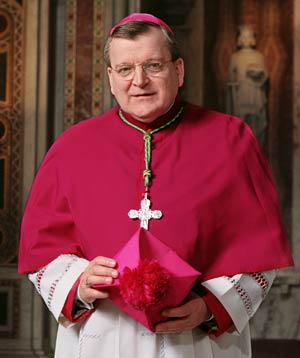
Archbishop Burke's Talk is titled "Vocations Come From Families",
from the guidelines of "I Will Give You Shepherds" (Pastores Dabo Vobis) by His Holiness, Pope John Paul II.
Reservations are required. Tickets are $35.00 each. For more information call (636)300-4465 or (636) 447-3673. Proceeds for the Vocation Programs of the St. Charles Deanery Serra Club.
Last year the event was sold out so you may to make your reservations early!
The Serra Club of the St. Charles Deanery
is hosting
the Second Annual Dinner Banquet
for honoring all priests serving in the St. Charles Deanery.
Date: Tuesday, April 12
Time: 6:00 P.M.
Place: The Columns Banquet Center
Address:711 Veteran Pkwy, St Charles MO.
The Keynote Speaker for this event will be:
The Most Reverend Raymond L. Burke, Archbishop of St. Louis
Archbishop Burke's Talk is titled "Vocations Come From Families",
from the guidelines of "I Will Give You Shepherds" (Pastores Dabo Vobis) by His Holiness, Pope John Paul II.
Reservations are required. Tickets are $35.00 each. For more information call (636)300-4465 or (636) 447-3673. Proceeds for the Vocation Programs of the St. Charles Deanery Serra Club.
Last year the event was sold out so you may to make your reservations early!
Presentation of "'Dignitas connubii' (Dignity of Marriage)
VATICAN CITY, FEB 8, 2005 (VIS) - This morning in the Holy See Press Office, there was the presentation of "'Dignitas connubii' (Dignity of Marriage), Instruction to be Observed by Diocesan and Interdiocesan Tribunals in Handling Causes of the Nullity of Marriage. The Instruction was prepared by the Pontifical Council for Legislative Texts, with the collaboration of other dicasteries.Vatican statement here.
Cardinal Julian Herranz explained that the Instruction Dignitas connubii aims to offer judges in ecclesial courts "a practical document, a kind of vademecum to use as a ready guide for carrying out their duties in canonical hearings on the nullity of marriage." A similar document, the Instruction "Provida Mater," was published in 1936, relating to the Code of Canon Law of 1917.
...
Dignitas Connubii is available in the official Latin text with English translation and also in Latin/Italian. It consists of a "Proemium" or Introduction, Preliminary Articles and 15 Titles, most of which are subdivided into Chapters.
UK Bishops Issue Diversity and Equality Guidelines
There seems to have some reports yesterday that may have been slightly inaccurate. There is really no need to go over those. We can look to the document issued by the Bishops to see exactly what they say:
However, when one continues reading the next pargraph, the confusion should be abated:
I have not read the complete document, and must therefore, withhold opinions regarding its fidelity or prudence. My only initial reaction, however, is that we must strive, with Gods grace, to change the culture which will naturally follow from the conversions of hearts and minds to Christ. We must be in the world but not of the world. We cannot embrace evil as good. We must speak the truth always, without hesitation or fear of ridicule or fear of persecution.
The document of the Bishops of England and Wakes may be viewed here.
In recent years, a series of EU Directives on Race, Employment and Equal Treatment has established a common framework within the European Union to prohibit discrimination on the grounds of race, gender, disability, sexual orientation, religion or belief and age. The Government has passed UK legislation to implement these Directives and it intends to establish a new single Commission on Equality and Human Rights.We can see, from a misreading of the document, that the teachings of the Church may seem distorted. Look, for example, at Paragraph 28:
In the light of these developments, the Catholic Bishops' Conference of England and Wales has issued a Policy Statement and Guidelines dealing with diversity and equality.
28. The Catholic community includes people of heterosexual, homosexual and bi-sexual orientation. Every human being, whatever his or her sexual orientation, has the right to live a life free from discrimination and harassment, and we welcome new legislation which protects this right. Moreover, people of all sexual orientations have a right to take a full and active part in the life of the Catholic community.This statement, taken by itself, could be, and probably was, a source of confusion for many.
However, when one continues reading the next pargraph, the confusion should be abated:
29. Catholic teaching, of course, makes a distinction between sexual orientation and sexual activity, and it holds that all men and women are called to a life of chastity, and to fidelity if they choose to marry. Catholic organisations and institutions ask their members and staff to respect this teaching.Hopefully, a full and careful study of the document will be done - this would diminish the tendency which some of us have to jump to conclusions and rash judgements based on partial and incomplete information or emotion. Perhaps, even as some of us in the US have come to view with skepticism many of the statements and documents of our Bishops, some of us, as a consequence, look with skepticism at the documents and statements from other Bishops' conferences?
I have not read the complete document, and must therefore, withhold opinions regarding its fidelity or prudence. My only initial reaction, however, is that we must strive, with Gods grace, to change the culture which will naturally follow from the conversions of hearts and minds to Christ. We must be in the world but not of the world. We cannot embrace evil as good. We must speak the truth always, without hesitation or fear of ridicule or fear of persecution.
The document of the Bishops of England and Wakes may be viewed here.
George Weigel: Christianity, by the numbers
For 20 years, David Barrett's "Annual Statistical Table on Global Mission" (available in the quarterly International Bulletin of Missionary Research) has offered a numerical cornucopia to anyone interested in pondering the state of Christianity, and indeed of religious belief, throughout the world. Even for the statistically-challenged (like me), two large conclusions jump out from Dr. Barrett's 2005 table.Interesting observations are made here.
Gospel for Tuesday, 5th Week in Ordinary Time
The Tradition of the Elders (Mark 7:1-13)
[1] Now when the Pharisees gathered together to Him (Jesus), with some of the scribes, who had come from Jerusalem, [2] they saw that some of His disciples ate with hands defiled, that is, unwashed. [3] (For the Pharisees, and all the Jews, do not eat unless they wash their hands, observing the tradition of the elders; [4] and when they come from the market place, they do not eat unless they purify themselves; and there are many other traditions which they observe, the washing of cups and pots and vessels of bronze.) [5] And the Pharisees and the scribes asked Him, "Why do Your disciples not live according to the tradition of the elders, but eat with hands defiled?" [6] And He said to them, "Well did Isaiah prophesy of you hypocrites, as it is written, `This people honors Me with their lips, but their heart is far from Me; [7] in vain do they worship Me, teaching as doctrines the precepts of men.' [8] You leave the commandment of God, and hold fast the tradition of men.
[9] And He said to them, "You have a fine way of rejecting the commandment of God, in order to keep your tradition! [10] For Moses said, "Honor your father and your mother'; and `He who speaks evil of father or mother, let him surely die'; [11] but you say, `If a man tells his father or his mother, What you would have gained from me is Corban' (that is, given to God)--[12] then you no longer permit him to do anything for his father or mother, [13] thus making void the word of God through your tradition which you hand on. And many such things you do."
*********************
Commentary:
1-2. Hands were washed not for reasons of hygiene or good manners but because the custom had religious significance: it was a rite of purification. In Exodus 30:17ff the Law of God laid down how priests should wash before offering sacrifice. Jewish tradition had extended this to all Jews before every meal, in an effort to give meals a religious significance, which was reflected in the blessings which marked the start of meals. Ritual purification was a symbol of the moral purity a person should have when approaching God (Psalm 24:3ff; 51:4 and 9); but the Pharisees had focused on the mere external rite. Therefore Jesus restores the genuine meaning of these precepts of the Law, whose purpose is to teach the right way to render homage to God (cf. John 4:24).
3-5. We can see clearly from this text that very many of those to whom St. Mark's Gospel was first addressed were Christians who had been pagans and were unfamiliar with Jewish customs. The Evangelist explains these customs in some detail, to help them realize the significance of the events and teachings reported in the Gospel story.
Similarly, Sacred Scripture needs to be preached and taught in a way which puts it within reach of its hearers. This is why Vatican II teaches that "it is for the bishops suitable to instruct the faithful [...] by giving them translations of the sacred texts which are equipped with necessary and really adequate explanations. Thus the children of the Church can familiarize themselves safely and profitably with the Sacred Scriptures, and become steeped in their spirit" ("Dei Verbum", 25).
11-13. For an explanation of this text cf. note on Mt. 15:5-6. Jesus Christ, who is the authentic interpreter of the Law, because as God He is its author, explains the scope of the fourth commandment and points out the mistakes made by the Jewish casuistry. There were many other occasions when He corrected mistaken interpretations offered by the Jewish teachers: for example, when He recalls that phrase of the Old Testament, "Go and learn what this means, I desire mercy, and not sacrifice" (Hosea 6:6, 1 Samuel 15:22; Sirach 35:4) in Matthew 9:13.
[The note on Matthew 15:5-6 states:
5-6. Over the years teachers of the Law (scribes) and priests of the temple had distorted the true meaning of the fourth commandment. In Jesus' time, they were saying that people who contributed to the temple in cash or in kind were absolved from supporting their parents: it would be sacrilegious for parents to lay claim to this "corban" (offerings for the altar). People educated in this kind of thinking felt that they were keeping the fourth commandment--in fact, fulfilling it in the best way possible--and they were praised for their piety by the religious leaders of the nation. But what in fact it meant was that, under the cloak of piety, they were leaving elderly parents to fend for themselves. Jesus, who is Messiah and God, is the one who can correctly interpret the Law. Here He explains the proper scope of the fourth commandment, exposing the error of Jewish practice at the time.
For Christians, therefore, the fourth commandment includes affectionate help of parents if they are old or needy, even if one has other family, social or religious obligations to attend to. Children should check regularly on whether they are looking after their parents properly.]
******************
Source: "The Navarre Bible: Text and Commentaries". Biblical text taken from the Revised Standard Version and New Vulgate. Commentaries made by members of the Faculty of Theology of the University of Navarre, Spain. Published by Four Courts Press, Kill Lane, Blackrock, Co. Dublin, Ireland.
Reprinted with permission from Four Courts Press and Scepter Publishers, the U.S. publisher.
[1] Now when the Pharisees gathered together to Him (Jesus), with some of the scribes, who had come from Jerusalem, [2] they saw that some of His disciples ate with hands defiled, that is, unwashed. [3] (For the Pharisees, and all the Jews, do not eat unless they wash their hands, observing the tradition of the elders; [4] and when they come from the market place, they do not eat unless they purify themselves; and there are many other traditions which they observe, the washing of cups and pots and vessels of bronze.) [5] And the Pharisees and the scribes asked Him, "Why do Your disciples not live according to the tradition of the elders, but eat with hands defiled?" [6] And He said to them, "Well did Isaiah prophesy of you hypocrites, as it is written, `This people honors Me with their lips, but their heart is far from Me; [7] in vain do they worship Me, teaching as doctrines the precepts of men.' [8] You leave the commandment of God, and hold fast the tradition of men.
[9] And He said to them, "You have a fine way of rejecting the commandment of God, in order to keep your tradition! [10] For Moses said, "Honor your father and your mother'; and `He who speaks evil of father or mother, let him surely die'; [11] but you say, `If a man tells his father or his mother, What you would have gained from me is Corban' (that is, given to God)--[12] then you no longer permit him to do anything for his father or mother, [13] thus making void the word of God through your tradition which you hand on. And many such things you do."
*********************
Commentary:
1-2. Hands were washed not for reasons of hygiene or good manners but because the custom had religious significance: it was a rite of purification. In Exodus 30:17ff the Law of God laid down how priests should wash before offering sacrifice. Jewish tradition had extended this to all Jews before every meal, in an effort to give meals a religious significance, which was reflected in the blessings which marked the start of meals. Ritual purification was a symbol of the moral purity a person should have when approaching God (Psalm 24:3ff; 51:4 and 9); but the Pharisees had focused on the mere external rite. Therefore Jesus restores the genuine meaning of these precepts of the Law, whose purpose is to teach the right way to render homage to God (cf. John 4:24).
3-5. We can see clearly from this text that very many of those to whom St. Mark's Gospel was first addressed were Christians who had been pagans and were unfamiliar with Jewish customs. The Evangelist explains these customs in some detail, to help them realize the significance of the events and teachings reported in the Gospel story.
Similarly, Sacred Scripture needs to be preached and taught in a way which puts it within reach of its hearers. This is why Vatican II teaches that "it is for the bishops suitable to instruct the faithful [...] by giving them translations of the sacred texts which are equipped with necessary and really adequate explanations. Thus the children of the Church can familiarize themselves safely and profitably with the Sacred Scriptures, and become steeped in their spirit" ("Dei Verbum", 25).
11-13. For an explanation of this text cf. note on Mt. 15:5-6. Jesus Christ, who is the authentic interpreter of the Law, because as God He is its author, explains the scope of the fourth commandment and points out the mistakes made by the Jewish casuistry. There were many other occasions when He corrected mistaken interpretations offered by the Jewish teachers: for example, when He recalls that phrase of the Old Testament, "Go and learn what this means, I desire mercy, and not sacrifice" (Hosea 6:6, 1 Samuel 15:22; Sirach 35:4) in Matthew 9:13.
[The note on Matthew 15:5-6 states:
5-6. Over the years teachers of the Law (scribes) and priests of the temple had distorted the true meaning of the fourth commandment. In Jesus' time, they were saying that people who contributed to the temple in cash or in kind were absolved from supporting their parents: it would be sacrilegious for parents to lay claim to this "corban" (offerings for the altar). People educated in this kind of thinking felt that they were keeping the fourth commandment--in fact, fulfilling it in the best way possible--and they were praised for their piety by the religious leaders of the nation. But what in fact it meant was that, under the cloak of piety, they were leaving elderly parents to fend for themselves. Jesus, who is Messiah and God, is the one who can correctly interpret the Law. Here He explains the proper scope of the fourth commandment, exposing the error of Jewish practice at the time.
For Christians, therefore, the fourth commandment includes affectionate help of parents if they are old or needy, even if one has other family, social or religious obligations to attend to. Children should check regularly on whether they are looking after their parents properly.]
******************
Source: "The Navarre Bible: Text and Commentaries". Biblical text taken from the Revised Standard Version and New Vulgate. Commentaries made by members of the Faculty of Theology of the University of Navarre, Spain. Published by Four Courts Press, Kill Lane, Blackrock, Co. Dublin, Ireland.
Reprinted with permission from Four Courts Press and Scepter Publishers, the U.S. publisher.
Monday, February 07, 2005
Catholic Culture's Site Review of "Catholic Action Network"
I'm glad to see this review is finally complete!
And the VERDICT is .... DANGER!
And the VERDICT is .... DANGER!
The Catholic Action Network claims to be "an independent, authentic, and inclusive organization working for social justice within the Catholic Church, and in our world. Comprised of both lay and religious, the members of CAN seek to provide an active vehicle to put faith into action." In reality, they are a dissident organzation working towards a false idea of justice and peace. Along with regularly featuring articles by well-known dissidents such as Joan Chittister, CAN openly promotes the ordination of women, same-sex unions, and changing the liturgy.Source.
City Officials Rally Against Possible Parish Closings
ST. LOUIS (AP) -- A coalition of city officials wants St. Louis' archbishop to move cautiously in closing parishes, pressing that such decisions should reflect population growth of the city "experiencing a rebirth."Post Dispatch article here.
The eight-person, largely Catholic group -- including the city's prosecutor, circuit clerk and treasurer -- also suggests that possible closures being considered by Archbishop Raymond Burke may strip communities of their identities and benefits of Catholic charity.
Jamie Allman, a spokesman for the archdiocese, said a task force tapped to draft the consolidation plan for Burke's review already has considered Census Bureau figures and populations of certain neighborhoods.
Catholic Blog Awards on Times Against Humanity
I am truly humbled to have been nominated and I would be remiss if I failed to thank those responsible for such a wonderful honor; therefore, thank you most sincerely!
I, for one, also would pray that Catholic Blogs continue to help others grow spiritually and in bringing Christ to the world, for the world is in much need of sanctification today.
I, for one, also would pray that Catholic Blogs continue to help others grow spiritually and in bringing Christ to the world, for the world is in much need of sanctification today.
UPDATE on V-Monologues Prayer Protest at SLU
This has just come in:
If you would like to read the letter I received from from St Louis University in 2003 attempting to justify the 'performance' of the 'V-Monologues', it is here.
With respect to the SLU performance:
There is additional information about this 'performance'...It is sponsored by School of Social Service, Center for Social Justice, Una.
Do you think that the new Social Justice Compendium from the Holy See will have addressed this? Also, there is a related event:
This whole affair is a scandalous and despicable example for young adults, especially those whose parent thought they were attending a Catholic college.
Protest against the presentation of the vulgar "play" The V*****Monologues at St. Louis University this Friday February 11, 2005.Please pass this along to everyone you know.
Please join America Needs Fatima in a peaceful protest against this play. Tell the University and your fellow citizens that the "V***** Monologues" is offensive to Our Lord Jesus Christ, His Blessed Mother and Christians everywhere. Come and stand with fellow Catholics and defend the sanctity of Marriage.
We will be meeting at St. Francis Xavier Church on Lindell across from the St. Louis University Campus on Friday evening at 5:45PM. From there we will organize and assemble on the sidewalk in front of Tegeler Hall and Carlo Auditorium at 3498 Lindell Blvd from 6 to 7PM.
Please pass this email announcement on to all faithful Catholics. We must take a stand against this play and let the University know without any doubt that this does NOT meet the standards for Catholic higher education.
If you are unable to stand outside, due to health concerns, perhaps you could come to St. Francis Xavier Church and offer an hour of prayer in reparation as others gather outside.
We would be especially grateful to have priests join us on this protest!
If you would like to read the letter I received from from St Louis University in 2003 attempting to justify the 'performance' of the 'V-Monologues', it is here.
With respect to the SLU performance:
There is additional information about this 'performance'...It is sponsored by School of Social Service, Center for Social Justice, Una.
Do you think that the new Social Justice Compendium from the Holy See will have addressed this? Also, there is a related event:
A Panel Reflection on: Community Based Responses to Ending Violence Against Women ~ Moderator: Dr. Gretchen Arnold (Sociology and Criminal Justice Dept.) ~ Participants: Yelena Todic (Barnes-Jewish Hospital with AWARE) Katherine Monpiegel (The Women's Safe House) Jenny Truax (Karen House) Gerry Rauch (Women's Ordination Conference) ~ 7:00 pm Thursday, February 10 2005 ~ Carlo Auditorium, Tegeler Hall ~ Admission is free.It's certainly nice to see that the Women's Ordination Conference is represented...And all at a professedly Catholic University. I can't seem to comprehend the connection, however, between violence against women and women's ordination??? Both Jenny Truax and Gerry Rauch are listed as core members of Catholic Action Network, a less than "Catholic" group.
This whole affair is a scandalous and despicable example for young adults, especially those whose parent thought they were attending a Catholic college.
Shanley Convicted of Child Rape in Massachussetts
CAMBRIDGE, Mass. (AP) - Defrocked priest Paul Shanley, the most notorious figure in the sex scandal that rocked the Boston Archdiocese, was convicted Monday of raping and fondling a boy at his church during the 1980s.Complete AP News story here...
The conviction on all four charges gives prosecutors a high-profile victory in their effort to bring pedophile priests to justice for decades of abuse at Roman Catholic parishes around the country.
Shanley, 74, could get life in prison.
St Louis Univ. Knights to Show "The Passion of the Christ"
SLU Knights of Columbus to show Mel Gibson's "The Passion of the Christ" on Ash Wednesday
...the Knights of Columbus council (4561) at St. Louis University in St. Louis, MO, is putting on a public screening of Mel Gibson's "The Passion of the Christ" this Wednesday [Feb 9] at 6:30 PM.
FYI, a little over two years ago, after some friends of mine and myself were exposed to the Knights and realized what an awesome vessel for Catholic university reform this organization is by nature, we reactivated SLU's dormant university K of C council and, following strict guidelines of Catholic orthodoxy in our admissions committees, we now have 50 members.
We sponsor traditional devotions on campus (chanted Chaplet of Divine Mercy on Fridays at 3:00, and the Holy Rosary of the BVM prayed partly in Latin every Tuesday). We offer a more traditional form of Roman Catholicism to students on campus and it seems like the Holy Spirit just can't stop providing for us. This public screening of The Passion will mark our biggest step yet in exposing all university students to our traditional charism and help all believers and non-believers alike to prepare for a penitential Lenten season.
In case anyone in the St. Louis area would like to come, the showing will be in Kelley Auditorium at St. Louis University.
If you know SLU's campus, that's just east of the Busch Student Center. Space may be limited, but I honestly have no idea what the turn out will be like. We will be taking donations to cover the significant copyright costs and anything collected beyond that will go to a charity of our choosing. Possibly SLU's Campus Ministry Tsunamai Relief Fund. Our Campus Ministry has also been kind enough to co-sponsor this exciting event! Dominus Vobiscum
Posted at FR by Squire of St. Michael
"Ten Minutes Later, He [the Pope] Would Have Been Gone"
From an Inside the Vatican Newsflash:
The Pope's condition was grave on the evening he was taken to the hospital. Here follows our reconstruction of the eventsContinued here...
- by Inside the Vatican staff
February 5, 2005
At about 7 p.m. on Tuesday evening, February 1, the chop of helicopter blades began to cut through the still evening air above Vatican City. It was an Italian police helicopter, equipped with special infra-red heat-sensors to pick up traffic jams in Rome's streets, or to closely track a speeding vehicle in the night.
The helicopter wheeled in a tight circle not far from the dome of St. Peter's, then followed the streets along the Vatican's high walls toward the "Agostino Gemelli" hospital, about two and a half miles from St. Peter's Square.
At about 7:30 p.m., from the Gemelli's internal heliport, another helicopter lifted off and sped rapidly toward Vatican City. Within moments, it was landing on the helicopter pad in the Vatican gardens, not far from the back wall of St. Peter's Basilica, at the very heart of the world's smallest state.
An Italian doctor, Prof. Dogliani, an expert in cardiovascular medicine, hastened from the helicopter pad toward the Apostolic Palace, where for some 500 years the bishops of Rome have had their residence. The Swiss Guards, advised of his coming, allowed him to enter. Millions of Italians heard these details on the evening of February 2, on the Italian television program "Porta a Porta" ["Door to Door"] from Giuseppe De Carli, the "vaticanista" of the most important Italian television news channel, TG1. De Carli was continually on the air informing Italians and the world about the Pope's illness and hospitalization. On the topmost floor of the Vatical palace where John Paul II has his private apartment, the Holy Father was having trouble breathing. His throat was inflamed and constricted due to a bout with the flu.
With the Pope was his most trusted advisor, Bishop Stanislaw Dziwisz, 65, John Paul's personal secretary since 1965, since the days when John Paul was bishop of Krakow, Poland, and "don Stanislaw" was one of the fastest skiers on the slopes of the Tatra mountains in southern Poland, where he and John Paul first met.
Dziwisz, widely regarded as one of the most powerful men in the Vatican today because of his role at the Pope's side, suggested to John Paul that it might be a good idea to go to the hospital to have his breathing checked. The Pope, 84 years old, rejected the suggestion, decisively shaking his head.
He felt, evidently, that his situation was not serious enough to require hospitalization. He indicated that he wanted dinner served. Medical experts in Rome report that part of the Pope's breathing problem is due to his curved posture and general lack of mobility for a number of years. He has difficulty breathing because his lung cavity is under pressure, according to doctors.
At about 8 p.m., the Pope and Dziwisz sat down for a light dinner. Some minutes passed quietly.
Then, his inflamed throat irritated by eating he suddenly coughed and had difficulty swallowing. Soon, the Pope was gasping for breath. "The Pope had a strong feeling that he was suffocating," the veteran Vatican journalist Marco Tosatti would explain in "La Stampa" of Turin on February 3.
Soon, however, normalcy returned and the Pope could breathe again. But Dziwisz by then had summoned Doctor Renato Buzzonetti, the Pope's long-time personal physician.
Buzzonetti, too, urged the Pope to leave the Vatican and go to the hospital. The Pope still refused. He did not consider his condition that serious. An hour passed. An hour and a half. Two hours...
Then, another coughing spell in which the Pope sensed he could not breathe. At last, the Pope himself was worried. He yielded.
A papal ambulance -- yes, there is an ambulance in Vatican City -- left from a side entrance of the Vatican at 10:15 p.m., carrying the sufferinng Pope. (It was this same ambulance -- a 1981 gift to the Pope from then-monsignor, now-Cardinal Fiorenzo Angelini -- which carried the Pope on the afternoon of May 13, 1981, to the Gemelli clinic, after Ali Agca attempted to assassinate him in St. Peter's Square.)
Prayer Vigil at SLU to Protest V-Monologues
On the Feast of Our Lady of Lourdes, February 11, a prayer vigil is being planned so that we might meet in prayer to protest of the upcoming "V-Monologues" play which is to be performed at St. Louis University, a professed Catholic institution.
The e-mail I received stated:
"Here in St. Louis, we are trying to mobilize as many faithful Catholics as possible with such short notice to come and protest the play on opening night. Please come and stand with fellow Catholics in making an act of reparation.
"We will be contacting Catholics around the St. Louis Region to ask them to join in our protest on Friday February 11th. Arrangements are currently underway and we expect to announce a time and location no later than Wednesday February 9th. In the meanwhile, please keep the date open and plan to attend the protest. "
------------------------
Details are still being worked on and will be posted as soon as they become available (exact location and time, etc.).
The e-mail I received stated:
"Here in St. Louis, we are trying to mobilize as many faithful Catholics as possible with such short notice to come and protest the play on opening night. Please come and stand with fellow Catholics in making an act of reparation.
"We will be contacting Catholics around the St. Louis Region to ask them to join in our protest on Friday February 11th. Arrangements are currently underway and we expect to announce a time and location no later than Wednesday February 9th. In the meanwhile, please keep the date open and plan to attend the protest. "
------------------------
Details are still being worked on and will be posted as soon as they become available (exact location and time, etc.).
A Philosopher, a Mystic, and a Theologian Sound an Alarm for the Church
They are Romano Amerio, Divo Barsotti and Inos Biffi. Though widely different from each other, they agree in recalling the Church to its foundations – that it not disappear "in the fog of the faith.""
by Sandro Magister
------------------------
ROMA, February 7, 2005 – Almost during the very same days when the frailty of John Paul II filled the Church with apprehension, two books and a conference focused attention on three important Christian authors who have expressed, and still do, a radical critique of the weaknesses of today's Church, even though they love it and obey it wholeheartedly.
These three are Romano Amerio, a philosopher, Divo Barsotti, a mystic, and Inos Biffi, a theologian. The first is Swiss, the other two Italian.
A conference on Amerio, who died in 1997 at the age of 92, was held in Lugano on January 29, in the main hall of the University of Italian Switzerland, under the sponsorship of the local theological faculty and with the participation of the bishop, Pier Giacomo Grampa.
As for Divo Barsotti (in the photo), the community he founded, the Community of the Children of God, has published on the occasion of his 90th birthday a biographical profile composed in large part of his previously unpublished manuscripts.
Inos Biffi has seen the publication of a book with an eloquent title: "Christian Truths in the Fog of the Faith."
Here are some news on the conference, the two books, and the three personalities.
Diocese of La Crosse Eliminates Positions
*** Corrected ****
One of the positions whose hours were cut from 40 hours to 35 hours is that held by Dr. Arthur Hippler, the Director of the Office of Justice and Peace. Other positions with cut hours include those of Director of the Office of Family Life, and the Director of the Office of Youth Ministry. Positions eliminated are the assistant director of Catechesis and Evangelization, Diocesan Annual Appeal coordinator, secretary of the Office of Catholic Schools, and assistant director of Ministries. Other positions also had hours reduced.
Bishop-elect Jerome Listecki, when he is installed as Bishop in March, could reverse some or all of these decisions which were made by diocesan administrator, Rev. Richard Gilles, inconsultation with Bisho-elect Listecki.
Perhaps Archbishop Burke could bring Dr. Hippler to the St. Louis Archdiocese if Bishop-elect Listecki leaves the situation in La Crosse as it is? Dr. Hippler's many good articles, which are were no longer on line the last time I checked, were some of the best reading regarding Social Justice and Peace issues. One could easily understand why then Bishop Burke hired him for the La Cross diocese.
Article here.
One of the positions whose hours were cut from 40 hours to 35 hours is that held by Dr. Arthur Hippler, the Director of the Office of Justice and Peace. Other positions with cut hours include those of Director of the Office of Family Life, and the Director of the Office of Youth Ministry. Positions eliminated are the assistant director of Catechesis and Evangelization, Diocesan Annual Appeal coordinator, secretary of the Office of Catholic Schools, and assistant director of Ministries. Other positions also had hours reduced.
Bishop-elect Jerome Listecki, when he is installed as Bishop in March, could reverse some or all of these decisions which were made by diocesan administrator, Rev. Richard Gilles, inconsultation with Bisho-elect Listecki.
Perhaps Archbishop Burke could bring Dr. Hippler to the St. Louis Archdiocese if Bishop-elect Listecki leaves the situation in La Crosse as it is? Dr. Hippler's many good articles, which are were no longer on line the last time I checked, were some of the best reading regarding Social Justice and Peace issues. One could easily understand why then Bishop Burke hired him for the La Cross diocese.
Article here.
Prayers for the Unity of the Church
We have witnessed in recent years - even decades, it seems, a greater degree of efforts aimed at disrupting the unity of the Church. Unity means that the members of the Church are united in belief of the same doctrines of revelation, and in the acknowledgment of the authority of the pastors of the Church.
St. Paul ranked schism and heresy with the crimes of murder and idolatry and he stated that these would not possess the kingdom of God (Gal 5:20, 21).
In his epistle to the Ephesians, he called for unity by exhorting, "Be careful to keep the unity of the Spirit in the bond of peace. One body and one Spirit; as you are called in one hope of your calling. One Lord, one faith, one baptism. One God and Father of all, Who is above all, and through all, and in us all." (Eph 4:3-6)
Unity in the governance of the Church is no less essential to the Church than that of doctrines, despite what some have been saying. Our Lord speaks of one Church - His Church. There is but one kingdom not many kingdoms.
Our Lord speaks of one fold and one shepherd (John 10:16).
St. Paul compares the Church to a human body: "For as in one body we have many members, but all the members have not the same office: So we being many, are one body in Christ, and every one members one of another." (Rom 12: 4-5)
The Church is compared to a vine, in which all the branches are connected to the main stem. All of the branches so connected, therefore, obtain their life and nourishment from it.
As God is one, so, too is the Church. Anyone who would knowingly and willfully withdraw from the communion of the Church, or from communion with her legitimate pastors, becomes like the withered branch and is cut off from the main vine.
The hierarchical structure of the Church has been established to maintain unity just as the body is united to the head. The faithful should be subject to their immediate Pastor, the Priests should be subordinate to the Bishop, and each Bishop should acknowledge the jurisdiction of the Holy Father, the Bishop of Rome, the successor of St. Peter.
Prayer is needed to petition our Lord to grant the graces necessary that unity be restored and that further ruptures be avoided.
St. Paul ranked schism and heresy with the crimes of murder and idolatry and he stated that these would not possess the kingdom of God (Gal 5:20, 21).
In his epistle to the Ephesians, he called for unity by exhorting, "Be careful to keep the unity of the Spirit in the bond of peace. One body and one Spirit; as you are called in one hope of your calling. One Lord, one faith, one baptism. One God and Father of all, Who is above all, and through all, and in us all." (Eph 4:3-6)
Unity in the governance of the Church is no less essential to the Church than that of doctrines, despite what some have been saying. Our Lord speaks of one Church - His Church. There is but one kingdom not many kingdoms.
Our Lord speaks of one fold and one shepherd (John 10:16).
St. Paul compares the Church to a human body: "For as in one body we have many members, but all the members have not the same office: So we being many, are one body in Christ, and every one members one of another." (Rom 12: 4-5)
The Church is compared to a vine, in which all the branches are connected to the main stem. All of the branches so connected, therefore, obtain their life and nourishment from it.
As God is one, so, too is the Church. Anyone who would knowingly and willfully withdraw from the communion of the Church, or from communion with her legitimate pastors, becomes like the withered branch and is cut off from the main vine.
The hierarchical structure of the Church has been established to maintain unity just as the body is united to the head. The faithful should be subject to their immediate Pastor, the Priests should be subordinate to the Bishop, and each Bishop should acknowledge the jurisdiction of the Holy Father, the Bishop of Rome, the successor of St. Peter.
Prayer is needed to petition our Lord to grant the graces necessary that unity be restored and that further ruptures be avoided.
Reading for Monday, 5th Week in Ordinary Time
From: Genesis 1:1-19
The Creation Account
[1] In the beginning God created the heavens and the earth. [2] The earth was without form and void, and darkness was upon the face of the deep; and the Spirit of God was moving over the face of the waters.
[3] And God said, "Let there be light"; and there was light. [4] And God saw that the light was good; and God separated the light from the darkness. [5] God called the light Day, and the darkness he called Night. And there was evening and there was morning, one day.
[6] And God said, "Let there be a firmament in the midst of the waters, and let it separate the waters from the waters." [7] And God made the firmament and separated the waters which were under the firmament from the waters which were above the firmament. And it was so. [8] And God called the firmament Heaven. And there was evening and there was morning, a second day.
[9] And God said, "Let the waters under the heavens be gathered together into one place, and let the dry land appear." And it was so. [10] God called the dry land Earth, and the waters that were gathered together he called Seas. And God saw that it was good. [11] And God said, "Let the earth put forth vegetation, plants yielding seed, and fruit trees bearing fruit in which is their seed, each according to its kind, upon the earth." And it was so. [12] The earth brought forth vegetation, plants yielding seed according to their own kinds, and trees hearing fruit in which is their seed, each according to its kind. And God saw that it was good. [13] And there was evening and there was morning, a third day.
[14] And God said, "Let there be lights in the firmament of the heavens to separate the day from the night; and let them be for signs and for seasons and for days and years, [15] and let them be lights in the firmament of the heavens to give light upon the earth." And it was so. [16] And God made the two great lights, the greater light to rule the day, and the lesser light to rule the night; he made the stars also. [17] And God set them in the firmament of the heavens to give light upon the earth, [18] to rule over the day and over the night, and to separate the light from the darkness. And God saw that it was good. [19] And there was evening and there was morning, a fourth day.
******************
Commentary:
1:1-2:4a. Creatlon is the beginning of salvation history and the foundation on which are built God's salvific plans, which reach their climax in Jesus Christ. The biblical accounts of creation focus on the action of God; it is he who sets the scene and he is the creator, too, of those who will act out the drama and with whom he will enter into dialogue.
The sacred text incorporates ancient traditions about the origin of the world; scholars identify two separate accounts in the early chapters of Genesis. The first of these emphasizes God's transcendence over all created things, and is written in a very schematic style; this account (1:1-2:4a) is attributed to the "Priestly" tradition. The second, which also covers the fall and the expulsion from paradise, speaks of God in an anthropomorphic way; this more vivid, more popular account (2:4b-4:26) is considered to belong to the "Yahwistic" tradition. Here we have two different ways in which the Word of God (not intending to provide a scientific explanation of the origin of the world and of man) expounds the basic facts and truths on the subject in a way people can readily understand, inviting us to see me greatness and love of God manifested first in creation and then in the history of mankind. "Our faith teaches us," St. Josemaria Escriva writes, "that all creation, the movement of the earth and the other heavenly bodies, the good actions of creatures and all the good that has been achieved in history, in short everything, comes from God and directed toward him" ("Christ Is Passing By", 130).
In the first account the Bible offers profound teaching about God, about man and about the world. About God, who is the only God, creator of all things and man in particular; he transcends the created world and is its supreme master. About man, who is the image and likeness of God, above all other created beings and placed in the world to rule all creation. About the world, which is something good and is at the service of man.
1.1. "Three things are affirmed in these first words of Scripture: the eternal God gave a beginning to all that exists outside of himself; he alone is Creator (the verb 'create'--Hebrew "bara"--always has God for its subject). The totality of what exists (expressed by the formula 'the heavens and the earth') depends on the One who gives it being" ("Catechism of the Catholic Church", 290).
"In the beginning" means that creation marks the start of time and the course of history. Time and history have a beginning and they are headed towards a final goal, which the Bible will tell us more about, especially in its last book, Revelation. At the end, we are told: 'Then I saw a new heaven and a new earth; for the first heaven and the first earth had passed away, and the sea was no more" (Rev 21:1).
God the Creator is the same God as will manifest himself to the patriarchs, to Moses and to the prophets and make himself known to as through Jesus Christ. In the light of the New Testament we know that God created all things through his eternal Word, his beloved Son (cf. Jn 1:1; Col 1:16-17). God the Creator is Father and Son and (the relationship of love between them) the Holy Spirit. Creation is the work of the Blessed Trinity, and all of creation (particularly man, created in the image and likeness of God) in some way bears their seal. Some Fathers of the Church (Augustine, Ambrose and Basil, for example), in the light of the New Testament, saw the words "in the beginning" as having a deeper meaning--namely, "in the Son".
The "action of creating" belongs exclusively to God; man cannot create; he can only "change" or "develop" something that already exists. In the creation accounts of other Near East religions the world and gods developed out of preexistent matter. The Bible, however, records gradual revelation of the mystery of creation interpreted in the light of God's choice of Israel and his covenant with mankind; it roundly asserts that everything was made by God. Later on it will draw the conclusion that everything was created out of' nothing: "I beseech you, my child, to look at the heavens and the earth and see everything that is in them, and to recognize that God did not make them out of things that existed" (2 Mac 7:28). This creative power of God is also able to give sinful man a pure heart (cf. Ps 51:12), to restore the dead to life and to give the light of faith to those who do not know him (cf. 2 Cor 4:6).
It was God's love and wisdom that moved him to create the world, thereby communicating his goodness and making his glory manifest. The world, therefore, "is not the product of any necessity whatever, nor of blind, fate or chance. We believe that it proceeds from God's free will; he wanted to make his creatures share in his being, wisdom and goodness" ("Catechism of the Catholic Church", 295).
The _expression "the heavens and the earth" means everything that exists. The earth is the world of men; the sky (or the heavens) can mean the firmament or the divine world, God's own "place", his glory and all spiritual (non-material) creatures--the angels.
1:2. The Bible teaches not just that God created all things, but also that the separation and ordering of the elements of nature is something established by God once and for all. The presence of the loving power of God, symbolized by a gentle breeze or a breath (the text refers to it as a spirit; "ruah" in Hebrew) which hovers and keeps watch over the world when it is still in chaos, shows that, as the text will go on to say, the Word of God and his Breath are present in the origin of being and in the origin of every creature's life. That is why many Fathers of the Church (Jerome and Athanasius, for example) saw this passage as reflecting the presence of the Holy Spirit as a divine Person who, along with the Father and the Son, is at work in the creation of the world, "This biblical concept of creation", John Paul II explains, "includes not only the call to existence of the very being of the cosmos, that is to say, "the giving of existence", but also the presence of the Spirit of God in creation, that is to say, the beginning of God's salvific self-communication to the things he creates. This is true "first of all concerning man", who has been created in the image and likeness of God" ("Dominum Et Vivificantem", 12).
1:3-5. At this point strictly speaking begins the description of the creation, which, according to the literary plan of this account, is going to take place over six days. These six days are meant to indicate the orderliness with which God went about his work, and to show a rhythm of work and rest: the Jewish Law laid down Saturday, the sabbath, as a day of rest and a day dedicated to the Lord. In the Christian Church this day was shifted to Sunday, because Sunday was the day on which our Lord rose from the dead, thereby inaugurating the new Creation: Sunday, the "dies dominica" (Latin), the Lord's day.
On the first day God creates light and separates light from darkness (the latter, being something negative--the absence of light--cannot be created). Light is seen here as being a thing in its own right (without reference to the fact that daylight comes from the sun, which will not be created until the fourth day). The fact that God puts names on things (or in this case on situations caused by some elements being separated from others) indicates that he wields absolute power over them. God is in authority, whether it be day or night.
Here we meet for the first time a phrase which is going to be used seven times over the course of the narrative: "And God saw that it was good." This means that everything that God creates is good because in some way it bears his seal and shares in his own goodness, for it has come from divine goodness. The goodness of the world proclaimed here by Holy Scripture has important consequences for the Christian: "We must love the world and work and all human things. For the world is good. Adam's sin destroyed the divine balance of creation; but God the Father sent his only Son to re-establish peace, so that we, his children by adoption, might free creation from disorder and reconcile all things to God" ([St] Escriva, "Christ Is Passing By", 112).
1:6-8. In line with the culture of their time, the early Hebrews thought that rain came from huge containers of water in the vault of heaven; when trapdoors were opened, the rain poured down. When it says here that God separated the water which were above the firmament from those below, what is really being taught is that God imposed order on the natural world and is responsible for the phenomenon of rain. It is also making it clear from the outset that the firmament must not be thought to involve any divinity (as was believed in the nations roundabout Israel); the firmament is part of the created world.
1:11. As the inspired author depicts here, a distinction is made between God's action in separating and ordering the elements (creating the vast spaces of sky, sea and land) and his action of filling or adorning these spaces with different kinds of creatures. These creatures introduced in an increasing order of dignity (in line with the thinking of the time)--first the vegetable kingdom, then the stellar kingdom, and, lastly, the animal kingdom. Everything is perfectly arranged; the world of Creation invites to contemplate the Creator.
1:14-17. Against the neighboring religions, which regarded the heavenly bodies as divinities exerting influence over human life, the biblical author, enlightened by inspiration, teaches that the sun, moon and stars are simply created things; their purpose is to serve man by giving him light by day and night, and to be a way of measuring time. Put in their proper, natural place heavenly bodies (like all the rest of creation) lead man to appreciate the greatness of God, and to praise him for his awesome works: "The heavens are telling the glory of God; and the firmament proclaims his handiwork..." (Ps 19:1; cf. Ps 104). It follows that all forms of divination are to be rejected--consulting horoscopes, astrology, clairvoyance etc. (cf. "Catechism of the Catholic Church", 2116).
************
Source: "The Navarre Bible: Text and Commentaries". Biblical text taken from the Revised Standard Version and New Vulgate. Commentaries made by members of the Faculty of Theology of the University of Navarre, Spain. Published by Four Courts Press, Kill Lane, Blackrock, Co. Dublin, Ireland.
Reprinted with permission from Four Courts Press and Scepter Publishers, the U.S. publisher.
The Creation Account
[1] In the beginning God created the heavens and the earth. [2] The earth was without form and void, and darkness was upon the face of the deep; and the Spirit of God was moving over the face of the waters.
[3] And God said, "Let there be light"; and there was light. [4] And God saw that the light was good; and God separated the light from the darkness. [5] God called the light Day, and the darkness he called Night. And there was evening and there was morning, one day.
[6] And God said, "Let there be a firmament in the midst of the waters, and let it separate the waters from the waters." [7] And God made the firmament and separated the waters which were under the firmament from the waters which were above the firmament. And it was so. [8] And God called the firmament Heaven. And there was evening and there was morning, a second day.
[9] And God said, "Let the waters under the heavens be gathered together into one place, and let the dry land appear." And it was so. [10] God called the dry land Earth, and the waters that were gathered together he called Seas. And God saw that it was good. [11] And God said, "Let the earth put forth vegetation, plants yielding seed, and fruit trees bearing fruit in which is their seed, each according to its kind, upon the earth." And it was so. [12] The earth brought forth vegetation, plants yielding seed according to their own kinds, and trees hearing fruit in which is their seed, each according to its kind. And God saw that it was good. [13] And there was evening and there was morning, a third day.
[14] And God said, "Let there be lights in the firmament of the heavens to separate the day from the night; and let them be for signs and for seasons and for days and years, [15] and let them be lights in the firmament of the heavens to give light upon the earth." And it was so. [16] And God made the two great lights, the greater light to rule the day, and the lesser light to rule the night; he made the stars also. [17] And God set them in the firmament of the heavens to give light upon the earth, [18] to rule over the day and over the night, and to separate the light from the darkness. And God saw that it was good. [19] And there was evening and there was morning, a fourth day.
******************
Commentary:
1:1-2:4a. Creatlon is the beginning of salvation history and the foundation on which are built God's salvific plans, which reach their climax in Jesus Christ. The biblical accounts of creation focus on the action of God; it is he who sets the scene and he is the creator, too, of those who will act out the drama and with whom he will enter into dialogue.
The sacred text incorporates ancient traditions about the origin of the world; scholars identify two separate accounts in the early chapters of Genesis. The first of these emphasizes God's transcendence over all created things, and is written in a very schematic style; this account (1:1-2:4a) is attributed to the "Priestly" tradition. The second, which also covers the fall and the expulsion from paradise, speaks of God in an anthropomorphic way; this more vivid, more popular account (2:4b-4:26) is considered to belong to the "Yahwistic" tradition. Here we have two different ways in which the Word of God (not intending to provide a scientific explanation of the origin of the world and of man) expounds the basic facts and truths on the subject in a way people can readily understand, inviting us to see me greatness and love of God manifested first in creation and then in the history of mankind. "Our faith teaches us," St. Josemaria Escriva writes, "that all creation, the movement of the earth and the other heavenly bodies, the good actions of creatures and all the good that has been achieved in history, in short everything, comes from God and directed toward him" ("Christ Is Passing By", 130).
In the first account the Bible offers profound teaching about God, about man and about the world. About God, who is the only God, creator of all things and man in particular; he transcends the created world and is its supreme master. About man, who is the image and likeness of God, above all other created beings and placed in the world to rule all creation. About the world, which is something good and is at the service of man.
1.1. "Three things are affirmed in these first words of Scripture: the eternal God gave a beginning to all that exists outside of himself; he alone is Creator (the verb 'create'--Hebrew "bara"--always has God for its subject). The totality of what exists (expressed by the formula 'the heavens and the earth') depends on the One who gives it being" ("Catechism of the Catholic Church", 290).
"In the beginning" means that creation marks the start of time and the course of history. Time and history have a beginning and they are headed towards a final goal, which the Bible will tell us more about, especially in its last book, Revelation. At the end, we are told: 'Then I saw a new heaven and a new earth; for the first heaven and the first earth had passed away, and the sea was no more" (Rev 21:1).
God the Creator is the same God as will manifest himself to the patriarchs, to Moses and to the prophets and make himself known to as through Jesus Christ. In the light of the New Testament we know that God created all things through his eternal Word, his beloved Son (cf. Jn 1:1; Col 1:16-17). God the Creator is Father and Son and (the relationship of love between them) the Holy Spirit. Creation is the work of the Blessed Trinity, and all of creation (particularly man, created in the image and likeness of God) in some way bears their seal. Some Fathers of the Church (Augustine, Ambrose and Basil, for example), in the light of the New Testament, saw the words "in the beginning" as having a deeper meaning--namely, "in the Son".
The "action of creating" belongs exclusively to God; man cannot create; he can only "change" or "develop" something that already exists. In the creation accounts of other Near East religions the world and gods developed out of preexistent matter. The Bible, however, records gradual revelation of the mystery of creation interpreted in the light of God's choice of Israel and his covenant with mankind; it roundly asserts that everything was made by God. Later on it will draw the conclusion that everything was created out of' nothing: "I beseech you, my child, to look at the heavens and the earth and see everything that is in them, and to recognize that God did not make them out of things that existed" (2 Mac 7:28). This creative power of God is also able to give sinful man a pure heart (cf. Ps 51:12), to restore the dead to life and to give the light of faith to those who do not know him (cf. 2 Cor 4:6).
It was God's love and wisdom that moved him to create the world, thereby communicating his goodness and making his glory manifest. The world, therefore, "is not the product of any necessity whatever, nor of blind, fate or chance. We believe that it proceeds from God's free will; he wanted to make his creatures share in his being, wisdom and goodness" ("Catechism of the Catholic Church", 295).
The _expression "the heavens and the earth" means everything that exists. The earth is the world of men; the sky (or the heavens) can mean the firmament or the divine world, God's own "place", his glory and all spiritual (non-material) creatures--the angels.
1:2. The Bible teaches not just that God created all things, but also that the separation and ordering of the elements of nature is something established by God once and for all. The presence of the loving power of God, symbolized by a gentle breeze or a breath (the text refers to it as a spirit; "ruah" in Hebrew) which hovers and keeps watch over the world when it is still in chaos, shows that, as the text will go on to say, the Word of God and his Breath are present in the origin of being and in the origin of every creature's life. That is why many Fathers of the Church (Jerome and Athanasius, for example) saw this passage as reflecting the presence of the Holy Spirit as a divine Person who, along with the Father and the Son, is at work in the creation of the world, "This biblical concept of creation", John Paul II explains, "includes not only the call to existence of the very being of the cosmos, that is to say, "the giving of existence", but also the presence of the Spirit of God in creation, that is to say, the beginning of God's salvific self-communication to the things he creates. This is true "first of all concerning man", who has been created in the image and likeness of God" ("Dominum Et Vivificantem", 12).
1:3-5. At this point strictly speaking begins the description of the creation, which, according to the literary plan of this account, is going to take place over six days. These six days are meant to indicate the orderliness with which God went about his work, and to show a rhythm of work and rest: the Jewish Law laid down Saturday, the sabbath, as a day of rest and a day dedicated to the Lord. In the Christian Church this day was shifted to Sunday, because Sunday was the day on which our Lord rose from the dead, thereby inaugurating the new Creation: Sunday, the "dies dominica" (Latin), the Lord's day.
On the first day God creates light and separates light from darkness (the latter, being something negative--the absence of light--cannot be created). Light is seen here as being a thing in its own right (without reference to the fact that daylight comes from the sun, which will not be created until the fourth day). The fact that God puts names on things (or in this case on situations caused by some elements being separated from others) indicates that he wields absolute power over them. God is in authority, whether it be day or night.
Here we meet for the first time a phrase which is going to be used seven times over the course of the narrative: "And God saw that it was good." This means that everything that God creates is good because in some way it bears his seal and shares in his own goodness, for it has come from divine goodness. The goodness of the world proclaimed here by Holy Scripture has important consequences for the Christian: "We must love the world and work and all human things. For the world is good. Adam's sin destroyed the divine balance of creation; but God the Father sent his only Son to re-establish peace, so that we, his children by adoption, might free creation from disorder and reconcile all things to God" ([St] Escriva, "Christ Is Passing By", 112).
1:6-8. In line with the culture of their time, the early Hebrews thought that rain came from huge containers of water in the vault of heaven; when trapdoors were opened, the rain poured down. When it says here that God separated the water which were above the firmament from those below, what is really being taught is that God imposed order on the natural world and is responsible for the phenomenon of rain. It is also making it clear from the outset that the firmament must not be thought to involve any divinity (as was believed in the nations roundabout Israel); the firmament is part of the created world.
1:11. As the inspired author depicts here, a distinction is made between God's action in separating and ordering the elements (creating the vast spaces of sky, sea and land) and his action of filling or adorning these spaces with different kinds of creatures. These creatures introduced in an increasing order of dignity (in line with the thinking of the time)--first the vegetable kingdom, then the stellar kingdom, and, lastly, the animal kingdom. Everything is perfectly arranged; the world of Creation invites to contemplate the Creator.
1:14-17. Against the neighboring religions, which regarded the heavenly bodies as divinities exerting influence over human life, the biblical author, enlightened by inspiration, teaches that the sun, moon and stars are simply created things; their purpose is to serve man by giving him light by day and night, and to be a way of measuring time. Put in their proper, natural place heavenly bodies (like all the rest of creation) lead man to appreciate the greatness of God, and to praise him for his awesome works: "The heavens are telling the glory of God; and the firmament proclaims his handiwork..." (Ps 19:1; cf. Ps 104). It follows that all forms of divination are to be rejected--consulting horoscopes, astrology, clairvoyance etc. (cf. "Catechism of the Catholic Church", 2116).
************
Source: "The Navarre Bible: Text and Commentaries". Biblical text taken from the Revised Standard Version and New Vulgate. Commentaries made by members of the Faculty of Theology of the University of Navarre, Spain. Published by Four Courts Press, Kill Lane, Blackrock, Co. Dublin, Ireland.
Reprinted with permission from Four Courts Press and Scepter Publishers, the U.S. publisher.
Gospel for Monday, 5th Week in Ordinary Time
From: Mark 6:53-56
Cures at Gennesaret
[53] And when they had crossed over, they came to land at Gennesaret, and moored to the shore. [54] And when they got out of the boat, immediately the people recognized Him (Jesus), [55] and ran about the whole neighborhood and began to bring sick people on their pallets to any place where they heard He was. [56] And wherever He came in, in villages, cities, or country, they laid the sick in the market places, and besought Him that they might touch even the fringe of His garment; and as many as touched it were made well.
***************
Commentary: There is no commentary in the Navarre Bible for this part of the Gospel.
I have included the noted from A Catholic Commentary on Holy Scripture, published by Thomas Nelson & Sons, 1953:
53. The plain at the north-west of the Lake was called Gennesar. It was renown for its fertility.
55-56. Once more we see the unbounded enthusiasm of the crowd as they bring their sick to be healed by Christ.
Cures at Gennesaret
[53] And when they had crossed over, they came to land at Gennesaret, and moored to the shore. [54] And when they got out of the boat, immediately the people recognized Him (Jesus), [55] and ran about the whole neighborhood and began to bring sick people on their pallets to any place where they heard He was. [56] And wherever He came in, in villages, cities, or country, they laid the sick in the market places, and besought Him that they might touch even the fringe of His garment; and as many as touched it were made well.
***************
Commentary: There is no commentary in the Navarre Bible for this part of the Gospel.
I have included the noted from A Catholic Commentary on Holy Scripture, published by Thomas Nelson & Sons, 1953:
53. The plain at the north-west of the Lake was called Gennesar. It was renown for its fertility.
55-56. Once more we see the unbounded enthusiasm of the crowd as they bring their sick to be healed by Christ.
Sunday, February 06, 2005
Pope Imparts Blessing From Hospital Window
"I Continue to Serve the Church," He SaysZenit Article
VATICAN CITY, FEB. 6, 2005 (Zenit.org).- After five days of hospitalization, John Paul II addressed the world via television to impart his apostolic blessing from the window of the Gemelli Polyclinic.
"Also here in hospital, in the midst of the other patients, to whom I address my affectionate greetings, I continue to serve the Church and the whole of humanity," said the Pope in the message read in his name today by Archbishop Leonardo Sandri, substitute of the Vatican Secretariat of State.
V-Monologues Making Rounds in "Catholic" Colleges Again
Cardinal Newman Society Urges 30 Colleges to Halt Monologues PerformancesSome of the places in St. Louis which are hosting this offensive play are:
For the fourth year, Cardinal Newman Society has identified planned performances of the vulgar and offensive play, The Vagina Monologues, at 30 Catholic colleges and universities during February and March.
As Catholics worldwide fast and pray during Lent—the season of purification leading up to Easter—students and faculty at many Catholic colleges will be taking to the stage chanting obscenities, telling tales of lesbian activity and masturbation, and declaring the lesbian rape of a teenage girl her “salvation.” Most performances are scheduled on or around Saint Valentine’s Day on February 14.
“Performing this offensive play during Lent mocks the Catholic faith, as does the attempt to replace Saint Valentine’s Day with ‘V-Day,’” said CNS president Patrick J. Reilly in a statement to national media. “The Vagina Monologues is contrary to all that Catholics believe about the dignity of women and human sexuality.”
V-Day Saint Louis University
College Campaign Event : Saint Louis University
St. Louis, Missouri, United States
11 February 2005 - 7 PM
12 February 2005 - 7 PM
13 February 2005 - 2 PM
[See more details]
V-Day Washington University in St. Louis
College Campaign Event : Washington University in St. Louis
St. Louis, Missouri, United States
10 February 2005 - 8 PM
11 February 2005 - 8 PM
12 February 2005 - 8 PM
[See more details]
V-Day St. Louis
Worldwide Campaign Event
St. Louis, Missouri, United States
(dates to be announced)
[See more details]
V-Day Webster University
College Campaign Event : Webster University
St. Louis, Missouri, United States
(dates to be announced)
[See more details]
V-Day Fontbonne College
College Campaign Event : Fontbonne College
St. Louis, Missouri, United States
(dates to be announced)
The Cardinal Newman Society link is here.
Pope is getting better, eating regular food, Vatican says
The papal spokesman says it will be announced today how John Paul's usual Sunday appearances will be carried out.CWNews states that the Holy Father will not address Sunday audience.
Surely there is no reason to rush things. We continue to pray that he will make a full and speedy recovery.
Gospel for the 5th Sunday in Ordinary Time
From: Matthew 5:13-16
Salt of the Earth and Light of the World
(Jesus said to the multitude:) [13] "You are the salt of the earth; but if salt has lost its taste, how shall its saltness be restored? It is no longer good for anything except to be thrown out and trodden under foot by men.
[14] "You are the light of the world. A city set on a hill cannot be hid. [15] Nor do men light a lamp and put it under a bushel, but on a stand, and it gives light to all in the house. [16] Let your light so shine before men, that they may see your good works and give glory to your Father who is in Heaven."
***************************
Commentary:
13-16. These verses are a calling to that apostolate which is part and parcel of being a Christian. Every Christian has to strive for personal sanctification, but he also has to seek the sanctification of others. Jesus teaches us this, using the very expressive simile of salt and light. Salt preserves food from corruption; it also brings out its flavor and makes it more pleasant; and it disappears into the food; the Christian should do the same among the people around him.
"You are salt, apostolic soul. `Bonum est sal': salt is a useful thing', we read in the holy Gospel; `si autem sal evanuerit': but if the salt loses its taste', it is good for nothing, neither for the land nor for the manure heap; it is thrown out as useless. You are salt, apostolic soul. But if you lose your taste..." ([St] J. Escriva, "The Way", 921).
Good works are the fruit of charity, which consists in loving others as God loves us (cf. John 15:12). "I see now", St. Therese of Lisieux writes, "that true charity consists in bearing with the faults of those about us, never being surprised at their weaknesses, but edified at the least sign of virtue. I see above all that charity must not remain hidden in the bottom of our hearts: `nor do men light a lamp and put it under a bushel, but on a stand, and it gives light to all in the house.' It seems to me that this lamp is the symbol of charity; it must shine out not only to cheer those we love best but all in the house" ("The Autobiography of a Saint", Chapter 9).
Apostolate is one of the clearest expressions of charity. The Second Vatican Council emphasized the Christian's duty to be apostolic. Baptism and Confirmation confer this duty, which is also a right (cf. "Lumen Gentium", 33), so much so that, because the Christian is part of the mystical body, "a member who does not work at the growth of the body to the extent of his possibilities must be considered useless both to the Church and to himself" ("Apostolicam Actuositatem", 2). "Laymen have countless opportunities for exercising the apostolate of evangelization and sanctification. The very witness of a Christian life, and good works done in a supernatural spirit, are effective in drawing men to the faith and to God; and that is what the Lord has said: "Let your light so shine before men, that they may see your good works and give glory to your Father who is in Heaven" ("Apostolicam Actuositatem", 6).
"The Church must be present to these groups [those who do not even believe in God] through those of its members who live among them or have been sent to them. All Christians by the example of their lives and witness of their word, wherever they live, have an obligation to manifest the new man which they put on in Baptism, and to reveal the power of the Holy Spirit by whom they were strengthened at Confirmation, so that others, seeing their good works, might glorify the Father and more perfectly perceive the true meaning of human life and the universal solidarity of mankind" ("Ad Gentes", 11; cf. 36).
*******************
Source: "The Navarre Bible: Text and Commentaries". Biblical text taken from the Revised Standard Version and New Vulgate. Commentaries made by members of the Faculty of Theology of the University of Navarre, Spain. Published by Four Courts Press, Kill Lane, Blackrock, Co. Dublin, Ireland.
Reprinted with permission from Four Courts Press and Scepter Publishers, the U.S. publisher.
Salt of the Earth and Light of the World
(Jesus said to the multitude:) [13] "You are the salt of the earth; but if salt has lost its taste, how shall its saltness be restored? It is no longer good for anything except to be thrown out and trodden under foot by men.
[14] "You are the light of the world. A city set on a hill cannot be hid. [15] Nor do men light a lamp and put it under a bushel, but on a stand, and it gives light to all in the house. [16] Let your light so shine before men, that they may see your good works and give glory to your Father who is in Heaven."
***************************
Commentary:
13-16. These verses are a calling to that apostolate which is part and parcel of being a Christian. Every Christian has to strive for personal sanctification, but he also has to seek the sanctification of others. Jesus teaches us this, using the very expressive simile of salt and light. Salt preserves food from corruption; it also brings out its flavor and makes it more pleasant; and it disappears into the food; the Christian should do the same among the people around him.
"You are salt, apostolic soul. `Bonum est sal': salt is a useful thing', we read in the holy Gospel; `si autem sal evanuerit': but if the salt loses its taste', it is good for nothing, neither for the land nor for the manure heap; it is thrown out as useless. You are salt, apostolic soul. But if you lose your taste..." ([St] J. Escriva, "The Way", 921).
Good works are the fruit of charity, which consists in loving others as God loves us (cf. John 15:12). "I see now", St. Therese of Lisieux writes, "that true charity consists in bearing with the faults of those about us, never being surprised at their weaknesses, but edified at the least sign of virtue. I see above all that charity must not remain hidden in the bottom of our hearts: `nor do men light a lamp and put it under a bushel, but on a stand, and it gives light to all in the house.' It seems to me that this lamp is the symbol of charity; it must shine out not only to cheer those we love best but all in the house" ("The Autobiography of a Saint", Chapter 9).
Apostolate is one of the clearest expressions of charity. The Second Vatican Council emphasized the Christian's duty to be apostolic. Baptism and Confirmation confer this duty, which is also a right (cf. "Lumen Gentium", 33), so much so that, because the Christian is part of the mystical body, "a member who does not work at the growth of the body to the extent of his possibilities must be considered useless both to the Church and to himself" ("Apostolicam Actuositatem", 2). "Laymen have countless opportunities for exercising the apostolate of evangelization and sanctification. The very witness of a Christian life, and good works done in a supernatural spirit, are effective in drawing men to the faith and to God; and that is what the Lord has said: "Let your light so shine before men, that they may see your good works and give glory to your Father who is in Heaven" ("Apostolicam Actuositatem", 6).
"The Church must be present to these groups [those who do not even believe in God] through those of its members who live among them or have been sent to them. All Christians by the example of their lives and witness of their word, wherever they live, have an obligation to manifest the new man which they put on in Baptism, and to reveal the power of the Holy Spirit by whom they were strengthened at Confirmation, so that others, seeing their good works, might glorify the Father and more perfectly perceive the true meaning of human life and the universal solidarity of mankind" ("Ad Gentes", 11; cf. 36).
*******************
Source: "The Navarre Bible: Text and Commentaries". Biblical text taken from the Revised Standard Version and New Vulgate. Commentaries made by members of the Faculty of Theology of the University of Navarre, Spain. Published by Four Courts Press, Kill Lane, Blackrock, Co. Dublin, Ireland.
Reprinted with permission from Four Courts Press and Scepter Publishers, the U.S. publisher.
Subscribe to:
Posts (Atom)