Monday, April 18, 2005

General Contact Information for St Stanislaus

Mr. Richard Bach has commented to several posts but has always neglected to provide an email address so that one might be able to discuss and clarify his statements.

It is unfortunate that, while letters from faithful parishioners are openly posted and questions are openly asked of Mr. Bach, the spokesman for the parish persists in ignoring or sidestepping valid and logical questions and disseminating misinformation - both here and through various media outlets. I'm not certain how often he frequents this site, so perhaps it's possible that many of the comments and questions have gone unnoticed through no fault of his. This, I think, would be the charitable way to view the situation.

Fortunately, however, the web site used to promote a rebellious and defiant attitude toward the Church and our Archbishop provides contact information for Mr. Bach and others: Contact Information

Might it not, therefore, be possible to have the many outstanding questions answered by direct email contact? Surely, this would be one of the reasons for posting contact information on a public web site.

One must remember that we are called to exercise charity in our thoughts and in our actions. It is paramount, then, that as a Christian, one conduct himself in a manner that will glorify God and serve as a fitting example to others - one need not lower oneself to the level of his adversary. We should do all we can to convert hearts - and presenting the the facts and the truth will help in that effort.

The information from that link is provided here as well:
General Information
Rectory 314-421-5948
info@saveststans.org

Richard Bach 314-518-5047
rbach@pretiumpkg.com

Roger Krasnicki 314-849-4041
krasnicki@charter.net

Robert Zabielski 314-579-2423
rzabielski@yahoo.com

Polish Heritage Center
Rectory 314-421-5948
info@saveststans.org

Leona Kaminski 314-351-4347

Robert Zabielski 314-579-2423
rzabielski@yahoo.com

Media Inquiries
Richard Bach 314-518-5047
rbach@pretiumpkg.com

Roger Krasnicki 314-849-4041
krasnicki@charter.net

Volunteer Opportunities
Bill Bialczak 314-432-4444

Stan Novak 314-487-4696

Black Smoke Signals No New Pope Elected

VATICAN CITY (AP) - Black smoke poured from the Sistine Chapel's chimney Monday evening, signaling that the cardinals sequestered inside for the first papal conclave of the new millennium failed to elect a new pope.The black smoke meant the 115 voting cardinal "princes" of the church would retire for the night and return to the chapel Tuesday morning for more balloting in their search for a successor to Pope John Paul II.
More here.

Cardinal Ratzinger Calls for “Clarity of Faith”

VATICAN CITY - German Cardinal Joseph Ratzinger defended Roman Catholic Church doctrine and condemned “the dictatorship of relativism” at Monday’s mass to pray for guidance in the election of the next pope.


In his homily, Ratzinger, the dean of the College of Cardinals and a leading candidate for the papacy, said relativism “recognizes nothing definitive and its final measure is no more than ego and desire.”

The 78-year-old cardinal pointed to “so many winds of doctrine that we have known in recent decades, so many ideological currents, so many ways of thinking,” including Marxism, liberalism, radical individualism, atheism and mysticism.
More.

Cardinal Ratzinger's Homily at this morning's Mass

At this hour of great responsibility, we hear with special consideration what the Lord says to us in his own words. From the three readings I would like to examine just a few passages which concern us directly at this time.

The first reading gives us a prophetic depiction of the person of the Messiah - a depiction which takes all its meaning from the moment Jesus reads the text in the synagogue in Nazareth, when he says: "Today this scripture passage is fulfilled in your hearing" (Lk 4,21). At the core of the prophetic text we find a word which seems contradictory, at least at first sight. The Messiah, speaking of himself, says that he was sent "To announce a year of favor from the Lord and a day of vindication by our God" (Is 61,2). We hear with joy the news of a year of favor: divine mercy puts a limit on evil - the Holy Father told us. Jesus Christ is divine mercy in person: encountering Christ means encountering the mercy of God. Christ's mandate has become our mandate through priestly anointing. We are called to proclaim - not only with our words, but with our lives, and through the valuable signs of the sacraments, the "year of favor from the Lord". But what does the prophet Isaiah mean when he announces the "day of vindication by our God"? In Nazareth, Jesus did not pronounce these words in his reading of the prophet's text - Jesus concluded by announcing the year of favor. Was this, perhaps, the reason for the scandal which took place after his sermon? We do not know. In any case, the Lord gave a genuine commentary on these words by being put to death on the cross. Saint Peter says: "He himself bore our sins in his body upon the cross" (1 Pe 2,24). And Saint Paul writes in his letter to the Galatians: "Christ ransomed us from the curse of the law by becoming a curse for us, for it is written, 'Cursed be everyone who hangs on a tree', that the blessing of Abraham might be extended to the Gentiles through Christ Jesus, so that we might receive the promise of the Spirit through faith." (Gal 3, 13s).

The mercy of Christ is not a cheap grace; it does not presume a trivialization of evil. Christ carries in his body and on his soul all the weight of evil, and all its destructive force. He burns and transforms evil through suffering, in the fire of his suffering love. The day of vindication and the year of favor meet in the paschal mystery, in Christ died and risen. This is the vindication of God: he himself, in the person of the Son, suffers for us. The more we are touched by the mercy of the Lord, the more we draw closer in solidarity with his suffering - and become willing to bear in our flesh "what is lacking in the afflictions of Christ" (Col 1, 24).

In the second reading, the letter to the Ephesians, we see basically three aspects: first, the ministries and charisms in the Church, as gifts of the Lord risen and ascended into heaven. Then there is the maturing of faith and knowledge of the Son of God, as a condition and essence of unity in the body of Christ. Finally, there is the common participation in the growth of the body of Christ - of the transformation of the world into communion with the Lord.

Let us dwell on only two points. The first is the journey towards "the maturity of Christ" as it is said in the Italian text, simplifying it a bit. More precisely, according to the Greek text, we should speak of the "measure of the fullness of Christ", to which we are called to reach in order to be true adults in the faith. We should not remain infants in faith, in a state of minority. And what does it mean to be an infant in faith? Saint Paul answers: it means "tossed by waves and swept along by every wind of teaching arising from human trickery" (Eph 4, 14). This description is very relevant today!

How many winds of doctrine we have known in recent decades, how many ideological currents, how many ways of thinking... The small boat of thought of many Christians has often been tossed about by these waves - thrown from one extreme to the other: from Marxism to liberalism, even to libertinism; from collectivism to radical individualism; from atheism to a vague religious mysticism; from agnosticism to syncretism, and so forth. Every day new sects are created and what Saint Paul says about human trickery comes true, with cunning which tries to draw those into error (cf Eph 4, 14). Having a clear faith, based on the Creed of the Church, is often labeled today as a fundamentalism. Whereas, relativism, which is letting oneself be tossed and "swept along by every wind of teaching", looks like the only attitude (acceptable) to today's standards. We are moving towards a dictatorship of relativism which does not recognize anything as for certain and which has as its highest goal one's own ego and one's own desires.

However, we have a different goal: the Son of God, true man. He is the measure of true humanism. Being an "Adult" means having a faith which does not follow the waves of today's fashions or the latest novelties. A faith which is deeply rooted in friendship with Christ is adult and mature. It is this friendship which opens us up to all that is good and gives us the knowledge to judge true from false, and deceit from truth. We must become mature in this adult faith; we must guide the flock of Christ to this faith. And it is this faith - only faith - which creates unity and takes form in love. On this theme, Saint Paul offers us some beautiful words - in contrast to the continual ups and downs of those were are like infants, tossed about by the waves: (he says) make truth in love, as the basic formula of Christian existence. In Christ, truth and love coincide. To the extent that we draw near to Christ, in our own life, truth and love merge. Love without truth would be blind; truth without love would be like "a resounding gong or a clashing cymbal" (1 Cor 13,1).

Looking now at the richness of the Gospel reading, I would like to make only two small observations. The Lord addresses to us these wonderful words: "I no longer call you slaves...I have called you friends" (Jn 15,15). So many times we feel like, and it is true, that we are only useless servants. (cf Lk 17,10). And despite this, the Lord calls us friends, he makes us his friends, he gives us his friendship. The Lord defines friendship in a dual way. There are no secrets among friends: Christ tells us all everything he hears from the Father; he gives us his full trust, and with that, also knowledge. He reveals his face and his heart to us. He shows us his tenderness for us, his passionate love that goes to the madness of the cross. He entrusts us, he gives us power to speak in his name: "this is my body...", "I forgive you...". He entrusts us with his body, the Church. He entrusts our weak minds and our weak hands with his truth - the mystery of God the Father, Son and Holy Spirit; the mystery of God who "so loved the world that he gave his only begotten Son" (Jn 3, 16). He made us his friends - and how do we respond?

The second element with which Jesus defines friendship is the communion of wills. For the Romans "Idem velle - idem nolle", (same desires, same dislikes ) was also the definition of friendship. "You are my friends if you do what I command you." (Jn 15, 14). Friendship with Christ coincides with what is said in the third request of the Our Father: "Thy will be done on earth as it is in heaven". At the hour in the Garden of Gethsemane, Jesus transformed our rebellious human will in a will shaped and united to the divine will. He suffered the whole experience of our autonomy - and precisely bringing our will into the hands of God, he have us true freedom: "Not my will, but your will be done". In this communion of wills our redemption takes place: being friends of Jesus to become friends of God. How much more we love Jesus, how much more we know him, how much more our true freedom grows as well as our joy in being redeemed. Thank you, Jesus, for your friendship!

The other element of the Gospel to which I would like to refer is the teaching of Jesus on bearing fruit: "I who chose you and appointed you to go and bear fruit that will remain" (Jn 15, 16). It is here that is expressed the dynamic existence of the Christian, the apostle: I chose you to go and bear fruit...". We must be inspired by a holy restlessness: restlessness to bring to everyone the gift of faith, of friendship with Christ. In truth, the love and friendship of God was given to us so that it would also be shared with others. We have received the faith to give it to others - we are priests meant to serve others. And we must bring a fruit that will remain. All people want to leave a mark which lasts. But what remains? Money does not. Buildings do not, nor books. After a certain amount of time, whether long or short, all these things disappear. The only thing which remains forever is the human soul, the human person created by God for eternity. The fruit which remains then is that which we have sowed in human souls - love, knowledge, a gesture capable of touching the heart, words which open the soul to joy in the Lord. Let us then go to the Lord and pray to him, so that he may help us bear fruit which remains. Only in this way will the earth be changed from a valley of tears to a garden of God.

In conclusion, returning again to the letter to the Ephesians, which says with words from Psalm 68 that Christ, ascending into heaven, "gave gifts to men" (Eph 4,8). The victor offers gifts. And these gifts are apostles, prophets, evangelists, pastors and teachers. Our ministry is a gift of Christ to humankind, to build up his body - the new world. We live out our ministry in this way, as a gift of Christ to humanity! But at this time, above all, we pray with insistence to the Lord, so that after the great gift of Pope John Paul II, he again gives us a pastor according to his own heart, a pastor who guides us to knowledge in Christ, to his love and to true joy. Amen.

"Give to us a pope who is acceptable to you"

Cardinals of the Roman Catholic Church have celebrated a special Mass at the Vatican at the beginning of a process to choose the new pontiff.

"Give to us a pope who is acceptable to you," Cardinal Joseph Ratzinger, considered to be a front-runner, said.

In a homily, he spoke of the need to preserve the Church's traditional Catholic tenets against modern trends.
More.

Gospel for Monday, 4th Week of Easter

From: John 10:11-18


The Good Shepherd (Continuation)

(Jesus said to the Pharisees,) [11] "I am the good shepherd. The good shepherd lays down his life for the sheep. [12] He who is a hireling and not a shepherd, whose own the sheep are not, sees the wolf coming and leaves the sheep and flees; and the wolf snatches them and scatters them. [13] He flees because he is a hireling and cares nothing for the sheep. [14] I am the good shepherd; I know my own and my own know me, [15] as the Father knows Me and I know the Father; and I lay down My life for My sheep. [16] And I have other sheep that are not of this fold; I must bring them also, and they will heed My voice. So there shall be one flock, one shepherd. [17] For this reason the Father loves Me, because I lay down My life, that I may take it again. [18] No one takes it from Me, but I lay it down of My own accord. I have power to lay it down, and I have power to take it again; this charge I have received from My Father."
**************************
Commentary:

11-15. "The good shepherd lays down his life for his sheep": "Here", says St. John Chrysostom, "He is speaking of His passion, making it clear this would take place for the salvation of the world and that He would go to it freely and willingly" ("Hom. on St. John", 59, 3). Our Lord spoke further about giving abundant pasture; now He speaks about giving His very life: "He did what He said He would do", St. Gregory comments; "He gave His life for His sheep, and He gave His body and blood in the Sacrament to nourish with His flesh the sheep He had redeemed" ("In Evangelia Homilae", 14, "ad loc."). Hired men, on the other hand, run away if there is any danger, leaving the flock at risk. "Who is the hireling? He who sees the wolf coming and flees. The man who seeks his own glory, not the glory of Christ; the man who does not dare reprove sinners. You are the hireling; you have seen the wolf coming and have fled [...] because you held your peace; and you held your peace, because you were afraid" (St. Augustine, "In Ioann Evang.", 46, 8).

"Let them remember that their priestly ministry [...] is--in a special way--'ordered' to the great solicitude of the Good Shepherd, solicitude for the salvation of every human being. And this we must all remember: that it is not lawful for any one of us to deserve the name of 'hireling', that is to say, the name of one 'to whom the sheep do not belong', one who, 'since he is not the shepherd and the sheep do not belong to him, abandons the sheep and runs away as soon as he sees the wolf coming, and then the wolf attacks and scatters the sheep; this is because he is only a hired man and has no concern for the sheep.' The solicitude of every good shepherd is that all people 'may have life and have it to the full', so that none of them may be lost but should have eternal life. Let us endeavor to make this solicitude penetrate deeply into our souls; let us strive to live it. May it characterize our personality, and be at the foundation of our priestly identity" ([Pope] John Paul II, "Letter to Priests", 8 April 1979).

The Good Shepherd knows each of His sheep and calls it by name. This touching simile seems to be an exhortation to future pastors of the Church, as St. Peter will later on explain: "Tend the flock that is your charge, not for shameful gain but eagerly, not as domineering over those in your charge but being examples to the flock" (1 Peter 5:2).

"The holiness of Christ's Spouse has always been shown--as it can be seen today--by the abundance of good shepherds. But our Christian faith, which teaches us to be simple, does not bid us to be simple-minded. There are hirelings who keep silent, and there are hirelings who speak with words which are not those of Christ. That is why, if the Lord allows us to be left in the dark even in little things, if we feel that our faith is not firm, we should go to the good shepherd. He enters by the door as of right. He gives his life for others and wants to be in word and behavior a soul in love. He may be a sinner too, but he trusts always in Christ's forgiveness and mercy" ([St] J. Escriva, "Christ Is Passing By", 34).

16. "One flock, one shepherd": Christ's mission extends to everyone even though His own preaching is addressed, in the first instance, to the sheep of the house of Israel, as He Himself revealed to the Canaanite woman (cf. Matthew 15:24), and even though He sent the Apostles on their first mission (cf. Matthew 10:6) to preach to the people of Israel. Now, however, foreseeing the fruits of His redemptive death (verse 15), He reveals that these will be applied to "other sheep, that are not of this fold", that is, Israel, and, after the Resurrection, He does send the Apostles to all nations (cf. Matthew 28:19), to preach the Gospel to all creation (cf. Matthew 16:15), beginning in Jerusalem and extending to all Judea, Samaria and the ends of the earth (cf. Acts 1:8). This fulfills the ancient promises about the rule of the Messiah covering the whole world (cf. Psalm 2:7; Isaiah 2:2-6; 66:17-19). The universal scope of salvation caused St. Paul to exclaim: "Remember that at one time you...were...separated from Christ, alienated from the commonwealth of Israel, and strangers to the covenants of promise, having no hope and without God in the world. But now in Christ Jesus you who once were far off have been brought near in the blood of Christ" (Ephesians 2:11-13; cf. Galatians 3:27-28; Romans 3:22).

The unity of the Church is to be found under one visible head, for "it was to the Apostolic College alone, of which Peter is the head, that we believe that our Lord entrusted all the blessings of the New Covenant, in order to establish on earth the one body of Christ into which all those should be fully incorporated who belong in any way to the people of God" (Vatican II, "Unitatis Redintegratio", 3). It is a Catholic's constant yearning that everyone should come to the true Church, "God's one flock, which like a standard lifted high for the nations to see, ministers the Gospel of peace to all mankind, as it makes it pilgrim way in hope towards its goal, the fatherland above" ("ibid.", 2).

17-18. Jesus shows that of His own free will He will give Himself up to death for the sake of the flock (cf. John 6:51). Having been given supreme authority, Christ is free to offer Himself as a sacrifice of expiation, and He voluntarily accepts His Father's commandment, in an act of perfect obedience. "We will never fully understand Jesus' freedom. It is immense, infinite, as is His love. But the priceless treasure of His generous holocaust should move us to ask, 'Why, Lord, have you granted me this privilege which I can use to follow in Your footsteps, but also to offend You?' Thus we come to appreciate that freedom is used properly when it is directed towards the good; and that it is misused when men are forgetful and turn away from the Love of loves" ([St] J. Escriva, "Friends of God", 26).
************************
Source: "The Navarre Bible: Text and Commentaries". Biblical text taken from the Revised Standard Version and New Vulgate. Commentaries made by members of the Faculty of Theology of the University of Navarre, Spain. Published by Four Courts Press, Kill Lane, Blackrock, Co. Dublin, Ireland.

Reprinted with permission from Four Courts Press and Scepter Publishers, the U.S. publisher.

Sunday, April 17, 2005

True Collegiality is Union with Peter

John Mallon writes about an issue which should cause consternation and concern for faithful Catholics - that of a false understanding of "collegiality".
Clearly, one of the worst ideas swirling around the conclave scuttlebutt is the notion of making the Church "less centralized" "more democratic" and "more collegial" with more authority given to local bishops' conferences.

What a nightmare.

In the United States alone the United States Conference of Catholic Bishops (USCCB) has been a source of constant exasperation and humiliation to fauthful Catholics with documents being issued at times by the heavily left-wing bureaucratic staff. This has even happened without the approval of the bishops themselves. Two examples spring to mind: The Many Faces of AIDS of 1986 and Always our Children, both of which flew in the face of Magisterial teaching, and requiring rewrites.

Ask yourself: Do you really want the crowd that brought us the 2002 sex scandals tying the hands of the Pope? Can you imagine if the brilliant encyclicals and Apostolic Letters of John Paul II tied up in committees as things are at the USCCB?
Spare us, O Lord!
In a nutshell, you have the cause of most of the social evils of the present day, all because the Magisterial teaching of Pope Paul VI in Humanae Vitae was treated as a scoff law in most of the world, including those responsible for teaching the Faith..

Do I want more collegiality between the Pope and those bishops who failed or refused to support Papal teachings? Not a chance.
This article is one which all should read...John points out, rightly, what has been done (or not done). Article is here for April 17.

Pope acts as global conscience

On Monday afternoon in Rome, 115 cardinals will enter the conclave - the secret election that will determine the next leader of the world's 1 billion Roman Catholics.

One American cardinal said privately, in the days before John Paul II's funeral, that he was awed, humbled and even a little afraid of the task the cardinals have ahead of them. It is easy to see why.
...
"This pope was acutely aware of his opportunity to become a moral force for good in the world," said the Rev. C. Eugene Morris, professor of sacramental theology at Kenrick-Glennon Seminary. "For him the focus was on the human person . . . and coming out of the unrest and skepticisms of the 1960s and 1970s, he gave us a healthy reminder of what institutions, especially the church, can do for us."
This seems to be a fairly decent article by Tim Townsend of the Post Dispatch.

More here.

Eucharistic Whisperings, April 17

Jesus is Mine

When I let my eyes roam in spirit over the whole wide world, I find that there is simply nothing anywhere that I can really and truly call my own. Nor could I do so were I as rich and powerful as Solomon. But when I turn my eyes towards heaven,-lo! I find that all things are mine; for Jesus is mine.

* * *

Jesus is mine. So I may do just what I want to with Him. With Him I can draw near to God and pay all that I owe Him.

Hence it is that I can use Jesus in order to offer to the Father fitting adoration; in order to make due satisfaction, not only for my sins, but also for the sins of the whole world; in order worthily to thank Him for the many, many graces and blessings He has already heaped upon me and intends still to heap upon me; in order to storm His Fatherly heart with countless petitions for myself and for others-with petitions, especially for my own sanctification and salvation.

Can it be possible, then, that there is really anyone in heaven or on earth who is richer than I am?

* * *

Jesus is mine. He is my Treasure. Before me pass the monarchs of this earth with their vast dominions. . . . . the learned with their sciences. . . . . the rich with the abundance of their treasures . . . . . the proud and haughty with their honors. . . . . pleasure-seekers with their pleasures. . . . . I see the flowers in all their beauty . . . . the stars with their twinkling light. . . . . the universe in all its glory. . . . . Let these things pass! O pass on I pass on! I cannot envy you; the smallest portion of a tiny Host is worth infinitely more than all of you together!

Jesus is mine. I think more of Him than of myself. To Him do I give the very best place in my heart, in my soul. I make him a present of the purest love of which I am capable; I adorn Him with the tenderest of thoughts; and I try to do Him honor by practicing the most beautiful virtues.

My every glance of love and kindness shall fall upon Jesus; my every word of charity and cheer shall be directed towards Him; and His, too, shall be each friendly smile.

I will keep Jesus with me at work and at recreation, in joy and in sorrow, in life and in death.

* * *

Jesus is mine. Woe to him that tries to rob me of my Jesus! I will treat such a one as my enemy, as my bitterest, bitterest enemy.

For Jesus, the joy of my heart, I will give battle to the scandals of the wicked world; to all the temptations of hell will I give battle for Jesus, the God of my love. Because Jesus alone is the magnet of my soul and all my happiness, I will stoutly wage war against the host of passions that try to take Him from me; because He is to me as a burning fire of charity, I will wage constant war against my lukewarmness and coldness. I will defend Jesus, my beauty, against all venial sin-Jesus, my hope, against all fear-Jesus, my bliss, against all discouragement. I will always defend Jesus against everything and everybody, because He is my all.

Jesus is mine. What will I do that He may remain mine forevermore? I will cheerfully make any sacrifice. I will live very near to Him. I will never leave Him.

Were it necessary, I would gladly shut myself up in the stable at Bethlehem and suffer in the wind and cold; I would gladly wander through the dreary desert and bear the pain of exile; gladly would I endure the stranger's cold indifference in banishment. . . . . Only I would have to have Jesus with me always.

Gladly would. I toil wearily in the workshop at Nazareth; I would even joyfully wander through the world begging my daily bread - but only with Jesus.

I will love His fasting, His praying, His humiliation; I will patiently endure the hypocrisy of the Pharisees, the persecutions of His enemies, the kiss of Judas . . . . . but Jesus must always be with me.

He must be mine always; mine in His agony in. the Garden of Olives; mine during the fearful scourging in Jerusalem; mine on the cross of Golgotha. And when I no longer perceive the warmth of His divine body, when I -no longer feel the throb of His loving Heart, when I no longer experience His tender goodness, but only hold His cold and lifeless corpse in my arms-also then shall He be always mine.

* * *

Jesus is mine. And so I am going to spend many an hour before the tabernacle; for a bride has the right to be near her bridegroom. I will go to Holy Mass every day; for the sinful soul has a right to assist at the Sacrifice of its Redeemer. I will frequently go to Holy Communion; for one that is hungry and sick has a right to food and medicine. Never, -never will I give .up the right I have to stay with Him-for Jesus is mine.

* * *

O my Jesus, You know how many thorns wound my heart! But I suffer their pangs with patience, even with a little joy; for each thorn is saturated with Your Precious Blood. One thorn only I cannot stand, one pain only do I cast from me in fear; it is the loss of You. The very thought of spending a day without You frightens me. Oh, I often think that then the very heavens would hurl their lightnings down upon me, and the earth's fiery volcanoes would open up to swallow me! O dear Jesus, I am willing to give up everything else but not You!

* * *

You may fill my existence to overflowing with misfortunes and cares, You may let fearful storms encompass me, You may afflict my spirit, sadden my heart . . . . . Do with me what You will, only do not despise the ardent importunity of my love. I beg of You to be always mine. O may my last word in the hour of death be for my Jesus; may my last glance rest upon my Jesus; may my last heartbeat belong to my Jesus; and in the Heart of my Jesus may my last breath die away!

________________________________________
From Eucharistic Whisperings, Winfrid Herbst,SDS,
The Society of the Divine Saviour, 1929

Gospel for 4th Sunday of Easter

From: John 10:1-10

The Good Shepherd

(Jesus said to the Pharisees,) [1] "Truly, truly, I say to you, he who does not enter the sheepfold by the door but climbs in by another way, that man is a thief and a robber; [2] but he who enters by the door is the shepherd of the sheep. [3] To him the gatekeeper opens; the sheep hear his voice, and he calls his own sheep by name and leads them out. [4] When he has brought out all his own, he goes before them, and the sheep follow him, for they know his voice. [5] A stranger they will not follow, but they will flee from him, for they do not know the voice of strangers." [6] This figure Jesus used with them, but they did not understand what He was saying to them.

[7] So Jesus again said to them, "Truly, truly, I say to you, I am the door of the sheep. [8] All who came before Me are thieves and robbers; but the sheep did not heed them. [9] I am the door; if any one enters by Me, he will be saved, and will go in and out and find pasture. [10] The thief comes only to steal and kill and destroy; I came that they may have life, and have it abundantly."
*************************
Commentary:

1-18. The image of the Good Shepherd recalls a favorite theme of Old Testament prophetic literature: the chosen people is the flock, and Yahweh is their shepherd (cf. Psalm 23). Kings and priests are also described as shepherds or pastors. Jeremiah inveighs against those pastors who had let their sheep go astray and in God's name promises new pastors who will graze their flocks properly so that they will never again be harassed or anxious (cf. 23:1-6; also 2:8; 3:15; 10:21; Isaiah 40:1-11). Ezekiel reproaches pastors for their misdeeds and sloth, their greed and neglect of their responsibility: Yahweh will take the flock away from them and He Himself will look after their sheep: indeed, a unique shepherd will appear, descended from David, who will graze them and protect them (Ezekiel 34). Jesus presents Himself as this shepherd who looks after His sheep, seeks out the strays, cures the crippled and carries the weak on His shoulders (cf. Matthew 18:12-14; Luke 15:4-7), thereby fulfilling the ancient prophecies.

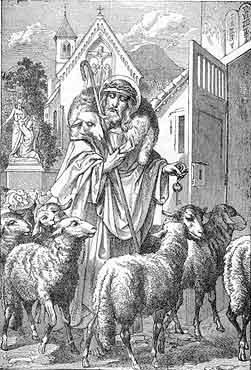
From earliest times, Christian art found its inspiration in this touching image of the Good Shepherd, thereby leaving us a representation of Christ's love for each of us.

In addition to the title of Good Shepherd, Christ applies to Himself the image of the door into the sheepfold of the Church. "The Church," Vatican II teaches, "is a sheepfold, the sole and necessary gateway to which is Christ (cf. John 10:1-10). It is also a flock, of which God foretold that He Himself would be the shepherd (cf. Isaiah 40:11; Ezekiel 34:11ff.), and whose sheep, although watched over by human shepherds, are nevertheless at all times led and brought to pasture by Christ Himself, the Good Shepherd and Prince of shepherds (cf. John 10:11; 1 Peter 5:4), who gave His life for His sheep (cf. John 10:11-15)" ("Lumen Gentium", 6).

1-2. The flock can be harmed in a subtle, hidden way, or in a blatant way through abuse of authority. The history of the Church shows that its enemies have used both methods: sometimes they enter the flock in a secretive way to harm it from within; sometimes they attack it from outside, openly and violently. "Who is the good shepherd? `He who enters by the door' of faithfulness to the Church's doctrine and does not act like the hireling `who sees the wolf coming and leaves the sheep and flees'; whereupon `the wolf snatches them and scatters them'" ([St] J. Escriva, "Christ Is Passing By", 34).

3-5. In those times it was usual at nightfall to bring a number of flocks together into one sheepfold, where they would be kept for the night with someone acting as look-out. Then at dawn the shepherds would come back and open the sheepfold and each would call his sheep which would gather round and follow him out of the pen they were used to his voice because he used to call them to prevent them from going astray) and he would then lead them to pasture. Our Lord uses this image--one very familiar to His listeners--to teach them a divine truth: since there are strange voices around, we need to know the voice of Christ--which is continually addressing us through the Magisterium of the Church--and to follow it, if we are to get the nourishment our soul needs. "Christ has given His Church sureness in doctrine and a fountain of grace in the Sacraments. He has arranged things so that there will always be people to guide and lead us, to remind us constantly of our way. There is an infinite treasure of knowledge available to us: the word of God kept safe by the Church, the grace of Christ administered in the Sacraments and also the witness and example of those who live by our side and have known how to build with their good lives a road of faithfulness to God" ([St] J. Escriva, "Christ Is Passing By", 34).

6. Christ develops and interprets the image of the shepherd and the flock, to ensure that everyone who is well-disposed can understand His meaning. But the Jews fail to understand--as happened also when He promised the Eucharist (John 6:41-43) and spoke of the "living water" (John 7:40-43), or when He raised Lazarus from the dead (John 11:45-46).

7. After describing His future Church through the image of the flock, Christ extends the simile and calls Himself the "door of the sheep". The shepherds and the sheep enter the sheepfold: both must enter through the door, which is Christ. "I", St. Augustine preached, "seeking to enter in among you, that is, into your heart, preach Christ: if I were to preach other than that, I should be trying to enter by some other way. Through Christ I enter in, not to your houses but to your hearts. Through Him I enter and you have willingly heard me speak of Him. Why? Because you are Christ's sheep and you have been purchased with Christ's blood" ("In Ioann. Evang." 47, 2-3).

8. The severe reproach Jesus levels against those who came before Him does not apply to Moses or the prophets (cf. John 5:39, 45; 8:56; 12:41), nor to the Baptist (cf. John 5:33), for they proclaimed the future Messiah and prepared the way for Him. He is referring to the false prophets and deceivers of the people, among them some teachers of the Law--blind men and blind guides (cf. Matthew 23:16-24) who block the people's way to Christ, as happened just a little before when the man born blind was cured (cf. John 9).
**********************
Source: "The Navarre Bible: Text and Commentaries". Biblical text taken from the Revised Standard Version and New Vulgate. Commentaries made by members of the Faculty of Theology of the University of Navarre, Spain. Published by Four Courts Press, Kill Lane, Blackrock, Co. Dublin, Ireland.

Reprinted with permission from Four Courts Press and Scepter Publishers, the U.S. publisher.

Saturday, April 16, 2005

Protocol and Procedures Involved in the Forthcoming Conclave

Holy See Press Office Director, Dr. Joaquin Navarro-Valls - April 16, 2005
On Monday April 18, 115 cardinals from 52 countries representing five continents will begin the first conclave of the third millennium to elect the 264th successor of St. Peter: In other words the 265th Pope in the history of the Catholic Church.

The cardinals will move into the Domus Sanctae Marthae tomorrow afternoon, Sunday April 17. They will all meet together for dinner.

As previously announced, the Mass 'for the election of the Supreme Pontiff' will be celebrated in the Vatican Basilica at 10 a.m. on Monday morning.

At 4.30 p.m. on Monday, the procession of cardinal electors will leave the Hall of Blessings for the Sistine Chapel. This ritual will be transmitted live on television.

Once in the Sistine Chapel, all the cardinal electors will swear the oath. The cardinal dean will read the formula of the oath, after which each cardinal, stating his name and placing his hand on the Gospel, will pronounce the words: 'I promise, pledge and swear.' Over these days, there has been frequent talk of the bond of secrecy concerning the election of the Pope. However, I would like to reiterate that this is just part of the oath. First of all, an oath is made to observe the prescriptions of the Apostolic Constitution Universi Dominici Gregis; then another oath is made that - and I quote - 'whichever of us by divine disposition is elected Roman Pontiff will commit himself faithfully to carrying out the munus Petrinum of Pastor of the Universal Church.’

After the oath, the master of Liturgical Celebrations of the Supreme Pontiff pronounces the 'extra omnes,' and all those who do not participate in the conclave leave the Sistine Chapel. Only the master of Liturgical Celebrations and Cardinal Tomas Spidlik remain for the meditation, once that has finished they too leave the Sistine Chapel.

During the conclave, the cardinals will have the following timetable:

At 7.30 a.m., the celebration or concelebration of Mass will take place in the Domus Sanctae Marthae. By 9 a.m., they will be in the Sistine Chapel. There they will recite the Lauds of the Liturgy of the Hours and, immediately afterwards, voting will take place according to the prescribed ritual (two votes in the morning, and two votes in the afternoon). In the afternoon, voting will begin at 4 p.m. At the end of the second vote will be Vespers.

After the two votes of the morning and the two of the afternoon respectively, the ballots and any notes the cardinals have made will be burnt in a stove located inside the Sistine Chapel.

Purely as an indication then, the smoke signals could appear at around 12 noon and at about 7 p.m. (unless the new Pope is elected either in the first vote of the morning or the first vote of the afternoon, in which case the smoke signal will be earlier). In any case it is expected that, along with the white smoke, the bells of St Peter will sound to mark a successful election.

You know well the indications of the Apostolic Constitution Universi Dominici Gregis as far as the voting goes. The valid quorum for electing the Pope is initially two thirds. After three days of voting without an election, there will be a day at the most dedicated to reflection and prayer, without voting. Thereafter, voting will resume for seven additional ballots, another pause for reflection, another seven ballots, another pause and yet another seven ballots. After which an absolute majority will decide how to proceed, that is, for either a vote by the absolute majority or with balloting between two candidates. This will happen only in the event that the cardinals arrive at the 33rd or 34th ballot without a positive result.

As far as the first vote on Monday, the cardinals will decide whether or not to vote after they have entered into conclave on Monday afternoon, April 18.

The location for the conclave is the Domus Sanctae Marthae and the Sistine Chapel.

The route, along the street behind the Vatican Basilica, can be followed by the cardinals on foot or, if some prefer, by bus. Naturally this path will be clear of people. Access to the San Damaso courtyard will be sealed.

These days, tourists will not have access to either the dome of St. Peter's or the Vatican Gardens.

It will, however, be possible for pilgrims to visit the tomb of John Paul II during the hours the Vatican Grottoes are open.

The General Congregations of the cardinals conclude today.

At the end of these encounters I wish to add two brief notes.

The climate of these congregations has been one of great familiarity. This has been perhaps an _expression of the great responsibility that all the cardinals feel at this time. That allowed them to find great consensus on the general themes faced in the discussions.

I can also confirm that in no congregation were names ever brought up.

Source...The Vatican Press Office (PDF File)

The following was included in a email from Inside the Vatican
=======
LAST GENERAL CONGREGATION OF VACANT SEE IS HELD

Holy See Press Office Director, Dr. Joaquin Navarro-Valls - April 16, 2005

Today, Saturday, April 16 the twelfth General Congregation took place in the presence of 143 cardinals.

After the prayer 'Adsumus,' Cardinal Edward Cassidy, who had just arrived, took the oath.

The Cardinal Camerlengo Eduardo Martinez Somalo presented, in everyone's name, best wishes to Cardinal Joseph Ratzinger, Dean of the College of Cardinals, on the occasion of his birthday.

Indications were given concerning entrance into the Domus Sanctae Marthae on Sunday the 17th in the afternoon, for the Mass 'for the election of the Supreme Pontiff ' on Monday April 18 at 10 a.m. and for entrance into conclave, the same day, at 4:30 p.m.

The cardinal dean read messages from several cardinals who were not able to come to Rome. They thanked everyone for the words of closeness and affection sent to them by the cardinal dean in the name of everyone in the College of Cardinals.

The cardinal camerlengo proceeded to the destruction of the Fisherman's Ring and the lead seal as foreseen by the Apostolic Constitution 'Universi Dominici Gregis' in art 13g.

After having commented on several points of this same Apostolic Constitution, there was an exchange of ideas on the problems of the Church and the world.

The Regina Coeli prayer closed the last General Congregation.

Seller Pulls Communion Host from eBay Sale

SIOUX CITY, Iowa (AP) - A Holy Communion wafer allegedly bless by Pope John Paul II was not sold on eBay after all.

The seller withdrew the wafer, the Holy Eucharist, and the sale was never finalized, said Monsignor Roger J. Augustine, administrator of the Roman Catholic Diocese of Sioux City.

The wafer, reportedly blessed by the late pope during a Mass in Rome on Oct. 18, 1998, was offered last weekend by a seller in the northwest Iowa town Sloan. It sold on Monday for $2,000 to a buyer in California.

Augustine, who met with the seller on Friday, was told that the sale would not happen.
More here...

Gospel for Saturday, 3rd Week of Easter

From: John 6:60-69

The Disciples' Reaction

[60] Many of His (Jesus') disciples, when they heard of it, said, "This is a hard saying; who can listen to it?" [61] But Jesus, knowing in Himself that His disciples murmured at it, said to them, "Do you take offense at this? [62] Then what if you were to see the Son of Man ascending where He was before? [63] It is the Spirit that gives life, the flesh is of no avail; the words that I have spoken to you are spirit and life. [64] But there are some of you that do not believe." For Jesus knew from the first who those were that did not believe, and who it was that should betray Him. [65] And He said, "This is why I told you that no one can come to Me unless it is granted him by the Father."

[66] After this many of the disciples drew back and no longer went with Him. [67] Jesus said to the Twelve, "Will you also go away?" [68] Simon Peter answered Him, "Lord, to whom shall we go? You have the words of eternal life; [69] and we have believed, and have come to know, that You are the Holy One of God."
*******************
Commentary:

60-62. Many of His listeners find the Eucharistic mystery completely incomprehensible. Jesus Christ requires His disciples to accept His words because it is He who has spoken them. That is what the supernatural act of faith involves--that act "whereby, inspired and assisted by the grace of God, we believe that the things which He has revealed are true; not because of the intrinsic truth of the things, viewed by the natural light of reason, but because of the authority of God Himself who reveals them, and who can neither be deceived nor deceive" (Vatican I, "Dei Filius", Chapter 3).

As on other occasions, Jesus speaks about future events to help His disciples believe: "I have told you before it takes place, so that when it does take place, you may believe" (John 14:29).

63. Jesus says that we cannot accept this mystery if we think of it in too human a way, in other words, by just seeking to indulge our senses or having too earthbound a view of things. Only someone who listens to His words and receives them as God's revelation, which is "spirit and life", is in a position to accept them.

66. The promise of the Eucharist, which caused arguments (verse 52) among Christ's hearers at Capernaum and scandalized some of them (verse 61), led many people to give up following Him. Jesus had outlined a wonderful and salvific truth, but those disciples closed themselves to divine grace; they were not ready to accept anything which went beyond their very limited horizons. The mystery of the Eucharist does call for a special act of faith. St. John Chrysostom therefore advised Christians: "Let us in everything believe God, and gainsay Him in nothing, though what it said be contrary to our thoughts and senses. [...] Let us act likewise in respect to the [Eucharistic] mysteries, not looking at the things set before us, but keeping in mind His words. For His words cannot deceive" (St. John Chrysostom, "Hom. on St. Matthew", 82).

67-71. This passage is similar to that at Capernaum where Peter again, in the name of the Twelve, takes the initiative in expressing his faith in Jesus as Messiah (cf. Matthew 16:13-20; Mark 8:27-30). Other people present may have been unbelieving, but the Apostles are not scandalized by our Lord's words: they say that they have already a deep-rooted confidence in Him; they do not want to leave Him. What St. Peter says (verse 68) is not just a statement of human solidarity but an _expression of genuine supernatural faith--as yet imperfect--which is the result of the influence of divine grace on his soul (cf. Matthew 16:17).

Although the Twelve stay with Him at this point, Judas will later betray the Master. Jesus' foreknowledge of this future infidelity throws a shadow over His joy at the loyalty of the Twelve. We Christians should be humble enough to realize that we are capable of betraying our Lord if we give up using the means He has left us to cleave to Him. St. Peter's words (verse 68) are a beautiful aspiration we can use whenever we feel tempted.

68. Simon Peter expresses the feelings of the Apostles who, through staying loyal to Jesus, are getting to know Him much better and becoming more closely involved with Him: "Seek Jesus; endeavoring to acquire a deep personal faith that will inform and direct your whole life. But, above all, let it be your commitment and your program to love Jesus, with a sincere, authentic and personal love. He must be your friend and your support along the path of life. He alone has words of eternal life" ([Pope] John Paul II, "Address to Students in Guadalajara", 30 January 1979).

69. "The Holy One of God": this is what the original text must have said, according to most of the Greek codexes and the most important early translations. "The Holy One" is one of the expressions which designate the Messiah (cf. Mark 1:24; Luke 1:35; 4:34; Acts 2:27; Psalm 16:10), or God Himself (cf. Isaiah 6:3; 43:15; 1 Peter 1:15; 1 John 2:20; etc.). The rendering "the Christ, the Son of God" found in some translations, including the Vulgate, is supported by less important Greek manuscripts, and would seem to be an explanation of the messianic significance of the original phrase.
*********************
Source: "The Navarre Bible: Text and Commentaries". Biblical text taken from the Revised Standard Version and New Vulgate. Commentaries made by members of the Faculty of Theology of the University of Navarre, Spain. Published by Four Courts Press, Kill Lane, Blackrock, Co. Dublin, Ireland.

Reprinted with permission from Four Courts Press and Scepter Publishers, the U.S. publisher.

Friday, April 15, 2005

Updates from Inside the Vatican 4/15

VATICAN CITY, Saturday, April 16, 2005 -- As I walked down toward the Vatican today shortly before 1 p.m., just after the end of this morning's meeting of the cardinals who are preparing to enter the papal conclave on Monday afternoon, I saw two black cars pull up in front of the Mater Dei house near our office on the via delle Mura Aurelie.

Out of one car stepped the Patriarch of Venice, Cardinal Angelo Scola....Out of the other car stepped the former cardinal archbishop of Paris, Jean-Marie Lustiger, the German cardinal Karl Lehmann and a fourth cardinal with white hair, a round head and a powerful build whom I could not quite place, but who may have been, I think, from Latin America. I went through a book of cardinals' photos at lunch a half hour later, and tried to place the cardinal, but could not. Still, the other three identifications are certain.

Scola, Lustiger, Lehmann and the fourth cardinal went into the Mater Dei house, presumably for lunch.

Scola is normally thought to be close to Raztinger, and Lehmann is thought to be in some disagreement with Ratzinger on a number of issues. Lustiger is the most eminent cardinal from France, and was long considered a "papabile," but now is not normally considered "in the running" because of a throat condition that has caused him to almost lose his voice. People in Rome are saying this lack of a strong speaking voice makes it impossible for the cardinals to consider him seriously.
More - See "Friday Lunch (April 15/05)"

Liturgical Norms and Liturgical Piety

This is an HTML version of the Address which Cardinal Arinze was to give us last week. The PDF version is available on the Archdiocesan web site here. Msgr. James Moroney, executive director of the U.S. Conference of Catholic Bishops Secretariat for the Liturgy, was kind enough to give me a copy after the address. Please let me know if there are any typographical errors in the text...Thanks.

=========================================


Cardinal Arinze's Address was read by Msgr Moroney.

LITURGICAL NORMS AND LITURGICAL PIETY
(Address at Gateway Liturgical Conference
Saint Louis, Missouri, April 8, 2005)

1. The Holy Eucharist occupies a central place in the public worship of the Church and in her life. Its celebration therefore should receive from all of us the greatest attention. I am for that reason happy to learn that this Gateway Liturgical Conference is devoted especially to attention to the worthy celebration of the Holy Eucharist, in accord with the Holy Father's Encyclical Letter, Ecclesia de Eucharistia, and the Instruction of the Congregation for Divine Worship and the Discipline of the Sacraments, Redemptionis Sacramentum. This is also very much in line with the spirit of the present Year of the Eucharist.

In developing the theme assigned to me, "Liturgical Norms and Liturgical Piety", I intend to begin by examining why there should be liturgical norms at all, how what the Church believes and how she prays are related, and who has the authority to issue norms for the liturgy. It will then be time to spell out what we understand by liturgical piety. Creativity is an issue which often comes up with reference to the liturgy. It should be examined. The desire to make liturgical celebrations interesting also deserves to be looked into. Some people want to introduce dances into the liturgy. The discussion of this tendency cannot be avoided. We shall conclude by asking ourselves whether observance of liturgical norms is a call to formalism or rubricism or rather a promoter of faith and piety.


2. Reasons for Liturgical Norms

The sacred liturgy is an exercise of the priestly office of Jesus Christ. It is the public worship performed by the Mystical Body of Christ, by the Head and his members (cf Sacrosanctum Concilium, 7).

Liturgical celebrations have some elements which are of divine institution. Such are the essentials of the seven sacraments. There are elements which are of ecclesiastical institution. In deciding on these elements the Church takes great care to be faithful to Holy Scripture. to honor the tradition handed down through the centuries, to manifest her faith and rejoice in it, and to lead all the faithful to worship of God, following of the example of Christ, and showing love and service of.one's neighbour. Between these two we can speak of a third: namely, those elements of the liturgy which are found from early days in all or almost all of the great liturgical traditions and which must therefore go back at the very least to a period close to the Apostles, and perhaps even to Our Lord. While we may not have certain knowledge on the matter in a given case, it is a strong reason for avoiding hasty innovation or neglect (cf Varietatis legitimae, 26-27; General Instruction of the Roman Missal, 397; Liturgiam authenticam, 4-5; Redemptionis Sacramentum, 9).

Liturgical celebration should be experiences of the traditional faith that is confessed, celebrated and communicated, of hope that is expressed and confirmed and of charity that is sung and lived.

Since liturgical celebrations are public acts performed in the name of the universal Church, with Jesus Christ himself as the Chief Priest, it follows that as the centuries rolled by, the Church has necessarily developed norms according to which, her public worship is to be expressed. Liturgical norms protect this treasure which is Christian worship. They manifest the faith of the Church, promote it, celebrate it and communicate it. They also manifest the nature of the Church as a hierarchically constituted family, a community of worship, love and service, and a body which promotes union with God and holiness of life and gives sinners hope of conversion, forgiveness and new life in Christ.

Moreover, liturgical norms help to protect the celebration of the sacred mysteries, especially the Holy Eucharist, from being damaged by additions or subtractions which do damage to the faith and which may at times risk making a sacramental celebration invalid. The people of God are thus guaranteed celebrations in line with the traditional Catholic faith and they are not left at the mercy of someone's personal ideas, feelings, theories or idiosyncrasies.

Pope John Paul II is very insistent on the important role of norms regarding the celebration of the Eucharist. "These norms are a concrete expression of the authentically ecclesial nature of the Eucharist; this is their deepest meaning. Liturgy is never anyone's private property, be it of the celebrant or of the community in which the mysteries ate celebrated (Ecclesia de Euch., 52). Love for the Church leads a person to observe these norms: “Priests who faithfully celebrate Mass according to the liturgical norms, and communities which conform to those norms, quietly but eloquently demonstrate their love for the Church" (ibid.). Our respect for the mysteries of Christ leads us to respect these norms: "No one is permitted to undervalue the mystery entrusted to our hands: it is too great for anyone to feel free to treat it lightly and with disregard for its sacredness and its universality" (ibid,).

3. Lex orandi, lex credendi

The sacraments sanctify people, build up the Body of Christ and give worship to God. Because they are signs, they also instruct. They not only presuppose faith, but by words and objects they also nourish, strengthen and express it. That is why they are called "sacraments of faith" (cf Sacrosanctum Concilium, 59).

The faith of the Church has expressed itself in how the Church prays and especially in how she celebrates the Holy Eucharist and the other sacraments. There are words and concepts which have acquired a deep meaning in the Church's life, faith and prayer along the centuries. Examples are person, trinity, divine majesty, incarnation, passion, resurrection, salvation, merit, grace, intercession, redemption, sin, repentance, forgiveness, propitiation, mercy, penance, reconciliation, communion and service. There are gestures and postures which help to express what the Church believes. Examples are the Sign of the Cross, bowing, kneeling, standing, listening and going in procession.

"The Church's faith precedes the faith of the believer who is invited to adhere to it. When the Church celebrates the sacraments, she confesses the faith received from the Apostles" (Catechism of the Catholic Church, 1124). This is a strong argument in favour of great care in the wording, gestures and norms of liturgical celebrations.

The relation between the faith of the Church and her liturgical celebration has been encapsulated in the ancient saying, lex orandi, lex credendi (the law of prayer is the law of faith), or legem credendi lex .statuat supplicandi (let the law of prayer determine the norm of faith). This statement of Catholic faith is credited to Prosper of Aquitaine of the 5th century (Ep. 8). It is quoted in the Indiculus or the Pseudo-Celestine Chapters. Pope Celestine reigned from 422 to 432 (cf Ds 246).

The Church believes as she prays. The liturgy is a constitutive element of the holy and living tradition of the Church (cf Dei Verbum, 8). That is why the Church does not allow the minister or the community to modify or manipulate any sacramental or even general liturgical rite. "Even the supreme authority in the Church may not change the liturgy arbitrarily, but only in the obedience of faith and with religious respect for the mystery of the liturgy" (CCC, 1125).

Redemptionis Sacramentum is strong on this point: "The Church herself has no power over those things which were. established by Christ himself and which constitute an unchangeable part of the liturgy. Indeed, if the bond were to be broken which the Sacraments have with Christ himself who instituted them, and with the events of the Church's founding, it would not be beneficial to the faithful but rather would do them grave harm. For the Sacred Liturgy is quite intimately connected with principles of doctrine, so that the use of unapproved texts and rites necessarily leads either to the attenuation or to the disappearance of that necessary link between the lex orandi and the lex credendi. " (Red. Sacram., 10).

4. Authority over the Liturgy

The above reflections lead us to ask who has authority over the sacred liturgy. Who decides on the texts, the ceremonies, the norms? We cannot afford to be vague on this.

The Second Vatican Council is not ambiguous: "Regulation of the sacred liturgy depends solely on the authority of the Church, that is, on the Apostolic See and, as laws may determine, on the Bishop. In virtue of power conceded by the law, the regulation of the liturgy within certain defined limits belongs also to various kinds of competent territorial bodies of Bishops legitimately established". Then the Council adds the warning:" Therefore, absolutely no other person, not even a priest, may add, remove, or change anything in the liturgy on his own authority". (Sacrosanctum Concilium, 22).

These rulings are not a sign of lack of respect for anyone. They follow from the fact that the liturgy is a celebration of the universal Church. The prayers addressed to God by the priest who presides over the assembly in the person of Christ are said in the name of the entire holy people as well as of all present. And the visible signs used by the liturgy to signify invisible divine things have been chosen by Christ or the Church" (Sacrosanctum Concilium, 33).

From these considerations it follows that a do-it-yourself attitude is not acceptable in the public worship of the Church. It does damage to the Church's worship and to the faith of the people. The people of God have the right that the liturgy be celebrated as the Church wants it (cf. Red. Sacram., 12). The mysteries of Christ should not be celebrated as personal taste or whim may indicate. “The 'treasure' is to important and precious to risk impoverishment or compromise through forms of experimentation or practices introduced without a careful review on the part of the competent ecclesiastical authorities" (Eccl. de Euch., 51),


5. Liturgical Piety

When we say piety, we think in general of the honour and reverence given to someone who is in some way responsible for our existence and well-being. Therefore the virtue of piety refers first of all to God who is our creator and constant provider. But we can also talk of piety towards our parents, near relatives, country, tribe or people.

As a Christian virtue, piety is one of the gifts of the Holy Spirit. It moves us to worship God who is the Father of all and also to do good to others out of reverence for God. Piety leads us to love the sacred liturgy, to look forward to its celebration and to participate in it with love, faith and devotion. With the Psalmist we sing: "How lovely are your dwelling places, Lord Sabaoth. My whole being yearns and pines for the Lord's courts. My heart and. my body cry out for joy to the living God" (Ps 84:1-2). Liturgical celebrations become attractive to the pious person. The church bell which rings for Mass is a welcome sound: "I rejoiced that they said to me, 'Let us go to the house of the Lord'. At last our feet are standing at your gates, Jerusalem!" (Ps 122: 1-2). The pious soul has sheer joy in being in the church and more still in joining in divine worship: "Better one day in your courts than a thousand at my own devices, to stand on the threshold of God's house than to live in the tents of the wicked" (Ps 84:10).

Liturgical piety, as a beautiful manifestation of the virtue of religion, is at once a compound of love of God, faith in him, adoration, respect, reverence, sheer joy in his service, and a desire to serve him as best we can. A spirit of faith and reverence which shows itself also in the faithful observance of liturgical norms is most favourable to the promotion of liturgical piety.


6. Creativity in Liturgical Celebrations

One may now ask whether there is any room for creativity in the liturgy. The answer is that there is, but it has to be properly understood.

First of all, it is necessary to bear in mind that the public worship of the Church is something that we receive in faith through the Church. It is not something that we invent. Indeed the essentials of the sacraments are established by Christ himself. And the detailed rites, including words and actions, have been carefully worked out, guarded and handed down by the Church along the centuries. It would, therefore, not be the proper attitude for an individual or a committee to keep thinking and planning each week how to invent a new way of celebrating Mass.

Moreover, the priority at Mass and other liturgical acts is worship of God. The liturgy is not a field for self expression, free creation and the demonstration of personal tastes. Idiosyncrasies tend to attract attention to the person rather than to the mysteries of Christ being celebrated. They can also upset, puzzle, annoy, mislead or confuse the congregation.

Nevertheless, it is also true that the liturgical norms do allow some flexibility. With reference to the central and most important liturgical action, the Mass, for example, we can speak of three levels of flexibility. First, there are in the missal and the lectionary some alternative texts, rites, chants, readings and blessings from which the priest celebrant can choose (cf GIRM, 24; Redemptionis Sacramentum, 39). Then there are choices left at the competence of the Diocesan Bishop or the Conference of Bishops. Examples are regulation of concelebration, norms regarding the distribution of Communion under both kinds, the construction and ordering of churches, translations and some gestures (cf Sacrosanctum Concilium, 38, 40; GIRM 387, 390). Some such alternatives require recognitio from the Holy See. The most demanding level of variability concerns incu1turation in the strict sense. It involves action by the Conference of Bishops, after the conducting of deep interdisciplinary studies and recognitio from the Holy See.

Redemptionis Sacramentum is therefore able to say that "ample flexibility is given for appropriate creativity aimed at allowing each celebration to be adapted to the needs of the participants, to their comprehension, their interior preparation and their gifts, according to established liturgical norms" (Red. Sacram., 39). The last phrase is important: "according to established liturgical norms" The paragraph of Redemptionis Sacramentum concludes with a recall of the crucial observation that "it should be remembered that the power of the liturgical celebrations does not consist in frequently altering the rites, but in probing more deeply the word of God and the mystery being celebrated". What the people are asking for every Sunday from their pastor is not a novelty but a celebration of the sacred mysteries that nourishes faith, manifests devotion, awakens piety, leads to prayer and incites to active charity in daily life.


7. Making the Mass Interesting


Many priests are concerned with making the Eucharist celebration interesting. And they are not wrong. The Mass is not a dull carrying out of rituals. It is a vital celebration of the central mysteries of our salvation.

Care should be taken to prepare well for each celebration. The texts to be read, sung or proclaimed should be well studied in good time. The vestments and all altar fittings and furnishings should be in good taste. The people who carry out the roles of priest celebrant, altar servers, leader of song, readers of lessons, etc., should be at their best. The homily should give the people solid liturgical, theological and spiritual nourishment. If all that is done, the Mass will not be dull.

But when all is said and done, we have to come back to the fact that the Mass is not there to entertain people. Such horizontalism would be out of place. People do not come to Mass in order to admire the preacher, or the choir or the. readers. The priority movement or direction of the Mass is vertical, towards God, not horizontal, towards one another. What the people need is a faith-filled celebration, a spiritual experience which draws them to God and therefore also to their neighbour. As a by-product, such a celebration will capture the people's interest and attention.

It is also useful to remark that repetition of faith formulae and symbols, or of familiar words and gestures, need not make. a liturgical celebration uninteresting.. It matters, however, to what extent these formulae are understood, hence the importance of catechesis. In our daily lives, is it uninteresting for us to repeat our names or those of our loved ones? Do we not love our national anthem and sing it with piety? How much more what [this] has to do with our Christian identity!

If it helps to repeat, may I recall that liturgical celebrations allow for flexibility, provided that this is done according to approved norms. Redemptionis Sacramentum itself exhorts the Bishop not to stifle alternative choices provided for by the liturgical. norms:”The Bishop must take care not to allow the removal of that liberty foreseen by the norms of the liturgical books so that the celebration may be adapted in an intelligent manner to the church building, or to the group of the faithful who are present or to the particular pastoral circumstances" (Red. Sacram., 21). It is for this reason that the Bishop does well not to be tempted to introduce unnecessary restrictions in his diocese such as ordering that only one particular Eucharistic Prayer be used at Mass. The Bishop's authority is never firmer than when. he uses it to ensure that the general norms which safeguard the tradition are observed.

A general advice about whether the liturgical celebration is interesting or not is, to simply celebrate it with faith and devotion and according to the approved norms, and leave the rest to God's grace and people's cooperation with it.


8. Dance in the Liturgy

Some people want to introduce dance into the sacred liturgy. The Latin Rite liturgy has not had any such practice. We have therefore to ask those who want to bring in the dance to state their case.

If they say that the reason is to make the Mass interesting, the answer is what we have just considered. We come to Mass to worship God, not to see a spectacle. We have the parish hall and the theatre for shows.

Others say they welcome some dance in order to express fully our prayer, since we are body and soul. The answer is that the liturgy indeed appreciates bodily postures and gestures and has carefully incorporated many of them, such as standing, kneeling, genuflecting, singing, and giving a sign of peace. But the Latin Rite has not included the dance.

It is not easy for dancers not to draw attention to themselves. Granted that some very refined dances in some cultures can help to elevate the mind, is it not true that for many people dances are a distraction rather than a help to prayer?

Dances easily appeal to the sense and tend to call for approval, enjoyment, a desire for a repetition, and. a rewarding of the performers with the applause of the audience. Is this what we come to Mass to experience? Have we no theatres and parish halls, presuming that the dance in question is acceptable, which cannot be said of them all?

It is true that in many parts of Africa and Asia there may be a cultural habit of graceful body movement which, with due study and approval of the local Church, may go down well within a liturgical celebration. The Ethiopian Rite has known graceful rhythmical movements and the procession for the Gospel. The Roman Rite Mass approved for the Democratic Republic of the Congo has similar entry movements.

But this is very different from what the ordinary person in Europe or North America thinks of when the concept dance is evoked. Can we blame people who associate dance with Saturday evening, ball room, theatre or simply, innocent enjoyment? The liturgical books approved by the Bishops and the Holy See for Europe and North America understandably do not authorize the importation of dance into church, let alone the celebration of the Eucharistic Sacrifice (See the article in the official bulletin of the Congregation for Divine Worship and the Discipline of the Sacraments: Notitiae 106-107, June-July 1975, pp. 202-205).

9. Formalism and Ritualism not the Goal

From all that has been said above, it follows that an exhortation to be faithful to liturgical norms is not an invitation to formalism, ritualism or rubricism. People are not being invited to a dry and soulless carrying out of external actions. Jesus our Saviour already, quoting the prophet Isaiah, condemned those who do not internalize in their spirit the external rites they carry out:

"This people honours me only with lip-service,
while their hearts are far from me.
Their reverence of me is worthless;
the lesson they teach are nothing but human commandments" (Mt 15: 8-9; Is 29:13).


Liturgical celebrations are not primarily the observance of norms but rather the celebration of the mysteries of Christ by the Church and in the Church, with faith and love and with respect for tradition. The observance of norms is a consequence and fruit of faith and respect. It is not the final object of worship. It is a quality of it.

Moreover, liturgical norms are not arbitrary laws or regulations put together to please some historian, or aesthetist, or archaeologist. They are manifestations of what we believe and what we have received from tradition, from the "norm of the holy Fathers” (cf Sacrosanctum Concilium, 50; GIRM, 6), from what generations of our predecessors in the faith have said, done, observed and celebrated. To know that we are doing saying, hearing and seeing what millions of Christians have done throughout the world for hundreds of years and are doing today, should help us to enter better into a committed and prayerful participation. Moreover, by confirming our entire person to all that the liturgy represents, we undergo a transformation and become ever closer to God.

Interior prayer and sacrifice have priority. Hence the importance in liturgical celebrations of quiet preparation, silence, reflection, listening and personal prayer. "A merely external observation of norms would obviously be contrary to the nature of the sacred liturgy, in which Christ himself wishes to gather his Church, so that together with himself she will be 'one body and one spirit'" (Redemptionis Sacramentum, 5).

At the same time it needs to be repeated that the spirit of rejection of rules and regulations which would then be regarded as a violation of one's autonomy, needs to be corrected. It is wrong and unreasonable to maintain a spirit of "Nobody is going to tell me what to do”. This would be a false understanding of liberty. "God has not granted us in Christ an illusory liberty by which we may do what we wish, but a liberty by which we may do that which is fitting and right" (Redemptionis Sacramentum, 7).

It is a blessing and a privilege for us to belong to the Church which in her sacred liturgy celebrates the mysteries of Christ and has Christ himself as the Chief Priest in every liturgical act. Let us pray to the Most Blessed Virgin Mary, Mother of our Saviour, to obtain for us a growing understanding of the reasons for liturgical norms, willingness to observe them and the grace of daily growth in liturgical piety, love of God and commitment to love and service of our neighbour.

Pope wrote of 'dark shadows' over mankind

VATICAN CITY - Shortly before his last trip to the hospital, Pope John Paul II warned of “dark shadows” enveloping humanity.

A message, posthumously released on Friday, was one of the last pieces of writing by the pope before he died nearly two weeks ago.

“In our day human society appears to be shrouded in dark shadows while it is shaken by tragic events and shattered by catastrophic natural disasters,” the pope wrote in a message for the Roman Catholic Church’s World Day of Missions.
The article is here. Still looking for the complete message.

Cardinal’s remarks set tone for liturgy gathering

*** Updated ***
An HTML text version of Cardinal Arinze's Keynote Address is here.
_____________________________
The Mass is a vital celebration of the central mysteries of our salvation and should never be arbitrarily altered. So wrote Cardinal Francis Arinze in his keynote address for the 2005 Gateway Liturgical Conference Downtown April 8.

The cardinal frequently quoted from the pope’s encyclical letter, "Ecclesia de Eucharistia," and the Instruction of the Congregation for Divine Worship and the Discipline of the Sacraments, "Redemptionis Sacramentum." Among other sources, he also cited the "Catechism of the Catholic Church" several times to support his statements on liturgical norms and liturgical piety.
======================

Also at the keynote address, welcoming and thanking presenters and participants alike, was Archbishop Raymond L. Burke. The archbishop said he hoped those who heard the cardinal’s address would have “a deepening appreciation for the Sacred Liturgy, and a deeper understanding of how to grow in liturgical piety; that is, how to have a deeper love for Christ as He comes to us in the Sacred Liturgy and how to express that love of Christ coming to us in the Sacred Liturgy through a fidelity for liturgical discipline.”

He noted that “in ‘Ecclesia de Eucharistia,’ ‘Redemptionis Sacramentum,’ ‘Mane Nobiscum Domine’ (the pope’s apostolic letter on the occasion of the Year of the Eucharist) and the ‘General Instruction of the Roman Missal’ we will find the direction that we need in order to make our celebration of the Eucharist and the other sacraments as faithful and as beautiful as possible.”

A PDF version of the full text of Cardinal Francis Arinze’s remarks may be found at www.stlouisreview.com/pdfs/cardinalarinze2005.pdf
Full article here.

Archbishop Burke Requests Special Masses for Monday

Archbishop Raymond L. Burke is asking all parishes in the archdiocese to celebrate Masses on Monday, April 18, for the election of a new pope.

"In order to involve the entire Catholic Church, to the fullest extent possible in praying for the election of a new pope, the Office of Liturgical Celebrations of the Supreme Pontiff has issued a note which exhorts intercessory prayer for the new pope’s election," Archbishop Burke wrote in a memo to parishes.
More.

Pro-Life Forces Claim Victory at UN Population Conference

Pro-lifers can claim victory once more at a UN conference. Thanks to --- among others --- the United States, the Holy See, Costa Rica and Egypt, the UN was stopped from advancing abortion on demand in the just concluded Commission on the Population and Development. Thanks also to that indefatigable pro-life negotiator Jeanne Head of National Right to Life.

Spread the word.
Yours sincerely,

Austin Ruse
President

Action item: Please write an email of thanks to each of these governments at prolifevictory@yahoo.com and tell them "Thanks for standing up for life at the CPD."

We will deliver your message personally to the UN Ambassador of the US, the Holy See, Costa Rica and Egypt, and also to Jeanne Head of National Right to Life.
The full Friday Fax article may be viewed at www.c-fam.org.

Push for Ratzinger is real....

...So writes John Allen of the National unCatholic Distorter.

...One Vatican official who has worked with Ratzinger over the years said on April 13, “I am absolutely sure that Ratzinger will be the next pope.”

On the other hand, several cardinals have said privately that they’re uncomfortable with the prospect of a Ratzinger papacy.
Some are probably uncomfortable with taking up the cross as well.
It’s not just that some don’t believe his strong emphasis on the protection of Christian identity in a secular world ought to be the guiding light of the next papacy, but there’s also a real-world concern about the election of a figure with his “baggage.”
Baggage? I suppose this word "baggage" means an unwavering adherence to the teachings of the Church and, of course, the documents which were issued from the Congregation for the Doctrine of the Faith.
Fairly or unfairly, Ratzinger is to some extent a lightning rod for Catholic opinion, and in a church that’s already divided, some cardinals worry about exacerbating those divisions.
This problem grows worse each passing day that it is not addressed - more and more souls succumb to the shadows brought about by the divisions created by open dissent and disobedience. The exacerbation is brought to fruition by failing to address the situation. Cardinal Ratzinger is clear that there is a "cultural conflict between the Church and 'the radical emancipation of man from God and from the roots of life,' which characterizes contemporary Western culture and which 'leads in the end to the destruction of freedom.'...this....must be given absolute priority in the next pontificate."

Church leaders do the Church no good in failing to address the divisions. Will the problem simply go away if it is ignored long enough?
One [cardinal] said April 12: “I’m not sure how I would explain this [Cardinal Ratzinger as Pope] back home.”
It's simple, your Emminence. One says, "This is our new Holy Father. Follow him, obey him and pray for him." There...was that so hard?

Workers Attach Chimney Pipe for Conclave


A worker installs a new chimney on top of the Vatican's Sistine Chapel, April 15, 2005. During the conclave voting, if the necessary majority has not been reached, the ballots and tally sheets are placed in a stove and burned with an additive to produce black smoke. An additive to produce white smoke is used if a new pope has been elected. REUTERS/Kimimasa Mayama

Priests would be subject to searches

Priests in the Catholic Archdiocese of Milwaukee can be required to consent to unannounced searches of their homes at any time of the day or night if church officials suspect or know they have been involved in sexual conduct, alcohol or drug abuse, or other behavior deemed inappropriate by Archbishop Timothy Dolan, according to a policy change announced to clergy last week.
...
Several priests in the archdiocese described themselves in interviews this week as upset and livid and said they were struggling to make sense of the documents.
...
Deacon David L. Zimprich, who is a former Milwaukee police officer, will be in charge of the "day-to-day management and operations of the initiative," the policy memo says.
...
"The restrictions are not to be seen as punitive in nature," the document states. "Rather they are designed to support the individual in his desire to live according to the example of Jesus Christ, the gospels, the teaching of the Church and the demands of his vocation."
Source.

Media Gets Access to Schiavo Records

CLEARWATER, Fla. (AP) - A judge has ordered state officials to release summaries of their investigations into the treatment of Terri Schiavo, the severely brain-damaged woman who died last month after her feeding tube was removed.
Source.

If the Truth of Christ and Him, Crucified, Doesn't Work...

...Try Song and Dance (called by some, Inculturation)

Brazil's Priests Use Song and Dance To Stem Catholic Church's Decline
SAO PAULO, Brazil -- Pack 15,000 bodies shoulder to shoulder in a vast old warehouse, get them singing as loud as their lungs will allow and feel the temperature rise.

"How many people are sweating?"

As the Rev. Marcelo Rossi stands before a shimmering expanse of upraised hands, working up the crowd, a droplet of perspiration cuts a shining rivulet behind his left ear and trickles toward his clerical collar.

"Sweating is good," he announces. "It gets the bad things out. Now put your hands over your hearts and join me: Let's get rid of envy, of greed. . . ."
More here.

As a followup to the problems facing the Church in Brazil - indeed in all of Latin America - there is this article, also from the Washington Post, titled, "New Pope Should Reach Out to 'Inactive Catholics'".
Millions of Catholics in Latin America -- as in the developed world -- have turned against church dogma on sex, artificial birth control, and abortion. Even in the world's largest Catholic country, Brazil, where 80 percent consider themselves followers, 70 percent of married women use a method of artificial contraception, only two percentage points lower than women in the United States, according to the Population Reference Bureau. And that doesn't even take into account the millions of women who use birth control before marriage.
70% of Brazilian women consider themselves followers of the Church yet they practice birth control...Well, let's celebrate with song and dance!

How does the writer of the article suggest that the new Pope "reach out" to our 'inactive brothers and sisters'? With truth and charity?
... people ... have become comfortable living a life without religious guidance...In some respects we have even adopted an elitist attitude toward those who don't share our inactivity and have found spiritual fulfillment in more charismatic faiths such as Pentecostalism.

I am not sure if a liberalized dogma would draw back into the church people who are now Catholics by default or cultural Catholics. I am certain that if the church does not reconsider certain dogmas it will lose further relevance for those in the middle and upper classes who have become pretty good at justifying religious inactivity.
A "liberalized dogma"? I suppose that's similiar to a "half-truth."

At any rate, it always seems to come back to sex at some point in the conversation. People want, not freedom, but license to engage in behavior which is at odds with the dignity and beauty of human life and procreativity. Many have become enslaved by their so-called "freedom."

Gospel for Friday, 3rd Week of Easter

From: John 6:52-59

The Discourse on the Bread of Life (Continuation)

(Jesus said to the Jews,) [52] The Jews disputed among themselves, saying, "How can this Man give us His flesh to eat?" [53] So Jesus said to them, "Truly, truly, I say to you, unless you eat the flesh of the Son of Man and drink His blood, you have no life in you; [54] he who eats My flesh and drinks My blood has eternal life, and I will raise him up on the last day. [55] For My flesh is food indeed, and My blood is drink indeed. [56] He who eats My flesh and drinks My blood abides in Me, and I in him. [57] As the living Father sent Me, and I live because of the Father, so he who eats Me will live because of Me. [58] This is the bread which came from Heaven, not such as the fathers ate and died; he who eats this bread will live for ever." This He said in the synagogue, as He taught in Capernaum.
**********************
Commentary:

49-51. The manna during the Exodus was a figure of this bread--Christ Himself--which nourishes Christians on their pilgrimage through this world. Communion is the wonderful banquet at which Christ gives Himself to us: "the bread which I shall give for the life of the world is My flesh". These words promise the manifestation of the Eucharist at the Last Supper: "This is My body which is for you" (1 Corinthians 11:24). The words "for the life of the world" and "for you" refer to the redemptive value of the sacrifice of Christ on the cross. In some sacrifices of the Old Testament, which were a figure of the sacrifice of Christ, part of the animal offered up was later used for food, signifying participation in the sacred rite (cf. Exodus 11:3-4). So, by receiving Holy Communion, we are sharing in the sacrifice of Christ: which is why the Church sings in the Liturgy of the Hours on the Feast of Corpus Christi: "O sacred feast in which we partake of Christ: His sufferings are remembered, our minds are filled with His grace and we receive a pledge of the glory that is to be ours" ("Magnificat Antiphon", Evening Prayer II).

52. Christ's hearers understand perfectly well that He means exactly what He says; but they cannot believe that what He says could be true; if they had understood Him in a metaphorical, figurative or symbolic sense there would be no reason for them to be surprised and nothing to cause an argument. Later, Jesus reaffirms what He has said--confirming what they have understood Him to say (cf. verses 54-56).

53. Once again Jesus stresses very forcefully that it is necessary to receive Him in the Blessed Eucharist in order to share in divine life and develop the life of grace received in Baptism. No parent is content to bring children into the world: they have to be nourished and looked after to enable them to reach maturity. "We receive Jesus Christ in Holy Communion to nourish our souls and to give us an increase of grace and the gift of eternal life" ("St. Pius X Catechism", 289).

54. Jesus clearly states that His body and blood are a pledge of eternal life and a guarantee of the resurrection of the body. St. Thomas Aquinas gives this explanation: "The Word gives life to our souls, but the Word made flesh nourishes our bodies. In this Sacrament is contained the Word not only in His divinity but also in His humanity; therefore, it is the cause not only of the glorification of
our souls but also of that of our bodies" ("Commentary on St. John, in loc.").

Our Lord uses a stronger word than just "eating" (the original verb could be translated as "chewing") which shows that Communion is a real meal. There is no room for saying that He was speaking only symbolically, which would mean that Communion was only a metaphor and not really eating and drinking the Body and Blood of Christ.

"All these invitations, promises and threats sprang from the great desire which (Jesus) had of giving us Himself in the holy Sacrament of the altar. But why should Jesus so ardently desire us to receive Him in Holy Communion? It is because love always sighs for, and tends to a union with, the object beloved. True friends wish to be united in such a manner as to become only one. The love of God for us being immense, He destined us to possess Him not only in Heaven, but also here below, by the most intimate union, under the appearance of bread in the Eucharist. It is true we do not see Him; but He beholds us, and is really present; yes, He is present in order that we may possess Him and He conceals Himself, that we may desire Him, and until we reach our true homeland Jesus Christ wishes in this way to be entirely ours, and to be perfectly united to us" (St. Alphonsus Liguori, "The Love of Our Lord Jesus Christ Reduced to Practice", Chapter 2).

55. In the same way as bodily food is necessary for life on earth, Holy Communion is necessary for maintaining the life of the soul, which is why the Church exhorts us to receive this Sacrament frequently: "Every day, as is desirable, and in the greatest possible numbers, the faithful must take an active part in the sacrifice of the Mass, avail themselves of the pure, holy refreshment of Holy Communion and make a suitable thanksgiving in return for this great gift of Christ the Lord. Here are the words they should keep in mind: `Jesus Christ and the Church desire all Christ's faithful to approach the sacred banquet every day. The basis of this desire is that they should be united to God by the sacrament and draw strength from it to restrain lust, to wash away the slight faults of daily occurrence and to take precautions against the more serious sins to which human frailty is liable' (Decree of the S.C. of the Council, 20 December 1905)" ([Pope] Paul VI, "Mysterium Fidei").

"The Savior has instituted the most august sacrament of the Eucharist, which truly contains His flesh and His blood, so that he who eats this bread may live forever; whosoever, therefore, makes use of it often with devotion so strengthens the health and the life of his soul, that it is almost impossible for him to be poisoned by any kind of evil affection. We cannot be nourished with this flesh of life, and live with the affections of death. [...]. Christians who are damned will be unable to make any reply when the just Judge shows them how much they are to blame for dying spiritually, since it was so easy for them to maintain themselves in life and in health by eating His Body which He had left them for this purpose. Unhappy souls, He will say, why did you die, seeing that you had at your command the fruit and the food of life?" (St. Francis de Sales, "Introduction to the Devout Life", II, 20, 1).

56. The most important effect of the Blessed Eucharist is intimate union with Jesus Christ. The very word "communion" suggests sharing in the life of our Lord and becoming one with Him; if our union with Jesus is promoted by all the sacraments through the grace which they give us, this happens more intensely in the Eucharist, for in it we receive not only grace but the very Author of grace: "Really sharing in the body of the Lord in the breaking of the eucharistic bread, we are taken up into communion with Him and with one another. `Because the bread is one, we, though many, are one body, all of us who partake of the one bread' (1 Corinthians 10:17)" (Vatican II, "Lumen Gentium", 7). Precisely because the Eucharist is the sacrament which best signifies and effects our union with Christ, it is there that the whole Church manifests and effects its unity: Jesus Christ "instituted in His Church the wonderful sacrament of the Eucharist, by which the unity of the Church is both signified and brought about" (Vatican II, "Unitatis Redintegratio", 2).

57. In Christ, the Incarnate Word sent to mankind, "the whole fullness of deity, dwells bodily (Colossians 2:9) through the ineffable union of His human nature and His divine nature in the Person of the Word. By receiving in this sacrament the body and blood of Christ indissolubly united to His divinity, we share in the divine life of the second Person of the Blessed Trinity. We will never be able to appreciate enough the intimacy with God Himself--Father, Son and Holy Spirit--that we are offered in the eucharistic banquet.

"We can therefore do nothing more agreeable to Jesus Christ than to go to Communion with the dispositions suitable to so great an action, since we are then united to Jesus Christ, according to the desire of this all-loving God. I have said with `suitable' and not `worthy' disposition, for who could communicate if it was necessary to be worthy of so great a Savior? No one but a God would be worthy to receive a God. But by this word suitable, or convenient, I mean such a disposition as becomes a miserable creature, who is clothed with the unhappy flesh of Adam. Ordinarily speaking, it is sufficient that we communicate in a state of grace and with an anxious desire of advancing in the love of Jesus Christ" (St. Alphonsus Liguori, "The Love of Our Lord Jesus Christ Reduced to Practice", Chapter 2).

58. For the third time (cf. 6:31-32 and 6:49) Jesus compares the true bread of life, His own body, with the manna God used to feed the Israelites every day during their forty years in the wilderness--thereby, inviting us to nourish our soul frequently with the food of His body.

"`Going to Communion every day for so many years! Anybody else would be a saint by now, you told me, and I...I'm always the same!' Son, I replied, keep up your daily Communion, and think: what would I be if I had not gone'" ([St] J. Escriva, "The Way", 534).
*****************************
Source: "The Navarre Bible: Text and Commentaries". Biblical text taken from the Revised Standard Version and New Vulgate. Commentaries made by members of the Faculty of Theology of the University of Navarre, Spain. Published by Four Courts Press, Kill Lane, Blackrock, Co. Dublin, Ireland.

Reprinted with permission from Four Courts Press and Scepter Publishers, the U.S. publisher.