It Is Good to Be Here
Oh, I am even happier than were the three Apostles on Mount Tabor! I may remain here with Jesus just as long as I like. Here I am not dazzled by the splendor of His glory; no, but I am set aglow and warmed to the soul's very depths by the gentle fire of His love.
It is true; I do not hear the voices of Moses and Elias, but I do hear - O so plainly! - the voice of His love. I do not hear the Father say, "This is My beloved Son;" but I do hear Jesus telling me that I am His beloved child. Oh, it is good to be here, with Jesus!
***
Many things oppress me in life and weigh me down - things that I may not impart to others, because they would not understand. Verily, sometimes my heart would break if I could not tell my Jesus all.
I also tell Him the whole sad story of my sins, but He does not punish me with contempt. No; He even encourages me to wash those stains away from my soul by tears of true repentance - tears to which He graciously adds some few drops of His Precious Blood. Oh, how good it feels to weep in the arms of Jesus, Who forgives me everything! . . . .
And then, when I raise my eyes to the Sacred Host, I see Jesus before me; and He seems to look down upon me with those very eyes of goodness and love which He so tenderly cast upon the penitent Magdalen.
Ah! One only hour in the tabernacle’s shadow is truly worth infinitely more than a hundred years spent upon a throne!
Here I am now, before Jesus. And I think. . . . . and speak. . . . . and meditate a little.. .. From time to time my thoughts speed away to Palestine, and fond memories awake within me. I see some stones of Bethlehem's stable . . . . a wall of the house of Nazareth. . . . . a well at Sichar . . . . . a figtree in Jericho . . . . a chamber in Bethany. . . . . a large supper room in Jerusalem. . .. a heavy cross on Golgotha. . . . . Then, after I have plucked an ear of wheat and a bunch of grapes . . . . and tried to catch the song of an angel. . . . . and Mary's smile. . . . . I look up to the Host and find myself before Jesus still. He is goodness itself to me; He unfolds his kingly robes in order to offer me refuge and rest; He extends His divine hand to draw me to Himself; He speaks words of heavenly love to me. "Poor child," He says softly, "come! Repose in peace within My arms". . . . . Oh, it is good to be here, with Jesus!
* * *
If the world but knew how I entertain myself with Jesus - oh, it would laugh me to scorn!
I go through the garden of my soul and pluck flowers in sweet confusion. Then I pick out the best of them for a beauteous wreath. Enthusiastic love . . . . saddening concern about the future . . . . . the fear of being eternally lost . . . . hope of salvation. . . . . canticles of praise. . .. remembrance of benefits received. . . . . yearning for grace. . . . . backward glances at the days' of youth . . . . . plans for old age. . . . . thorns and roses. .. . out of all these I weave a wreath and intertwine it with the sparkling beams of the glittering monstrance. And the Savior accepts everything so condescendingly. He blesses everything. He rejects nothing.
And when I consider that this is what I do every day. . . . . . And Jesus never becomes weary of it; on the contrary, He even finds His pleasure in this confused medley of thoughts and words. As soon as the Divine Savior finds just a little spark of real love in my heart, He is so pleased that He quite forgets how miserable I really am. Oh, it is truly good to be here!
***
A little piece of heaven, planted here in the midst of earth, that is what the altar is for me. There I receive a foretaste of the joys and delights of Paradise.
Nothing so soothes my heart as the fond hope that I am good, and that I will become better; and I never leave this dear place without feeling that I have advanced in goodness.
One hour's adoration before the Blessed Sacrament, and afterwards - I have a real liking for prayer; it is easier for me to practice virtue; work becomes a pleasure to me. When contradicted I am the more patient; when afflicted, more resigned; when suffering, more submissive to the Divine Will. The cross then seems more beautiful; the ciborium has greater attraction for me; and Jesus? . . . . . Jesus becomes my love ever more and more.
***
Therefore I am going to come here a few moments every day in order to spend some joyful time with Jesus. I am also going to visit Him for those who never do so.
I will come to adore Him for all who blaspheme Him; to thank Him for all who do not thank Him; to make reparation for the sins of others. . . . . to pray for all.
And when one day I lie upon my deathbed, then will I send my heart once more to His tabernacle in order to offer to Jesus the myrrh of my bitter sufferings. And when my soul takes its flight to eternity, then, O Jesus, let it wing its way past this quiet, modest little home of Yours before it enters in to look upon You in the splendor of Your great, great glory!
________________________________
Adapted from Eucharistic Whisperings, Winfrid Herbst,SDS,
The Society of the Divine Saviour, 1929
Friday, April 22, 2005


Gospel for Friday, 4th Week of Easter
John 14:1-6
Jesus Reveals the Father
(Jesus said to His disciples,) [1] "Let not your hearts be troubled; believe in God, believe also in Me. [2] In My Father's house are many rooms; if it were not so, would I have told you that I go to prepare a place for you? [3] And when I go and prepare a place for you, I will come again and will take you to Myself, that where I am you may be also. [4] And you know the way where I am going." [5] Thomas said to Him, "Lord, we do not know where You are going; how can we know the way?" [6] Jesus said to him, "I am the Way, and the Truth, and the Life; no one comes to the Father, but by Me."
**********************
Commentary:
1-3. Apparently this prediction of Peter's denial has saddened the disciples. Jesus cheers them up by telling them that He is going away to prepare a place for them in Heaven, for Heaven they will eventually attain, despite their shortcomings and dragging their feet. The return which Jesus refers to includes His Second Coming (Parousia) at the end of the world (cf. 1 Corinthians 4:5; 11:26; 1 Thessalonians 4:16-17; 1 John 2:28) and His meeting with each soul after death: Christ has prepared a Heavenly dwelling-place through His work of redemption. Therefore, His words can be regarded as being addressed not only to the Twelve but also to everyone who believes in Him over the course of the centuries. The Lord will bring with Him into glory all those who have believed in Him and have stayed faithful to Him.
4-7. The Apostles did not really understand what Jesus was telling them: hence Thomas' question. The Lord explains that He is the way to the Father. "It was necessary for Him to say `I am the Way' to show them that they really knew what they thought they were ignorant of, because they knew Him" (St. Augustine, "In. Ioann. Evang.", 66, 2).
Jesus is the way to the Father--through what He teaches, for by keeping to His teaching we will reach Heaven; through faith, which He inspires, because He came to this world so "that whoever believes in Him may have eternal life" (John 3:15); through His example, since no one can go to the Father without imitating the Son; through His merits, which make it possible for us to enter our Heavenly home; and above all He is the way because He reveals the Father, with whom He is one because of His divine nature.
"Just as children by listening to their mothers, and prattling with them, learn to speak their language, so we, by keeping close to the Savior in meditation, and observing His words, His actions, and His affections, shall learn, with the help of His grace, to speak, to act, and to will like Him.
"We must pause here...; we can reach God the Father by no other route...; the Divinity could not be well contemplated by us in this world below if it were not united to the sacred humanity of the Savior, whose life and death are the most appropriate, sweet, delicious and profitable subjects which we can choose for our ordinary meditations" (St. Francis de Sales, "Introduction to the Devout Life", Part II, Chapter 1, 2).
"I am the way": He is the only path linking Heaven and Earth. "He is speaking to all men, but in a special way He is thinking of people who, like you and me, are determined to take our Christian vocation seriously: He wants God to be forever in our thoughts, on our lips and in everything we do, including our most ordinary and routine actions.
"Jesus is the way. Behind Him on this Earth of ours He has left the clear outlines of His footprints. They are indelible signs which neither the erosion of time nor the treachery of the Evil One have been able to erase" ([St] J. Escriva, "Friends of God", 127).
Jesus' words do much more than provide an answer to Thomas' question; He tells us: "I am the Way, and the Truth, and the Life". Being the Truth and the Life is something proper to the Son of God become man, who St. John says in the prologue of his Gospel is "full of grace and truth" (1:14). He is the Truth because by coming to this world He shows that God is faithful to His promises, and because He teaches the truth about who God is and tells us that true worship must be "in spirit and truth" (John 4:23). He is Life because from all eternity He has divine life with His Father (cf. John 1:4), and because He makes us, through grace, sharers in that divine life. This is why the Gospel says: "This is eternal life, that they know Thee, the only true God, and Jesus Christ whom Thou has sent" (John 17:3).
By His reply Jesus is, "as it were, saying, By which route do you want to go? I am the Way. To where do you want to go? I am the Truth. Where do you want to remain? I am the Life. Every man can attain an understanding of the Truth and the Life; but not all find the Way. The wise of this world realize that God is eternal life and knowable truth; but the Word of God, who is Truth and Life joined to the Father, has become the Way by taking a human nature. Make your way contemplating His humility and you will reach God" (St. Augustine, "De Verbis Domini Sermones", 54).
****************
Source: "The Navarre Bible: Text and Commentaries". Biblical text taken from the Revised Standard Version and New Vulgate. Commentaries made by members of the Faculty of Theology of the University of Navarre, Spain. Published by Four Courts Press, Kill Lane, Blackrock, Co. Dublin, Ireland.
Reprinted with permission from Four Courts Press and Scepter Publishers, the U.S. publisher.
Jesus Reveals the Father
(Jesus said to His disciples,) [1] "Let not your hearts be troubled; believe in God, believe also in Me. [2] In My Father's house are many rooms; if it were not so, would I have told you that I go to prepare a place for you? [3] And when I go and prepare a place for you, I will come again and will take you to Myself, that where I am you may be also. [4] And you know the way where I am going." [5] Thomas said to Him, "Lord, we do not know where You are going; how can we know the way?" [6] Jesus said to him, "I am the Way, and the Truth, and the Life; no one comes to the Father, but by Me."
**********************
Commentary:
1-3. Apparently this prediction of Peter's denial has saddened the disciples. Jesus cheers them up by telling them that He is going away to prepare a place for them in Heaven, for Heaven they will eventually attain, despite their shortcomings and dragging their feet. The return which Jesus refers to includes His Second Coming (Parousia) at the end of the world (cf. 1 Corinthians 4:5; 11:26; 1 Thessalonians 4:16-17; 1 John 2:28) and His meeting with each soul after death: Christ has prepared a Heavenly dwelling-place through His work of redemption. Therefore, His words can be regarded as being addressed not only to the Twelve but also to everyone who believes in Him over the course of the centuries. The Lord will bring with Him into glory all those who have believed in Him and have stayed faithful to Him.
4-7. The Apostles did not really understand what Jesus was telling them: hence Thomas' question. The Lord explains that He is the way to the Father. "It was necessary for Him to say `I am the Way' to show them that they really knew what they thought they were ignorant of, because they knew Him" (St. Augustine, "In. Ioann. Evang.", 66, 2).
Jesus is the way to the Father--through what He teaches, for by keeping to His teaching we will reach Heaven; through faith, which He inspires, because He came to this world so "that whoever believes in Him may have eternal life" (John 3:15); through His example, since no one can go to the Father without imitating the Son; through His merits, which make it possible for us to enter our Heavenly home; and above all He is the way because He reveals the Father, with whom He is one because of His divine nature.
"Just as children by listening to their mothers, and prattling with them, learn to speak their language, so we, by keeping close to the Savior in meditation, and observing His words, His actions, and His affections, shall learn, with the help of His grace, to speak, to act, and to will like Him.
"We must pause here...; we can reach God the Father by no other route...; the Divinity could not be well contemplated by us in this world below if it were not united to the sacred humanity of the Savior, whose life and death are the most appropriate, sweet, delicious and profitable subjects which we can choose for our ordinary meditations" (St. Francis de Sales, "Introduction to the Devout Life", Part II, Chapter 1, 2).
"I am the way": He is the only path linking Heaven and Earth. "He is speaking to all men, but in a special way He is thinking of people who, like you and me, are determined to take our Christian vocation seriously: He wants God to be forever in our thoughts, on our lips and in everything we do, including our most ordinary and routine actions.
"Jesus is the way. Behind Him on this Earth of ours He has left the clear outlines of His footprints. They are indelible signs which neither the erosion of time nor the treachery of the Evil One have been able to erase" ([St] J. Escriva, "Friends of God", 127).
Jesus' words do much more than provide an answer to Thomas' question; He tells us: "I am the Way, and the Truth, and the Life". Being the Truth and the Life is something proper to the Son of God become man, who St. John says in the prologue of his Gospel is "full of grace and truth" (1:14). He is the Truth because by coming to this world He shows that God is faithful to His promises, and because He teaches the truth about who God is and tells us that true worship must be "in spirit and truth" (John 4:23). He is Life because from all eternity He has divine life with His Father (cf. John 1:4), and because He makes us, through grace, sharers in that divine life. This is why the Gospel says: "This is eternal life, that they know Thee, the only true God, and Jesus Christ whom Thou has sent" (John 17:3).
By His reply Jesus is, "as it were, saying, By which route do you want to go? I am the Way. To where do you want to go? I am the Truth. Where do you want to remain? I am the Life. Every man can attain an understanding of the Truth and the Life; but not all find the Way. The wise of this world realize that God is eternal life and knowable truth; but the Word of God, who is Truth and Life joined to the Father, has become the Way by taking a human nature. Make your way contemplating His humility and you will reach God" (St. Augustine, "De Verbis Domini Sermones", 54).
****************
Source: "The Navarre Bible: Text and Commentaries". Biblical text taken from the Revised Standard Version and New Vulgate. Commentaries made by members of the Faculty of Theology of the University of Navarre, Spain. Published by Four Courts Press, Kill Lane, Blackrock, Co. Dublin, Ireland.
Reprinted with permission from Four Courts Press and Scepter Publishers, the U.S. publisher.
Thursday, April 21, 2005
More on Clandestine Operations, etc.
I had posted excerpts from a news article and comments earlier about the "clandestine operation" of bringing in outside "priests" at St. Stanislaus. My comments were:
Mr. Bach chose to respond in the comments section as follows:
Tired of his incessant and incoherent ramblings, I initially fired off what I felt was a blistering response to his comments. After reflecting for a bit, I decided to delete my response and go a different route - hoping that he and others might be moved by the grace of God to enlighten their intellects and conform their wills to the will of our Lord and praying that I might be more charitable.
Some of us have been around long enough to be able to discern something about a man's character by his words and actions. I have transcribed a couple of Mr. Bach's radio interviews and I have listened to his venomous attacks on Archbishop Burke so many times that I have lost all patience with this man who claims to be a faithful Catholic - despite the verbal assaults on the Archbishop, and by his example, encouraging others to engage in similar activities and behavior. One should not be surprised that these malevolent attacks have caused untold scandals in the Archdiocese. Further scandals are perpetuated by the shameful act of bringing in outside "priests" in direct defiance of the Archbishop and his directives. This act, now repeated three times, can leave no doubt that those responsible have "refused submission to the Holy Father or of communion with the members of the Church subject to him." [CCC #2089, Code of Canon Law c.751] This repeated act of defiance results in bringing shame and humiliation on the Archdiocese and on our Archbishop. I find all of this inexecusable and worthy of righteous indignation and condemnation.
Add to the materially schismatic act of rebellion and defiance, the further calumnies committed on the radio airwaves of St. Louis. The most recent attack of which I am aware occurred on April 4 on the Dave Glover show (97.1FM) - and this I found both pathetic and revolting as well. This 'interview' or, more rightly, propaganda piece, concerned an 82 year old parishioner who had died and who wished to have a funeral Mass at St. Stanislaus but due the the Archbishop's directive following the Board's act of defiance, no Mass has been permitted to be celebrated. One wonders why the Board was unable to resort to its "clandenstine operation" to enlist the aid of a renegade priest to fulfill this man's wishes?
Below are my revised responses...
In his comments, Mr. Bach writes:
Secondly, the Catholic faithful have no guarantee that this "priest" is, in fact, a man of the cloth, as Mr. Bach claims. Certainly, it seems rather foolish to believe Mr. Bach that the man brought in from outside the diocese is a Roman Catholic priest.
Lastly, Mr. Bach regularly employs flawed arguments and rhetoric - this time, it is a lame attempt to tug at one's heartstrings by stating that "priests deal with enough abuse." This statement is true enough, yet, in this context it is merely another indication of a feigned sincerity and a confirmation of a continued process of obfuscation of the issues.
Fortunately many people can see through this attempt at evoking a sympathetic response.
Also, a claim is made that he is "not the one that goes around attacking people." It is beyond belief that one could make such a statement! Let us name things for what they truly are - this claim is patently false, a lie and can be seen in the transcript of the radio interview by McGraw Milhaven which was previously posted on this site. Is it truly the obligation of a spokesman to distort the facts while simultaneously claiming that he is not distorting the facts?
It must be noted that, because those in authority are not impeccable, the Catholic Church recognizes and protects the right to question lawful authority. The Church also recognizes the need to protect the common good and avoid scandal when questioning lawful authority. Because of the rights and obligations attached to ecclesiastical offices and the need to protect right order, the Church always presumes good faith on the part of lawful authority, and she always presumes their actions are in accord with law. She expects the faithful to make these same presumptions. To protect the common good, the Church has established various procedures to be used when questioning the actions of those in authority.
While we have a right to question authority, we have an obligation to do so only according to the means provided by the Church.These means safeguard the common good against scandal and protect the reputations of everyone involved. If we question lawful authority according to the means provided by the Church, we remain obedient to the Church. If we use unlawful means that cause scandal and destroy reputations, we become guilty of disobedience and detraction, even if the one in authority is wrong. (Note 1)
The ISSUE here is ultimately one of OBEDIENCE to lawful Church authority, despite the repeated feeble claims of it being about money. Mr. Bach, the Board and those who support the rebellion are making the issue about money and, as the facts so clearly indicate, they are wrong for doing so.
And the claim is made that "truth is never allowed to be presented by your blog"...I must admit that this comes as a real shock to me. Evidently, I have been outed as a purveyor of falsehoods in keeping with my "agenda" and the agenda of the Archdiocese. I have inverted reality. Here on this blog, lies are presented as the truth, evil is good, and darkness is light...I can only ask - Does this man expect me or others to take him seriously?
I have allowed him to enter into a sensible dialogue or conversation here without interference knowing that discerning individuals would come to see what those "St. Stanislaus parishioners in exile" have had to endure for so long. They deserve our prayers and support as victims forced to flee oppression.
The continued defiance directed toward the Archbishop and the Holy See is reprehensible. Their actions and words are disgraceful. The attitude of this group of malcontents is no different, in principle, than that of other groups of dissenting and disobedient people who claim the name "Catholic".
May they come to their senses and repent of their actions before it is too late. We ask this of you, O Lord.
(Note 1.) Should I Obey?: Faithfully Responding to Lawful Authority (Catholics United for the Faith, Faith Fact) Source.
The terminology is not mine but that of Mr. Richard Bach, a professed Catholic and spokesman for some of the St Stanislaus Kostka parishioners. Mr. Bach, in a previous radio interview, termed the act of bringing in an outside priest as a "clandestine operation"...As if God does not see all._________________________
One should also be aware that there is NO way that one can be assured that the "priest" that these professed Catholics bring in under the cover of darkness, is in fact a priest at all.
Does one "believe" those who routinely distort the facts?
One cannot be certain if the man was a priest at one time and whether he still has faculties to celebrate Mass. There is no guarantee that Mr. Bach could provide that would permit one to assume that the sacrament of Holy Communion would even be valid - that is, no priest - no sacrament...Is one to rely on Mr. Bach's promises or words? Talk about a leap of faith!
The defiance of authority exhibited by Mr. Bach and others is, not only scandalous, it is contemptible and truly worthy of disciplinary action. He and others, by their repeated statements and actions, encourage others to follow them into schism.
Mr. Bach chose to respond in the comments section as follows:
Please do not intentionally slander a man of the cloth for purposes of your gain. Priests deal with enough abuse in today's world.During the late evening of April 20, I sat down and began to read his all too familiar words - words which are jaded and which lack any association with reality.
I do not distort facts. I am not the one that goes around attacking people and breaking microphones in church and then profess to be Chrisitan.
To question authority is the root of our faith, as is defending our faith, not secularism. The issue that the diocese is interested in is the monies and property of St. Stan's. The souls of the people there do not matter to the diocese. If they did, they would not be refusing funerals.
I also realize that I am probably wasting my time here since the truth is never allowed to be presented by your blog, and that is not the intent ... rather it is to propogate your agenda, the diocese's agenda, and the group that abandoned St. Stan's agenda.
Tired of his incessant and incoherent ramblings, I initially fired off what I felt was a blistering response to his comments. After reflecting for a bit, I decided to delete my response and go a different route - hoping that he and others might be moved by the grace of God to enlighten their intellects and conform their wills to the will of our Lord and praying that I might be more charitable.
Some of us have been around long enough to be able to discern something about a man's character by his words and actions. I have transcribed a couple of Mr. Bach's radio interviews and I have listened to his venomous attacks on Archbishop Burke so many times that I have lost all patience with this man who claims to be a faithful Catholic - despite the verbal assaults on the Archbishop, and by his example, encouraging others to engage in similar activities and behavior. One should not be surprised that these malevolent attacks have caused untold scandals in the Archdiocese. Further scandals are perpetuated by the shameful act of bringing in outside "priests" in direct defiance of the Archbishop and his directives. This act, now repeated three times, can leave no doubt that those responsible have "refused submission to the Holy Father or of communion with the members of the Church subject to him." [CCC #2089, Code of Canon Law c.751] This repeated act of defiance results in bringing shame and humiliation on the Archdiocese and on our Archbishop. I find all of this inexecusable and worthy of righteous indignation and condemnation.
Add to the materially schismatic act of rebellion and defiance, the further calumnies committed on the radio airwaves of St. Louis. The most recent attack of which I am aware occurred on April 4 on the Dave Glover show (97.1FM) - and this I found both pathetic and revolting as well. This 'interview' or, more rightly, propaganda piece, concerned an 82 year old parishioner who had died and who wished to have a funeral Mass at St. Stanislaus but due the the Archbishop's directive following the Board's act of defiance, no Mass has been permitted to be celebrated. One wonders why the Board was unable to resort to its "clandenstine operation" to enlist the aid of a renegade priest to fulfill this man's wishes?
Below are my revised responses...
In his comments, Mr. Bach writes:
Please do not intentionally slander a man of the cloth for purposes of your gain. Priests deal with enough abuse in today's world.Mr. Bach's frequent use of the word "slander" has become tedious - it seems to be one of his favorite words. It was also used in his comments to me on the "FreeRepublic" web site recently. One can only wonder if he could demonstrate exactly WHERE this "slander" occurred above? One would think that a spokesman would have the adequate command of the English language and be knowledgeable enough to understand the meaning of the word and to use it in its proper sense. And what "gain" is there for me? The only gain I can see is that, perhaps, by bringing this out into the open, some may choose the path of Christ in humble obedience rather than the path of Satan in prideful arrogance.
Secondly, the Catholic faithful have no guarantee that this "priest" is, in fact, a man of the cloth, as Mr. Bach claims. Certainly, it seems rather foolish to believe Mr. Bach that the man brought in from outside the diocese is a Roman Catholic priest.
Lastly, Mr. Bach regularly employs flawed arguments and rhetoric - this time, it is a lame attempt to tug at one's heartstrings by stating that "priests deal with enough abuse." This statement is true enough, yet, in this context it is merely another indication of a feigned sincerity and a confirmation of a continued process of obfuscation of the issues.
Fortunately many people can see through this attempt at evoking a sympathetic response.
I do not distort facts. I am not the one that goes around attacking people and breaking microphones in church and then profess to be Chrisitan.Invariably the story about the broken microphone incident always arises. Apparently, Mr. Bach is obsessed with irrelevant minutiae such as this. This is a standard tactic of those who are desperate and unable to argue a case on its merits - they change the subject from the real issue to other topics - in other words, they use distraction. As mentioned before in previous comments to Mr. Bach, all of which have been ignored, the microphone incident is irrelevant and has nothing to do with the ISSUES and FACTS. Again, we could properly state that this is a practice of distorting the facts. These distortions have been DOCUMENTED here a number of times - yet neither Mr. Bach nor anyone else there chooses to answer pointed and direct questions.
Also, a claim is made that he is "not the one that goes around attacking people." It is beyond belief that one could make such a statement! Let us name things for what they truly are - this claim is patently false, a lie and can be seen in the transcript of the radio interview by McGraw Milhaven which was previously posted on this site. Is it truly the obligation of a spokesman to distort the facts while simultaneously claiming that he is not distorting the facts?
To question authority is the root of our faith, as is defending our faith, not secularism. The issue that the diocese is interested in is the monies and property of St. Stan's. The souls of the people there do not matter to the diocese. If they did, they would not be refusing funerals.Where, in God's name, does one find that "questioning authority" is "the root of our faith"? It sounds more like a motto or battle cry of Call-to-Action, or the Women Priest advocates, or some other pseudo-Catholic faction composed of whiners and malcontents. Perhaps, this is just something else that mysteriously pops into one's mind?
It must be noted that, because those in authority are not impeccable, the Catholic Church recognizes and protects the right to question lawful authority. The Church also recognizes the need to protect the common good and avoid scandal when questioning lawful authority. Because of the rights and obligations attached to ecclesiastical offices and the need to protect right order, the Church always presumes good faith on the part of lawful authority, and she always presumes their actions are in accord with law. She expects the faithful to make these same presumptions. To protect the common good, the Church has established various procedures to be used when questioning the actions of those in authority.
While we have a right to question authority, we have an obligation to do so only according to the means provided by the Church.These means safeguard the common good against scandal and protect the reputations of everyone involved. If we question lawful authority according to the means provided by the Church, we remain obedient to the Church. If we use unlawful means that cause scandal and destroy reputations, we become guilty of disobedience and detraction, even if the one in authority is wrong. (Note 1)
The ISSUE here is ultimately one of OBEDIENCE to lawful Church authority, despite the repeated feeble claims of it being about money. Mr. Bach, the Board and those who support the rebellion are making the issue about money and, as the facts so clearly indicate, they are wrong for doing so.
I also realize that I am probably wasting my time here since the truth is never allowed to be presented by your blog, and that is not the intent ... rather it is to propogate your agenda, the diocese's agenda, and the group that abandoned St. Stan's agenda.Frankly, about the only modicum of truth, so far, has been the fact that Mr. Bach and his comrades see the issue as one of money. The historical facts, however, demonstrate that the "problem" is about conformity to Church law and obedience to the Church and her leaders. The spokesman, as his duties no doubt demand, speaks as propagandist of distortions and lies. His speech and actions confirm to rational and prudent people that he is a supporter of dissent and rebellion. The insipid "arguments" made above and elsewhere cannot withstand the test of any sort of scrutiny or examination.
And the claim is made that "truth is never allowed to be presented by your blog"...I must admit that this comes as a real shock to me. Evidently, I have been outed as a purveyor of falsehoods in keeping with my "agenda" and the agenda of the Archdiocese. I have inverted reality. Here on this blog, lies are presented as the truth, evil is good, and darkness is light...I can only ask - Does this man expect me or others to take him seriously?
I have allowed him to enter into a sensible dialogue or conversation here without interference knowing that discerning individuals would come to see what those "St. Stanislaus parishioners in exile" have had to endure for so long. They deserve our prayers and support as victims forced to flee oppression.
The continued defiance directed toward the Archbishop and the Holy See is reprehensible. Their actions and words are disgraceful. The attitude of this group of malcontents is no different, in principle, than that of other groups of dissenting and disobedient people who claim the name "Catholic".
May they come to their senses and repent of their actions before it is too late. We ask this of you, O Lord.
(Note 1.) Should I Obey?: Faithfully Responding to Lawful Authority (Catholics United for the Faith, Faith Fact) Source.
Hilary Clinton to Receive Honorary Doctorate at Catholic College
MANASSAS, VA, April 21, 2005 (LifeSiteNews.com) - Marymount Manhattan College has invited pro-abortion Sen. Hillary Clinton to deliver its commencement address and receive an honorary doctoral degree on May 20, publicly defying New York's Cardinal Edward Egan and the U.S. bishops who forbade such honors in a statement last June.This college is no longer Catholic. Check its website here.
The President of the College, Judson Shaver, wrote an 'interesting' article last year about "The Passion"...Last year's Blog entry about this is here.

A Local Pastor's Nuanced Reaction to the New Pope
The pastor of a local Catholic parish (which somehow escaped being closed) opines about our new Holy Father in the parish bulletin for this coming Sunday.
I also hope that he is not implying that the Holy Father will be the cause of this parish suffering...although I believe this is what is meant. Some of them do believe that Cardinal Ratzinger was a source of their suffering - The Holy Families Group was formed at this parish...Particularly frustrating for this groups was the document from the Congregation for the Doctrine of the Faith: Considerations Regarding Proposals To Give Legal Recognition To Unions Between Homosexual Persons
Source.
HOLY FATHER - BENEDICT XVI -The media has said it all? Well, not exactly...
The media has said it all, so all I can say is, “We must pray.” I am reminded of the description in the Acts of the Apostles regarding the early church. “The disciples praised God that they had been privileged to suffer in the name of Christ Jesus.” May we be so bold!
I also hope that he is not implying that the Holy Father will be the cause of this parish suffering...although I believe this is what is meant. Some of them do believe that Cardinal Ratzinger was a source of their suffering - The Holy Families Group was formed at this parish...Particularly frustrating for this groups was the document from the Congregation for the Doctrine of the Faith: Considerations Regarding Proposals To Give Legal Recognition To Unions Between Homosexual Persons
Source.
Archbishop Burke on the Election of Pope Benedict XVI
God has abundantly blessed the Church with the election of Cardinal Joseph Ratzinger, Prefect of the Congregation for the Doctrine of the Faith, to the office of Successor to Saint Peter, Bishop of Rome and of the Universal Church. Our new Holy Father has chosen the name of Benedict, which means “Blessed.” Truly, through his selfless response to the call to serve as the Vicar of Christ on earth, he will be most blessed and the whole Church is truly blessed.Full statement here.
...
May the respect and obedience which we show to our new shepherd be his great joy.
...
In the name of all the faithful of the Archdiocese of Saint Louis and in my own name, I pledge to our new Holy Father, Pope Benedict XVI, our loyal affection and faithful obedience. (My emphasis)
Pope Benedict XVI Provides Great Hope For Christians Fighting the Culture War
ANN ARBOR, MI — Thomas More Law Center President and Chief Counsel Richard Thompson commented on yesterday’s election of Cardinal Joseph Ratzinger as Pope John Paul II’s successor, “Orthodox Catholics as well as all people of faith engaged in America’s Culture War, have great reason to celebrate. He is a clear trumpet sound leading us into the battle to restore the...More.
A New E-Mail Address for the Holy Father
Showing that Pope Benedict XVI intends to follow in the footsteps of John Paul II's multimedia ministry, the Vatican on Thursday modified its Web site so that users who click on an icon on the home page automatically activate an e-mail composer with his address: benedettoxvi@vatican.va.Source.
Top Vatican officials re-appointed by Benedict XVI
Vatican, Apr. 21 (CWNews.com) - Pope Benedict XVI has confirmed the top leaders of the Roman Curia in their posts for the immediate future.
NOMINE E CONFERME NELLA CURIA ROMANA
Fr. Corapi's Tribute to the Pope John Paul the Great
In remembrance of the legacy of Pope John Paul II, Father Corapi offers this loving
tribute (PDF file) to this humble servant of God. Father Corapi was ordained by John Paul II on May 26, 1991, and so shares a deep respect and love for our Holy Father.
Father Corapi's video tribute is also available by clicking one of the files below:
Large Video (7.1 MB)
Small Video (1.57 MB)
Audio Only (559 KB)
tribute (PDF file) to this humble servant of God. Father Corapi was ordained by John Paul II on May 26, 1991, and so shares a deep respect and love for our Holy Father.
Father Corapi's video tribute is also available by clicking one of the files below:
Large Video (7.1 MB)
Small Video (1.57 MB)
Audio Only (559 KB)
Groundswell Swept Ratzinger Into Office
VATICAN CITY — Although the conclave officially began when the ornate doors of the Sistine Chapel closed Monday, the election of Pope Benedict XVI less than 24 hours later was virtually decided before the balloting began.More here.
...
As Ratzinger gathered momentum during the conclave, some holdouts changed their votes "for the unity of the church," British Cardinal Cormac Murphy-O'Connor said. The fourth ballot resulted in victory Tuesday afternoon, a speedy outcome that seemed to awe the new pope.
"When the majority of 77 or 78 was reached, there was a gasp," Murphy-O'Connor said. "Everyone clapped. He had his head down. He must have said a prayer. I didn't see his face. He must have been aware this could happen, but when it does, it is a very special moment."
Gospel for Thursday, 4th Week of Easter
From: John 13:16-20
Jesus Washes His Disciples' Feet
(Jesus said to His disciples,) [16] "Truly, truly, I say to you, a servant is not greater than his master; nor is he who is sent greater than he who sent him. [17] If you know these things, blessed are you if you do them. [18] I am not speaking to you all; I know whom I have chosen; it is that the Scripture may be fulfilled, `He who ate my bread has lifted his heel against me.' [19] I tell you this now, before it takes place, that when it does take place you may believe that I am He. [20] Truly, truly, I say to you, he who receives any man whom I send receives Me; and he who receives Me receives Him who sent Me."
********************
Commentary:
15-17. Jesus' whole life was an example of service towards men, fulfilling His Father's will to the point of dying on the Cross. Here our Lord promises us that if we imitate Him, our Teacher, in disinterested service (which always implies sacrifice), we will find true happiness which no one can wrest from us (cf. 16:22; 17:13). "`I have given you an example', He tells His disciples after washing their feet, on the night of the Last Supper. Let us reject from our hearts any pride, any ambition, any desire to dominate; and peace and joy will reign around us and within us, as a consequence of our personal sacrifice" ([St] J. Escriva, "Christ Is Passing By", 94).
18. Lifting one's heel against someone means hitting him brutally; metaphorically, therefore, it means violent enmity. Judas' treachery fulfills the words of Psalm 41:10 where the psalmist complains bitterly of a friend's treachery. Once again the Old Testament prefigures events which find their full __expression in the New.
Through Baptism, the Christian has become a son of God and is called to share in God's good things, not only in Heaven but also on earth: He has received grace, he shares in the Eucharistic Banquet..., he shares with his brethren, other Christians, the friendship of Jesus. Therefore, if a person sins who has been born again through Baptism, in some sense his is a sort of treachery similar to Judas'. However, we have the recourse of repentance: if we trust in God's mercy we can set about recovering our friendship with God.
"React. Listen to what the Holy Spirit tells you: `"Si inimicus meus maledixisset mihi, sustinuissem utique"'. If it were the enemy who insulted me, I could put up with that. But you...`"tu vero homo unanimis, dux meus, et notus meus, qui simul mecum dulces capiebas cibos"': you, My friend, My Apostle, who sit at My table and take sweet food with Me!" ([St] J. Escriva, "The Way", 244).
19. Jesus tells the Apostles in advance about Judas' treachery, so that when they see Christ's predictions come true, they will realize He has divine knowledge and that in Him are fulfilled the Scriptures of the Old Testament (cf. John 2:22). On the words "I am", cf. note on John 8:21-24.
**********************
Source: "The Navarre Bible: Text and Commentaries". Biblical text taken from the Revised Standard Version and New Vulgate. Commentaries made by members of the Faculty of Theology of the University of Navarre, Spain. Published by Four Courts Press, Kill Lane, Blackrock, Co. Dublin, Ireland.
Reprinted with permission from Four Courts Press and Scepter Publishers, the U.S. publisher.
Jesus Washes His Disciples' Feet
(Jesus said to His disciples,) [16] "Truly, truly, I say to you, a servant is not greater than his master; nor is he who is sent greater than he who sent him. [17] If you know these things, blessed are you if you do them. [18] I am not speaking to you all; I know whom I have chosen; it is that the Scripture may be fulfilled, `He who ate my bread has lifted his heel against me.' [19] I tell you this now, before it takes place, that when it does take place you may believe that I am He. [20] Truly, truly, I say to you, he who receives any man whom I send receives Me; and he who receives Me receives Him who sent Me."
********************
Commentary:
15-17. Jesus' whole life was an example of service towards men, fulfilling His Father's will to the point of dying on the Cross. Here our Lord promises us that if we imitate Him, our Teacher, in disinterested service (which always implies sacrifice), we will find true happiness which no one can wrest from us (cf. 16:22; 17:13). "`I have given you an example', He tells His disciples after washing their feet, on the night of the Last Supper. Let us reject from our hearts any pride, any ambition, any desire to dominate; and peace and joy will reign around us and within us, as a consequence of our personal sacrifice" ([St] J. Escriva, "Christ Is Passing By", 94).
18. Lifting one's heel against someone means hitting him brutally; metaphorically, therefore, it means violent enmity. Judas' treachery fulfills the words of Psalm 41:10 where the psalmist complains bitterly of a friend's treachery. Once again the Old Testament prefigures events which find their full __expression in the New.
Through Baptism, the Christian has become a son of God and is called to share in God's good things, not only in Heaven but also on earth: He has received grace, he shares in the Eucharistic Banquet..., he shares with his brethren, other Christians, the friendship of Jesus. Therefore, if a person sins who has been born again through Baptism, in some sense his is a sort of treachery similar to Judas'. However, we have the recourse of repentance: if we trust in God's mercy we can set about recovering our friendship with God.
"React. Listen to what the Holy Spirit tells you: `"Si inimicus meus maledixisset mihi, sustinuissem utique"'. If it were the enemy who insulted me, I could put up with that. But you...`"tu vero homo unanimis, dux meus, et notus meus, qui simul mecum dulces capiebas cibos"': you, My friend, My Apostle, who sit at My table and take sweet food with Me!" ([St] J. Escriva, "The Way", 244).
19. Jesus tells the Apostles in advance about Judas' treachery, so that when they see Christ's predictions come true, they will realize He has divine knowledge and that in Him are fulfilled the Scriptures of the Old Testament (cf. John 2:22). On the words "I am", cf. note on John 8:21-24.
**********************
Source: "The Navarre Bible: Text and Commentaries". Biblical text taken from the Revised Standard Version and New Vulgate. Commentaries made by members of the Faculty of Theology of the University of Navarre, Spain. Published by Four Courts Press, Kill Lane, Blackrock, Co. Dublin, Ireland.
Reprinted with permission from Four Courts Press and Scepter Publishers, the U.S. publisher.
Archbishop Burke, Pope are aligned on many moral issues
Such is the headline in the Post Dispatch. More precisely, they would be in agreement in ALL moral teachings of the Church.
To help him navigate the uproar [over denying Holy Communion to Kerry or others supporting abortion] that followed, Burke had ideological support from the man who would become Pope Benedict XVI.Are we prepared for this?
...
"We know each other and I am very grateful to him for his encouragement," said Burke in an interview Wednesday. "I have a great deal of respect for him and I can't say how happy I am that he's our new pope."
...
Benedict and Burke despise the creeping influence of secularism on the church, especially in their native continents of Europe and North America. Burke said he believes the re-evangelization of Europe, especially, was probably foremost in the cardinals' minds when they elected Ratzinger pope.
...
"Cafeteria Catholics, or whatever you want to call it, have to be invited to examine the Catholic faith and make a decision whether to live it fully or move in that direction," he said. "Pope Benedict . . . wouldn't want anyone to leave the church. On the other hand, he would not want to compromise the faith for the benefit of anyone."
...could Burke be aligned so perfectly with Benedict that he could replace Cardinal McCarrick as the new cardinal of Washington?I would hate to see Archbishop Burke leave, but I would love to see him received the red hat...
Asked if he thinks he would become a Benedict favorite and receive a cardinal's red hat sometime soon, Burke let out a huge laugh. "I really don't know what to say about that," he said.Article here.
The new pope speaks to the inner adult in all of us.
The choosing of Benedict XVI, a man who is serious, deep and brave, is a gift. He has many enemies. They imagine themselves courageous and oppressed. What they are is agitated, aggressive, and well-connected.Peggy Noonan's excellent article, "Why They Ran", here.
They want to make sure his papacy begins with a battle. They want to make sure no one gets a chance to love him. Which is too bad because even his foes admit he is thoughtful, eager for dialogue, sensitive, honest.
They want to make sure that when he speaks and writes, the people of the world won't come running.
What to do to help? See his enemies for what they are, and see him for what he is. Read him--he is a writer, a natural communicator of and thinker upon challenging ideas. Listen to him. Consult your internal compass as you listen, and see if it isn't pointing true north.
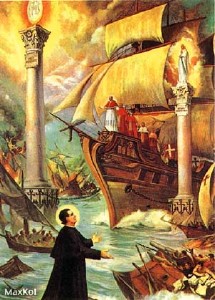
Don Bosco's Prophecy of the Two Columns
Complete article here.
...
"Meanwhile, enemy cannons blow up, firearms and beaks fall to pieces, ships crack up and sink to the bottom. In blind fury the enemy takes to hand-to-hand combat, cursing and blaspheming. Suddenly the Pope falls, seriously wounded. He is instantly helped up but, struck down a second time, dies. A shout of victory rises from the enemy and wild rejoicing sweeps their ships. But no sooner is the Pope dead than another takes his place. The captains of the auxiliary ships elected him so quickly that the news of the Pope's death coincides with that of his successor's election. The enemy's self-assurance wanes.
...
"Breaking through all resistance, the new Pope steers his ship safely between the two columns and moors it to the two columns; first to the one surmounted by the Host, and then to the other, topped by the statue of the Virgin. At this point something unexpected happens. The enemy ships panic and disperse, colliding with and scuttling each other. Some auxiliary ships which had gallantly fought alongside their flagship are the first to tie up at the two columns. (emphasis added)

New parishes to have centralized accounting
The Archdiocese of St. Louis will implement a centralized accounting system for the four new Catholic parishes created by the Northeast County Deanery's reorganization.Some, of course, have questions and concerns about this. Perhaps, that's why it's considered a pilot program?
The effort is described as a pilot program.
Source.
Wednesday, April 20, 2005
Fr J. Augustine Di Noia: People Will Love Him
I don't recall from whom I heard about this, but thank you!
As the Vatican’s Undersecretary of the Congregation for the Doctrine of the Faith, Father J. Augustine Di Noia has worked closely with Cardinal Joseph Ratzinger for the last four years. Di Noia, whose responsibilities involve helping to protect and clarify the doctrines and teachings of the Roman Catholic Church, spoke to NEWSWEEK’s Edward Pentin in Rome about the style and personality of the new Pope Benedict XVI.More here.
New Pope's Name Signals Modernists in the Church and Radical Secularists in Europe
ROME, April 20, 2005 (LifeSiteNews.com) - In the early days of any papacy, much attention is given to signals that give hints to the direction and priorities of the newly elected pope. One of the most significant, but difficult to verify of these signals is the papal name. Since the early centuries of the Church the newly elected pope has followed the custom of adopting a name, usually one of some predecessor.More at LifeSiteNews
....
The deeper roots of the name might be more illuminating. The Church’s first famous Benedict was the 6th century founder of Western Monasticism. St. Benedict of Nursia is normally credited with saving western Christian culture during the rise of the barbarian invasions of Europe that finally threw down the corrupt old order of the Roman Empire.
First Message of His Holiness Benedict XVI ...
....at the end of the Eucharistic Concelebration with the Cardinal electors in the Sistine Chapel (April 20, 2005)
Here in Italian and Latin
English text:
Here in Italian and Latin
English text:
"Grace and peace in abundance to all of you! In my soul there are two contrasting sentiments in these hours. On the one hand, a sense of inadequacy and human turmoil for the responsibility entrusted to me yesterday as the Successor of the Apostle Peter in this See of Rome, with regard to the Universal Church. On the other hand I sense within me profound gratitude to God Who - as the liturgy makes us sing - does not abandon His flock, but leads it throughout time, under the guidance of those whom He has chosen as vicars of His Son, and made pastors.
"Dear Ones, this intimate recognition for a gift of divine mercy prevails in my heart in spite of everything. I consider this a grace obtained for me by my venerated predecessor, John Paul II. It seems I can feel his strong hand squeezing mine; I seem to see his smiling eyes and listen to his words, addressed to me especially at this moment: 'Do not be afraid!'
"The death of the Holy Father John Paul II, and the days which followed, were for the Church and for the entire world an extraordinary time of grace. The great pain for his death and the void that it left in all of us were tempered by the action of the Risen Christ, which showed itself during long days in the choral wave of faith, love and spiritual solidarity, culminating in his solemn funeral.
"We can say it: the funeral of John Paul II was a truly extraordinary experience in which was perceived in some way the power of God Who, through His Church, wishes to form a great family of all peoples, through the unifying force of Truth and Love. In the hour of death, conformed to his Master and Lord, John Paul II crowned his long and fruitful pontificate, confirming the Christian people in faith, gathering them around him and making the entire human family feel more united.
"How can one not feel sustained by this witness? How can one not feel the encouragement that comes from this event of grace?
"Surprising every prevision I had, Divine Providence, through the will of the venerable Cardinal Fathers, called me to succeed this great Pope. I have been thinking in these hours about what happened in the region of Cesarea of Phillippi two thousand years ago: I seem to hear the words of Peter: 'You are Christ, the Son of the living God,' and the solemn affirmation of the Lord: 'You are Peter and on this rock I will build my Church ... I will give you the keys of the kingdom of heaven'.
"You are Christ! You are Peter! It seems I am reliving this very Gospel scene; I, the Successor of Peter, repeat with trepidation the anxious words of the fisherman from Galilee and I listen again with intimate emotion to the reassuring promise of the divine Master. If the weight of the responsibility that now lies on my poor shoulders is enormous, the divine power on which I can count is surely immeasurable: 'You are Peter and on this rock I will build my Church'. Electing me as the Bishop of Rome, the Lord wanted me as his Vicar, he wished me to be the 'rock' upon which everyone may rest with confidence. I ask him to make up for the poverty of my strength, that I may be a courageous and faithful pastor of His flock, always docile to the inspirations of His Spirit.
"I undertake this special ministry, the 'Petrine' ministry at the service of the Universal Church, with humble abandon to the hands of the Providence of God. And it is to Christ in the first place that I renew my total and trustworthy adhesion: 'In Te, Domine, speravi; non confundar in aeternum!'
"To you, Lord Cardinals, with a grateful soul for the trust shown me, I ask you to sustain me with prayer and with constant, active and wise collaboration. I also ask my brothers in the episcopacy to be close to me in prayer and counsel so that I may truly be the 'Servus servorum Dei' (Servant of the servants of God). As Peter and the other Apostles were, through the will of the Lord, one apostolic college, in the same way the Successor of Peter and the Bishops, successors of the Apostles - and the Council forcefully repeated this - must be closely united among themselves. This collegial communion, even in the diversity of roles and functions of the Supreme Pontiff and the bishops, is at the service of the Church and the unity of faith, from which depend in a notable measure the effectiveness of the evangelizing action of the contemporary world. Thus, this path, upon which my venerated predecessors went forward, I too intend to follow, concerned solely with proclaiming to the world the living presence of Christ.
"Before my eyes is, in particular, the witness of Pope John Paul II. He leaves us a Church that is more courageous, freer, younger. A Church that, according to his teaching and example, looks with serenity to the past and is not afraid of the future. With the Great Jubilee the Church was introduced into the new millennium carrying in her hands the Gospel, applied to the world through the authoritative re-reading of Vatican Council II. Pope John Paul II justly indicated the Council as a 'compass' with which to orient ourselves in the vast ocean of the third millennium. Also in his spiritual testament he noted: ' I am convinced that for a very long time the new generations will draw upon the riches that this council of the 20th century gave us'.
"I too, as I start in the service that is proper to the Successor of Peter, wish to affirm with force my decided will to pursue the commitment to enact Vatican Council II, in the wake of my predecessors and in faithful continuity with the millennia-old tradition of the Church. Precisely this year is the 40th anniversary of the conclusion of this conciliar assembly (December 8, 1965). With the passing of time, the conciliar documents have not lost their timeliness; their teachings have shown themselves to be especially pertinent to the new exigencies of the Church and the present globalized society.
"In a very significant way, my pontificate starts as the Church is living the special year dedicated to the Eucharist. How can I not see in this providential coincidence an element that must mark the ministry to which I have been called? The Eucharist, the heart of Christian life and the source of the evangelizing mission of the Church, cannot but be the permanent center and the source of the petrine service entrusted to me.
"The Eucharist makes the Risen Christ constantly present, Christ Who continues to give Himself to us, calling us to participate in the banquet of His Body and His Blood. From this full communion with Him comes every other element of the life of the Church, in the first place the communion among the faithful, the commitment to proclaim and give witness to the Gospel, the ardor of charity towards all, especially towards the poor and the smallest.
"In this year, therefore, the Solemnity of Corpus Christ must be celebrated in a particularly special way. The Eucharist will be at the center, in August, of World Youth Day in Cologne and, in October, of the ordinary Assembly of the Synod of Bishops which will take place on the theme "The Eucharist, Source and Summit of the Life and Mission of the Church.' I ask everyone to intensify in coming months love and devotion to the Eucharistic Jesus and to express in a courageous and clear way the real presence of the Lord, above all through the solemnity and the correctness of the celebrations.
"I ask this in a special way of priests, about whom I am thinking in this moment with great affection. The priestly ministry was born in the Cenacle, together with the Eucharist, as my venerated predecessor John Paul II underlined so many times. 'The priestly life must have in a special way a 'Eucharistic form', he wrote in his last Letter for Holy Thursday. The devout daily celebration of Holy Mass, the center of the life and mission of every priest, contributes to this end.
"Nourished and sustained by the Eucharist, Catholics cannot but feel stimulated to tend towards that full unity for which Christ hoped in the Cenacle. Peter's Successor knows that he must take on this supreme desire of the Divine Master in a particularly special way. To him, indeed, has been entrusted the duty of strengthening his brethren.
"Thus, in full awareness and at the beginning of his ministry in the Church of Rome that Peter bathed with his blood, the current Successor assumes as his primary commitment that of working tirelessly towards the reconstitution of the full and visible unity of all Christ's followers. This is his ambition, this is his compelling duty. He is aware that to do so, expressions of good feelings are not enough. Concrete gestures are required to penetrate souls and move consciences, encouraging everyone to that interior conversion which is the basis for all progress on the road of ecumenism.
"Theological dialogue is necessary. A profound examination of the historical reasons behind past choices is also indispensable. But even more urgent is that 'purification of memory,' which was so often evoked by John Paul II, and which alone can dispose souls to welcome the full truth of Christ. It is before Him, supreme Judge of all living things, that each of us must stand, in the awareness that one day we must explain to Him what we did and what we did not do for the great good that is the full and visible unity of all His disciples.
"The current Successor of Peter feels himself to be personally implicated in this question and is disposed to do all in his power to promote the fundamental cause of ecumenism. In the wake of his predecessors, he is fully determined to cultivate any initiative that may seem appropriate to promote contact and agreement with representatives from the various Churches and ecclesial communities. Indeed, on this occasion too, he sends them his most cordial greetings in Christ, the one Lord of all.
"In this moment, I go back in my memory to the unforgettable experience we all underwent with the death and the funeral of the lamented John Paul II. Around his mortal remains, lying on the bare earth, leaders of nations gathered, with people from all social classes and especially the young, in an unforgettable embrace of affection and admiration. The entire world looked to him with trust. To many it seemed as if that intense participation, amplified to the confines of the planet by the social communications media, was like a choral request for help addressed to the Pope by modern humanity which, wracked by fear and uncertainty, questions itself about the future.
"The Church today must revive within herself an awareness of the task to present the world again with the voice of the One Who said: 'I am the light of the world; he who follows me will not walk in darkness but will have the light of life.' In undertaking his ministry, the new Pope knows that his task is to bring the light of Christ to shine before the men and women of today: not his own light but that of Christ.
"With this awareness, I address myself to everyone, even to those who follow other religions or who are simply seeking an answer to the fundamental questions of life and have not yet found it. I address everyone with simplicity and affection, to assure them that the Church wants to continue to build an open and sincere dialogue with them, in a search for the true good of mankind and of society.
"From God I invoke unity and peace for the human family and declare the willingness of all Catholics to cooperate for true social development, one that respects the dignity of all human beings.
"I will make every effort and dedicate myself to pursuing the promising dialogue that my predecessors began with various civilizations, because it is mutual understanding that gives rise to conditions for a better future for everyone.
"I am particularly thinking of young people. To them, the privileged interlocutors of John Paul II, I send an affectionate embrace in the hope, God willing, of meeting them at Cologne on the occasion of the next World Youth Day. With you, dear young people, I will continue to maintain a dialogue, listening to your expectations in an attempt to help you meet ever more profoundly the living, ever young, Christ.
"'Mane nobiscum, Domine!' Stay with us Lord! This invocation, which forms the dominant theme of John Paul II's Apostolic Letter for the Year of the Eucharist, is the prayer that comes spontaneously from my heart as I turn to begin the ministry to which Christ has called me. Like Peter, I too renew to Him my unconditional promise of faithfulness. He alone I intend to serve as I dedicate myself totally to the service of His Church.
"In support of this promise, We invoke the maternal intercession of Mary Most Holy, in whose hands I place the present and the future of my person and of the Church. May the Holy Apostles Peter and Paul, and all the saints, also intercede.
"With these sentiments, We impart to you venerated brother cardinals, to those participating in this ritual, and to all those following to us by television and radio, a special and affectionate blessing."
Benedict XVI: The Pope and His Agenda
Joseph Ratzinger reproposed it in his last homily before the conclave: “being adults in the faith,” and not “children in a state of guardianship, tossed about by the waves and carried here and there by every wind of doctrine.” Entry by entry, the open questions of his pontificate.Received this email update this morning:
by Sandro Magister
Never in the past century has the choice of a pontiff been spoken in a language so clear and sharp...Full article here.
As a cardinal, Ratzinger put nothing “on sale” in order to be elected pope...At the last mass in Saint Peter’s he reproposed this with the words of the apostle Paul: the goal is that of “being adults in the faith,” and not “children in a state of guardianship, tossed about by the waves and carried here and there by every wind of doctrine.”
Because modern times are leading precisely toward this, he warned: to “a dictatorship of relativism which recognizes nothing as definitive and leaves as the ultimate standard one’s own personality and desires.”
The plain conclusion: “We must foster the maturity of this adult faith; we must guide the flock of Christ to this faith.” And it doesn’t matter if “having a clear faith according to the Church’s creed is frequently labeled fundamentalism.”
Watching MSNBC & CNN as a Means of Mortification
After taping and reviewing some of the EWTN highlights from yesterday and last night's coverage of the election of our new Holy Father, Pope Benedict XVI, I decided to quickly check MSNBC and CNN for coverage they were providing...
Larry King's guests included Fr. Joseph Fessio, Fr. John Bartunek, Paul Wilkes of BeliefNet, Fr. Michael Manning of "The Word in the World", John Allen of The National unCatholic Reporter, and the infamous "Sister" Joan Chittister. Thankfully, Frs. Fessio and Bartunek were there to bring some sanity back to the conversations.
So, as a sort of unique method of self-flagellation, I opted to watch this "wringing of hands" for about 15-20 minutes.
Wilkes stated:
Fr. Manning (with whom I'm not familiar and thankfully so) says:
And then we have John Allen, self-described Vatican 'expert':
Thankfully, Fr. Fessio helps to steer us back to reality:
But then "Sister" Joan reminds us that her view of the Church is different than that of Christ:
There was much more but, in order to be inspire faith , hope and charity, I close with something Fr. Fessio says:
Larry King's guests included Fr. Joseph Fessio, Fr. John Bartunek, Paul Wilkes of BeliefNet, Fr. Michael Manning of "The Word in the World", John Allen of The National unCatholic Reporter, and the infamous "Sister" Joan Chittister. Thankfully, Frs. Fessio and Bartunek were there to bring some sanity back to the conversations.
So, as a sort of unique method of self-flagellation, I opted to watch this "wringing of hands" for about 15-20 minutes.
Wilkes stated:
I called some of my excellent parishes and talked to the pastors. And their reaction was a lot like mine, Larry, that this was a real crisis of imagination on the part of the cardinals. We had talked so much during the week about third world collegiality, a new voice for the church. And really, what the cardinals did, they went right back to the same old, same old. And this is the man that has been kind of the grim reaper in the Catholic Church and been this very strict guy on doctrine and liturgyHe called some of his excellent parishes? He may not realize it, but the real crisis is with him and his apostate brethren...
Fr. Manning (with whom I'm not familiar and thankfully so) says:
I'm concerned about a lot of issues. And I'm hoping -- I was hoping in a strong way that the new man would be able to open it up, this topic of collegiality, the empowerment of local areas to be able to make decisions on their own and to be empowered. The place of women in the church, the empowerment of women.Ahhh, yes! The elusive and nebulous "collegiality". And, of course, no conversation is complete unless one speaks about "empowerment"...especially "empowerment" of womyn...
And then we have John Allen, self-described Vatican 'expert':
I certainly would agree that Cardinal Ratzinger, now Pope Benedict XVI, comes to this job with a bit of baggage.Reality, also, is something which escapes many...it seems that it is those who are (and have been )carrying a load of baggage who wish to project that image on to others. To some, baggage is synonomous with upholding the truth, with standing up for the teachings of Christ and His Church. Perhaps a better word would be, not baggage, but the Cross. Pope Benedict XVI, as our previous Holy Father and so many before him, have the burden of the Cross to bear for Christ and his Church. Some are incapable of seeing this - some have been blinded and can no longer see.
Thankfully, Fr. Fessio helps to steer us back to reality:
...after all is said and done, he's a Catholic, Larry. And Catholics believe that Jesus has given us the truth and we must preserve it and pass it on. He does that. John Paul II did that...So he clearly knows the church's teaching, loves them, expresses them very beautifully, and I think we have a pope for our time.Amen, Father! It's about the truth as given to us by Christ - not what our puny and flawed minds think that it might be.
But then "Sister" Joan reminds us that her view of the Church is different than that of Christ:
I was expecting a more pastoral, a more open face to the church than this history brings us....At the same time I must admit that as a woman I was deeply concerned. His latest document on women is disheartening. It shows a very limited awareness of the development of the woman's movement. I think he's going to have an awful lot to learn in this arena. He seems to think that feminism is monolithic. He doesn't seem to understand there's been an evolution.Surely, she means "Revolution" rather than "evolution"...Anyway, watching her and listening to her is truly painful, a rather vile sort of penance.
There was much more but, in order to be inspire faith , hope and charity, I close with something Fr. Fessio says:
First of all, Larry, he's already performed a miracle. We've seen it on your show. He got me to agree with Sister Joan Chittister, if he follows St. Benedict, he'll be a good listener. I agree with Father Manning too, he needs to listen. But you know something, I've know him for 33 years, I've never ever met a man who listens as well and as intently as Cardinal Ratzinger does. I've never heard him raise his voice, never heard him lose his temper. He's got a gentle sense of humor. But he always listens....More here.
So, there's no one more collegial than Cardinal Ratzinger or Benedict. He will be a great blessing in that area.
...
I want to say one thing, Larry, about Vatican II, too -- there's kind of a myth here. The Pope Benedict -- I've seen him celebrate the mass in English. He does that beautifully. But Vatican II actually did not call for an anti-Gregorian chant, in fact, it said specifically, the Gregorian chant should have the pride of place in the Catholic liturgy. Vatican II did not abolish Latin. In fact, it said specifically that Latin should remain the language of the mass with some vernacular for the readings especially. So, to claim that Second Vatican Council was responsible for abolishing Latin or for abolishing Gregorian chant is simply misunderstanding the council at which Ratzinger was present helping the people that wrote those documents.
The "Clandestine Operation" Continues at St Stanislaus
The terminology is not mine but that of Mr Richard Bach, a professed Catholic and spokesman for some of the St Stanislaus Kostka parishioners. Mr. Bach, in a previous radio interview, termed the act of bringing in an outside priest as a "clandestine operation"...As if God does not see all.
This was in the Post...I assume that it refers to this evening...However, one should call to find out for certain...The phone: 314-421-5948.
One should also be aware that there is NO way that one can be assured that the "priest" that these professed Catholics bring in under the cover of darkness, is in fact a priest at all.
Does one "believe" those who routinely distort the facts?
One cannot be certain that, if the man was a priest at one time, whether he still has faculties to celebrate Mass. There is no guarantee that Mr Bach could provide that would permit one to assume that the sacrament of Holy Communion would even be valid - that is, no priest - no sacrament...Is one to rely on Mr. Bach's promises or words? Talk about a leap of faith!
The defiance of authority exhibited by Mr Bach and others is, not only scandalous, it is contemptible and truly worthy of disciplinary action. He and others, by their repeated statements and actions, encourage others to follow them into schism.
This was in the Post...I assume that it refers to this evening...However, one should call to find out for certain...The phone: 314-421-5948.
There will be a Eucharistic Mass to celebrate the election of Pope Benedict XVI and to memorialize Pope John Paul II tonight at St. Stanislaus Kostka Church at 1413 North 20th Street.So says the Post.
Confessions will begin at 6, the rosary at 6:30, and Mass at 7. A Roman Catholic priest from outside the St. Louis diocese will celebrate Mass.
One should also be aware that there is NO way that one can be assured that the "priest" that these professed Catholics bring in under the cover of darkness, is in fact a priest at all.
Does one "believe" those who routinely distort the facts?
One cannot be certain that, if the man was a priest at one time, whether he still has faculties to celebrate Mass. There is no guarantee that Mr Bach could provide that would permit one to assume that the sacrament of Holy Communion would even be valid - that is, no priest - no sacrament...Is one to rely on Mr. Bach's promises or words? Talk about a leap of faith!
The defiance of authority exhibited by Mr Bach and others is, not only scandalous, it is contemptible and truly worthy of disciplinary action. He and others, by their repeated statements and actions, encourage others to follow them into schism.
An Important Aspect of Christianity
The Qualities of Faith
"Faith, without works is dead" (James 2:20).
"Stand fast in the faith" (1 Cor. 16:13).
Faith is necessary - indispensably necessary - to salvation, and we need hardly add that in making this statement we are speaking of the true faith taught by Jesus Christ. But it is an important matter to know where we are to find this true faith. We find it in the Catholic Church. Christ has not only taught us the truth; He founded an institution, a Church, to promulgate and preserve it. What Church did He found? That one, surely, which, as the Catholic Church alone can do, traces her origin and history right back to Christ and His apostles. All other bodies, whatever be their name, arose more recently. They are all cadets in comparison with the Catholic Church.
There is but one objection that can be urged against the conclusion that the Catholic Church is the only real heir to the truth of Christ, and it is frequently made use of. Men say: No doubt it is true that the Catholic Church is older than any other, and that in the beginning she possessed the truth. But in the course of time she deviated more and more widely from her original doctrines and then younger and more modern Churches arose and restored Christ's teaching in all its purity and freshness.
This objection is absolutely untenable because Jesus Christ not only founded a Church, but He promised that it should last forever: "The gates of hell shall not prevail against it." He further promised that He Himself and the Holy Spirit would dwell with it always when He said: "And behold I am with you always even to the consummation of the world," and "He will abide with you forever."
Could a Church so guided and supported lose the true faith? We can not consider even the possibility of such a thing, for in order to do so one must admit either that Our Lord was mistaken or that He failed to keep His word. Once that is allowed, it follows as the next step that Christ was not truly God; and whoever says so must go the rest of the way and call the entire Christian religion a myth. If the Catholic Church does not possess the truth, we need not further to seek it; it is not to be found elsewhere.
To sum up: the Faith, the true faith taught by Jesus Christ, is necessary to salvation, and is to be found in the Catholic Church alone.
Essential as it is in itself, our faith must have certain qualities if it is to contain for us the germ of eternal life. It must be entire, firm, steadfast, and living. Let us, with the help of the Holy Spirit, consider as shortly as possible the first three of these characteristics.
I
Our faith is to be entire.
When is it entire? It is entire when we believe not only a part, but all that the Catholic Church proposes to our belief. All the truths of faith have been revealed by the same God, all are therefore equally true; and they are all presented to us by the same Church, so they must all without exception be accepted and believed one as firmly as the other. It is by no means permissible to make a selection, that is, to choose some and to reject others, but this unfortunately is what is too often done.
Many people receive with great alacrity the sweet and consolmg doctrme of God's mercy, His patience, His willingness to forgive; they welcome the promise of the unspeakable happmess of heaven. But, suggest to them that He exacts repentance, penance, and that in His inconceivable justice He tolerates a hell to punish eternally, and they are filled with horror and refuse to accept it.
Those truths which human intelligence can grasp are to be believed; but some think that those incomprehensible mysteries of faith which our minds can not penetrate we are to be free to throw aside. This is not perfect faith - in fact, it is not in its essence faith at all. "Whosoever shall keep the whole law, but offend in one point, is guilty of all." He who denies one article of faith denies them all. If one stone of an arch loosens and slips the whole arch is surely to collapse. We must believe all that God has revealed and that the Holy Catholic Church proposes to our belief.
Good heavens! some of you may exclaim, what a task, to believe everything which God has revealed and the Church teaches! Why, I don't even know half of it. At school I learned very little and I have forgotten most of that. My intelligence is limited, my memory weak, and I go very seldom attend conferences. Can one believe a thing that one does not know? Certainly, one can! Suppose you receive a letter and you see by the writing on the envelope that it comes from a friend whom you highly respect and consider to be an absolutely truth-loving person. You know that this friend has been an eye-witness of certain occurrences which the letter details to you. Are you not satisfied that you hold in your hand an authentic and truthful account of all that happened? You believed the contents of the letter really before you read it, before you opened it, or knew what was in it. In a similar manner we must, therefore, believe all that God has revealed, even if we have not complete knowledge of it all.
II
Our faith must be firm.
It is firm when we do not wilfully doubt of any article of faith. Firmness is the opposite of doubt, or rather of wilful doubt, for many staunch Christians are frequently troubled and tormented with difficulties. This is not to be wondered at, for the evil spirit knows what he is doing, and when he finds his assaults in other directions make no impression then he seeks to disturb us about the truths of religion. For, if faith, the foundation of the Christian life, be once undermined, the whole structure totters and falls to the ground. Moreover, faith deals with so many unfathomable mysteries that it is an easy matter to induce people to call it in question, but as long as these doubts are not voluntary and are not wilfully entertained they are not sinful and do not in any way shake the firmness of our faith.
What, then, are we to do if we find ourselves assailed by doubts of one or other article of faith? If doubts against faith trouble you, recail to mind the rock on which your belief is built, namely, the truth of God, which is eternal and never failing, which can not err and can not lie. Say, with all your heart: "My God, I believe all Thou hast revealed; because Thou art the infallible truth I trust Thy word more than my own understanding." Excite in yourself lively sentiments of faith and boldly ignore all temptations against it.
III
Our faith must be steadfast.
It is steadfast when we are ready to sacrifice everything, even life itself, rather than give it up.
I read somewhere of a sailor, who, in a battle at sea, caught hold of an enemy's boat with his hand and held it tight so as to give his comrades time to come up and capture it. The enemy yelled at him to let go, but he clung on all the harder; they hurled threats at him, but he stuck to it with all the more determination. They slashed at his fingers with their swords, but he still grasped the boat with the wounded hand till it was cut right through and then he substituted the other. He preferred to lose both hands rather than to relinquish what he had secured. This must be our attitude toward the Faith. We must choose rather to part with all we have - goods, honors, position, yes, even with life itself, sooner than loosen our hold on it.
The holy martyrs are striking examples of this steadfastness. There was no advantage they were not willing to forego, no suffering they would not gladly endure for the sake of the Faith, and the later history of the Church is full of such examples in people of every age, condition, and sex. We are children of the same religion and of the same Church as they, and we ought to be ashamed if we are not ready to follow in their footsteps.
We close our instruction with the resolve to be ready to bear for our faith, if and when necessary, the ridicule and contempt of the world, and the slights and disadvantages which even in our day are not infrequently the portion of those who believe. By so doing we shall walk in the bloodstained footsteps of the saints and shall attain with them the reward, of the life to come.
Adapted from Popular Sermons on the Catechism
by Fr. Hubert Bamberg, 1914
"Faith, without works is dead" (James 2:20).
"Stand fast in the faith" (1 Cor. 16:13).
Faith is necessary - indispensably necessary - to salvation, and we need hardly add that in making this statement we are speaking of the true faith taught by Jesus Christ. But it is an important matter to know where we are to find this true faith. We find it in the Catholic Church. Christ has not only taught us the truth; He founded an institution, a Church, to promulgate and preserve it. What Church did He found? That one, surely, which, as the Catholic Church alone can do, traces her origin and history right back to Christ and His apostles. All other bodies, whatever be their name, arose more recently. They are all cadets in comparison with the Catholic Church.
There is but one objection that can be urged against the conclusion that the Catholic Church is the only real heir to the truth of Christ, and it is frequently made use of. Men say: No doubt it is true that the Catholic Church is older than any other, and that in the beginning she possessed the truth. But in the course of time she deviated more and more widely from her original doctrines and then younger and more modern Churches arose and restored Christ's teaching in all its purity and freshness.
This objection is absolutely untenable because Jesus Christ not only founded a Church, but He promised that it should last forever: "The gates of hell shall not prevail against it." He further promised that He Himself and the Holy Spirit would dwell with it always when He said: "And behold I am with you always even to the consummation of the world," and "He will abide with you forever."
Could a Church so guided and supported lose the true faith? We can not consider even the possibility of such a thing, for in order to do so one must admit either that Our Lord was mistaken or that He failed to keep His word. Once that is allowed, it follows as the next step that Christ was not truly God; and whoever says so must go the rest of the way and call the entire Christian religion a myth. If the Catholic Church does not possess the truth, we need not further to seek it; it is not to be found elsewhere.
To sum up: the Faith, the true faith taught by Jesus Christ, is necessary to salvation, and is to be found in the Catholic Church alone.
Essential as it is in itself, our faith must have certain qualities if it is to contain for us the germ of eternal life. It must be entire, firm, steadfast, and living. Let us, with the help of the Holy Spirit, consider as shortly as possible the first three of these characteristics.
Our faith is to be entire.
When is it entire? It is entire when we believe not only a part, but all that the Catholic Church proposes to our belief. All the truths of faith have been revealed by the same God, all are therefore equally true; and they are all presented to us by the same Church, so they must all without exception be accepted and believed one as firmly as the other. It is by no means permissible to make a selection, that is, to choose some and to reject others, but this unfortunately is what is too often done.
Many people receive with great alacrity the sweet and consolmg doctrme of God's mercy, His patience, His willingness to forgive; they welcome the promise of the unspeakable happmess of heaven. But, suggest to them that He exacts repentance, penance, and that in His inconceivable justice He tolerates a hell to punish eternally, and they are filled with horror and refuse to accept it.
Those truths which human intelligence can grasp are to be believed; but some think that those incomprehensible mysteries of faith which our minds can not penetrate we are to be free to throw aside. This is not perfect faith - in fact, it is not in its essence faith at all. "Whosoever shall keep the whole law, but offend in one point, is guilty of all." He who denies one article of faith denies them all. If one stone of an arch loosens and slips the whole arch is surely to collapse. We must believe all that God has revealed and that the Holy Catholic Church proposes to our belief.
Good heavens! some of you may exclaim, what a task, to believe everything which God has revealed and the Church teaches! Why, I don't even know half of it. At school I learned very little and I have forgotten most of that. My intelligence is limited, my memory weak, and I go very seldom attend conferences. Can one believe a thing that one does not know? Certainly, one can! Suppose you receive a letter and you see by the writing on the envelope that it comes from a friend whom you highly respect and consider to be an absolutely truth-loving person. You know that this friend has been an eye-witness of certain occurrences which the letter details to you. Are you not satisfied that you hold in your hand an authentic and truthful account of all that happened? You believed the contents of the letter really before you read it, before you opened it, or knew what was in it. In a similar manner we must, therefore, believe all that God has revealed, even if we have not complete knowledge of it all.
Our faith must be firm.
It is firm when we do not wilfully doubt of any article of faith. Firmness is the opposite of doubt, or rather of wilful doubt, for many staunch Christians are frequently troubled and tormented with difficulties. This is not to be wondered at, for the evil spirit knows what he is doing, and when he finds his assaults in other directions make no impression then he seeks to disturb us about the truths of religion. For, if faith, the foundation of the Christian life, be once undermined, the whole structure totters and falls to the ground. Moreover, faith deals with so many unfathomable mysteries that it is an easy matter to induce people to call it in question, but as long as these doubts are not voluntary and are not wilfully entertained they are not sinful and do not in any way shake the firmness of our faith.
What, then, are we to do if we find ourselves assailed by doubts of one or other article of faith? If doubts against faith trouble you, recail to mind the rock on which your belief is built, namely, the truth of God, which is eternal and never failing, which can not err and can not lie. Say, with all your heart: "My God, I believe all Thou hast revealed; because Thou art the infallible truth I trust Thy word more than my own understanding." Excite in yourself lively sentiments of faith and boldly ignore all temptations against it.
Our faith must be steadfast.
It is steadfast when we are ready to sacrifice everything, even life itself, rather than give it up.
I read somewhere of a sailor, who, in a battle at sea, caught hold of an enemy's boat with his hand and held it tight so as to give his comrades time to come up and capture it. The enemy yelled at him to let go, but he clung on all the harder; they hurled threats at him, but he stuck to it with all the more determination. They slashed at his fingers with their swords, but he still grasped the boat with the wounded hand till it was cut right through and then he substituted the other. He preferred to lose both hands rather than to relinquish what he had secured. This must be our attitude toward the Faith. We must choose rather to part with all we have - goods, honors, position, yes, even with life itself, sooner than loosen our hold on it.
The holy martyrs are striking examples of this steadfastness. There was no advantage they were not willing to forego, no suffering they would not gladly endure for the sake of the Faith, and the later history of the Church is full of such examples in people of every age, condition, and sex. We are children of the same religion and of the same Church as they, and we ought to be ashamed if we are not ready to follow in their footsteps.
We close our instruction with the resolve to be ready to bear for our faith, if and when necessary, the ridicule and contempt of the world, and the slights and disadvantages which even in our day are not infrequently the portion of those who believe. By so doing we shall walk in the bloodstained footsteps of the saints and shall attain with them the reward, of the life to come.
Adapted from Popular Sermons on the Catechism
by Fr. Hubert Bamberg, 1914
Gospel for Wednesday, 4th Week of Easter
From: John 12:44-50
The Unbelief of the Jews
[44] And Jesus cried out and said, "He who believes in Me, believes not in Me, but in Him who sent Me. [45] And he who sees Me sees Him who sent Me. [46] I have come as light into the world, that whoever believes in Me may not remain in darkness. [47] If any one hears My sayings and does not keep them, I do not judge him; for I did not come to judge the world but to save the world. [48] He who rejects Me and does not receive My sayings has a judge; the word that I have spoken will be His judge on the last day. [49] For I have not spoken on My own authority; the Father who sent Me has Himself given Me commandment what to say and what to speak. [50] And I know that His commandment is eternal life. What I say, therefore, I say as the Father has bidden Me."
********************
Commentary:
44-50. With these verses St. John brings to an end his account of our Lord's public ministry. He brings together certain fundamental themes developed in previous chapters--the need for faith in Christ (verse 44); the Father and the Son are one yet distinct (cf. 45); Jesus is Light and Life of the world (verses 46, 50); men will be judged in accordance with whether they accept or reject the Son of God (verses 47-49). The chapters which follow contain Jesus' teaching to His Apostles at the Last Supper, and the accounts of the Passion and Resurrection.
45. Christ, the Word Incarnate, is one with the Father (cf. John 10:30); "He reflects the glory of God" (Hebrews 1:3); "He is the image of the invisible God" (Colossians 1:15). In John 14:9 Jesus expresses Himself in almost the same words: "He who has seen Me has seen the Father". At the same time as He speaks of His oneness with the Father, we are clearly shown the distinction of persons--the Father who sends, and the Son who is sent.
In Christ's holy human nature His divinity is, as it were, hidden, that divinity which He possesses with the Father in the unity of the Holy Spirit (cf. John 14:7-11). In theology "circumincession" is the word usually used for the fact that, by virtue of the unity among the three Persons of the Blessed Trinity, "the Father is wholly in the Son and wholly in the Holy Spirit; the Son wholly in the Father and wholly in the Holy Spirit; the Holy Spirit wholly in the Father and wholly in the Son" (Council of Florence, "Decree Pro Jacobitis, Dz-Sch", 1331).
47. Christ has come to save the world by offering Himself in sacrifice for our sins and bringing us supernatural life (cf. John 3:17). But He has also been made Judge of the living and the dead (cf. Acts 10:42): He passes sentence at the Particular Judgment which happens immediately after death, and at the end of the world, at His Second Coming or Parousia, at the universal judgment (cf. John 5:22; 8:15-16).
*******************
Source: "The Navarre Bible: Text and Commentaries". Biblical text taken from the Revised Standard Version and New Vulgate. Commentaries made by members of the Faculty of Theology of the University of Navarre, Spain. Published by Four Courts Press, Kill Lane, Blackrock, Co. Dublin, Ireland.
Reprinted with permission from Four Courts Press and Scepter Publishers, the U.S. publisher.
The Unbelief of the Jews
[44] And Jesus cried out and said, "He who believes in Me, believes not in Me, but in Him who sent Me. [45] And he who sees Me sees Him who sent Me. [46] I have come as light into the world, that whoever believes in Me may not remain in darkness. [47] If any one hears My sayings and does not keep them, I do not judge him; for I did not come to judge the world but to save the world. [48] He who rejects Me and does not receive My sayings has a judge; the word that I have spoken will be His judge on the last day. [49] For I have not spoken on My own authority; the Father who sent Me has Himself given Me commandment what to say and what to speak. [50] And I know that His commandment is eternal life. What I say, therefore, I say as the Father has bidden Me."
********************
Commentary:
44-50. With these verses St. John brings to an end his account of our Lord's public ministry. He brings together certain fundamental themes developed in previous chapters--the need for faith in Christ (verse 44); the Father and the Son are one yet distinct (cf. 45); Jesus is Light and Life of the world (verses 46, 50); men will be judged in accordance with whether they accept or reject the Son of God (verses 47-49). The chapters which follow contain Jesus' teaching to His Apostles at the Last Supper, and the accounts of the Passion and Resurrection.
45. Christ, the Word Incarnate, is one with the Father (cf. John 10:30); "He reflects the glory of God" (Hebrews 1:3); "He is the image of the invisible God" (Colossians 1:15). In John 14:9 Jesus expresses Himself in almost the same words: "He who has seen Me has seen the Father". At the same time as He speaks of His oneness with the Father, we are clearly shown the distinction of persons--the Father who sends, and the Son who is sent.
In Christ's holy human nature His divinity is, as it were, hidden, that divinity which He possesses with the Father in the unity of the Holy Spirit (cf. John 14:7-11). In theology "circumincession" is the word usually used for the fact that, by virtue of the unity among the three Persons of the Blessed Trinity, "the Father is wholly in the Son and wholly in the Holy Spirit; the Son wholly in the Father and wholly in the Holy Spirit; the Holy Spirit wholly in the Father and wholly in the Son" (Council of Florence, "Decree Pro Jacobitis, Dz-Sch", 1331).
47. Christ has come to save the world by offering Himself in sacrifice for our sins and bringing us supernatural life (cf. John 3:17). But He has also been made Judge of the living and the dead (cf. Acts 10:42): He passes sentence at the Particular Judgment which happens immediately after death, and at the end of the world, at His Second Coming or Parousia, at the universal judgment (cf. John 5:22; 8:15-16).
*******************
Source: "The Navarre Bible: Text and Commentaries". Biblical text taken from the Revised Standard Version and New Vulgate. Commentaries made by members of the Faculty of Theology of the University of Navarre, Spain. Published by Four Courts Press, Kill Lane, Blackrock, Co. Dublin, Ireland.
Reprinted with permission from Four Courts Press and Scepter Publishers, the U.S. publisher.
Tuesday, April 19, 2005
Something we must not forget: Dissent Poisons
Fr. John Corapi, gave an address some time ago called "A Message for Homeschoolers". I have listened to the tape a number of times and it is a powerful and truthful expression of the fatal dangers of dissent and disobedience.
Some excerpts:
More of Fr. Corapi's address here.
Some excerpts:
"There is no such thing as being a good Catholic and being disobedient to the Holy Father. There is no such thing as being a good Catholic and being a dissident when it comes to faith and morals. There is no such thing as dissent from authentic and authoritative Church teaching. No such thing. Those who do that separate themselves from Christ and His body. They become dead members of the body of Christ.Crystal clear!
You should avoid such people like the plague and you should keep your children from such people as though keeping them from the worst contagion, because contact with such people can poison their minds, poison their souls and kill them morally and spiritually, and you don't want to be responsible for that. That is not lack of charity, that is not lack of pastoral concern. That IS charity, that IS being pastoral and that IS being merciful. It is not merciful to turn our children over to those that can poison their hearts and minds. That is not charitable, merciful, nor pastoral.Such is what has been permitted in many parts of the Church - and the fruits of such permissiveness is death. Many, however, do not see it. They have been blinded by living in darkness for too long of a time...They are spiritually dead or dying. They need prayers most of all with perhaps, a dose of catechesis.
More of Fr. Corapi's address here.
Liberal U.S. Catholics Dismayed at Choice of Pope
BOSTON (Reuters) - Liberal U.S. Catholics on Tuesday expressed dismay at the choice of a conservative new pope and doubted he will heal an institution racked by disillusionment and tarnished by a sex abuse scandal among the clergy.Are those who advocate homosexuality, contraception, abortion, euthanasia, and womyn priestesses really "Catholic"? Some would maintain that the outright and obstinate refusal to assent to the teachings of the Church would make those persons material heretics and that they may have, depending on one's level of advocacy, formally defected from the faith.
The election of Cardinal Joseph Ratzinger as Pope Benedict XVI rankled those who advocate married priests, a bigger role for women within the church and softening its policy on homosexuality, birth control, euthanasia and abortion.
"Gay and lesbian Catholics are going to be very hurt by this election because Cardinal Ratzinger was the lightning rod for so much of the anger they felt under the previous pope," said Francis DeBernardo, executive director of the New Ways Ministry, a national ministry for lesbian and gay Catholics.The anger they feel is due, no doubt, to some underlying or subconscious guilt which is brought to the surface when one speaks the truth.
Catholics for a Free Choice, a progressive group based in Washington, laid out an action plan for the new pontiff to pursue in his first 100 days with the goal of healing fractures within the church.No doubt His Holiness, Pope Benedict XVI, will make this his first order of business...
It urged the new pope to appoint a commission to review church policy on condoms, to establish a pontifical academy on women's rights in the church, and to welcome back those marginalized over the last quarter-century -- including gays and lesbians.
More lunacy here.
First Address of Pope Benedict XVI
Dear Brothers and Sisters:This address was given after his election to the pontificate, from the balcony of St. Peter's Basilica.
After the great Pope, John Paul II, the Lord Cardinals have elected me, a simple, humble worker in the Lord's vineyard. I am consoled by the fact that the Lord is able to work and act with insufficient instruments and, above all, I rely on your prayers.
In the joy of the risen Lord, confident of his permanent help, let us go forward. The Lord will help us. Mary, his Most Holy Mother, is on our side. Thank you.
It Doesn't Take Long for the Ill-Informed to Become Confused
Some are getting caught up in the "Ratzinger a Nazi?" bandwagon.
The Jerusalem Post tells us: "Don't believe it."
The Jerusalem Post tells us: "Don't believe it."
London's Sunday Times would have us believe that one of the leading contenders for the papacy is a closet Nazi. In if-only-they-knew tones, the newspaper informs readers that German-born Cardinal Joseph Ratzinger was a member of the Hitler Youth during World War II and suggests that, because of this, the "panzer cardinal" would be quite a contrast to his predecessor, John Paul II.More.
The article also classifies Ratzinger as a "theological anti-Semite" for believing in Jesus so strongly that – gasp! – he thinks that everyone, even Jews, should accept him as the messiah.
To all this we should say, "This is news?!"
As the Sunday Times article admits, Ratzinger's membership in the Hitler Youth was not voluntary but compulsory; also admitted are the facts that the cardinal – only a teenager during the period in question – was the son of an anti-Nazi policeman, that he was given a dispensation from Hitler Youth activities because of his religious studies, and that he deserted the German army.
Ratzinger has several times gone on record on his supposedly "problematic" past. In the 1997 book Salt of the Earth, Ratzinger is asked whether he was ever in the Hitler Youth.
From the Post Dispatch: Germany's Cardinal Ratzinger elected pope
VATICAN CITY (AP) -- Cardinal Joseph Ratzinger of Germany, the Roman Catholic Church's leading hard-liner, was elected pope Tuesday in the first conclave of the new millennium. He chose the name Benedict XVI and called himself "a simple, humble worker.""Hard-liner"??? Yes, the truth is difficult for many to accept.
Faithful Catholics must offer their prayers and sacrifices for our new Holy Father, just as many of us are doing here for Archbishop Burke. When one of our spiritual fathers in faith are steadfast in teaching the fullness of the truth, they will be attacked, ridiculed, and spurned. We should, as humble and obedient children of God, offer our unhesitating support and encouragement to them and pray that God will continue to bless them and watch over them.
Ratzinger, the first German pope in centuries, emerged onto the balcony of St. Peter's Basilica, where he waved to a wildly cheering crowd of tens of thousands and gave his first blessing. Other cardinals clad in their crimson robes came out on other balconies to watch him after one of the fastest papal conclaves of the past century.More here.
Dr. Ed Peters on eBay and the Eucharist
Dr. Peteres has updated his blog with some pertinent information about this latest episode here.
"Against the Grain" was down...
I tried to head over to the Ratzinger Fan Club to express my joy and thanksgiving for our new Holy Father - and the site has been deluged, it seems...
Annuntio vobis gaudium magnum. Habemus Papam!
WHITE SMOKE! BELLS are RINGING!

*** Updated ***
IT'S CARDINAL RATZINGER!

Now, Pope Benedict XVI!
Thanks be to God!
*** Updated ***
IT'S CARDINAL RATZINGER!
Now, Pope Benedict XVI!
Thanks be to God!
Women send up pink smoke to protest male-only conclave to elect pope
The heading should have had "WOMYN" instead of "Women"-my mistake.
Does anyone take these people seriously anymore? They are among the lost, as they wander aimlessly about in the darkness - we should pray for them even though we denounce their positions.
CHICAGO -- Members of the National Coalition of American Nuns on Monday protested the exclusion of women from the process of selecting a new pope.Source
Demonstrators released pink smoke to symbolize what they called secrecy and sexism in the church hierarchy, NBC5's Kim Vatis reported. The display mimicked the ritual in Vatican City where the conclave of cardinals will release black or white smoke to let the faithful know whether a new pope has been selected.
The National Coalition of American Nuns is one of several groups pushing to ordain women in the church.
Does anyone take these people seriously anymore? They are among the lost, as they wander aimlessly about in the darkness - we should pray for them even though we denounce their positions.
Omaha police investigate fraud allegations made against priest
OMAHA, Neb. (CNS) -- Omaha police are investigating allegations of fraud made against Father Peter Stravinskas, temporary administrator of St. Anthony's Parish in south Omaha and the well-known author of several books on Catholicism.More.
Tuesday Morning - Black Smoke
VATICAN CITY - Black smoke emerged from the Sistine Chapel chimney again Tuesday as the scarlet-robed cardinals inside failed in two more ballots to elect a new pope to build on John Paul II's legacy and heal deep rifts within the Roman Catholic Church.

Gospel for Tuesday, 4th Week of Easter
From: John 10:22-30
Jesus and the Father are One
[22] It was the feast of the Dedication at Jerusalem; [23] it was winter, and Jesus was walking in the temple, in the portico of Solomon. [24] So the Jews gathered round Him and said to Him, "How long will You keep us in suspense? If you are the Christ, tell us plainly." [25] Jesus answered them, "I told you, and you do not believe. The works that I do in My Father's name, they bear witness to Me; [26] but you do not believe, because you do not belong to My sheep. [27] My sheep hear My voice, and I know them, and they follow Me; [28] and I give them eternal life, and they shall never perish, and no one shall snatch them out of My hand. [29] My Father, who has given them to Me, is greater than all, and no one is able to snatch them out of the Father's hand. [30] I and the Father are one."
****************************
Commentary:
22. This feast commemorates an episode in Jewish history (cf. 1 Maccabees 4:36-59; 2 Maccabees 1-2:19; 10:1-8) when Judas Maccabeus, in the year 165 B.C., after liberating Jerusalem from the control of the Seleucid kings of Syria, cleansed the temple of the profanations of Antiochus Epiphanes (1 Maccabees 1:54). From then onwards, on the twenty-fifth day of the month of Kislev (November-December) and throughout the following week, all Judea celebrated the anniversary of the dedication of the new altar. It was also known as the "Festival of Lights" because it was customary to light lamps, a symbol of the Law, and put them in the windows of the houses (cf. 2 Maccabees 1:18).
24-25. When these Jews ask Jesus if He is the Messiah, "they speak in this way", St. Augustine comments, "not because they desire truth, but to prepare the way for calumny" ("In Ioann. Evang.", 48, 3). We have already seen Jesus reveal, by His words and deeds, that He is the Only Son of God (5:19ff; 7:16ff; 8:25ff). In view of their good dispositions, He explicitly told the Samaritan woman (4:26) and the man born blind (9:37) that He was the Messiah and Savior. Now He reproaches His listeners for refusing to recognize the works He does in His Father's name (cf. 5:36; 10:38). On other occasions He referred to works as a way to distinguish true prophets from false ones: "You will know them by their fruits" (Matthew 7:16; cf. Matthew 12:33).
26-29. Certainly faith and eternal life cannot be merited by man's own efforts: they are a gift of God. But the Lord does not deny anyone grace to believe and be saved, because He `wishes all men to be saved and to come to the knowledge of the Truth" (1 Timothy 2:4). If someone tries to avoid receiving the gift of faith, his unbelief is blameworthy. On this point St. Thomas Aquinas teaches: "I can see, thanks to the light of the sun; but if I close my eyes, I cannot see: this is no fault of the sun, it is my own fault, because by closing my eyes, I prevent the sunlight from reaching me" ("Commentary on St. John, ad loc.").
But those who do not oppose divine grace do come to believe in Jesus. They are known to and loved by Him, enter under His protection and remain faithful with the help of His grace, which is a pledge of the eternal life which the Good Shepherd will eventually give them. It is true that in this world they will have to strive and in the course of striving they will sustain wounds; but if they stay united to the Good Shepherd nothing and no one will snatch Christ's sheep from Him, because our Father, God, is stronger than the Evil One. Our hope that God will grant us final perseverance is not based on our strength but on God's mercy: this hope should always motivate us to strive to respond to grace and to be more faithful to the demands of our faith.
30. Jesus reveals that He and the Father are one in substance. Earlier He proclaimed that God was His Father, "making Himself equal with God"--which is why a number of times the Jewish authorities think of putting Him to death (cf. 5:18; 8:59). Now He speaks about the mystery of God, which is something we can know about only through Revelation. Later on He will reveal more about this mystery, particularly at the Last Supper (14:10; 17:21-22). It is something the evangelist reflects on at the very beginning of the Gospel, in the prologue (cf. John 1:1 and note).
"Listen to the Son Himself", St. Augustine invites us. "`I and the Father are one.' He did not say, `I am the Father' or `I and the Father are one [Person].' But when He says, `I and the Father are one,' notice the two words `[we are]' and `one'...For if they are one, then they are not diverse; if `[we] are', then there is both a Father and a Son" ("In Ioann. Evang.", 36, 9). Jesus reveals that He is one in substance with the Father as far as divine essence or nature is concerned, but He also reveals that the Father and the Son are distinct Persons: "We believe then in the Father who eternally begets the Son; in the Son, the Word of God, who is eternally begotten; in the Holy Spirit, the uncreated Person who proceeds from the Father and the Son as their eternal Love. Thus in the three divine Persons, "coaeternae sibi et coaequales", the life and beatitude of God perfectly One superabound and are consummated in the supreme excellence and glory proper to uncreated Being, and always `there should be venerated Unity in the Trinity and Trinity in the Unity'" ([Pope] Paul VI, "Creed of the People of God," 10).
*********************************
Source: "The Navarre Bible: Text and Commentaries". Biblical text taken from the Revised Standard Version and New Vulgate. Commentaries made by members of the Faculty of Theology of the University of Navarre, Spain. Published by Four Courts Press, Kill Lane, Blackrock, Co. Dublin, Ireland.
Reprinted with permission from Four Courts Press and Scepter Publishers, the U.S. publisher.
Jesus and the Father are One
[22] It was the feast of the Dedication at Jerusalem; [23] it was winter, and Jesus was walking in the temple, in the portico of Solomon. [24] So the Jews gathered round Him and said to Him, "How long will You keep us in suspense? If you are the Christ, tell us plainly." [25] Jesus answered them, "I told you, and you do not believe. The works that I do in My Father's name, they bear witness to Me; [26] but you do not believe, because you do not belong to My sheep. [27] My sheep hear My voice, and I know them, and they follow Me; [28] and I give them eternal life, and they shall never perish, and no one shall snatch them out of My hand. [29] My Father, who has given them to Me, is greater than all, and no one is able to snatch them out of the Father's hand. [30] I and the Father are one."
****************************
Commentary:
22. This feast commemorates an episode in Jewish history (cf. 1 Maccabees 4:36-59; 2 Maccabees 1-2:19; 10:1-8) when Judas Maccabeus, in the year 165 B.C., after liberating Jerusalem from the control of the Seleucid kings of Syria, cleansed the temple of the profanations of Antiochus Epiphanes (1 Maccabees 1:54). From then onwards, on the twenty-fifth day of the month of Kislev (November-December) and throughout the following week, all Judea celebrated the anniversary of the dedication of the new altar. It was also known as the "Festival of Lights" because it was customary to light lamps, a symbol of the Law, and put them in the windows of the houses (cf. 2 Maccabees 1:18).
24-25. When these Jews ask Jesus if He is the Messiah, "they speak in this way", St. Augustine comments, "not because they desire truth, but to prepare the way for calumny" ("In Ioann. Evang.", 48, 3). We have already seen Jesus reveal, by His words and deeds, that He is the Only Son of God (5:19ff; 7:16ff; 8:25ff). In view of their good dispositions, He explicitly told the Samaritan woman (4:26) and the man born blind (9:37) that He was the Messiah and Savior. Now He reproaches His listeners for refusing to recognize the works He does in His Father's name (cf. 5:36; 10:38). On other occasions He referred to works as a way to distinguish true prophets from false ones: "You will know them by their fruits" (Matthew 7:16; cf. Matthew 12:33).
26-29. Certainly faith and eternal life cannot be merited by man's own efforts: they are a gift of God. But the Lord does not deny anyone grace to believe and be saved, because He `wishes all men to be saved and to come to the knowledge of the Truth" (1 Timothy 2:4). If someone tries to avoid receiving the gift of faith, his unbelief is blameworthy. On this point St. Thomas Aquinas teaches: "I can see, thanks to the light of the sun; but if I close my eyes, I cannot see: this is no fault of the sun, it is my own fault, because by closing my eyes, I prevent the sunlight from reaching me" ("Commentary on St. John, ad loc.").
But those who do not oppose divine grace do come to believe in Jesus. They are known to and loved by Him, enter under His protection and remain faithful with the help of His grace, which is a pledge of the eternal life which the Good Shepherd will eventually give them. It is true that in this world they will have to strive and in the course of striving they will sustain wounds; but if they stay united to the Good Shepherd nothing and no one will snatch Christ's sheep from Him, because our Father, God, is stronger than the Evil One. Our hope that God will grant us final perseverance is not based on our strength but on God's mercy: this hope should always motivate us to strive to respond to grace and to be more faithful to the demands of our faith.
30. Jesus reveals that He and the Father are one in substance. Earlier He proclaimed that God was His Father, "making Himself equal with God"--which is why a number of times the Jewish authorities think of putting Him to death (cf. 5:18; 8:59). Now He speaks about the mystery of God, which is something we can know about only through Revelation. Later on He will reveal more about this mystery, particularly at the Last Supper (14:10; 17:21-22). It is something the evangelist reflects on at the very beginning of the Gospel, in the prologue (cf. John 1:1 and note).
"Listen to the Son Himself", St. Augustine invites us. "`I and the Father are one.' He did not say, `I am the Father' or `I and the Father are one [Person].' But when He says, `I and the Father are one,' notice the two words `[we are]' and `one'...For if they are one, then they are not diverse; if `[we] are', then there is both a Father and a Son" ("In Ioann. Evang.", 36, 9). Jesus reveals that He is one in substance with the Father as far as divine essence or nature is concerned, but He also reveals that the Father and the Son are distinct Persons: "We believe then in the Father who eternally begets the Son; in the Son, the Word of God, who is eternally begotten; in the Holy Spirit, the uncreated Person who proceeds from the Father and the Son as their eternal Love. Thus in the three divine Persons, "coaeternae sibi et coaequales", the life and beatitude of God perfectly One superabound and are consummated in the supreme excellence and glory proper to uncreated Being, and always `there should be venerated Unity in the Trinity and Trinity in the Unity'" ([Pope] Paul VI, "Creed of the People of God," 10).
*********************************
Source: "The Navarre Bible: Text and Commentaries". Biblical text taken from the Revised Standard Version and New Vulgate. Commentaries made by members of the Faculty of Theology of the University of Navarre, Spain. Published by Four Courts Press, Kill Lane, Blackrock, Co. Dublin, Ireland.
Reprinted with permission from Four Courts Press and Scepter Publishers, the U.S. publisher.
Monday, April 18, 2005
May 8 - Polish Constitution Day Picnic
On Sunday, May 8, the monthly Mass of Solidarity of the Polish Apostolate of St. Stanislaus Kostka Parish will also celebrate the May 3, 1791 adoption of the Polish Constitution (making it the second-oldest democratic constitution in the world).
The festivities begin with a 9:00 a.m. Mass, in both Polish and English, at St. John the Apostle and Evangelist Catholic Church, 15 Plaza Square in downtown St. Louis, and continue with a Polish Constitution Day Picnic (also on the St. John campus), featuring traditional Polish food and pastries.
The Polish Apostolate invites all Catholics to join them in prayer and celebration. For more information, please call Fr. Adam Hurbanczuk at (314) 621-9206.
The festivities begin with a 9:00 a.m. Mass, in both Polish and English, at St. John the Apostle and Evangelist Catholic Church, 15 Plaza Square in downtown St. Louis, and continue with a Polish Constitution Day Picnic (also on the St. John campus), featuring traditional Polish food and pastries.
The Polish Apostolate invites all Catholics to join them in prayer and celebration. For more information, please call Fr. Adam Hurbanczuk at (314) 621-9206.
Picking a Papal Name
An interesting article here.
For instance:
For instance:
"If he chooses the name Pius XIII, it is a clear signal that he didn't like Vatican II and wants to move the church backwards," said the Rev. Thomas Reese, editor of the Jesuit weekly magazine America, referring to the conservative stance of Pope Pius XII, who died in 1958.Of course, Reese is engaging in pure speculation based on his own biases...as we see continued here:
Taking the name John XXIV would signify "a desire to continue the Second Vatican Council," Reese said. Pius XII's successor, John XXIII, called the international gathering of prelates from 1962-65, which was credited with modernizing the church through its liberalizing reforms.
The Pope, the Successor of St. Peter
The apostle St. Peter was the first head of the Church, appointed by the divine Founder Himself. Our Saviour promised this dignity to St. Peter, and then actually bestowed it upon him. After the ascension of Christ St. Peter acted as the ruler of the Church, and he was recognized and accepted as such by the other apostles.
In continuing the course of our instructions the next question to be considered is, who has been the head of the Church since the death of St. Peter' A little thought on the three following points will give us the answer:
I. It was necessary that the office of chief shepherd should continue to exist after the death of St. Peter.
II. St. Peter went to Rome and there became Bishop of Rome, and was holding this office at the time of his death.
III. The Pope is the head of the Church because he is the legitimate successor of St. Peter to the See of Rome.
I
It was necessary that after the death of St. Peter the Church should still have a supreme head. This we know was the intention of Chris-for He instituted the Church that it might last not only for a few years, or a couple of centuries, but for all time. "Behold I am with you always, even to the consummation of the world" (Matt. xxviii. 20). “The gates of hell shall not prevail against My Church," and "The spirit of truth will abide with you forever." Clearly, Christ meant His Church to endure forever, and we have proved to you beyond doubt that in the beginning He Himself appointed who was to be its head. If a supreme head of the Church was necessary at the beginning, was it not just as necessary later on and at all times of her existence?
Our Saviour likened His Church to a building, and certainly a building can neither be erected nor can it stand firm without foundations. He compared her to a flock, which, whether it be a large flock or a small flock, will not long remain intact without a shepherd. Our Saviour also called His Church a kingdom, and you will agree that a kingdom where there were no regent to rule in the absence of the king would be in grave danger. St. Paul likens the Church to a body, and neither in youth nor in old age can a body exist without a head. The position of the Church in later centuries became, if anything, more complicated and difficult than in the beginning and, therefore, more in need of a ruler and guide.
In the early days of Christianity the Church was more limited; congregations were smaller, consisting perhaps only of a handful of people, and they were closely united, being one heart and one soul, and living really as fellow citizens of the one great kingdom of God. Moreover, the apostles had themselves been learners at the feet of the Saviour but a short time before, and, full of the Spirit of God, were unerring in what they taught. If ever the Church could have dispensed with the authority of a supreme ruler it would have been at this time, and yet one was definitely named and appointed by our Saviour.
His wisdom and providence foresaw the persecutions and divisions that were to follow the greater expansion of the Church, which He knew would grow and increase, spreading over many countries and nations, and embracing many different races of people. He realized that the apostles themselves would pass away in a very few years, while the ranks of the faithful, growing larger and larger, would require a greater number of priests and bishops. He knew, too, that His Church would number more sinners than saints among her children, and that enemies from without and from within would rise up against her.
Could He, in His wisdom and providence, have meant to leave her to face these dangers and difficulties with no supreme head, no ruler and guide to control and direct her? Such a thing is incredible. If our Saviour appointed a supreme head for the days of the apostles, it is beyond question His will that the office of Pope should always exist in His Church.
II
On whom was to fall St. Peter's mantle after his death, or, in other words, who was to be his. Successor? The following points will make this clearly apparent.
(1) We say that St. Peter went to Rome and remained in Rome. Now is this true? Since the Great Schism it has been fiercely contested, and it is easy to understand that those who do not want to recognize and submit to the Pope of Rome should try to make out that he is not the successor of St. Peter. It is certainly clear that he is not the successor of St. Peter, if St. Peter never went to Rome. A great deal depends, therefore, on our being certain whether or not St. Peter ever did go to the Eternal City, and for this reason the enemies of the Papacy have left no stone unturned to controvert this fact.
But they have not been successful, for it is established beyond doubt that St. Peter not only went to Rome, but that he remained there. A whole host of trustworthy witnesses of ancient times, and from the most different parts of the world, from Italy (Caius), Gallicia, Africa (Tertullian), Greece, Asia (Eusebius), Egypt (Clement), testify to it. It would be traveling too far afield for me to lay before you in detail the evidence of every single one of these writers. To do so I should have to give you their names and the date at which they lived; explaining how much weight was to be attached to what they say and citing their exact words in their full meaning and context. But I will quote one writer for you, whose testimony, in perhaps a more striking way than any other, lends weight to what I am contending; for St. Peter himself has written two epistles, both of which form part of the Canon of Scripture, and at the close of the first one he says: "The Church that is in Babylon, elected together with you, saluteth you." Now where was St. Peter when he wrote this? He tells us himself he was in Babylon: "The Church that is in Babylon, elected together with you, saluteth you" (1 Peter v. 13).
Which Babylon can he mean? Was it Babylon on the river Euphrates in distant Asia, where King Nabuchodonosor and King Balthasar reigned, where Daniel performed his miracles, the city which was finally conquered by Cyrus the Great? No, this is not the Babylon meant, for at the time St. Peter wrote his epistle it had long been a heap of ruins. None of the apostles ever went there; it had had no Christian community. The Babylon to which the apostle alludes is Rome. The early Christians were fond of comparing Rome to the ancient city of Babylon, and of bringing out and accentuating the points of resemblance between them; and there were many. Babylon, which once represented an empire with 120 provinces, had been as Rome was, the most powerful capital of the world in its own day. It had been, like Rome, the center and the bulwark of Paganism, and a perfect swamp of iniquity and vice.
The rulers of Babylon were the great enemies of the religion of the true God under the old dispensation, and the emperors of Rome played the same part to the divine dispensations under the New Law, by the zeal and bitterness with which they persecuted the Christians. You will agree that the name of "the new Babylon" given to Rome can not be considered very far-fetched. In the Apocalypse St. John speaks of the mighty Babylon, which he describes as a city built on seven hills, having dominion over all the kings of the earth, which though at that time prosperous and flourishing would in the end be overthrown and meet its downfall.
Clearly, this 'is the city of Rome, which is actually built on seven hills, and which then held dominion over all the kings of the world. Though it was glorious and appeared unconquerable it was, nevertheless, hurrying to its end. If St. John alluded to Rome simply as "Babylon" it would be natural that St. Peter should do the same. So it is St. Peter's own lips that tell us of his being in Rome: "The Church that is in Babylon. . . saluteth you," means" the Church that is in Rome."
III
St. Peter not only went to Rome, he died there. I will give you the evidence of but one of the many writers of old from whom we learn this. Eusebius, the Father of Church history, writes: "According to tradition Paul was decapitated in Rome during the reign of Nero, while Peter was crucified, and this tradition is supported by the fact that the holy apostles are buried in Rome and their remains venerated there up to this very day." Tradition vouches for the fact that both the holy apostles suffered martyrdom under Nero, and at the time of this writer it is shown that their remains were venerated actually in their sepulchers. The same author appeals to another writer, who lived and wrote in Rome a hundred years earlier: "I can direct you to the memorials of the apostles. In going to the Vatican or along the Ostian Way you will see the memorials of the founders of this church in front of you.” So, apparently, at the time at which this was written there existed in Rome either at the place where they suffered death, or at the spot where they were interred, memorials to St. Peter and St. Paul; the writer had himself seen them, there is no doubting his word.
Now, would memorials be erected in Rome to people who had never been there, or would the people of Rome be likely to commemorate the death of those who were unconnected with their city? Rome was not an unknown village, but the capital of the world, full of Christians, divines, learned men, and artists of all kinds. It is impossible that a monument commemorating St. Peter's martyrdom could have been erected there, that the place of his burial could have been venerated for centuries, if it were not true that he had died and been buried there. Such a thing is absolutely incredible.
St. Peter was in Rome, and died in Rome, as bishop and guide of the Roman Church. Now, whoever became Bishop of Rome in his place would naturally be his successor and here we have the beginning of the supremacy of the Bishop of Rome over all the other bishops of the world. Their judgment is appealed to, and with them rests all decisions in matters relating to faith; they summon Church councils, presiding themselves on all occasions, and always taking precedence. Here we see the working of divine Providence. Rome was originally the center and capital of the world, the home of many different forms of worship, the sink of immorality and vice; but it was likewise the seat of the most powerful emperor, where all the culture, knowledge, art, and magnificence of Paganism was concentrated. All roads lead to Rome. It seems but fit that the capital of the great Pagan empire should become the center of God's earthly kingdom; that the chair of Peter should be side by side with the throne of the great emperors; that the head of the apostles should exercise his jurisdiction there where all the powers of Paganism were once let loose against him.
Yes, dearly beloved brethren, if we had lived at the time of the apostles, and been present when they divided the world between them for their work of conversion, and if we had been asked where Peter was to go, I think that even with our limited knowledge and outlook we should at once have said: "Peter is the head; Peter must go to the capital; Peter must go to Rome."
The veneration due from us to St. Peter, the head of the apostles, should be extended to his successor the Pope, and to his city, the very name of which should ring in Catholic ears as that of a second home-the holy city of Rome.
Adapted from Popular Sermons on the Catechism
by Fr. Hubert Bamberg, 1914
In continuing the course of our instructions the next question to be considered is, who has been the head of the Church since the death of St. Peter' A little thought on the three following points will give us the answer:
I. It was necessary that the office of chief shepherd should continue to exist after the death of St. Peter.
II. St. Peter went to Rome and there became Bishop of Rome, and was holding this office at the time of his death.
III. The Pope is the head of the Church because he is the legitimate successor of St. Peter to the See of Rome.
It was necessary that after the death of St. Peter the Church should still have a supreme head. This we know was the intention of Chris-for He instituted the Church that it might last not only for a few years, or a couple of centuries, but for all time. "Behold I am with you always, even to the consummation of the world" (Matt. xxviii. 20). “The gates of hell shall not prevail against My Church," and "The spirit of truth will abide with you forever." Clearly, Christ meant His Church to endure forever, and we have proved to you beyond doubt that in the beginning He Himself appointed who was to be its head. If a supreme head of the Church was necessary at the beginning, was it not just as necessary later on and at all times of her existence?
Our Saviour likened His Church to a building, and certainly a building can neither be erected nor can it stand firm without foundations. He compared her to a flock, which, whether it be a large flock or a small flock, will not long remain intact without a shepherd. Our Saviour also called His Church a kingdom, and you will agree that a kingdom where there were no regent to rule in the absence of the king would be in grave danger. St. Paul likens the Church to a body, and neither in youth nor in old age can a body exist without a head. The position of the Church in later centuries became, if anything, more complicated and difficult than in the beginning and, therefore, more in need of a ruler and guide.
In the early days of Christianity the Church was more limited; congregations were smaller, consisting perhaps only of a handful of people, and they were closely united, being one heart and one soul, and living really as fellow citizens of the one great kingdom of God. Moreover, the apostles had themselves been learners at the feet of the Saviour but a short time before, and, full of the Spirit of God, were unerring in what they taught. If ever the Church could have dispensed with the authority of a supreme ruler it would have been at this time, and yet one was definitely named and appointed by our Saviour.
His wisdom and providence foresaw the persecutions and divisions that were to follow the greater expansion of the Church, which He knew would grow and increase, spreading over many countries and nations, and embracing many different races of people. He realized that the apostles themselves would pass away in a very few years, while the ranks of the faithful, growing larger and larger, would require a greater number of priests and bishops. He knew, too, that His Church would number more sinners than saints among her children, and that enemies from without and from within would rise up against her.
Could He, in His wisdom and providence, have meant to leave her to face these dangers and difficulties with no supreme head, no ruler and guide to control and direct her? Such a thing is incredible. If our Saviour appointed a supreme head for the days of the apostles, it is beyond question His will that the office of Pope should always exist in His Church.
On whom was to fall St. Peter's mantle after his death, or, in other words, who was to be his. Successor? The following points will make this clearly apparent.
(1) We say that St. Peter went to Rome and remained in Rome. Now is this true? Since the Great Schism it has been fiercely contested, and it is easy to understand that those who do not want to recognize and submit to the Pope of Rome should try to make out that he is not the successor of St. Peter. It is certainly clear that he is not the successor of St. Peter, if St. Peter never went to Rome. A great deal depends, therefore, on our being certain whether or not St. Peter ever did go to the Eternal City, and for this reason the enemies of the Papacy have left no stone unturned to controvert this fact.
But they have not been successful, for it is established beyond doubt that St. Peter not only went to Rome, but that he remained there. A whole host of trustworthy witnesses of ancient times, and from the most different parts of the world, from Italy (Caius), Gallicia, Africa (Tertullian), Greece, Asia (Eusebius), Egypt (Clement), testify to it. It would be traveling too far afield for me to lay before you in detail the evidence of every single one of these writers. To do so I should have to give you their names and the date at which they lived; explaining how much weight was to be attached to what they say and citing their exact words in their full meaning and context. But I will quote one writer for you, whose testimony, in perhaps a more striking way than any other, lends weight to what I am contending; for St. Peter himself has written two epistles, both of which form part of the Canon of Scripture, and at the close of the first one he says: "The Church that is in Babylon, elected together with you, saluteth you." Now where was St. Peter when he wrote this? He tells us himself he was in Babylon: "The Church that is in Babylon, elected together with you, saluteth you" (1 Peter v. 13).
Which Babylon can he mean? Was it Babylon on the river Euphrates in distant Asia, where King Nabuchodonosor and King Balthasar reigned, where Daniel performed his miracles, the city which was finally conquered by Cyrus the Great? No, this is not the Babylon meant, for at the time St. Peter wrote his epistle it had long been a heap of ruins. None of the apostles ever went there; it had had no Christian community. The Babylon to which the apostle alludes is Rome. The early Christians were fond of comparing Rome to the ancient city of Babylon, and of bringing out and accentuating the points of resemblance between them; and there were many. Babylon, which once represented an empire with 120 provinces, had been as Rome was, the most powerful capital of the world in its own day. It had been, like Rome, the center and the bulwark of Paganism, and a perfect swamp of iniquity and vice.
The rulers of Babylon were the great enemies of the religion of the true God under the old dispensation, and the emperors of Rome played the same part to the divine dispensations under the New Law, by the zeal and bitterness with which they persecuted the Christians. You will agree that the name of "the new Babylon" given to Rome can not be considered very far-fetched. In the Apocalypse St. John speaks of the mighty Babylon, which he describes as a city built on seven hills, having dominion over all the kings of the earth, which though at that time prosperous and flourishing would in the end be overthrown and meet its downfall.
Clearly, this 'is the city of Rome, which is actually built on seven hills, and which then held dominion over all the kings of the world. Though it was glorious and appeared unconquerable it was, nevertheless, hurrying to its end. If St. John alluded to Rome simply as "Babylon" it would be natural that St. Peter should do the same. So it is St. Peter's own lips that tell us of his being in Rome: "The Church that is in Babylon. . . saluteth you," means" the Church that is in Rome."
St. Peter not only went to Rome, he died there. I will give you the evidence of but one of the many writers of old from whom we learn this. Eusebius, the Father of Church history, writes: "According to tradition Paul was decapitated in Rome during the reign of Nero, while Peter was crucified, and this tradition is supported by the fact that the holy apostles are buried in Rome and their remains venerated there up to this very day." Tradition vouches for the fact that both the holy apostles suffered martyrdom under Nero, and at the time of this writer it is shown that their remains were venerated actually in their sepulchers. The same author appeals to another writer, who lived and wrote in Rome a hundred years earlier: "I can direct you to the memorials of the apostles. In going to the Vatican or along the Ostian Way you will see the memorials of the founders of this church in front of you.” So, apparently, at the time at which this was written there existed in Rome either at the place where they suffered death, or at the spot where they were interred, memorials to St. Peter and St. Paul; the writer had himself seen them, there is no doubting his word.
Now, would memorials be erected in Rome to people who had never been there, or would the people of Rome be likely to commemorate the death of those who were unconnected with their city? Rome was not an unknown village, but the capital of the world, full of Christians, divines, learned men, and artists of all kinds. It is impossible that a monument commemorating St. Peter's martyrdom could have been erected there, that the place of his burial could have been venerated for centuries, if it were not true that he had died and been buried there. Such a thing is absolutely incredible.
St. Peter was in Rome, and died in Rome, as bishop and guide of the Roman Church. Now, whoever became Bishop of Rome in his place would naturally be his successor and here we have the beginning of the supremacy of the Bishop of Rome over all the other bishops of the world. Their judgment is appealed to, and with them rests all decisions in matters relating to faith; they summon Church councils, presiding themselves on all occasions, and always taking precedence. Here we see the working of divine Providence. Rome was originally the center and capital of the world, the home of many different forms of worship, the sink of immorality and vice; but it was likewise the seat of the most powerful emperor, where all the culture, knowledge, art, and magnificence of Paganism was concentrated. All roads lead to Rome. It seems but fit that the capital of the great Pagan empire should become the center of God's earthly kingdom; that the chair of Peter should be side by side with the throne of the great emperors; that the head of the apostles should exercise his jurisdiction there where all the powers of Paganism were once let loose against him.
Yes, dearly beloved brethren, if we had lived at the time of the apostles, and been present when they divided the world between them for their work of conversion, and if we had been asked where Peter was to go, I think that even with our limited knowledge and outlook we should at once have said: "Peter is the head; Peter must go to the capital; Peter must go to Rome."
The veneration due from us to St. Peter, the head of the apostles, should be extended to his successor the Pope, and to his city, the very name of which should ring in Catholic ears as that of a second home-the holy city of Rome.
Adapted from Popular Sermons on the Catechism
by Fr. Hubert Bamberg, 1914
Bishop Paprocki Admonishes Illinois Governor. . .
. . .For Ordering Pharmacists To Fill Birth Control Prescriptions
Subscribe to:
Posts (Atom)