Saturday, January 08, 2005

Dr. Ed Peters Comments on the Following...

Admitting children of same-sex couples to Catholic elementary schools: thinking beyond the clichés

A Special Canon Law Blog
Opinion / Analysis

As the moral fabric of Western society continues to unravel, novel problems such as those facing parents, teachers, and Church officials in the Diocese of Orange—namely, how Catholic schools should handle requests to admit children of same-sex couples—will continue to arise. Moreover, as the pace of social disintegration quickens, these new problems will be both more numerous and more complex. Just ten years ago, did parents paying for their children to attend a Catholic kindergarten really have to worry about explaining (assuming it is explainable) to their own youngsters why some of their classmates have two mommies or two daddies?
. . .
What I am suggesting is simply this: The issues raised by admitting into Catholic grade schools children from same-sex households are much deeper than implied by the statements offered so far in favor of or in opposition to such admission. Catholic schools are dogged by the impression that they are basically refuges for the rich fleeing failed public education. I think that view is unfair, but when parental contempt for the fundamental goals of Catholic education is so flagrant, how do Church officials escape the charge that one’s willingness to pay tuition is more important than one’s own willingness to live by and cooperate in the transmission of the vital values being taught? Certainly a Catholic child’s right to a Catholic education is of great importance (1983 CIC 217, 229, 793-795). But since when does this particular right become the prime directive before which all other considerations yield (1983 CIC 223)?
Full article here.

Heated Debate Over Fate of St. Stanislaus

This was emailed to me by a parishioner of St. Stanislaus. I have posted it here since Fox2News does not archive its reports.

http://www.fox2ktvi.com/
HEATED DEBATE OVER FATE OF ST. STANISLAUS CHURCH

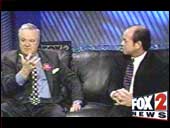
The heated debate over the fate of St. Stanislaus Polish Catholic Church took center stage on FOX 2 News in the Morning. Both sides joined us for a spirited debate over who should control the church and it's money the Archdioscese as Canon Law dictates or a lay board which has been doing so for years.

St. Stanislaus Spokesman Roger Krasnicki (pictured left): "The Archdiocese has continually attacked us. They took away our priests. They took away the Sacraments. People can't get baptized, they can't get married, and they can't have the Eucharist...the center of our faith. And the Archbishop is standing there with the Eucharist in his hand and he's saying to us 'You can have this. All you need to do is give me your property and your money.' What he's doing is exactly what the devil did to Jesus in the desert after the forty days of fasting. The devil came up to Jesus with a loaf of bread and said 'you can have this if you only worship me', and that's exactly what's happening in this case."


Archdiocese Spokesman Jamie Allman (pictured right): "Comparing the Archbishop to the devil is beyond the realm of comprehension here. This is an example of how these individuals, who previously were considered to be honorable individuals, would go out and accuse the Archbishop. Comparing him to the devil is beyond me."

Krasnicki: "Are you calling me a dishonorable person?"

Allman: "It is an example of how you all are not dealing with the Archdiocese in good faith."

In a letter this week, Archbishop Burke said the board members have until February 4th to hand over control or the members could be censured and not be able to participate in the liturgy or Sacraments of the Catholic church. A church spokesman says the Archbishop hasn't even made a threat that strong to pedophile priests.
I wish I would have known this was on - I would have taped it. Surely, one can see through the deceptive language in this:
"The Archdiocese has continually attacked us. They took away our priests. They took away the Sacraments. People can't get baptized, they can't get married, and they can't have the Eucharist..."
Archbishop Burke arranged for Holy Mass and the Sacraments at St. John the Apostle and Evangelist Parish. Why does Mr. Krasnicki persist in not telling the truth? Are the people from St Stanislaus who attend Mass at St John's denied Holy Communion?

(Picture by Mark Kempf - from the St. Louis Review)
[ARCHBISHOP RAYMOND L. BURKE meets Jan. 2 with those who had attended the 9 a.m. Mass in Polish at St. John the Apostle and Evangelist Parish in Downtown St. Louis. The archbishop used an interpreter to deliver his homily to the faithful, most of whom are Polish immigrants who have attended the weekly Polish-language Mass at St. John since the Polish apostolate was transferred there last summer from nearby St. Stanislaus Kostka Parish.]

Thursday night, for example, Richard? Bach, a spokesman for St. Stanislaus, was on 97.1 Talk FM radio and he was given free reign to distort facts as they have been presented by Archbishop Burke and free reign to distort Catholic teaching regarding conscience and obedience. I called in to inform him that he was mistaken regarding his understanding of obedience but was unable to drive, talk, shift and listen - and I was in a bad cell besides...Many of the callers, it seemed, were siding with the St. Stanislaus board, who seems to have been eager to get as much publicity as possible from this incident which the board alone has created - based upon the history probvide by the Archbishop and others.

One only has to recall some of the details of the confidential letter Archbishop Burke sent to them which, somehow, was quoted in a recent story by the Post Dispatch...What was the purpose of revealing all or part of a confidential letter if not for eliciting sympathy or presenting oneself as a "victim"?

Archbishop Burke Seeks Unified St. Stanislaus Parish

Archbishop Raymond L. Burke is asking members of St. Stanislaus Kostka Parish to tell the parish’s board of directors of their desire that the parish be fully Catholic — following the model of all the parishes of the archdiocese.

The archbishop recently wrote a letter to parishioners of St. Stanislaus regarding their decisions on the future of the parish. He also addressed the matter in his homily at a Mass for Polish immigrants at St. John Apostle and Evangelist Church Downtown.

The archbishop told the Review Jan. 5 that he’d written a confidential letter to the board of directors of St. Stanislaus discussing possible disciplinary action.

"I’m under an obligation to do what the Congregation for the Clergy (in the Vatican) has instructed me to do, plus I have an obligation to the parishioners of St. Stanislaus. I had no choice but to apply some discipline in the matter," the archbishop said.

He said the imposition of an interdict is considered more "medicinal" than "punitive."

In the interview and in his letter, Archbishop Burke said he will take three steps to assure parishioners of his commitment. The steps are to place all assets of the parish in an irrevocable charitable trust, enforceable by the state attorney general; establish an endowment fund within the trust to ensure the maintenance of parish property; and conduct an independent public audit to provide assurance of responsible financial management.
Full story at the St. Louis Review.

Gospel for Saturday after Epiphany

From: John 3:22-30

John Again Bears Witness

[22] After this Jesus and his disciples went into the land of Judea; there he remained with them and baptized. [23] John also was baptizing at Aenon near Salim, because there was much water there; and people came and were baptized. [24] For John had not yet been put in prison.

[25] Now a discussion arose between John's disciples and a Jew over purifying. [26] And they came to John, and said to him, Rabbi, he who was with you beyond the Jordan, to whom you bore witness, here he is, baptizing, and all are going to him." [27] John answered, "No one can receive anything except what is given him from heaven. [28] You yourselves bear me witness, that I said, I am not the Christ, but I have been sent before him. [29] He who has the bride is the bridegroom; the friend of the bridegroom, who stands and hears him, rejoices greatly at the bridegroom's voice; therefore this joy of mine is now full. [30] He must increase, but I must decrease.
****************
Commentary:

22-24. A little later on (Jn 4:2) the evangelist makes it clear that it was not Jesus himself who baptized, but his disciples Our Lord probably wanted them from the very beginning to get practice in exhorting people to conversion. The rite referred to here was not yet Christian Baptism--which only began after the resurrection of Christ (cf. Jn 7:39; 16:7; Mt 28:19)--but "both baptisms, that of St John the Baptist and that of our Lord's disciples [...], had a single purpose--to bring the baptized to Christ [...] and prepare the way for future faith" (St John Chrysostom, "Hom. on St John", 29, 1).

The Gospel gives the exact time and place of this episode. Aenon is an Aramaic word meaning "wells". Salim was situated to the north-east of Samaria, south of the town of Scythopolis or Beisan, near the western bank of the Jordan, about twenty kilometers (thirteen miles) to the south of the Lake of Gennesaret.

The Gospel notes that "John had not yet been put in prison" (v. 24), thus rounding out the information given by the Synoptics (Mt 4:12; Mk 1:14). We know, therefore, that Jesus' public ministry began when John the Baptist's mission was still going on, and, particularly, that there was no competition of any kind between them; on the contrary, the Baptist, who was preparing the way of the Lord, had the joy of actually seeing his own disciples follow Jesus (cf. Jn 1:37).

27-29. John the Baptist is speaking in a symbolic way here, after the style of the prophets; our Lord himself does the same thing. The bridegroom is Jesus Christ. From other passages in the New Testament we know that the Church is described as the Bride (cf. Eph 5:24-32; Rev 19:7-9). This symbol of the wedding expresses the way Christ unites the Church to himself, and the way the Church is hallowed and shaped in God's own life. The Baptist rejoices to see that the Messiah has already begun his public ministry, and he recognizes the infinite distance between his position and that of Christ: his joy is full because he sees Jesus calling people and them following him.

"The friend of the bridegroom", according to Jewish custom, refers to the man who used to accompany the bridegroom at the start of the wedding and play a formal part in the wedding celebration--the best man. Obviously, as the Baptist says, there is a great difference between him and the bridegroom, who occupies the center of the stage.

30. The Baptist knew his mission was one of preparing the way of the Lord; he was to fade into the background once the Messiah arrived, which he did faithfully and humbly. In the same way, a Christian, when engaged in apostolate, should try to keep out of the limelight and allow Christ to seek men out; he should be always emptying himself, to allow Christ fill his life. "It is necessary for Christ to grow in you, for you to progress in your knowledge and love of him: for, the more you know him and love him, the more he grows in you. [...] Therefore, people who advance in this way need to have less self-esteem, because the more a person discovers God's greatness the less importance he gives to his own human condition" (St Thomas Aquinas, "Commentary on St John, in loc.").
******
Source: "The Navarre Bible: Text and Commentaries". Biblical text taken from the Revised Standard Version and New Vulgate. Commentaries made by members of the Faculty of Theology of the University of Navarre, Spain. Published by Four Courts Press, Kill Lane, Blackrock, Co. Dublin, Ireland.

Reprinted with permission from Four Courts Press and Scepter Publishers, the U.S. publisher.

May the priest or the deacon change the words at Mass?

The answer comes to us from Father Thomas Keller, who is archdiocesan master of ceremonies and associate director at the archdiocesan Office of Worship.
Sometimes. The liturgical texts direct us to true active participation where we offer ourselves with Christ on the altar of the cross in the sure and certain hope of the resurrection. Many of these prayers have nourished saints and sinners for nearly two millennia. Some have emerged from the collective wisdom of the Church in the modern world. All of them belong to the people in the pews.

All liturgical texts may be divided into two kinds. The first kind is where the Roman Missal (Sacramentary) offers the option "in these or in similar words." Here, the sacred minister may vary the texts to help direct the assembly to greater participation.

The other texts in the Missal may not be changed. The Second Vatican Council’s "Constitution on Sacred Liturgy" offers this general norm: "(N)o other person, even if he be a priest, may add, remove, or change anything in the liturgy on his own authority" (No. 22.3).

The regulation of the liturgy belongs solely to the Holy See and where the law determines, the local bishop.

Also, the new instruction on the liturgy, "Sacrament of Redemption," insists on adherence to the proper texts: "The reprobated practice by which priests, deacons or the faithful here and there alter or vary at will the texts of the Sacred Liturgy that they are charged to pronounce must cease. For in doing thus, they render the celebration of the Sacred Liturgy unstable, and not infrequently distort the authentic meaning of the Liturgy" (No. 59).

It is an abuse of power to change the words for novelty, to distort theology or even to increase one’s own popularity. In doing so, the assembly is robbed of its right to fully participate. The prayers are deprived of their power; instead the power resides in the one who alters them.
Now if only this were put into practice...

Source.

Friday, January 07, 2005

Archbishop Burke Discusses "Vocation and Vocations"

On this coming Jan. 9 to 15, we will observe National Vocation Awareness Week. Beginning with the celebration of the Baptism of the Lord on Sunday, Jan. 9, the annual celebration gives us many helps in considering our share in Christ’s vocation and mission for the salvation of the world, which was revealed to the world at His baptism in the Jordan by John.

We are called to follow Christ in holiness of life. This is our vocation. We are called to follow Christ as a married person, a dedicated single person, a consecrated person or an ordained priest. These are the vocations by which we respond to the universal vocation to holiness of life.

We say in the Church that our vocation is our way to salvation, and it is true. It is through our vocation that we most fully express our life in Christ and realize our share in His mission of salvation. We are called to life in Christ, so that, when we reach adulthood, we may give our lives in response to God’s call. Therefore, it is important that children and young people pray each day to know their vocation in life, and that those of us, who have already responded to God’s call by embracing our vocation, pray each day for the virtues of fidelity and generosity in living our vocation.

Because of the importance of National Vocation Awareness Week for the Church and because prayer is the foundation of the apostolate of vocations to the priesthood or consecrated life, I urge you to set aside special time for prayer for vocations during National Vocation Awareness Week, making time for prayer for vocations a part of your daily living. Please pray that the young men and women whom God is calling to the priesthood and consecrated life will respond faithfully and generously to God’s call. (Emphasis added)
Complete article here.

Meeting Series at St Joseph-Cottleville

Speaker-discussion series

The public is invited to a speaker-discussion series based on universal social teachings in the administration building at St. Joseph Catholic Church, Motherhead Road, Cottleville.

The first gathering will begin with an overview at 7 p.m. Thursday.

Monthly themes will be: Life and Dignity of the Human Person; Call to Family, Community and Participation; Rights and Responsibilities, Option for the Poor and Vulnerable; the Dignity of Work and Rights of Workers; Solidarity and [Subsidarity] and Care for God's Creation.

Participants can attend any or all of the sessions. Information: Sandy Garrett at 636-300-1515 or e-mail Walt Gemmer at WGemmer@archstl.org.
Taken from the Post Dispatch.

Archdiocese of New York Reviews Selling Property

Officials of the Archdiocese of New York, one of the city's largest property owners, expect to sell off a significant number of church buildings, schools, and charitable facilities in the next year, to compensate for shifts in Catholic population concentrations, a church spokesman said yesterday.
Source.

A report on two mosques in Baghdad and the elections

Countdown to Voting in Iraq: The Mosques Are Clashing, Too
by Sandro Magiste

The Shiite mosques preach in favor of peaceful elections. Some of the Sunni ones are preaching against them, and justifying the bombings.

The Holy See has repeatedly encouraged the birth of a democratic Iraq: it did so most explicitly last November 4, when it received at the Vatican the head of Baghdad's provisional government, Iyad Allawi.

...as the voting draws near, Iraqi Muslims are profoundly divided.

And there is one principal arena in which this division is being expressed: the mosques.

But the point is, there's preaching and then there's preaching. On the same Friday in Baghdad, one can hear two diametrically opposed sermons about the imminent elections.

The Baratha mosque, for example, which belongs to the Shiite Muslims, is decisively in favor of the vote. The Um al-Qura mosque, which is Sunni, is against it.
Full story here

Bishop Listecki brings new perspective

...some needs, [Bishop] Listecki said, remain common to all Catholics.

"When I assume the leadership role, I will do an assessment of the particular needs of the diocese," he said. "There's always a need for all Catholics to support the dignity of life. ... Given the fact that we have new technologies, resources, given the fact that we have the ability to privatize so many things, respect for the dignity of human life is crucial."

Although his predecessor didn't back down when it came to certain hot-button issues, Listecki said that as of now, he doesn't know if he would change any of Burke's decisions.

"Bishop Burke was, always in my mind, a person who was thorough and very spiritual and very pastoral," he said. "That's not a person I would see as controversial or rash. ... (But) until I meet or confront those issues, I couldn't give you a definite answer."
Source.

The Bishops are Back

[I]t turned out that in 2004, the American bishops played a decisive role in turning the presidential candidacy of Sen. John Kerry into a teaching moment about Catholics in public life. It was no mean accomplishment.

The challenge to pro-abortion politicians emerged on the national scene as the result of Archbishop Raymond Burke’s decision to bar certain politicians from receiving holy Communion just before he moved from La Crosse to St. Louis. Within days, the relevant documents from La Crosse were readily available on websites, and bishops all over the country were being asked whether they agreed or disagreed.

A national debate no longer requires national institutions to take the initiative. Neither the major media nor the bishops’ conference had the abortion/Communion question on the agenda at the end of 2003. That an individual bishop can break into the national conversation this way is an encouraging development — especially for those bishops who face unfriendly mainstream media on the local scene.
Excerpts from an editorial in the National Catholic Register by Fr. Raymond J. de Souza.

Gospel for Friday after Epiphany

From: Luke 5:12-16

The Cure of a Leper

[12] While he (Jesus) was in one of the cities, there came a man full of leprosy; and when he saw Jesus, he fell on his face and besought him, "Lord, if you will, you can make me clean." [13] And he stretched out his hand, and touched him, saying, "I will; be clean." And immediately the leprosy left him. [14] And he charged him to tell no one; but "go and show yourself to the priest, and make an offering for your cleansing, as Moses commanded, for a proof to the people." [15] But so much the more the report went abroad concerning him; and great multitudes gathered to hear and to be healed of their infirmities. [16] But he withdrew to the wilderness and prayed.
*****************
Commentary:

12. The words of the leper are a model prayer. First, they show his faith. "He did not say, 'If you ask God for it...', but 'If you will"' (Chrysostom, "Hom. on St Matthew", 25). He rounds this off by saying, "You can"--an open confession of Christ's omnipotence. The psalmist expressed this same faith: "Whatever the Lord pleases he does, in heaven and on earth, in the seas and in the deep" (Ps 135:6). Along with this faith he shows confidence in God's mercy. "God is merciful; there is no need therefore to ask him; all we have to do is show him our need" (St Thomas Aquinas, "Commentary on St Matthew", 8, 1). And St John Chrysostom concludes: "Prayer is perfect when it is joined to faith and confession; the leper showed his faith and confessed his need out loud" ("Hom. on St Matthew", 25).

"'Domine!--Lord--"si vis, potes me mundare"--if thou wilt, thou canst make me clean.' What a beautiful prayer for you to say often, with the faith of the poor leper, when there happens to you what God and you and I know! You will not have to wait long to hear the Master's reply: '"Volo, mundare!" I will: be thou made clean!"' ([St] J. Escriva, "The Way", 142).

13. Jesus listens to the leper's petition and cures him of his disease. All of us suffer from spiritual ailments and our Lord is waiting for us to approach him: "He is our physician, and he heals our selfishness if we let his grace penetrate to the depths of our soul. Jesus has taught us that the worst sickness is hypocrisy, the pride that leads us to hide our own sins. We have to be totally sincere with him. We have to tell the whole truth, and then we have to say, 'Lord, if you will'--and you are always willing--'you can make me clean' (Mt 8:2). You know my weaknesses; I feel these symptoms; I suffer these failings. We show him the wound, with simplicity, and if the wound is festering, we show the pus too. Lord, you have cured so many souls; help me to recognize you as the divine physician when I have you in my heart or when I contemplate your presence in the tabernacle" ([St] J. Escriva, "Christ Is Passing By", 93).

16. The Third Gospel frequently draws attention to Jesus going off, alone, to pray (cf. 6:12; 9:18; 11:1). By doing this Jesus teaches us the need for personal prayer in all the various situations in which we find ourselves.

"Forgive me if I insist, but it is very important to note carefully what the Messiah did, because he came to show us the path that leads to the Father. With our Lord we will discover how to give a supernatural dimension to all our actions, even those that seem least important. We will learn to live every moment of our lives with a lively awareness of eternity, and we will understand more deeply man's need for periods of intimate conversation with his God, so as to get to know him, to invoke him, to praise him, to break out into acts of thanksgiving, to listen to him or, quite simply, to be with him" ([St] J. Escriva, "Friends of God", 239).
***********
Source: "The Navarre Bible: Text and Commentaries". Biblical text taken from the Revised Standard Version and New Vulgate. Commentaries made by members of the Faculty of Theology of the University of Navarre, Spain. Published by Four Courts Press, Kill Lane, Blackrock, Co. Dublin, Ireland.

Reprinted with permission from Four Courts Press and Scepter Publishers, the U.S. publisher.

Thursday, January 06, 2005

Ignorance Displayed in Post's Letters re:St Stanislaus

It's unfortunate that the Post has not, to my knowledge, printed a complete background of the St. Stanislaus issue so that their readers might be able to come to intelligent and well reasoned understandings of the situation. Perhaps, it makes better copy to keep fanning the flames, so to speak. As a result of the this, the Post prints a couple letters which demonstrate a severely deficient understanding of the issue:
The archbishop should apologize

Archbishop Raymond Burke should repent of his recent behavior toward the board of St. Stanislaus Church, admit his errors and apologize to the board and to the archdiocese. His actions regarding the good, harmless people of the parish and his interdict against the board are nothing more than bare-knuckles brawling for control.

It is a scandal for a representative of Jesus Christ, who preached a message of mercy, humility and peace, not canon law.

And Burke needs to find a new spokesman. Jamie Allman's comments are not conciliatory, but inflammatory.

Kevin McGrane
Maplewood
And then there is this:
The archbishop's spokesman, Jamie Allman, speaking of the penalty threatened against the St. Stanislaus board, said: "It might be rare, but it's even rarer for a board of directors to hijack a Catholic church." Give me a break!

If it weren't for the board of St. Stanislaus and like-minded parishioners, there wouldn't even be a church left to hijack.

It seems to me the only hijacking attempt here is from the archdiocese wanting the $9 million in parish assets.

An interdiction is probably a blessing. Who really wants to belong to an organization that protects pedophiles and persecutes good men?

Becky Elfrink
Fenton
Source.

Bishop Olmsted takes firm hold of diocese

Catholic Bishop Thomas J. Olmsted, who just marked his first year as head of the 500,000-member Diocese of Phoenix, has become known for his conservative, orthodox ways and his willingness to confront aspects of American culture he views as anti-religious.

Olmsted is sending Valley Catholics strong messages about homosexuality and abortion and implementing stricter church rules governing the Mass, aimed at restoring reverence to the service.

Olmsted's appointment ... continued a trend in bishop appointments of relatively conservative, highly orthodox priests, many with experience working in the Vatican.
And for this, we should be ever grateful to the Holy Father, but especially to our Lord.
The Rev. Charles Goraieb, pastor of St. Henry, the Catholic church in Buckeye, said the bishop's "decisiveness" is "clear, not arbitrary, because it is based on church law and teaching."

The bishop, he said, exhibits "extraordinary pastoral charity."

"It is a wonder to watch him with people who disagree with him," Goraieb said. "He is kind, patient, so gentle and forbearing, but he doesn't give an inch."

"He holds his priests accountable. He also is uncompromising in his fidelity to the church," said the Rev. John Ehrich, associate pastor at St. Thomas the Apostle in Phoenix. "He is very present to his priests and communicates with us very well."
Phoenix is on a course of a genuine renewal of the faith due primarily, it seems, to having a true shepherd leading the faithful. Of course, fidelity causes problems for others:
Marta Pecuch, a Catholic who declines to give her parish affiliation, said, "There are many people who are unhappy with this bishop. I hope all their views are represented."

Another, Robert Blair Kaiser of Phoenix, an author and journalist who has focused his career on the Catholic Church, said the bishop, along with others throughout the United States, is trying to "widen the regrettable chasm between the clergy and the rest of us."

"(This effort is) driving more and more good Catholics from regular attendance at Mass," Kaiser said.

Tom Van Dyke, 53, who attends Our Lady of the Valley in Phoenix, said that although he applauds several of Olmsted's changes, the bishop seems to be "a theological policeman" who believes the role of the laity is to "pray, pay and obey."
Frankly, we would be much better off if more Catholics did pray and obey.

Also, how is it possible that a bishop who would promote fidelity to the teachings of the Church and demands the same from his priests "widens the regrettable chasm between the clergy and the rest of us?" The statement makes absolutely no sense because it is patently false - UNLESS - the "US" refers to those who claim to be Catholic while. at the same time, reject Church teaching.

The other statement about "more good Catholics" being driven from regular Mass attendance because of the bishop's efforts must also be viewed as a distortion of the truth. Good and faithful Catholics would not be driven from regular Sunday Mass by a faithful and determined bishop - A bishop (or priest for that matter) who exercises his duties with humility, charity, and fidelity, who speaks the truth in season and out of season, can only help draw more people to Christ. Only those "Catholics" who are opposed to the truth are driven away by faithful bishops and priests.

Bishop Olmsted says:
"My job requires different duties. I try to explain the teachings, apply them and at times defend them, and there will be times I have to speak strongly," he said. "But I also try to express my thoughts persuasively and with a reasoned explanation arising out of a rich intellectual heritage."

He said he is focused on church teaching, not his own, and that his role is more that of a servant than an authority.

"The work of the [C]hurch is Christ's work, and [H]e works through me," he explained.
Our good bishops and priests need our loving support and our prayers. Remember to pray for them daily as they fulfill they work for which they were called.

Article here.

Gospel for Thursday after Epiphany

From: Luke 4:14-22

Jesus Fasts and is Tempted in the Wilderness (Continuation)

[14] And Jesus returned in the power of the Spirit into Galilee, and a report concerning Him went out through all the surrounding country. [15] And He taught in their synagogues, being glorified by all.

Jesus Preaches in Nazareth

[16] And He came to Nazareth, where He had been brought up; and He went to the synagogue, as His custom was, on the Sabbath Day. And He stood up to read; [17] and there was given to Him the book of the prophet Isaiah. He opened the book and found the place where it was written, [18] "The Spirit of the Lord is upon Me, because He has anointed Me to preach good news to the poor. He has sent Me to proclaim release to the captives and recovering of sight to the blind, to set at liberty those who are oppressed, [19] to proclaim the acceptable year of the Lord." [20] And He closed the book, and gave it back to the attendant, and sat down; and the eyes of all in the synagogue were fixed on Him. [21] And He began to say to them, "Today this scripture has been fulfilled in your hearing. [22] And all spoke well of Him, and wondered at the gracious words which proceeded out of His mouth; and they said, "Is not this Joseph's son?"
**************
Commentary:

16-30. For the Jews the Sabbath was a day of rest and prayer, as God commanded (Exodus 20:8-11). On that day they would gather together to be instructed in Sacred Scripture. At the beginning of this meeting they all recited the "Shema", a summary of the precepts of the Lord, and the "eighteen blessings". Then a passage was read from the Book of the Law--the Pentateuch--and another from the Prophets. The president invited one of those present who was well versed in the Scriptures to address the gathering. Sometimes someone would volunteer and request the honor of being allowed to give this address--as must have happened on this occasion. Jesus avails Himself of this opportunity to instruct the people (cf. Luke 4:16ff), as will His Apostles later on (cf. Acts 13:5, 14, 42, 44; 14:1; etc.). The Sabbath meeting concluded with the priestly blessing, recited by the president or by a priest if there was one present, to which the people answered "Amen" (cf. Numbers 6:22ff).

18-21. Jesus read the passage from Isaiah 61:1-2 where the prophet announces the coming of the Lord, who will free His people of their afflictions. In Christ this prophecy finds its fulfillment, for He is the Anointed, the Messiah whom God has sent to His people in their tribulation. Jesus has been anointed by the Holy Spirit for the mission the Father has entrusted to Him. "These phrases, according to Luke (verses 18-19), are His first messianic declaration. They are followed by the actions and words known through the Gospel. By these actions and words Christ makes the Father present among men" (John Paul II, "Dives In Misericordia", 3).

The promises proclaimed in verses 18 and 19 are the blessings God will send His people through the Messiah. According to Old Testament tradition and Jesus' own preaching (cf. note on Matthew 5:3), "the poor" refers not so much to a particular social condition as to a very religious attitude of indigence and humility towards God, which is to be found in those who, instead of relying on their possessions and merits, trust in God's goodness and mercy. Thus, preaching good news to the poor means bringing them the "good news" that God has taken pity on them. Similarly, the Redemption, the release, which the text mentions, is to be understood mainly in a spiritual, transcendental sense: Christ has come to free us from the blindness and oppression of sin, which, in the last analysis, is slavery imposed on us by the devil. "Captivity can be felt", St. John Chrysostom teaches in a commentary on Psalm 126, "when it proceeds from physical enemies, but the spiritual captivity referred to here is worse; sin exerts a more severe tyranny, evil takes control and blinds those who lend it obedience; from this spiritual prison Jesus Christ rescued us" ("Catena Aurea"). However, this passage is also in line with Jesus' special concern for those most in need. "Similarly, the Church encompasses with her love all those who are afflicted by human misery and she recognizes in those who are poor and who suffer the image of her poor and suffering Founder. She does all in her power to relieve their need and in them she strives to serve Christ" (Vatican II, "Lumen Gentium", 8).

18-19. The words of Isaiah which Christ read out on this occasion describe very graphically the reason why God has sent His Son into the world--to redeem men from sin, to liberate them from slavery to the devil and from eternal death. It is true that in the course of His public ministry Christ, in His mercy, worked many cures, cast out devils, etc. But He did not cure all the sick people in the world, nor did He eliminate all forms of distress in this life, because pain, which entered the world through sin, has a permanent redemptive value when associated with the sufferings of Christ. Therefore, Christ worked miracles not so much to release the people concerned from suffering, as to demonstrate that He had a God-given mission to bring everyone to eternal salvation.

The Church carries on this mission of Christ: "Go therefore and make disciples of all nations, baptizing them in the name of the Father and of the Son and of the Holy Spirit, teaching them to observe all that I have commanded you; and lo, I am with you always, to the close of the age" (Matthew 28:19-20). These simple and sublime words, which conclude the Gospel of St. Matthew, point out "the obligation to preach the truths of faith, the need for sacramental life, the promise of Christ's continual assistance to His Church. You cannot be faithful to our Lord if you neglect these supernatural demands--to receive instruction in Christian faith and morality and to frequent the Sacraments. It is with this mandate that Christ founded His Church [...]. And the Church can bring salvation to souls only if she remains faithful to Christ in her constitution and teaching, both dogmatic and moral.

"Let us reject, therefore, the suggestion that the Church, ignoring the Sermon on the Mount, seeks a purely human happiness on earth, since we know that her only task is to bring men to eternal glory in Heaven. Let us reject any purely naturalistic view that fails to value the supernatural role of divine grace. Let us reject materialistic opinions that exclude spiritual values from human life. Let us equally reject any secularizing theory which attempts to equate the aims of the Church with those of earthly states, distorting its essence, institutions and activities into something similar to those of temporal society" ([St] J. Escriva, "In Love with the Church", 23 and 31).

18. The Fathers of the Church see in this verse a reference to the three persons of the Holy Trinity: the Spirit (the Holy Spirit) of the Lord (the Father) is upon Me (the Son); cf. Origen, "Homily 32". The Holy Spirit dwelt in Christ's soul from the very moment of the Incarnation and descended visibly upon Him in the form of a dove when He was baptized by John (cf. Luke 3:21-22).

"Because He has anointed Me": this is a reference to the anointing Jesus received at the moment of His Incarnation, principally through the grace of the hypostatic union. "This anointing of Jesus Christ was not an anointing of the body as in the case of the ancient kings, priests and prophets; rather it was entirely spiritual and divine, because the fullness of the Godhead dwells in Him substantially" ("St. Pius X Catechism", 77). From this hypostatic union the fullness of all graces derives. To show this, Jesus Christ is said to have been anointed by the Holy Spirit Himself--not just to have received the graces and gifts of the Spirit, like the saints.

19. "The acceptable year": this is a reference to the jubilee year of the Jews, which the Law of God (Leviticus 25:8) lays down as occurring every fifty years, symbolizing the era of redemption and liberation which the Messiah would usher in. The era inaugurated by Christ, the era of the New Law extending to the end of the world, is "the acceptable year", the time of mercy and redemption, which will be obtained definitively in Heaven.

The Catholic Church's custom of the "Holy Year" is also designed to proclaim and remind people of the redemption brought by Christ, and of the full form it will take in the future life.

20-22. Christ's words in verse 21 show us the authenticity with which He preached and explained the Scriptures: "Today this scripture has been fulfilled in your hearing." Jesus teaches that this prophecy, like the other main prophecies in the Old Testament, refers to Him and finds its fulfillment in Him (cf. Luke 24:44ff). Thus, the Old Testament can be rightly understood only in the light of the New - as the risen Christ showed the Apostles when He opened their minds to understand the Scriptures (cf. Luke 24:45), an understanding which the Holy Spirit perfected on the day of Pentecost (cf. Acts 2:4).

22-29. At first the people of Nazareth listened readily to the wisdom of Jesus' words. But they were very superficial; in their narrow-minded pride they felt hurt that Jesus, their fellow-townsman, had not worked in Nazareth the wonders He had worked elsewhere. They presume they have a special entitlement and they insolently demand that He perform miracles to satisfy their vanity, not to change their hearts. In view of their attitude, Jesus performs no miracle (His normal response to lack of faith: cf., for example, His meeting with Herod in Luke 23:7-11); He actually reproaches them, using two examples taken from the Old Testament (cf. 1 Kings 17:9 and 2 Kings 5:14), which show that one needs to be well-disposed if miracles are to lead to faith. His attitude so wounds their pride that they are ready to kill Him. This whole episode is a good lesson about understanding Jesus. We can understand Him only if we are humble and are genuinely resolved to make ourselves available to Him.
*********
Source: "The Navarre Bible: Text and Commentaries". Biblical text taken from the Revised Standard Version and New Vulgate. Commentaries made by members of the Faculty of Theology of the University of Navarre, Spain. Published by Four Courts Press, Kill Lane, Blackrock, Co. Dublin, Ireland.

Reprinted with permission from Four Courts Press and Scepter
Publishers, the U.S. publisher.
Wednesday, January 05, 2005

Latin High Mass at St. Agatha Tomorrow Evening

I was informed today that A Latin High Mass will be celebrated by a priest from the Institute of Christ the King at St Agatha Church in St. Louis tomorrow evening at 7:00PM to celebrate the Feast of the Epiphany.

To that end, then, I have include an excerpt on the Feast of the Epiphany from Fr. Leonard Goffine's "The Church's Year".
What festival is this?

This festival is set apart to solemnly commemorate the coming of the three wise men from the East, guided by a miraculous star which appeared to them, and directed them to Bethlehem, where they found Christ in the stable; here they honored and adored Him and offered gifts to Him.

Why is this day called Epiphqnid Domini, or Apparition of the Lord?

Because the Church wishes to bring before our mind the three great events in the life of Christ, when He made known to man His divinity: the coming of the wise men from the East, through whom He revealed Himself to the Gentiles as the Son of God; His baptism, on which occasion His Divinity was made known to the Jews, and His first miracle at the marriage of Cana, by which He revealed Himself to His disciples.

GOSPEL (Mt. 2:1-12).
When Jesus was born in Bethlehem of Juda, in the days of king Herod, behold there came wise men from the East to Jerusalem, saying: Where is he that is born King of the Jews? For we have seen his star in the East, and are come to adore him. And king Herod hearing this, was troubled, and all Jerusalem with him. And assembling together all the chief priests and the scribes of the people, he inquired of them where Christ should be born. But they said to him: In Bethlehem of Juda; for so it is written by the prophet: And thou, Bethlehem, the land of Juda, art not the least among the princes of Juda, for out of thee shall come forth the ruler that shall rule my people Israel. Then Herod, privately calling the wise men, learned diligently of them the time of the star which appeared to them; and sending them into Bethlehem, said: Go and diligently inquire after the child, and when you have found him, bring me word again, that I also may come and adore him. Who having heard the king, went their way; and behold, the star which they had seen in the East went before them, until it came and stood over where the child was. And seeing the star, they rejoiced with exceeding great joy. And entering into the house, they found the child with Mary his mother and falling down they adored him. And opening their treasures, they offered him gifts; gold, frankincense, and myrrh. And having received an answer in sleep that they should not return to Herod, they went back another way into their own country.

What caused the three kings to undertake so tedious a journey?

A star which God permitted to appear in their land, at the sight of which they were inwardly enlightened, so that they at once recognized its signification. Let us learn from these kings who so readily responded to the inspiration of God, by immediately undertaking so difficult a journey, to follow without delay the promptings of divine grace, and from their zeal, and the fearlessness with which they asked Herod where the Messiah would be found, we should learn to seek and practice, without fear of men, whatever is necessary for our salvation.

Why did Herod fear, and all Jerusalem with him?

Because Herod, a proud, imperious, cruel, and therefore jealous king, was afraid, when he heard of a new-born king, that he would be deprived of his throne, and punished for his vices. A bad conscience is always ill at ease, and has no peace. There is no peace to the wicked, saith the Lord God (Is. 57:21). Jerusalem, that is, the inhabitants of Jerusalem, feared because many of them were attached to Herod, and others, especially the chief priests and the scribes, feared they would be punished for their secret crimes, when the Messiah would come, of whom they knew that He shall judge the poor with justice, and with the breath of his lips he shall slay the wicked (Is. 11:4).

Why did Herod assemble the chief priests and the scribes?

Partly to find from them where the Messiah was to be born, partly and principally because God so directed it, that Herod and the chief priests, knowing the time and place of the Messiah's birth, would have no excuse for their infidelity. In the same way God often makes known to us, in the clearest manner the most wholesome truths, yet we heed them as little as did the Jews who had sufficient knowledge of the Messiah, indeed, even showed the way to the three kings, but made no use of it for themselves, and were therefore cast away.

Why did Herod say he wished to adore the child?

This he did out of wicked hypocrisy and dissimulation. He had no other intention than to put Jesus to death, and therefore affected piety to find out exactly the time and place of His birth. Thus do those murderers of souls who desire the fall of the innocent; they do not let their evil intentions be made known at once, and so they put on sheep's clothing, feign piety and devotion, until they creep into the heart from which, by flattery and irony about religion and virtue, and by presents, they expel shame, the fear of God, and thus murder the soul.

Why did the kings fall down and adore Christ?

Because by the light of faith they saw in the Infant at Bethlehem God Himself, and, notwithstanding the poverty of His surroundings, recognized in Him the expected Messiah, the new-born king of the Jews, and by prostrating themselves before Him paid Him the homage of their country.

Why did the kings offer gold, frankincense and myrrh?

Because it was the ancient Eastern custom, never to appear without presents before a prince or king, and the three kings, as the holy Fathers universally teach, enlightened by the Holy Ghost, desired by their presents to honor Christ as God, as king, and as man. Of this the venerable Bede writes: "The first of the kings, named Melchior, offered gold to Christ the Lord and king; the second, named Caspar, frankincense to the divinity of Christ; and the third, Balthassar, myrrh, by which was expressed that Christ, the Son of man, must die."

How can we bring similar offerings to Christ?

We offer gold to Him, when we love Him with our whole heart, and out of love to Him, present Him our will by perfect obedience and continual self-denial, as our will is our most precious treasure. We also offer Him gold when we assist the poor by alms given in His name. We offer Him frankincense when we devoutly and ardently pray to Him, especially when we meditate upon His omnipotence, love, goodness, justice and mercy. We offer Him myrrh when we avoid carnal desires, mortify our evil inclinations and passions, and strive for purity of body and soul.

Why did the kings return by another way to their own country?

This they did by command of God. From the example of the three wise men we should learn to obey God rather than man, that we must be obedient to His directions, even if we do not understand them; so the three kings obeyed, although they may not have understood why God commanded them to flee from Herod. After we have found God we should walk in the path of virtue, and not return to our old sinful ways. "Our fatherland is paradise, heaven," writes St. Gregory. "We have departed from it by pride, disobedience, abuse of the senses, therefore it is needed that we return to it by obedience, contempt of the world, and by taming the desires of the flesh; thus we return to our own country by another road. By forbidden pleasures we have forfeited the joys of paradise, by penance we must regain them."

ASPIRATION
Give me, O divine Savior, the faith of those East­ern kings. Enlighten my understanding with the light which en­lightened them, and move my heart, that I may in future follow this light, and sincerely seek Thee who hast first sought me. Grant also, that I may really find Thee, with the wise men may adore Thee in spirit and in truth, and bring to Thee the gold of love, the frankin­cense of prayer, and the myrrh of penance and mortification, that, having here offered Thee the sacrifice of my faith, I may adore Thee in Thy eternal glory. Amen.
Special thanks to Marc P. for informing me of this special Mass.

The Denial of Personhood to Justify Abortion & ESCR

Today, a letter in the Post Dispatch by a "professor" of historical theology attempts to justify embryonic stem cell research by using false arguments to deny that personhood begins at conception. He, wrongly, asserts that since St. Augustine and St. Thomas Aquinas, because they did not view a fetus as a person, it must therefore follow that it is permissible to destroy the fetus or the embryo. Evidently, the knowledge obtained in the intervening centuries must be of no importance. Amazingly, he does not mention the first century document, the Didache, which clearly and unambiguously forbids abortion by any means.
Avoiding the issue

Lawrence A. Weber's Jan. 1 letter, "Embryonic stem cell research involves the destruction of life," disingenuously avoids the real issue. No one disputes that stem cell research involves the "disaggregation of a human embryo."

The question is whether a human embryo, tiny in size, months from developing a central nervous system, and not implanted in a woman's womb, could be called a human person. Being alive with human DNA differs from being alive with the sentience required for human personhood.

The great weight of Western tradition, including Christian (and thus Catholic) thought, has recognized this. Not until the 17th century, when through faulty biology scientists thought fertilized eggs were fully developed but miniature creatures, did the "fetus as a person" argument develop. Neither Sts. Augustine (354-430) nor Thomas Aquinas (1225-1274), for example, thought the fetus was a person until later in pregnancy. Augustine compared the early developing fetus to vegetation.

There is precious little scriptural, historical or theological reason to think that the embryonic human life "disaggregated" in stem cell research bears any connection to a human person being destroyed. Weber's arguments could use more clarity of thought and language and less self-righteous sarcasm.

John W. Riggs
Professor of Historical Theology
and Church History,
Eden Theological Seminary
Webster Groves
Perhaps, Mr. Riggs would be well served to read Dr. Peter Kreeft's excellent article, "Human Personhood Begins at Conception", which can be read here.

Jamie Allman Highlighted in Post Article

Former television reporter takes on new role with Archdiocese
Julie Randle
Of the Suburban Journals
Oakville-Mehlville Journal

The beginning of the new year marked a change in career positions for longtime television personality Jamie Allman.
I was not aware that Jamie is a recent convert to the faith. An interesting article here.

Millstadt's ‘Father Bernie' leaving

After about 30 years as a priest, the Rev. Bernard Goedde, pastor of St. James Catholic Church in Millstadt, is taking a sabbatical beginning next week.

This is good news for him—six months in sunny California at the Vatican II Institute for the Clergy in Menlo Park, Calif.—but not such good news for Millstadt.

When "Father Bernie" returns he will not be coming back to St. James, but will be reassigned elsewhere, perhaps to a smaller parish, St. James trustee, Rich Brune said.
Source

Archbishop Burke Issues Ultimatum to St. Stanislaus Board

St. Louis Archbishop Raymond Burke has threatened to withhold the sacraments of the Roman Catholic church, including Communion, from board members of St. Stanislaus Kostka Parish in a dispute over control of the church.

"I warn you that your refusal to comply with the legitimate directives of the Holy See and me, your Archbishop, carries with it, the punishment of 'interdict or other just penalties,'" wrote Burke in a letter to the board members. The archbishop set a date of Feb. 4 for the board to comply with his directives.
I think Archbishop Burke has been more than generous with his patience with this group. They continue to act like spoiled children who are upset because they are being called to obedience.
The penalty of interdict would be issued by Burke, not by the Vatican, but its effect for the board members would be in place throughout the Catholic world, not just in the archdiocese of St. Louis. If Burke issues the penalty, the board members would be given an opportunity to respond during what would amount to an appeal. It would also be lifted if any of those penalized were to repent.

"I consider it a badge of honor," said board member Robert Zabielski. "I'm sticking up for what is right. Pedophiles in this church are transferred from diocese to diocese while good, faithful people are excommunicated." Zabielski said he was not surprised to receive the letter. "It was only a matter of time before something like this came," he said.

Roger Krasnicki, a St. Stanislaus spokesman, called Burke's warning "a heinous act."

"Archbishop Burke has gone far beyond his authority," he said, "and he has abused his authority in executing an order like this."
A badge of honor? A heinous act? It's shameful language that these menu use.

These professed Catholic men are in for a rude awakening, I believe. A proud and arroganct person always becomes disobedient and this rejection of humility and obedience always ends in spiritual death. The scandal that the board members give to others is yet another source of sin. For the sake of money, many people have abandoned our Lord, just as Judas did. I fear that some at St. Stanislaus are intent on doing the same. Perhaps with prayer and God's grace, these people will avoid further rupturing any bonds with the Church that they still have.

Source.