The Armor of God
Reflections and Prayers for Wartime
CHAPTER IX
The Blessed Mother
"TO OUR LADY"
Lovely Lady dressed in blue -
Teach me how to pray!
God was just your little Boy,
Tell me what to say!
Did you lift Him up, sometimes,
Gently, on your knee?
Did you sing to Him the way
Mother does to me?
Did you hold His hand at night?
Did you ever try
Telling stories of the world?
O! And did He cry?
Do you really think He cares
If I tell Him things -
Little things that happen? And
Do the Angels' wings
Make a noise? And can He hear
Me if I speak low?
Does He understand me now?
Tell me - for you know?
Lovely Lady dressed in blue,
Teach me how to pray!
God was just your little Boy.
And you know the way.
- Mary Dixon Thayer
[Continued tomorrow]
_____________
From:
The Armor of God
Reflections and Prayers for Wartime
by Rt. Rev. Msgr. Fulton J. Sheen
(C) 1943, P.J. Kenedy & Sons
Showing posts with label Mary. Show all posts
Showing posts with label Mary. Show all posts
Tuesday, March 29, 2011


Friday, March 11, 2011
Prayers & Reflections for March 11
The Armor of God
Reflections and Prayers for Wartime
CHAPTER IX
The Blessed Mother
If you could have pre-existed your mother would you not have made her the most beautiful woman and the best woman in the world?
Well; Our Lord pre-existed His Mother.
We may therefore presume that He did that very thing.
[Continued tomorrow]
_____________
From:
The Armor of God
Reflections and Prayers for Wartime
by Rt. Rev. Msgr. Fulton J. Sheen
(C) 1943, P.J. Kenedy & Sons
Reflections and Prayers for Wartime
CHAPTER IX
The Blessed Mother
If you could have pre-existed your mother would you not have made her the most beautiful woman and the best woman in the world?
Well; Our Lord pre-existed His Mother.
We may therefore presume that He did that very thing.
[Continued tomorrow]
_____________
From:
The Armor of God
Reflections and Prayers for Wartime
by Rt. Rev. Msgr. Fulton J. Sheen
(C) 1943, P.J. Kenedy & Sons
Tuesday, February 01, 2011
Gospel for Feb 2, Feast of the Presentation of the Lord (Candlemas)
Old Calendar: Purification of the Blessed Virgin Mary
From: Luke 2:22-40
The Purification of Mary and the Presentation of Jesus in the Temple
[22] And when the time came for their purification according to the law of Moses, they (Joseph and Mary) brought Him (Jesus) up to Jerusalem to present Him to the Lord [23] (as it is written in the law of the Lord, "every male that opens the womb shall be called holy to the Lord") [24] and to offer a sacrifice according to what is said in the law of the Lord, "a pair of turtle-doves, or two young pigeons."
Simeon's Prophecy
[25] Now there was a man in Jerusalem, whose name was Simeon, and this man was righteous and devout, looking for the consolation of Israel, and the Holy Spirit was upon him. [26] And it had been revealed to him by the Holy Spirit that he should not see death before he had seen the Lord's Christ. [27] And inspired by the Spirit he came into the temple; and when the parents brought in the child Jesus, to do for Him according to the custom of the law, [28] he took Him up in his arms and blessed God and said, [29] "Lord, now lettest thou thy servant depart in peace, according to Thy word; [30] for mine eyes have seen Thy salvation [31] which Thou hast prepared in the presence of all peoples, [32] a light for revelation to the Gentiles, and for the glory to Thy people Israel."
[33] And His father and His mother marvelled at what was said about Him; [34] and Simeon blessed them and said to Mary, His mother, "Behold this child is set for the fall the rising of many in Israel, and for a sign that is spoken against [35] (and a sword will pierce through your own soul also), that thoughts out of many hearts may be revealed."
Anna's Prophecy
[36] And there was a prophetess Anna, the daughter of Phanuel, of the tribe of Ahser; she was of a great age, having lived with her husband seven years from her virginity, [37] and as a widow till she was eighty-four. She did not depart from the temple, worshipping with fasting and prayer night and day. [38] And coming up at that very hour she gave thanks to God, and spoke of Him to all who were looking for the redemption of Jerusalem.
The Childhood of Jesus
[39] And when they had performed everything according to the law of the Lord, they returned to Galilee, to their own city, Nazareth. [40] And the child grew and became strong, filled with wisdom; and the favor of God was upon Him.
_____________________
Commentary:
22-24. The Holy Family goes up to Jerusalem to fulfill the prescriptions of the Law of Moses--the purification of the mother and the presentation and then redemption or buying back of the first-born. According to Leviticus 12:2-8, a woman who bore a child was unclean. The period of legal impurity ended, in the case of a mother of a male child, after forty days, with a rite of purification. Mary most holy, ever-virgin, was exempt from these precepts of the Law, because she conceived without intercourse, nor did Christ's birth undo the virginal integrity of His Mother. However, she chose to submit herself to the Law, although she was under no obligation to do so.
"Through this example, foolish child, won't you learn to fulfill the holy Law of God, regardless of personal sacrifice?
"Purification! You and I certainly do need purification. Atonement and, more than atonement, Love. Love as a searing iron to cauterize our soul's uncleanness, and as a fire to kindle with divine flames the wretchedness of our hearts" ([St] J. Escriva, "Holy Rosary", Fourth Joyful Mystery).
Also, in Exodus 13:2, 12-13 it is indicated that every first-born male belongs to God and must be set apart for the Lord, that is, dedicated to the service of God. However, once divine worship was reserved to the tribe of Levi, first-born who did not belong to that tribe were not dedicated to God's service, and to show that they continued to be God's special property, a rite of redemption was performed.
The Law also laid down that the Israelites should offer in sacrifice some lesser victim--for example, a lamb or, if they were poor, a pair of doves or two pigeons. Our Lord, who "though He was rich, yet for your sake He became poor, so that by His poverty you might become rich" (2 Corinthians 8:9), chose to have a poor man's offering made on His behalf.
25-32. Simeon, who is described as a righteous and devout man, obedient to God's will, addresses himself to our Lord as a vassal or loyal servant who, having kept watch all his life in expectation of the coming of his Lord, sees that this moment has "now" come, the moment that explains his whole life. When he takes the Child in his arms, he learns, not through any reasoning process but through a special grace from God, that this Child is the promised Messiah, the Consolation of Israel, the Light of the nations.
Simeon's canticle (verses 29-32) is also a prophecy. It consists of two stanzas: the first (verses 29-30) is an act of thanksgiving to God, filled with profound joy for having seen the Messiah. The second (verses 31-32) is more obviously prophetic and extols the divine blessings which the Messiah is bringing to Israel and to all men. The canticle highlights the fact that Christ brings redemption to all men without exception--something foretold in many Old Testament prophecies (cf. Genesis 22:18; Isaiah 2:6; 42:6; 60:3; Psalm 28:2).
It is easy to realize how extremely happy Simeon was--given that many patriarchs, prophets and kings of Israel had yearned to see the Messiah, yet did not see Him, whereas he now held Him in his arms (cf. Luke 10:24; 1 Peter 1:10).
33. The Blessed Virgin and St. Joseph marvelled not because they did not know who Christ was; they were in awe at the way God was revealing Him. Once again they teach us to contemplate the mysteries involved in the birth of Christ.
34-35. After Simeon blesses them, the Holy Spirit moves him to further prophecy about the Child's future and His Mother's. His words become clearer in the light of our Lord's life and death.
Jesus came to bring salvation to all men, yet He will be a sign of contradiction because some people will obstinately reject Him--and for this reason He will be their ruin. But for those who accept Him with faith Jesus will be their salvation, freeing them from sin in this life and raising them up to eternal life.
The words Simeon addresses to Mary announce that she will be intimately linked with her Son's redemptive work. The sword indicates that Mary will have a share in her Son's sufferings; hers will be an unspeakable pain which pierces her soul. Our Lord suffered on the cross for our sins, and it is those sins which forge the sword of Mary's pain. Therefore, we have a duty to atone not only to God but also to His Mother, who is our Mother too.
The last words of the prophecy, "that out of many hearts thoughts may be revealed", link up with verse 34: uprightness or perversity will be demonstrated by whether one accepts or rejects Christ.
36-38. Anna's testimony is very similar to Simeon's; like him, she too has been awaiting the coming of the Messiah her whole life long, in faithful service of God, and she too is rewarded with the joy of seeing Him. "She spoke of Him," that is, of the Child--praising God in her prayer and exhorting others to believe that this Child is the Messiah.
Thus, the birth of Christ was revealed by three kinds of witnesses in three different ways--first, by the shepherds, after the angel's announcement; second, by the Magi, who were guided by a star; third, by Simeon and Anna, who were inspired by the Holy Spirit.
All who, like Simeon and Anna, persevere in piety and in the service of God, no matter how insignificant their lives seem in men's eyes, become instruments the Holy Spirit uses to make Christ known to other. In His plan of redemption God avails of these simple souls to do much good to all mankind.
39. Before their return to Nazareth, St. Matthew tells us (2:13-23), the Holy Family fled to Egypt where they stayed for some time.
40. "Our Lord Jesus Christ as a child, that is, as one clothed in the fragility of human nature, had to grow and become stronger but as the eternal Word of God He had no need to become stronger or to grow. Hence He is rightly described as full of wisdom and grace" (St. Bede, "In Lucae Evangelium Expositio, in loc.").
___________________________
Source: "The Navarre Bible: Text and Commentaries". Biblical text taken from the Revised Standard Version and New Vulgate. Commentaries made by members of the Faculty of Theology of the University of Navarre, Spain. Published by Four Courts Press, Kill Lane, Blackrock, Co. Dublin, Ireland. Reprinted with permission from Four Courts Press and Scepter Publishers, the U.S. publisher.
From: Luke 2:22-40
The Purification of Mary and the Presentation of Jesus in the Temple
[22] And when the time came for their purification according to the law of Moses, they (Joseph and Mary) brought Him (Jesus) up to Jerusalem to present Him to the Lord [23] (as it is written in the law of the Lord, "every male that opens the womb shall be called holy to the Lord") [24] and to offer a sacrifice according to what is said in the law of the Lord, "a pair of turtle-doves, or two young pigeons."
Simeon's Prophecy
[25] Now there was a man in Jerusalem, whose name was Simeon, and this man was righteous and devout, looking for the consolation of Israel, and the Holy Spirit was upon him. [26] And it had been revealed to him by the Holy Spirit that he should not see death before he had seen the Lord's Christ. [27] And inspired by the Spirit he came into the temple; and when the parents brought in the child Jesus, to do for Him according to the custom of the law, [28] he took Him up in his arms and blessed God and said, [29] "Lord, now lettest thou thy servant depart in peace, according to Thy word; [30] for mine eyes have seen Thy salvation [31] which Thou hast prepared in the presence of all peoples, [32] a light for revelation to the Gentiles, and for the glory to Thy people Israel."
[33] And His father and His mother marvelled at what was said about Him; [34] and Simeon blessed them and said to Mary, His mother, "Behold this child is set for the fall the rising of many in Israel, and for a sign that is spoken against [35] (and a sword will pierce through your own soul also), that thoughts out of many hearts may be revealed."
Anna's Prophecy
[36] And there was a prophetess Anna, the daughter of Phanuel, of the tribe of Ahser; she was of a great age, having lived with her husband seven years from her virginity, [37] and as a widow till she was eighty-four. She did not depart from the temple, worshipping with fasting and prayer night and day. [38] And coming up at that very hour she gave thanks to God, and spoke of Him to all who were looking for the redemption of Jerusalem.
The Childhood of Jesus
[39] And when they had performed everything according to the law of the Lord, they returned to Galilee, to their own city, Nazareth. [40] And the child grew and became strong, filled with wisdom; and the favor of God was upon Him.
_____________________
Commentary:
22-24. The Holy Family goes up to Jerusalem to fulfill the prescriptions of the Law of Moses--the purification of the mother and the presentation and then redemption or buying back of the first-born. According to Leviticus 12:2-8, a woman who bore a child was unclean. The period of legal impurity ended, in the case of a mother of a male child, after forty days, with a rite of purification. Mary most holy, ever-virgin, was exempt from these precepts of the Law, because she conceived without intercourse, nor did Christ's birth undo the virginal integrity of His Mother. However, she chose to submit herself to the Law, although she was under no obligation to do so.
"Through this example, foolish child, won't you learn to fulfill the holy Law of God, regardless of personal sacrifice?
"Purification! You and I certainly do need purification. Atonement and, more than atonement, Love. Love as a searing iron to cauterize our soul's uncleanness, and as a fire to kindle with divine flames the wretchedness of our hearts" ([St] J. Escriva, "Holy Rosary", Fourth Joyful Mystery).
Also, in Exodus 13:2, 12-13 it is indicated that every first-born male belongs to God and must be set apart for the Lord, that is, dedicated to the service of God. However, once divine worship was reserved to the tribe of Levi, first-born who did not belong to that tribe were not dedicated to God's service, and to show that they continued to be God's special property, a rite of redemption was performed.
The Law also laid down that the Israelites should offer in sacrifice some lesser victim--for example, a lamb or, if they were poor, a pair of doves or two pigeons. Our Lord, who "though He was rich, yet for your sake He became poor, so that by His poverty you might become rich" (2 Corinthians 8:9), chose to have a poor man's offering made on His behalf.
25-32. Simeon, who is described as a righteous and devout man, obedient to God's will, addresses himself to our Lord as a vassal or loyal servant who, having kept watch all his life in expectation of the coming of his Lord, sees that this moment has "now" come, the moment that explains his whole life. When he takes the Child in his arms, he learns, not through any reasoning process but through a special grace from God, that this Child is the promised Messiah, the Consolation of Israel, the Light of the nations.
Simeon's canticle (verses 29-32) is also a prophecy. It consists of two stanzas: the first (verses 29-30) is an act of thanksgiving to God, filled with profound joy for having seen the Messiah. The second (verses 31-32) is more obviously prophetic and extols the divine blessings which the Messiah is bringing to Israel and to all men. The canticle highlights the fact that Christ brings redemption to all men without exception--something foretold in many Old Testament prophecies (cf. Genesis 22:18; Isaiah 2:6; 42:6; 60:3; Psalm 28:2).
It is easy to realize how extremely happy Simeon was--given that many patriarchs, prophets and kings of Israel had yearned to see the Messiah, yet did not see Him, whereas he now held Him in his arms (cf. Luke 10:24; 1 Peter 1:10).
33. The Blessed Virgin and St. Joseph marvelled not because they did not know who Christ was; they were in awe at the way God was revealing Him. Once again they teach us to contemplate the mysteries involved in the birth of Christ.
34-35. After Simeon blesses them, the Holy Spirit moves him to further prophecy about the Child's future and His Mother's. His words become clearer in the light of our Lord's life and death.
Jesus came to bring salvation to all men, yet He will be a sign of contradiction because some people will obstinately reject Him--and for this reason He will be their ruin. But for those who accept Him with faith Jesus will be their salvation, freeing them from sin in this life and raising them up to eternal life.
The words Simeon addresses to Mary announce that she will be intimately linked with her Son's redemptive work. The sword indicates that Mary will have a share in her Son's sufferings; hers will be an unspeakable pain which pierces her soul. Our Lord suffered on the cross for our sins, and it is those sins which forge the sword of Mary's pain. Therefore, we have a duty to atone not only to God but also to His Mother, who is our Mother too.
The last words of the prophecy, "that out of many hearts thoughts may be revealed", link up with verse 34: uprightness or perversity will be demonstrated by whether one accepts or rejects Christ.
36-38. Anna's testimony is very similar to Simeon's; like him, she too has been awaiting the coming of the Messiah her whole life long, in faithful service of God, and she too is rewarded with the joy of seeing Him. "She spoke of Him," that is, of the Child--praising God in her prayer and exhorting others to believe that this Child is the Messiah.
Thus, the birth of Christ was revealed by three kinds of witnesses in three different ways--first, by the shepherds, after the angel's announcement; second, by the Magi, who were guided by a star; third, by Simeon and Anna, who were inspired by the Holy Spirit.
All who, like Simeon and Anna, persevere in piety and in the service of God, no matter how insignificant their lives seem in men's eyes, become instruments the Holy Spirit uses to make Christ known to other. In His plan of redemption God avails of these simple souls to do much good to all mankind.
39. Before their return to Nazareth, St. Matthew tells us (2:13-23), the Holy Family fled to Egypt where they stayed for some time.
40. "Our Lord Jesus Christ as a child, that is, as one clothed in the fragility of human nature, had to grow and become stronger but as the eternal Word of God He had no need to become stronger or to grow. Hence He is rightly described as full of wisdom and grace" (St. Bede, "In Lucae Evangelium Expositio, in loc.").
___________________________
Source: "The Navarre Bible: Text and Commentaries". Biblical text taken from the Revised Standard Version and New Vulgate. Commentaries made by members of the Faculty of Theology of the University of Navarre, Spain. Published by Four Courts Press, Kill Lane, Blackrock, Co. Dublin, Ireland. Reprinted with permission from Four Courts Press and Scepter Publishers, the U.S. publisher.
Friday, December 31, 2010
Gospel for Jan 1, Solemnity: The Blessed Virgin Mary, Mother of God
From: Luke 2:16-21
The Adoration of the Shepherds (Continuation)
[16] And they (the shepherds) went with haste, and found Mary and Joseph, and the babe lying in a manger. [17] And when they saw it they made known the saying which had been told them concerning this child; and all who heard it wondered at what the shepherds told them. [19] But Mary kept all these things, pondering them in her heart. [20] And the shepherds returned, glorifying and praising God for all they had heard and seen, as it had been told them.
The Circumcision of Jesus
[21] And at the end of eight days, when he was circumcised, he was called Jesus, the name given by the angels before he was conceived in the womb.
_____________________
Commentary:
15-18. The birth of the Savior Messiah is the key event in the history of mankind, but God wanted it to take place so quietly that the world went about its business as if nothing had happened. The only people he tells about it are a few shepherds. It was also to a shepherd, Abraham, that God gave his promise to save mankind.
The shepherds make their way to Bethlehem propelled by the sign they have received. And when they verify it they tell what they heard from the angel and about seeing the heavenly host. They are the first witnesses of the birth of the Messiah. "The shepherds were not content with believing in the happy event which the angel proclaimed to them and which, full of wonder, they saw for a fact; they manifested their joy not only to Mary and Joseph but to everyone and, what is more, they tried to engrave it on their memory. 'And all who heard it wondered at what the shepherds told them.' And why would they not have wondered, seeing on earth him who is in heaven, and earth and heaven reconciled; seeing that ineffable Child who joined what was heavenly--divinity--and what was earthly--humanity--creating a wonderful covenant through this union. Not only were they in awe at the mystery of the Incarnation, but also at the great testimony born by the shepherds, who could not have invented something they had not heard and who publish the truth with a simple eloquence" (Photius, "Ad Amphilochium", 155).
16. The shepherds hasten because they are full of joy and eager to see the Savior. St Ambrose comments: "No one seeks Christ halfheartedly" ("Expositio Evangelii Sec. Lucam., in loc."). Earlier on, the evangelist observed that our Lady, after the Annunciation, "went in haste" to see St Elizabeth (Lk 1:39). A soul who has given God entry rejoices that God has visited him and his life acquires new energy.
19. In very few words this verse tells us a great deal about our Lady. We see the serenity with which she contemplates the wonderful things that are coming true with the birth of her divine Son. She studies them, ponders them and stores them in the silence of her heart. She is a true teacher of prayer. If we imitate her, if we guard and ponder in our hearts what Jesus says to us and what he does in us, we are well on the way to Christian holiness and we shall never lack his doctrine and his grace. Also, by meditating in this way on the teaching Jesus has given us, we shall obtain a deeper understanding of the mystery of Christ, which is how "the Tradition that comes from the Apostles makes progress in the Church, with the help of the Holy Spirit. There is a growth in insight into the realities and words that are being passed on. This comes about in various ways. It comes through the contemplation and study of believers who ponder these things in their hearts. It comes from the intimate sense of spiritual realities which they experience. And it comes from the preaching of those who have received, along with their right of succession in the episcopate, the sure charism of truth" (Vatican II, "Dei Verbum", 8).
21. On the meaning and rite of circumcision, see the note on Lk 1:59. "Jesus" means "Yahweh saves" or "Yahweh is salvation", that is, Savior. This name was given the Child not as the result of any human decision but in keeping with the commandment of God which the angel communicated to the Blessed Virgin and to St Joseph (cf. Lk 1:31; Mk 1:21).
The Son of God became incarnate in order to redeem and save all men; so it is very fitting that he be called Jesus, Savior. We confess this in the Creed: "For us men and for our salvation he came down from heaven." "There were indeed many who were called by this name [...]. But how much more appropriate it is to call by this name our Savior, who brought light, liberty and salvation, not to one people only, but to all men, of all ages--to men oppressed, not by famine, or Egyptian or Babylonian bondage, but sitting in the shadow of death and fettered by the galling chains of sin and of the devil" ("St Pius V Catechism", I, 36).
___________________________
Source: "The Navarre Bible: Text and Commentaries". Biblical text taken from the Revised Standard Version and New Vulgate. Commentaries made by members of the Faculty of Theology of the University of Navarre, Spain. Published by Four Courts Press, Kill Lane, Blackrock, Co. Dublin, Ireland. Reprinted with permission from Four Courts Press and Scepter Publishers, the U.S. publisher.
The Adoration of the Shepherds (Continuation)
[16] And they (the shepherds) went with haste, and found Mary and Joseph, and the babe lying in a manger. [17] And when they saw it they made known the saying which had been told them concerning this child; and all who heard it wondered at what the shepherds told them. [19] But Mary kept all these things, pondering them in her heart. [20] And the shepherds returned, glorifying and praising God for all they had heard and seen, as it had been told them.
The Circumcision of Jesus
[21] And at the end of eight days, when he was circumcised, he was called Jesus, the name given by the angels before he was conceived in the womb.
_____________________
Commentary:
15-18. The birth of the Savior Messiah is the key event in the history of mankind, but God wanted it to take place so quietly that the world went about its business as if nothing had happened. The only people he tells about it are a few shepherds. It was also to a shepherd, Abraham, that God gave his promise to save mankind.
The shepherds make their way to Bethlehem propelled by the sign they have received. And when they verify it they tell what they heard from the angel and about seeing the heavenly host. They are the first witnesses of the birth of the Messiah. "The shepherds were not content with believing in the happy event which the angel proclaimed to them and which, full of wonder, they saw for a fact; they manifested their joy not only to Mary and Joseph but to everyone and, what is more, they tried to engrave it on their memory. 'And all who heard it wondered at what the shepherds told them.' And why would they not have wondered, seeing on earth him who is in heaven, and earth and heaven reconciled; seeing that ineffable Child who joined what was heavenly--divinity--and what was earthly--humanity--creating a wonderful covenant through this union. Not only were they in awe at the mystery of the Incarnation, but also at the great testimony born by the shepherds, who could not have invented something they had not heard and who publish the truth with a simple eloquence" (Photius, "Ad Amphilochium", 155).
16. The shepherds hasten because they are full of joy and eager to see the Savior. St Ambrose comments: "No one seeks Christ halfheartedly" ("Expositio Evangelii Sec. Lucam., in loc."). Earlier on, the evangelist observed that our Lady, after the Annunciation, "went in haste" to see St Elizabeth (Lk 1:39). A soul who has given God entry rejoices that God has visited him and his life acquires new energy.
19. In very few words this verse tells us a great deal about our Lady. We see the serenity with which she contemplates the wonderful things that are coming true with the birth of her divine Son. She studies them, ponders them and stores them in the silence of her heart. She is a true teacher of prayer. If we imitate her, if we guard and ponder in our hearts what Jesus says to us and what he does in us, we are well on the way to Christian holiness and we shall never lack his doctrine and his grace. Also, by meditating in this way on the teaching Jesus has given us, we shall obtain a deeper understanding of the mystery of Christ, which is how "the Tradition that comes from the Apostles makes progress in the Church, with the help of the Holy Spirit. There is a growth in insight into the realities and words that are being passed on. This comes about in various ways. It comes through the contemplation and study of believers who ponder these things in their hearts. It comes from the intimate sense of spiritual realities which they experience. And it comes from the preaching of those who have received, along with their right of succession in the episcopate, the sure charism of truth" (Vatican II, "Dei Verbum", 8).
21. On the meaning and rite of circumcision, see the note on Lk 1:59. "Jesus" means "Yahweh saves" or "Yahweh is salvation", that is, Savior. This name was given the Child not as the result of any human decision but in keeping with the commandment of God which the angel communicated to the Blessed Virgin and to St Joseph (cf. Lk 1:31; Mk 1:21).
The Son of God became incarnate in order to redeem and save all men; so it is very fitting that he be called Jesus, Savior. We confess this in the Creed: "For us men and for our salvation he came down from heaven." "There were indeed many who were called by this name [...]. But how much more appropriate it is to call by this name our Savior, who brought light, liberty and salvation, not to one people only, but to all men, of all ages--to men oppressed, not by famine, or Egyptian or Babylonian bondage, but sitting in the shadow of death and fettered by the galling chains of sin and of the devil" ("St Pius V Catechism", I, 36).
___________________________
Source: "The Navarre Bible: Text and Commentaries". Biblical text taken from the Revised Standard Version and New Vulgate. Commentaries made by members of the Faculty of Theology of the University of Navarre, Spain. Published by Four Courts Press, Kill Lane, Blackrock, Co. Dublin, Ireland. Reprinted with permission from Four Courts Press and Scepter Publishers, the U.S. publisher.
Tuesday, December 07, 2010
Gospel for December 8, Solemnity: The Immaculate Conception of the Virgin Mary
From: Luke 1:26-38
The Annunciation and Incarnation of the Son of God

[26] In the sixth month the angel Gabriel was sent from God to a city of Galilee named Nazareth, [27] to a virgin betrothed to a man whose name was Joseph, of the house of David; and the virgin's name was Mary. [28] And he came to her and said, "Hail, full of grace, the Lord is with you!" [29] But she was greatly troubled at the saying, and considered in her mind what sort of greeting this might be. [30] And the angel said to her, "Do not be afraid, Mary, for you have found favor with God. [31] And behold, you will conceive in your womb and bear a son, and you shall call His name Jesus. [32] He will be great, and will be called the Son of the Most High; and the Lord God will give to Him the throne of His father David, [33] and He will reign over the house of Jacob for ever; and of His Kingdom there will be no end." [34] And Mary said to the angel, "How can this be, since I have no husband?" [35] And the angel said to her, "The Holy Spirit will come upon you, and the power of the Most High will overshadow you; therefore the child to be born will be called holy, the Son of God. [36] And behold, your kinswoman Elizabeth in her old age has also conceived a son; and this is the sixth month with her who was called barren. [37] For with God nothing will be impossible." [38] And Mary said, "Behold, I am the handmaid of the Lord; let it be done to me according to your word." And the angel departed from her.
_______________________
Commentary:
26-38. Here we contemplate our Lady who was "enriched from the first instant of her conception with the splendor of an entirely unique holiness; [...] the virgin of Nazareth is hailed by the heralding angel, by divine command, as `full of grace' (cf. Luke 1:28), and to the heavenly messenger she replies, `Behold the handmaid of the Lord, be it done unto me according to thy word' (Luke 1:38). Thus the daughter of Adam, Mary, consenting to the word of God, became the Mother of Jesus. Committing herself wholeheartedly to God's saving will and impeded by no sin, she devoted herself totally, as a handmaid of the Lord, to the person and work of her Son, under and with Him, serving the mystery of Redemption, by the grace of Almighty God. Rightly, therefore, the Fathers (of the Church) see Mary not merely as passively engaged by God, but as freely cooperating in the work of man's salvation through faith and obedience" (Vatican II, "Lumen Gentium", 56).
The annunciation to Mary and incarnation of the Word constitute the deepest mystery of the relationship between God and men and the most important event in the history of mankind: God becomes man, and will remain so forever, such is the extent of His goodness and mercy and love for all of us. And yet on the day when the Second Person of the Blessed Trinity assumed frail human nature in the pure womb of the Blessed Virgin, it all happened quietly, without fanfare of any kind.
St. Luke tells the story in a very simple way. We should treasure these words of the Gospel and use them often, for example, practising the Christian custom of saying the Angelus every day and reflecting on the five Joyful Mysteries of the Rosary.
27. God chose to be born of a virgin; centuries earlier He disclosed this through the prophet Isaiah (cf. Isaiah 7:14; Matthew 1:22-23). God, "before all ages made choice of, and set in her proper place, a mother for His only-begotten Son from whom He, after being made flesh, should be born in the blessed fullness of time: and He continued His persevering regard for her in preference to all other creatures, to such a degree that for her alone He had singular regard" (Pius IX, "Ineffabilis Deus," 2). This privilege granted to our Lady of being a virgin and a mother at the same time is a unique gift of God. This was the work of the Holy Spirit "who at the conception and the birth of the Son so favored the Virgin Mother as to impart fruitfulness to her while preserving inviolate her perpetual virginity" ("St. Pius V Catechism," I, 4, 8). Paul VI reminds us of this truth of faith: "We believe that the Blessed Mary, who ever enjoys the dignity of virginity, was the Mother of the incarnate Word, of our God and Savior Jesus Christ" ("Creed of the People of God", 14).
Although many suggestions have been made as to what the name Mary means, most of the best scholars seem to agree that Mary means "lady". However, no single meaning fully conveys the richness of the name.
28. "Hail, full of grace": literally the Greek text reads "Rejoice!", obviously referring to the unique joy over the news which the angel is about to communicate.
"Full of grace": by this unusual form of greeting the archangel reveals Mary's special dignity and honor. The Fathers and Doctors of the Church "taught that this singular, solemn and unheard-of-greeting showed that all the divine graces reposed in the Mother of God and that she was adorned with all the gifts of the Holy Spirit", which meant that she "was never subject to the curse", that is, was preserved from all sin. These words of the archangel in this text constitute one of the sources which reveal the dogma of Mary's Immaculate Conception (cf. Pius IX, "Ineffabilis Deus"; Paul VI, "Creed of the People of God").
"The Lord is with you!": these words are not simply a greeting ("the Lord be with you") but an affirmation ("the Lord is with you"), and they are closely connected with the Incarnation. St. Augustine comments by putting these words on the archangel's lips: "He is more with you than He is with me: He is in your heart, He takes shape within you, He fills your soul, He is in your womb" ("Sermo De Nativitate Domini", 4).
Some important Greek manuscripts and early translations add at the end of the verse: "Blessed are you among women!", meaning that God will exalt Mary over all women. She is more excellent than Sarah, Hannah, Deborah, Rachel, Judith, etc., for only she has the supreme honor of being chosen to be the Mother of God.
29-30. Our Lady is troubled by the presence of the archangel and by the confusion truly humble people experience when they receive praise.
30. The Annunciation is the moment when our Lady is given to know the vocation which God planned for her from eternity. When the archangel sets her mind at ease by saying, "Do not be afraid, Mary," he is helping her to overcome that initial fear which a person normally experiences when God gives him or her a special calling. The fact that Mary felt this fear does not imply the least trace of imperfection in her: hers is a perfectly natural reaction in the face of the supernatural. Imperfection would arise if one did not overcome this fear or rejected the advice of those in a position to help--as St. Gabriel helped Mary.
31-33. The archangel Gabriel tells the Blessed Virgin Mary that she is to be the Mother of God by reminding her of the words of Isaiah which announced that the Messiah would be born of a virgin, a prophecy which will find its fulfillment in Mary (cf. Matthew 1:22-23; Isaiah 7:14).
He reveals that the Child will be "great": His greatness comes from His being God, a greatness He does not lose when He takes on the lowliness of human nature. He also reveals that Jesus will be the king of the Davidic dynasty sent by God in keeping with His promise of salvation; that His Kingdom will last forever, for His humanity will remain forever joined to His divinity; that "He will be called Son of the Most High", that is that He really will be the Son of the Most High and will be publicly recognized as such, that is, the Child will be the Son of God.
The archangel's announcement evokes the ancient prophecies which foretold these prerogatives. Mary, who was well-versed in Sacred Scripture, clearly realized that she was to be the Mother of God.
34-38. Commenting on this passage John Paul II said: "`Virgo fidelis', the faithful Virgin. What does this faithfulness of Mary mean? What are the dimensions of this faithfulness? The first dimension is called search. Mary was faithful first of all when she began, lovingly, to seek the deep sense of God's plan in her and for the world. `Quomodo fiet?' How shall this be?, she asked the Angel of the Annunciation [...]."
"The second dimension of faithfulness is called reception, acceptance. The `quomodo fiet?' is changed, on Mary's lips, to a `fiat': Let it be done, I am ready, I accept. This is the crucial moment of faithfulness, the moment in which man perceives that he will never completely understand the `how': that there are in God's plan more areas of mystery than of clarity; that is, however he may try, he will never succeed in understanding it completely[...]."
"The third dimension of faithfulness is consistency to live in accordance with what one believes; to adapt one's own life to the object of one's adherence. To accept misunderstanding, persecutions, rather than a break between what one practises and what one believes: this is consistency[...]."
"But all faithfulness must pass the most exacting test, that of duration. Therefore, the fourth dimension of faithfulness is constancy. It is easy to be consistent for a day or two. It is difficult and important to be consistent for one's whole life. It is easy to be consistent in the hour of enthusiasm, it is difficult to be so in the hour of tribulation. And only a consistency that lasts throughout the whole life can be called faithfulness. Mary's `fiat' in the Annunciation finds its fullness in the silent `fiat' that she repeats at the foot of the Cross" ("Homily in Mexico City Cathedral", 26 January 1979).
34. Mary believed in the archangel's words absolutely; she did not doubt as Zechariah had done (cf. 1:18). Her question, "How can this be?", expresses her readiness to obey the will of God even though at first sight it implied a contradiction: on the one hand, she was convinced that God wished her to remain a virgin; on the other, here was God also announcing that she would become a mother. The archangel announces God's mysterious design, and what had seemed impossible, according to the laws of nature, is explained by a unique intervention on the part of God.
Mary's resolution to remain a virgin was certainly something very unusual, not in line with the practice of righteous people under the Old Covenant, for, as St. Augustine explains, "particularly attentive to the propagation and growth of the people of God, through whom the Prince and Savior of the world might be prophesied and be born, the saints were obliged to make use of the good of matrimony" ("De Bono Matrimonii", 9, 9). However, in the Old Testament, there were some who, in keeping with God's plan, did remain celibate--for example, Jeremiah, Elijah, Eliseus and John the Baptist. The Blessed Virgin, who received a very special inspiration of the Holy Spirit to practise virginity, is a first-fruit of the New Testament, which will establish the excellence of virginity over marriage while not taking from the holiness of the married state, which it raises to the level of a sacrament (cf. "Gaudium Et Spes", 48).
35. The "shadow" is a symbol of the presence of God. When Israel was journeying through the wilderness, the glory of God filled the Tabernacle and a cloud covered the Ark of the Covenant (Exodus 40:34-36). And when God gave Moses the tablets of the Law, a cloud covered Mount Sinai (Exodus 24:15-16); and also, at the transfiguration of Jesus the voice of God the Father was heard coming out of a cloud (Luke 9:35).
At the moment of the Incarnation the power of God envelops our Lady--an expression of God's omnipotence. The Spirit of God--which, according to the account in Genesis (1:2), moved over the face of the waters, bringing things to life--now comes down on Mary. And the fruit of her womb will be the work of the Holy Spirit. The Virgin Mary, who herself was conceived without any stain of sin (cf. Pius IX, "Ineffabilis Deus") becomes, after the Incarnation, a new tabernacle of God. This is the mystery we recall every day when saying the Angelus.
38. Once she learns of God's plan, our Lady yields to God's will with prompt obedience, unreservedly. She realizes the disproportion between what she is going to become--the Mother of God--and what she is--a woman. However, this is what God wants to happen and for Him nothing is impossible; therefore no one should stand in His way. So Mary, combining humility and obedience, responds perfectly to God's call: "Behold, I am the handmaid of the Lord; let it be done according to your word."
"At the enchantment of this virginal phrase, the Word became flesh" ([St] J. Escriva, "Holy Rosary", first joyful mystery). From the pure body of Mary, God shaped a new body, He created a soul out of nothing, and the Son of God united Himself with this body and soul: prior to this He was only God; now He is still God but also man. Mary is now the Mother of God. This truth is a dogma of faith, first defined by the Council of Ephesus (431). At this point she also begins to be the spiritual Mother of all mankind. What Christ says when He is dying--`Behold, your son..., behold, your mother" (John 19:26-27)--simply promulgates what came about silently at Nazareth. "With her generous `fiat' (Mary) became, through the working of the Spirit, the Mother of God, but also the Mother of the living, and, by receiving into her womb the one Mediator, she became the true Ark of the Covenant and true Temple of God" (Paul VI, "Marialis Cultus", 6).
The Annunciation shows us the Blessed Virgin as perfect model of "purity" (the RSV "I have no husband" is a euphemism); of "humility" ("Behold, I am the handmaid of the Lord"); of "candor" and "simplicity" ("How can this be?"); of "obedience" and "lively faith" ("Let it be done to me according to your word"). "Following her example of obedience to God, we can learn to serve delicately without being slavish. In Mary, we don't find the slightest trace of the attitude of the foolish virgins, who obey, but thoughtlessly. Our Lady listens attentively to what God wants, ponders what she doesn't fully understand and asks about what she doesn't know. Then she gives herself completely to doing the divine will: `Behold I am the handmaid of the Lord; let it be done to me according to your word'. Isn't that marvellous? The Blessed Virgin, our teacher in all we do, shows us here that obedience to God is not servile, does not bypass our conscience. We should be inwardly moved to discover the `freedom of the children of God' (cf. Romans 8:21)" ([St] J. Escriva, "Christ Is Passing By", 173).
___________________________
Source: "The Navarre Bible: Text and Commentaries". Biblical text taken from the Revised Standard Version and New Vulgate. Commentaries made by members of the Faculty of Theology of the University of Navarre, Spain. Published by Four Courts Press, Kill Lane, Blackrock, Co. Dublin, Ireland. Reprinted with permission from Four Courts Press and Scepter Publishers, the U.S. publisher.
The Annunciation and Incarnation of the Son of God

[26] In the sixth month the angel Gabriel was sent from God to a city of Galilee named Nazareth, [27] to a virgin betrothed to a man whose name was Joseph, of the house of David; and the virgin's name was Mary. [28] And he came to her and said, "Hail, full of grace, the Lord is with you!" [29] But she was greatly troubled at the saying, and considered in her mind what sort of greeting this might be. [30] And the angel said to her, "Do not be afraid, Mary, for you have found favor with God. [31] And behold, you will conceive in your womb and bear a son, and you shall call His name Jesus. [32] He will be great, and will be called the Son of the Most High; and the Lord God will give to Him the throne of His father David, [33] and He will reign over the house of Jacob for ever; and of His Kingdom there will be no end." [34] And Mary said to the angel, "How can this be, since I have no husband?" [35] And the angel said to her, "The Holy Spirit will come upon you, and the power of the Most High will overshadow you; therefore the child to be born will be called holy, the Son of God. [36] And behold, your kinswoman Elizabeth in her old age has also conceived a son; and this is the sixth month with her who was called barren. [37] For with God nothing will be impossible." [38] And Mary said, "Behold, I am the handmaid of the Lord; let it be done to me according to your word." And the angel departed from her.
_______________________
Commentary:
26-38. Here we contemplate our Lady who was "enriched from the first instant of her conception with the splendor of an entirely unique holiness; [...] the virgin of Nazareth is hailed by the heralding angel, by divine command, as `full of grace' (cf. Luke 1:28), and to the heavenly messenger she replies, `Behold the handmaid of the Lord, be it done unto me according to thy word' (Luke 1:38). Thus the daughter of Adam, Mary, consenting to the word of God, became the Mother of Jesus. Committing herself wholeheartedly to God's saving will and impeded by no sin, she devoted herself totally, as a handmaid of the Lord, to the person and work of her Son, under and with Him, serving the mystery of Redemption, by the grace of Almighty God. Rightly, therefore, the Fathers (of the Church) see Mary not merely as passively engaged by God, but as freely cooperating in the work of man's salvation through faith and obedience" (Vatican II, "Lumen Gentium", 56).
The annunciation to Mary and incarnation of the Word constitute the deepest mystery of the relationship between God and men and the most important event in the history of mankind: God becomes man, and will remain so forever, such is the extent of His goodness and mercy and love for all of us. And yet on the day when the Second Person of the Blessed Trinity assumed frail human nature in the pure womb of the Blessed Virgin, it all happened quietly, without fanfare of any kind.
St. Luke tells the story in a very simple way. We should treasure these words of the Gospel and use them often, for example, practising the Christian custom of saying the Angelus every day and reflecting on the five Joyful Mysteries of the Rosary.
27. God chose to be born of a virgin; centuries earlier He disclosed this through the prophet Isaiah (cf. Isaiah 7:14; Matthew 1:22-23). God, "before all ages made choice of, and set in her proper place, a mother for His only-begotten Son from whom He, after being made flesh, should be born in the blessed fullness of time: and He continued His persevering regard for her in preference to all other creatures, to such a degree that for her alone He had singular regard" (Pius IX, "Ineffabilis Deus," 2). This privilege granted to our Lady of being a virgin and a mother at the same time is a unique gift of God. This was the work of the Holy Spirit "who at the conception and the birth of the Son so favored the Virgin Mother as to impart fruitfulness to her while preserving inviolate her perpetual virginity" ("St. Pius V Catechism," I, 4, 8). Paul VI reminds us of this truth of faith: "We believe that the Blessed Mary, who ever enjoys the dignity of virginity, was the Mother of the incarnate Word, of our God and Savior Jesus Christ" ("Creed of the People of God", 14).
Although many suggestions have been made as to what the name Mary means, most of the best scholars seem to agree that Mary means "lady". However, no single meaning fully conveys the richness of the name.
28. "Hail, full of grace": literally the Greek text reads "Rejoice!", obviously referring to the unique joy over the news which the angel is about to communicate.
"Full of grace": by this unusual form of greeting the archangel reveals Mary's special dignity and honor. The Fathers and Doctors of the Church "taught that this singular, solemn and unheard-of-greeting showed that all the divine graces reposed in the Mother of God and that she was adorned with all the gifts of the Holy Spirit", which meant that she "was never subject to the curse", that is, was preserved from all sin. These words of the archangel in this text constitute one of the sources which reveal the dogma of Mary's Immaculate Conception (cf. Pius IX, "Ineffabilis Deus"; Paul VI, "Creed of the People of God").
"The Lord is with you!": these words are not simply a greeting ("the Lord be with you") but an affirmation ("the Lord is with you"), and they are closely connected with the Incarnation. St. Augustine comments by putting these words on the archangel's lips: "He is more with you than He is with me: He is in your heart, He takes shape within you, He fills your soul, He is in your womb" ("Sermo De Nativitate Domini", 4).
Some important Greek manuscripts and early translations add at the end of the verse: "Blessed are you among women!", meaning that God will exalt Mary over all women. She is more excellent than Sarah, Hannah, Deborah, Rachel, Judith, etc., for only she has the supreme honor of being chosen to be the Mother of God.
29-30. Our Lady is troubled by the presence of the archangel and by the confusion truly humble people experience when they receive praise.
30. The Annunciation is the moment when our Lady is given to know the vocation which God planned for her from eternity. When the archangel sets her mind at ease by saying, "Do not be afraid, Mary," he is helping her to overcome that initial fear which a person normally experiences when God gives him or her a special calling. The fact that Mary felt this fear does not imply the least trace of imperfection in her: hers is a perfectly natural reaction in the face of the supernatural. Imperfection would arise if one did not overcome this fear or rejected the advice of those in a position to help--as St. Gabriel helped Mary.
31-33. The archangel Gabriel tells the Blessed Virgin Mary that she is to be the Mother of God by reminding her of the words of Isaiah which announced that the Messiah would be born of a virgin, a prophecy which will find its fulfillment in Mary (cf. Matthew 1:22-23; Isaiah 7:14).
He reveals that the Child will be "great": His greatness comes from His being God, a greatness He does not lose when He takes on the lowliness of human nature. He also reveals that Jesus will be the king of the Davidic dynasty sent by God in keeping with His promise of salvation; that His Kingdom will last forever, for His humanity will remain forever joined to His divinity; that "He will be called Son of the Most High", that is that He really will be the Son of the Most High and will be publicly recognized as such, that is, the Child will be the Son of God.
The archangel's announcement evokes the ancient prophecies which foretold these prerogatives. Mary, who was well-versed in Sacred Scripture, clearly realized that she was to be the Mother of God.
34-38. Commenting on this passage John Paul II said: "`Virgo fidelis', the faithful Virgin. What does this faithfulness of Mary mean? What are the dimensions of this faithfulness? The first dimension is called search. Mary was faithful first of all when she began, lovingly, to seek the deep sense of God's plan in her and for the world. `Quomodo fiet?' How shall this be?, she asked the Angel of the Annunciation [...]."
"The second dimension of faithfulness is called reception, acceptance. The `quomodo fiet?' is changed, on Mary's lips, to a `fiat': Let it be done, I am ready, I accept. This is the crucial moment of faithfulness, the moment in which man perceives that he will never completely understand the `how': that there are in God's plan more areas of mystery than of clarity; that is, however he may try, he will never succeed in understanding it completely[...]."
"The third dimension of faithfulness is consistency to live in accordance with what one believes; to adapt one's own life to the object of one's adherence. To accept misunderstanding, persecutions, rather than a break between what one practises and what one believes: this is consistency[...]."
"But all faithfulness must pass the most exacting test, that of duration. Therefore, the fourth dimension of faithfulness is constancy. It is easy to be consistent for a day or two. It is difficult and important to be consistent for one's whole life. It is easy to be consistent in the hour of enthusiasm, it is difficult to be so in the hour of tribulation. And only a consistency that lasts throughout the whole life can be called faithfulness. Mary's `fiat' in the Annunciation finds its fullness in the silent `fiat' that she repeats at the foot of the Cross" ("Homily in Mexico City Cathedral", 26 January 1979).
34. Mary believed in the archangel's words absolutely; she did not doubt as Zechariah had done (cf. 1:18). Her question, "How can this be?", expresses her readiness to obey the will of God even though at first sight it implied a contradiction: on the one hand, she was convinced that God wished her to remain a virgin; on the other, here was God also announcing that she would become a mother. The archangel announces God's mysterious design, and what had seemed impossible, according to the laws of nature, is explained by a unique intervention on the part of God.
Mary's resolution to remain a virgin was certainly something very unusual, not in line with the practice of righteous people under the Old Covenant, for, as St. Augustine explains, "particularly attentive to the propagation and growth of the people of God, through whom the Prince and Savior of the world might be prophesied and be born, the saints were obliged to make use of the good of matrimony" ("De Bono Matrimonii", 9, 9). However, in the Old Testament, there were some who, in keeping with God's plan, did remain celibate--for example, Jeremiah, Elijah, Eliseus and John the Baptist. The Blessed Virgin, who received a very special inspiration of the Holy Spirit to practise virginity, is a first-fruit of the New Testament, which will establish the excellence of virginity over marriage while not taking from the holiness of the married state, which it raises to the level of a sacrament (cf. "Gaudium Et Spes", 48).
35. The "shadow" is a symbol of the presence of God. When Israel was journeying through the wilderness, the glory of God filled the Tabernacle and a cloud covered the Ark of the Covenant (Exodus 40:34-36). And when God gave Moses the tablets of the Law, a cloud covered Mount Sinai (Exodus 24:15-16); and also, at the transfiguration of Jesus the voice of God the Father was heard coming out of a cloud (Luke 9:35).
At the moment of the Incarnation the power of God envelops our Lady--an expression of God's omnipotence. The Spirit of God--which, according to the account in Genesis (1:2), moved over the face of the waters, bringing things to life--now comes down on Mary. And the fruit of her womb will be the work of the Holy Spirit. The Virgin Mary, who herself was conceived without any stain of sin (cf. Pius IX, "Ineffabilis Deus") becomes, after the Incarnation, a new tabernacle of God. This is the mystery we recall every day when saying the Angelus.
38. Once she learns of God's plan, our Lady yields to God's will with prompt obedience, unreservedly. She realizes the disproportion between what she is going to become--the Mother of God--and what she is--a woman. However, this is what God wants to happen and for Him nothing is impossible; therefore no one should stand in His way. So Mary, combining humility and obedience, responds perfectly to God's call: "Behold, I am the handmaid of the Lord; let it be done according to your word."
"At the enchantment of this virginal phrase, the Word became flesh" ([St] J. Escriva, "Holy Rosary", first joyful mystery). From the pure body of Mary, God shaped a new body, He created a soul out of nothing, and the Son of God united Himself with this body and soul: prior to this He was only God; now He is still God but also man. Mary is now the Mother of God. This truth is a dogma of faith, first defined by the Council of Ephesus (431). At this point she also begins to be the spiritual Mother of all mankind. What Christ says when He is dying--`Behold, your son..., behold, your mother" (John 19:26-27)--simply promulgates what came about silently at Nazareth. "With her generous `fiat' (Mary) became, through the working of the Spirit, the Mother of God, but also the Mother of the living, and, by receiving into her womb the one Mediator, she became the true Ark of the Covenant and true Temple of God" (Paul VI, "Marialis Cultus", 6).
The Annunciation shows us the Blessed Virgin as perfect model of "purity" (the RSV "I have no husband" is a euphemism); of "humility" ("Behold, I am the handmaid of the Lord"); of "candor" and "simplicity" ("How can this be?"); of "obedience" and "lively faith" ("Let it be done to me according to your word"). "Following her example of obedience to God, we can learn to serve delicately without being slavish. In Mary, we don't find the slightest trace of the attitude of the foolish virgins, who obey, but thoughtlessly. Our Lady listens attentively to what God wants, ponders what she doesn't fully understand and asks about what she doesn't know. Then she gives herself completely to doing the divine will: `Behold I am the handmaid of the Lord; let it be done to me according to your word'. Isn't that marvellous? The Blessed Virgin, our teacher in all we do, shows us here that obedience to God is not servile, does not bypass our conscience. We should be inwardly moved to discover the `freedom of the children of God' (cf. Romans 8:21)" ([St] J. Escriva, "Christ Is Passing By", 173).
___________________________
Source: "The Navarre Bible: Text and Commentaries". Biblical text taken from the Revised Standard Version and New Vulgate. Commentaries made by members of the Faculty of Theology of the University of Navarre, Spain. Published by Four Courts Press, Kill Lane, Blackrock, Co. Dublin, Ireland. Reprinted with permission from Four Courts Press and Scepter Publishers, the U.S. publisher.
Tuesday, September 14, 2010
Gospel for Sept 15, Memorial: Our Lady of Sorrows
Wednesday, 24th Week in Ordinary Time
For the Alternate Gospel according to John 19:25-27, click here.
________________
From: Luke 2:33-35
Simeon's Prophecy
[33] And His father and His mother marvelled at what was said about Him; [34] and Simeon blessed them and said to Mary, His mother, "Behold this child is set for the fall the rising of many in Israel, and for a sign that is spoken against [35] (and a sword will pierce through your own soul also), that thoughts out of many hearts may be revealed."
_______________
Commentary:
33. The Blessed Virgin and St. Joseph marvelled not because they did not know who Christ was; they were in awe at the way God was revealing Him. Once again they teach us to contemplate the mysteries involved in the birth of Christ.
34-35. After Simeon blesses them, the Holy Spirit moves him to further prophecy about the Child's future and His Mother's. His words become clearer in the light of our Lord's life and death.
Jesus came to bring salvation to all men, yet He will be a sign of contradiction because some people will obstinately reject Him--and for this reason He will be their ruin. But for those who accept Him with faith Jesus will be their salvation, freeing them from sin in this life and raising them up to eternal life.
The words Simeon addresses to Mary announce that she will be intimately linked with her Son's redemptive work. The sword indicates that Mary will have a share in her Son's sufferings; hers will be an unspeakable pain which pierces her soul. Our Lord suffered on the cross for our sins, and it is those sins which forge the sword of Mary's pain. Therefore, we have a duty to atone not only to God but also to His Mother, who is our Mother too.
The last words of the prophecy, "that out of many hearts thoughts may be revealed", link up with verse 34: uprightness or perversity will be demonstrated by whether one accepts or rejects Christ.
___________________________
Source: "The Navarre Bible: Text and Commentaries". Biblical text taken from the Revised Standard Version and New Vulgate. Commentaries made by members of the Faculty of Theology of the University of Navarre, Spain. Published by Four Courts Press, Kill Lane, Blackrock, Co. Dublin, Ireland. Reprinted with permission from Four Courts Press and Scepter Publishers, the U.S. publisher.
For the Alternate Gospel according to John 19:25-27, click here.
________________
From: Luke 2:33-35
Simeon's Prophecy
[33] And His father and His mother marvelled at what was said about Him; [34] and Simeon blessed them and said to Mary, His mother, "Behold this child is set for the fall the rising of many in Israel, and for a sign that is spoken against [35] (and a sword will pierce through your own soul also), that thoughts out of many hearts may be revealed."
_______________
Commentary:
33. The Blessed Virgin and St. Joseph marvelled not because they did not know who Christ was; they were in awe at the way God was revealing Him. Once again they teach us to contemplate the mysteries involved in the birth of Christ.
34-35. After Simeon blesses them, the Holy Spirit moves him to further prophecy about the Child's future and His Mother's. His words become clearer in the light of our Lord's life and death.
Jesus came to bring salvation to all men, yet He will be a sign of contradiction because some people will obstinately reject Him--and for this reason He will be their ruin. But for those who accept Him with faith Jesus will be their salvation, freeing them from sin in this life and raising them up to eternal life.
The words Simeon addresses to Mary announce that she will be intimately linked with her Son's redemptive work. The sword indicates that Mary will have a share in her Son's sufferings; hers will be an unspeakable pain which pierces her soul. Our Lord suffered on the cross for our sins, and it is those sins which forge the sword of Mary's pain. Therefore, we have a duty to atone not only to God but also to His Mother, who is our Mother too.
The last words of the prophecy, "that out of many hearts thoughts may be revealed", link up with verse 34: uprightness or perversity will be demonstrated by whether one accepts or rejects Christ.
___________________________
Source: "The Navarre Bible: Text and Commentaries". Biblical text taken from the Revised Standard Version and New Vulgate. Commentaries made by members of the Faculty of Theology of the University of Navarre, Spain. Published by Four Courts Press, Kill Lane, Blackrock, Co. Dublin, Ireland. Reprinted with permission from Four Courts Press and Scepter Publishers, the U.S. publisher.
Tuesday, September 07, 2010
Gospel for Sept 8, Feast: The Nativity of the Blessed Virgin Mary
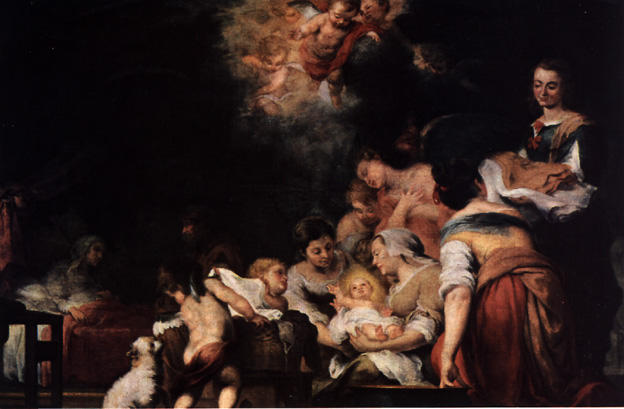 From: Matthew 1:1-16, 18-23
The Ancestry of Jesus Christ
[1] The book of the genealogy of Jesus Christ, the Son of David, the son of Abraham.[2] Abraham was the father of Isaac, and Isaac the father of Jacob, and Jacob the father of Judah and his brothers, [3] and Judah the father of Perez and Zerah by Tamar, and Perez the father of Hezron, and Hezron the father of Ram, [4] and Ram the father of Amminadab, and Amminadab the father of Nahson, and Nahson the father of Salmon, [5] and Salmon the father of Boaz by Rahab, and Boaz due father of Obed by Ruth, and Obed the father of Jesse, [6] and Jesse the father of David the king. And David was the father of Solomon by the wife of Uriah, [7] and Solomon the father of Rehoboam, and Rehoboam the father of Abijah, and Abijah the father of Asa, [8] and Asa the father of Jehoshaphat, and Jehoshaphat the father of Joram, and Joram the father of Uzziah, [9] and Uzziah the father of Jotham, and Jotham the father of Ahaz, and Ahaz the father of Hezekiah, [10] and Hezekiah the father of Manasseh, and Manasseh the father of Amos, and Amos the father of Josiah, [11] and Josiah the father of Jechoniah and his brothers, at the time of the deportation to Babylon.
[12] And after the deportation to Babylon: Jechoniah was the father of Shealtiel, and Shealtiel the father of Zerubbabel, [13] and Zerubbabel the father of Abiud, and Abiud the father of Eliakim, and Eliakim the father of Azor, [14] and Azor the father of Zadok, and Zadok the father of Aching and Achim the father of Eliud, [15] and Eliud the father of Eleazar, and Eleazar the father of Matthan, and Matthan the father of Jacob, [16] and Jacob the father of Joseph the husband of Mary, of whom Jesus was born, who is called Christ.
The Virginal Conception of Jesus, and His Birth
[18] Now the birth of Jesus Christ took place in this way. When His mother Mary had been betrothed to Joseph, before they came together she was found to be with child of the Holy Spirit; [19] and her husband Joseph, being a just man and unwilling to put her to shame, resolved to send her away quietly. [20] But as he considered this, behold, an angel of the Lord appeared to him in a dream, saying, "Joseph, son of David, do not fear to take Mary your wife, for that which is conceived in her is of the Holy Spirit; [21] she will bear a son, and you shall call His name Jesus, for He will save His people from their sins." [22] All this took place to fulfill what the Lord had spoken by the prophet: [23] "Behold, a virgin shall conceive and bear a son and His name shall be called Emmanuel" (which means God with us).
___________________________
Commentary:
1. This verse is a kind of title to St Matthew's entire Gospel. The promises God made to Abraham for the salvation of mankind (Gen 12:3) are fulfilled in Jesus Christ, as is Nathan's prophecy to King David of an everlasting kingdom (2 Sam 7:12-16).
The genealogy presented here by St Matthew shows Jesus' human ancestry and also indicates that salvation history has reached its climax with the birth of the Son of God through the working of the Holy Spirit. Jesus Christ, true God and true man, is the expected Messiah.
The genealogy is presented in a framework of three series, each consisting of fourteen links which show the progressive development of salvation history.
For the Jews (and for other Eastern peoples of nomadic origin) genealogical trees were of great importance because a person's identity was especially linked to family and tribe, with place of birth taking secondary importance. In the case of the Jewish people there was the added religious significance of belonging by blood to the chosen people.
In Christ's time each family still kept a careful record of its genealogical tree, since because of it people acquired rights and duties.
6. Four women are named in these genealogies--Tamar (cf. Gen 38; 1 Chron 2:4), Rahab (cf. Josh 2:6,17), Bathsheba (cf. 2 Sam 11:12, 24) and Ruth (cf. Book of Ruth). These four foreign women, who in one way or another are brought into the history of Israel, are one sign among many others of God's design to save all men.
By mentioning sinful people, God's ways are shown to be different from man's. God will sometimes carry out his plan of salvation by means of people whose conduct has not been just. God saves us, sanctifies us and chooses us to do good despite our sins and infidelities--and he chose to leave evidence of this at various stages in the history of our salvation.
11. The deportation to Babylon, described in 2 Kings 24-25, fulfilled the prophets' warning to the people of Israel and their kings that they would be punished for their infidelity to the commandments of the Law of God, especially the first commandment.
16. Jewish genealogies followed the male line. Joseph, being Mary's husband, was the legal father of Jesus. The legal father is on a par with the real father as regards rights and duties. This fact provides a sound basis for recognizing St Joseph as Patron of the whole Church, since he was chosen to play a very special role in God's plan for our salvation; with St Joseph as his legal father, Jesus the Messiah has David as his ancestor.
Since it was quite usual for people to marry within their clan, it can be concluded that Mary belonged to the house of David. Several early Fathers of the Church testify to this--for example, St Ignatius of Antioch, St Irenaeus, St Justin and Tertullian, who base their testimony on an unbroken oral tradition.
It should also be pointed out that when St Matthew comes to speak of the birth of Jesus, he uses an __expression which is completely different from that used for the other people in the genealogy. With these words the text positively teaches that Mary conceived Jesus while still a virgin, without the intervention of man.
18. St. Matthew relates here how Christ was conceived (cf. Luke 1:25-38): "We truly honor and venerate (Mary) as Mother of God, because she gave birth to a person who is at the same time both God and man" ("St. Pius V Catechism", I, 4, 7).
According to the provisions of the Law of Moses, engagement took place about one year before marriage and enjoyed almost the same legal validity. The marriage proper consisted, among other ceremonies, in the bride being brought solemnly and joyously to her husband's house (cf. Deuteronomy 20:7).
From the moment of engagement onwards, a certificate of divorce was needed in the event of a break in the relationship between the couple.
The entire account of Jesus' birth teaches, through the fulfillment of the prophecy of Isaiah 7:14 (which is expressly quoted in verses 22-23) that: 1) Jesus has David as His ancestor since Joseph is His legal father; 2) Mary is the Virgin who gives birth according to the prophecy; 3) the Child's conception without the intervention of man was miraculous.
19. "St. Joseph was an ordinary sort of man on whom God relied to do great things. He did exactly what the Lord wanted him to do, in each and every event that went to make up his life. That is why Scripture praises Joseph as `a just man'. In Hebrew a just man means a good and faithful servant of God, someone who fulfills the divine will (cf. Genesis 7:1; 18:23-32; Ezekiel 18:5ff.; Proverbs 12:10), or who is honorable and charitable toward his neighbor (cf. Tobias 7:6; 9:6). So a just man is someone who loves God and proves his love by keeping God's commandments and directing his whole life towards the service of his brothers, his fellow men" ([St] J. Escriva, "Christ Is Passing By", 40).
Joseph considered his spouse to be holy despite the signs that she was going to have a child. He was therefore faced with a situation he could not explain. Precisely because he was trying to do God's will, he felt obliged to put her away; but to shield her from public shame he decided to send her away quietly.
Mary's silence is admirable. Her perfect surrender to God even leads her to the extreme of not defending her honor or innocence. She prefers to suffer suspicion and shame rather than reveal the work of grace in her. Faced with a fact which was inexplicable in human terms she abandons herself confidently to the love and providence of God. God certainly submitted the holy souls of Joseph and Mary to a severe trial. We ought not to be surprised if we also undergo difficult trials in the course of our lives. We ought to trust in God during them, and remain faithful to Him, following the example they gave us.
20. God gives His light to those who act in an upright way and who trust in His power and wisdom when faced with situations which exceed human understanding. By calling him the son of David, the angel reminds Joseph that he is the providential link which joins Jesus with the family of David, according to Nathan's messianic prophecy (cf. 2 Samuel 7:12). As St. John Chrysostom says: "At the very start he straightaway reminds him of David, of whom the Christ was to spring, and he does not wish him to be worried from the moment he reminds him, through naming his most illustrious ancestor, of the promise made to all his lineage" ("Hom. on St. Matthew", 4).
"The same Jesus Christ, our only Lord, the Son of God, when He assumed human flesh for us in the womb of the Virgin, was not conceived like other men, from the seed of man, but in a manner transcending the order of nature, that is, by the power of the Holy Spirit, so that the same person, remaining God as He was from eternity, became man, which He was not before" ("St. Pius V Catechism", I, 4, 1).
21. According to the Hebrew root, the name Jesus means "savior". After our Lady, St. Joseph is the first person to be told by God that salvation has begun.
"Jesus is the proper name of the God-man and signifies `Savior'--a name given Him not accidentally, or by the judgment or will of man, but by the counsel and command of God" [...]. All other names which prophecy gave to the Son of God--Wonderful, Counsellor, Mighty God, Everlasting Father, Prince of Peace (cf. Isaiah 9:6)--are comprised in this one name Jesus; for while they partially signified the salvation which He was to bestow on us, this name included the force and meaning of all human salvation" ("St. Pius V Catechism", I, 3, 5 and 6).
23. "Emmanuel": the prophecy of Isaiah 7:14, quoted in this verse, foretold about 700 years in advance that God's salvation would be marked by the extraordinary event of virgin giving birth to a son. The Gospel here, therefore, reveals two truths.
First, that Jesus is in fact the God-with-us foretold by the prophet. This is how Christian tradition has always understood it. Indeed the Church has officially condemned an interpretation denying the messianic sense of the Isaiah text (cf. Pius VI, Brief, "Divina", 1779). Christ is truly God-with-us, therefore, not only because of His God-given mission but because He is God made man (cf. John 1:14). This does not mean that Jesus should normally be called Emmanuel, for this name refers more directly to the mystery of His being the Incarnate Word. At the Annunciation the angel said that He should be called Jesus, that is, Savior. And that was the name St. Joseph gave Him.
The second truth revealed to us by the sacred text is that Mary, in whom the prophecy of Isaiah 7:14 is fulfilled, was a virgin before and during the birth itself. The miraculous sign given by God that salvation had arrived was precisely that a woman would be a virgin and a mother at the same time.
"Jesus Christ came forth from His mother's womb without injury to her maternal virginity. This immaculate and perpetual virginity forms, therefore, the just theme of our eulogy. Such was the work of the Holy Spirit, who at the conception and birth of the Son so favored the Virgin Mother as to impart fruitfulness to her while preserving inviolate her perpetual virginity" ("St. Pius V Catechism", I, 4, 8).
___________________________
Source: "The Navarre Bible: Text and Commentaries". Biblical text taken from the Revised Standard Version and New Vulgate. Commentaries made by members of the Faculty of Theology of the University of Navarre, Spain. Published by Four Courts Press, Kill Lane, Blackrock, Co. Dublin, Ireland. Reprinted with permission from Four Courts Press and Scepter Publishers, the U.S. publisher.
Saturday, August 14, 2010
Gospel for Aug 15, Solemnity: The Assumption of the Blessed Virgin Mary

From: Luke 1:39-56
The Visitation
[39] In those days Mary arose and went with haste into the hill country, to a city of Judah, [40] and she entered the house of Zechariah and greeted Elizabeth. [41] And when Elizabeth heard the greeting of Mary, the babe leaped in her womb; and Elizabeth was filled with the Holy Spirit [42] and she exclaimed with a loud cry, "Blessed are you among women, and blessed is the fruit of your womb! [43] And why is this granted me, that the mother of my Lord should come to me? [44] For behold, when the voice of your greeting came to my ears, the babe in my womb leaped for joy. [45] And blessed is she who believed that there would be a fulfillment of what was spoken to her from the Lord."
The Magnificat
[46] And Mary said, "My soul magnifies the Lord, [47] and my spirit rejoices in God my Savior, [48] for He has regarded the low estate of His handmaiden. For behold, henceforth all generations will call me blessed; [49] for He who is mighty has done great things for me, and holy is His name. [50] And His mercy is on those who fear Him from generation to generation. [51] He has shown strength with His arm, He has scattered the proud in the imagination of their hearts, [52] He has put down the mighty from their thrones, and exalted those of low degree; [53] He has filled the hungry with good things, and the rich He has sent empty away. [54] He has helped His servant Israel, in remembrance of His mercy, [55] as He spoke to our fathers, to Abraham and to his posterity for ever."
[56] And Mary remained with her about three months, and returned to her home.
_____________________
Commentary:
39-56. We contemplate this episode of our Lady's visit to her cousin St. Elizabeth in the Second Joyful Mystery of the Rosary: "Joyfully keep Joseph and Mary company...and you will hear the traditions of the House of David.... We walk in haste towards the mountains, to a town of the tribe of Judah (Luke 1:39).
"We arrive. It is the house where John the Baptist is to be born. Elizabeth gratefully hails the Mother of her Redeemer: Blessed are you among women, and blessed is the fruit of your womb. Why should I be honored with a visit from the mother of my Lord? (Luke 1:42-43).
"The unborn Baptist quivers...(Luke 1:41). Mary's humility pours forth in the "Magnificat".... And you and I, who are proud--who were proud--promise to be humble" ([St] J. Escriva, "Holy Rosary").
39. On learning from the angel that her cousin St. Elizabeth is soon to give birth and is in need of support, our Lady in her charity hastens to her aid. She has no regard for the difficulties this involves. Although we do not know where exactly Elizabeth was living (it is now thought to be Ain Karim), it certainly meant a journey into the hill country which at that time would have taken four days.
From Mary's visit to Elizabeth Christians should learn to be caring people. "If we have this filial contact with Mary, we won't be able to think just about ourselves and our problems. Selfish personal problems will find no place in our mind" ([St] J. Escriva, "Christ Is Passing By," 145).
42. St. Bede comments that Elizabeth blesses Mary using the same words as the archangel "to show that she should be honored by angels and by men and why she should indeed be revered above all other women" ("In Lucae Evangelium Expositio, in loc.").
When we say the "Hail Mary" we repeat these divine greetings, "rejoicing with Mary at her dignity as Mother of God and praising the Lord, thanking Him for having given us Jesus Christ through Mary" ("St. Pius X Catechism", 333).
43. Elizabeth is moved by the Holy Spirit to call Mary "the mother of my Lord", thereby showing that Mary is the Mother of God.
44. Although he was conceived in sin--original sin--like other men, St. John the Baptist was born sinless because he was sanctified in his mother's womb by the presence of Jesus Christ (then in Mary's womb) and of the Blessed Virgin. On receiving this grace of God St. John rejoices by leaping with joy in his mother's womb--thereby fulfilling the archangel's prophecy (cf. Luke 1:15).
St. John Chrysostom comments on this scene of the Gospel: "See how new and how wonderful this mystery is. He has not yet left the womb but he speaks by leaping; he is not yet allowed to cry out but he makes himself heard by his actions [...]; he has not yet seen the light but he points out the Sun; he has not yet been born and he is keen to act as Precursor. The Lord is present, so he cannot contain himself or wait for nature to run its course: he wants to break out of the prison of his mother's womb and he makes sure he witnesses to the fact that the Savior is about to come" ("Sermo Apud Metaphr., Mense Julio").
45. Joining the chorus of all future generations, Elizabeth, moved by the Holy Spirit, declares the Lord's Mother to be blessed and praises her faith. No one ever had faith to compare with Mary's; she is the model of the attitude a creature should have towards its Creator--complete submission, total attachment. Through her faith, Mary is the instrument chosen by God to bring about the Redemption; as Mediatrix of all graces, she is associated with the redemptive work of her Son: "This union of the Mother with the Son in the work of salvation is made manifest from the time of Christ's virginal conception up to His death; first when Mary, arising in haste to go to visit Elizabeth, is greeted by her as blessed because of her belief in the promise of salvation and the Precursor leaps with joy in the womb of his mother [...]. The Blessed Virgin advanced in her pilgrimage of faith and faithfully persevered in her union with her Son unto the cross, where she stood (cf. John 19:25), in keeping with the Divine Plan, enduring with her only-begotten Son the intensity of His suffering, associating herself with His sacrifice in her mother's heart, and lovingly consenting to the immolation of this Victim which was born of her" (Vatican II, "Lumen Gentium", 57f).
The new Latin text gives a literal rendering of the original Greek when it says "quae credidit" (RSV "she who has believed") as opposed to the Vulgate "quae credidisti" ("you who have believed") which gave more of the sense than a literal rendering.
46-55. Mary's "Magnificat" canticle is a poem of singular beauty. It evokes certain passages of the Old Testament with which she would have been very familiar (especially 1 Samuel 2:1-10).
Three stanzas may be distinguished in the canticle: in the first (verses 46-50) Mary glorifies God for making her the Mother of the Savior, which is why future generations will call her blessed; she shows that the Incarnation is a mysterious __expression of God's power and holiness and mercy. In the second (verses 51-53) she teaches us that the Lord has always had a preference for the humble, resisting the proud and boastful. In the third (verses 54-55) she proclaims that God, in keeping with His promise, has always taken care of His chosen people--and now does them the greatest honor of all by becoming a Jew (cf. Romans 1:3).
"Our prayer can accompany and imitate this prayer of Mary. Like her, we feel the desire to sing, to acclaim the wonders of God, so that all mankind and all creation may share our joy" ([St] J. Escriva, "Christ Is Passing By", 144).
46-47. "The first fruits of the Holy Spirit are peace and joy. And the Blessed Virgin had received within herself all the grace of the Holy Spirit" (St. Basil, "In Psalmos Homilae", on Psalm 32). Mary's soul overflows in the words of the "Magnificat". God's favors cause every humble soul to feel joy and gratitude. In the case of the Blessed Virgin, God has bestowed more on her than on any other creature. "Virgin Mother of God, He whom the heavens cannot contain, on becoming man, enclosed Himself within your womb" ("Roman Missal", Antiphon of the Common of the Mass for Feasts of Our Lady). The humble Virgin of Nazareth is going to be the Mother of God; the Creator's omnipotence has never before manifested itself in as complete a way as this.
48-49. Mary's __expression of humility causes St. Bede to exclaim: "It was fitting, then, that just as death entered the world through the pride of our first parents, the entry of Life should be manifested by the humility of Mary" ("In Lucae Evangelium Expositio, in loc.").
"How great the value of humility!--"Quia respexit humilitatem.... It is not of her faith, nor of her charity, nor of her immaculate purity that our Mother speaks in the house of Zachary. Her joyful hymn sings: `Since He has looked on my humility, all generations will call me blessed'" ([St] J. Escriva, "The Way", 598).
God rewards our Lady's humility by mankind's recognition of her greatness: "All generations will call me blessed." This prophecy is fulfilled every time someone says the Hail Mary, and indeed she is praised on earth continually, without interruption. "From the earliest times the Blessed Virgin is honored under the title of Mother of God, under whose protection the faithful take refuge together in prayer in all their perils and needs. Accordingly, following the Council of Ephesus, there was a remarkable growth in the cult of the people of God towards Mary, in veneration and love, in invocation and imitation, according to her own prophetic words: `all generations will call me blessed, for He who is mighty has done great things for me'" (Vatican II, "Lumen Gentium", 66).
50. "And His mercy is on those who fear Him from generation to generation": "At the very moment of the Incarnation, these words open up a new perspective of salvation history. After the Resurrection of Christ, this perspective is new on both the historical and the eschatological level. From that time onwards there is a succession of new generations of individuals in the immense human family, in ever-increasing dimensions; there is also a succession of new generations of the people of God, marked with the sign of the Cross and of the Resurrection and `sealed' with the sign of the paschal mystery of Christ, the absolute revelation of the mercy that Mary proclaimed on the threshold of her kinswoman's house: "His mercy is [...] from generation to generation' [...].
"Mary, then, is the one who has the "deepest knowledge of the mystery of God's mercy". She knows its price, she knows how great it is. In this sense, we call her the "Mother of Mercy": Our Lady of Mercy, or Mother of Divine Mercy; in each one of these titles there is a deep theological meaning, for they express the special preparation of her soul, of her whole personality, so that she was able to perceive, through the complex events, first of Israel, then of every individual and of the whole of humanity, that mercy of which `from generation to generation' people become sharers according to the eternal design of the Most Holy Trinity" (John Paul II, "Dives In Misericordia", 9).
51. "The proud": those who want to be regarded as superior to others, whom they look down on. This also refers to those who, in their arrogance, seek to organize society without reference to, or in opposition to, God's law. Even if they seem to do so successfully, the words of our Lady's canticle will ultimately come true, for God will scatter them as He did those who tried to build the Tower of Babel, thinking that they could reach as high as Heaven (cf. Genesis 11:4).
"When pride takes hold of a soul, it is no surprise to find it bringing along with it a whole string of other vices--greed, self-indulgence, envy, injustice. The proud man is always vainly striving to dethrone God, who is merciful to all His creatures, so as to make room for himself and his ever cruel ways.
"We should beg God not to let us fall into this temptation. Pride is the worst sin of all, and the most ridiculous.... Pride is unpleasant, even from a human point of view. The person who rates himself better than everyone and everything is constantly studying himself and looking down on other people, who in turn react by ridiculing his foolish vanity" ([St] J. Escriva, "Friends of God", 100).
53. This form of divine providence has been experienced countless times over the course of history. For example, God nourished the people of Israel with manna during their forty years in the wilderness (Exodus 16:4-35); similarly His angel brought food to Elijah (1 Kings 19:5-8), and to Daniel in the lions' den (Daniel 14:31-40); and the widow of Sarepta was given a supply of oil which miraculously never ran out (1 Kings 17:8ff). So, too, the Blessed Virgin's yearning for holiness was fulfilled by the incarnation of the Word.
God nourished the chosen people with His Law and the preaching of His prophets, but the rest of mankind was left hungry for His word, a hunger now satisfied by the Incarnation. This gift of God will be accepted by the humble; the self-sufficient, having no desire for the good things of God, will not partake of them (cf. St. Basil, "In Psalmos Homilae", on Psalm 33).
54. God led the people of Israel as He would a child whom He loved tenderly: "the Lord your God bore you, as a man bears his son, in all the way that you went" (Deuteronomy 1:31). He did so many times, using Moses, Joshua, Samuel, David, etc., and now He gives them a definitive leader by sending the Messiah--moved by His great mercy which takes pity on the wretchedness of Israel and of all mankind.
55. God promised the patriarchs of old that He would have mercy on mankind. This promise He made to Adam (Genesis 3:15), Abraham (Genesis 22:18), David (2 Samuel 7:12), etc. From all eternity God had planned and decreed that the Word should become incarnate for the salvation of all mankind. As Christ Himself put it, "God so loved the world that He gave His only Son, that whoever believes in Him should not perish but have eternal life" (John 3:16).
___________________________
Source: "The Navarre Bible: Text and Commentaries". Biblical text taken from the Revised Standard Version and New Vulgate. Commentaries made by members of the Faculty of Theology of the University of Navarre, Spain. Published by Four Courts Press, Kill Lane, Blackrock, Co. Dublin, Ireland. Reprinted with permission from Four Courts Press and Scepter Publishers, the U.S. publisher.
Friday, June 11, 2010
Gospel for June 20, Memorial: The Immaculate Heart of Mary
From: Luke 2:41-51
The Finding in the Temple
41] Now his (Jesus') parents went to Jerusalem every year at the feast of the Passover. [42] And when he was twelve years old, they went up according to custom; [43] and when the feast was ended, as they were returning, the boy Jesus stayed behind in Jerusalem. His parents did not know it, [44 but supposing him to be in the company they went a day's journey, and they sought him among their kinsfolk and acquaintances; [45] and when they did not find him, they returned to Jerusalem, seeking him. [46] And after three days they found him in the temple sitting among the teachers, listening to them and asking them questions; [47] and all who heard him were amazed at his understanding and his answers. [48] And when they saw him they were astonished; and his mother said to him, "Son, why have you treated us so? Behold, your father and I have been looking for you anxiously." [49] And he said to them, "How is it that you sought me? Did you not know that I must be in my Father's house?" [50] And they did not understand the saying which he spoke to them.
The Hidden Life of Jesus at Nazareth
[51] And he went down with them and came to Nazareth, and was obedient to them; and his mother kept all these things in her heart.
_____________________________
Commentary:
41. Only St Luke (2:41-50) reports the event of the Child Jesus being lost and then found in the temple, which we contemplate in the "Fifth Joyful Mystery" of the Rosary.
Only males aged twelve and upwards were required to make this journey. Nazareth is about 100 km (60 miles) from Jerusalem as the crow flies, but the hilly nature of the country would have made it a trip of 140 km.
43-44. On pilgrimages to Jerusalem, the Jews used to go in two groups--one of men, the other of women. Children could go with either group. This explains how they could go a day's journey before they discovered the Child was missing when the families regrouped to camp.
"Mary is crying. In vain you and I have run from group to group, from caravan to caravan. No one has seen him. Joseph, after fruitless attempts to keep from crying, cries too.... And you.... And I.
'Being a common little fellow, I cry my eyes out and wail to heaven and earth..., to make up for the times when I lost him through my own fault and did not cry" ([St] J. Escriva, "Holy Rosary", Fifth Joyful Mystery).
45. The concern which Mary and Joseph show in looking for the Child should encourage us always to seek Jesus out, particularly if we lose him through sin.
"Jesus, may I never lose you again.... Now you and I are united in misfortune and grief, as were united in sin. And from the depths of our being comes sighs of heartfelt sorrow and burning phrases which the pen cannot and should not record" ("Holy Rosary", Fifth Joyful Mystery).
46-47. The Child Jesus must have been in the courtyard of the temple, which was where the teachers usually taught. Listeners used to sit at their feet, now and again asking questions and responding to them. This was what Jesus did, but his questions and answers attracted the teachers' attention, he was so wise and well-informed.
48. Ever since the Annunciation our Lady had known that the Child Jesus was God. This faith was the basis of her generous fidelity throughout her life--but there was no reason why it should include detailed knowledge of all the sacrifices God would ask of her, nor of how Christ would go about his mission of redemption: that was something she would discover as time went by, contemplating her Son's life.
49. Christ's reply is a form of explanation. His words--his first words to be recorded in the Gospel--clearly show his down Sonship; and they also show his determination to fulfill the will of his Eternal Father. "He does not upbraid them--Mary and Joseph--for searching for their son, but he raises the eyes of their souls to appreciate what he owes him whose Eternal Son he is" (St Bede, "In Lucae Evangelium Expositio, in loc."). Jesus teaches us that over and above any human authority, even that of our parents, there is the primary duty to do the will of God. "And once we are consoled by the joy of finding Jesus--three days he was gone!--debating with the teachers of Israel (Lk 2:46), you and I shall be left deeply impressed by the duty to leave our home and family to serve our heavenly Father" ([St] J. Escriva, "Holy Rosary", Fifth Joyful Mystery"). See note on Mt 10:34-37.
50. We must remember that Jesus knew in detail the whole course his earthly life would take from his conception onwards (cf. note on Lk 2:52). This is shown by what he says in reply to his parents. Mary and Joseph realized that his reply contained a deeper meaning which they did not grasp. They grew to understand it as the life of their Child unfolded. Mary's and Joseph's faith and their reverence towards the Child led them not to ask any further questions but to reflect on Jesus' words and behavior in this instance, as they had done so on other occasions.
51. The Gospel sums up Jesus' life in Nazareth in just three words: "erat subditus illis", he was obedient to them. "Jesus obeys, and he obeys Joseph and Mary. God has come to the world to obey, and to obey creatures. Admittedly they were very perfect creatures--Holy Mary, our mother, greater than whom God alone; and that most chaste man Joseph. But they are only creatures, and yet Jesus, who is God, obeyed them. We have to love God so as to love his will and desire to respond to his calls. They come to us through the duties of our ordinary life--duties of state, profession, work, family, social life, our own and other people's difficulties, friendship, eagerness to do what is right and just" ([St] J. Escriva, "Christ Is Passing By", 17).
Jesus lived like any other inhabitant of Nazareth, working at the same trade as St Joseph and earning his living by the sweat of his brow. "His hidden years are not without significance, nor were they simply a preparation for the years which were to come after--those of his public life. Since 1928 I have understood clearly that God wants our Lord's whole life to be an example for Christians. I saw this with special reference to his hidden life, the years he spent working side by side with ordinary men. Our Lord wants many people to ratify their vocation during years of quiet, unspectacular living. Obeying God's will always means leaving our selfishness behind, but there is no reason why it should entail cutting ourselves off from the normal life of ordinary people who share the same status, work and social position with us.
"I dream--and the dream has come true--of multitudes of God's children, sanctifying themselves as ordinary citizens, sharing the ambitions and endeavors of their colleagues and friends. I want to shout to them about this divine truth: If you are there in the middle of ordinary life, it doesn't mean Christ has forgotten about you or hasn't called you. He has invited you to stay among the activities and concerns of the world. He wants you to know that your human vocation, your profession, your talents, are not omitted from his divine plans. He has sanctified them and made them a most acceptable offering to his Father" ([St] J. Escriva, "Christ Is Passing By", 20).
___________________________
Source: "The Navarre Bible: Text and Commentaries". Biblical text taken from the Revised Standard Version and New Vulgate. Commentaries made by members of the Faculty of Theology of the University of Navarre, Spain. Published by Four Courts Press, Kill Lane, Blackrock, Co. Dublin, Ireland. Reprinted with permission from Four Courts Press and Scepter Publishers, the U.S. publisher.
The Finding in the Temple
41] Now his (Jesus') parents went to Jerusalem every year at the feast of the Passover. [42] And when he was twelve years old, they went up according to custom; [43] and when the feast was ended, as they were returning, the boy Jesus stayed behind in Jerusalem. His parents did not know it, [44 but supposing him to be in the company they went a day's journey, and they sought him among their kinsfolk and acquaintances; [45] and when they did not find him, they returned to Jerusalem, seeking him. [46] And after three days they found him in the temple sitting among the teachers, listening to them and asking them questions; [47] and all who heard him were amazed at his understanding and his answers. [48] And when they saw him they were astonished; and his mother said to him, "Son, why have you treated us so? Behold, your father and I have been looking for you anxiously." [49] And he said to them, "How is it that you sought me? Did you not know that I must be in my Father's house?" [50] And they did not understand the saying which he spoke to them.
The Hidden Life of Jesus at Nazareth
[51] And he went down with them and came to Nazareth, and was obedient to them; and his mother kept all these things in her heart.
_____________________________
Commentary:
41. Only St Luke (2:41-50) reports the event of the Child Jesus being lost and then found in the temple, which we contemplate in the "Fifth Joyful Mystery" of the Rosary.
Only males aged twelve and upwards were required to make this journey. Nazareth is about 100 km (60 miles) from Jerusalem as the crow flies, but the hilly nature of the country would have made it a trip of 140 km.
43-44. On pilgrimages to Jerusalem, the Jews used to go in two groups--one of men, the other of women. Children could go with either group. This explains how they could go a day's journey before they discovered the Child was missing when the families regrouped to camp.
"Mary is crying. In vain you and I have run from group to group, from caravan to caravan. No one has seen him. Joseph, after fruitless attempts to keep from crying, cries too.... And you.... And I.
'Being a common little fellow, I cry my eyes out and wail to heaven and earth..., to make up for the times when I lost him through my own fault and did not cry" ([St] J. Escriva, "Holy Rosary", Fifth Joyful Mystery).
45. The concern which Mary and Joseph show in looking for the Child should encourage us always to seek Jesus out, particularly if we lose him through sin.
"Jesus, may I never lose you again.... Now you and I are united in misfortune and grief, as were united in sin. And from the depths of our being comes sighs of heartfelt sorrow and burning phrases which the pen cannot and should not record" ("Holy Rosary", Fifth Joyful Mystery).
46-47. The Child Jesus must have been in the courtyard of the temple, which was where the teachers usually taught. Listeners used to sit at their feet, now and again asking questions and responding to them. This was what Jesus did, but his questions and answers attracted the teachers' attention, he was so wise and well-informed.
48. Ever since the Annunciation our Lady had known that the Child Jesus was God. This faith was the basis of her generous fidelity throughout her life--but there was no reason why it should include detailed knowledge of all the sacrifices God would ask of her, nor of how Christ would go about his mission of redemption: that was something she would discover as time went by, contemplating her Son's life.
49. Christ's reply is a form of explanation. His words--his first words to be recorded in the Gospel--clearly show his down Sonship; and they also show his determination to fulfill the will of his Eternal Father. "He does not upbraid them--Mary and Joseph--for searching for their son, but he raises the eyes of their souls to appreciate what he owes him whose Eternal Son he is" (St Bede, "In Lucae Evangelium Expositio, in loc."). Jesus teaches us that over and above any human authority, even that of our parents, there is the primary duty to do the will of God. "And once we are consoled by the joy of finding Jesus--three days he was gone!--debating with the teachers of Israel (Lk 2:46), you and I shall be left deeply impressed by the duty to leave our home and family to serve our heavenly Father" ([St] J. Escriva, "Holy Rosary", Fifth Joyful Mystery"). See note on Mt 10:34-37.
50. We must remember that Jesus knew in detail the whole course his earthly life would take from his conception onwards (cf. note on Lk 2:52). This is shown by what he says in reply to his parents. Mary and Joseph realized that his reply contained a deeper meaning which they did not grasp. They grew to understand it as the life of their Child unfolded. Mary's and Joseph's faith and their reverence towards the Child led them not to ask any further questions but to reflect on Jesus' words and behavior in this instance, as they had done so on other occasions.
51. The Gospel sums up Jesus' life in Nazareth in just three words: "erat subditus illis", he was obedient to them. "Jesus obeys, and he obeys Joseph and Mary. God has come to the world to obey, and to obey creatures. Admittedly they were very perfect creatures--Holy Mary, our mother, greater than whom God alone; and that most chaste man Joseph. But they are only creatures, and yet Jesus, who is God, obeyed them. We have to love God so as to love his will and desire to respond to his calls. They come to us through the duties of our ordinary life--duties of state, profession, work, family, social life, our own and other people's difficulties, friendship, eagerness to do what is right and just" ([St] J. Escriva, "Christ Is Passing By", 17).
Jesus lived like any other inhabitant of Nazareth, working at the same trade as St Joseph and earning his living by the sweat of his brow. "His hidden years are not without significance, nor were they simply a preparation for the years which were to come after--those of his public life. Since 1928 I have understood clearly that God wants our Lord's whole life to be an example for Christians. I saw this with special reference to his hidden life, the years he spent working side by side with ordinary men. Our Lord wants many people to ratify their vocation during years of quiet, unspectacular living. Obeying God's will always means leaving our selfishness behind, but there is no reason why it should entail cutting ourselves off from the normal life of ordinary people who share the same status, work and social position with us.
"I dream--and the dream has come true--of multitudes of God's children, sanctifying themselves as ordinary citizens, sharing the ambitions and endeavors of their colleagues and friends. I want to shout to them about this divine truth: If you are there in the middle of ordinary life, it doesn't mean Christ has forgotten about you or hasn't called you. He has invited you to stay among the activities and concerns of the world. He wants you to know that your human vocation, your profession, your talents, are not omitted from his divine plans. He has sanctified them and made them a most acceptable offering to his Father" ([St] J. Escriva, "Christ Is Passing By", 20).
___________________________
Source: "The Navarre Bible: Text and Commentaries". Biblical text taken from the Revised Standard Version and New Vulgate. Commentaries made by members of the Faculty of Theology of the University of Navarre, Spain. Published by Four Courts Press, Kill Lane, Blackrock, Co. Dublin, Ireland. Reprinted with permission from Four Courts Press and Scepter Publishers, the U.S. publisher.
Sunday, May 30, 2010
Gospel for May 31, Feast: The Visitation of the Blessed Virgin Mary

From: Luke 1:39-56
The Visitation
[39] In those days Mary arose and went with haste into the hill country, to a city of Judah, [40] and she entered the house of Zechariah and greeted Elizabeth. [41] And when Elizabeth heard the greeting of Mary, the babe leaped in her womb; and Elizabeth was filled with the Holy Spirit [42] and she exclaimed with a loud cry, "Blessed are you among women, and blessed is the fruit of your womb! [43] And why is this granted me, that the mother of my Lord should come to me? [44] For behold, when the voice of your greeting came to my ears, the babe in my womb leaped for joy. [45] And blessed is she who believed that there would be a fulfillment of what was spoken to her from the Lord."
The Magnificat
[46] And Mary said, "My soul magnifies the Lord, [47] and my spirit rejoices in God my Savior, [48] for He has regarded the low estate of His handmaiden. For behold, henceforth all generations will call me blessed; [49] for He who is mighty has done great things for me, and holy is His name. [50] And His mercy is on those who fear Him from generation to generation. [51] He has shown strength with His arm, He has scattered the proud in the imagination of their hearts, [52] He has put down the mighty from their thrones, and exalted those of low degree; [53] He has filled the hungry with good things, and the rich He has sent empty away. [54] He has helped His servant Israel, in remembrance of His mercy, [55] as He spoke to our fathers, to Abraham and to his posterity for ever."
[56] And Mary remained with her about three months, and returned to her home.
_______________________
Commentary:
39-56. We contemplate this episode of our Lady's visit to her cousin St. Elizabeth in the Second Joyful Mystery of the Rosary: "Joyfully keep Joseph and Mary company...and you will hear the traditions of the House of David.... We walk in haste towards the mountains, to a town of the tribe of Judah (Luke 1:39).
"We arrive. It is the house where John the Baptist is to be born. Elizabeth gratefully hails the Mother of her Redeemer: Blessed are you among women, and blessed is the fruit of your womb. Why should I be honored with a visit from the mother of my Lord? (Luke 1:42-43).
"The unborn Baptist quivers...(Luke 1:41). Mary's humility pours forth in the "Magnificat".... And you and I, who are proud--who were proud--promise to be humble" ([St] J. Escriva, "Holy Rosary").
39. On learning from the angel that her cousin St. Elizabeth is soon to give birth and is in need of support, our Lady in her charity hastens to her aid. She has no regard for the difficulties this involves. Although we do not know where exactly Elizabeth was living (it is now thought to be Ain Karim), it certainly meant a journey into the hill country which at that time would have taken four days.
From Mary's visit to Elizabeth Christians should learn to be caring people. "If we have this filial contact with Mary, we won't be able to think just about ourselves and our problems. Selfish personal problems will find no place in our mind" ([St] J. Escriva, "Christ Is Passing By," 145).
42. St. Bede comments that Elizabeth blesses Mary using the same words as the archangel "to show that she should be honored by angels and by men and why she should indeed be revered above all other women" ("In Lucae Evangelium Expositio, in loc.").
When we say the "Hail Mary" we repeat these divine greetings, "rejoicing with Mary at her dignity as Mother of God and praising the Lord, thanking Him for having given us Jesus Christ through Mary" ("St. Pius X Catechism", 333).
43. Elizabeth is moved by the Holy Spirit to call Mary "the mother of my Lord", thereby showing that Mary is the Mother of God.
44. Although he was conceived in sin--original sin--like other men, St. John the Baptist was born sinless because he was sanctified in his mother's womb by the presence of Jesus Christ (then in Mary's womb) and of the Blessed Virgin. On receiving this grace of God St. John rejoices by leaping with joy in his mother's womb--thereby fulfilling the archangel's prophecy (cf. Luke 1:15).
St. John Chrysostom comments on this scene of the Gospel: "See how new and how wonderful this mystery is. He has not yet left the womb but he speaks by leaping; he is not yet allowed to cry out but he makes himself heard by his actions [...]; he has not yet seen the light but he points out the Sun; he has not yet been born and he is keen to act as Precursor. The Lord is present, so he cannot contain himself or wait for nature to run its course: he wants to break out of the prison of his mother's womb and he makes sure he witnesses to the fact that the Savior is about to come" ("Sermo Apud Metaphr., Mense Julio").
45. Joining the chorus of all future generations, Elizabeth, moved by the Holy Spirit, declares the Lord's Mother to be blessed and praises her faith. No one ever had faith to compare with Mary's; she is the model of the attitude a creature should have towards its Creator--complete submission, total attachment. Through her faith, Mary is the instrument chosen by God to bring about the Redemption; as Mediatrix of all graces, she is associated with the redemptive work of her Son: "This union of the Mother with the Son in the work of salvation is made manifest from the time of Christ's virginal conception up to His death; first when Mary, arising in haste to go to visit Elizabeth, is greeted by her as blessed because of her belief in the promise of salvation and the Precursor leaps with joy in the womb of his mother [...]. The Blessed Virgin advanced in her pilgrimage of faith and faithfully persevered in her union with her Son unto the cross, where she stood (cf. John 19:25), in keeping with the Divine Plan, enduring with her only-begotten Son the intensity of His suffering, associating herself with His sacrifice in her mother's heart, and lovingly consenting to the immolation of this Victim which was born of her" (Vatican II, "Lumen Gentium", 57f).
The new Latin text gives a literal rendering of the original Greek when it says "quae credidit" (RSV "she who has believed") as opposed to the Vulgate "quae credidisti" ("you who have believed") which gave more of the sense than a literal rendering.
46-55. Mary's "Magnificat" canticle is a poem of singular beauty. It evokes certain passages of the Old Testament with which she would have been very familiar (especially 1 Samuel 2:1-10).
Three stanzas may be distinguished in the canticle: in the first (verses 46-50) Mary glorifies God for making her the Mother of the Savior, which is why future generations will call her blessed; she shows that the Incarnation is a mysterious __expression of God's power and holiness and mercy. In the second (verses 51-53) she teaches us that the Lord has always had a preference for the humble, resisting the proud and boastful. In the third (verses 54-55) she proclaims that God, in keeping with His promise, has always taken care of His chosen people--and now does them the greatest honor of all by becoming a Jew (cf. Romans 1:3).
"Our prayer can accompany and imitate this prayer of Mary. Like her, we feel the desire to sing, to acclaim the wonders of God, so that all mankind and all creation may share our joy" ([St] J. Escriva, "Christ Is Passing By", 144).
46-47. "The first fruits of the Holy Spirit are peace and joy. And the Blessed Virgin had received within herself all the grace of the Holy Spirit" (St. Basil, "In Psalmos Homilae", on Psalm 32). Mary's soul overflows in the words of the "Magnificat". God's favors cause every humble soul to feel joy and gratitude. In the case of the Blessed Virgin, God has bestowed more on her than on any other creature. "Virgin Mother of God, He whom the heavens cannot contain, on becoming man, enclosed Himself within your womb" ("Roman Missal", Antiphon of the Common of the Mass for Feasts of Our Lady). The humble Virgin of Nazareth is going to be the Mother of God; the Creator's omnipotence has never before manifested itself in as complete a way as this.
48-49. Mary's __expression of humility causes St. Bede to exclaim: "It was fitting, then, that just as death entered the world through the pride of our first parents, the entry of Life should be manifested by the humility of Mary" ("In Lucae Evangelium Expositio, in loc.").
"How great the value of humility!--"Quia respexit humilitatem.... It is not of her faith, nor of her charity, nor of her immaculate purity that our Mother speaks in the house of Zachary. Her joyful hymn sings: `Since He has looked on my humility, all generations will call me blessed'" ([St] J. Escriva, "The Way", 598).
God rewards our Lady's humility by mankind's recognition of her greatness: "All generations will call me blessed." This prophecy is fulfilled every time someone says the Hail Mary, and indeed she is praised on earth continually, without interruption. "From the earliest times the Blessed Virgin is honored under the title of Mother of God, under whose protection the faithful take refuge together in prayer in all their perils and needs. Accordingly, following the Council of Ephesus, there was a remarkable growth in the cult of the people of God towards Mary, in veneration and love, in invocation and imitation, according to her own prophetic words: `all generations will call me blessed, for He who is mighty has done great things for me'" (Vatican II, "Lumen Gentium", 66).
50. "And His mercy is on those who fear Him from generation to generation": "At the very moment of the Incarnation, these words open up a new perspective of salvation history. After the Resurrection of Christ, this perspective is new on both the historical and the eschatological level. From that time onwards there is a succession of new generations of individuals in the immense human family, in ever-increasing dimensions; there is also a succession of new generations of the people of God, marked with the sign of the Cross and of the Resurrection and `sealed' with the sign of the paschal mystery of Christ, the absolute revelation of the mercy that Mary proclaimed on the threshold of her kinswoman's house: "His mercy is [...] from generation to generation' [...].
"Mary, then, is the one who has the "deepest knowledge of the mystery of God's mercy". She knows its price, she knows how great it is. In this sense, we call her the "Mother of Mercy": Our Lady of Mercy, or Mother of Divine Mercy; in each one of these titles there is a deep theological meaning, for they express the special preparation of her soul, of her whole personality, so that she was able to perceive, through the complex events, first of Israel, then of every individual and of the whole of humanity, that mercy of which `from generation to generation' people become sharers according to the eternal design of the Most Holy Trinity" (John Paul II, "Dives In Misericordia", 9).
51. "The proud": those who want to be regarded as superior to others, whom they look down on. This also refers to those who, in their arrogance, seek to organize society without reference to, or in opposition to, God's law. Even if they seem to do so successfully, the words of our Lady's canticle will ultimately come true, for God will scatter them as He did those who tried to build the Tower of Babel, thinking that they could reach as high as Heaven (cf. Genesis 11:4).
"When pride takes hold of a soul, it is no surprise to find it bringing along with it a whole string of other vices--greed, self-indulgence, envy, injustice. The proud man is always vainly striving to dethrone God, who is merciful to all His creatures, so as to make room for himself and his ever cruel ways.
"We should beg God not to let us fall into this temptation. Pride is the worst sin of all, and the most ridiculous.... Pride is unpleasant, even from a human point of view. The person who rates himself better than everyone and everything is constantly studying himself and looking down on other people, who in turn react by ridiculing his foolish vanity" ([St] J. Escriva, "Friends of God", 100).
53. This form of divine providence has been experienced countless times over the course of history. For example, God nourished the people of Israel with manna during their forty years in the wilderness (Exodus 16:4-35); similarly His angel brought food to Elijah (1 Kings 19:5-8), and to Daniel in the lions' den (Daniel 14:31-40); and the widow of Sarepta was given a supply of oil which miraculously never ran out (1 Kings 17:8ff). So, too, the Blessed Virgin's yearning for holiness was fulfilled by the incarnation of the Word.
God nourished the chosen people with His Law and the preaching of His prophets, but the rest of mankind was left hungry for His word, a hunger now satisfied by the Incarnation. This gift of God will be accepted by the humble; the self-sufficient, having no desire for the good things of God, will not partake of them (cf. St. Basil, "In Psalmos Homilae", on Psalm 33).
54. God led the people of Israel as He would a child whom He loved tenderly: "the Lord your God bore you, as a man bears his son, in all the way that you went" (Deuteronomy 1:31). He did so many times, using Moses, Joshua, Samuel, David, etc., and now He gives them a definitive leader by sending the Messiah--moved by His great mercy which takes pity on the wretchedness of Israel and of all mankind.
55. God promised the patriarchs of old that He would have mercy on mankind. This promise He made to Adam (Genesis 3:15), Abraham (Genesis 22:18), David (2 Samuel 7:12), etc. From all eternity God had planned and decreed that the Word should become incarnate for the salvation of all mankind. As Christ Himself put it, "God so loved the world that He gave His only Son, that whoever believes in Him should not perish but have eternal life" (John 3:16).
___________________________
Source: "The Navarre Bible: Text and Commentaries". Biblical text taken from the Revised Standard Version and New Vulgate. Commentaries made by members of the Faculty of Theology of the University of Navarre, Spain. Published by Four Courts Press, Kill Lane, Blackrock, Co. Dublin, Ireland. Reprinted with permission from Four Courts Press and Scepter Publishers, the U.S. publisher.
Wednesday, April 14, 2010
Your Fatima IQ -- QUIZ
From America Needs Fatima:
Ever wonder how much you know about the Fatima message?
Now’s the time to find out by taking the Fatima Quiz.
It won’t take long. About 90 seconds.
Why is it important?
Because Our Lady’s apparition at Fatima is the most spectacular and important supernatural event of the 20th century.
In fact, She foretold a great chastisement and much suffering; even many nations will be annihilated, if Her requests are neglected.
So, our future depends on obeying Our Lady’s Fatima message. But if people don’t know it, how can they practice it?
I know you believe Our Lady’s message deserves to be practiced with love and trust. And you know it’s the supernatural solution to all of our terrible and growing earthly problems... the abortions, same-sex “marriage”, financial downturn, moral corruption and scandal, and war.
That’s why I invite you to: Take the Fatima Quiz
Thank you and may God bless you!
Sincerely,
Robert E. Ritchie
America Needs Fatima
www.ANF.org
Wednesday, March 24, 2010
Gospel for Mar 25, Solemnity: The Annunciation of the Lord
From: Luke 1:26-38
The Annunciation and Incarnation of the Son of God
[26] In the sixth month the angel Gabriel was sent from God to a city of Galilee named Nazareth, [27] to a virgin betrothed to a man whose name was Joseph, of the house of David; and the virgin's name was Mary. [28] And he came to her and said, "Hail, full of grace, the Lord is with you!" [29] But she was greatly troubled at the saying, and considered in her mind what sort of greeting this might be. [30] And the angel said to her, "Do not be afraid, Mary, for you have found favor with God. [31] And behold, you will conceive in your womb and bear a son, and you shall call His name Jesus. [32] He will be great, and will be called the Son of the Most High; and the Lord God will give to Him the throne of His father David, [33] and He will reign over the house of Jacob for ever; and of His Kingdom there will be no end."
[34] And Mary said to the angel, "How can this be, since I have no husband?" [35] And the angel said to her, "The Holy Spirit will come upon you, and the power of the Most High will overshadow you; therefore the child to be born will be called holy, the Son of God. [36] And behold, your kinswoman Elizabeth in her old age has also conceived a son; and this is the sixth month with her who was called barren. [37] For with God nothing will be impossible." [38] And Mary said, "Behold, I am the handmaid of the Lord; let it be done to me according to your word." And the angel departed from her.
__________________
Commentary:
26-38. Here we contemplate our Lady who was "enriched from the first instant of her conception with the splendor of an entirely unique holiness; [...] the virgin of Nazareth is hailed by the heralding angel, by divine command, as `full of grace' (cf. Luke 1:28), and to the heavenly messenger she replies, `Behold the handmaid of the Lord, be it done unto me according to thy word' (Luke 1:38). Thus the daughter of Adam, Mary, consenting to the word of God, became the Mother of Jesus. Committing herself wholeheartedly to God's saving will and impeded by no sin, she devoted herself totally, as a handmaid of the Lord, to the person and work of her Son, under and with Him, serving the mystery of Redemption, by the grace of Almighty God. Rightly, therefore, the Fathers (of the Church) see Mary not merely as passively engaged by God, but as freely cooperating in the work of man's salvation through faith and obedience" (Vatican II, "Lumen Gentium", 56).
The annunciation to Mary and incarnation of the Word constitute the deepest mystery of the relationship between God and men and the most important event in the history of mankind: God becomes man, and will remain so forever, such is the extent of His goodness and mercy and love for all of us. And yet on the day when the Second Person of the Blessed Trinity assumed frail human nature in the pure womb of the Blessed Virgin, it all happened quietly, without fanfare of any kind.
St. Luke tells the story in a very simple way. We should treasure these words of the Gospel and use them often, for example, practising the Christian custom of saying the Angelus every day and reflecting on the five Joyful Mysteries of the Rosary.
27. God chose to be born of a virgin; centuries earlier He disclosed this through the prophet Isaiah (cf. Isaiah 7:14; Matthew 1:22-23). God, "before all ages made choice of, and set in her proper place, a mother for His only-begotten Son from whom He, after being made flesh, should be born in the blessed fullness of time: and He continued His persevering regard for her in preference to all other creatures, to such a degree that for her alone He had singular regard" (Pius IX, "Ineffabilis Deus," 2). This privilege granted to our Lady of being a virgin and a mother at the same time is a unique gift of God. This was the work of the Holy Spirit "who at the conception and the birth of the Son so favored the Virgin Mother as to impart fruitfulness to her while preserving inviolate her perpetual virginity" ("St. Pius V Catechism," I, 4, 8). Paul VI reminds us of this truth of faith: "We believe that the Blessed Mary, who ever enjoys the dignity of virginity, was the Mother of the incarnate Word, of our God and Savior Jesus Christ" ("Creed of the People of God", 14).
Although many suggestions have been made as to what the name Mary means, most of the best scholars seem to agree that Mary means "lady". However, no single meaning fully conveys the richness of the name.
28. "Hail, full of grace": literally the Greek text reads "Rejoice!", obviously referring to the unique joy over the news which the angel is about to communicate.
"Full of grace": by this unusual form of greeting the archangel reveals Mary's special dignity and honor. The Fathers and Doctors of the Church "taught that this singular, solemn and unheard-of-greeting showed that all the divine graces reposed in the Mother of God and that she was adorned with all the gifts of the Holy Spirit", which meant that she "was never subject to the curse", that is, was preserved from all sin. These words of the archangel in this text constitute one of the sources which reveal the dogma of Mary's Immaculate Conception (cf. Pius IX, "Ineffabilis Deus"; Paul VI, "Creed of the People of God").
"The Lord is with you!": these words are not simply a greeting ("the Lord be with you") but an affirmation ("the Lord is with you"), and they are closely connected with the Incarnation. St. Augustine comments by putting these words on the archangel's lips: "He is more with you than He is with me: He is in your heart, He takes shape within you, He fills your soul, He is in your womb" ("Sermo De Nativitate Domini", 4).
Some important Greek manuscripts and early translations add at the end of the verse: "Blessed are you among women!", meaning that God will exalt Mary over all women. She is more excellent than Sarah, Hannah, Deborah, Rachel, Judith, etc., for only she has the supreme honor of being chosen to be the Mother of God.
29-30. Our Lady is troubled by the presence of the archangel and by the confusion truly humble people experience when they receive praise.
30. The Annunciation is the moment when our Lady is given to know the vocation which God planned for her from eternity. When the archangel sets her mind at ease by saying, "Do not be afraid, Mary," he is helping her to overcome that initial fear which a person normally experiences when God gives him or her a special calling. The fact that Mary felt this fear does not imply the least trace of imperfection in her: hers is a perfectly natural reaction in the face of the supernatural. Imperfection would arise if one did not overcome this fear or rejected the advice of those in a position to help - as St. Gabriel helped Mary.
31-33. The archangel Gabriel tells the Blessed Virgin Mary that she is to be the Mother of God by reminding her of the words of Isaiah which announced that the Messiah would be born of a virgin, a prophecy which will find its fulfillment in Mary (cf. Matthew 1:22-23; Isaiah 7:14).
He reveals that the Child will be "great": His greatness comes from His being God, a greatness He does not lose when He takes on the lowliness of human nature. He also reveals that Jesus will be the king of the Davidic dynasty sent by God in keeping with His promise of salvation; that His Kingdom will last forever, for His humanity will remain forever joined to His divinity; that "He will be called Son of the Most High", that is that He really will be the Son of the Most High and will be publicly recognized as such, that is, the Child will be the Son of God.
The archangel's announcement evokes the ancient prophecies which foretold these prerogatives. Mary, who was well-versed in Sacred Scripture, clearly realized that she was to be the Mother of God.
34-38. Commenting on this passage John Paul II said: "`Virgo fidelis', the faithful Virgin. What does this faithfulness of Mary mean? What are the dimensions of this faithfulness? The first dimension is called search. Mary was faithful first of all when she began, lovingly, to seek the deep sense of God's plan in her and for the world. `Quomodo fiet?' How shall this be?, she asked the Angel of the Annunciation [...]."
"The second dimension of faithfulness is called reception, acceptance. The `quomodo fiet?' is changed, on Mary's lips, to a `fiat': Let it be done, I am ready, I accept. This is the crucial moment of faithfulness, the moment in which man perceives that he will never completely understand the `how': that there are in God's plan more areas of mystery than of clarity; that is, however he may try, he will never succeed in understanding it completely[...]."
"The third dimension of faithfulness is consistency to live in accordance with what one believes; to adapt one's own life to the object of one's adherence. To accept misunderstanding, persecutions, rather than a break between what one practises and what one believes: this is consistency[...]."
"But all faithfulness must pass the most exacting test, that of duration. Therefore, the fourth dimension of faithfulness is constancy. It is easy to be consistent for a day or two. It is difficult and important to be consistent for one's whole life. It is easy to be consistent in the hour of enthusiasm, it is difficult to be so in the hour of tribulation. And only a consistency that lasts throughout the whole life can be called faithfulness. Mary's `fiat' in the Annunciation finds its fullness in the silent `fiat' that she repeats at the foot of the Cross" ("Homily in Mexico City Cathedral", 26 January 1979).
34. Mary believed in the archangel's words absolutely; she did not doubt as Zechariah had done (cf. 1:18). Her question, "How can this be?", expresses her readiness to obey the will of God even though at first sight it implied a contradiction: on the one hand, she was convinced that God wished her to remain a virgin; on the other, here was God also announcing that she would become a mother. The archangel announces God's mysterious design, and what had seemed impossible, according to the laws of nature, is explained by a unique interventionon the part of God.
Mary's resolution to remain a virgin was certainly something very unusual, not in line with the practice of righteous people under the Old Covenant, for, as St. Augustine explains, "particularly attentive to the propagation and growth of the people of God, through whom the Prince and Savior of the world might be prophesied and be born, the saints were obliged to make use of the good of matrimony" ("De Bono Matrimonii", 9, 9). However, in the Old Testament, there were some who, in keeping with God's plan, did remain celibate--for example, Jeremiah, Elijah, Eliseus and John the Baptist. The Blessed Virgin, who received a very special inspiration of the Holy Spirit to practise virginity, is a first-fruit of the New Testament, which will establish the excellence of virginity over marriage while not taking from the holiness of the married state, which it raises to the level of a sacrament (cf. "Gaudium Et Spes", 48).
35. The "shadow" is a symbol of the presence of God. When Israel was journeying through the wilderness, the glory of God filled the Tabernacle and a cloud covered the Ark of the Covenant (Exodus 40:34-36). And when God gave Moses the tablets of the Law, a cloud covered Mount Sinai (Exodus 24:15-16); and also, at the Transfiguration of Jesus the voice of God the Father was heard coming out of a cloud (Luke 9:35).
At the moment of the Incarnation the power of God envelops our Lady--an expression of God's omnipotence. The Spirit of God--which, according to the account in Genesis (1:2), moved over the face of the waters, bringing things to life--now comes down on Mary. And the fruit of her womb will be the work of the Holy Spirit. The Virgin Mary, who herself was conceived without any stain of sin (cf. Pius IX, "Ineffabilis Deus") becomes, after the Incarnation, a new tabernacle of God. This is the mystery we recall every day when saying the Angelus.
38. Once she learns of God's plan, our Lady yields to God's will with prompt obedience, unreservedly. She realizes the disproportion between what she is going to become--the Mother of God--and what she is - a woman. However, this is what God wants to happen and for Him nothing is impossible; therefore no one should stand in His way. So Mary, combining humility and obedience, responds perfectly to God's call: "Behold, I am the handmaid of the Lord; let it be done according to your word."
"At the enchantment of this virginal phrase, the Word became flesh" ([St] J. Escriva, "Holy Rosary", first joyful mystery). From the pure body of Mary, God shaped a new body, He created a soul out of nothing, and the Son of God united Himself with this body and soul: prior to this He was only God; now He is still God but also man. Mary is now the Mother of God. This truth is a dogma of faith, first defined by the Council of Ephesus (431). At this point she also begins to be the spiritual Mother of all mankind. What Christ says when He is dying - `Behold, your son..., behold, your mother" (John 19:26-27) - simply promulgates what came about silently at Nazareth. "With her generous `fiat' (Mary) became, through the working of the Spirit, the Mother of God, but also the Mother of the living, and, by receiving into her womb the one Mediator, she became the true Ark of the Covenant and true Temple of God" (Paul VI, "Marialis Cultus", 6).
The Annunciation shows us the Blessed Virgin as perfect model of "purity" (the RSV "I have no husband" is a euphemism); of "humility" ("Behold, I am the handmaid of the Lord"); of "candor" and "simplicity" ("How can this be?"); of "obedience" and "lively faith" ("Let it be done to me according to your word"). "Following her example of obedience to God, we can learn to serve delicately without being slavish. In Mary, we don't find the slightest trace of the attitude of the foolish virgins, who obey, but thoughtlessly. Our Lady listens attentively to what God wants, ponders what she doesn't fully understand and asks about what she doesn't know. Then she gives herself completely to doing the divine will: `Behold I am the handmaid of the Lord; let it be done to me according to your word'. Isn't that marvellous? The Blessed Virgin, our teacher in all we do, shows us here that obedience to God is not servile, does not bypass our conscience. We should be inwardly moved to discover the `freedom of the children of God' (cf. Romans 8:21)" ([St] J. Escriva, "Christ Is Passing By", 173).
____________________
Source: "The Navarre Bible: Text and Commentaries". Biblical text taken from the Revised Standard Version and New Vulgate. Commentaries made by members of the Faculty of Theology of the University of Navarre, Spain. Published by Four Courts Press, Kill Lane, Blackrock, Co. Dublin, Ireland. Reprinted with permission from Four Courts Press and Scepter Publishers, the U.S. publisher.
The Annunciation and Incarnation of the Son of God
[26] In the sixth month the angel Gabriel was sent from God to a city of Galilee named Nazareth, [27] to a virgin betrothed to a man whose name was Joseph, of the house of David; and the virgin's name was Mary. [28] And he came to her and said, "Hail, full of grace, the Lord is with you!" [29] But she was greatly troubled at the saying, and considered in her mind what sort of greeting this might be. [30] And the angel said to her, "Do not be afraid, Mary, for you have found favor with God. [31] And behold, you will conceive in your womb and bear a son, and you shall call His name Jesus. [32] He will be great, and will be called the Son of the Most High; and the Lord God will give to Him the throne of His father David, [33] and He will reign over the house of Jacob for ever; and of His Kingdom there will be no end."
[34] And Mary said to the angel, "How can this be, since I have no husband?" [35] And the angel said to her, "The Holy Spirit will come upon you, and the power of the Most High will overshadow you; therefore the child to be born will be called holy, the Son of God. [36] And behold, your kinswoman Elizabeth in her old age has also conceived a son; and this is the sixth month with her who was called barren. [37] For with God nothing will be impossible." [38] And Mary said, "Behold, I am the handmaid of the Lord; let it be done to me according to your word." And the angel departed from her.
__________________
Commentary:
26-38. Here we contemplate our Lady who was "enriched from the first instant of her conception with the splendor of an entirely unique holiness; [...] the virgin of Nazareth is hailed by the heralding angel, by divine command, as `full of grace' (cf. Luke 1:28), and to the heavenly messenger she replies, `Behold the handmaid of the Lord, be it done unto me according to thy word' (Luke 1:38). Thus the daughter of Adam, Mary, consenting to the word of God, became the Mother of Jesus. Committing herself wholeheartedly to God's saving will and impeded by no sin, she devoted herself totally, as a handmaid of the Lord, to the person and work of her Son, under and with Him, serving the mystery of Redemption, by the grace of Almighty God. Rightly, therefore, the Fathers (of the Church) see Mary not merely as passively engaged by God, but as freely cooperating in the work of man's salvation through faith and obedience" (Vatican II, "Lumen Gentium", 56).
The annunciation to Mary and incarnation of the Word constitute the deepest mystery of the relationship between God and men and the most important event in the history of mankind: God becomes man, and will remain so forever, such is the extent of His goodness and mercy and love for all of us. And yet on the day when the Second Person of the Blessed Trinity assumed frail human nature in the pure womb of the Blessed Virgin, it all happened quietly, without fanfare of any kind.
St. Luke tells the story in a very simple way. We should treasure these words of the Gospel and use them often, for example, practising the Christian custom of saying the Angelus every day and reflecting on the five Joyful Mysteries of the Rosary.
27. God chose to be born of a virgin; centuries earlier He disclosed this through the prophet Isaiah (cf. Isaiah 7:14; Matthew 1:22-23). God, "before all ages made choice of, and set in her proper place, a mother for His only-begotten Son from whom He, after being made flesh, should be born in the blessed fullness of time: and He continued His persevering regard for her in preference to all other creatures, to such a degree that for her alone He had singular regard" (Pius IX, "Ineffabilis Deus," 2). This privilege granted to our Lady of being a virgin and a mother at the same time is a unique gift of God. This was the work of the Holy Spirit "who at the conception and the birth of the Son so favored the Virgin Mother as to impart fruitfulness to her while preserving inviolate her perpetual virginity" ("St. Pius V Catechism," I, 4, 8). Paul VI reminds us of this truth of faith: "We believe that the Blessed Mary, who ever enjoys the dignity of virginity, was the Mother of the incarnate Word, of our God and Savior Jesus Christ" ("Creed of the People of God", 14).
Although many suggestions have been made as to what the name Mary means, most of the best scholars seem to agree that Mary means "lady". However, no single meaning fully conveys the richness of the name.
28. "Hail, full of grace": literally the Greek text reads "Rejoice!", obviously referring to the unique joy over the news which the angel is about to communicate.
"Full of grace": by this unusual form of greeting the archangel reveals Mary's special dignity and honor. The Fathers and Doctors of the Church "taught that this singular, solemn and unheard-of-greeting showed that all the divine graces reposed in the Mother of God and that she was adorned with all the gifts of the Holy Spirit", which meant that she "was never subject to the curse", that is, was preserved from all sin. These words of the archangel in this text constitute one of the sources which reveal the dogma of Mary's Immaculate Conception (cf. Pius IX, "Ineffabilis Deus"; Paul VI, "Creed of the People of God").
"The Lord is with you!": these words are not simply a greeting ("the Lord be with you") but an affirmation ("the Lord is with you"), and they are closely connected with the Incarnation. St. Augustine comments by putting these words on the archangel's lips: "He is more with you than He is with me: He is in your heart, He takes shape within you, He fills your soul, He is in your womb" ("Sermo De Nativitate Domini", 4).
Some important Greek manuscripts and early translations add at the end of the verse: "Blessed are you among women!", meaning that God will exalt Mary over all women. She is more excellent than Sarah, Hannah, Deborah, Rachel, Judith, etc., for only she has the supreme honor of being chosen to be the Mother of God.
29-30. Our Lady is troubled by the presence of the archangel and by the confusion truly humble people experience when they receive praise.
30. The Annunciation is the moment when our Lady is given to know the vocation which God planned for her from eternity. When the archangel sets her mind at ease by saying, "Do not be afraid, Mary," he is helping her to overcome that initial fear which a person normally experiences when God gives him or her a special calling. The fact that Mary felt this fear does not imply the least trace of imperfection in her: hers is a perfectly natural reaction in the face of the supernatural. Imperfection would arise if one did not overcome this fear or rejected the advice of those in a position to help - as St. Gabriel helped Mary.
31-33. The archangel Gabriel tells the Blessed Virgin Mary that she is to be the Mother of God by reminding her of the words of Isaiah which announced that the Messiah would be born of a virgin, a prophecy which will find its fulfillment in Mary (cf. Matthew 1:22-23; Isaiah 7:14).
He reveals that the Child will be "great": His greatness comes from His being God, a greatness He does not lose when He takes on the lowliness of human nature. He also reveals that Jesus will be the king of the Davidic dynasty sent by God in keeping with His promise of salvation; that His Kingdom will last forever, for His humanity will remain forever joined to His divinity; that "He will be called Son of the Most High", that is that He really will be the Son of the Most High and will be publicly recognized as such, that is, the Child will be the Son of God.
The archangel's announcement evokes the ancient prophecies which foretold these prerogatives. Mary, who was well-versed in Sacred Scripture, clearly realized that she was to be the Mother of God.
34-38. Commenting on this passage John Paul II said: "`Virgo fidelis', the faithful Virgin. What does this faithfulness of Mary mean? What are the dimensions of this faithfulness? The first dimension is called search. Mary was faithful first of all when she began, lovingly, to seek the deep sense of God's plan in her and for the world. `Quomodo fiet?' How shall this be?, she asked the Angel of the Annunciation [...]."
"The second dimension of faithfulness is called reception, acceptance. The `quomodo fiet?' is changed, on Mary's lips, to a `fiat': Let it be done, I am ready, I accept. This is the crucial moment of faithfulness, the moment in which man perceives that he will never completely understand the `how': that there are in God's plan more areas of mystery than of clarity; that is, however he may try, he will never succeed in understanding it completely[...]."
"The third dimension of faithfulness is consistency to live in accordance with what one believes; to adapt one's own life to the object of one's adherence. To accept misunderstanding, persecutions, rather than a break between what one practises and what one believes: this is consistency[...]."
"But all faithfulness must pass the most exacting test, that of duration. Therefore, the fourth dimension of faithfulness is constancy. It is easy to be consistent for a day or two. It is difficult and important to be consistent for one's whole life. It is easy to be consistent in the hour of enthusiasm, it is difficult to be so in the hour of tribulation. And only a consistency that lasts throughout the whole life can be called faithfulness. Mary's `fiat' in the Annunciation finds its fullness in the silent `fiat' that she repeats at the foot of the Cross" ("Homily in Mexico City Cathedral", 26 January 1979).
34. Mary believed in the archangel's words absolutely; she did not doubt as Zechariah had done (cf. 1:18). Her question, "How can this be?", expresses her readiness to obey the will of God even though at first sight it implied a contradiction: on the one hand, she was convinced that God wished her to remain a virgin; on the other, here was God also announcing that she would become a mother. The archangel announces God's mysterious design, and what had seemed impossible, according to the laws of nature, is explained by a unique interventionon the part of God.
Mary's resolution to remain a virgin was certainly something very unusual, not in line with the practice of righteous people under the Old Covenant, for, as St. Augustine explains, "particularly attentive to the propagation and growth of the people of God, through whom the Prince and Savior of the world might be prophesied and be born, the saints were obliged to make use of the good of matrimony" ("De Bono Matrimonii", 9, 9). However, in the Old Testament, there were some who, in keeping with God's plan, did remain celibate--for example, Jeremiah, Elijah, Eliseus and John the Baptist. The Blessed Virgin, who received a very special inspiration of the Holy Spirit to practise virginity, is a first-fruit of the New Testament, which will establish the excellence of virginity over marriage while not taking from the holiness of the married state, which it raises to the level of a sacrament (cf. "Gaudium Et Spes", 48).
35. The "shadow" is a symbol of the presence of God. When Israel was journeying through the wilderness, the glory of God filled the Tabernacle and a cloud covered the Ark of the Covenant (Exodus 40:34-36). And when God gave Moses the tablets of the Law, a cloud covered Mount Sinai (Exodus 24:15-16); and also, at the Transfiguration of Jesus the voice of God the Father was heard coming out of a cloud (Luke 9:35).
At the moment of the Incarnation the power of God envelops our Lady--an expression of God's omnipotence. The Spirit of God--which, according to the account in Genesis (1:2), moved over the face of the waters, bringing things to life--now comes down on Mary. And the fruit of her womb will be the work of the Holy Spirit. The Virgin Mary, who herself was conceived without any stain of sin (cf. Pius IX, "Ineffabilis Deus") becomes, after the Incarnation, a new tabernacle of God. This is the mystery we recall every day when saying the Angelus.
38. Once she learns of God's plan, our Lady yields to God's will with prompt obedience, unreservedly. She realizes the disproportion between what she is going to become--the Mother of God--and what she is - a woman. However, this is what God wants to happen and for Him nothing is impossible; therefore no one should stand in His way. So Mary, combining humility and obedience, responds perfectly to God's call: "Behold, I am the handmaid of the Lord; let it be done according to your word."
"At the enchantment of this virginal phrase, the Word became flesh" ([St] J. Escriva, "Holy Rosary", first joyful mystery). From the pure body of Mary, God shaped a new body, He created a soul out of nothing, and the Son of God united Himself with this body and soul: prior to this He was only God; now He is still God but also man. Mary is now the Mother of God. This truth is a dogma of faith, first defined by the Council of Ephesus (431). At this point she also begins to be the spiritual Mother of all mankind. What Christ says when He is dying - `Behold, your son..., behold, your mother" (John 19:26-27) - simply promulgates what came about silently at Nazareth. "With her generous `fiat' (Mary) became, through the working of the Spirit, the Mother of God, but also the Mother of the living, and, by receiving into her womb the one Mediator, she became the true Ark of the Covenant and true Temple of God" (Paul VI, "Marialis Cultus", 6).
The Annunciation shows us the Blessed Virgin as perfect model of "purity" (the RSV "I have no husband" is a euphemism); of "humility" ("Behold, I am the handmaid of the Lord"); of "candor" and "simplicity" ("How can this be?"); of "obedience" and "lively faith" ("Let it be done to me according to your word"). "Following her example of obedience to God, we can learn to serve delicately without being slavish. In Mary, we don't find the slightest trace of the attitude of the foolish virgins, who obey, but thoughtlessly. Our Lady listens attentively to what God wants, ponders what she doesn't fully understand and asks about what she doesn't know. Then she gives herself completely to doing the divine will: `Behold I am the handmaid of the Lord; let it be done to me according to your word'. Isn't that marvellous? The Blessed Virgin, our teacher in all we do, shows us here that obedience to God is not servile, does not bypass our conscience. We should be inwardly moved to discover the `freedom of the children of God' (cf. Romans 8:21)" ([St] J. Escriva, "Christ Is Passing By", 173).
____________________
Source: "The Navarre Bible: Text and Commentaries". Biblical text taken from the Revised Standard Version and New Vulgate. Commentaries made by members of the Faculty of Theology of the University of Navarre, Spain. Published by Four Courts Press, Kill Lane, Blackrock, Co. Dublin, Ireland. Reprinted with permission from Four Courts Press and Scepter Publishers, the U.S. publisher.
Subscribe to:
Posts (Atom)