I will carefully consider how, on the day of judgment, I would wish to have discharged my office or my duty; and the way I would wish to have done it then I shall do now.
-St. Ignatius
________________________
From Mary, Help of Christians
Part VI, Thoughts and Counsels of the Saints for Every Day of the Year
Compiled by Fr. Bonaventure Hammer, OFM (© 1909, Benziger Brothers)
Sunday, March 16, 2008


Meditation for March 17, The Apostle of Despair
Jesus' great regret in dying was Judas, Judas who personified the terrible frustration of the saving grace of Redemption and of the Blood of the Redeemer through the malice of man.
From the height of His gibbet, the dying Savior could see mentally, if not actually, Judas hanging on the main branch of an olive tree not far from Calvary.
And Mary, meeting Jesus ascending Calvary, must have understood this great suffering of her Son. It was not His physical suffering, but that breaking of the soul caused by the resistance of those who all along the centuries would refuse redemption. If this miserable Judas were the only one, but how many others will probably imitate him? And then what will the sufferings of the Savior avail? Why a sacrifice as great as that of Golgotha? Why this excruciating effort? Why this outpouring of love of which so much is but a heart-breaking loss?
And Mary saw the shadow of the traitor's gibbet stretch out over the centuries to come, as an immense threatening rent in the seamless robe of the Church of Christ. This picture is taken almost as it is given in Isaias. Why the need for the gibbet that bears her Son if the gibbet of Judas remains upright? How true it is that "The way of the cross did not begin for Mary at the home of Pilate but at the infamous gibbet of the Apostle of despair."
Adapted from Meditations for Religious
by Father Raoul Plus, S.J. (© 1939, Frederick Pustet Co.)
From the height of His gibbet, the dying Savior could see mentally, if not actually, Judas hanging on the main branch of an olive tree not far from Calvary.
And Mary, meeting Jesus ascending Calvary, must have understood this great suffering of her Son. It was not His physical suffering, but that breaking of the soul caused by the resistance of those who all along the centuries would refuse redemption. If this miserable Judas were the only one, but how many others will probably imitate him? And then what will the sufferings of the Savior avail? Why a sacrifice as great as that of Golgotha? Why this excruciating effort? Why this outpouring of love of which so much is but a heart-breaking loss?
And Mary saw the shadow of the traitor's gibbet stretch out over the centuries to come, as an immense threatening rent in the seamless robe of the Church of Christ. This picture is taken almost as it is given in Isaias. Why the need for the gibbet that bears her Son if the gibbet of Judas remains upright? How true it is that "The way of the cross did not begin for Mary at the home of Pilate but at the infamous gibbet of the Apostle of despair."
"Blessed Mother, Sorrowful Mother, how I would like to offer you a heart so rich in love that it might be for you generous and abundant compensation for the indifference of sinners."_________________
Adapted from Meditations for Religious
by Father Raoul Plus, S.J. (© 1939, Frederick Pustet Co.)
Gospel for Palm Sunday of the Lord's Passion
The Gospel for Palm Sunday is from: Matthew 26:14-27:66
The Passion of our Lord Jesus Christ according to Matthew
Judas Betrays Jesus
[14] Then one of the twelve, who was called Judas Iscariot, went to the chief priests [15] and said, "What will you give me if I deliver Him (Jesus) to you?" And they paid him thirty pieces of silver. [16] And from that moment he sought an opportunity to betray Him.
Preparations for the Last Supper
[17] Now on the first day of Unleavened Bread the disciples came to Jesus, saying, "Where will You have us prepare for You to eat the Passover?" [18] He said, "Go into the city to such a one, and say to him, `The Teacher says, My time is at hand; I will keep the Passover at your house with My disciples.'" [19] And the disciples did as Jesus had directed them, and they prepared for the Passover.
[20] When it was evening, He sat at table with the twelve disciples; [21] and as they were eating, He said, "Truly, I say to you, one of you will betray Me." [22] And they were very sorrowful, and began to say to Him one after another, "Is it I, Lord?" [23] He answered, "He who has dipped his hand in the dish with Me, will betray Me. [24] The Son of Man goes as it is written of Him, but woe to that man by whom the Son of Man is betrayed! It would have been better for that man if he had not been born." [25] Judas, who betrayed Him, said, "Is it I, Master?" He said to him, "You have said so."
The Institution of the Eucharist
[26] Now as they were eating, Jesus took bread, and blessed, and broke it, and gave it to the disciples and said, "Take, eat; this is my body." [27] And he took a cup, and when he had given thanks he gave it to them, saying, "Drink of it, all of you; [28] for this is my blood of the covenant, which is poured out for many for the forgiveness of sins. [29] I tell you I shall not drink again of this fruit of the vine until that day when I drink it new with you in my Father's kingdom."
The Disciples' Desertion Foretold
[30] And when they had sung a hymn, they went out to the Mount of Olives. [31] Then Jesus said to them, "You will all fall away because of me this night; for it is written, 'I will strike the shepherd, and the sheep of the flock will be scattered.' [32] But after I am raised up, I will go before you to Galilee." [33] Peter declared to him, "Though they all fall away because of you, I will never fall away." [34] Jesus said to him, "Truly, I say to you, this very night, before the cock crows, you will deny me three times." [35] Peter said to him, "Even if I must die with you, I will not deny you." And so did all the disciples.
Gethsemane: The Agony in the Garden
[36] Then Jesus went with them to a place called Gethsemane, and he said to his disciples, "Sit here, while I go yonder and pray." [37] And taking with him Peter and the two sons of Zebedee, he began to be sorrowful and troubled. [38] Then he said to them, "My soul is very sorrowful, even to death; remain here, and watch with me." [39] And going a little farther he fell on his face and prayed, "My Father, if it be possible, let this cup pass from me; nevertheless, not as I will, but as thou wilt." [40] And he came to the disciples and found them sleeping; and he said to Peter, "So, could you not watch with me one hour? [41] Watch and pray that you may not enter into temptation; the spirit indeed is willing, but the flesh is weak." [42] Again, for the second time, he went away and prayed, "My Father, if this cannot pass unless I drink it, thy will be done." [43] And again he came and found them sleeping, for their eyes were heavy. [44] So leaving them again, he went away and prayed for the third time, saying the same words. [45] Then he came to the disciples and said to them, "Are you still sleeping and taking your rest? Behold, the hour is at hand, and the Son of man is betrayed into the hands of sinners. [46] Rise, let us be going; see, my betrayer is at hand."
The Arrest
[47] While he was still speaking, Judas came, one of the twelve, and with him a great crowd with swords and club: from the chief priests and the elders of the people. [48] Now the betrayer had given them a sign, saying, "The one I shall kiss is the man; seize him." [49] And he came up to Jesus once and said, "Hail, Master!" And he kissed him. [50] Jesus said to him, "Friend, why are you here?" Then they came up and laid hands on Jesus and seized him. [51] And behold one of those who were with Jesus stretched out his hand and drew his sword, and struck the slave of the high priest and cut off his ear. [52] Then Jesus said to him, "Put your sword back into its place; for all who take the sword will perish by the sword. [53] Do you think that I cannot appeal to my Father, and he will at once send me more than twelve legions of angels? [54] But how then should the scriptures be fulfilled, that it must be so?" [55] At that hour Jesus said to the crowds, 'Have you come out as against a robber, with swords and clubs to capture me? Day after day I sat in the temple teaching, and you did not seize me. [56] But all this has taken place, that the scriptures of the prophets might be fulfilled." Then all the disciples forsook him and fled.
Jesus Before the Sanhedrin
[57] Then those who had seized Jesus led him to Caiaphas the high priest, where the scribes and the elders had gathered. [58] But Peter followed him at a distance, as far as the courtyard of the high priest, and going inside he sat with the guards to see the end. [59] Now the chief priests and the whole council sought false testimony against Jesus that they might put him to death, [60] but they found none, though many false witnesses came forward. At last two came forward [61] and said, "This fellow said, 'I am able to destroy the temple of God, and to build it in three days.' [62] And the high priest stood up and said, "Have you no answer to make? What is it that these men testify against you?" [63] But Jesus was silent. And the high priest said to him, "I adjure you by the living God, tell us if you are the Christ, the Son of God." [64] Jesus said to him, "You have said so. But I tell you, hereafter you will see the Son of man seated at the right hand of Power, and coming on the clouds of heaven." [65] Then the high priest tore his robes, and said, "He has uttered blasphemy. Why do we still need witnesses? You have now heard his blasphemy. [66] What is your judgment?' They answered, "He deserves death." [67] Then they spat in his face, and struck him; and some slapped him, [68] saying "Prophesy to us, you Christ! Who is it that struck you?"
Peter's Denials
[69] Now Peter was sitting outside in the courtyard. And maid came up to him, and said, "You also were with Jesus the Galilean." [70] But he denied it before them all, saying, "I do not know what you mean." [71] And when he went out to the porch, another maid saw him, and she said to the bystanders, "This man was with Jesus of Nazareth." [72] And again he denied it with an oath, "I do not know the man." [73] After a little while the bystanders came up and said to Peter, "Certainly you are also one of them, for your accent betrays you." [74] Then he began to invoke a curse on himself and to swear, "I do not know the man." And immediately the cock crowed. [75] And Peter remembered the saying of Jesus, "Before the cock crows, you will deny me three times." And he went out and wept bitterly.
Jesus is Delivered to Pilate
[1] When morning came, all the chief priests and the elders of the people took counsel against Jesus to put him to death; [2] and they bound him and led him away and delivered him to Pilate the governor.
Judas' Despair and Death
[3] When Judas, his betrayer, saw that he was condemned he repented and brought back the thirty pieces of silver to the chief priests and the elders, [4] saying, "I have sinned in betraying innocent blood." They said, "What is that to us? See to it yourself." [5] And throwing down the pieces of silver in the temple, he departed; and he went and hanged himself. [6] But the chief priests, taking the pieces of silver, said, "It is not lawful to put them into the treasury, since they are blood money." [7] So they took counsel, and bought with them the potter's field, to bury strangers in. [8] Therefore that field has been called the Field of Blood to this day. [9] Then was fulfilled what had been spoken by the prophet Jeremiah, saying, "And they took the thirty pieces of silver the price of him on whom a price had been set by some of the sons of Israel, [10] and they gave them for the potter's field, as the Lord directed me."
Jesus Before Pilate
[11] Now Jesus stood before the governor; and the governor asked him, "Are you the King of the Jews?" Jesus said to him, "You have said so." [12] But when he was accused by the chief priests and elders, he made no answer. [13] Then Pilate said to him, "Do you not hear how many things they testify against you?" [14] But he gave him no answer, not even to a single charge; so that the governor wondered greatly.
[15] Now at the feast the governor was accustomed to release for the crowd any one prisoner whom they wanted. [16] And they had then a notorious prisoner, called Barabbas. [17] So when they had gathered, Pilate said to them, "Whom do you want me to release for you, Barabbas or Jesus who is called Christ?" [18] For he knew that it was out of envy that they had delivered him up. [19] Besides, while he was sitting on the judgment seat, his wife sent word to him, "Have nothing to do with that righteous man, for I have suffered much over him today in a dream." [20] Now the chief priest and the elders persuaded the people to ask for Barabbas and destroy Jesus. [21] The governor again said to them, "Which of the two do you want me to release for you?" And they said, "Barabbas." [22] Pilate said to them, "Then what shall I do with Jesus who is called Christ?" They all said, "Let him be crucified." [23] And he said, "Why, what evil has he done?" But they shouted all the more, "Let him be crucified."
[24] So when Pilate saw that he was gaining nothing, but rather that a riot was beginning, he took water and washed his hands before the crowd, saying, "I am innocent of this righteous man's blood; see to it yourselves." [25] And all the people answered, "His blood be on us and on our children!" [26] Then he released for them Barabbas, and having scourged Jesus, delivered him to be crucified.
The Crowning with Thorns
[27] Then the soldiers of the governor took Jesus into the praetorium, and they gathered the whole battalion before him. [28] And they stripped him and put a scarlet robe upon him, [29] and plaiting a crown of thorns they put it on his head, and put a reed in his right hand. And kneeling before him they mocked him, saying, "Hail, King of the Jews!" [30] And they spat upon him, and took the reed and struck him on the head. [31] And when they had mocked him, they stripped him of the robe, and put his own clothes on him, and led him away to crucify him.
The Crucifixion and Death of Jesus
[32] As they were marching out, they came upon a man of Cyrene, Simon by name; this man they compelled to carry his cross. [33] And when they came to a place called Golgotha (which means the place of a skull), [34] they offered him wine to drink, mingled with gall; but when he tasted it, he would not drink it. [35] And when they had crucified him, they divided his garments among them by casting lots; [36] then they sat down and kept watch over him there. [37] And over his head they put the charge against him, which read, "This is Jesus the King of the Jews." [38] Then two robbers were crucified with him, one on the right and one on the left. [39] And those who passed by derided him, wagging their heads [40] and saying, "You who would destroy the temple and build it in three days, save yourself! If you are the Son of God, come down from the cross." [41] So also the chief priests, with the scribes and elders, mocked him, saying, [42] "He saved others; he cannot save himself. He is the King of Israel; let him come down now from the cross, and we will believe in him. [43] He trusts in God, let God deliver him now, if he desires him; for he said, 'I am the Son of God.' [44] And the robbers who were crucified with him also reviled him in the same way.
[45] Now from the sixth hour there was darkness over all the land'" until the ninth hour. [46] And about the ninth hour Jesus cried with a loud voice, "Eli, Eli, lama sabachthani" that is, "My God, My God, why hast thou forsaken me?" [47] And some of the bystanders hearing it said, "This man is calling Elijah." [48] And one of them at once ran and took a sponge, filled it with vinegar, and put it on a reed, and gave it to him to drink. [49] But the others said, "Wait, let us see whether Elijah will come to save him." [50] And Jesus cried again with a loud voice and yielded up his spirit.
[51] And behold, the curtain of the temple was torn in two, from top to bottom; and the earth shook, and the rocks were split; [52] the tombs also were opened, and many bodies of the saints who had fallen asleep were raised, [53] and coming out of the tombs after his resurrection they went into the holy city and appeared to many. [54] When the centurion and those who were with him, keeping watch over Jesus, saw the earthquake and what took place, they were filled with awe, and said, "Truly this was the Son of God!"
[55] There were also many women there, looking on from afar, who had followed Jesus from Galilee, ministering to him; [56] among whom were Mary Magdalene, and Mary the mother of James and Joseph and the mother of the sons of Zebedee.
The Burial
[57] When it was evening, there came a rich man from Arimathea, named Joseph, who also was a disciple of Jesus. [58] He went to Pilate and asked for the body of Jesus. Then Pilate ordered it to be given to him. [59] And Joseph took the body, and wrapped it in a clean linen shroud, [60] and laid in his own new tomb, which he had hewn in the rock; and he rolled a great stone to the door of the tomb, and departed. [61] Mary Magdalene and the other Mary were there, sitting opposite the sepulchre.
[62] Next day, that is, after the day of Preparation, the chief priests and the Pharisees gathered before Pilate [63] and said, "Sir, we remember how that imposter said, while he was still alive, 'After three days I will rise again.' [64] Therefore order the sepulchre to be made secure until the third day, lest his disciples go and steal him away, and tell the people, 'He has risen from the dead,' and the last fraud will be worse than the first." [65] Pilate said to them, 'You have a guard of soldiers; go, make it as secure as you can." [66] So they went and made the sepulchre secure by sealing the stone and setting a guard.
__________________
Commentary:
15. It is disconcerting and sobering to realize that Judas Iscariot actually went as far as to sell the man whom he had believed to be the Messiah and who had called him to be one of the Apostles. Thirty shekels or pieces of silver were the price of a slave (cf. Exodus 21:32), the same value as Judas put on his Master.
17. This unleavened bread, azymes, took the form of loaves which had to be eaten over a seven-day period, in commemoration of the unleavened bread which the Israelites had to take with them in their hurry to leave Egypt (cf. Exodus 12:34). In Jesus' time the Passover supper was celebrated on the first day of the week of the Unleavened Bread.
18. Although the reference is to an unnamed person, probably our Lord gave the person's actual name. In any event, from what other evangelists tell us (Mark 14:13; Luke 22:10), Jesus gave the disciples enough information to enable them to find the house.
22. Although the glorious events of Easter have yet to occur (which will teach the Apostles much more about Jesus), their faith has been steadily fortified and deepened in the course of Jesus' public ministry (cf. John 2:11; 6:68-69) through their contact with Him and the divine grace they have been given (cf. Matthew 16:17). At this point they are quite convinced that our Lord knows their internal attitudes and how they are going to act: each asks in a concerned way whether he will prove to be loyal in the time ahead.
24. Jesus is referring to the fact that He will give Himself up freely to suffering and death. In so doing He would fulfill the Will of God, as proclaimed centuries before (cf. Psalm 41:10; Isaiah 53:7). Although our Lord goes to His death voluntarily, this does not reduce the seriousness of Judas' treachery.
25. This advance indication that Judas is the traitor is not noticed by the other Apostles (cf. John 13:26-29).
26-29. This short scene, covered also in Mk 14:22-25, Lk 22: 19-20 and 1 Cor 11:23-26, contains the essential truths of faith about the sublime mystery of the Eucharist--1) the institution of this sacrament and Jesus' real presence in it; 2) the institution of the Christian priesthood; and 3) the Eucharist, the sacrifice of the New Testament or the Holy Mass.
1) In the first place, we can see the institution of the Eucharist by Jesus Christ, when he says, "This is my body..., this is my blood...". What up to this point was nothing but unleavened bread and wine, now--through the words and by the will of Jesus Christ, true God and true Man--becomes the true body and true blood of the Savior. His words, which have such a realism about them, cannot be interpreted as being merely symbolic or explained in a way which obscures the mysterious fact that Christ is really present in the Eucharist: all we can do is humbly subscribe to the faith "which the Catholic Church has always held and which she will hold until the end of the world" (Council of Trent, "De SS. Eucharistia"). Paul VI expresses this faith in these words in his encyclical letter "Mysterium Fidei", 5: "The continuous teaching of the Catholic Church, the traditions delivered to catechumens, the perception of the Christian people, the doctrine defined by the Council of Trent, and the very words of Christ as he instituted the most holy Eucharist, all insist that we profess: 'The Eucharist is the flesh of our Savior Jesus Christ; the flesh which suffered for our sins and which the Father, of his kindness, brought to life.' To these words of St Ignatius of Antioch may be added the statement addressed to the people by Theodore of Mopsuestia. a faithful witness of the Church's belief on this subject: "The Lord did not say: "This is the symbol of my body and this the symbol of my blood." He said: "This is my body and my blood"."'
This sacrament, which not only has the power to sanctify but actually contains the very Author of holiness, was instituted by Jesus Christ to be spiritual nourishment of the soul, to strengthen it in its struggle to attain salvation. The Church teaches that it also confers pardon of venial sins and helps the Christian not to fall into mortal sin: it unites us to God and thereby is a pledge of future glory.
2) In instituting the Blessed Eucharist our Lord laid down that it should be repeated until the end of time (cf. 1 Cor 11:24-25; Lk 22:19) by giving the Apostles the power to perform it. From this passage, and the accounts in St Paul and St Luke ("loc. cit".), we can see that Christ also instituted the priesthood, giving the Apostles the power to confect the Eucharist, a power which they in turn passed on to their successors. This making of the Eucharist takes place at Mass when the priest, with the intention of doing what the Church does, says Christ's words of consecration over the bread and the wine. At this very moment, "a change takes place in which the whole substance of bread is changed into the substance of the body of Christ our Lord and the whole substance of the wine into the substance of his blood" ("De SS. Eucharistia"). This amazing change is given the name of "transubstantiation". Through transubstantiation the unleavened bread and the fruit of the vine disappear, becoming the body, blood, soul and divinity of Jesus Christ. Christ's real presence is to be found also in any little particles which become detached from the host, or the smallest drop from the chalice, after the consecration. It continues when the sacred species are reserved in the tabernacle, as long as the appearances (of bread and wine) last.
3) At the Last Supper, Christ--miraculously, in an unbloody manner--brought forward his passion and death. Every Mass celebrated from then on renews the sacrifice of our Savior on the cross--Jesus once again giving his body and blood, offering himself to God the Father as a sacrifice on man's behalf, as he did on Calvary--with this clear difference: on the cross he gave himself shedding his blood, whereas on the altar he does so in an unbloody manner. "He, then, our Lord and our God, was once and for all to offer himself by his death on the altar of the cross to God the Father, to accomplish for them an everlasting redemption. But death was not to end his priesthood. And so, at the Last Supper, [...] in order to leave for his beloved spouse, the Church, a sacrifice that was visible, [...] he offered his body and blood under the species of bread and wine to God the Father and he gave his body and blood under the same species to the Apostles to receive, making them priests of the New Testament at that time. This sacrifice was to represent the bloody sacrifice which he accomplished on the cross once and for all" (Council of Trent, "De SS. Missae Sacrficio", chap. 1).
The expression, "which is poured out for many for the forgiveness of sins" means the same as "which is poured out for all" (cf. now on Mt 20:27-28). Here we have the fulfillment of the prophecies of Isaiah (chapter 53), which spoke of the atoning death of Christ for all men. Only Christ's sacrifice is capable of atoning to the Father; the Mass has this power because it is that very sacrifice: "The priest offers the Holy Sacrifice "in persona Christi"; this means more than offering "in the name of" or "in the place of" Christ. "In persona" means in specific sacramental identification with the eternal High Priest who is the Author and principal Subject of this sacrifice of his, a sacrifice in which, in truth, nobody can take his place. Only he-- only Christ--was able and is always able to be the true and effective 'expiation for our sins and...for the sins of the whole world' (1 Jn 2:2; cf. 4:10)" (John Paul II, "Letter to All Bishops", on the Eucharist, 24 November 1980).
Finally, we should notice that this sublime sacrament should be received with proper dispositions of soul and body--in the state of grace, in a spirit of adoration, respect and recollection, for it is God himself whom one is receiving. "Let a man examine himself, and so eat of the bread and drink of the cup. For anyone who eats and drinks without discerning the body eats and drinks judgment upon himself" (1 Cor 11:28-29).
30-35. At the celebration of the Passover, Psalms 113-118 were recited: this is what the reference to the "hymn" means. Our Lord knows what is going to happen --the main events (his death and resurrection) and the lesser ones (such as Peter's denials).
Peter becomes so afraid that he denies his Master three times--a fall which Jesus allowed to happen in order to teach him humility. "Here we learn a great truth: that a man's resolution is not sufficient unless he relies on the help of God" (St John Chrysostom, "Hom, on St Matthew", 83).
36-46. Here our Lord allows us to glimpse the full reality and exquisite sensitivity of his human nature. Strictly speaking, Christ, because he had complete self- control, could have avoided showing these limitations. However, by letting them express themselves, we are better able to understand the mystery of his genuine humanness--and to that extent, better able to imitate it. After tempting Jesus in the wilderness, the devil "departed from him until an opportune time" (Lk 4:13). Now, with the passion, he attacks again, using the flesh's natural repugnance to suffering; this is his hour "and the power of darkness" (Lk 22:53).
"Remain here": as if he did not want them to be depressed by seeing his agony; and "watch with me": to keep him company and to prepare themselves by prayer for the temptations that will follow. He goes a little farther away--about a stone's throw, St Luke tells us (22:41). Because there was a full moon, the Apostles may have been able to see Jesus; they may also have heard some words of his prayers; but that could hardly explain how they were able to report this scene in such detail. It is more likely that our Lord, after his resurrection, told his disciples about his agony (cf. Acts 1:3), as he must also have told them about the time he was tempted in the wilderness (Mt 4:1).
47-56. Jesus again demonstrates that he is giving himself up of his own free will. He could have asked his Father to send angels to defend him, but he does not do so. He knows why this is all happening and he wants to make it quit clear that in the last analysis it is not force which puts him to death but his own love and his desire to fulfill his Father's Will.
His opponents fail to grasp Jesus' supernatural way of doing things; he had done his best to teach them but their hardness of heart came in the way and prevented them from accepting his teaching.
50. To effect his betrayal Judas uses a sign of friendship and trust. Although he knows what Judas is about, Jesus treats him with great gentleness: he gives him a chance to open his heart and repent. This is a lesson to show us that we should respect even people who harm us and should treat them with a refined charity.
61. As we know from St John's Gospel (2:19), Jesus had said, "Destroy this temple, and in three days I will raise it up", referring to the destruction of his own body, that is, his death and resurrection. They misunderstood him (Jn 2:20), thinking he referred to the temple of Jerusalem.
69. The houses of well-to-do Jews had a front lobby or porter's office; going through the lobby one came into a patio and by crossing the patio one could enter the rooms proper. Peter goes through the lobby but he is afraid to buoy the mill of people around Jesus, so he stays in the patio, with the servants.
70-75. When they went to arrest Jesus in the Garden of Olives, Peter set about defending him and, sword in hand, he struck at the head of the first to lay a hand on his Master, but he only succeeded in cutting off his ear. Our Lord's reaction ("Put your sword back into its place": Mt 26:52) disconcerts Peter. His faith is not in doubt--Jesus himself had praised him above the other Apostles (Mt 16:17) --but it is still too human and needs a profound purification. On Jesus' arrest, all the disciples flee in disarray; thereby the prophecy is fulfilled which says "Strike the shepherd, that the sheep may be scattered" (Zech 13:7). However, Peter keeps following our Lord, though at a distance (Mt 26:58); he is quite demoralized and disconcerted yet brave enough to enter Caiaphas house, where Malchus, the man whose ear he cut off, works (Jn 18:10-11).
Peter's faith is put to the supreme test. A few hours before Jesus' arrest Peter had assured him, "Lord, I am ready to go with you to prison and to death" (Lk 22:33); and now, as Jesus predicted, he three times denies that he ever knew him. In the midst of his confusion, our Lord's serene glance reinforces his faith (Lk 22:61) and Peter's tears purify it. What our Lord had said a few hours earlier, in the intimacy of the Last Supper, has come true: "Simon, Simon, behold, Satan demanded to have you, that he might sift you like wheat, but I have prayed for you that your faith may not fail; and when you have turned again, strengthen your brethren" (Lk 22:31-32).
Peter has committed a grave sin, but his repentance also is deep. His faith, now put to the test, will become the basis on which Christ will build his Church (Mt 16:18).
As regards our own lives we should remember that no matter how low we may have fallen. God in his mercy, which is infinite, is ever ready to forgive us, because he does not despise a broken and contrite heart (Ps 51:19). If we sincerely repent, God will use us, sinners though we be, as his faithful instruments.
2. During this period the governor or procurator was the senior official in Judea. Although he was subordinate to the Roman legate in Syria, he had the "ius gladii", the authority to condemn a criminal to death--which was why the Jewish leaders brought Jesus before Pilate: they were seeking a public sentence of death, to counteract Jesus' reputation and erase his teaching from people' minds.
3-5. Judas' remorse does not lead him to repent his sins and be converted; he cannot bring himself to turn trustingly to God and be forgiven. He despairs mistrusting God's infinite mercy, and takes his own life.
6. Once again the chief priests and elders show their hypocrisy. They behave inconsistently: they worry about exact fulfillment of a precept of the Law--not to put into the temple treasury money resulting from an evil action--yet they themselves have instigated that action.
9. By recalling the prophecy of Jeremiah (cf. Jer 18:2; 19:1; 32:6-15) and completing it with that of Zechariah (Zech 11:12-13), the Gospel shows that this incident was foreseen by God.
14. The evangelist possibly wishes to indicate that this silence was foretold in the Old Testament when Is 53:7 speaks of his being "afflicted, yet he opened not his mouth; like a lamb that is led to the slaughter, and like a sheep that before its shearers is dumb."
Sometimes the right thing for a Christian to do is to remain silent, bearing out what Isaiah says elsewhere: 'in quietness and in trust shall be your strength" (Is 30:15).
"'Jesus remained silent. "Jesus autem tacebat."' Why do you speak, to console yourself or to excuse yourself? Say nothing. Seek joy in contempt; you will always receive less than you deserve. Can you, by any chance, ask: '"Quid enim mali feci?" What evil have I done?"' (J. Escriva, "The Way", 671).
18. The chief priests and elders had seen how the crowd followed Jesus. This caused them to be envious of him, an envy which grew into a hatred that sought his death (Jn 11:47). St Thomas observes that just as at the beginning it was envy that caused man's death (Wis 2:24), so it was envy that condemned Christ (cf. "Commentary on St Matthew", 27:18). Envy is indeed one of the causes of hatred (Gen 37:8). "So put away all malice and all guile and insincerity and envy and all slander" (1 Pet 2:1).
23. "It is hard to read that question of Pilate's in the holy Gospel: 'Whom do you wish me to release to you, Barabbas, or Jesus, who is called Christ?'--lt is more painful to hear the answer: 'Barabbas!' And more terrible still when I realize that very often by going astray I too have said 'Barabbas' and added 'Christ?... "Crucifige eum!" Crucify him!"' (J. Escriva, "The Way", 296).
24. Pilate tries publicly to justify his lack of courage, even though he has all the material necessary for giving an honest verdict.
His cowardice, which he disguises by this external gesture, ends up condemning Christ to death.
26-50. Meditation on the passion of our Lord has made many saints in the course of Church history. Few things are of more benefit to a Christian than contemplation --slow and devout, to the point of being amazed--of the saving events surrounding the death of the Son of God made man. Our mind and heart will be overwhelmed to see the suffering of him who created the angels, men, heaven and earth; who is the Lord of all creation; the Almighty who humbles himself to this extent (something quite unimaginable, were it not that it happened). He suffers in this way because of sin--the original sin of our first parents, the personal sins of all men, of those who have gone before us and those who will come after us, and each one's own sins. Christ's terrible sufferings spell out for us, as nothing else can, the infinite gravity of sin, which has called for the death of God himself made man; moreover, this physical and moral suffering which Jesus undergoes is also the most eloquent proof of his love for the Father, which seeks to atone to him for man's incredible rebellion by the punishment inflicted on his own innocent humanity; and of his love for mankind, his brothers and sisters; he suffers what we deserve to suffer in just punishment for our sins. Our Lord's desire to atone was so great that there was no part of his body that he did not permit to be inflicted with pain--his hands and feet pierced by the nails; his head torn by the crown of thorns; his face battered and spat upon; his back pitted by the terrible scourging he received; his chest pierced by the lance; finally, his arms and legs utterly exhausted by such pain and weariness that he dies. His spirit, also, is saturated with suffering--the pain caused by his being abandoned and betrayed by his disciples, the hatred his own people turn on him, the jeers and brutality of the Gentiles, the mysterious way his divinity permits his soul to suffer.
Only one thing can explain why Christ undergoes this redemptive passion--Love, immense, infinite, indescribable love. As he himself taught, the entire Law of God and the Prophets are summed up in the divine commandment of love (cf. Mt 22:36-40).
The four evangelists have filled many pages with their account of the sufferings of our Lord. Contemplation of Jesus' passion, identification with the suffering Christ, should play a key role in the life of every Christian, if he is to share later in the resurrection of his Lord: "Don't hinder the work of the Paraclete: seek union with Christ, so as to be purified, and feel with him the insults, the spits, and the blows, and the thorns, and the weight of the Cross..., and the nails tearing through your flesh, and the agony of a forsaken death.
"And enter through our Lord's open side until you find sure refuge there in his wounded Heart" (J. Escriva, "The Way", 58).
27. A cohort, or battalion, consisted of some 625 soldiers. In Jesus' time there was always a cohort garrisoned in Jerusalem, quartered in the Antonia Tower, adjoining the temple. This reported to the governor and was recruited from non-Jewish inhabitants of the region.
28-31. The Gospel describes very soberly how Jesus puts up no resistance to being beaten and ridiculed; the facts are allowed to speak for themselves. He takes upon himself, out of love for the Father and for us, the punishment we deserve to suffer for our sins. This should make us very grateful and, at the same time, cause us to have sorrow for sin, to desire to suffer in silence at Jesus' side and atone for our sins and those of others: Lord, I want never to sin again: but you must help me to stay true to you.
32. Seeing how much Jesus has suffered, the soldiers realize that he is incapable of carrying the Cross on his own as far as the top of Golgotha. There he is, in the center of the crowd, with not a friend in sight. Where are all the people who benefitted from his preaching and healing and miracles? None of them is there to help him. He had said, "If any man would come after me, let him deny himself and take up his cross and follow me" (Mt 16:24). But cowardice and fear have taken over. The soldiers resort to laying hold of a stranger and forcing him to carry the Cross. Our Lord will reward this favor done to him: God's grace will come down on "Simon of Cyrene,...the father of Alexander and Rufus" (Mk 15:21), who will soon be prominent members of the early Church. The experience of pain proves to be the best route to Christian discipleship.
Christ's disciples must try to ensure that cowardice does not undermine their commitment: "See how lovingly he embraces the Cross. Learn from him. Jesus carries the Cross for you: you...carry it for Jesus. But don't drag the Cross... Carry it squarely an your shoulder, because your Cross, if you carry it like that, will not be just any Cross.... It will be the Holy Cross. Don't carry your Cross with resignation: resignation is not a generous word. Love the Cross. When you really love it, your Cross will be...a Cross without a Cross" (J. Escriva, "Holy Rosary", fourth sorrowful mystery).
33. On the outskirts of Jerusalem there was a little hill called "Golgotha", or "the place of a skull", as the evangelist expressly states. It was used as a site for executing criminals. The name "Golgotha" comes from a transcription of an Aramaic word meaning "head". The name "Calvary" comes from a Latin word with the same meaning.
34. They offered Jesus a drink consisting of a mixture of wine, honey and myrrh (cf. Mk 15:23); this was usually given to people condemned to death, as a narcotic to lessen the pain. Our Lord chooses not to take it, because he wants to suffer the full rigor of his passion.
"Let us drink to the last drop the chalice of pain in this poor present life. What does it matter to suffer for ten years, twenty, fifty...if afterwards there is heaven forever, forever...forever? And, above all--rather than because of the reward, "propter retributionem"--what does suffering matter if we suffer to console, to please God our Father, in a spirit of reparation, united to him on his Cross; in a word: if we suffer for Love?..." (J. Escriva, "The Way", 182).
35. Some manuscripts add to this verse the following words taken from Jn 19:24: "This was to fulfill the scripture, 'They parted my garments among them, and for my clothing they cast lots"' (cf. Ps 22:19).
45. Approximately from twelve midday to three o'clock in the afternoon. See the note on Mt 20:3.
46. Words from Psalm 22:2, which our Lord uses to show the physical and moral pain he is suffering. In no sense should these words be taken as complaint against God's plans. "Suffering does not consist in not feeling since that is proper to those who have no feelings; nor does it lie in not showing that one feels pain: rather, suffering means that in spite of pain one does not set aside the law or obedience to God. For feeling is natural to the flesh, which is not like bronze; and so reason does not remove it, because reason gives to everything what its nature demands; and our sensitivity is very soft and tender; when it is wounded it of necessity feels, and when it feels it has to cry out" (Fray Luis de Leon, "Exposicisn del Libro de Job").
In his agony in the garden (cf. note on Mt 26:36-46), Jesus experienced a kind of anticipation of the pain and abandonment he feels at this point in his Passion. In the context of the mystery of Jesus Christ, God-and-Man, we should notice how his Humanity - body and soul - suffers without his Divinity assuaging that suffering, as it could have done. "Here before the Cross, we should have sorrow for our sins and for those of all men, for they are responsible for Jesus' death. We should have faith to penetrate deep into this sublime truth which surpasses our understanding and to fill ourselves with amazement at God's love. And we should pray so that Christ's life and death may become the model and motivation for our own life and self-giving. Only thus will we earn the name of conquerors: for the risen Christ will conquer in us, and death will be changed into life" (J. Escriva, "Christ is Passing By", 101).
50. The phrase "yielded up his spirit" (literally, "released, exhaled") is a way of saying that Christ really died; like any other man, his death meant the separation of soul and body. The fact that he genuinely did die--something which everyone, even his enemies, acknowledged--will show that his Resurrection was a real resurrection, a miraculous, divine fact.
This is the climax of Christ's surrender to the Will of the Father. Here he accomplishes the salvation of mankind (Mt 26:27-28; Mk 10:45; Heb 9:14) and gives us the greatest proof of God's love for us (Jn 3:16). The saints usually explain the expiatory value of Christ's sacrifice by underlining that he voluntarily "yielded up his Spirit". "Our Savior's death was a sacrifice of holocaust which he himself offered to his Father for our redemption; for though the pains and sufferings of his passion were so great and violent that anyone else would have died of them, Jesus would not have died of them unless he so chose and unless the fire of his infinite charity had consumed his life. He was, then, himself the sacrificer who offered himself to the Father and immolated himself, dying in love, to love, by love, for love and of love" (St Francis de Sales, "Treatise on the Love of God", Book 10, Chap. 17). This fidelity of Christ to the point of dying should be a permanent encouragement to us to persevere until the end, conscious of the fact that only he who is true until death will receive the crown of life (cf. Rev 2:10).
51-53. The rending of the veil of the temple indicates that the way to God the Father has been opened up to all men (cf. Heb 9:15) and that the New Covenant, sealed with the blood of Christ, has begun to operate. The other portents which attend Jesus' death are signs of the divine character of that event: it was not just one more man who was dying, but the Son of God.
52-53. These events are undoubtedly difficult to understand. No explanation should say what the text does not say. Nor does any other part of sacred Scripture, or the Magisterium of the Church, help to clarify what actually happened.
The great Church writers have suggested three possible explanations. First: that it was not a matter of resurrections in the strict sense, but of apparitions of these dead people. Second: they would have been dead people who arose in the way Lazarus did, and then died again. Third: their resurrection would have been definitive, that is glorious, in this way anticipating the final universal resurrection of the dead.
The first explanation does not seem to be very faithful to the text, which does use the words "were raised" ("surrexenint"). The third is difficult to reconcile with the clear assertion of Scripture that Christ was the first-born from the dead (cf. 1 Cor 15:20; Col 1:18). St Augustine, St Jerome and St Thomas are inclined towards the second explanation because they feel it fits in best with the sacred text and does not present the theological difficulties which the third does (cf. "Summa Theologiae", III,q. 53, a. 3). his also in keeping with the solution proposed by the "St Pius V Catechism", I, 6, 9.
55-56. The presence of the holy women beside Christ on the Cross gives an example of stoutheartedness to all Christians.
"Woman is stronger than man, and more faithful, in the hour of suffering: Mary of Magdala and Mary Cleophas and Salome! With a group of valiant women like these, closely united to our Lady of Sorrows, what work for souls could be done in the world!" (J. Escriva. "The Way", 982).
60. It was customary for well-to-do Jews to build tombs for themselves on their own property. Most of these tombs were excavated out of rock, in the form of a cavern; they would have had a small hall or vestibule leading to the tomb proper. At the end of the hall, which would only have been a few meters long, a very low doorway gave access to the burial chamber. The first entrance door, which was at ground level, was closed off by a huge stone which could be rolled (it was called a "gobel"), fitted into a groove to make rolling easier.
62. The Day of Preparation (the Greek word "parasceve" means "preparation") was the day prior to the sabbath (cf. Lk 23:54). It derived its name from the fact that it was the day when everything needed for the sabbath was prepared, the sabbath being a day of rest, consecrated to God, on which no work was permitted.
66. All these preventative measures (sealing the entrance to the tomb, placing the guard there, etc)--measures taken by Christ's enemies--became factors which helped people believe in his resurrection.
___________________________
Source: "The Navarre Bible: Text and Commentaries". Biblical text taken from the Revised Standard Version and New Vulgate. Commentaries made by members of the Faculty of Theology of the University of Navarre, Spain. Published by Four Courts Press, Kill Lane, Blackrock, Co. Dublin, Ireland. Reprinted with permission from Four Courts Press and Scepter Publishers, the U.S. publisher.
The Passion of our Lord Jesus Christ according to Matthew
Judas Betrays Jesus
[14] Then one of the twelve, who was called Judas Iscariot, went to the chief priests [15] and said, "What will you give me if I deliver Him (Jesus) to you?" And they paid him thirty pieces of silver. [16] And from that moment he sought an opportunity to betray Him.
Preparations for the Last Supper
[17] Now on the first day of Unleavened Bread the disciples came to Jesus, saying, "Where will You have us prepare for You to eat the Passover?" [18] He said, "Go into the city to such a one, and say to him, `The Teacher says, My time is at hand; I will keep the Passover at your house with My disciples.'" [19] And the disciples did as Jesus had directed them, and they prepared for the Passover.
[20] When it was evening, He sat at table with the twelve disciples; [21] and as they were eating, He said, "Truly, I say to you, one of you will betray Me." [22] And they were very sorrowful, and began to say to Him one after another, "Is it I, Lord?" [23] He answered, "He who has dipped his hand in the dish with Me, will betray Me. [24] The Son of Man goes as it is written of Him, but woe to that man by whom the Son of Man is betrayed! It would have been better for that man if he had not been born." [25] Judas, who betrayed Him, said, "Is it I, Master?" He said to him, "You have said so."
The Institution of the Eucharist
[26] Now as they were eating, Jesus took bread, and blessed, and broke it, and gave it to the disciples and said, "Take, eat; this is my body." [27] And he took a cup, and when he had given thanks he gave it to them, saying, "Drink of it, all of you; [28] for this is my blood of the covenant, which is poured out for many for the forgiveness of sins. [29] I tell you I shall not drink again of this fruit of the vine until that day when I drink it new with you in my Father's kingdom."
The Disciples' Desertion Foretold
[30] And when they had sung a hymn, they went out to the Mount of Olives. [31] Then Jesus said to them, "You will all fall away because of me this night; for it is written, 'I will strike the shepherd, and the sheep of the flock will be scattered.' [32] But after I am raised up, I will go before you to Galilee." [33] Peter declared to him, "Though they all fall away because of you, I will never fall away." [34] Jesus said to him, "Truly, I say to you, this very night, before the cock crows, you will deny me three times." [35] Peter said to him, "Even if I must die with you, I will not deny you." And so did all the disciples.
Gethsemane: The Agony in the Garden
[36] Then Jesus went with them to a place called Gethsemane, and he said to his disciples, "Sit here, while I go yonder and pray." [37] And taking with him Peter and the two sons of Zebedee, he began to be sorrowful and troubled. [38] Then he said to them, "My soul is very sorrowful, even to death; remain here, and watch with me." [39] And going a little farther he fell on his face and prayed, "My Father, if it be possible, let this cup pass from me; nevertheless, not as I will, but as thou wilt." [40] And he came to the disciples and found them sleeping; and he said to Peter, "So, could you not watch with me one hour? [41] Watch and pray that you may not enter into temptation; the spirit indeed is willing, but the flesh is weak." [42] Again, for the second time, he went away and prayed, "My Father, if this cannot pass unless I drink it, thy will be done." [43] And again he came and found them sleeping, for their eyes were heavy. [44] So leaving them again, he went away and prayed for the third time, saying the same words. [45] Then he came to the disciples and said to them, "Are you still sleeping and taking your rest? Behold, the hour is at hand, and the Son of man is betrayed into the hands of sinners. [46] Rise, let us be going; see, my betrayer is at hand."
The Arrest
[47] While he was still speaking, Judas came, one of the twelve, and with him a great crowd with swords and club: from the chief priests and the elders of the people. [48] Now the betrayer had given them a sign, saying, "The one I shall kiss is the man; seize him." [49] And he came up to Jesus once and said, "Hail, Master!" And he kissed him. [50] Jesus said to him, "Friend, why are you here?" Then they came up and laid hands on Jesus and seized him. [51] And behold one of those who were with Jesus stretched out his hand and drew his sword, and struck the slave of the high priest and cut off his ear. [52] Then Jesus said to him, "Put your sword back into its place; for all who take the sword will perish by the sword. [53] Do you think that I cannot appeal to my Father, and he will at once send me more than twelve legions of angels? [54] But how then should the scriptures be fulfilled, that it must be so?" [55] At that hour Jesus said to the crowds, 'Have you come out as against a robber, with swords and clubs to capture me? Day after day I sat in the temple teaching, and you did not seize me. [56] But all this has taken place, that the scriptures of the prophets might be fulfilled." Then all the disciples forsook him and fled.
Jesus Before the Sanhedrin
[57] Then those who had seized Jesus led him to Caiaphas the high priest, where the scribes and the elders had gathered. [58] But Peter followed him at a distance, as far as the courtyard of the high priest, and going inside he sat with the guards to see the end. [59] Now the chief priests and the whole council sought false testimony against Jesus that they might put him to death, [60] but they found none, though many false witnesses came forward. At last two came forward [61] and said, "This fellow said, 'I am able to destroy the temple of God, and to build it in three days.' [62] And the high priest stood up and said, "Have you no answer to make? What is it that these men testify against you?" [63] But Jesus was silent. And the high priest said to him, "I adjure you by the living God, tell us if you are the Christ, the Son of God." [64] Jesus said to him, "You have said so. But I tell you, hereafter you will see the Son of man seated at the right hand of Power, and coming on the clouds of heaven." [65] Then the high priest tore his robes, and said, "He has uttered blasphemy. Why do we still need witnesses? You have now heard his blasphemy. [66] What is your judgment?' They answered, "He deserves death." [67] Then they spat in his face, and struck him; and some slapped him, [68] saying "Prophesy to us, you Christ! Who is it that struck you?"
Peter's Denials
[69] Now Peter was sitting outside in the courtyard. And maid came up to him, and said, "You also were with Jesus the Galilean." [70] But he denied it before them all, saying, "I do not know what you mean." [71] And when he went out to the porch, another maid saw him, and she said to the bystanders, "This man was with Jesus of Nazareth." [72] And again he denied it with an oath, "I do not know the man." [73] After a little while the bystanders came up and said to Peter, "Certainly you are also one of them, for your accent betrays you." [74] Then he began to invoke a curse on himself and to swear, "I do not know the man." And immediately the cock crowed. [75] And Peter remembered the saying of Jesus, "Before the cock crows, you will deny me three times." And he went out and wept bitterly.
Jesus is Delivered to Pilate
[1] When morning came, all the chief priests and the elders of the people took counsel against Jesus to put him to death; [2] and they bound him and led him away and delivered him to Pilate the governor.
Judas' Despair and Death
[3] When Judas, his betrayer, saw that he was condemned he repented and brought back the thirty pieces of silver to the chief priests and the elders, [4] saying, "I have sinned in betraying innocent blood." They said, "What is that to us? See to it yourself." [5] And throwing down the pieces of silver in the temple, he departed; and he went and hanged himself. [6] But the chief priests, taking the pieces of silver, said, "It is not lawful to put them into the treasury, since they are blood money." [7] So they took counsel, and bought with them the potter's field, to bury strangers in. [8] Therefore that field has been called the Field of Blood to this day. [9] Then was fulfilled what had been spoken by the prophet Jeremiah, saying, "And they took the thirty pieces of silver the price of him on whom a price had been set by some of the sons of Israel, [10] and they gave them for the potter's field, as the Lord directed me."
Jesus Before Pilate
[11] Now Jesus stood before the governor; and the governor asked him, "Are you the King of the Jews?" Jesus said to him, "You have said so." [12] But when he was accused by the chief priests and elders, he made no answer. [13] Then Pilate said to him, "Do you not hear how many things they testify against you?" [14] But he gave him no answer, not even to a single charge; so that the governor wondered greatly.
[15] Now at the feast the governor was accustomed to release for the crowd any one prisoner whom they wanted. [16] And they had then a notorious prisoner, called Barabbas. [17] So when they had gathered, Pilate said to them, "Whom do you want me to release for you, Barabbas or Jesus who is called Christ?" [18] For he knew that it was out of envy that they had delivered him up. [19] Besides, while he was sitting on the judgment seat, his wife sent word to him, "Have nothing to do with that righteous man, for I have suffered much over him today in a dream." [20] Now the chief priest and the elders persuaded the people to ask for Barabbas and destroy Jesus. [21] The governor again said to them, "Which of the two do you want me to release for you?" And they said, "Barabbas." [22] Pilate said to them, "Then what shall I do with Jesus who is called Christ?" They all said, "Let him be crucified." [23] And he said, "Why, what evil has he done?" But they shouted all the more, "Let him be crucified."
[24] So when Pilate saw that he was gaining nothing, but rather that a riot was beginning, he took water and washed his hands before the crowd, saying, "I am innocent of this righteous man's blood; see to it yourselves." [25] And all the people answered, "His blood be on us and on our children!" [26] Then he released for them Barabbas, and having scourged Jesus, delivered him to be crucified.
The Crowning with Thorns
[27] Then the soldiers of the governor took Jesus into the praetorium, and they gathered the whole battalion before him. [28] And they stripped him and put a scarlet robe upon him, [29] and plaiting a crown of thorns they put it on his head, and put a reed in his right hand. And kneeling before him they mocked him, saying, "Hail, King of the Jews!" [30] And they spat upon him, and took the reed and struck him on the head. [31] And when they had mocked him, they stripped him of the robe, and put his own clothes on him, and led him away to crucify him.
The Crucifixion and Death of Jesus
[32] As they were marching out, they came upon a man of Cyrene, Simon by name; this man they compelled to carry his cross. [33] And when they came to a place called Golgotha (which means the place of a skull), [34] they offered him wine to drink, mingled with gall; but when he tasted it, he would not drink it. [35] And when they had crucified him, they divided his garments among them by casting lots; [36] then they sat down and kept watch over him there. [37] And over his head they put the charge against him, which read, "This is Jesus the King of the Jews." [38] Then two robbers were crucified with him, one on the right and one on the left. [39] And those who passed by derided him, wagging their heads [40] and saying, "You who would destroy the temple and build it in three days, save yourself! If you are the Son of God, come down from the cross." [41] So also the chief priests, with the scribes and elders, mocked him, saying, [42] "He saved others; he cannot save himself. He is the King of Israel; let him come down now from the cross, and we will believe in him. [43] He trusts in God, let God deliver him now, if he desires him; for he said, 'I am the Son of God.' [44] And the robbers who were crucified with him also reviled him in the same way.
[45] Now from the sixth hour there was darkness over all the land'" until the ninth hour. [46] And about the ninth hour Jesus cried with a loud voice, "Eli, Eli, lama sabachthani" that is, "My God, My God, why hast thou forsaken me?" [47] And some of the bystanders hearing it said, "This man is calling Elijah." [48] And one of them at once ran and took a sponge, filled it with vinegar, and put it on a reed, and gave it to him to drink. [49] But the others said, "Wait, let us see whether Elijah will come to save him." [50] And Jesus cried again with a loud voice and yielded up his spirit.
[51] And behold, the curtain of the temple was torn in two, from top to bottom; and the earth shook, and the rocks were split; [52] the tombs also were opened, and many bodies of the saints who had fallen asleep were raised, [53] and coming out of the tombs after his resurrection they went into the holy city and appeared to many. [54] When the centurion and those who were with him, keeping watch over Jesus, saw the earthquake and what took place, they were filled with awe, and said, "Truly this was the Son of God!"
[55] There were also many women there, looking on from afar, who had followed Jesus from Galilee, ministering to him; [56] among whom were Mary Magdalene, and Mary the mother of James and Joseph and the mother of the sons of Zebedee.
The Burial
[57] When it was evening, there came a rich man from Arimathea, named Joseph, who also was a disciple of Jesus. [58] He went to Pilate and asked for the body of Jesus. Then Pilate ordered it to be given to him. [59] And Joseph took the body, and wrapped it in a clean linen shroud, [60] and laid in his own new tomb, which he had hewn in the rock; and he rolled a great stone to the door of the tomb, and departed. [61] Mary Magdalene and the other Mary were there, sitting opposite the sepulchre.
[62] Next day, that is, after the day of Preparation, the chief priests and the Pharisees gathered before Pilate [63] and said, "Sir, we remember how that imposter said, while he was still alive, 'After three days I will rise again.' [64] Therefore order the sepulchre to be made secure until the third day, lest his disciples go and steal him away, and tell the people, 'He has risen from the dead,' and the last fraud will be worse than the first." [65] Pilate said to them, 'You have a guard of soldiers; go, make it as secure as you can." [66] So they went and made the sepulchre secure by sealing the stone and setting a guard.
__________________
Commentary:
15. It is disconcerting and sobering to realize that Judas Iscariot actually went as far as to sell the man whom he had believed to be the Messiah and who had called him to be one of the Apostles. Thirty shekels or pieces of silver were the price of a slave (cf. Exodus 21:32), the same value as Judas put on his Master.
17. This unleavened bread, azymes, took the form of loaves which had to be eaten over a seven-day period, in commemoration of the unleavened bread which the Israelites had to take with them in their hurry to leave Egypt (cf. Exodus 12:34). In Jesus' time the Passover supper was celebrated on the first day of the week of the Unleavened Bread.
18. Although the reference is to an unnamed person, probably our Lord gave the person's actual name. In any event, from what other evangelists tell us (Mark 14:13; Luke 22:10), Jesus gave the disciples enough information to enable them to find the house.
22. Although the glorious events of Easter have yet to occur (which will teach the Apostles much more about Jesus), their faith has been steadily fortified and deepened in the course of Jesus' public ministry (cf. John 2:11; 6:68-69) through their contact with Him and the divine grace they have been given (cf. Matthew 16:17). At this point they are quite convinced that our Lord knows their internal attitudes and how they are going to act: each asks in a concerned way whether he will prove to be loyal in the time ahead.
24. Jesus is referring to the fact that He will give Himself up freely to suffering and death. In so doing He would fulfill the Will of God, as proclaimed centuries before (cf. Psalm 41:10; Isaiah 53:7). Although our Lord goes to His death voluntarily, this does not reduce the seriousness of Judas' treachery.
25. This advance indication that Judas is the traitor is not noticed by the other Apostles (cf. John 13:26-29).
26-29. This short scene, covered also in Mk 14:22-25, Lk 22: 19-20 and 1 Cor 11:23-26, contains the essential truths of faith about the sublime mystery of the Eucharist--1) the institution of this sacrament and Jesus' real presence in it; 2) the institution of the Christian priesthood; and 3) the Eucharist, the sacrifice of the New Testament or the Holy Mass.
1) In the first place, we can see the institution of the Eucharist by Jesus Christ, when he says, "This is my body..., this is my blood...". What up to this point was nothing but unleavened bread and wine, now--through the words and by the will of Jesus Christ, true God and true Man--becomes the true body and true blood of the Savior. His words, which have such a realism about them, cannot be interpreted as being merely symbolic or explained in a way which obscures the mysterious fact that Christ is really present in the Eucharist: all we can do is humbly subscribe to the faith "which the Catholic Church has always held and which she will hold until the end of the world" (Council of Trent, "De SS. Eucharistia"). Paul VI expresses this faith in these words in his encyclical letter "Mysterium Fidei", 5: "The continuous teaching of the Catholic Church, the traditions delivered to catechumens, the perception of the Christian people, the doctrine defined by the Council of Trent, and the very words of Christ as he instituted the most holy Eucharist, all insist that we profess: 'The Eucharist is the flesh of our Savior Jesus Christ; the flesh which suffered for our sins and which the Father, of his kindness, brought to life.' To these words of St Ignatius of Antioch may be added the statement addressed to the people by Theodore of Mopsuestia. a faithful witness of the Church's belief on this subject: "The Lord did not say: "This is the symbol of my body and this the symbol of my blood." He said: "This is my body and my blood"."'
This sacrament, which not only has the power to sanctify but actually contains the very Author of holiness, was instituted by Jesus Christ to be spiritual nourishment of the soul, to strengthen it in its struggle to attain salvation. The Church teaches that it also confers pardon of venial sins and helps the Christian not to fall into mortal sin: it unites us to God and thereby is a pledge of future glory.
2) In instituting the Blessed Eucharist our Lord laid down that it should be repeated until the end of time (cf. 1 Cor 11:24-25; Lk 22:19) by giving the Apostles the power to perform it. From this passage, and the accounts in St Paul and St Luke ("loc. cit".), we can see that Christ also instituted the priesthood, giving the Apostles the power to confect the Eucharist, a power which they in turn passed on to their successors. This making of the Eucharist takes place at Mass when the priest, with the intention of doing what the Church does, says Christ's words of consecration over the bread and the wine. At this very moment, "a change takes place in which the whole substance of bread is changed into the substance of the body of Christ our Lord and the whole substance of the wine into the substance of his blood" ("De SS. Eucharistia"). This amazing change is given the name of "transubstantiation". Through transubstantiation the unleavened bread and the fruit of the vine disappear, becoming the body, blood, soul and divinity of Jesus Christ. Christ's real presence is to be found also in any little particles which become detached from the host, or the smallest drop from the chalice, after the consecration. It continues when the sacred species are reserved in the tabernacle, as long as the appearances (of bread and wine) last.
3) At the Last Supper, Christ--miraculously, in an unbloody manner--brought forward his passion and death. Every Mass celebrated from then on renews the sacrifice of our Savior on the cross--Jesus once again giving his body and blood, offering himself to God the Father as a sacrifice on man's behalf, as he did on Calvary--with this clear difference: on the cross he gave himself shedding his blood, whereas on the altar he does so in an unbloody manner. "He, then, our Lord and our God, was once and for all to offer himself by his death on the altar of the cross to God the Father, to accomplish for them an everlasting redemption. But death was not to end his priesthood. And so, at the Last Supper, [...] in order to leave for his beloved spouse, the Church, a sacrifice that was visible, [...] he offered his body and blood under the species of bread and wine to God the Father and he gave his body and blood under the same species to the Apostles to receive, making them priests of the New Testament at that time. This sacrifice was to represent the bloody sacrifice which he accomplished on the cross once and for all" (Council of Trent, "De SS. Missae Sacrficio", chap. 1).
The expression, "which is poured out for many for the forgiveness of sins" means the same as "which is poured out for all" (cf. now on Mt 20:27-28). Here we have the fulfillment of the prophecies of Isaiah (chapter 53), which spoke of the atoning death of Christ for all men. Only Christ's sacrifice is capable of atoning to the Father; the Mass has this power because it is that very sacrifice: "The priest offers the Holy Sacrifice "in persona Christi"; this means more than offering "in the name of" or "in the place of" Christ. "In persona" means in specific sacramental identification with the eternal High Priest who is the Author and principal Subject of this sacrifice of his, a sacrifice in which, in truth, nobody can take his place. Only he-- only Christ--was able and is always able to be the true and effective 'expiation for our sins and...for the sins of the whole world' (1 Jn 2:2; cf. 4:10)" (John Paul II, "Letter to All Bishops", on the Eucharist, 24 November 1980).
Finally, we should notice that this sublime sacrament should be received with proper dispositions of soul and body--in the state of grace, in a spirit of adoration, respect and recollection, for it is God himself whom one is receiving. "Let a man examine himself, and so eat of the bread and drink of the cup. For anyone who eats and drinks without discerning the body eats and drinks judgment upon himself" (1 Cor 11:28-29).
30-35. At the celebration of the Passover, Psalms 113-118 were recited: this is what the reference to the "hymn" means. Our Lord knows what is going to happen --the main events (his death and resurrection) and the lesser ones (such as Peter's denials).
Peter becomes so afraid that he denies his Master three times--a fall which Jesus allowed to happen in order to teach him humility. "Here we learn a great truth: that a man's resolution is not sufficient unless he relies on the help of God" (St John Chrysostom, "Hom, on St Matthew", 83).
36-46. Here our Lord allows us to glimpse the full reality and exquisite sensitivity of his human nature. Strictly speaking, Christ, because he had complete self- control, could have avoided showing these limitations. However, by letting them express themselves, we are better able to understand the mystery of his genuine humanness--and to that extent, better able to imitate it. After tempting Jesus in the wilderness, the devil "departed from him until an opportune time" (Lk 4:13). Now, with the passion, he attacks again, using the flesh's natural repugnance to suffering; this is his hour "and the power of darkness" (Lk 22:53).
"Remain here": as if he did not want them to be depressed by seeing his agony; and "watch with me": to keep him company and to prepare themselves by prayer for the temptations that will follow. He goes a little farther away--about a stone's throw, St Luke tells us (22:41). Because there was a full moon, the Apostles may have been able to see Jesus; they may also have heard some words of his prayers; but that could hardly explain how they were able to report this scene in such detail. It is more likely that our Lord, after his resurrection, told his disciples about his agony (cf. Acts 1:3), as he must also have told them about the time he was tempted in the wilderness (Mt 4:1).
47-56. Jesus again demonstrates that he is giving himself up of his own free will. He could have asked his Father to send angels to defend him, but he does not do so. He knows why this is all happening and he wants to make it quit clear that in the last analysis it is not force which puts him to death but his own love and his desire to fulfill his Father's Will.
His opponents fail to grasp Jesus' supernatural way of doing things; he had done his best to teach them but their hardness of heart came in the way and prevented them from accepting his teaching.
50. To effect his betrayal Judas uses a sign of friendship and trust. Although he knows what Judas is about, Jesus treats him with great gentleness: he gives him a chance to open his heart and repent. This is a lesson to show us that we should respect even people who harm us and should treat them with a refined charity.
61. As we know from St John's Gospel (2:19), Jesus had said, "Destroy this temple, and in three days I will raise it up", referring to the destruction of his own body, that is, his death and resurrection. They misunderstood him (Jn 2:20), thinking he referred to the temple of Jerusalem.
69. The houses of well-to-do Jews had a front lobby or porter's office; going through the lobby one came into a patio and by crossing the patio one could enter the rooms proper. Peter goes through the lobby but he is afraid to buoy the mill of people around Jesus, so he stays in the patio, with the servants.
70-75. When they went to arrest Jesus in the Garden of Olives, Peter set about defending him and, sword in hand, he struck at the head of the first to lay a hand on his Master, but he only succeeded in cutting off his ear. Our Lord's reaction ("Put your sword back into its place": Mt 26:52) disconcerts Peter. His faith is not in doubt--Jesus himself had praised him above the other Apostles (Mt 16:17) --but it is still too human and needs a profound purification. On Jesus' arrest, all the disciples flee in disarray; thereby the prophecy is fulfilled which says "Strike the shepherd, that the sheep may be scattered" (Zech 13:7). However, Peter keeps following our Lord, though at a distance (Mt 26:58); he is quite demoralized and disconcerted yet brave enough to enter Caiaphas house, where Malchus, the man whose ear he cut off, works (Jn 18:10-11).
Peter's faith is put to the supreme test. A few hours before Jesus' arrest Peter had assured him, "Lord, I am ready to go with you to prison and to death" (Lk 22:33); and now, as Jesus predicted, he three times denies that he ever knew him. In the midst of his confusion, our Lord's serene glance reinforces his faith (Lk 22:61) and Peter's tears purify it. What our Lord had said a few hours earlier, in the intimacy of the Last Supper, has come true: "Simon, Simon, behold, Satan demanded to have you, that he might sift you like wheat, but I have prayed for you that your faith may not fail; and when you have turned again, strengthen your brethren" (Lk 22:31-32).
Peter has committed a grave sin, but his repentance also is deep. His faith, now put to the test, will become the basis on which Christ will build his Church (Mt 16:18).
As regards our own lives we should remember that no matter how low we may have fallen. God in his mercy, which is infinite, is ever ready to forgive us, because he does not despise a broken and contrite heart (Ps 51:19). If we sincerely repent, God will use us, sinners though we be, as his faithful instruments.
2. During this period the governor or procurator was the senior official in Judea. Although he was subordinate to the Roman legate in Syria, he had the "ius gladii", the authority to condemn a criminal to death--which was why the Jewish leaders brought Jesus before Pilate: they were seeking a public sentence of death, to counteract Jesus' reputation and erase his teaching from people' minds.
3-5. Judas' remorse does not lead him to repent his sins and be converted; he cannot bring himself to turn trustingly to God and be forgiven. He despairs mistrusting God's infinite mercy, and takes his own life.
6. Once again the chief priests and elders show their hypocrisy. They behave inconsistently: they worry about exact fulfillment of a precept of the Law--not to put into the temple treasury money resulting from an evil action--yet they themselves have instigated that action.
9. By recalling the prophecy of Jeremiah (cf. Jer 18:2; 19:1; 32:6-15) and completing it with that of Zechariah (Zech 11:12-13), the Gospel shows that this incident was foreseen by God.
14. The evangelist possibly wishes to indicate that this silence was foretold in the Old Testament when Is 53:7 speaks of his being "afflicted, yet he opened not his mouth; like a lamb that is led to the slaughter, and like a sheep that before its shearers is dumb."
Sometimes the right thing for a Christian to do is to remain silent, bearing out what Isaiah says elsewhere: 'in quietness and in trust shall be your strength" (Is 30:15).
"'Jesus remained silent. "Jesus autem tacebat."' Why do you speak, to console yourself or to excuse yourself? Say nothing. Seek joy in contempt; you will always receive less than you deserve. Can you, by any chance, ask: '"Quid enim mali feci?" What evil have I done?"' (J. Escriva, "The Way", 671).
18. The chief priests and elders had seen how the crowd followed Jesus. This caused them to be envious of him, an envy which grew into a hatred that sought his death (Jn 11:47). St Thomas observes that just as at the beginning it was envy that caused man's death (Wis 2:24), so it was envy that condemned Christ (cf. "Commentary on St Matthew", 27:18). Envy is indeed one of the causes of hatred (Gen 37:8). "So put away all malice and all guile and insincerity and envy and all slander" (1 Pet 2:1).
23. "It is hard to read that question of Pilate's in the holy Gospel: 'Whom do you wish me to release to you, Barabbas, or Jesus, who is called Christ?'--lt is more painful to hear the answer: 'Barabbas!' And more terrible still when I realize that very often by going astray I too have said 'Barabbas' and added 'Christ?... "Crucifige eum!" Crucify him!"' (J. Escriva, "The Way", 296).
24. Pilate tries publicly to justify his lack of courage, even though he has all the material necessary for giving an honest verdict.
His cowardice, which he disguises by this external gesture, ends up condemning Christ to death.
26-50. Meditation on the passion of our Lord has made many saints in the course of Church history. Few things are of more benefit to a Christian than contemplation --slow and devout, to the point of being amazed--of the saving events surrounding the death of the Son of God made man. Our mind and heart will be overwhelmed to see the suffering of him who created the angels, men, heaven and earth; who is the Lord of all creation; the Almighty who humbles himself to this extent (something quite unimaginable, were it not that it happened). He suffers in this way because of sin--the original sin of our first parents, the personal sins of all men, of those who have gone before us and those who will come after us, and each one's own sins. Christ's terrible sufferings spell out for us, as nothing else can, the infinite gravity of sin, which has called for the death of God himself made man; moreover, this physical and moral suffering which Jesus undergoes is also the most eloquent proof of his love for the Father, which seeks to atone to him for man's incredible rebellion by the punishment inflicted on his own innocent humanity; and of his love for mankind, his brothers and sisters; he suffers what we deserve to suffer in just punishment for our sins. Our Lord's desire to atone was so great that there was no part of his body that he did not permit to be inflicted with pain--his hands and feet pierced by the nails; his head torn by the crown of thorns; his face battered and spat upon; his back pitted by the terrible scourging he received; his chest pierced by the lance; finally, his arms and legs utterly exhausted by such pain and weariness that he dies. His spirit, also, is saturated with suffering--the pain caused by his being abandoned and betrayed by his disciples, the hatred his own people turn on him, the jeers and brutality of the Gentiles, the mysterious way his divinity permits his soul to suffer.
Only one thing can explain why Christ undergoes this redemptive passion--Love, immense, infinite, indescribable love. As he himself taught, the entire Law of God and the Prophets are summed up in the divine commandment of love (cf. Mt 22:36-40).
The four evangelists have filled many pages with their account of the sufferings of our Lord. Contemplation of Jesus' passion, identification with the suffering Christ, should play a key role in the life of every Christian, if he is to share later in the resurrection of his Lord: "Don't hinder the work of the Paraclete: seek union with Christ, so as to be purified, and feel with him the insults, the spits, and the blows, and the thorns, and the weight of the Cross..., and the nails tearing through your flesh, and the agony of a forsaken death.
"And enter through our Lord's open side until you find sure refuge there in his wounded Heart" (J. Escriva, "The Way", 58).
27. A cohort, or battalion, consisted of some 625 soldiers. In Jesus' time there was always a cohort garrisoned in Jerusalem, quartered in the Antonia Tower, adjoining the temple. This reported to the governor and was recruited from non-Jewish inhabitants of the region.
28-31. The Gospel describes very soberly how Jesus puts up no resistance to being beaten and ridiculed; the facts are allowed to speak for themselves. He takes upon himself, out of love for the Father and for us, the punishment we deserve to suffer for our sins. This should make us very grateful and, at the same time, cause us to have sorrow for sin, to desire to suffer in silence at Jesus' side and atone for our sins and those of others: Lord, I want never to sin again: but you must help me to stay true to you.
32. Seeing how much Jesus has suffered, the soldiers realize that he is incapable of carrying the Cross on his own as far as the top of Golgotha. There he is, in the center of the crowd, with not a friend in sight. Where are all the people who benefitted from his preaching and healing and miracles? None of them is there to help him. He had said, "If any man would come after me, let him deny himself and take up his cross and follow me" (Mt 16:24). But cowardice and fear have taken over. The soldiers resort to laying hold of a stranger and forcing him to carry the Cross. Our Lord will reward this favor done to him: God's grace will come down on "Simon of Cyrene,...the father of Alexander and Rufus" (Mk 15:21), who will soon be prominent members of the early Church. The experience of pain proves to be the best route to Christian discipleship.
Christ's disciples must try to ensure that cowardice does not undermine their commitment: "See how lovingly he embraces the Cross. Learn from him. Jesus carries the Cross for you: you...carry it for Jesus. But don't drag the Cross... Carry it squarely an your shoulder, because your Cross, if you carry it like that, will not be just any Cross.... It will be the Holy Cross. Don't carry your Cross with resignation: resignation is not a generous word. Love the Cross. When you really love it, your Cross will be...a Cross without a Cross" (J. Escriva, "Holy Rosary", fourth sorrowful mystery).
33. On the outskirts of Jerusalem there was a little hill called "Golgotha", or "the place of a skull", as the evangelist expressly states. It was used as a site for executing criminals. The name "Golgotha" comes from a transcription of an Aramaic word meaning "head". The name "Calvary" comes from a Latin word with the same meaning.
34. They offered Jesus a drink consisting of a mixture of wine, honey and myrrh (cf. Mk 15:23); this was usually given to people condemned to death, as a narcotic to lessen the pain. Our Lord chooses not to take it, because he wants to suffer the full rigor of his passion.
"Let us drink to the last drop the chalice of pain in this poor present life. What does it matter to suffer for ten years, twenty, fifty...if afterwards there is heaven forever, forever...forever? And, above all--rather than because of the reward, "propter retributionem"--what does suffering matter if we suffer to console, to please God our Father, in a spirit of reparation, united to him on his Cross; in a word: if we suffer for Love?..." (J. Escriva, "The Way", 182).
35. Some manuscripts add to this verse the following words taken from Jn 19:24: "This was to fulfill the scripture, 'They parted my garments among them, and for my clothing they cast lots"' (cf. Ps 22:19).
45. Approximately from twelve midday to three o'clock in the afternoon. See the note on Mt 20:3.
46. Words from Psalm 22:2, which our Lord uses to show the physical and moral pain he is suffering. In no sense should these words be taken as complaint against God's plans. "Suffering does not consist in not feeling since that is proper to those who have no feelings; nor does it lie in not showing that one feels pain: rather, suffering means that in spite of pain one does not set aside the law or obedience to God. For feeling is natural to the flesh, which is not like bronze; and so reason does not remove it, because reason gives to everything what its nature demands; and our sensitivity is very soft and tender; when it is wounded it of necessity feels, and when it feels it has to cry out" (Fray Luis de Leon, "Exposicisn del Libro de Job").
In his agony in the garden (cf. note on Mt 26:36-46), Jesus experienced a kind of anticipation of the pain and abandonment he feels at this point in his Passion. In the context of the mystery of Jesus Christ, God-and-Man, we should notice how his Humanity - body and soul - suffers without his Divinity assuaging that suffering, as it could have done. "Here before the Cross, we should have sorrow for our sins and for those of all men, for they are responsible for Jesus' death. We should have faith to penetrate deep into this sublime truth which surpasses our understanding and to fill ourselves with amazement at God's love. And we should pray so that Christ's life and death may become the model and motivation for our own life and self-giving. Only thus will we earn the name of conquerors: for the risen Christ will conquer in us, and death will be changed into life" (J. Escriva, "Christ is Passing By", 101).
50. The phrase "yielded up his spirit" (literally, "released, exhaled") is a way of saying that Christ really died; like any other man, his death meant the separation of soul and body. The fact that he genuinely did die--something which everyone, even his enemies, acknowledged--will show that his Resurrection was a real resurrection, a miraculous, divine fact.
This is the climax of Christ's surrender to the Will of the Father. Here he accomplishes the salvation of mankind (Mt 26:27-28; Mk 10:45; Heb 9:14) and gives us the greatest proof of God's love for us (Jn 3:16). The saints usually explain the expiatory value of Christ's sacrifice by underlining that he voluntarily "yielded up his Spirit". "Our Savior's death was a sacrifice of holocaust which he himself offered to his Father for our redemption; for though the pains and sufferings of his passion were so great and violent that anyone else would have died of them, Jesus would not have died of them unless he so chose and unless the fire of his infinite charity had consumed his life. He was, then, himself the sacrificer who offered himself to the Father and immolated himself, dying in love, to love, by love, for love and of love" (St Francis de Sales, "Treatise on the Love of God", Book 10, Chap. 17). This fidelity of Christ to the point of dying should be a permanent encouragement to us to persevere until the end, conscious of the fact that only he who is true until death will receive the crown of life (cf. Rev 2:10).
51-53. The rending of the veil of the temple indicates that the way to God the Father has been opened up to all men (cf. Heb 9:15) and that the New Covenant, sealed with the blood of Christ, has begun to operate. The other portents which attend Jesus' death are signs of the divine character of that event: it was not just one more man who was dying, but the Son of God.
52-53. These events are undoubtedly difficult to understand. No explanation should say what the text does not say. Nor does any other part of sacred Scripture, or the Magisterium of the Church, help to clarify what actually happened.
The great Church writers have suggested three possible explanations. First: that it was not a matter of resurrections in the strict sense, but of apparitions of these dead people. Second: they would have been dead people who arose in the way Lazarus did, and then died again. Third: their resurrection would have been definitive, that is glorious, in this way anticipating the final universal resurrection of the dead.
The first explanation does not seem to be very faithful to the text, which does use the words "were raised" ("surrexenint"). The third is difficult to reconcile with the clear assertion of Scripture that Christ was the first-born from the dead (cf. 1 Cor 15:20; Col 1:18). St Augustine, St Jerome and St Thomas are inclined towards the second explanation because they feel it fits in best with the sacred text and does not present the theological difficulties which the third does (cf. "Summa Theologiae", III,q. 53, a. 3). his also in keeping with the solution proposed by the "St Pius V Catechism", I, 6, 9.
55-56. The presence of the holy women beside Christ on the Cross gives an example of stoutheartedness to all Christians.
"Woman is stronger than man, and more faithful, in the hour of suffering: Mary of Magdala and Mary Cleophas and Salome! With a group of valiant women like these, closely united to our Lady of Sorrows, what work for souls could be done in the world!" (J. Escriva. "The Way", 982).
60. It was customary for well-to-do Jews to build tombs for themselves on their own property. Most of these tombs were excavated out of rock, in the form of a cavern; they would have had a small hall or vestibule leading to the tomb proper. At the end of the hall, which would only have been a few meters long, a very low doorway gave access to the burial chamber. The first entrance door, which was at ground level, was closed off by a huge stone which could be rolled (it was called a "gobel"), fitted into a groove to make rolling easier.
62. The Day of Preparation (the Greek word "parasceve" means "preparation") was the day prior to the sabbath (cf. Lk 23:54). It derived its name from the fact that it was the day when everything needed for the sabbath was prepared, the sabbath being a day of rest, consecrated to God, on which no work was permitted.
66. All these preventative measures (sealing the entrance to the tomb, placing the guard there, etc)--measures taken by Christ's enemies--became factors which helped people believe in his resurrection.
___________________________
Source: "The Navarre Bible: Text and Commentaries". Biblical text taken from the Revised Standard Version and New Vulgate. Commentaries made by members of the Faculty of Theology of the University of Navarre, Spain. Published by Four Courts Press, Kill Lane, Blackrock, Co. Dublin, Ireland. Reprinted with permission from Four Courts Press and Scepter Publishers, the U.S. publisher.
Saturday, March 15, 2008
Just for Today, March 16
When the grace of God comes to a man, then he is strong and powerful for all things; and when it departs, then he is poor and weak, left, as it were, only to stripes.
In these he must not be dejected nor despair, but stand with an even mind, resigned to the will of God, and bear for the glory of Christ whatever shall befall him: because after winter comes summer; after the night the day returns; after a storm there follows a great calm.
-Bk. II. ch. viii.
_______________
I can now look back upon the past; my soul has been plunged into the crucible of suffering, and has been matured by many trials, both interior and exterior. Just as a flower lifts its head when the storm is over, so I can look up and realize that the words of the Psalmist have been fulfilled in me: The Lord ruleth me and I shall want nothing. He hath set me in a place of pasture. He hath brought me up on the water of refreshment: he hath converted my soul....Though I should walk in the midst of the shadow of death, I will fear no evils, for thou art with me (Ps. xxii).
Yes, the Lord has ever been compassionate and merciful, long-suffering and plenteous in mercy (Ps. cii) towards me. I rejoice in this opportunity of singing the praises of His unspeakable goodness, and I am going to write, for your eyes alone, the life-story of the little flower that Jesus has plucked.
-The Story of a Soul (L'Histoire d'une Âme)
__________________
For more information, see this post.
Adapted from Just For Today(©1943 Burns & Oates)
Nihil Obstat: Reginaldus Phillips, S.T.L.,Censor deputatus
Imprimatur: Edwardus Myers, Vic. Cap.
In these he must not be dejected nor despair, but stand with an even mind, resigned to the will of God, and bear for the glory of Christ whatever shall befall him: because after winter comes summer; after the night the day returns; after a storm there follows a great calm.
-Bk. II. ch. viii.
_______________
I can now look back upon the past; my soul has been plunged into the crucible of suffering, and has been matured by many trials, both interior and exterior. Just as a flower lifts its head when the storm is over, so I can look up and realize that the words of the Psalmist have been fulfilled in me: The Lord ruleth me and I shall want nothing. He hath set me in a place of pasture. He hath brought me up on the water of refreshment: he hath converted my soul....Though I should walk in the midst of the shadow of death, I will fear no evils, for thou art with me (Ps. xxii).
Yes, the Lord has ever been compassionate and merciful, long-suffering and plenteous in mercy (Ps. cii) towards me. I rejoice in this opportunity of singing the praises of His unspeakable goodness, and I am going to write, for your eyes alone, the life-story of the little flower that Jesus has plucked.
-The Story of a Soul (L'Histoire d'une Âme)
__________________
For more information, see this post.
Adapted from Just For Today(©1943 Burns & Oates)
Nihil Obstat: Reginaldus Phillips, S.T.L.,Censor deputatus
Imprimatur: Edwardus Myers, Vic. Cap.
Thoughts and Counsels - March 16
In prayer we should particularly combat our predominant passion or evil inclination. We should devote continual attention to it, because when it is once conquered we will easily obtain the victory over all our other faults.
-St Vincent de Paul
________________________
From Mary, Help of Christians
Part VI, Thoughts and Counsels of the Saints for Every Day of the Year
Compiled by Fr. Bonaventure Hammer, OFM (© 1909, Benziger Brothers)
-St Vincent de Paul
________________________
From Mary, Help of Christians
Part VI, Thoughts and Counsels of the Saints for Every Day of the Year
Compiled by Fr. Bonaventure Hammer, OFM (© 1909, Benziger Brothers)
Meditation for March 16, The Master Key
The evening of Palm Sunday, St. Gertrude was meditating on the reception Mary, Martha and Lazarus had given to Our Lord at Bethany; and she was carried away with the desire to offer to Our Savior an ardent welcome to her heart.
Then suddenly Jesus manifested Himself to her, saying, "Here I am! What do wish to give me?"
"Oh!" replied Gertrude, "welcome, Solace of my soul, my only Treasure. Alas! I have prepared nothing suitable for Your greatness, but I offer You my whole being, asking that You prepare in me what would be most pleasing to Your Heart."
"Since you give Me the liberty, I will do it," answered Our Lord, "but you will have to give me the key that My hand may be able to open your heart and dispose of whatsoever I wish."
"What is this key that I must give you?" asked the Saint. "It is," answered Jesus, "your will."
Submit your will; that is the key which permits Our Lord to give Himself as He wishes to the religious soul; he who gives the key to the apartment gives the whole apartment; the one who gives his will reserves nothing for himself.
Adapted from Meditations for Religious
by Father Raoul Plus, S.J. (© 1939, Frederick Pustet Co.)
Then suddenly Jesus manifested Himself to her, saying, "Here I am! What do wish to give me?"
"Oh!" replied Gertrude, "welcome, Solace of my soul, my only Treasure. Alas! I have prepared nothing suitable for Your greatness, but I offer You my whole being, asking that You prepare in me what would be most pleasing to Your Heart."
"Since you give Me the liberty, I will do it," answered Our Lord, "but you will have to give me the key that My hand may be able to open your heart and dispose of whatsoever I wish."
"What is this key that I must give you?" asked the Saint. "It is," answered Jesus, "your will."
Submit your will; that is the key which permits Our Lord to give Himself as He wishes to the religious soul; he who gives the key to the apartment gives the whole apartment; the one who gives his will reserves nothing for himself.
"Lord Jesus, You know that like St. Gertrude, I want You to be the sole and sovereign Master of my being. I offer You my poor will with all its possibilities, with all its power of enthusiasm, as well as its fear of making a complete gift and its instinctive tendency to hold back._________________
You know where to find the key; take it Yourself; may there no longer be anything in me which belongs to me; may I belong entirely to You. O my Good Master, be a real Master to me."
Adapted from Meditations for Religious
by Father Raoul Plus, S.J. (© 1939, Frederick Pustet Co.)
Reflections & Meditations for Palm Sunday
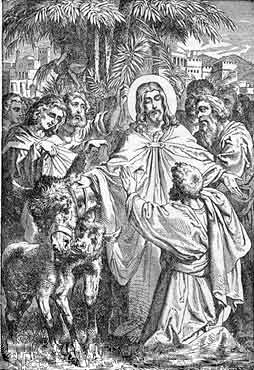
There are several reflections/meditation available for Palm Sunday:
Gospel for Palm Sunday (At the Procession with Palms)
Homily/Reflection for Palm Sunday
A Meditation for Palm Sunday - His Dying Words
Meditation for Palm Sunday - Faith
Why is this day called Palm Sunday?
A Meditation for Palm Sunday - Duties of Teachers
A Meditation for the Week - Eucharistic Devotions
Gospel for the Solemnity: St. Joseph, Husband of the Blessed Virgin Mary
Solemnity of St. Joseph, husband of the Blessed Virgin Mary
Old Calendar: St. Louise de Marillac, widow
From: Matthew 1:16, 18-21, 24a
The Ancestry of Jesus Christ (Continuation)
[16] And Jacob, (was) the father of Joseph the husband of Mary, ofwhom Jesus was born, who is called Christ.
The Virginal Conception of Jesus, and His Birth
[18] Now the birth of Jesus Christ took place in this way. When His mother Mary had been betrothed to Joseph, before they came together she was found to be with child of the Holy Spirit; [19] and her husband Joseph, being a just man and unwilling to put her to shame, resolved to send her away quietly. [20] But as he considered this, behold, an angel of the Lord appeared to him in a dream, saying, "Joseph, son of David, do not fear to take Mary your wife, for that which is conceived in her is of the Holy Spirit; [21] she will bear a son, and you shall call His name Jesus, for He will save His people from their sins." [24a] When Joseph woke from sleep, he did as the angel of the Lord commanded him.
__________________________
Commentary:
16. Jewish genealogies followed the male line. Joseph, being Mary's husband, was the legal father of Jesus. The legal father is on a par with the real father as regards rights and duties. This fact provides a sound basis for recognizing St. Joseph as Patron of the whole Church, since he was chosen to play a very special role in God's plan for our salvation; with Joseph as his legal father, Jesus the Messiah has David as his successor.
Since it was quite usual for people to marry within their clan, it can be concluded that Mary belonged to the house of David. Several early Fathers of the Church testify to this--for example, St. Ignatius of Antioch, St. Irenaeus, St. Justin and Tertullian, who base their testimony on an unbroken oral tradition.
It should also be pointed out that when St. Matthew comes to speak of the birth of Jesus, he uses an ___expression which is completely different from that used for the other people in the genealogy. With these words the text positively teaches that Mary conceived Jesus while still a virgin, without the intervention of man.
18. St. Matthew relates here how Christ was conceived (cf. Luke 1:25-38): "We truly honor and venerate (Mary) as Mother of God, because she gave birth to a person who is at the same time both God and man" ("St. Pius V Catechism", I, 4, 7).
According to the provisions of the Law of Moses, engagement took place about one year before marriage and enjoyed almost the same legal validity. The marriage proper consisted, among other ceremonies, in the bride being brought solemnly and joyously to her husband's house (cf. Deuteronomy 20:7).
From the moment of engagement onwards, a certificate of divorce was needed in the event of a break in the relationship between the couple.
The entire account of Jesus' birth teaches, through the different fulfillment of the prophecy of Isaiah 7:14 (which is expressly quoted in verses 22-23) that: 1) Jesus has David as His ancestor since Joseph is His legal father; 2) Mary is the Virgin who gives birth according to the prophecy; 3) the Child's conception without the intervention of man was miraculous.
19. "St. Joseph was an ordinary sort of man on whom God relied to do great things. He did exactly what the Lord wanted him to do, in each and every event that went to make up his life. That is why Scripture praises Joseph as `a just man'. In Hebrew a just man means a good and faithful servant of God, someone who fulfills the divine will (cf. Genesis 7:1; 18:23-32; Ezekiel 18:5ff.; Proverbs 12:10), or who is honorable and charitable toward his neighbor (cf. Tobias 7:6; 9:6). So a just man is someone who loves God and proves his love by keeping God's commandments and directing his whole life towards the service of his brothers, his fellow men" ([St] J. Escriva, "Christ Is Passing By", 40).
Joseph considered his spouse to be holy despite the signs that she was going to have a child. He was therefore faced with a situation he could not explain. Precisely because he was trying to do God's will, he felt obliged to put her away; but to shield her from public shame he decided to send her away quietly.
Mary's silence is admirable. Her perfect surrender to God even leads her to the extreme of not defending her honor or innocence. She prefers to suffer suspicion and shame rather than reveal the work of grace in her. Faced with a fact which was inexplicable in human terms she abandons herself confidently to the love and providence of God. God certainly submitted the holy souls of Joseph and Mary to a severe trial. We ought not to be surprised if we also undergo difficult trials in the course of our lives. We ought to trust in God during them, and remain faithful to Him, following the example they gave us.
20. God gives His light to those who act in an upright way and who trust in His power and wisdom when faced with situations which exceed human understanding. By calling him the son of David, the angel reminds Joseph that he is the providential link which joins Jesus with the family of David, according to Nathan's messianic prophecy (cf. 2 Samuel 7:12). As St. John Chrysostom says: "At the very start he straightaway reminds him of David, of whom the Christ was to spring, and he does not wish him to be worried from the moment he reminds him, through naming his most illustrious ancestor, of the promise made to all his lineage" ("Hom. on St. Matthew", 4).
"The same Jesus Christ, our only Lord, the Son of God, when He assumed human flesh for us in the womb of the Virgin, was not conceived like other men, from the seed of man, but in a manner transcending the order of nature, that is, by the power of the Holy Spirit, so that the same person, remaining God as He was from eternity, became man, which He was not before" ("St. Pius V Catechism", I, 4, 1).
21. According to the Hebrew root, the name Jesus means "savior". After our Lady, St. Joseph is the first person to be told by God that salvation has begun.
"Jesus is the proper name of the God-man and signifies `Savior'--a name given Him not accidentally, or by the judgment or will of man, but by the counsel and command of God" [...]. All other names which prophecy gave to the Son of God--Wonderful, Counsellor, Mighty God, Everlasting Father, Prince of Peace (cf. Isaiah 9:6)--are comprised in this one name Jesus; for while they partially signified the salvation which He was to bestow on us, this name included the force and meaning of all human salvation" ("St. Pius V Catechism", I, 3, 5 and 6).
________________________
Source: "The Navarre Bible: Text and Commentaries". Biblical text taken from the Revised Standard Version and New Vulgate. Commentaries made by members of the Faculty of Theology of the University of Navarre, Spain. Published by Four Courts Press, Kill Lane, Blackrock, Co. Dublin, Ireland. Reprinted with permission from Four Courts Press and Scepter Publishers, the U.S. publisher.
Old Calendar: St. Louise de Marillac, widow
From: Matthew 1:16, 18-21, 24a
The Ancestry of Jesus Christ (Continuation)
[16] And Jacob, (was) the father of Joseph the husband of Mary, ofwhom Jesus was born, who is called Christ.
The Virginal Conception of Jesus, and His Birth
[18] Now the birth of Jesus Christ took place in this way. When His mother Mary had been betrothed to Joseph, before they came together she was found to be with child of the Holy Spirit; [19] and her husband Joseph, being a just man and unwilling to put her to shame, resolved to send her away quietly. [20] But as he considered this, behold, an angel of the Lord appeared to him in a dream, saying, "Joseph, son of David, do not fear to take Mary your wife, for that which is conceived in her is of the Holy Spirit; [21] she will bear a son, and you shall call His name Jesus, for He will save His people from their sins." [24a] When Joseph woke from sleep, he did as the angel of the Lord commanded him.
__________________________
Commentary:
16. Jewish genealogies followed the male line. Joseph, being Mary's husband, was the legal father of Jesus. The legal father is on a par with the real father as regards rights and duties. This fact provides a sound basis for recognizing St. Joseph as Patron of the whole Church, since he was chosen to play a very special role in God's plan for our salvation; with Joseph as his legal father, Jesus the Messiah has David as his successor.
Since it was quite usual for people to marry within their clan, it can be concluded that Mary belonged to the house of David. Several early Fathers of the Church testify to this--for example, St. Ignatius of Antioch, St. Irenaeus, St. Justin and Tertullian, who base their testimony on an unbroken oral tradition.
It should also be pointed out that when St. Matthew comes to speak of the birth of Jesus, he uses an ___expression which is completely different from that used for the other people in the genealogy. With these words the text positively teaches that Mary conceived Jesus while still a virgin, without the intervention of man.
18. St. Matthew relates here how Christ was conceived (cf. Luke 1:25-38): "We truly honor and venerate (Mary) as Mother of God, because she gave birth to a person who is at the same time both God and man" ("St. Pius V Catechism", I, 4, 7).
According to the provisions of the Law of Moses, engagement took place about one year before marriage and enjoyed almost the same legal validity. The marriage proper consisted, among other ceremonies, in the bride being brought solemnly and joyously to her husband's house (cf. Deuteronomy 20:7).
From the moment of engagement onwards, a certificate of divorce was needed in the event of a break in the relationship between the couple.
The entire account of Jesus' birth teaches, through the different fulfillment of the prophecy of Isaiah 7:14 (which is expressly quoted in verses 22-23) that: 1) Jesus has David as His ancestor since Joseph is His legal father; 2) Mary is the Virgin who gives birth according to the prophecy; 3) the Child's conception without the intervention of man was miraculous.
19. "St. Joseph was an ordinary sort of man on whom God relied to do great things. He did exactly what the Lord wanted him to do, in each and every event that went to make up his life. That is why Scripture praises Joseph as `a just man'. In Hebrew a just man means a good and faithful servant of God, someone who fulfills the divine will (cf. Genesis 7:1; 18:23-32; Ezekiel 18:5ff.; Proverbs 12:10), or who is honorable and charitable toward his neighbor (cf. Tobias 7:6; 9:6). So a just man is someone who loves God and proves his love by keeping God's commandments and directing his whole life towards the service of his brothers, his fellow men" ([St] J. Escriva, "Christ Is Passing By", 40).
Joseph considered his spouse to be holy despite the signs that she was going to have a child. He was therefore faced with a situation he could not explain. Precisely because he was trying to do God's will, he felt obliged to put her away; but to shield her from public shame he decided to send her away quietly.
Mary's silence is admirable. Her perfect surrender to God even leads her to the extreme of not defending her honor or innocence. She prefers to suffer suspicion and shame rather than reveal the work of grace in her. Faced with a fact which was inexplicable in human terms she abandons herself confidently to the love and providence of God. God certainly submitted the holy souls of Joseph and Mary to a severe trial. We ought not to be surprised if we also undergo difficult trials in the course of our lives. We ought to trust in God during them, and remain faithful to Him, following the example they gave us.
20. God gives His light to those who act in an upright way and who trust in His power and wisdom when faced with situations which exceed human understanding. By calling him the son of David, the angel reminds Joseph that he is the providential link which joins Jesus with the family of David, according to Nathan's messianic prophecy (cf. 2 Samuel 7:12). As St. John Chrysostom says: "At the very start he straightaway reminds him of David, of whom the Christ was to spring, and he does not wish him to be worried from the moment he reminds him, through naming his most illustrious ancestor, of the promise made to all his lineage" ("Hom. on St. Matthew", 4).
"The same Jesus Christ, our only Lord, the Son of God, when He assumed human flesh for us in the womb of the Virgin, was not conceived like other men, from the seed of man, but in a manner transcending the order of nature, that is, by the power of the Holy Spirit, so that the same person, remaining God as He was from eternity, became man, which He was not before" ("St. Pius V Catechism", I, 4, 1).
21. According to the Hebrew root, the name Jesus means "savior". After our Lady, St. Joseph is the first person to be told by God that salvation has begun.
"Jesus is the proper name of the God-man and signifies `Savior'--a name given Him not accidentally, or by the judgment or will of man, but by the counsel and command of God" [...]. All other names which prophecy gave to the Son of God--Wonderful, Counsellor, Mighty God, Everlasting Father, Prince of Peace (cf. Isaiah 9:6)--are comprised in this one name Jesus; for while they partially signified the salvation which He was to bestow on us, this name included the force and meaning of all human salvation" ("St. Pius V Catechism", I, 3, 5 and 6).
________________________
Source: "The Navarre Bible: Text and Commentaries". Biblical text taken from the Revised Standard Version and New Vulgate. Commentaries made by members of the Faculty of Theology of the University of Navarre, Spain. Published by Four Courts Press, Kill Lane, Blackrock, Co. Dublin, Ireland. Reprinted with permission from Four Courts Press and Scepter Publishers, the U.S. publisher.
Friday, March 14, 2008
Lenten Reflection: Sloth, the Seventh Capital Sin
"Slothfulness casteth into a deep sleep, and an idle soul shall suffer hunger." Proverbs, 19:15.
At Long Beach, California, tnere is a section called Signal Hill. Some years ago two lots and a house were for sale on that hill. A man and his wife were looking for a place to live. Here was an ideal location. Here they could look down over the picturesque city of Long Beach stretching along the Pacific. And the price was most reasonable - only $1500. They were on the point of purchasing the place, when his wife objected: "I don't want to climb that hill every day."
As a result they did not purchase the property. Imagine their regret when they heard a short time later that oil had been discovered on Signal Hill. They had lost a golden opportunity; they had passed up a chance to be millionaires.
Their regret only grew as the fame and productiveness of the spot increased. Everyone of its 1350 acres yielded 322,000 barrels of oil. Since 1921 Signal Hill has produced upwards of 435 million barrels of crude oil, which would be valued at about the same number of dollars. The black gold gushes in streams from over 890 producing wells.
The man who had failed to buy the house and two lots at the paltry price of $1500, later estimated that at the lowest figure he had lost at least two million dollars.
And the wife who had refused to walk up that hill? Who can describe her feelings of remorse at her unwillingness to make that little effort to climb the hill? How miserable she must have felt ,when she saw that "black gold" gushing so profusely from the spot which might have been hers. Too late she realized that she would not have had to climb that hill very often. They could have leased the lots and lived in luxury elsewhere. But that chance was gone - through her refusal to climb a hill, through her selfish sloth.
Many another treasure has been missed through this sin of sloth, the seventh of the capital sins. Many a blessing of soul and body has been lost through spiritual and physical laziness. Many will never get to heaven because they are unwilling to climb the hill that leads to our home above.
This story is particularly fitting during Lent when we walk the way of the cross with Christ and follow Him as He climbs a hill, the cross on His bruised and burning back. Our Savior gave His all to climb that hill, so that we might all share the unlimited riches that gush forth from the gashes in His hands and feet and side. Sloth has kept many from climbing that hill, just as sloth kept the couple of our story from climbing a hill to material riches.
1. What is sloth? The sin of sloth means an excessive love of ease and idleness, an unwillingness to exert the body or the soul. Sloth means a laziness that leads to neglecting either our physical or spiritual duties.
Sloth, the seventh capital sin, is a distress of soul at the thought of what one has to do in order to secure or to keep the friendship of God.
2. Since we intend to emphasize spiritual sloth, rather than physical laziness, as the former is more important, we should point out at the very beginning the difference between sloth and lukewarmness. Lukewarmness or tepidity, as it is sometimes called, is a decided distaste for religious and spiritual things in general. This dislike causes a person to perform his religious duties in a careless, indifferent, lazy manner.
Sloth, on the other hand, is a disgust for spiritual practices, so strong that it makes a person disregard and even despise the friendship of God. We must not confuse either of these sins with what is usually called dryness, that is, a certain difficulty or drag in performing our spiritual duties. Sloth and lukewarmness are voluntary, and hence sinful; dryness is involuntary, and hence not sinful.
3. How serious a sin is sloth? Sloth is seriously sinful for two main reasons:
A. It makes a man neglect the principal purpose of his life, the one thing necessary, namely, the salvation of his soul. Accordingly, it is a sin against the charity he owes himself, the love he should have for his own soul and salvation.
B. Sloth is directly opposed to the commandment that we love God with our whole heart, and our whole mind, and our whole strength, and our whole soul. In other words, sloth is opposed to the first and principal commandment, that of loving God.
C. Accordingly, sloth is a mortal sin, when it is fully voluntary, fully willed, and when it makes a person regret or neglect serious duties and obligations or even less important ones. It is a venial sin when it is not entirely voluntary.
D. Tepidity or lukewarmness, which means a careless, lazy performance of our religious duties, is not in itself seriously sinful, but it is extremely dangerous. It often leads to sloth. Our Lord used some strong language about tepidity or carelessness.
A. In avoiding as much as possible all manual labor or physical effort. The wife in our story, by refusing to climb that hill, showed her physical sloth and laziness. Of course, in a day when people aro heart-trouble conscious, the wife might have feared that the climb would be harmful to her heart. She may even have had heart trouble. But the story does not say anything about that. However, we must be careful in judging people who are physically slow and even apparently lazy.
B. In seeking bodily ease and comfort. Look at the Catholic who slouches and lounges at Mass, and you are looking at a slothful person. To be at ease at times is good for the body and the mind, but constantly to seek the easiest position and the softest chair is definitely harmful to both body and soul.
C. In a dislike for concentrating the mind in some mental effort, or the soul in some spiritual act. Physical laziness is more or less evident, and is more or less ugly and repulsive. But mental laziness is not always so evident, yet it is even more common. You have all met the man and the woman who cannot be aroused to take in a new idea. They regulate their lives and their thinking by some out-worn formula, by some rule or fad that was in vogue in the distant past. Such people might even be energetic, hardworking as far as their bodies are concerned, but their minds are inactive, sluggish, lazy. They will never change their viewpoint. They will never fit in their thinking with changed conditions, with newly discovered facts, and with a new approach to old problems.
Among such, I class those Catholics who never read a good Catholic paper, magazine or pamphlet, and least of all a good Catholic book. Their religious ideas are those of mere beginners. They do not know, for example, that there is a Christian, Catholic, and thoroughly scientific explanation of evolution. They are too lazy to learn what the Catholic Church teaches on questions like labor and management, the Pope's points for world peace, and similar questions of the day. They are mentally lazy. According to your time and ability you should continue studying your religion.
D. In putting off things that must be done. Such procrastination has been called "the thief of time," and rightly so. Those who live in "Put-off Town" are the sons and daughters of sloth. They will put off answering a letter. They will put off paying a bill. They wil1 put off visiting a sick person. Yes, they will put off doing the dishes and finishing the washing, wasting precious minutes and even hours.
The worst citizen of "Put-off Town" is the Catholic who puts off going to the sacraments, who puts off saying his prayers until he is too sleepy to center his mind on them, who puts off changing his ways for the better in religious matters. His eldest children are called, "Plenty of Time," "No Hurry," and "Wait a While."
E. In giving up before a task is completed. How many lack this sterling stick-to-it-iveness. They start mowing the lawn, but quit when they are half finished. They paint one side of the garage and stop before they even see the other side.
But the worst quitters, for such we must call them, are the spiritual quitters, men and women who start out Lent, for example with the determination to attend Mass every day, or to perform some special penance. How long do they last? The least lazy excuse makes them give up their resolution. During Lent pareticularly slothful souls must watch our Lord closely see Him persevering for forty long days in the desert, must watch him as He perseveres through the bitter tortures of His passion, must watch and follow Him as He sticks to His task of saving us, stays with it to the bitter end-on a cross.
F. In habitual tardiness, starting late and coming late to every kind of activity. They are late in rising, late for work, late for appointments, late with meals, late with assignments whether in the office or at school, and late with almost everyone of their daily duties.
Chief among these are late-comers to Mass. Coming late to the Holy Sacrifice is a positive sign of laziness, a capital sin. They are too lazy to get up a few minutes earlier; too lazy to get things ready the night before; too lazy to make an extra effort, or even an ordinary effort, to be on time for the greatest Action, the Holy Sacrifice. Such sloth is a sin, don't forget.
G. In excusing oneself for neglecting duties. You have met the type. He forever has an excuse for failing to do little tasks about the home. The wife, in turn, is forever explaining why she did not sew on that button. Appoint them to some parish society work. They fail to come through. But will they admit any fault in this? Not on your life. They have always an apparently excellent excuse to offer. Such sloth is sinful and sickening.
H. In wasting effort on useless activities. There is the ironing waiting to be done, but mother listens to a radio program, reads a bit in the paper, talks on the telephone - anything except get down to the task at hand. Wea re almost all guilty in some way or other of this "dawdling" and "doodling." It springs from sloth.
Another form of useless effort is staying up too late at night, making it difficult or impossible to rise at the proper time, and making a person unfit for his work when he does get up. From childhood on human beings want to stay up late - listening to the radio, watching television, and listlessly lolling over the pictures in magazines. A certain amount of social life is necessary for health of body and soul; some need more recreation than others. Nevertheless it is a sign of sloth when we give all our time and energy, or most of it, to useless pastimes.
I. In too much chatter. Here, again, conversation is an important element of normal life, but long telephone conversations, endless and aimless talk about things of no moment, "jawing" needlessly with workers while on the job, are signs of sloth or dodging duty.
J. In neglecting the particular duties of our state in life. The doctor who is slow and indifferent in answering a call; the nurse who neglects any care of her patient; the worker who is slipshod; thu mother who gives as little time as possible to her children and home: tho head of the house who fails to be a father as well as a bread-winner - all are slaves of sloth.
5. Sloth has many evil effects:
A. It brings on poverty, physical as well as spiritual. It drives out all desire for spiritual things. Sloth explains the dislike many have for religious practices, which they either neglect entirely or hurry through as quickly as possible. One example of this is the Catholic who comes late to Mass and who hurries away before, or as soon as, Mass is over.
B. Sloth causes cowardice in meeting problems and difficulties. In smaller or larger form, setbacks and trials come to all. The lazy man folds his hands, twiddles his thumbs, and groans about his bad luck.
C. Sloth suffocates the soul. It chokes off essential grace, the life of the soul, by neglecting prayer, the sacraments, and other spiritual duties.
D. Sloth causes a person to waste talents, opportunities, time and effort, the very things that will help him to climb the hill to heaven.
E. The slothful person is abnormally curious about the doings and sayings of others. He is tempted to idle gossip and unkind talk.
F. The slothful man turns to dangerous diversions, like bad company, drinking, gambling. How true the saying: "An idle mind is the devil's workshop."
6. Any Catholic who can see will readily realize the remedies for sloth. May I suggest a few of them:
A. Learn the duties of your calling or state in life. Actually write them down, putting the principal obligations first, listing them in the order of their importance. Then try to take care of them in that order. Whatever your main work is, do that well.
The story is told of Ethel Barrymore, of the famous family of actors. She was once playing in Kansas City. In the audience was Sinclair Lewis, who remarked after the performance: "Ethel, I don't believe you did as well as you could this afternoon. You let us down."
The grand old lady of the stage bristled: "No Drew or Barrymore," she retorted, "ever goes on the stage, no matter how he feels, or how large or small the crowd is; no matter whether it is New York City or some small town; that he does not give the best that he has to an audience. For we have learned through four generations that we get back just about what we give."
What a stirring principle, not only for the actor, but for those who play on the real stage of life!
B. To overcome sloth, stop and think. What are you doing? Why are you doing it? Here one of the best incentives is the daily good intention, the offering up first thing in the morning of all the thoughts nnd words and actions of that day. Nothing puts meaning into daily duties, nothing gives more zest to humdrum tasks and labor, like the offering of the entire day to Almighty God. The more frequently and fervently one repeats that good intention, the more interesting and profitable life becomes, the more you will develop the virtue opposite the vice of sloth, namely, zeal.
C. Make a daily or weekly list of duties that must be performed, even of such simple tasks as patching clothes or answering letters. A popular magazine some years ago carried an article by a housewife who always seemed swamped by the tiny tasks and big jobs of her home. Finally she hit upon the plan of writing down what she had to do, what she wanted to do. Then she worked down the list, item by item, checking off each as it was accomplished. She came out from under her pile of duties with surprising ease and speed. Try it.
D. Have some sort of daily schedule. In our complex, modern life this is difficult, but necessary. It gives peace and balance. The Catholic, for example, who has a regular time for saying his prayers, for doing some religious reading, for receiving the Sacraments, will get them done faithfully and fervently.
One could scarcely find in all history a busier man than Leonardo Da Vinci, who was not only one the three greatest painters the world has known, but who was also a remarkable success in five other fields of activity. It was he who declared:
"O God, thou givest everything for the price of an effort."
Yes, and that everything includes heaven. God gives heaven for the price of an effort.
E. Fan the love of God in your heart. If you really love God, you will make the best use of your time, your talents, your energies, according to His plan. You need not wait for this fervor. The Christian who waits for feeling before he does something is like the woodsman on a frosty morning standing with his axe leaning against his knee.
"Good morning, my friend," asks a traveler, "what are you going to do?"
"I am going to cut down this tree," he replies.
"Why don't you get at it?" inquires the traveler.
"I'm waiting until I begin to sweat," declares the woodsman.
If he started chopping he would start to sweat. If you start doing things for God, you too will begin to feel the fervor of God's love in your heart.
F. Recall the labors of Christ for you - His long, laborious years as a carpenter, His preaching and teaching, and above all the taxing, fatiguing labor of His passion and death. All of it was done for you.
7. There is no better time than Lent to root out the vice of sloth and plant the virtue of zeal and diligence. May Christ, the Worker, inspire and help you to work for the welfare of your body, but above all for the good of your soul. Amen.
__________________
Adapted from Lent and the Capital Sins
by Fr. Arthur Tonne, OFM (©1952)
At Long Beach, California, tnere is a section called Signal Hill. Some years ago two lots and a house were for sale on that hill. A man and his wife were looking for a place to live. Here was an ideal location. Here they could look down over the picturesque city of Long Beach stretching along the Pacific. And the price was most reasonable - only $1500. They were on the point of purchasing the place, when his wife objected: "I don't want to climb that hill every day."
As a result they did not purchase the property. Imagine their regret when they heard a short time later that oil had been discovered on Signal Hill. They had lost a golden opportunity; they had passed up a chance to be millionaires.
Their regret only grew as the fame and productiveness of the spot increased. Everyone of its 1350 acres yielded 322,000 barrels of oil. Since 1921 Signal Hill has produced upwards of 435 million barrels of crude oil, which would be valued at about the same number of dollars. The black gold gushes in streams from over 890 producing wells.
The man who had failed to buy the house and two lots at the paltry price of $1500, later estimated that at the lowest figure he had lost at least two million dollars.
And the wife who had refused to walk up that hill? Who can describe her feelings of remorse at her unwillingness to make that little effort to climb the hill? How miserable she must have felt ,when she saw that "black gold" gushing so profusely from the spot which might have been hers. Too late she realized that she would not have had to climb that hill very often. They could have leased the lots and lived in luxury elsewhere. But that chance was gone - through her refusal to climb a hill, through her selfish sloth.
Many another treasure has been missed through this sin of sloth, the seventh of the capital sins. Many a blessing of soul and body has been lost through spiritual and physical laziness. Many will never get to heaven because they are unwilling to climb the hill that leads to our home above.
This story is particularly fitting during Lent when we walk the way of the cross with Christ and follow Him as He climbs a hill, the cross on His bruised and burning back. Our Savior gave His all to climb that hill, so that we might all share the unlimited riches that gush forth from the gashes in His hands and feet and side. Sloth has kept many from climbing that hill, just as sloth kept the couple of our story from climbing a hill to material riches.
1. What is sloth? The sin of sloth means an excessive love of ease and idleness, an unwillingness to exert the body or the soul. Sloth means a laziness that leads to neglecting either our physical or spiritual duties.
Sloth, the seventh capital sin, is a distress of soul at the thought of what one has to do in order to secure or to keep the friendship of God.
2. Since we intend to emphasize spiritual sloth, rather than physical laziness, as the former is more important, we should point out at the very beginning the difference between sloth and lukewarmness. Lukewarmness or tepidity, as it is sometimes called, is a decided distaste for religious and spiritual things in general. This dislike causes a person to perform his religious duties in a careless, indifferent, lazy manner.
Sloth, on the other hand, is a disgust for spiritual practices, so strong that it makes a person disregard and even despise the friendship of God. We must not confuse either of these sins with what is usually called dryness, that is, a certain difficulty or drag in performing our spiritual duties. Sloth and lukewarmness are voluntary, and hence sinful; dryness is involuntary, and hence not sinful.
3. How serious a sin is sloth? Sloth is seriously sinful for two main reasons:
A. It makes a man neglect the principal purpose of his life, the one thing necessary, namely, the salvation of his soul. Accordingly, it is a sin against the charity he owes himself, the love he should have for his own soul and salvation.
B. Sloth is directly opposed to the commandment that we love God with our whole heart, and our whole mind, and our whole strength, and our whole soul. In other words, sloth is opposed to the first and principal commandment, that of loving God.
C. Accordingly, sloth is a mortal sin, when it is fully voluntary, fully willed, and when it makes a person regret or neglect serious duties and obligations or even less important ones. It is a venial sin when it is not entirely voluntary.
D. Tepidity or lukewarmness, which means a careless, lazy performance of our religious duties, is not in itself seriously sinful, but it is extremely dangerous. It often leads to sloth. Our Lord used some strong language about tepidity or carelessness.
"I would that thou were cold or hot. But because thou are lukewarm and neither cold nor hot, I am about to vomit thee out of my mouth." Apocalypse, 3:16.4. Sloth betrays itself in many ways:
A. In avoiding as much as possible all manual labor or physical effort. The wife in our story, by refusing to climb that hill, showed her physical sloth and laziness. Of course, in a day when people aro heart-trouble conscious, the wife might have feared that the climb would be harmful to her heart. She may even have had heart trouble. But the story does not say anything about that. However, we must be careful in judging people who are physically slow and even apparently lazy.
B. In seeking bodily ease and comfort. Look at the Catholic who slouches and lounges at Mass, and you are looking at a slothful person. To be at ease at times is good for the body and the mind, but constantly to seek the easiest position and the softest chair is definitely harmful to both body and soul.
C. In a dislike for concentrating the mind in some mental effort, or the soul in some spiritual act. Physical laziness is more or less evident, and is more or less ugly and repulsive. But mental laziness is not always so evident, yet it is even more common. You have all met the man and the woman who cannot be aroused to take in a new idea. They regulate their lives and their thinking by some out-worn formula, by some rule or fad that was in vogue in the distant past. Such people might even be energetic, hardworking as far as their bodies are concerned, but their minds are inactive, sluggish, lazy. They will never change their viewpoint. They will never fit in their thinking with changed conditions, with newly discovered facts, and with a new approach to old problems.
Among such, I class those Catholics who never read a good Catholic paper, magazine or pamphlet, and least of all a good Catholic book. Their religious ideas are those of mere beginners. They do not know, for example, that there is a Christian, Catholic, and thoroughly scientific explanation of evolution. They are too lazy to learn what the Catholic Church teaches on questions like labor and management, the Pope's points for world peace, and similar questions of the day. They are mentally lazy. According to your time and ability you should continue studying your religion.
D. In putting off things that must be done. Such procrastination has been called "the thief of time," and rightly so. Those who live in "Put-off Town" are the sons and daughters of sloth. They will put off answering a letter. They will put off paying a bill. They wil1 put off visiting a sick person. Yes, they will put off doing the dishes and finishing the washing, wasting precious minutes and even hours.
The worst citizen of "Put-off Town" is the Catholic who puts off going to the sacraments, who puts off saying his prayers until he is too sleepy to center his mind on them, who puts off changing his ways for the better in religious matters. His eldest children are called, "Plenty of Time," "No Hurry," and "Wait a While."
E. In giving up before a task is completed. How many lack this sterling stick-to-it-iveness. They start mowing the lawn, but quit when they are half finished. They paint one side of the garage and stop before they even see the other side.
But the worst quitters, for such we must call them, are the spiritual quitters, men and women who start out Lent, for example with the determination to attend Mass every day, or to perform some special penance. How long do they last? The least lazy excuse makes them give up their resolution. During Lent pareticularly slothful souls must watch our Lord closely see Him persevering for forty long days in the desert, must watch him as He perseveres through the bitter tortures of His passion, must watch and follow Him as He sticks to His task of saving us, stays with it to the bitter end-on a cross.
F. In habitual tardiness, starting late and coming late to every kind of activity. They are late in rising, late for work, late for appointments, late with meals, late with assignments whether in the office or at school, and late with almost everyone of their daily duties.
Chief among these are late-comers to Mass. Coming late to the Holy Sacrifice is a positive sign of laziness, a capital sin. They are too lazy to get up a few minutes earlier; too lazy to get things ready the night before; too lazy to make an extra effort, or even an ordinary effort, to be on time for the greatest Action, the Holy Sacrifice. Such sloth is a sin, don't forget.
G. In excusing oneself for neglecting duties. You have met the type. He forever has an excuse for failing to do little tasks about the home. The wife, in turn, is forever explaining why she did not sew on that button. Appoint them to some parish society work. They fail to come through. But will they admit any fault in this? Not on your life. They have always an apparently excellent excuse to offer. Such sloth is sinful and sickening.
H. In wasting effort on useless activities. There is the ironing waiting to be done, but mother listens to a radio program, reads a bit in the paper, talks on the telephone - anything except get down to the task at hand. Wea re almost all guilty in some way or other of this "dawdling" and "doodling." It springs from sloth.
Another form of useless effort is staying up too late at night, making it difficult or impossible to rise at the proper time, and making a person unfit for his work when he does get up. From childhood on human beings want to stay up late - listening to the radio, watching television, and listlessly lolling over the pictures in magazines. A certain amount of social life is necessary for health of body and soul; some need more recreation than others. Nevertheless it is a sign of sloth when we give all our time and energy, or most of it, to useless pastimes.
I. In too much chatter. Here, again, conversation is an important element of normal life, but long telephone conversations, endless and aimless talk about things of no moment, "jawing" needlessly with workers while on the job, are signs of sloth or dodging duty.
J. In neglecting the particular duties of our state in life. The doctor who is slow and indifferent in answering a call; the nurse who neglects any care of her patient; the worker who is slipshod; thu mother who gives as little time as possible to her children and home: tho head of the house who fails to be a father as well as a bread-winner - all are slaves of sloth.
5. Sloth has many evil effects:
A. It brings on poverty, physical as well as spiritual. It drives out all desire for spiritual things. Sloth explains the dislike many have for religious practices, which they either neglect entirely or hurry through as quickly as possible. One example of this is the Catholic who comes late to Mass and who hurries away before, or as soon as, Mass is over.
B. Sloth causes cowardice in meeting problems and difficulties. In smaller or larger form, setbacks and trials come to all. The lazy man folds his hands, twiddles his thumbs, and groans about his bad luck.
C. Sloth suffocates the soul. It chokes off essential grace, the life of the soul, by neglecting prayer, the sacraments, and other spiritual duties.
D. Sloth causes a person to waste talents, opportunities, time and effort, the very things that will help him to climb the hill to heaven.
E. The slothful person is abnormally curious about the doings and sayings of others. He is tempted to idle gossip and unkind talk.
F. The slothful man turns to dangerous diversions, like bad company, drinking, gambling. How true the saying: "An idle mind is the devil's workshop."
6. Any Catholic who can see will readily realize the remedies for sloth. May I suggest a few of them:
A. Learn the duties of your calling or state in life. Actually write them down, putting the principal obligations first, listing them in the order of their importance. Then try to take care of them in that order. Whatever your main work is, do that well.
The story is told of Ethel Barrymore, of the famous family of actors. She was once playing in Kansas City. In the audience was Sinclair Lewis, who remarked after the performance: "Ethel, I don't believe you did as well as you could this afternoon. You let us down."
The grand old lady of the stage bristled: "No Drew or Barrymore," she retorted, "ever goes on the stage, no matter how he feels, or how large or small the crowd is; no matter whether it is New York City or some small town; that he does not give the best that he has to an audience. For we have learned through four generations that we get back just about what we give."
What a stirring principle, not only for the actor, but for those who play on the real stage of life!
B. To overcome sloth, stop and think. What are you doing? Why are you doing it? Here one of the best incentives is the daily good intention, the offering up first thing in the morning of all the thoughts nnd words and actions of that day. Nothing puts meaning into daily duties, nothing gives more zest to humdrum tasks and labor, like the offering of the entire day to Almighty God. The more frequently and fervently one repeats that good intention, the more interesting and profitable life becomes, the more you will develop the virtue opposite the vice of sloth, namely, zeal.
C. Make a daily or weekly list of duties that must be performed, even of such simple tasks as patching clothes or answering letters. A popular magazine some years ago carried an article by a housewife who always seemed swamped by the tiny tasks and big jobs of her home. Finally she hit upon the plan of writing down what she had to do, what she wanted to do. Then she worked down the list, item by item, checking off each as it was accomplished. She came out from under her pile of duties with surprising ease and speed. Try it.
D. Have some sort of daily schedule. In our complex, modern life this is difficult, but necessary. It gives peace and balance. The Catholic, for example, who has a regular time for saying his prayers, for doing some religious reading, for receiving the Sacraments, will get them done faithfully and fervently.
One could scarcely find in all history a busier man than Leonardo Da Vinci, who was not only one the three greatest painters the world has known, but who was also a remarkable success in five other fields of activity. It was he who declared:
"O God, thou givest everything for the price of an effort."
Yes, and that everything includes heaven. God gives heaven for the price of an effort.
E. Fan the love of God in your heart. If you really love God, you will make the best use of your time, your talents, your energies, according to His plan. You need not wait for this fervor. The Christian who waits for feeling before he does something is like the woodsman on a frosty morning standing with his axe leaning against his knee.
"Good morning, my friend," asks a traveler, "what are you going to do?"
"I am going to cut down this tree," he replies.
"Why don't you get at it?" inquires the traveler.
"I'm waiting until I begin to sweat," declares the woodsman.
If he started chopping he would start to sweat. If you start doing things for God, you too will begin to feel the fervor of God's love in your heart.
F. Recall the labors of Christ for you - His long, laborious years as a carpenter, His preaching and teaching, and above all the taxing, fatiguing labor of His passion and death. All of it was done for you.
7. There is no better time than Lent to root out the vice of sloth and plant the virtue of zeal and diligence. May Christ, the Worker, inspire and help you to work for the welfare of your body, but above all for the good of your soul. Amen.
__________________
Adapted from Lent and the Capital Sins
by Fr. Arthur Tonne, OFM (©1952)
Just for Today, March 15
If thou wouldst know and learn anything to the purpose, love to be unknown, and esteemed as nothing.
-Bk. I, ch. ii.
________________
My little Mother taught me what unsuspected treasures lie hidden in the Holy Face. Just as she had entered Carmel before her three sisters, so was she the first to discover the mystery of love hidden in the sacred Face of the Bridegroom. When she had revealed it to me, I understood where true glory is to be found. He whose Kingdom is not of this world taught me that the only royal dignity worthy of our ambition is to love to be unknown and esteemed as nothing, and that we should gladly despise ourselves. I wished that like His, my face might be as it were hidden and despised, whereupon we esteemed him not (Is. liii). I longed to suffer and be forgotten.
-The Story of a Soul (L'Histoire d'une Âme)
__________________
For more information, see this post.
Adapted from Just For Today(©1943 Burns & Oates)
Nihil Obstat: Reginaldus Phillips, S.T.L.,Censor deputatus
Imprimatur: Edwardus Myers, Vic. Cap.
-Bk. I, ch. ii.
________________
My little Mother taught me what unsuspected treasures lie hidden in the Holy Face. Just as she had entered Carmel before her three sisters, so was she the first to discover the mystery of love hidden in the sacred Face of the Bridegroom. When she had revealed it to me, I understood where true glory is to be found. He whose Kingdom is not of this world taught me that the only royal dignity worthy of our ambition is to love to be unknown and esteemed as nothing, and that we should gladly despise ourselves. I wished that like His, my face might be as it were hidden and despised, whereupon we esteemed him not (Is. liii). I longed to suffer and be forgotten.
-The Story of a Soul (L'Histoire d'une Âme)
__________________
For more information, see this post.
Adapted from Just For Today(©1943 Burns & Oates)
Nihil Obstat: Reginaldus Phillips, S.T.L.,Censor deputatus
Imprimatur: Edwardus Myers, Vic. Cap.
Thoughts and Counsels - March 15
When the devil again tempts you to sin, telling you that God is merciful, remember that the Lord shows mercy to them that fear Him, but not to them who despise Him,
-St. Alphonsus
________________________
From Mary, Help of Christians
Part VI, Thoughts and Counsels of the Saints for Every Day of the Year
Compiled by Fr. Bonaventure Hammer, OFM (© 1909, Benziger Brothers)
-St. Alphonsus
________________________
From Mary, Help of Christians
Part VI, Thoughts and Counsels of the Saints for Every Day of the Year
Compiled by Fr. Bonaventure Hammer, OFM (© 1909, Benziger Brothers)
Meditation for March 15, Five Roses of Blood
The five wounds of Christ.
St. Ignatius in his methods of prayer advises what he calls "the application of the senses." "I will force myself," he said, "to see, to hear, to touch...." I will take my stand before our Savior on the Cross. It is the hour of the Passion and I am on Calvary....They have just raised the gibbet. Jesus is there: When I shall be lifted up, I shall draw all things to myself. There He is between the offended Majesty of the Father and the indescribable depravity of humanity.
His hands, His poor hands that have done only good to every one! Look at them, wounded, sore and bleeding.
His feet, they never trod this earth except to help mankind. They are pierced with huge nails. I see, it is all so real....I can touch....Lord, You permit me to press my lips, not to Your sacred flesh, but to this nail which has torn Your feet.
And the pierced side. My head almost reaches the opening; my eyes can penetrate the depth of Your love, O Jesus....
And these cries I hear...the feeble moan of Mary, the weeping of Magdalen, the dull sound of a drop of blood that has just fallen near me....Oh, this blood, with its own sweet fragrance; this blood, which flows down, streaking the Savior's body!
Grant that I may never hear the Crucifixus of the Credo without recalling the five bleeding roses.
_________________
Adapted from Meditations for Religious
by Father Raoul Plus, S.J. (© 1939, Frederick Pustet Co.)
St. Ignatius in his methods of prayer advises what he calls "the application of the senses." "I will force myself," he said, "to see, to hear, to touch...." I will take my stand before our Savior on the Cross. It is the hour of the Passion and I am on Calvary....They have just raised the gibbet. Jesus is there: When I shall be lifted up, I shall draw all things to myself. There He is between the offended Majesty of the Father and the indescribable depravity of humanity.
His hands, His poor hands that have done only good to every one! Look at them, wounded, sore and bleeding.
His feet, they never trod this earth except to help mankind. They are pierced with huge nails. I see, it is all so real....I can touch....Lord, You permit me to press my lips, not to Your sacred flesh, but to this nail which has torn Your feet.
And the pierced side. My head almost reaches the opening; my eyes can penetrate the depth of Your love, O Jesus....
And these cries I hear...the feeble moan of Mary, the weeping of Magdalen, the dull sound of a drop of blood that has just fallen near me....Oh, this blood, with its own sweet fragrance; this blood, which flows down, streaking the Savior's body!
Grant that I may never hear the Crucifixus of the Credo without recalling the five bleeding roses.
_________________
Adapted from Meditations for Religious
by Father Raoul Plus, S.J. (© 1939, Frederick Pustet Co.)
Belleville Rebellion Continues
45 priests call for Braxton to resignThese priests err greatly by making their dissatisifaction with Bishop Braxton public - they bring scandal among themselves, the bishop, and the Church.
BELLEVILLE --A statement issued at noon today and signed by 45 priests asked Bishop Edward Braxton to resign, "...for his own good, for the good of the diocese and for the good of the presbyterate," or priests.
The priests met Wednesday in Germantown and agreed to what they called "a plan of action" but would not reveal it until today.
Braxton could not be reached for comment.
Priests who signed the document represent 60 percent of the active priests in the diocese, not counting clergy from other countries who are on temporary duty....
The call to Braxton to resign was lauded by a national Catholic reform group, Call To Action, based near Chicago.We know there is a problem when CTA supports these priests against their bishop.
The statement can be read here (PDF format).

Meditation for the Solemnity of St Joseph
It often happens that a carpenter in coupling planks produces a cross.
That sometimes happened in St. Joseph's workshop; let me contemplate him there working with the Child to fill the orders of their customers as well and as speedily as possible. While they handled the wood, suddenly there was outlined on the bench the strangely foreboding shadow.
What did St. Joseph know of the future crucifixion? No doubt, in the course of the evenings at Nazareth, he questioned Jesus, asking Him to comment on one or other of the Prophecies. The Child gave the required explanation simply, saying what was necessary, and kept for Himself the harrowing details. But St. Joseph, who was well versed in the Holy Scriptures, penetrated beyond the silence of Jesus into the true meaning of the distressing texts which he read in the Prophecies or heard commented on by the Rabbis.
Jesus knew everything down to the last details. He came into the world to fulfill them, and nothing of that horror - the crucifixion - escaped Him. He was conscious of it at every moment. Later at Gethsemane He gave entrance into His soul to this agony which tortured Him - this agony which He had suffered all His life.
One who has a very delicate nature and knows he must undergo painful treatment suffers continually from the dread of the approaching ordeal. It is a great blessing for us that we do not have previous knowledge of our crosses. Jesus knew in advance of His cross and all that His cross implied. He needed all the support that His divinity could give to bear up under the perpetual agony of each moment of His life on earth.
Those beams which crossed and formed that instrument of torture are only another vivid reminder. What an agony to live thus In constant anguish! I, who know so little about suffering, must learn to bear my little crosses.
_________________
Adapted from Meditations for Religious
by Father Raoul Plus, S.J. (© 1939, Frederick Pustet Co.)
That sometimes happened in St. Joseph's workshop; let me contemplate him there working with the Child to fill the orders of their customers as well and as speedily as possible. While they handled the wood, suddenly there was outlined on the bench the strangely foreboding shadow.
What did St. Joseph know of the future crucifixion? No doubt, in the course of the evenings at Nazareth, he questioned Jesus, asking Him to comment on one or other of the Prophecies. The Child gave the required explanation simply, saying what was necessary, and kept for Himself the harrowing details. But St. Joseph, who was well versed in the Holy Scriptures, penetrated beyond the silence of Jesus into the true meaning of the distressing texts which he read in the Prophecies or heard commented on by the Rabbis.
Jesus knew everything down to the last details. He came into the world to fulfill them, and nothing of that horror - the crucifixion - escaped Him. He was conscious of it at every moment. Later at Gethsemane He gave entrance into His soul to this agony which tortured Him - this agony which He had suffered all His life.
One who has a very delicate nature and knows he must undergo painful treatment suffers continually from the dread of the approaching ordeal. It is a great blessing for us that we do not have previous knowledge of our crosses. Jesus knew in advance of His cross and all that His cross implied. He needed all the support that His divinity could give to bear up under the perpetual agony of each moment of His life on earth.
Those beams which crossed and formed that instrument of torture are only another vivid reminder. What an agony to live thus In constant anguish! I, who know so little about suffering, must learn to bear my little crosses.
_________________
Adapted from Meditations for Religious
by Father Raoul Plus, S.J. (© 1939, Frederick Pustet Co.)
More from the Post-Dispatch on the Excommunicated Womyn Priestesses
St. Louis Archbishop Raymond Burke has declared two Roman Catholic women who live in the archdiocese, and another who lives in Germany, excommunicated.Overreaching, she says???? Much like these malcontents overreaching in thinking that they can become "priests" in the Catholic Church?
The area women, Rose Marie Hudson and Elsie Hainz McGrath, were ordained as priests in an organization called Roman Catholic Womenpriests in November...
[...]
Bridget Mary Meehan, a spokeswoman for Roman Catholic Womenpriests, said there were 53 ordained North American members of the organization, which Burke, in the document sent to Hudson and McGrath, called "a new and separate sect."
[...]
Meehan said she didn't believe Burke had the authority to declare Fresen excommunicated because she did not live in the St. Louis archdiocese. "We think he's overreaching," she said.
Hudson, 68, of Festus, and McGrath, 69, of St. Louis, co-pastor a faith community and hold a worship service for about 35 people Sunday evenings at the First Unitarian Church of St. Louis in the Central West End.They perform before a small group of likeminded dissenters...And it seems numbers are falling from the initial crowd of about 100 or so. Where, we wonder, is all the support previously demonstrated for these two sad and confused individuals? Numbers have dwindled from the 500-600 at their "ordination" to a mere 35 people today? Counterfeits never seem to last long, do they?
In a statement Thursday, Hudson and McGrath said that they "and all Roman Catholic Womenpriests, reject the penalties of excommunication, interdict, and any other punitive actions from church officials. We are loyal daughters of the church, and we stand in the prophetic tradition of holy (canonical) disobedience to an unjust man-made law that discriminates against women."Clowns! All of them! Claiming to be "loyal" daughters of the Church...they're loyal daughters, alright, but not to Christ or His Church - they're loyal daughters of the Church of the evil one, walking hand in hand with him on the way to eternal damnation and trying to take as many souls as possible with them. Pathetic!
And just as repugnant as the statements these women make is the fact the Liguori Publications is still selling McGrath's booklets (click here)...Shame on them!
Encouraging Dissent - CAN at it again...
The most recent web page of the local group "Catholic Action Network" calles for a "Lay Synod" in May - a gathering which would presumably include the area's local dissenters, heretics, and schismatics. What a way to spend a "First Saturday" after Holy Mass - [hint, hint]...
Source
Lay Synod- "A Time for Courage"This ought to be good...though, I can't figure out what is really meant by the phrase "a time for courage." Does it mean "courage" to stand up against the ways of the world, or the "arrogance" and lack of courage in opposing the Church and standing with Satan?
Saturday, May 3rd
9:00 am-3:30 pm
Location: TBA
CAN is calling for a Lay Synod. Catholics from throughout St. Louis are invited to come and discuss our Church. We will look at the history of the church and the ways in which leaderhip of the church has developed. In this light we will recognize the vital leadership role of the laity. Lena Woltering will be giving the keynote address.
Please join us- RSVP by April 27th by e-mailing can@catholicactionnetwork.org
Source
Dr Edward Peters on Archbishop Burke's Declaratoin of Excommunication
I would like to say that Abp. Raymond Burke's excommunication of three women who recently participated in a pseudo-ordination in Saint Louis is a "text-book illustration" of how (non-judicial) excommunication is supposed to be applied in the Church today, but I can't say that: Why not?Read why he says this here.
Because Abp. Burke's attention to juridic detail and his provision for the pastoral care of the people in his care so exceeds what the textbooks teach, that it is the textbooks that must copy from him, not him from the textbooks.
Gospel for Friday, 5th Week of Lent
From: John 10:31-42
Jesus and the Father Are One (Continuation)
[31] The Jews took stones again to stone Him (Jesus). [32] Jesus answered them, "I have shown you many good works from the Father; for which of these do you stone Me?" [33] The Jews answered Him, "We stone you for no good work but for blasphemy; because You, being a man, make Yourself God." [34] Jesus answered them, "Is it not written in your law, `I said you are gods'? [35] If He called them gods to whom the word of God came (and Scripture cannot be broken), [36] do you say of Him whom the Father consecrated and sent into the world, `You are blaspheming,' because I said, `I am the Son of God'? [37] If I am not doing the works of My Father, then do not believe Me; [38] but if I do them, even though you do not believe Me, believe the works, that you may know and understand that the Father is in Me and I am in the Father." [39] Again they tried to arrest Him, but He escaped from their hands.
[40] He went away again across the Jordan to the place where John at first baptized, and there He remained. [41] And many came to Him; and they said, "John did no sign, but everything that John said about this Man was true." [42] And many believed in Him there.
________________
Commentary:
31-33. The Jews realize that Jesus is saying that He is God, but they interpret His words as blasphemy. He was called a blasphemer when He forgave the sins of the paralytic (Matthew 9:1-8), and He will also be accused of blasphemy when He is condemned after solemnly confessing His divinity before the Sanhedrin (Matthew 26:63-65). Our Lord, then, did reveal that He was God; but His hearers rejected this revelation of the mystery of the Incarnate God, refusing to examine the proof Jesus offered them; consequently, they accuse Him, a man, of making Himself God. Faith bases itself on reasonable evidence--miracles and prophecies--for believing that Jesus is really man and really God, even though our limited minds cannot work out how this can be so. Thus, our Lord, in order to affirm His divinity once more, uses two arguments which His adversaries cannot refute--the testimony of Sacred Scripture (prophecies) and that of His own works (miracles).
34-36. On a number of occasions the Gospel has shown our Lord replying to the Jews' objections. Here He patiently uses a form of argument which they regards as decisive - the authority of Sacred Scripture. He quotes Psalm 82 in which God upbraids certain judges for acting unjustly despite His reminding them that "You are gods, sons of the Most High, all of you" (Psalm 82:6). If this psalm calls the sons of Israel gods and sons of God, with how much more reason should He be called God who has been sanctified and sent by God? Christ's human nature, on being assumed by the Word, is sanctified completely and comes to the world to sanctify men. "The Fathers of the Church constantly proclaim that what was not assumed by Christ was not healed. Now Christ took a complete human nature just as it is found in us poor unfortunates, but one that was without sin, for Christ said of Himself that He was the one `whom the Father consecrated and sent into the world'" (Vatican II, "Ad Gentes", 3).
By using Sacred Scripture (cf. Matthew 4:4, 7, 10; Luke 4:1, 17) Jesus teaches us that Scripture comes from God. Therefore, the Church believes and affirms that "those divinely revealed realities which are contained and presented in Sacred Scripture have been committed to writing under the inspiration of the Holy Spirit. Holy Mother Church, relying on the belief of the Apostles, holds that the books of both the Old and New Testament in their entirety, with all their parts, are sacred and canonical because, having been written under the inspiration of the Holy Spirit (cf. John 20:31; 2 Timothy 3:16; 2 Peter 1:19-21; 3:15-16) they have God as their author and have been handed on as such to the Church. [...] Therefore, since everything asserted by the inspired authors or sacred writers must be held to be asserted by the Holy Spirit, it follows that the books of Scriptures must be acknowledged as teaching firmly, faithfully, and without error that truth which God wanted put into the sacred writings for the sake of our salvation" (Vatican II, "Dei Verbum", 11).
37-38. The works which our Lord is referring to are His miracles, through which God's power is made manifest. Jesus presents His words and His works as forming a unity, with the miracles confirming His words and His words explaining the meaning of the miracles. Therefore, when He asserts that He is the Son of God, this revelation is supported by the credentials of the miracles He works: hence, if no one can deny the fact of the miracles, it is only right for Him to accept the truth of the words.
41-42. The opposition offered by some people (cf. John 10:20, 31, 39) contrasts with the way other people accept Him and follow Him to where He goes after this. St. John the Baptist's preparatory work is still producing results: those who accepted the Baptist's message now look for Christ and they believe when they see the truth of what the Precursor said: Jesus is the Messiah, the Son of God (John 1:34).
Work done in the Lord's name is never useless: "Therefore, My beloved brethren, be steadfast, immovable, always abounding in the work of the Lord, knowing that in the Lord your labor is not in vain" (1 Corinthians 15:58). Just as the Baptist's word and example had the effect of helping many people later to believe in Jesus, the apostolic example given by Christians will never be in vain, even though the results may not come immediately. "To sow. The sower went out... Scatter your seed, apostolic soul. The wind of grace will bear it away if the furrow where it falls is not worthy.... Sow, and be certain that the seed will take root and bear fruit" ([St] J. Escriva, "The Way", 794).
___________________________
Source: "The Navarre Bible: Text and Commentaries". Biblical text taken from the Revised Standard Version and New Vulgate. Commentaries made by members of the Faculty of Theology of the University of Navarre, Spain. Published by Four Courts Press, Kill Lane, Blackrock, Co. Dublin, Ireland. Reprinted with permission from Four Courts Press and Scepter Publishers, the U.S. publisher.
Jesus and the Father Are One (Continuation)
[31] The Jews took stones again to stone Him (Jesus). [32] Jesus answered them, "I have shown you many good works from the Father; for which of these do you stone Me?" [33] The Jews answered Him, "We stone you for no good work but for blasphemy; because You, being a man, make Yourself God." [34] Jesus answered them, "Is it not written in your law, `I said you are gods'? [35] If He called them gods to whom the word of God came (and Scripture cannot be broken), [36] do you say of Him whom the Father consecrated and sent into the world, `You are blaspheming,' because I said, `I am the Son of God'? [37] If I am not doing the works of My Father, then do not believe Me; [38] but if I do them, even though you do not believe Me, believe the works, that you may know and understand that the Father is in Me and I am in the Father." [39] Again they tried to arrest Him, but He escaped from their hands.
[40] He went away again across the Jordan to the place where John at first baptized, and there He remained. [41] And many came to Him; and they said, "John did no sign, but everything that John said about this Man was true." [42] And many believed in Him there.
________________
Commentary:
31-33. The Jews realize that Jesus is saying that He is God, but they interpret His words as blasphemy. He was called a blasphemer when He forgave the sins of the paralytic (Matthew 9:1-8), and He will also be accused of blasphemy when He is condemned after solemnly confessing His divinity before the Sanhedrin (Matthew 26:63-65). Our Lord, then, did reveal that He was God; but His hearers rejected this revelation of the mystery of the Incarnate God, refusing to examine the proof Jesus offered them; consequently, they accuse Him, a man, of making Himself God. Faith bases itself on reasonable evidence--miracles and prophecies--for believing that Jesus is really man and really God, even though our limited minds cannot work out how this can be so. Thus, our Lord, in order to affirm His divinity once more, uses two arguments which His adversaries cannot refute--the testimony of Sacred Scripture (prophecies) and that of His own works (miracles).
34-36. On a number of occasions the Gospel has shown our Lord replying to the Jews' objections. Here He patiently uses a form of argument which they regards as decisive - the authority of Sacred Scripture. He quotes Psalm 82 in which God upbraids certain judges for acting unjustly despite His reminding them that "You are gods, sons of the Most High, all of you" (Psalm 82:6). If this psalm calls the sons of Israel gods and sons of God, with how much more reason should He be called God who has been sanctified and sent by God? Christ's human nature, on being assumed by the Word, is sanctified completely and comes to the world to sanctify men. "The Fathers of the Church constantly proclaim that what was not assumed by Christ was not healed. Now Christ took a complete human nature just as it is found in us poor unfortunates, but one that was without sin, for Christ said of Himself that He was the one `whom the Father consecrated and sent into the world'" (Vatican II, "Ad Gentes", 3).
By using Sacred Scripture (cf. Matthew 4:4, 7, 10; Luke 4:1, 17) Jesus teaches us that Scripture comes from God. Therefore, the Church believes and affirms that "those divinely revealed realities which are contained and presented in Sacred Scripture have been committed to writing under the inspiration of the Holy Spirit. Holy Mother Church, relying on the belief of the Apostles, holds that the books of both the Old and New Testament in their entirety, with all their parts, are sacred and canonical because, having been written under the inspiration of the Holy Spirit (cf. John 20:31; 2 Timothy 3:16; 2 Peter 1:19-21; 3:15-16) they have God as their author and have been handed on as such to the Church. [...] Therefore, since everything asserted by the inspired authors or sacred writers must be held to be asserted by the Holy Spirit, it follows that the books of Scriptures must be acknowledged as teaching firmly, faithfully, and without error that truth which God wanted put into the sacred writings for the sake of our salvation" (Vatican II, "Dei Verbum", 11).
37-38. The works which our Lord is referring to are His miracles, through which God's power is made manifest. Jesus presents His words and His works as forming a unity, with the miracles confirming His words and His words explaining the meaning of the miracles. Therefore, when He asserts that He is the Son of God, this revelation is supported by the credentials of the miracles He works: hence, if no one can deny the fact of the miracles, it is only right for Him to accept the truth of the words.
41-42. The opposition offered by some people (cf. John 10:20, 31, 39) contrasts with the way other people accept Him and follow Him to where He goes after this. St. John the Baptist's preparatory work is still producing results: those who accepted the Baptist's message now look for Christ and they believe when they see the truth of what the Precursor said: Jesus is the Messiah, the Son of God (John 1:34).
Work done in the Lord's name is never useless: "Therefore, My beloved brethren, be steadfast, immovable, always abounding in the work of the Lord, knowing that in the Lord your labor is not in vain" (1 Corinthians 15:58). Just as the Baptist's word and example had the effect of helping many people later to believe in Jesus, the apostolic example given by Christians will never be in vain, even though the results may not come immediately. "To sow. The sower went out... Scatter your seed, apostolic soul. The wind of grace will bear it away if the furrow where it falls is not worthy.... Sow, and be certain that the seed will take root and bear fruit" ([St] J. Escriva, "The Way", 794).
___________________________
Source: "The Navarre Bible: Text and Commentaries". Biblical text taken from the Revised Standard Version and New Vulgate. Commentaries made by members of the Faculty of Theology of the University of Navarre, Spain. Published by Four Courts Press, Kill Lane, Blackrock, Co. Dublin, Ireland. Reprinted with permission from Four Courts Press and Scepter Publishers, the U.S. publisher.
Subscribe to:
Posts (Atom)