From: John 12:44-50
The Unbelief of the Jews
[44] And Jesus cried out and said, "He who believes in Me, believes not in Me, but in Him who sent Me. [45] And he who sees Me sees Him who sent Me. [46] I have come as light into the world, that whoever believes in Me may not remain in darkness. [47] If any one hears My sayings and does not keep them, I do not judge him; for I did not come to judge the world but to save the world. [48] He who rejects Me and does not receive My sayings has a judge; the word that I have spoken will be His judge on the last day. [49] For I have not spoken on My own authority; the Father who sent Me has Himself given Me commandment what to say and what to speak. [50] And I know that His commandment is eternal life. What I say, therefore, I say as the Father has bidden Me."
______________________
Commentary:
44-50. With these verses St. John brings to an end his account of our Lord's public ministry. He brings together certain fundamental themes developed in previous chapters--the need for faith in Christ (verse 44); the Father and the Son are one yet distinct (cf. 45); Jesus is Light and Life of the world (verses 46, 50); men will be judged in accordance with whether they accept or reject the Son of God (verses 47-49). The chapters which follow contain Jesus' teaching to His Apostles at the Last Supper, and the accounts of the Passion and Resurrection.
45. Christ, the Word Incarnate, is one with the Father (cf. John 10:30); "He reflects the glory of God" (Hebrews 1:3); "He is the image of the invisible God" (Colossians 1:15). In John 14:9 Jesus expresses Himself in almost the same words: "He who has seen Me has seen the Father". At the same time as He speaks of His oneness with the Father, we are clearly shown the distinction of persons--the Father who sends, and the Son who is sent.
In Christ's holy human nature His divinity is, as it were, hidden, that divinity which He possesses with the Father in the unity of the Holy Spirit (cf. John 14:7-11). In theology "circumincession" is the word usually used for the fact that, by virtue of the unity among the three Persons of the Blessed Trinity, "the Father is wholly in the Son and wholly in the Holy Spirit; the Son wholly in the Father and wholly in the Holy Spirit; the Holy Spirit wholly in the Father and wholly in the Son" (Council of Florence, "Decree Pro Jacobitis, Dz-Sch", 1331).
47. Christ has come to save the world by offering Himself in sacrifice for our sins and bringing us supernatural life (cf. John 3:17). But He has also been made Judge of the living and the dead (cf. Acts 10:42): He passes sentence at the Particular Judgment which happens immediately after death, and at the end of the world, at His Second Coming or Parousia, at the universal judgment (cf. John 5:22; 8:15-16).
___________________________
Source: "The Navarre Bible: Text and Commentaries". Biblical text taken from the Revised Standard Version and New Vulgate. Commentaries made by members of the Faculty of Theology of the University of Navarre, Spain. Published by Four Courts Press, Kill Lane, Blackrock, Co. Dublin, Ireland. Reprinted with permission from Four Courts Press and Scepter Publishers, the U.S. publisher.
Wednesday, April 16, 2008


Tuesday, April 15, 2008
Just for Today, April 16
Son, trust not to thy present affection; it will quickly be changed into another. As long as thou livest thou art subject to change, even against thy will; so as to be sometimes joyful, at other times sad; now easy, then troubled; at one time devout, at another time dry; sometimes fervent, at other times sluggish; one day heavy, another lighter.
But he that is wise and well instructed in spirit, stands above all these changes; not minding what he feels in himself, nor on what side the wind of mutability blows; but that the whole bent of his soul may advance towards its due and wished-for end. For so he may continue one and the self-same, without being shaken, by directing without ceasing, through all this variety of events, the single eye of his intention towards Me.
-Bk. III, ch. xxxiii.
_______________
If my soul were not filled with submission to the Will of God, it would sink beneath the flood of changing impressions, now joyful, now sad, that pour in upon one in this life. They are a great trial, it is true, but they only touch the surface of my soul.
-Novissima Verba.
__________________
For more information, see this post.
Adapted from Just For Today(©1943 Burns & Oates)
Nihil Obstat: Reginaldus Phillips, S.T.L.,Censor deputatus
Imprimatur: Edwardus Myers, Vic. Cap.
But he that is wise and well instructed in spirit, stands above all these changes; not minding what he feels in himself, nor on what side the wind of mutability blows; but that the whole bent of his soul may advance towards its due and wished-for end. For so he may continue one and the self-same, without being shaken, by directing without ceasing, through all this variety of events, the single eye of his intention towards Me.
-Bk. III, ch. xxxiii.
_______________
If my soul were not filled with submission to the Will of God, it would sink beneath the flood of changing impressions, now joyful, now sad, that pour in upon one in this life. They are a great trial, it is true, but they only touch the surface of my soul.
-Novissima Verba.
__________________
For more information, see this post.
Adapted from Just For Today(©1943 Burns & Oates)
Nihil Obstat: Reginaldus Phillips, S.T.L.,Censor deputatus
Imprimatur: Edwardus Myers, Vic. Cap.
Thoughts and Counsels - April 16
Meditation for April 16, Spiritual Inventory
We are living in times, said the great and generous university professor, Antoine Martel, "which are not satisfied with good parishioners and good religious, but which wait impatiently for saints."
Martel could say that. He lived his Catholicism intensely, and in the exercise of his remarkable charity, he recoiled before nothing. Each week he went to wash the feet of a sick man whose stiffened body made all personal care of himself impossible.
Our age is not satisfied with good religious but waits impatiently for saints.
Is this not an opportune time to examine my spiritual status?
A bad religious? - No, I hope not.
Merely a "good religious"? - That is not enough.
A saint? - That is what I must know. It is no risk to wager that I am far from it. But then I am betraying my rule, the expectation of God and the desires of my superiors and companions. Is it not time to begin?...I must question myself, pass judgment on myself. Does it suffice that the coming months be like those that have passed? Ought there not be something else; more generosity, more enthusiasm, more love?
A brave young girl, Eve Lavalliere, who had been thoroughly converted from a shameful life, asked that these words be inscribed on her tombstone:
Adapted from Meditations for Religious
by Father Raoul Plus, S.J. (© 1939, Frederick Pustet Co.)
Martel could say that. He lived his Catholicism intensely, and in the exercise of his remarkable charity, he recoiled before nothing. Each week he went to wash the feet of a sick man whose stiffened body made all personal care of himself impossible.
Our age is not satisfied with good religious but waits impatiently for saints.
Is this not an opportune time to examine my spiritual status?
A bad religious? - No, I hope not.
Merely a "good religious"? - That is not enough.
A saint? - That is what I must know. It is no risk to wager that I am far from it. But then I am betraying my rule, the expectation of God and the desires of my superiors and companions. Is it not time to begin?...I must question myself, pass judgment on myself. Does it suffice that the coming months be like those that have passed? Ought there not be something else; more generosity, more enthusiasm, more love?
A brave young girl, Eve Lavalliere, who had been thoroughly converted from a shameful life, asked that these words be inscribed on her tombstone:
"You who have created me, have mercy on me. I shall trust the past to God with confidence. For the future, I shall march on to sanctity!"_________________
Adapted from Meditations for Religious
by Father Raoul Plus, S.J. (© 1939, Frederick Pustet Co.)
Hamas Cleric Predicts 'Rome Will Be Conquered by Islam'
A sermon last Friday by a prominent Muslim cleric and Hamas member of the Palestinian parliament openly declared that "the capital of the Catholics, or the Crusader capital," would soon be conquered by Islam.
The fiery sermon, delivered by Yunis al-Astal and aired on Hamas' Al-Aqsa TV, predicted that Rome would become "an advanced post for the Islamic conquests, which will spread though Europe in its entirety, and then will turn to the two Americas, even Eastern Europe."
"Allah has chosen you for Himself and for His religion," al-Astal preached, "so that you will serve as the engine pulling this nation to the phase of succession, security and consolidation of power, and even to conquests through da'wa and military conquests of the capitals of the entire world...."

Gospel for Tuesday, 4th Week of Easter
From: John 10:22-30
Jesus and the Father are One
[22] It was the feast of the Dedication at Jerusalem; [23] it was winter, and Jesus was walking in the temple, in the portico of Solomon. [24] So the Jews gathered round Him and said to Him, "How long will You keep us in suspense? If you are the Christ, tell us plainly." [25] Jesus answered them, "I told you, and you do not believe. The works that I do in My Father's name, they bear witness to Me; [26] but you do not believe, because you do not belong to My sheep. [27] My sheep hear My voice, and I know them, and they follow Me; [28] and I give them eternal life, and they shall never perish, and no one shall snatch them out of My hand. [29] My Father, who has given them to Me, is greater than all, and no one is able to snatch them out of the Father's hand. [30] I and the Father are one."
___________________
Commentary:
22. This feast commemorates an episode in Jewish history (cf. 1 Maccabees 4:36-59; 2 Maccabees 1-2:19; 10:1-8) when Judas Maccabeus, in the year 165 B.C., after liberating Jerusalem from the control of the Seleucid kings of Syria, cleansed the temple of the profanations of Antiochus Epiphanes (1 Maccabees 1:54). From then onwards, on the twenty-fifth day of the month of Kislev (November-December) and throughout the following week, all Judea celebrated the anniversary of the dedication of the new altar. It was also known as the "Festival of Lights" because it was customary to light lamps, a symbol of the Law, and put them in the windows of the houses (cf. 2 Maccabees 1:18).
24-25. When these Jews ask Jesus if He is the Messiah, "they speak in this way", St. Augustine comments, "not because they desire truth, but to prepare the way for calumny" ("In Ioann. Evang.", 48, 3). We have already seen Jesus reveal, by His words and deeds, that He is the Only Son of God (5:19ff; 7:16ff; 8:25ff). In view of their good dispositions, He explicitly told the Samaritan woman (4:26) and the man born blind (9:37) that He was the Messiah and Savior. Now He reproaches His listeners for refusing to recognize the works He does in His Father's name (cf. 5:36; 10:38). On other occasions He referred to works as a way to distinguish true prophets from false ones: "You will know them by their fruits" (Matthew 7:16; cf. Matthew 12:33).
26-29. Certainly faith and eternal life cannot be merited by man's own efforts: they are a gift of God. But the Lord does not deny anyone grace to believe and be saved, because He `wishes all men to be saved and to come to the knowledge of the Truth" (1 Timothy 2:4). If someone tries to avoid receiving the gift of faith, his unbelief is blameworthy. On this point St. Thomas Aquinas teaches: "I can see, thanks to the light of the sun; but if I close my eyes, I cannot see: this is no fault of the sun, it is my own fault, because by closing my eyes, I prevent the sunlight from reaching me" ("Commentary on St. John, ad loc.").
But those who do not oppose divine grace do come to believe in Jesus. They are known to and loved by Him, enter under His protection and remain faithful with the help of His grace, which is a pledge of the eternal life which the Good Shepherd will eventually give them. It is true that in this world they will have to strive and in the course of striving they will sustain wounds; but if they stay united to the Good Shepherd nothing and no one will snatch Christ's sheep from Him, because our Father, God, is stronger than the Evil One. Our hope that God will grant us final perseverance is not based on our strength but on God's mercy: this hope should always motivate us to strive to respond to grace and to be more faithful to the demands of our faith.
30. Jesus reveals that He and the Father are one in substance. Earlier He proclaimed that God was His Father, "making Himself equal with God"--which is why a number of times the Jewish authorities think of putting Him to death (cf. 5:18; 8:59). Now He speaks about the mystery of God, which is something we can know about only through Revelation. Later on He will reveal more about this mystery, particularly at the Last Supper (14:10; 17:21-22). It is something the evangelist reflects on at the very beginning of the Gospel, in the prologue (cf. John 1:1 and note).
"Listen to the Son Himself", St. Augustine invites us. "`I and the Father are one.' He did not say, `I am the Father' or `I and the Father are one [Person].' But when He says, `I and the Father are one,' notice the two words `[we are]' and `one'...For if they are one, then they are not diverse; if `[we] are', then there is both a Father and a Son" ("In Ioann. Evang.", 36, 9). Jesus reveals that He is one in substance with the Father as far as divine essence or nature is concerned, but He also reveals that the Father and the Son are distinct Persons: "We believe then in the Father who eternally begets the Son; in the Son, the Word of God, who is eternally begotten; in the Holy Spirit, the uncreated Person who proceeds from the Father and the Son as their eternal Love. Thus in the three divine Persons, "coaeternae sibi et coaequales", the life and beatitude of God perfectly One superabound and are consummated in the supreme excellence and glory proper to uncreated Being, and always `there should be venerated Unity in the Trinity and Trinity in the Unity'" ([Pope] Paul VI, "Creed of the People of God," 10).
___________________________
Source: "The Navarre Bible: Text and Commentaries". Biblical text taken from the Revised Standard Version and New Vulgate. Commentaries made by members of the Faculty of Theology of the University of Navarre, Spain. Published by Four Courts Press, Kill Lane, Blackrock, Co. Dublin, Ireland. Reprinted with permission from Four Courts Press and Scepter Publishers, the U.S. publisher.
Jesus and the Father are One
[22] It was the feast of the Dedication at Jerusalem; [23] it was winter, and Jesus was walking in the temple, in the portico of Solomon. [24] So the Jews gathered round Him and said to Him, "How long will You keep us in suspense? If you are the Christ, tell us plainly." [25] Jesus answered them, "I told you, and you do not believe. The works that I do in My Father's name, they bear witness to Me; [26] but you do not believe, because you do not belong to My sheep. [27] My sheep hear My voice, and I know them, and they follow Me; [28] and I give them eternal life, and they shall never perish, and no one shall snatch them out of My hand. [29] My Father, who has given them to Me, is greater than all, and no one is able to snatch them out of the Father's hand. [30] I and the Father are one."
___________________
Commentary:
22. This feast commemorates an episode in Jewish history (cf. 1 Maccabees 4:36-59; 2 Maccabees 1-2:19; 10:1-8) when Judas Maccabeus, in the year 165 B.C., after liberating Jerusalem from the control of the Seleucid kings of Syria, cleansed the temple of the profanations of Antiochus Epiphanes (1 Maccabees 1:54). From then onwards, on the twenty-fifth day of the month of Kislev (November-December) and throughout the following week, all Judea celebrated the anniversary of the dedication of the new altar. It was also known as the "Festival of Lights" because it was customary to light lamps, a symbol of the Law, and put them in the windows of the houses (cf. 2 Maccabees 1:18).
24-25. When these Jews ask Jesus if He is the Messiah, "they speak in this way", St. Augustine comments, "not because they desire truth, but to prepare the way for calumny" ("In Ioann. Evang.", 48, 3). We have already seen Jesus reveal, by His words and deeds, that He is the Only Son of God (5:19ff; 7:16ff; 8:25ff). In view of their good dispositions, He explicitly told the Samaritan woman (4:26) and the man born blind (9:37) that He was the Messiah and Savior. Now He reproaches His listeners for refusing to recognize the works He does in His Father's name (cf. 5:36; 10:38). On other occasions He referred to works as a way to distinguish true prophets from false ones: "You will know them by their fruits" (Matthew 7:16; cf. Matthew 12:33).
26-29. Certainly faith and eternal life cannot be merited by man's own efforts: they are a gift of God. But the Lord does not deny anyone grace to believe and be saved, because He `wishes all men to be saved and to come to the knowledge of the Truth" (1 Timothy 2:4). If someone tries to avoid receiving the gift of faith, his unbelief is blameworthy. On this point St. Thomas Aquinas teaches: "I can see, thanks to the light of the sun; but if I close my eyes, I cannot see: this is no fault of the sun, it is my own fault, because by closing my eyes, I prevent the sunlight from reaching me" ("Commentary on St. John, ad loc.").
But those who do not oppose divine grace do come to believe in Jesus. They are known to and loved by Him, enter under His protection and remain faithful with the help of His grace, which is a pledge of the eternal life which the Good Shepherd will eventually give them. It is true that in this world they will have to strive and in the course of striving they will sustain wounds; but if they stay united to the Good Shepherd nothing and no one will snatch Christ's sheep from Him, because our Father, God, is stronger than the Evil One. Our hope that God will grant us final perseverance is not based on our strength but on God's mercy: this hope should always motivate us to strive to respond to grace and to be more faithful to the demands of our faith.
30. Jesus reveals that He and the Father are one in substance. Earlier He proclaimed that God was His Father, "making Himself equal with God"--which is why a number of times the Jewish authorities think of putting Him to death (cf. 5:18; 8:59). Now He speaks about the mystery of God, which is something we can know about only through Revelation. Later on He will reveal more about this mystery, particularly at the Last Supper (14:10; 17:21-22). It is something the evangelist reflects on at the very beginning of the Gospel, in the prologue (cf. John 1:1 and note).
"Listen to the Son Himself", St. Augustine invites us. "`I and the Father are one.' He did not say, `I am the Father' or `I and the Father are one [Person].' But when He says, `I and the Father are one,' notice the two words `[we are]' and `one'...For if they are one, then they are not diverse; if `[we] are', then there is both a Father and a Son" ("In Ioann. Evang.", 36, 9). Jesus reveals that He is one in substance with the Father as far as divine essence or nature is concerned, but He also reveals that the Father and the Son are distinct Persons: "We believe then in the Father who eternally begets the Son; in the Son, the Word of God, who is eternally begotten; in the Holy Spirit, the uncreated Person who proceeds from the Father and the Son as their eternal Love. Thus in the three divine Persons, "coaeternae sibi et coaequales", the life and beatitude of God perfectly One superabound and are consummated in the supreme excellence and glory proper to uncreated Being, and always `there should be venerated Unity in the Trinity and Trinity in the Unity'" ([Pope] Paul VI, "Creed of the People of God," 10).
___________________________
Source: "The Navarre Bible: Text and Commentaries". Biblical text taken from the Revised Standard Version and New Vulgate. Commentaries made by members of the Faculty of Theology of the University of Navarre, Spain. Published by Four Courts Press, Kill Lane, Blackrock, Co. Dublin, Ireland. Reprinted with permission from Four Courts Press and Scepter Publishers, the U.S. publisher.
Monday, April 14, 2008
Just for Today, April 15
They became needy, and were left in a wretched condition, who had built themselves a nest in heaven; to the end that being thus humbled and impoverished, they might learn not to trust to their own wings, but to hide themselves under Mine.
-Bk. III, ch. vii.
_______________
One day when walking in the garden leaning on the arm of one of her sisters, she stopped to look at a hen who was sheltering her chickens under her wings. After a few moments she said: "Let us go in; I cannot remain out any longer".
When she reached her cell she wept for some time, and was unable to speak. At length she said to her sister: "I was thinking of the figure chosen by Our Lord to express His infinite tenderness. All my life He has done that for me: He has covered me with his wings! I cannot tell you what I felt just now. God does well to veil Himself from my sight, to show me only rarely, and as it were through the lattices the effects of His mercy, for I think it would be more than I could bear."
-The Story of a Soul (L'Histoire d'une Âme)
__________________
For more information, see this post.
Adapted from Just For Today(©1943 Burns & Oates)
Nihil Obstat: Reginaldus Phillips, S.T.L.,Censor deputatus
Imprimatur: Edwardus Myers, Vic. Cap.
-Bk. III, ch. vii.
_______________
One day when walking in the garden leaning on the arm of one of her sisters, she stopped to look at a hen who was sheltering her chickens under her wings. After a few moments she said: "Let us go in; I cannot remain out any longer".
When she reached her cell she wept for some time, and was unable to speak. At length she said to her sister: "I was thinking of the figure chosen by Our Lord to express His infinite tenderness. All my life He has done that for me: He has covered me with his wings! I cannot tell you what I felt just now. God does well to veil Himself from my sight, to show me only rarely, and as it were through the lattices the effects of His mercy, for I think it would be more than I could bear."
-The Story of a Soul (L'Histoire d'une Âme)
__________________
For more information, see this post.
Adapted from Just For Today(©1943 Burns & Oates)
Nihil Obstat: Reginaldus Phillips, S.T.L.,Censor deputatus
Imprimatur: Edwardus Myers, Vic. Cap.
Thoughts and Counsels - April 15
To acquire courage it is very useful to read the lives of the saints, especially of those who, after living in sin, attained great sanctity.
-St. Alphonsus.
________________________
From Mary, Help of Christians
Part VI, Thoughts and Counsels of the Saints for Every Day of the Year
Compiled by Fr. Bonaventure Hammer, OFM (© 1909, Benziger Brothers)
-St. Alphonsus.
________________________
From Mary, Help of Christians
Part VI, Thoughts and Counsels of the Saints for Every Day of the Year
Compiled by Fr. Bonaventure Hammer, OFM (© 1909, Benziger Brothers)
Meditation for April 15, Angels of the Agony
It is difficult to suffer well. Sometimes, however, we meet souls who are perfectly submissive to God and who, having offered themselves, never wish to take back anything even during the most excruciating sufferings.
Vaincre, a review for the sick, says: "Father Lacordaire, broken by a thousand trials but heroically faithful, declares that he is not mistaken: 'One must have an absolute infinite conviction that what comes from God is best, even though it seems the worst from the human point of view. I have experienced that a thousand times in my life.'" And the author of the article adds, "A brave patient, in the evening of his young life, said with a celestial smile, 'Father, I have offered to the good God every beat of my heart. Ah! He has heard me. It is too wonderful! How much I can love Him now that my heart beats at one hundred thirty!'"
Another patient writes: "I was deceived by the opinion of the doctor. Convinced that I could not survive the operation, I spent all the days of preparation longing for Our Lord and I pictured myself feasting with joy in the fold of the Good Shepherd. I stumbled and tottered in taking up again the heavier cross of continued life. I have not suffered enough. I called Our Lord so much that He came, but not as I had expected. Oh! assuredly, I take nothing back of my surrender, but I have not yet regained my balance. My present profound peace seeks greater peace in the new order proposed to it.
"Now I suffer almost continually, and for some days I have been in very sharp pain. It is only the beginning, I offer all without hesitation but not without trembling."
This is generosity of the same caliber expressed in a different way.
Do I know how to suffer?
_________________
Adapted from Meditations for Religious
by Father Raoul Plus, S.J. (© 1939, Frederick Pustet Co.)
Vaincre, a review for the sick, says: "Father Lacordaire, broken by a thousand trials but heroically faithful, declares that he is not mistaken: 'One must have an absolute infinite conviction that what comes from God is best, even though it seems the worst from the human point of view. I have experienced that a thousand times in my life.'" And the author of the article adds, "A brave patient, in the evening of his young life, said with a celestial smile, 'Father, I have offered to the good God every beat of my heart. Ah! He has heard me. It is too wonderful! How much I can love Him now that my heart beats at one hundred thirty!'"
Another patient writes: "I was deceived by the opinion of the doctor. Convinced that I could not survive the operation, I spent all the days of preparation longing for Our Lord and I pictured myself feasting with joy in the fold of the Good Shepherd. I stumbled and tottered in taking up again the heavier cross of continued life. I have not suffered enough. I called Our Lord so much that He came, but not as I had expected. Oh! assuredly, I take nothing back of my surrender, but I have not yet regained my balance. My present profound peace seeks greater peace in the new order proposed to it.
"Now I suffer almost continually, and for some days I have been in very sharp pain. It is only the beginning, I offer all without hesitation but not without trembling."
This is generosity of the same caliber expressed in a different way.
Do I know how to suffer?
_________________
Adapted from Meditations for Religious
by Father Raoul Plus, S.J. (© 1939, Frederick Pustet Co.)
Papal Visit Provokes Array of Protests
And this protest comes from those who refer to themselves as "thinking" Catholics. However, we have come to recognize them as those who like to think of themselves as Catholic while rejecting the authority of the Church and her doctrines...
The article is filled with the usual suspects - a 'who's who' of every major dissenting, heretical or schismatic group in the U.S. seeking media attention:
Nevetheless, it is an opportunity to pray for these confused and lost souls and to offer reparations for their deadly spiritual illnesses and diseases. This is a week for more fervent prayer and sacrifice.
Full article here.
The article is filled with the usual suspects - a 'who's who' of every major dissenting, heretical or schismatic group in the U.S. seeking media attention:
NEW YORK (AP) — Pope Benedict XVI may not see them or hear them, but aggrieved Roman Catholic activists hope his U.S. visit this week will help them draw attention to issues ranging from the ordination of women and gay rights to sex abuse by priests and the Vatican ban on contraception.Priestettes Elsie McGrath and Rose Hudson will be there worshipping the goddess they've created for themselves - how touching!
The groups have planned vigils, demonstrations and news conferences to press their causes as the pope visits Washington and New York. On Monday evening, the eve of his arrival, supporters of women's ordination will host what they are calling "an inclusive Mass" at a Methodist church in Washington, presided over by Catholic women — including two who were recently excommunicated...
"We cannot welcome this pope until he begins to do away with the church's continuing violence of sexism," said Sister Donna Quinn, coordinator of the National Coalition of American Nuns.Sounds like they've joined the goats on the left...
Gay Catholic activists, who plan to demonstrate Tuesday along the papal motorcade route in Washington, have compiled a list of statements by Benedict during his career which they consider hostile to gays and lesbians. These include forceful denunciations of gay marriage and of adoption rights for same-sex couples.They'll not be satisfied - ever - because perversion and sin always results in pain and death. And they want everyone to accept deviant sexual behavior as normal and good.
Another divisive issue being raised this week is the Vatican's ban on contraception. Gay rights groups and others say the ban undermines programs promoting condom use to curb the spread of HIV/AIDS.Sexual perversion and hedonism is rampant - chastity and purity have been replaced by lust and pride.
"Catholics wonder why there's this huge disparity between what the hierarchy says we should do in regard to contraception and what Catholics on the ground actually do," said Catholics for Choice president Jon O'Brien.Actually, faithful Catholics accept the Church's teaching on the intrinsic evil of artificial contraception. Those who claim to be Catholic while choosing Satan's path cannot find any joy in life - and they never will while they stray from Christ and His Church. They are blinded by sin, they are slaves to sin, and they are dying in their sins...
Voice of the Faithful, a Boston-based reform group which emerged from the scandal, placed a full-page ad last week in The New York Times, costing more than $50,000, to air its call for a transformation of the church.Even with its financial troubles this group of 'unfaithful' still finds money to spread its views...What a waste...
Nevetheless, it is an opportunity to pray for these confused and lost souls and to offer reparations for their deadly spiritual illnesses and diseases. This is a week for more fervent prayer and sacrifice.
Full article here.
Pope says U.S. visit will be 'special missionary experience'
VATICAN CITY (CNS) -- Two days before his first visit as pope to the United States, Pope Benedict XVI described the trip as a "special missionary experience" and requested prayers for its success.Amen!
The pope made the remarks at his weekly noon blessing at the Vatican April 13, his last public appearance before his April 15-20 visit to Washington and New York...
"Dear brothers and sisters, I ask you all to pray for the success of my visit, so that it may be a time of spiritual renewal for all Americans," he said....
Winona to Experience Women Priestettes!
Saddened bishop: Redig's excommunicating herself from Catholic ChurchMust be a communicable disease of sorts...
When Winona Bishop Bernard Harrington talks about Kathy Redig, he speaks of her great heart. He regards her as a “great Christian person.”
Harrington praises her work as a chaplain at Community Memorial Hospital. And when he thinks of her upcoming ordination in the Roman Catholic Womenpriests movement — a largely excommunicated group of women ordaining other women to the priesthood — his mood changes. He calls the situation “very, very sad....”
Harrington said he remains committed to teaching the Catholic church’s position on the ordination of women into the priesthood, while at the same time respecting Redig, who has been a lifelong member of the diocese and will be ordained May 4 in Winona....
“She, by her actions, has excommunicated herself,” he said. “Archbishop Burke did something that formally had already taken place. It means my job is easier....”
Gospel for Monday, 4th Week of Easter
Old Calendar: St. Justin, martyr; Sts. Tiburtius, Valerian, and Maximus, martyrs
From: John 10:11-18
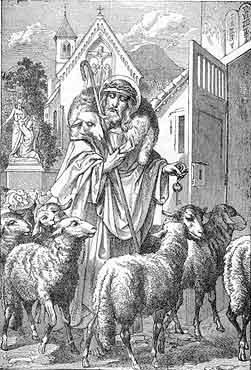
The Good Shepherd (Continuation)
(Jesus said to the Pharisees,) [11] "I am the good shepherd. The good shepherd lays down his life for the sheep. [12] He who is a hireling and not a shepherd, whose own the sheep are not, sees the wolf coming and leaves the sheep and flees; and the wolf snatches them and scatters them. [13] He flees because he is a hireling and cares nothing for the sheep. [14] I am the good shepherd; I know my own and my own know me, [15] as the Father knows Me and I know the Father; and I lay down My life for My sheep. [16] And I have other sheep that are not of this fold; I must bring them also, and they will heed My voice. So there shall be one flock, one shepherd. [17] For this reason the Father loves Me, because I lay down My life, that I may take it again. [18] No one takes it from Me, but I lay it down of My own accord. I have power to lay it down, and I have power to take it again; this charge I have received from My Father."
_______________
Commentary:
11-15. "The good shepherd lays down his life for his sheep": "Here", says St. John Chrysostom, "He is speaking of His passion, making it clear this would take place for the salvation of the world and that He would go to it freely and willingly" ("Hom. on St. John", 59, 3). Our Lord spoke further about giving abundant pasture; now He speaks about giving His very life: "He did what He said He would do", St. Gregory comments; "He gave His life for His sheep, and He gave His body and blood in the Sacrament to nourish with His flesh the sheep He had redeemed" ("In Evangelia Homilae", 14, "ad loc."). Hired men, on the other hand, run away if there is any danger, leaving the flock at risk. "Who is the hireling? He who sees the wolf coming and flees. The man who seeks his own glory, not the glory of Christ; the man who does not dare reprove sinners. You are the hireling; you have seen the wolf coming and have fled [...] because you held your peace; and you held your peace, because you were afraid" (St. Augustine, "In Ioann Evang.", 46, 8).
"Let them remember that their priestly ministry [...] is--in a special way--'ordered' to the great solicitude of the Good Shepherd, solicitude for the salvation of every human being. And this we must all remember: that it is not lawful for any one of us to deserve the name of 'hireling', that is to say, the name of one 'to whom the sheep do not belong', one who, 'since he is not the shepherd and the sheep do not belong to him, abandons the sheep and runs away as soon as he sees the wolf coming, and then the wolf attacks and scatters the sheep; this is because he is only a hired man and has no concern for the sheep.' The solicitude of every good shepherd is that all people 'may have life and have it to the full', so that none of them may be lost but should have eternal life. Let us endeavor to make this solicitude penetrate deeply into our souls; let us strive to live it. May it characterize our personality, and be at the foundation of our priestly identity" ([Pope] John Paul II, "Letter to Priests", 8 April 1979).
The Good Shepherd knows each of His sheep and calls it by name. This touching simile seems to be an exhortation to future pastors of the Church, as St. Peter will later on explain: "Tend the flock that is your charge, not for shameful gain but eagerly, not as domineering over those in your charge but being examples to the flock" (1 Peter 5:2).
"The holiness of Christ's Spouse has always been shown--as it can be seen today--by the abundance of good shepherds. But our Christian faith, which teaches us to be simple, does not bid us to be simple-minded. There are hirelings who keep silent, and there are hirelings who speak with words which are not those of Christ. That is why, if the Lord allows us to be left in the dark even in little things, if we feel that our faith is not firm, we should go to the good shepherd. He enters by the door as of right. He gives his life for others and wants to be in word and behavior a soul in love. He may be a sinner too, but he trusts always in Christ's forgiveness and mercy" ([St] J. Escriva, "Christ Is Passing By", 34).
16. "One flock, one shepherd": Christ's mission extends to everyone even though His own preaching is addressed, in the first instance, to the sheep of the house of Israel, as He Himself revealed to the Canaanite woman (cf. Matthew 15:24), and even though He sent the Apostles on their first mission (cf. Matthew 10:6) to preach to the people of Israel. Now, however, foreseeing the fruits of His redemptive death (verse 15), He reveals that these will be applied to "other sheep, that are not of this fold", that is, Israel, and, after the Resurrection, He does send the Apostles to all nations (cf. Matthew 28:19), to preach the Gospel to all creation (cf. Matthew 16:15), beginning in Jerusalem and extending to all Judea, Samaria and the ends of the earth (cf. Acts 1:8). This fulfills the ancient promises about the rule of the Messiah covering the whole world (cf. Psalm 2:7; Isaiah 2:2-6; 66:17-19). The universal scope of salvation caused St. Paul to exclaim: "Remember that at one time you...were...separated from Christ, alienated from the commonwealth of Israel, and strangers to the covenants of promise, having no hope and without God in the world. But now in Christ Jesus you who once were far off have been brought near in the blood of Christ" (Ephesians 2:11-13; cf. Galatians 3:27-28; Romans 3:22).
The unity of the Church is to be found under one visible head, for "it was to the Apostolic College alone, of which Peter is the head, that we believe that our Lord entrusted all the blessings of the New Covenant, in order to establish on earth the one body of Christ into which all those should be fully incorporated who belong in any way to the people of God" (Vatican II, "Unitatis Redintegratio", 3). It is a Catholic's constant yearning that everyone should come to the true Church, "God's one flock, which like a standard lifted high for the nations to see, ministers the Gospel of peace to all mankind, as it makes it pilgrim way in hope towards its goal, the fatherland above" ("ibid.", 2).
17-18. Jesus shows that of His own free will He will give Himself up to death for the sake of the flock (cf. John 6:51). Having been given supreme authority, Christ is free to offer Himself as a sacrifice of expiation, and He voluntarily accepts His Father's commandment, in an act of perfect obedience. "We will never fully understand Jesus' freedom. It is immense, infinite, as is His love. But the priceless treasure of His generous holocaust should move us to ask, 'Why, Lord, have you granted me this privilege which I can use to follow in Your footsteps, but also to offend You?' Thus we come to appreciate that freedom is used properly when it is directed towards the good; and that it is misused when men are forgetful and turn away from the Love of loves" ([St] J. Escriva, "Friends of God", 26).
___________________________
Source: "The Navarre Bible: Text and Commentaries". Biblical text taken from the Revised Standard Version and New Vulgate. Commentaries made by members of the Faculty of Theology of the University of Navarre, Spain. Published by Four Courts Press, Kill Lane, Blackrock, Co. Dublin, Ireland. Reprinted with permission from Four Courts Press and Scepter Publishers, the U.S. publisher.
From: John 10:11-18
The Good Shepherd (Continuation)
(Jesus said to the Pharisees,) [11] "I am the good shepherd. The good shepherd lays down his life for the sheep. [12] He who is a hireling and not a shepherd, whose own the sheep are not, sees the wolf coming and leaves the sheep and flees; and the wolf snatches them and scatters them. [13] He flees because he is a hireling and cares nothing for the sheep. [14] I am the good shepherd; I know my own and my own know me, [15] as the Father knows Me and I know the Father; and I lay down My life for My sheep. [16] And I have other sheep that are not of this fold; I must bring them also, and they will heed My voice. So there shall be one flock, one shepherd. [17] For this reason the Father loves Me, because I lay down My life, that I may take it again. [18] No one takes it from Me, but I lay it down of My own accord. I have power to lay it down, and I have power to take it again; this charge I have received from My Father."
_______________
Commentary:
11-15. "The good shepherd lays down his life for his sheep": "Here", says St. John Chrysostom, "He is speaking of His passion, making it clear this would take place for the salvation of the world and that He would go to it freely and willingly" ("Hom. on St. John", 59, 3). Our Lord spoke further about giving abundant pasture; now He speaks about giving His very life: "He did what He said He would do", St. Gregory comments; "He gave His life for His sheep, and He gave His body and blood in the Sacrament to nourish with His flesh the sheep He had redeemed" ("In Evangelia Homilae", 14, "ad loc."). Hired men, on the other hand, run away if there is any danger, leaving the flock at risk. "Who is the hireling? He who sees the wolf coming and flees. The man who seeks his own glory, not the glory of Christ; the man who does not dare reprove sinners. You are the hireling; you have seen the wolf coming and have fled [...] because you held your peace; and you held your peace, because you were afraid" (St. Augustine, "In Ioann Evang.", 46, 8).
"Let them remember that their priestly ministry [...] is--in a special way--'ordered' to the great solicitude of the Good Shepherd, solicitude for the salvation of every human being. And this we must all remember: that it is not lawful for any one of us to deserve the name of 'hireling', that is to say, the name of one 'to whom the sheep do not belong', one who, 'since he is not the shepherd and the sheep do not belong to him, abandons the sheep and runs away as soon as he sees the wolf coming, and then the wolf attacks and scatters the sheep; this is because he is only a hired man and has no concern for the sheep.' The solicitude of every good shepherd is that all people 'may have life and have it to the full', so that none of them may be lost but should have eternal life. Let us endeavor to make this solicitude penetrate deeply into our souls; let us strive to live it. May it characterize our personality, and be at the foundation of our priestly identity" ([Pope] John Paul II, "Letter to Priests", 8 April 1979).
The Good Shepherd knows each of His sheep and calls it by name. This touching simile seems to be an exhortation to future pastors of the Church, as St. Peter will later on explain: "Tend the flock that is your charge, not for shameful gain but eagerly, not as domineering over those in your charge but being examples to the flock" (1 Peter 5:2).
"The holiness of Christ's Spouse has always been shown--as it can be seen today--by the abundance of good shepherds. But our Christian faith, which teaches us to be simple, does not bid us to be simple-minded. There are hirelings who keep silent, and there are hirelings who speak with words which are not those of Christ. That is why, if the Lord allows us to be left in the dark even in little things, if we feel that our faith is not firm, we should go to the good shepherd. He enters by the door as of right. He gives his life for others and wants to be in word and behavior a soul in love. He may be a sinner too, but he trusts always in Christ's forgiveness and mercy" ([St] J. Escriva, "Christ Is Passing By", 34).
16. "One flock, one shepherd": Christ's mission extends to everyone even though His own preaching is addressed, in the first instance, to the sheep of the house of Israel, as He Himself revealed to the Canaanite woman (cf. Matthew 15:24), and even though He sent the Apostles on their first mission (cf. Matthew 10:6) to preach to the people of Israel. Now, however, foreseeing the fruits of His redemptive death (verse 15), He reveals that these will be applied to "other sheep, that are not of this fold", that is, Israel, and, after the Resurrection, He does send the Apostles to all nations (cf. Matthew 28:19), to preach the Gospel to all creation (cf. Matthew 16:15), beginning in Jerusalem and extending to all Judea, Samaria and the ends of the earth (cf. Acts 1:8). This fulfills the ancient promises about the rule of the Messiah covering the whole world (cf. Psalm 2:7; Isaiah 2:2-6; 66:17-19). The universal scope of salvation caused St. Paul to exclaim: "Remember that at one time you...were...separated from Christ, alienated from the commonwealth of Israel, and strangers to the covenants of promise, having no hope and without God in the world. But now in Christ Jesus you who once were far off have been brought near in the blood of Christ" (Ephesians 2:11-13; cf. Galatians 3:27-28; Romans 3:22).
The unity of the Church is to be found under one visible head, for "it was to the Apostolic College alone, of which Peter is the head, that we believe that our Lord entrusted all the blessings of the New Covenant, in order to establish on earth the one body of Christ into which all those should be fully incorporated who belong in any way to the people of God" (Vatican II, "Unitatis Redintegratio", 3). It is a Catholic's constant yearning that everyone should come to the true Church, "God's one flock, which like a standard lifted high for the nations to see, ministers the Gospel of peace to all mankind, as it makes it pilgrim way in hope towards its goal, the fatherland above" ("ibid.", 2).
17-18. Jesus shows that of His own free will He will give Himself up to death for the sake of the flock (cf. John 6:51). Having been given supreme authority, Christ is free to offer Himself as a sacrifice of expiation, and He voluntarily accepts His Father's commandment, in an act of perfect obedience. "We will never fully understand Jesus' freedom. It is immense, infinite, as is His love. But the priceless treasure of His generous holocaust should move us to ask, 'Why, Lord, have you granted me this privilege which I can use to follow in Your footsteps, but also to offend You?' Thus we come to appreciate that freedom is used properly when it is directed towards the good; and that it is misused when men are forgetful and turn away from the Love of loves" ([St] J. Escriva, "Friends of God", 26).
___________________________
Source: "The Navarre Bible: Text and Commentaries". Biblical text taken from the Revised Standard Version and New Vulgate. Commentaries made by members of the Faculty of Theology of the University of Navarre, Spain. Published by Four Courts Press, Kill Lane, Blackrock, Co. Dublin, Ireland. Reprinted with permission from Four Courts Press and Scepter Publishers, the U.S. publisher.
Sunday, April 13, 2008
Just for Today, April 14
Son, now thou knowest these things, and hast read them all, happy shalt thou be if thou fulfil them. He that hath my commandments and keepeth them, he it is that loveth me, and I will love him, and I will manifest myself unto him (John xiv,21).
Lord Jesus, as Thou hast said and hast promised, so may it be indeed; and may it be my lot to merit it.
-Bk. III, ch. lvi.
____________
If anyone love me, he will keep my word, and my Father will love him, and we will come to him, and will make our abode with him (John xiv, 23).
I live by love and ever keep
Thy Word within my heart,
And thus I draw the Father down,
Whom none from Thee can part.
The Holy Ghost, the bond of love,
One God in Persons three:
Till captive in my heart I hold
The Blessed Trinity.
-Poems
__________________
For more information, see this post.
Adapted from Just For Today(©1943 Burns & Oates)
Nihil Obstat: Reginaldus Phillips, S.T.L.,Censor deputatus
Imprimatur: Edwardus Myers, Vic. Cap.
Lord Jesus, as Thou hast said and hast promised, so may it be indeed; and may it be my lot to merit it.
-Bk. III, ch. lvi.
____________
If anyone love me, he will keep my word, and my Father will love him, and we will come to him, and will make our abode with him (John xiv, 23).
I live by love and ever keep
Thy Word within my heart,
And thus I draw the Father down,
Whom none from Thee can part.
The Holy Ghost, the bond of love,
One God in Persons three:
Till captive in my heart I hold
The Blessed Trinity.
-Poems
__________________
For more information, see this post.
Adapted from Just For Today(©1943 Burns & Oates)
Nihil Obstat: Reginaldus Phillips, S.T.L.,Censor deputatus
Imprimatur: Edwardus Myers, Vic. Cap.
Thoughts and Counsels - April 14
Prayer is the only channel through which God's great graces and favors may flow into the soul; and if this be once closed, I know no other way He can communicate them.
-St. Teresa
________________________
From Mary, Help of Christians
Part VI, Thoughts and Counsels of the Saints for Every Day of the Year
Compiled by Fr. Bonaventure Hammer, OFM (© 1909, Benziger Brothers)
-St. Teresa
________________________
From Mary, Help of Christians
Part VI, Thoughts and Counsels of the Saints for Every Day of the Year
Compiled by Fr. Bonaventure Hammer, OFM (© 1909, Benziger Brothers)
Meditation for April 14, No Parking
To avoid traffic congestion there are No Parking signs at certain places in the city. We cannot stop long on that street or boulevard. We must advance, press forward, however inconvenient, toward the outlet.
I have entered upon a road. I must move continually toward the end. If I cease to advance in the road of perfection, I no longer fulfill the expectations of my Institute, my vows and the will of God for me.
To effect a thorough renovation at the time of retreat, and then to return soon to the same state of stagnation, is not enough.
When an occasional traveler rings the bell of a little mountain chapel, the sparrows, crows and bats fly out at once, surprised in their peace or their sleep....After fluttering about for a few moments, they go off some distance and then little by little they retum, as assured conquerors to their loved haven.
Thus it is with me in my retreats. What a flight of undesirable traits! Soon calm settles again; the bell no longer disturbs; the noise is silenced. One by one my little old passions, my habits on silent wings, in large flocks like crows, find their recently vacated nest in the niche.
That must not be! I must pull the cord every day, make the bell ring, chase the guests installed without my invitation, keep them from re-establishing themselves in some favorite comer. No Parking!
_________________
Adapted from Meditations for Religious
by Father Raoul Plus, S.J. (© 1939, Frederick Pustet Co.)
I have entered upon a road. I must move continually toward the end. If I cease to advance in the road of perfection, I no longer fulfill the expectations of my Institute, my vows and the will of God for me.
To effect a thorough renovation at the time of retreat, and then to return soon to the same state of stagnation, is not enough.
When an occasional traveler rings the bell of a little mountain chapel, the sparrows, crows and bats fly out at once, surprised in their peace or their sleep....After fluttering about for a few moments, they go off some distance and then little by little they retum, as assured conquerors to their loved haven.
Thus it is with me in my retreats. What a flight of undesirable traits! Soon calm settles again; the bell no longer disturbs; the noise is silenced. One by one my little old passions, my habits on silent wings, in large flocks like crows, find their recently vacated nest in the niche.
That must not be! I must pull the cord every day, make the bell ring, chase the guests installed without my invitation, keep them from re-establishing themselves in some favorite comer. No Parking!
_________________
Adapted from Meditations for Religious
by Father Raoul Plus, S.J. (© 1939, Frederick Pustet Co.)
Archbishop Ranjith To Leave Vatican?
From Inside the Vatican:
In Rome in recent days there has been much speculation that Archbishop Malcolm Ranjith, one of the more "tradition-minded" prelates in the Vatican curia, may soon leave Rome to serve in his native Sri Lanka.More here at Rorate Caeli
Ranjith, who serves now as the Secretary in the Congregation for Divine Worship, under the Prefect, Nigerian Cardinal Francis Arinze, has made enemies in "progressive" circles because he has taken "conservative" stands.
Against much opposition, he has supported a widespread return of the Tridentine Mass -- something many in the Vatican oppose -- and he has suggested that some practices, like Communion in the hand and standing for Holy Communion, should be ended.
It is important to note, however, as Ranjith has advised Inside the Vatican in a personal conversation, that the government of Sri Lanka holds Ranjith in very high regard, and has asked Rome to consider transferring Ranjith back to his country to help bring peace in the country's long-simmering civil war.
So there may be factors not mentioned in the article below which could lead the Pope to agree to transfer Ranjith. We will learn more about Ranjith's future -- and the fate of the liturgical reform Pope Benedict has desired and Ranjith has toiled to defend -- in coming weeks, after the April 15-20 trip to the United States.
Here follows a posting from the interesting Rorate caeli web site, containing a translation of a recent Italian magazine article on the Ranjith matter. - The Editor
Archbishop Burke bans canon lawyer from archdiocese
This from yesterday's Post-Dispatch:
ST. LOUIS (AP) -- A prominent Roman Catholic priest and canon lawyer, who says he has been helping those "harmed by the institutional Catholic Church" since 1985 and counseling a Polish heritage church here, has been banned from working in the archdiocese.Continued here...
The Rev. Thomas Doyle, a Dominican priest and canon lawyer based in Virginia, also has been ordered by Archbishop Raymond Burke to pay back any payment he received from St. Stanislaus Kostka Church.
Burke issued a decree [PDF here] charging Doyle with two "canonical crimes" related to his defense of two excommunicated board members of St. Stanislaus.
The decree, published Friday in the archdiocesan newspaper, says Doyle did not receive prior approval from Burke to represent board members Stan Rozanski and Bernice Krauze. It also says Doyle didn't immediately respond to Burke's summons to appear before him....
Gospel for 4th Sunday of Easter
From: John 10:1-10
The Good Shepherd
(Jesus said to the Pharisees,) [1] "Truly, truly, I say to you, he who does not enter the sheepfold by the door but climbs in by another way, that man is a thief and a robber; [2] but he who enters by the door is the shepherd of the sheep. [3] To him the gatekeeper opens; the sheep hear his voice, and he calls his own sheep by name and leads them out. [4] When he has brought out all his own, he goes before them, and the sheep follow him, for they know his voice. [5] A stranger they will not follow, but they will flee from him, for they do not know the voice of strangers." [6] This figure Jesus used with them, but they did not understand what He was saying to them.
[7] So Jesus again said to them, "Truly, truly, I say to you, I am the door of the sheep. [8] All who came before Me are thieves and robbers; but the sheep did not heed them. [9] I am the door; if any one enters by Me, he will be saved, and will go in and out and find pasture. [10] The thief comes only to steal and kill and destroy; I came that they may have life, and have it abundantly."
__________________
Commentary:
1-18. The image of the Good Shepherd recalls a favorite theme of Old Testament prophetic literature: the chosen people is the flock, and Yahweh is their shepherd (cf. Psalm 23). Kings and priests are also described as shepherds or pastors. Jeremiah inveighs against those pastors who had let their sheep go astray and in God's name promises new pastors who will graze their flocks properly so that they will never again be harassed or anxious (cf. 23:1-6; also 2:8; 3:15; 10:21; Isaiah 40:1-11). Ezekiel reproaches pastors for their misdeeds and sloth, their greed and neglect of their responsibility: Yahweh will take the flock away from them and He Himself will look after their sheep: indeed, a unique shepherd will appear, descended from David, who will graze them and protect them (Ezekiel 34). Jesus presents Himself as this shepherd who looks after His sheep, seeks out the strays, cures the crippled and carries the weak on His shoulders (cf. Matthew 18:12-14; Luke 15:4-7), thereby fulfilling the ancient prophecies.
From earliest times, Christian art found its inspiration in this touching image of the Good Shepherd, thereby leaving us a representation of Christ's love for each of us.
In addition to the title of Good Shepherd, Christ applies to Himself the image of the door into the sheepfold of the Church. "The Church," Vatican II teaches, "is a sheepfold, the sole and necessary gateway to which is Christ (cf. John 10:1-10). It is also a flock, of which God foretold that He Himself would be the shepherd (cf. Isaiah 40:11; Ezekiel 34:11ff.), and whose sheep, although watched over by human shepherds, are nevertheless at all times led and brought to pasture by Christ Himself, the Good Shepherd and Prince of shepherds (cf. John 10:11; 1 Peter 5:4), who gave His life for His sheep (cf. John 10:11-15)" ("Lumen Gentium", 6).
1-2. The flock can be harmed in a subtle, hidden way, or in a blatant way through abuse of authority. The history of the Church shows that its enemies have used both methods: sometimes they enter the flock in a secretive way to harm it from within; sometimes they attack it from outside, openly and violently. "Who is the good shepherd? `He who enters by the door' of faithfulness to the Church's doctrine and does not act like the hireling `who sees the wolf coming and leaves the sheep and flees'; whereupon `the wolf snatches them and scatters them'" ([St] J. Escriva, "Christ Is Passing By", 34).
3-5. In those times it was usual at nightfall to bring a number of flocks together into one sheepfold, where they would be kept for the night with someone acting as look-out. Then at dawn the shepherds would come back and open the sheepfold and each would call his sheep which would gather round and follow him out of the pen they were used to his voice because he used to call them to prevent them from going astray) and he would then lead them to pasture. Our Lord uses this image--one very familiar to His listeners--to teach them a divine truth: since there are strange voices around, we need to know the voice of Christ--which is continually addressing us through the Magisterium of the Church--and to follow it, if we are to get the nourishment our soul needs. "Christ has given His Church sureness in doctrine and a fountain of grace in the Sacraments. He has arranged things so that there will always be people to guide and lead us, to remind us constantly of our way. There is an infinite treasure of knowledge available to us: the word of God kept safe by the Church, the grace of Christ administered in the Sacraments and also the witness and example of those who live by our side and have known how to build with their good lives a road of faithfulness to God" ([St] J. Escriva, "Christ Is Passing By", 34).
6. Christ develops and interprets the image of the shepherd and the flock, to ensure that everyone who is well-disposed can understand His meaning. But the Jews fail to understand--as happened also when He promised the Eucharist (John 6:41-43) and spoke of the "living water" (John 7:40-43), or when He raised Lazarus from the dead (John 11:45-46).
7. After describing His future Church through the image of the flock, Christ extends the simile and calls Himself the "door of the sheep". The shepherds and the sheep enter the sheepfold: both must enter through the door, which is Christ. "I", St. Augustine preached, "seeking to enter in among you, that is, into your heart, preach Christ: if I were to preach other than that, I should be trying to enter by some other way. Through Christ I enter in, not to your houses but to your hearts. Through Him I enter and you have willingly heard me speak of Him. Why? Because you are Christ's sheep and you have been purchased with Christ's blood" ("In Ioann. Evang." 47, 2-3).
8. The severe reproach Jesus levels against those who came before Him does not apply to Moses or the prophets (cf. John 5:39, 45; 8:56; 12:41), nor to the Baptist (cf. John 5:33), for they proclaimed the future Messiah and prepared the way for Him. He is referring to the false prophets and deceivers of the people, among them some teachers of the Law--blind men and blind guides (cf. Matthew 23:16-24) who block the people's way to Christ, as happened just a little before when the man born blind was cured (cf. John 9).
___________________________
Source: "The Navarre Bible: Text and Commentaries". Biblical text taken from the Revised Standard Version and New Vulgate. Commentaries made by members of the Faculty of Theology of the University of Navarre, Spain. Published by Four Courts Press, Kill Lane, Blackrock, Co. Dublin, Ireland. Reprinted with permission from Four Courts Press and Scepter Publishers, the U.S. publisher.
The Good Shepherd
(Jesus said to the Pharisees,) [1] "Truly, truly, I say to you, he who does not enter the sheepfold by the door but climbs in by another way, that man is a thief and a robber; [2] but he who enters by the door is the shepherd of the sheep. [3] To him the gatekeeper opens; the sheep hear his voice, and he calls his own sheep by name and leads them out. [4] When he has brought out all his own, he goes before them, and the sheep follow him, for they know his voice. [5] A stranger they will not follow, but they will flee from him, for they do not know the voice of strangers." [6] This figure Jesus used with them, but they did not understand what He was saying to them.
[7] So Jesus again said to them, "Truly, truly, I say to you, I am the door of the sheep. [8] All who came before Me are thieves and robbers; but the sheep did not heed them. [9] I am the door; if any one enters by Me, he will be saved, and will go in and out and find pasture. [10] The thief comes only to steal and kill and destroy; I came that they may have life, and have it abundantly."
__________________
Commentary:
1-18. The image of the Good Shepherd recalls a favorite theme of Old Testament prophetic literature: the chosen people is the flock, and Yahweh is their shepherd (cf. Psalm 23). Kings and priests are also described as shepherds or pastors. Jeremiah inveighs against those pastors who had let their sheep go astray and in God's name promises new pastors who will graze their flocks properly so that they will never again be harassed or anxious (cf. 23:1-6; also 2:8; 3:15; 10:21; Isaiah 40:1-11). Ezekiel reproaches pastors for their misdeeds and sloth, their greed and neglect of their responsibility: Yahweh will take the flock away from them and He Himself will look after their sheep: indeed, a unique shepherd will appear, descended from David, who will graze them and protect them (Ezekiel 34). Jesus presents Himself as this shepherd who looks after His sheep, seeks out the strays, cures the crippled and carries the weak on His shoulders (cf. Matthew 18:12-14; Luke 15:4-7), thereby fulfilling the ancient prophecies.
From earliest times, Christian art found its inspiration in this touching image of the Good Shepherd, thereby leaving us a representation of Christ's love for each of us.
In addition to the title of Good Shepherd, Christ applies to Himself the image of the door into the sheepfold of the Church. "The Church," Vatican II teaches, "is a sheepfold, the sole and necessary gateway to which is Christ (cf. John 10:1-10). It is also a flock, of which God foretold that He Himself would be the shepherd (cf. Isaiah 40:11; Ezekiel 34:11ff.), and whose sheep, although watched over by human shepherds, are nevertheless at all times led and brought to pasture by Christ Himself, the Good Shepherd and Prince of shepherds (cf. John 10:11; 1 Peter 5:4), who gave His life for His sheep (cf. John 10:11-15)" ("Lumen Gentium", 6).
1-2. The flock can be harmed in a subtle, hidden way, or in a blatant way through abuse of authority. The history of the Church shows that its enemies have used both methods: sometimes they enter the flock in a secretive way to harm it from within; sometimes they attack it from outside, openly and violently. "Who is the good shepherd? `He who enters by the door' of faithfulness to the Church's doctrine and does not act like the hireling `who sees the wolf coming and leaves the sheep and flees'; whereupon `the wolf snatches them and scatters them'" ([St] J. Escriva, "Christ Is Passing By", 34).
3-5. In those times it was usual at nightfall to bring a number of flocks together into one sheepfold, where they would be kept for the night with someone acting as look-out. Then at dawn the shepherds would come back and open the sheepfold and each would call his sheep which would gather round and follow him out of the pen they were used to his voice because he used to call them to prevent them from going astray) and he would then lead them to pasture. Our Lord uses this image--one very familiar to His listeners--to teach them a divine truth: since there are strange voices around, we need to know the voice of Christ--which is continually addressing us through the Magisterium of the Church--and to follow it, if we are to get the nourishment our soul needs. "Christ has given His Church sureness in doctrine and a fountain of grace in the Sacraments. He has arranged things so that there will always be people to guide and lead us, to remind us constantly of our way. There is an infinite treasure of knowledge available to us: the word of God kept safe by the Church, the grace of Christ administered in the Sacraments and also the witness and example of those who live by our side and have known how to build with their good lives a road of faithfulness to God" ([St] J. Escriva, "Christ Is Passing By", 34).
6. Christ develops and interprets the image of the shepherd and the flock, to ensure that everyone who is well-disposed can understand His meaning. But the Jews fail to understand--as happened also when He promised the Eucharist (John 6:41-43) and spoke of the "living water" (John 7:40-43), or when He raised Lazarus from the dead (John 11:45-46).
7. After describing His future Church through the image of the flock, Christ extends the simile and calls Himself the "door of the sheep". The shepherds and the sheep enter the sheepfold: both must enter through the door, which is Christ. "I", St. Augustine preached, "seeking to enter in among you, that is, into your heart, preach Christ: if I were to preach other than that, I should be trying to enter by some other way. Through Christ I enter in, not to your houses but to your hearts. Through Him I enter and you have willingly heard me speak of Him. Why? Because you are Christ's sheep and you have been purchased with Christ's blood" ("In Ioann. Evang." 47, 2-3).
8. The severe reproach Jesus levels against those who came before Him does not apply to Moses or the prophets (cf. John 5:39, 45; 8:56; 12:41), nor to the Baptist (cf. John 5:33), for they proclaimed the future Messiah and prepared the way for Him. He is referring to the false prophets and deceivers of the people, among them some teachers of the Law--blind men and blind guides (cf. Matthew 23:16-24) who block the people's way to Christ, as happened just a little before when the man born blind was cured (cf. John 9).
___________________________
Source: "The Navarre Bible: Text and Commentaries". Biblical text taken from the Revised Standard Version and New Vulgate. Commentaries made by members of the Faculty of Theology of the University of Navarre, Spain. Published by Four Courts Press, Kill Lane, Blackrock, Co. Dublin, Ireland. Reprinted with permission from Four Courts Press and Scepter Publishers, the U.S. publisher.
2nd Reading for the 4th Sunday of Easter
From: 1 Peter 2b:20-25
Duties Towards Masters--Christ's Example
[20b] [Beloved}: if when you do right and suffer for it you take it patiently, you have God's approval. [21] For to this you have been called, because Christ also suffered for you, leaving you an example, that you should follow in his steps. [22] He committed no sin; no guile was found on His lips. [23] When He was reviled, He did not revile in return; when He suffered, He did not threaten; but He trusted to Him who judges justly. [24] He Himself bore our sins in His body on the tree, that we might die to sin and live to righteousness. By His wounds you have been healed. [25] For you were straying like sheep, but have now returned to the Shepherd and Guardian of your souls.
________________
Commentary:
18-25. The sacred writer now addresses all domestic servants (the Greek word means all who work in household tasks). He exhorts them to obey their masters, even if they are harsh (verse 18), because God is pleased if they put up with unfair- ness for His sake (verses 19-20); in doing so they are imitating the example of Jesus (verses 21-25). St. Paul, when addressing slaves in his letters (cf. Ephesians 5:5-9; Colossians 3:22-24), never encourages them to rebel. Christian teaching on social issues is not based on class struggle but on fraternal love: love eventually does away with all discrimination, for all men have created in the image of God and are equal in His sight. This peaceable policy gradually made for the suppression of slavery, and it will also lead to the solution of all social problems (cf. "Gaudium Et Spes", 29).
The fact that St. Peter addresses only servants and does not go on to say any- thing to masters (as St. Paul usually does: cf. Ephesians 6:5-9; Colossians 3:23ff) has led some commentators to suggest that most of the Christians addressed in this letter must have been people of humble condition.
21-25. This passage is a beautiful hymn to Christ on the cross. Christ's sufferings, which fulfill the prophecies about the Servant of Yahweh contained in the Book of Isaiah (52:13-53:12), have not been in vain, for they have a redemptive value. He has taken our sins upon Himself and brought them with Him on the cross, offering Himself as an atoning sacrifice. This means that we are free of our sins ("dead to sin") and can live "to righteousness", that is, can live for holiness with the help of grace.
The example of the suffering of Christ is always a necessary reference point for Christians: however great the trials they experience, they will never be as great or as unjust as those of our Lord. Reflecting on Christ's suffering led St. Bernard to comment: "I have come to see that true wisdom lies in meditating on these things [...]. Some have provided me with wholesome, if bitter, drink, and I have used others as gentle and soothing unction. This gives me strength in adversity and helps me to be humble in prosperity; it -allows me to walk with a sure step on the royal road of salvation, through the good things and the evil things of this present life, free from the dangers which threaten to right and left" ("Sermons on the Song of Songs", 43, 4).
25. The messianic prophecy about the Servant of Yahweh includes the image of the scattered flock (cf. Isaiah 53:6), to which Jesus alludes in His allegory of the Good Shepherd (cf. John 10:11-16). St. Peter, to whom our Lord had given charge of His flock (cf. John 21:15-19), would have had a special liking for imagery connected with shepherding.
Jesus Christ is "the Shepherd and Guardian of your souls" and "the chief Shepherd" (1 Peter 5:4). The etymology of the Greek word--"episcopos" (guardian)-- means "overseer"; the word was used in civic life to designate those who were responsible for seeing that the law was kept. In the Dead Sea manuscripts the Hebrew equivalent ("mebaqqer") is used to designate the religious leaders of the schismatic community of Qumran. Whatever might be the origin of the term, in the New Testament the word "episcopos" (bishop) is often used to mean the pastor of the Church (cf., e.g., Acts 20:28; see the note on 1 Peter 5:1-4). Here St. Peter applies to Christ the words the prophet Ezekiel places on the lips of God: "I will seek out My sheep and I will rescue them from all places where they have been scattered" (Ezekiel 34:12). Our Lord founded the Church as a sheep- fold "whose sheep, although watched over by human shepherds, are nevertheless at all times led and brought to pasture by Christ Himself, the Good Shepherd and prince of shepherds (cf. John 10:11; 1 Peter 5:4), who gave His life for His sheep (cf. John 10:11-16)" (Vatican II, "Lumen Gentium", 6).
___________________________
Source: "The Navarre Bible: Text and Commentaries". Biblical text taken from the Revised Standard Version and New Vulgate. Commentaries made by members of the Faculty of Theology of the University of Navarre, Spain. Published by Four Courts Press, Kill Lane, Blackrock, Co. Dublin, Ireland. Reprinted with permission from Four Courts Press and Scepter Publishers, the U.S. publisher.
Duties Towards Masters--Christ's Example
[20b] [Beloved}: if when you do right and suffer for it you take it patiently, you have God's approval. [21] For to this you have been called, because Christ also suffered for you, leaving you an example, that you should follow in his steps. [22] He committed no sin; no guile was found on His lips. [23] When He was reviled, He did not revile in return; when He suffered, He did not threaten; but He trusted to Him who judges justly. [24] He Himself bore our sins in His body on the tree, that we might die to sin and live to righteousness. By His wounds you have been healed. [25] For you were straying like sheep, but have now returned to the Shepherd and Guardian of your souls.
________________
Commentary:
18-25. The sacred writer now addresses all domestic servants (the Greek word means all who work in household tasks). He exhorts them to obey their masters, even if they are harsh (verse 18), because God is pleased if they put up with unfair- ness for His sake (verses 19-20); in doing so they are imitating the example of Jesus (verses 21-25). St. Paul, when addressing slaves in his letters (cf. Ephesians 5:5-9; Colossians 3:22-24), never encourages them to rebel. Christian teaching on social issues is not based on class struggle but on fraternal love: love eventually does away with all discrimination, for all men have created in the image of God and are equal in His sight. This peaceable policy gradually made for the suppression of slavery, and it will also lead to the solution of all social problems (cf. "Gaudium Et Spes", 29).
The fact that St. Peter addresses only servants and does not go on to say any- thing to masters (as St. Paul usually does: cf. Ephesians 6:5-9; Colossians 3:23ff) has led some commentators to suggest that most of the Christians addressed in this letter must have been people of humble condition.
21-25. This passage is a beautiful hymn to Christ on the cross. Christ's sufferings, which fulfill the prophecies about the Servant of Yahweh contained in the Book of Isaiah (52:13-53:12), have not been in vain, for they have a redemptive value. He has taken our sins upon Himself and brought them with Him on the cross, offering Himself as an atoning sacrifice. This means that we are free of our sins ("dead to sin") and can live "to righteousness", that is, can live for holiness with the help of grace.
The example of the suffering of Christ is always a necessary reference point for Christians: however great the trials they experience, they will never be as great or as unjust as those of our Lord. Reflecting on Christ's suffering led St. Bernard to comment: "I have come to see that true wisdom lies in meditating on these things [...]. Some have provided me with wholesome, if bitter, drink, and I have used others as gentle and soothing unction. This gives me strength in adversity and helps me to be humble in prosperity; it -allows me to walk with a sure step on the royal road of salvation, through the good things and the evil things of this present life, free from the dangers which threaten to right and left" ("Sermons on the Song of Songs", 43, 4).
25. The messianic prophecy about the Servant of Yahweh includes the image of the scattered flock (cf. Isaiah 53:6), to which Jesus alludes in His allegory of the Good Shepherd (cf. John 10:11-16). St. Peter, to whom our Lord had given charge of His flock (cf. John 21:15-19), would have had a special liking for imagery connected with shepherding.
Jesus Christ is "the Shepherd and Guardian of your souls" and "the chief Shepherd" (1 Peter 5:4). The etymology of the Greek word--"episcopos" (guardian)-- means "overseer"; the word was used in civic life to designate those who were responsible for seeing that the law was kept. In the Dead Sea manuscripts the Hebrew equivalent ("mebaqqer") is used to designate the religious leaders of the schismatic community of Qumran. Whatever might be the origin of the term, in the New Testament the word "episcopos" (bishop) is often used to mean the pastor of the Church (cf., e.g., Acts 20:28; see the note on 1 Peter 5:1-4). Here St. Peter applies to Christ the words the prophet Ezekiel places on the lips of God: "I will seek out My sheep and I will rescue them from all places where they have been scattered" (Ezekiel 34:12). Our Lord founded the Church as a sheep- fold "whose sheep, although watched over by human shepherds, are nevertheless at all times led and brought to pasture by Christ Himself, the Good Shepherd and prince of shepherds (cf. John 10:11; 1 Peter 5:4), who gave His life for His sheep (cf. John 10:11-16)" (Vatican II, "Lumen Gentium", 6).
___________________________
Source: "The Navarre Bible: Text and Commentaries". Biblical text taken from the Revised Standard Version and New Vulgate. Commentaries made by members of the Faculty of Theology of the University of Navarre, Spain. Published by Four Courts Press, Kill Lane, Blackrock, Co. Dublin, Ireland. Reprinted with permission from Four Courts Press and Scepter Publishers, the U.S. publisher.
Subscribe to:
Posts (Atom)