If you wish to take up your abode in the tabernacle of the heavenly kingdom, you must reach there through your good works, without which you can not hope to enter.
-St. Benedict
________________________
From Mary, Help of Christians
Part VI, Thoughts and Counsels of the Saints for Every Day of the Year
Compiled by Fr. Bonaventure Hammer, OFM (© 1909, Benziger Brothers)
Friday, March 28, 2008


Meditation for March 29, Saturday after Easter
Life in ChristWe lost divine love by the sin of Adam and Eve. The Word of God will come to restore it to us; that is the whole purpose of the Incarnation.
But the Word Incarnate will not only become one of us, a human being like ourselves, but He will also make each member of the human family a living continuation of Himself. Christ will be first and foremost Jesus, in the singular, Jesus, the Son of Mary and Child of the Father, the character of history who lived in Palestine; but Christ will also be this character in the plural, composed of the historical Jesus, described in the Gospels, plus all those whom He has deigned to make His members in the unity of His Mystical Body. That is to say, all of us - each and everyone of us.
When God looks upon us, He sees us united to His Son, and one with Him as the branch is joined to the vine to which it is grafted. God knows not only His Son, but also all those who form an integral and constituent part of His Son. God sees me in Jesus.
The Jesuit Saint-Jure said: "In all the universe, God the Father loves with the true love of friendship only Jesus Christ. That is why St. Paul calls Him the Son of His love and complacence, so that, as the same Apostle says, He makes us pleasing to His eyes, in Him and through Him. He finds us all beautiful and radiant with glory when we are united to Him, since this union communicates to His beauty and glory."
"O Jesus, let me understand this beautiful doctrine which is the very foundation of Christianity, that I may know that every Christian is a living member of Christ. I wish both to be dominated by it and to live by it."_________________
Adapted from Meditations for Religious
by Father Raoul Plus, S.J. (© 1939, Frederick Pustet Co.)
Gospel for Friday Within the Octave of Easter
From: John 21:1-14
The Miraculous Draught of Fish
[1] After this Jesus revealed Himself again to the disciples by the Sea of Tiberias; and He revealed Himself in this way. [2] Simon Peter, Thomas called the Twin, Nathaniel of Cana in Galilee, the sons of Zebedee, and two others of His disciples were together. [3] Simon Peter said to them, "I am going fishing." They said to him, "We will go with you." They went out and got into the boat; but that night they caught nothing.
[4] Just as day was breaking, Jesus stood on the beach; yet the disciples did not know that it was Jesus. [5] Jesus said to them, "Children, have you any fish?" They answered Him, "No." [6] He said to them, "Cast the net on the right side of the boat, and you will find some." So they cast it, and now they were not able to haul it in, for the quantity of fish. [7] That disciple whom Jesus loved said to Peter, "It is the Lord!" When Simon Peter heard that it was the Lord, he put on his clothes, for he was stripped for work, and sprang into the sea. [8] But the other disciples came in the boat, dragging the net full of fish, for they were not far from the land, but about a hundred yards off.
[9] When they got out on land, they saw a charcoal fire there, with fish lying on it, and bread. [10] Jesus said to them, "Bring some fish that you have just caught." [11] So Simon Peter went aboard and hauled the net ashore, full of large fish, a hundred and fifty-three of them; and although there were so many, the net was not torn. [12] Jesus said to them, "Come and have breakfast." Now none of the disciples dared ask Him, "Who are you?" They knew it was the Lord. [13] Jesus came and took the bread and gave it to them, and so with the fish. [14] This was now the third time that Jesus was revealed to the disciples after He was raised from the dead.
_______________
Commentary:
1-3. There are some very significant things in this account: we find the disciples "by the Sea of Tiberias", which means they have done what the risen Christ had told them to do (cf. Matthew 28:7); they are together, which shows that there is a close fraternity among them; Peter takes the initiative, which in a way shows his authority; and they have gone back to their old jobs as fishermen, probably waiting for our Lord to give them new instructions.
This episode is reminiscent of the first miraculous draught of fish (cf. Luke 5:1-11), where our Lord promised Peter He would make him a fisher of men; now He is going to confirm his mission as visible head of the Church.
4-8. The risen Jesus goes in search of His disciples, to encourage them and tell them more about the great mission He has entrusted to them. This account describes a very moving scene, our Lord together with His own: "He passes by, close to His Apostles, close to those souls who have given themselves to Him, and they do not realize He is there. How often Christ is not only near us, but in us; yet we still live in such a human way!... They, the disciples, recall what they have heard so often from their Master's lips: fisher of men, apostles. And they realize that all things are possible, because it is He who is directing their fishing.
"Whereupon `the disciple whom Jesus loved said to Peter, It is the Lord!' Love, love is farsighted. Love is the first to appreciate kindness. The adolescent Apostle, who felt a deep and firm affection for Jesus, because he loved Christ with all the purity and tenderness of a heart that had never been corrupted, exclaimed: `It is the Lord!'"
"`When Simon Peter heard that it was the Lord, he put on his clothes and sprang into the sea.' Peter personifies faith. Full of marvelous daring, he leaps into the sea. With a love like John's and a faith like Peter's, what is there that can stop us?" ([St] J. Escriva, "Friends of God", 265-266).
9-14. We can sense here the deep impression this appearance of the risen Jesus must have made on the Apostles, and how sweet a memory St. John kept of it. After His resurrection Jesus showed the same tenderness as characterized His public ministry. He makes use of natural things--the fire, the fish, etc.--to show that He really is there, and He maintains the familiar tone typical of when He lived with the disciples.
The Fathers and Doctors of the Church have often dwelt on the mystical meaning of this episode: the boat is the Church, whose unity is symbolized by the net which is not torn; the sea is the world, Peter in the boat stands for supreme authority of the Church, and the number of fish signifies the number of the elect (cf. St. Thomas Aquinas, "Commentary on St. John, in loc.").
___________________________
Source: "The Navarre Bible: Text and Commentaries". Biblical text taken from the Revised Standard Version and New Vulgate. Commentaries made by members of the Faculty of Theology of the University of Navarre, Spain. Published by Four Courts Press, Kill Lane, Blackrock, Co. Dublin, Ireland. Reprinted with permission from Four Courts Press and Scepter Publishers, the U.S. publisher.
The Miraculous Draught of Fish
[1] After this Jesus revealed Himself again to the disciples by the Sea of Tiberias; and He revealed Himself in this way. [2] Simon Peter, Thomas called the Twin, Nathaniel of Cana in Galilee, the sons of Zebedee, and two others of His disciples were together. [3] Simon Peter said to them, "I am going fishing." They said to him, "We will go with you." They went out and got into the boat; but that night they caught nothing.
[4] Just as day was breaking, Jesus stood on the beach; yet the disciples did not know that it was Jesus. [5] Jesus said to them, "Children, have you any fish?" They answered Him, "No." [6] He said to them, "Cast the net on the right side of the boat, and you will find some." So they cast it, and now they were not able to haul it in, for the quantity of fish. [7] That disciple whom Jesus loved said to Peter, "It is the Lord!" When Simon Peter heard that it was the Lord, he put on his clothes, for he was stripped for work, and sprang into the sea. [8] But the other disciples came in the boat, dragging the net full of fish, for they were not far from the land, but about a hundred yards off.
[9] When they got out on land, they saw a charcoal fire there, with fish lying on it, and bread. [10] Jesus said to them, "Bring some fish that you have just caught." [11] So Simon Peter went aboard and hauled the net ashore, full of large fish, a hundred and fifty-three of them; and although there were so many, the net was not torn. [12] Jesus said to them, "Come and have breakfast." Now none of the disciples dared ask Him, "Who are you?" They knew it was the Lord. [13] Jesus came and took the bread and gave it to them, and so with the fish. [14] This was now the third time that Jesus was revealed to the disciples after He was raised from the dead.
_______________
Commentary:
1-3. There are some very significant things in this account: we find the disciples "by the Sea of Tiberias", which means they have done what the risen Christ had told them to do (cf. Matthew 28:7); they are together, which shows that there is a close fraternity among them; Peter takes the initiative, which in a way shows his authority; and they have gone back to their old jobs as fishermen, probably waiting for our Lord to give them new instructions.
This episode is reminiscent of the first miraculous draught of fish (cf. Luke 5:1-11), where our Lord promised Peter He would make him a fisher of men; now He is going to confirm his mission as visible head of the Church.
4-8. The risen Jesus goes in search of His disciples, to encourage them and tell them more about the great mission He has entrusted to them. This account describes a very moving scene, our Lord together with His own: "He passes by, close to His Apostles, close to those souls who have given themselves to Him, and they do not realize He is there. How often Christ is not only near us, but in us; yet we still live in such a human way!... They, the disciples, recall what they have heard so often from their Master's lips: fisher of men, apostles. And they realize that all things are possible, because it is He who is directing their fishing.
"Whereupon `the disciple whom Jesus loved said to Peter, It is the Lord!' Love, love is farsighted. Love is the first to appreciate kindness. The adolescent Apostle, who felt a deep and firm affection for Jesus, because he loved Christ with all the purity and tenderness of a heart that had never been corrupted, exclaimed: `It is the Lord!'"
"`When Simon Peter heard that it was the Lord, he put on his clothes and sprang into the sea.' Peter personifies faith. Full of marvelous daring, he leaps into the sea. With a love like John's and a faith like Peter's, what is there that can stop us?" ([St] J. Escriva, "Friends of God", 265-266).
9-14. We can sense here the deep impression this appearance of the risen Jesus must have made on the Apostles, and how sweet a memory St. John kept of it. After His resurrection Jesus showed the same tenderness as characterized His public ministry. He makes use of natural things--the fire, the fish, etc.--to show that He really is there, and He maintains the familiar tone typical of when He lived with the disciples.
The Fathers and Doctors of the Church have often dwelt on the mystical meaning of this episode: the boat is the Church, whose unity is symbolized by the net which is not torn; the sea is the world, Peter in the boat stands for supreme authority of the Church, and the number of fish signifies the number of the elect (cf. St. Thomas Aquinas, "Commentary on St. John, in loc.").
___________________________
Source: "The Navarre Bible: Text and Commentaries". Biblical text taken from the Revised Standard Version and New Vulgate. Commentaries made by members of the Faculty of Theology of the University of Navarre, Spain. Published by Four Courts Press, Kill Lane, Blackrock, Co. Dublin, Ireland. Reprinted with permission from Four Courts Press and Scepter Publishers, the U.S. publisher.
Thursday, March 27, 2008
Just for Today, March 28
O faithful soul, prepare thy heart for this thy Spouse, that He may vouchsafe to come to thee and well in thee. For so He saith: If any man love me he will keep my word, and we will come to him, and we will make our abode with him (John xiv, 23).
Make room, then, for Christ within thee, and deny entrance to all others.
-Bk. II, ch. i.
_________________
The fox goes somewhere safe to earth,
The linnet has her nest,
The Son of Man can find nowhere
To lay His head and rest:
My heart shall be Thy resting-place,
My love shall welcome Thee,
Thou shalt forget man's cold neglect
In me, Thy Bethany.
-Poems
__________________
For more information, see this post.
Adapted from Just For Today(©1943 Burns & Oates)
Nihil Obstat: Reginaldus Phillips, S.T.L.,Censor deputatus
Imprimatur: Edwardus Myers, Vic. Cap.
Make room, then, for Christ within thee, and deny entrance to all others.
-Bk. II, ch. i.
_________________
The fox goes somewhere safe to earth,
The linnet has her nest,
The Son of Man can find nowhere
To lay His head and rest:
My heart shall be Thy resting-place,
My love shall welcome Thee,
Thou shalt forget man's cold neglect
In me, Thy Bethany.
-Poems
__________________
For more information, see this post.
Adapted from Just For Today(©1943 Burns & Oates)
Nihil Obstat: Reginaldus Phillips, S.T.L.,Censor deputatus
Imprimatur: Edwardus Myers, Vic. Cap.
Thoughts and Counsels - March 28
Meditation for March 28, Friday After Easter
"Go and Teach"
My particular vocation may be to teach. I ought to rejoice, because it is a beautiful duty.
But if I do not have to teach, I must not think myself dispensed from making Christ known. It may not be in an official and public manner, we grant that, but it will be in a fruitful manner just the same. Elizabeth Leseur has this interesting thought: "Be an influence rather than a profession of Faith." Among her husband's friends there were people of every type of whom a goodly number were unbelievers. To speak of religion might have been both inopportune and what's more ineffectual. Understanding the situation, this great, intelligent woman made the resolution - not to preach Christ - but to spread Christ in an invisible and imperceptible manner. "An influence rather than a profession of faith."
Unless I am officially appointed to do so, it is not my duty to make official exhortations on virtue. It would be a pity, however, if one were afraid to introduce a religious subject among religious souls. I must be careful to do so without being overly solicitous; in any case, my efforts in this respect should not be too apparent, lest I give the impression of trying to convert the community or even a certain person in the community. Tact and discretion are indispensable. There should be zeal, of course, and great zeal, but it must be intelligent and adapted to persons and circumstances.
"An influence rather than a profession of faith" is a fitting motto and a very practical one for me.
This sentence was inscribed on the tombstone of a small child: "Here lies a child whose playmates used to say that it was easier for them to be good when he was with them."
May I exert this influence, O God, without its being perceived and, better still, without my suspecting it.
_________________
Adapted from Meditations for Religious
by Father Raoul Plus, S.J. (© 1939, Frederick Pustet Co.)
Proposal: Impose excommunication for euthanasia
Dr Edward Peters writes:
For some months I have been researching and writing an article on euthanasia in canon law. I hoped against hope that it might remain an academic exercise, but (to judge from, say, this report on the practice of euthanasia in Belgium) the speed with which the Western, specifically Christian, protection of innocent life is collapsing suggests that one of my projected canonical recommendations deserves an earlier hearing than appearance in a peer-reviewed journal can afford.Read why here: http://www.canonlaw.info/2008/03/proposal-impose-excommunication-for.html
Simply put, I recommend that euthanasia be made an excommunicable offense under the 1983 Code of Canon Law.
Phyllis Zagano Wins Fulbright Fellowship to Teach in Ireland
From Religion Press Release Services:

Will Lecture on History Catholic Women, Conduct Research on Ordination LiturgiesPhyllis has commented here before about the articles we have posted on the assorted delusional deaconesses and priestesses. Some seem to think that Ordinatio Sacerdotalis does not apply to the order of "deacons." I believe that they are wrong...
Hofstra University, Hempstead, NY – Hofstra Senior Research Associate-in-Residence and Religion News Service columnist Phyllis Zagano, Ph.D., has been awarded a Fulbright Fellowship to teach a course at an Irish university on the history of women in ministry in the Catholic Church.
In addition to teaching at Mary Immaculate College of the University of Limerick for the Spring 2009 semester, Dr. Zagano will continue her research into the validity and legality of ordaining Catholic women as deacons, focusing on similarities among early ordination liturgies used for men and for women....
Houston church vandalized twice during Holy Week
Houston, Mar 27, 2008 / 02:22 am (CNA).- During Holy Week a Catholic church in Houston [All Saints Catholic Church] was targeted by iconoclastic vandals who in separate incidents damaged two statues of the Virgin Mary and sprayed an anti-Catholic slur on the church building....Crazed mental defectives - Hopefully, they'll be caught soon and required to pay the restoration costs in addition to receiving a punishment appropriate for these crimes.
Homosexual "Day of Silence" coming to Missouri High Schools
An FYI for MIssourians - Tax Dollars at Work! From the American Family Association:
On, Friday, April 25, several dozen schools in Missouri will be observing "Day of Silence (DOS)." DOS is a nationwide push to promote the homosexual lifestyle in public schools.
When AFA alerted parents of this public school classroom disruption by homosexual student activists, many Missourians took action immediately! As a result, 19 schools had their name removed from the participating list. If you haven't gotten involved, it's critical that you do so today!Take Action!What should parents do? Check with your local school principal to see if your child's school will be participating in DOS. If the school is participating, notify other parents about DOS and ask them to join in keeping their children out of school on that day.A simple phone call or letter to your local Missouri school administrators, telling them your child will not attend school the day it observes DOS, may be enough to cause some participating schools to change their plans.
Sample letter here.
Frequently Asked Questions about the Day of Silence.
Here is a partial list of Missouri schools which the Gay, Lesbian, and Straight Education Network says are participating in DOS:
Berkmar H.S. Clayton H.S. Crossroads H.S. Hickman H.S. Jefferson City H.S. John Burroughs H.S. Kirkwood Senior H.S. Ladue Horton Watkins H.S. Liberty H.S. Liberty Senior H.S. McCluer H.S. Metro H.S. Nerinx Hall H.S. Pattonville Sr. H.S. Raymore-Peculiar H.S. Rock Bridge H.S. South H.S. Pembroke H.S. Van Horn H.S. Webster Groves H.S. Winnetonka H.S William Chrisman H.S.
If your school is listed, call your local school and ascertain whether they officially or passively allow students to observe "Day of Silence." If your school is listed, please double-check with your local school to see if the school is actually sponsoring DOS. Sometimes the "participation" turns out to be a handful of kids who are saying they have a homosexual club and are observing this protest day, but without school endorsement. We sincerely hope your school, if listed, is not actually an official sponsor. If it is not, we will take them off the list, if a school official asks us to do so. Please e-mail your correction to webmaster@missionamerica.com.
Some tips:
1. Be sure of the date that DOS is planned for your school. (The national date is April 25, but some schools observe DOS on a different date.)
2. Inform the school of your intention to keep your child home on that date and explain why. See the sample letter above.
3. Explain to your children why you're taking a stand: Homosexual behavior is not an innate identity; it is a sinful, unnatural and destructive behavior. No school should advance a physically, emotionally, and spiritually destructive sexual lifestyle to students.
4. Schools do not have to tolerate students remaining silent in class. Schools can adopt policies that require parental consent for students to attend any club, including those premised on sexual orientation or gender identity. Here is more information from Attorney Mat Staver with Liberty Counsel who provides free information to parents, students, and schools regarding their rights associated with noncompliance on the Day of Silence.
Gospel for Thursday Within the Octave of Easter
From: Luke 24:35-48
[35] Then they (the disciples) told what had happened on the road, and how He (Jesus) was known to them in the breaking of the bread.
Jesus Appears To The Eleven And Their Companions
[36] As they were saying this, Jesus Himself stood among them, and said to them, "Peace to you!" [37] But they were startled and frightened, and supposed that they saw a spirit. [38] And He said to them, "Why are you troubled, and why do questionings rise in your hearts? [39] See My hands and My feet, that it is I Myself; handle Me, and see; for a spirit has not flesh and bones as you see that I have." [40] And when He had said this, He showed them His hands and His feet. [41] Andwhile they still disbelieved for joy, and wondered, He said to them, "Have you anything here to eat?" [42] They gave Him a piece of broiled fish, [43] and He took it and ate before them.
Jesus' Last Instructions And Leave-Taking
[44] Then He said to them, "These are My words which I spoke to you, while I was still with you, that everything written about Me in the law of Moses and the prophets and the psalms must be fulfilled." [45] Then He opened their minds to understand the Scriptures, [46] and He said to them, "Thus it is written, that the Christ should suffer and on the third day rise from the dead, [47] and that repentance and forgiveness of sins should be preached in His name to all nations, beginning from Jerusalem. [48] You are witnesses of these things."
_____________
Commentary:
36-43. This appearance of the risen Jesus is reported by St. Luke and St. John (cf. John 20:19-23). St. John reports the institution of the sacrament of Penance, whereas St. Luke puts the stress on the disciples' difficulty in accepting the miracle of the Resurrection, despite the angels' testimony to the women (cf. Matthew 28:5-7; Mark 16:5-7; Luke 24:4-11) and despite the witness of those who had already seen the risen Lord (cf. Matthew 28:9-10; Mark 16:9-13; Luke 24:13ff; John 20:11-18).
Jesus appears all of a sudden, when the doors are closed (cf. John 20:19), which explains their surprised reaction. St. Ambrose comments that "He penetrated their closed retreat not because His nature was incorporeal, but because He had the quality of a resurrected body" ("Expositio Evangelii Sec. Lucam, in loc".). "Subtility", which is one of the qualities of a glorified body, means that "the body is totally subject to the soul and ever ready to obey its wishes" "St. Pius V Catechism", I, 12, 13), with the result that it can pass through material obstacles without any difficulty.
This scene showing Christ's condescension to confirm for them the truth of His resurrection has a charm all of its own.
41-43. Although His risen body is incapable of suffering, and therefore has no need of food to nourish it, our Lord confirms His disciples' faith in His resurrection by giving them these two proofs--inviting them to touch Him and eating in their presence. "For myself, I know and believe that our Lord was in the flesh even after the Resurrection. And when He came to Peter and his companions, He said to them, `Here, feel Me and see that I am not a bodiless ghost.' They touched Him and believed, and were convinced that He was flesh and spirit [...]. Moreover, after the Resurrection, He ate and drank with them like a man of flesh and blood, though spiritually one with the Father" (St. Ignatius of Antioch, "Letter to the Christians at Smyrna", III, 1-3).
44-49. St. Matthew stresses that the Old Testament prophecies are fulfilled in Christ, because His immediate audience were Jews, who would accept this as proof that Jesus was indeed the promised Messiah. St. Luke does not usually argue along these lines because He is writing for Gentiles; however, in this epilogue he does report, in a summarized way, Christ's statement to the effect that everything foretold about Him had come true. By doing so He shows the unity of Old and New Testaments and that Jesus is truly the Messiah.
46. From St. Luke's account we have seen how slow the Apostles were to grasp Jesus' prophecy of His death and resurrection (cf. 9:45; 18:34). Now that the prophecy is fulfilled Jesus reminds them that it was necessary for the Christ to suffer and to rise from the dead (cf. Acts 2:1-4).
The Cross is a mystery, in our own life as well as in Christ's: "Jesus suffers to carry out the will of the Father. And you, who also want to carry out the most holy Will of God, following the steps of the Master, can you complain if you meet suffering on your way?" ([St] J. Escriva, "The Way", 213).
___________________________
Source: "The Navarre Bible: Text and Commentaries". Biblical text taken from the Revised Standard Version and New Vulgate. Commentaries made by members of the Faculty of Theology of the University of Navarre, Spain. Published by Four Courts Press, Kill Lane, Blackrock, Co. Dublin, Ireland. Reprinted with permission from Four Courts Press and Scepter Publishers, the U.S. publisher.
[35] Then they (the disciples) told what had happened on the road, and how He (Jesus) was known to them in the breaking of the bread.
Jesus Appears To The Eleven And Their Companions
[36] As they were saying this, Jesus Himself stood among them, and said to them, "Peace to you!" [37] But they were startled and frightened, and supposed that they saw a spirit. [38] And He said to them, "Why are you troubled, and why do questionings rise in your hearts? [39] See My hands and My feet, that it is I Myself; handle Me, and see; for a spirit has not flesh and bones as you see that I have." [40] And when He had said this, He showed them His hands and His feet. [41] Andwhile they still disbelieved for joy, and wondered, He said to them, "Have you anything here to eat?" [42] They gave Him a piece of broiled fish, [43] and He took it and ate before them.
Jesus' Last Instructions And Leave-Taking
[44] Then He said to them, "These are My words which I spoke to you, while I was still with you, that everything written about Me in the law of Moses and the prophets and the psalms must be fulfilled." [45] Then He opened their minds to understand the Scriptures, [46] and He said to them, "Thus it is written, that the Christ should suffer and on the third day rise from the dead, [47] and that repentance and forgiveness of sins should be preached in His name to all nations, beginning from Jerusalem. [48] You are witnesses of these things."
_____________
Commentary:
36-43. This appearance of the risen Jesus is reported by St. Luke and St. John (cf. John 20:19-23). St. John reports the institution of the sacrament of Penance, whereas St. Luke puts the stress on the disciples' difficulty in accepting the miracle of the Resurrection, despite the angels' testimony to the women (cf. Matthew 28:5-7; Mark 16:5-7; Luke 24:4-11) and despite the witness of those who had already seen the risen Lord (cf. Matthew 28:9-10; Mark 16:9-13; Luke 24:13ff; John 20:11-18).
Jesus appears all of a sudden, when the doors are closed (cf. John 20:19), which explains their surprised reaction. St. Ambrose comments that "He penetrated their closed retreat not because His nature was incorporeal, but because He had the quality of a resurrected body" ("Expositio Evangelii Sec. Lucam, in loc".). "Subtility", which is one of the qualities of a glorified body, means that "the body is totally subject to the soul and ever ready to obey its wishes" "St. Pius V Catechism", I, 12, 13), with the result that it can pass through material obstacles without any difficulty.
This scene showing Christ's condescension to confirm for them the truth of His resurrection has a charm all of its own.
41-43. Although His risen body is incapable of suffering, and therefore has no need of food to nourish it, our Lord confirms His disciples' faith in His resurrection by giving them these two proofs--inviting them to touch Him and eating in their presence. "For myself, I know and believe that our Lord was in the flesh even after the Resurrection. And when He came to Peter and his companions, He said to them, `Here, feel Me and see that I am not a bodiless ghost.' They touched Him and believed, and were convinced that He was flesh and spirit [...]. Moreover, after the Resurrection, He ate and drank with them like a man of flesh and blood, though spiritually one with the Father" (St. Ignatius of Antioch, "Letter to the Christians at Smyrna", III, 1-3).
44-49. St. Matthew stresses that the Old Testament prophecies are fulfilled in Christ, because His immediate audience were Jews, who would accept this as proof that Jesus was indeed the promised Messiah. St. Luke does not usually argue along these lines because He is writing for Gentiles; however, in this epilogue he does report, in a summarized way, Christ's statement to the effect that everything foretold about Him had come true. By doing so He shows the unity of Old and New Testaments and that Jesus is truly the Messiah.
46. From St. Luke's account we have seen how slow the Apostles were to grasp Jesus' prophecy of His death and resurrection (cf. 9:45; 18:34). Now that the prophecy is fulfilled Jesus reminds them that it was necessary for the Christ to suffer and to rise from the dead (cf. Acts 2:1-4).
The Cross is a mystery, in our own life as well as in Christ's: "Jesus suffers to carry out the will of the Father. And you, who also want to carry out the most holy Will of God, following the steps of the Master, can you complain if you meet suffering on your way?" ([St] J. Escriva, "The Way", 213).
___________________________
Source: "The Navarre Bible: Text and Commentaries". Biblical text taken from the Revised Standard Version and New Vulgate. Commentaries made by members of the Faculty of Theology of the University of Navarre, Spain. Published by Four Courts Press, Kill Lane, Blackrock, Co. Dublin, Ireland. Reprinted with permission from Four Courts Press and Scepter Publishers, the U.S. publisher.
Wednesday, March 26, 2008
Just for Today, March 27
Thou must be willing, for the love of God, to suffer all things: labours and sorrows, temptations and vexations, anxieties, necessities, sicknesses, injuries, detractions, reprehensions, humiliations, confusions, corrections, and contempt.
These things help to obtain virtue, try a novice of Christ, and procure a heavenly crown. I will give an everlasting reward for this short labour, and glory without end for transitory confusion.
-Bk. III,ch. xxxv.
____________________
God in His mercy has always preserved me from illusions. I found the religious life just what I expected it to be; no sacrifice took me by surprise, and, as you know, I met with more thorns than roses. My daily bread was spiritual dryness, and, moreover, Our Lord willed that I should be treated with the utmost severity by our Mother, although she did not realize it at the time.
Every time I met her I was scolded. I had once overlooked a spider's web in the cloister, and she said in front of the whole Community: It is easy to see that our cloisters are swept by a child of fifteen! Take away that spider's web, and be more careful in future.
On the rare occasions when she took me for an hour's spiritual direction, I was scolded nearly all the time. What grieved me most was not knowing how to correct my faults, my slowness, for instance, and lack of zeal in my work.
-The Story of a Soul (L'Histoire d'une Âme)
__________________
For more information, see this post.
Adapted from Just For Today(©1943 Burns & Oates)
Nihil Obstat: Reginaldus Phillips, S.T.L.,Censor deputatus
Imprimatur: Edwardus Myers, Vic. Cap.
These things help to obtain virtue, try a novice of Christ, and procure a heavenly crown. I will give an everlasting reward for this short labour, and glory without end for transitory confusion.
-Bk. III,ch. xxxv.
____________________
God in His mercy has always preserved me from illusions. I found the religious life just what I expected it to be; no sacrifice took me by surprise, and, as you know, I met with more thorns than roses. My daily bread was spiritual dryness, and, moreover, Our Lord willed that I should be treated with the utmost severity by our Mother, although she did not realize it at the time.
Every time I met her I was scolded. I had once overlooked a spider's web in the cloister, and she said in front of the whole Community: It is easy to see that our cloisters are swept by a child of fifteen! Take away that spider's web, and be more careful in future.
On the rare occasions when she took me for an hour's spiritual direction, I was scolded nearly all the time. What grieved me most was not knowing how to correct my faults, my slowness, for instance, and lack of zeal in my work.
-The Story of a Soul (L'Histoire d'une Âme)
__________________
For more information, see this post.
Adapted from Just For Today(©1943 Burns & Oates)
Nihil Obstat: Reginaldus Phillips, S.T.L.,Censor deputatus
Imprimatur: Edwardus Myers, Vic. Cap.
Thoughts and Counsels - March 27
Let us thank God for having called us to His holy faith. It is a great gift, and the number of those who thank God for it is small.
-St. Alphonsus
________________________
From Mary, Help of Christians
Part VI, Thoughts and Counsels of the Saints for Every Day of the Year
Compiled by Fr. Bonaventure Hammer, OFM (© 1909, Benziger Brothers)
-St. Alphonsus
________________________
From Mary, Help of Christians
Part VI, Thoughts and Counsels of the Saints for Every Day of the Year
Compiled by Fr. Bonaventure Hammer, OFM (© 1909, Benziger Brothers)
Meditation for March 27, Thursday After Easter
Soul QuestGod seeks you perpetually. At every moment He pursues us with His grace. Let Him meet a soul on its way to Him, thirsting for Him...at the point where these two yearnings meet...holiness springs forth.
You seek Jesus - What a magnificent testimony is this given by the angel to the Holy Women coming to anoint the body of the Lord.
How could grace, be it ever so ingenious, penetrate self complacent souls who seek no greater perfection; who are like nonabsorbent oilcloth whose smooth surface assimilates nothibg. But where there is the least possibility of penetrating the surface and consequently the possibility of an eventual aspiration, grace quickly worms its way in, and who can say what wonders it may effect.
Happy the souls who are not spiritually stolig but who can be inspired by a noble desire.
You seek Jesus? All is well! Perhaps you will not find Him at once, because to intensify your desire, He makes you wait for Him. But, patience! Continue to thirst. Continue your quest. To seek is to have found. He is there. He is calling you, "Mary!" "Rabonni!"
"I have so often pursued mere trifles! What a waste of time! The one thing necessary passes by while I am in quest of what is futile. You alone, my God. May nothing divert me in my quest of You. If someone asks me where I am going, I will respond, 'I am going to Him, the Source of Life, my very life.'"_________________
Adapted from Meditations for Religious
by Father Raoul Plus, S.J. (© 1939, Frederick Pustet Co.)
Majerus Offends with "Magic Underwear" Comments
Apparently not satisfied with offending faithful Catholics with his support of embryonic stem cell research and abortion "rights," Saint Louis University basketball coach Rick Majerus may have offended Mormons during an interview on the radio program, The Dan Patrick Show last Monday...
When asked about the BYU-Texas A&M matchup, Majerus responded, "A&M. I don't like BYU from my Utah days. The magic underwear Mitt and those guys send themselves."
Gorbachev Dispels "Closet Christian" Rumors; Says He is Atheist
An Inside the Vatican Editor's note states:
Perhaps Gorbachev is, and wants to remain, a closet Christian. Ambassador Thomas Melady, former US Ambassador to the Vatican, at an Inside the Vatican dinner in Washington D.C. in December, told others at his table that he found out in about 1990 that Gorbachev had been secretly meeting with John Paul II for 2 years leading up to the fall of the Berlin Wall and communism. The White House had sent Melady to Rome to find out why Gorbachev, on his way to meet with Reagan, was stopping first in Rome. That is when Amb. Melady first learned of this, and he said he credits John Paul II with helping to bring about the democratization of Russia.
Now, if Gorbachev is an atheist, why would he consult with John Paul II above many others?
And why did he recently kneel at the tomb of St. Francis, rather than stand and take photos as a non-pilgrim, tourist would do?
Things just don't add up.
Sisters of Perpetual Indulgence Hold Blasphemous "Hunky Jesus" Competition
From Australia we read:
San Franciscans have flocked to Dolores Park in the city to compete in, or watch, what has become an Easter Sunday tradition - the "Hunky Jesus" competition.From the SPI website we read the following:
Officiated by a gay charity group known as the Sisters of Perpetual Indulgence, which has been active in San Francisco since 1979, the contest pits costumed and usually scantily clad men against each other for the distinction of being declared the most attractive Jesus....
Join the Sisters of Perpetual Indulgence on Sunday, March 23rd as we celebrate our 29th Anniversary in Dolores Park from 10:30a until 4p.Sick...
SAN FRANCISCO — Down a dark alley at the intersection of 29th and Anniversary lies a joint of ill repute. This is a den of sin, where the only thing deadlier than a gun is the dame holding it. The joint is called NOIR, and it flows with the dough and screams with the swingin' sounds of San Francisco's finest performers. It's a little place run by that brothel better known as The Sisters of Perpetual Indulgence. And honey, no one will treat your frame better than us....
But we ain't quitin' yet! Oh no. We'll implicate you in our dirty deeds with our infamous contests. Break out your Sunday finest for our Bonnet Contest, and be judged by your peers and Sister Dana Van Iquity and Sister Roma [1:00p]!
Or if you really want a pair of cement shoes "downstairs", line up to be our next Hunky Jesus [3:20]. Be warned though -- Sister Barbi Mitzvah and Sister Edith Myflesh are tough as nails (although the word on the street is that they might be bribable). Each contestant has an opportunity to add $100 to their bank! Not bad for exhibiting the sins of pride and vanity with a little envy thrown in for good measure.
Now if all this talk of sin is getting you down, Sister Mable Syrup will be on hand to take Confessions. If this broad don't put you on the narrows, no one will. And yet, there are some mighty fine people in this city, and Sister Dinah Might will bestow the honor of Saint to those that serve our community [12:20p].
The Church needs priests who live authentic obedience
Lima, Mar 25, 2008 / 03:02 pm (CNA).- Bishop Kay Schmalhausen of Ayaviri in southern Peru said this week that the Church needs priests who are willingly obedient and have an intense spiritual life.Something a number of Belleville priests should consider. But, alas, it's probably too late for them. Nevertheless, we should continue to pray for priests.
During the Chrism Mass of Holy Week, the bishop reminded priests that their lives “should be oriented toward replicating the supreme model who is Jesus Christ. A priest does not live for himself, nor has he been consecrated to do his own will.”
Bishop Schmalhausen said obedience is a primary characteristic of the priestly life and that only by embracing it “will we be will authentically free, our ministry fruitful for the Kingdom and our priestly life happy and truly complete.”
[...]
Authentic obedience, he told priests, which frees the person from attachments, selfishness, pride and anger, springs forth from a heart “purified through an encounter with Jesus....”
In Persona Christi: The Priest and Contraception
Fr. Tom Euteneuer, President of Human Life International, writes:
In Persona Christi, the priest stands for the Bridegroom in ministering to His Bride, the Church. In bringing new life to the Bride in the sacraments, especially the Eucharist, he acts in a husbanding role and as a father. He cultivates....
The more one meditates on this Bridal mysticism the more staggering and beautiful it becomes, and the more the horror of contraception comes into relief....
Belleville Priests Talked with Cdl. George, Papal Nuncio
The Revs. Jerry Wirth of Olney, Marc Stec of Ridgeway and Edward E. Schaefer of St. Rose said they were among seven Belleville Diocese priests who first met with Cardinal Francis George, archbishop of Chicago, who provided an introduction to Archbishop Gabriel Montalvo, then the papal nuncio or U.S. representative of the pope. Both advised them to meet with Braxton about their concerns, the three priests said.
"We felt we had to meet with the bishop because of what George and the nuncio told us," Schaefer said.
[...]
Braxton recently released a letter to parishioners stating that shortly before his installation in June 2005, the priests met with him and threatened to release incriminating information concerning his past service unless he refused the job as bishop of Belleville. Braxton stated he told the priests he would not refuse the assignment. He also said in the letter he would not step down despite a March 14 request signed by 46 priests asking him to resign.
The three priests denied they threatened to blackmail Braxton....
Gospel for Wednesday Within the Octave of Easter
From: Luke 24:13-35
The Road To Emmaus
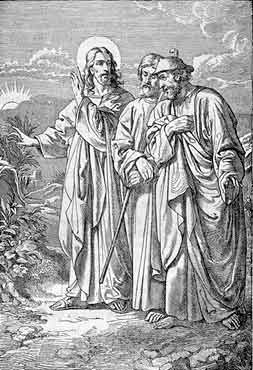 [13] That very day two of them (disciples) were going to a village named Emmaus, about seven miles from Jerusalem, [14] and talking with each other about all these things that had happened. [15] While they were talking and discussing together, Jesus Himself drew near and went with them. [16] But their eyes were kept from recognizing Him. [17] And He said to them, "What is this conversation which you are holding with each other as you walk?" And they stood still, looking sad. [18] Then one of them, named Cleopas, answered Him, "Are You the only visitor to Jerusalem who does not know the things that have happened there in these days?" [19] And He said to them, "What things?" And they said to Him, "Concerning Jesus of Nazareth, who was a prophet mighty in deed and word before God and all the people, [20] and how our chief priests and rulers delivered Him up to be condemned to death, and crucified Him. [21] But we had hoped that He was the one to redeem Israel. Yes, and besides all this, it is now the third day since this happened. [22] Moreover, some women of our company amazed us. They were at the tomb early in the morning [23] and did not find His body; and they came back saying that they had even seen a vision of angels, who said that He was alive. [24] Some of those who were with us went to the tomb, and found it just as the women had said; but Him they did not see." [25] And He said to them, "O foolish men, and slow of heart to believe all that the prophets have spoken! [26] Was it not necessary that the Christ should suffer these things and enter into His glory?" [27] And beginning with Moses and all the prophets, He interpreted to them in all the Scriptures the things concerning Himself.
[28] So they drew near to the village to which they were going. He appeared to be going further, [29] but they constrained Him, saying, "Stay with us, for it is toward evening and the day is now far spent." So He went in to stay with them. [30] When He was at table with them, He took the bread and blessed, and broke it, and gave it to them. [31] And their eyes were opened and they recognized Him; and He vanished out of their sight. [32] They said to each other, "Did not our hearts burn within us while He talked to us on the road, while He opened to us the Scriptures?" [33] And they rose that same hour and returned to Jerusalem; and they found the Eleven gathered together and those who were with them, [34] who said, "The Lord is risen indeed, and has appeared to Simon!" [35] Then they told what had happened on the road, and how He was known to them in the breaking of the bread.
__________________
Commentary:
13-35. In the course of their conversation with Jesus, the disciples' mood changes from sadness to joy; they begin to hope again, and feel the need to share their joy with others, thus becoming heralds and witnesses of the risen Christ.
This is an episode exclusive to St. Luke, who describes it in a masterly way. It shows our Lord's zeal for souls. "As He is walking along, Christ meets two men who have nearly lost all hope. They are beginning to feel that life has no meaning for them. Christ understands their sorrow; He sees into their heart and communicates to them some of the life He carries within Himself."
"When they draw near the village, He makes as if to go on, but the two disciples stop Him and practically force Him to stay with them. They recognize Him later when He breaks the bread. The Lord, they exclaimed, has been with us! `And they said to each other: "Did not our hearts burn within us while He talked to us on the road, while He opened to us the Scriptures?"' (Luke 24:32). Every Christian should make Christ present among men. He ought to act in such a way that those who know Him sense `the aroma of Christ' (cf. 2 Corinthians 2:15). Men should be able to recognize the Master in His disciples" ([St] J. Escriva, "Christ Is Passing By", 105).
13-27. Jesus' conversation with the two disciples on the road to Emmaus gives us a very good idea of the disillusionment felt by His disciples after His apparent total failure. Cleopas' words summarize Christ's life and mission (verse 19), His passion and death (verse 20), the despair felt by His disciples (verse 21), and the events of that Sunday morning (verse 22).
Earlier, Jesus had said to the Jews: "You search the Scriptures, because you think that in them you have eternal life; and it is they that bear witness to Me" (John 5:39). In saying this He indicated the best way for us to get to know Him. Pope Paul VI points out that today also frequent reading of and devotion to Holy Scripture is a clear inspiration of the Holy Spirit: "The progress made in biblical studies, the increasing dissemination of the Sacred Scriptures, and above all the example of tradition and the interior action of the Holy Spirit are tending to cause the modern Christian to use the Bible ever increasingly as the basic prayerbook and to draw from it genuine inspiration and unsurpassable examples" ([Pope] Paul VI, "Marialis Cultus", 30).
Because the disciples are so downhearted, Jesus patiently opens for them the meaning of all the Scriptural passages concerning the Messiah. "Was it not necessary that the Christ should suffer these things and enter into His glory?": with these words He disabuses them of the notion of an earthly and political Messiah and shows them that Christ's mission is a supernatural one--to save all mankind.
Sacred Scripture contained the prophecy that God would bring about salvation through the redemptive passion and death of the Messiah. The Cross does not mean failure: it is the route chosen by God for Christ to achieve definitive victory over sin and death (cf. 1 Corinthians 1:23-24). Many of our Lord's contemporaries failed to understand His supernatural mission because they misinterpreted the Old Testament texts. No one knew the meaning of Sacred Scripture like Jesus. And, after Him, only the Church has the mission and responsibility of conserving Scripture and interpreting it correctly: "All that has been said about the manner of interpreting Scripture is ultimately subject to the judgment of the Church which exercises the divinely conferred commission and ministry of watching over and interpreting the Word of God" (Vatican II, "Dei Verbum", 12).
28-35. The Master's presence and words restore the disciples' spirits and give them new and lasting hope. "There were two disciples on their way to Emmaus. They were walking along at a normal pace, like so many other travelers on that road. And there, without any fuss, Jesus appears to them, and walks with them, His conversation helping to alleviate their tiredness. I can well imagine the scene, just as dusk is falling. A gentle breeze is blowing. All around are fields ripe with wheat, and venerable olive trees, their branches shimmering in the soft glowing light.
"Jesus joins them as they go along their way. Lord, how great you are, in everything! But You move me even more when You come down to our level, to follow us and to seek us in the hustle and bustle of each day. Lord, grant us a childlike spirit, pure eyes and a clear mind so that we may recognize You when You come without any outward sign of Your glory.
"The journey ends when they reach the village. The two disciples who, without realizing it, have been deeply stirred by the words and love shown by God made man, are sorry to see Him leaving. For Jesus `appeared to be going further' (Luke 24:28). This Lord of ours never forces Himself on us. He wants us to turn to Him freely, when we begin to grasp the purity of His Love which He has placed in our souls. We have to hold Him back (`they constrained Him') and beg Him: `Stay with us, for it is towards evening, and the day is now far spent' (Luke 24:29).
"That's just like us - always short on daring, perhaps because we are insincere, or because we feel embarrassed. Deep down, what we are really thinking is: `Stay with us, because our souls are shrouded in darkness and You alone are the light. You alone can satisfy this longing that consumes us.' For `we know full well which among all things fair and honorable is the best - to possess God for ever' (St. Gregory Nazianzen, "Epistulae", 212).
"And Jesus stays. Our eyes are opened, as were those of Cleopas and his companion, when Christ breaks the bread; and, though He vanishes once more from sight, we too will find strength to start out once more - though night is falling - to tell the others about Him, because so much joy cannot be kept in one heart alone.
"The road to Emmaus - our God has filled this name with sweetness. Now the entire world has become an Emmaus, for the Lord has opened up all the divine paths of the earth" ([St] J. Escriva, "Friends of God", 313f).
32. If you were an apostle, these words of the disciples of Emmaus should rise spontaneously to the lips of your professional companions when they meet you along the way of their lives" ("The Way", 917).
33-35. The disciples now feel the need to return to Jerusalem immediately; there they find the Apostles and some other disciples gathered together with Peter, to whom Jesus has appeared.
In sacred history, Jerusalem was the place where God chose to be praised in a very special way and where the prophets carried out their main ministry. God willed that Christ should suffer, die and rise again in Jerusalem, and from there the Kingdom of God begins to spread (cf. Luke 24:47; Acts 1:8). In the New Testament the Church of Christ is described as "the Jerusalem above" (Galatians 4:26), "the Heavenly Jerusalem" (Hebrews 12:22) and the "new Jerusalem" (Revelation 21:2).
The Church began in the Holy City. Later on, St. Peter, not without a special intervention of Providence, moved to Rome, thereby making that city the center of the Church. Just as Peter strengthened these first disciples in the faith, so too Christians of all generations have recourse to the See of Peter to strengthen their faith and thereby build up the unity of the Church: "Take away the Pope and the Catholic Church would no longer be catholic. Moreover, without the supreme, effective and authoritative pastoral office of Peter the unity of Christ's Church would collapse. It would be vain to look for other principles of unity in place of the true one established by Christ Himself [...]. We would add that this cardinal principle of holy Church is not a supremacy of spiritual pride and a desire to dominate mankind, but a primacy of service, ministration and love. It is no vapid rhetoric which confers on Christ's vicar the title: `Servant of the servants of God'" ([Pope] Paul VI, "Ecclesiam Suam", 83).
___________________________
Source: "The Navarre Bible: Text and Commentaries". Biblical text taken from the Revised Standard Version and New Vulgate. Commentaries made by members of the Faculty of Theology of the University of Navarre, Spain. Published by Four Courts Press, Kill Lane, Blackrock, Co. Dublin, Ireland. Reprinted with permission from Four Courts Press and Scepter Publishers, the U.S. publisher.
The Road To Emmaus
[13] That very day two of them (disciples) were going to a village named Emmaus, about seven miles from Jerusalem, [14] and talking with each other about all these things that had happened. [15] While they were talking and discussing together, Jesus Himself drew near and went with them. [16] But their eyes were kept from recognizing Him. [17] And He said to them, "What is this conversation which you are holding with each other as you walk?" And they stood still, looking sad. [18] Then one of them, named Cleopas, answered Him, "Are You the only visitor to Jerusalem who does not know the things that have happened there in these days?" [19] And He said to them, "What things?" And they said to Him, "Concerning Jesus of Nazareth, who was a prophet mighty in deed and word before God and all the people, [20] and how our chief priests and rulers delivered Him up to be condemned to death, and crucified Him. [21] But we had hoped that He was the one to redeem Israel. Yes, and besides all this, it is now the third day since this happened. [22] Moreover, some women of our company amazed us. They were at the tomb early in the morning [23] and did not find His body; and they came back saying that they had even seen a vision of angels, who said that He was alive. [24] Some of those who were with us went to the tomb, and found it just as the women had said; but Him they did not see." [25] And He said to them, "O foolish men, and slow of heart to believe all that the prophets have spoken! [26] Was it not necessary that the Christ should suffer these things and enter into His glory?" [27] And beginning with Moses and all the prophets, He interpreted to them in all the Scriptures the things concerning Himself.[28] So they drew near to the village to which they were going. He appeared to be going further, [29] but they constrained Him, saying, "Stay with us, for it is toward evening and the day is now far spent." So He went in to stay with them. [30] When He was at table with them, He took the bread and blessed, and broke it, and gave it to them. [31] And their eyes were opened and they recognized Him; and He vanished out of their sight. [32] They said to each other, "Did not our hearts burn within us while He talked to us on the road, while He opened to us the Scriptures?" [33] And they rose that same hour and returned to Jerusalem; and they found the Eleven gathered together and those who were with them, [34] who said, "The Lord is risen indeed, and has appeared to Simon!" [35] Then they told what had happened on the road, and how He was known to them in the breaking of the bread.
__________________
Commentary:
13-35. In the course of their conversation with Jesus, the disciples' mood changes from sadness to joy; they begin to hope again, and feel the need to share their joy with others, thus becoming heralds and witnesses of the risen Christ.
This is an episode exclusive to St. Luke, who describes it in a masterly way. It shows our Lord's zeal for souls. "As He is walking along, Christ meets two men who have nearly lost all hope. They are beginning to feel that life has no meaning for them. Christ understands their sorrow; He sees into their heart and communicates to them some of the life He carries within Himself."
"When they draw near the village, He makes as if to go on, but the two disciples stop Him and practically force Him to stay with them. They recognize Him later when He breaks the bread. The Lord, they exclaimed, has been with us! `And they said to each other: "Did not our hearts burn within us while He talked to us on the road, while He opened to us the Scriptures?"' (Luke 24:32). Every Christian should make Christ present among men. He ought to act in such a way that those who know Him sense `the aroma of Christ' (cf. 2 Corinthians 2:15). Men should be able to recognize the Master in His disciples" ([St] J. Escriva, "Christ Is Passing By", 105).
13-27. Jesus' conversation with the two disciples on the road to Emmaus gives us a very good idea of the disillusionment felt by His disciples after His apparent total failure. Cleopas' words summarize Christ's life and mission (verse 19), His passion and death (verse 20), the despair felt by His disciples (verse 21), and the events of that Sunday morning (verse 22).
Earlier, Jesus had said to the Jews: "You search the Scriptures, because you think that in them you have eternal life; and it is they that bear witness to Me" (John 5:39). In saying this He indicated the best way for us to get to know Him. Pope Paul VI points out that today also frequent reading of and devotion to Holy Scripture is a clear inspiration of the Holy Spirit: "The progress made in biblical studies, the increasing dissemination of the Sacred Scriptures, and above all the example of tradition and the interior action of the Holy Spirit are tending to cause the modern Christian to use the Bible ever increasingly as the basic prayerbook and to draw from it genuine inspiration and unsurpassable examples" ([Pope] Paul VI, "Marialis Cultus", 30).
Because the disciples are so downhearted, Jesus patiently opens for them the meaning of all the Scriptural passages concerning the Messiah. "Was it not necessary that the Christ should suffer these things and enter into His glory?": with these words He disabuses them of the notion of an earthly and political Messiah and shows them that Christ's mission is a supernatural one--to save all mankind.
Sacred Scripture contained the prophecy that God would bring about salvation through the redemptive passion and death of the Messiah. The Cross does not mean failure: it is the route chosen by God for Christ to achieve definitive victory over sin and death (cf. 1 Corinthians 1:23-24). Many of our Lord's contemporaries failed to understand His supernatural mission because they misinterpreted the Old Testament texts. No one knew the meaning of Sacred Scripture like Jesus. And, after Him, only the Church has the mission and responsibility of conserving Scripture and interpreting it correctly: "All that has been said about the manner of interpreting Scripture is ultimately subject to the judgment of the Church which exercises the divinely conferred commission and ministry of watching over and interpreting the Word of God" (Vatican II, "Dei Verbum", 12).
28-35. The Master's presence and words restore the disciples' spirits and give them new and lasting hope. "There were two disciples on their way to Emmaus. They were walking along at a normal pace, like so many other travelers on that road. And there, without any fuss, Jesus appears to them, and walks with them, His conversation helping to alleviate their tiredness. I can well imagine the scene, just as dusk is falling. A gentle breeze is blowing. All around are fields ripe with wheat, and venerable olive trees, their branches shimmering in the soft glowing light.
"Jesus joins them as they go along their way. Lord, how great you are, in everything! But You move me even more when You come down to our level, to follow us and to seek us in the hustle and bustle of each day. Lord, grant us a childlike spirit, pure eyes and a clear mind so that we may recognize You when You come without any outward sign of Your glory.
"The journey ends when they reach the village. The two disciples who, without realizing it, have been deeply stirred by the words and love shown by God made man, are sorry to see Him leaving. For Jesus `appeared to be going further' (Luke 24:28). This Lord of ours never forces Himself on us. He wants us to turn to Him freely, when we begin to grasp the purity of His Love which He has placed in our souls. We have to hold Him back (`they constrained Him') and beg Him: `Stay with us, for it is towards evening, and the day is now far spent' (Luke 24:29).
"That's just like us - always short on daring, perhaps because we are insincere, or because we feel embarrassed. Deep down, what we are really thinking is: `Stay with us, because our souls are shrouded in darkness and You alone are the light. You alone can satisfy this longing that consumes us.' For `we know full well which among all things fair and honorable is the best - to possess God for ever' (St. Gregory Nazianzen, "Epistulae", 212).
"And Jesus stays. Our eyes are opened, as were those of Cleopas and his companion, when Christ breaks the bread; and, though He vanishes once more from sight, we too will find strength to start out once more - though night is falling - to tell the others about Him, because so much joy cannot be kept in one heart alone.
"The road to Emmaus - our God has filled this name with sweetness. Now the entire world has become an Emmaus, for the Lord has opened up all the divine paths of the earth" ([St] J. Escriva, "Friends of God", 313f).
32. If you were an apostle, these words of the disciples of Emmaus should rise spontaneously to the lips of your professional companions when they meet you along the way of their lives" ("The Way", 917).
33-35. The disciples now feel the need to return to Jerusalem immediately; there they find the Apostles and some other disciples gathered together with Peter, to whom Jesus has appeared.
In sacred history, Jerusalem was the place where God chose to be praised in a very special way and where the prophets carried out their main ministry. God willed that Christ should suffer, die and rise again in Jerusalem, and from there the Kingdom of God begins to spread (cf. Luke 24:47; Acts 1:8). In the New Testament the Church of Christ is described as "the Jerusalem above" (Galatians 4:26), "the Heavenly Jerusalem" (Hebrews 12:22) and the "new Jerusalem" (Revelation 21:2).
The Church began in the Holy City. Later on, St. Peter, not without a special intervention of Providence, moved to Rome, thereby making that city the center of the Church. Just as Peter strengthened these first disciples in the faith, so too Christians of all generations have recourse to the See of Peter to strengthen their faith and thereby build up the unity of the Church: "Take away the Pope and the Catholic Church would no longer be catholic. Moreover, without the supreme, effective and authoritative pastoral office of Peter the unity of Christ's Church would collapse. It would be vain to look for other principles of unity in place of the true one established by Christ Himself [...]. We would add that this cardinal principle of holy Church is not a supremacy of spiritual pride and a desire to dominate mankind, but a primacy of service, ministration and love. It is no vapid rhetoric which confers on Christ's vicar the title: `Servant of the servants of God'" ([Pope] Paul VI, "Ecclesiam Suam", 83).
___________________________
Source: "The Navarre Bible: Text and Commentaries". Biblical text taken from the Revised Standard Version and New Vulgate. Commentaries made by members of the Faculty of Theology of the University of Navarre, Spain. Published by Four Courts Press, Kill Lane, Blackrock, Co. Dublin, Ireland. Reprinted with permission from Four Courts Press and Scepter Publishers, the U.S. publisher.
Tuesday, March 25, 2008
Just for Today, March 26
Deal not roughly with one that is tempted, but comfort him, as thou wouldst wish to be done to thyself.
In temptations and tribulations a man is proved as to what progress he has made: and in them there is greater merit, and his virtue appears more conspicuous. Nor is it much if a man be devout and fervent when he feels no trouble; but if in the time of adversity he bears up with patience, there will be hope of a great advancement.
Some are preserved from great temptations, and are often overcome in daily little ones; that being humbled, they may never presume of themselves in great things, who are weak in such small occurences.
-Bk. I, ch. xiii.
___________________
You complain of the very thing in which you ought to rejoice. Where would be your merit if you only made an effort when you felt courageous? It does not matter in the least whether you are feeling brave, as long as you act bravely. If you feel too cowardly to stoop down and pick up a thread, and yet do so for love of Our Lord, your merit is greater than if you had accomplished some great deed in a moment of fervour. Instead of repining, be glad that Our Lord lets you feel your weakness, so that you may profit by it to win souls.
-Conseils et Souvenirs
__________________
For more information, see this post.
Adapted from Just For Today(©1943 Burns & Oates)
Nihil Obstat: Reginaldus Phillips, S.T.L.,Censor deputatus
Imprimatur: Edwardus Myers, Vic. Cap.
In temptations and tribulations a man is proved as to what progress he has made: and in them there is greater merit, and his virtue appears more conspicuous. Nor is it much if a man be devout and fervent when he feels no trouble; but if in the time of adversity he bears up with patience, there will be hope of a great advancement.
Some are preserved from great temptations, and are often overcome in daily little ones; that being humbled, they may never presume of themselves in great things, who are weak in such small occurences.
-Bk. I, ch. xiii.
___________________
You complain of the very thing in which you ought to rejoice. Where would be your merit if you only made an effort when you felt courageous? It does not matter in the least whether you are feeling brave, as long as you act bravely. If you feel too cowardly to stoop down and pick up a thread, and yet do so for love of Our Lord, your merit is greater than if you had accomplished some great deed in a moment of fervour. Instead of repining, be glad that Our Lord lets you feel your weakness, so that you may profit by it to win souls.
-Conseils et Souvenirs
__________________
For more information, see this post.
Adapted from Just For Today(©1943 Burns & Oates)
Nihil Obstat: Reginaldus Phillips, S.T.L.,Censor deputatus
Imprimatur: Edwardus Myers, Vic. Cap.
Thoughts and Counsels - March 26
Meditation for March 26, Wednesday After Easter
The Doors Were ClosedIn order that Jesus give Himself to the soul, it must be receptive to grace; the doors of the senses must remain closed. To desire is all well and good, it is an essential interior disposition, but exterior recollection is equally essential.
Call the divine guest, and close the door on thyself, is the counsel of the Imitation: Claude super te ostium tuum et voca at te dilectum tuum. Mane cum eo in cella. Stay with Him within.
What marvels does not the Savior effect in the silence of the Cenacle? First, He manifests Himself. Perhaps He was present before, but the distracted soul did not notice Him. One must shut out all exterior noise that the Guest within, the great Everpresent One, may reveal Himself.
There where the doors are closed, Jesus brings His peace. Peace be with you, He continues to repeat. Only tranquil souls will benefit from this peace; agitated souls do not share in the divine serenity.
Finally, like St. Thomas, Jesus allows recollected souls to touch His wounds, that is, He invites them to the closest union with Him. Nothing will be apparent, but in the depths of the soul marvels are being accomplished. There are contacts with God which the soul can have only when the silence of his prayer is profound.
The doors must be closed if Jesus is to take our hand and put it into His open side. Intimate friends dislike intrusions. Delicate as It is, the Heart of Jesus understands this.
Above all, I will cultivate interior silence; I will try to live in the Cenacle, in the interior Cenacle of my soul, where alone are found the presence of the Master, the peace of the Master, and heart to heart intimacy with the Master.
_________________
Adapted from Meditations for Religious
by Father Raoul Plus, S.J. (© 1939, Frederick Pustet Co.)
Priests praise return of traditional Latin Mass...
...say discouraging its use for so long was an error
Priests in the Bay Area are speaking out in favor of the traditional Latin Mass, telling a secular newspaper the old rite has several virtues nearly lost by the Church.
"For a long time, I have felt that the Mass we're doing today is not as reverent," Fr. Lawrence Goode told the March 13 Oakland Tribune. Fr. Goode offers the traditional Latin Mass at 7 p.m. every first Friday of the month at St. Francis of Assisi Church in East Palo Alto....
"We felt it was wrong to suppress it (the old Latin Mass)," Fr. William Young, who resides at Most Holy Redeemer parish in San Francisco’s Castro district, told the Tribune. Fr. Young says the traditional Latin Mass at the Chapel of the Most Holy Rosary in San Rafael...
New Generation of Altar Boys Drawn to Latin Mass
A new generation of young altar servers captivated by the solemn rituals of Latin Mass is mastering the traditional rite in growing numbers in the Boston archdiocese as the liturgy makes a comeback after a four-decade hiatus.There is much reason to rejoice - even the younger ones "get it."
“It’s really reverent. That’s why I like it,” said altar server Brendan MacKenzie, 12, of Marshfield, as he readied for the Tenebrae, or “Spy Wednesday,” service at Mary Immaculate of Lourdes in Newton during Holy Week. “It brings you closer to God.”
Nun who defied Vatican scheduled to speak in Los Angeles
It is Los Angeles, after all - is this really any surprise?
In April, the Immaculate Heart Community in Los Angeles will host a lecture by a woman religious who, seven years ago, publicly ignored a Vatican disciplinary order.The Benedictines of Erie - just another dying order?
Sister Christine Vladimiroff, prioress of the Benedictine Sisters of Erie, Pennsylvania, will deliver an Anita Caspary Lecture in Los Angeles on April 13, reported the March 19 “Justice and Peace Newsblast” of the Los Angeles archdiocese’s Office of Justice and Peace.
[...]
In a 2001 letter to the Holy See, Vladimiroff noted that the Vatican saw Sister Joan Chittester’s attendance at the Women’s Ordination Worldwide Conference “to be in opposition to its decree (Ordinatio Sacerdotalis) that priestly ordination will never be conferred on women in the Roman Catholic Church and must therefore not be discussed.” Vladimiroff said that “after much deliberation and prayer” she decided to “decline the request of the Vatican” to forbid Sister Joan to attend. She did so “out of the Benedictine, or monastic, tradition of obedience.” .....
Holy Week: The Hidden Homilies of Pope Benedict (Chiesa)
Hidden, except for those who were able to listen to them in person: a few thousand out of 1.2 billion Catholics in the world. Here are the complete texts. Required reading for understanding this pontificate...
by Sandro Magister
Gospel for Tuesday in the Octave of Easter
From: John 20:11-18
The Appearance To Mary Magdalene
[11] But Mary stood weeping outside the tomb, and as she wept she stooped to look into the tomb; [12] and she saw two angels in white, sitting where the body of Jesus had lain, one at the head and one at the feet. [13] They said to her, "Woman, why are you weeping?" She said to them, "Because they have taken away my Lord, and I do not know where they have laid Him." [14] Saying this, she turned around and saw Jesus standing, but she did not know that it was Jesus. [15] Jesus said to her, "Woman, why are you weeping? Whom do you seek?" Supposing Him to be gardener, she said to Him, "Sir, if you have carried Him away, tell me where you have laid Him, and I will take Him away." [16] Jesus said to her, "Mary." She turned and said to Him in Hebrew, "Rabboni!" (which means Teacher). [17] Jesus said to her, "Do not hold Me, for I have not yet ascended to the Father; but go to My brethren and say to them, I am ascending to My Father and your Father, to My God and your God." [18] Mary Magdalene went and said to the disciples, "I have seen the Lord"; and she told them that He had said these things to her.
______________
Commentary:
11-18. Mary's affection and sensitivity lead her to be concerned about what has become of the dead body of Jesus. This woman out of whom seven demons were cast (cf. Luke 8:2) stayed faithful during His passion and even now her love is still ardent: our Lord had freed her from the Evil One and she responded to that grace humbly and generously.
After consoling Mary Magdalene, Jesus gives her a message for the Apostles, whom He tenderly calls His "brethren". This message implies that He and they have the same Father, though each in an essentially different way: "I am ascending to My Father"-my own Father by nature-"and to your Father"-for He is your Father through the adoption I have won for you and by My death. Jesus, the Good Shepherd, shows His great mercy and understanding by gathering together all His disciples who had abandoned Him during His passion and were now in hiding for fear of the Jews (John 20:19).
Mary Magdalene's perseverance teaches us that anyone who sincerely keeps searching for Jesus Christ will eventually find Him. Jesus' gesture in calling His disciples His "brethren" despite their having run away should fill us with love in the midst of our own infidelities.
15. From Jesus' dialogue with Mary Magdalene, we can see the frame of mind all His disciples must have been in: they were not expecting the resurrection.
17. "Do not hold Me": the use of the negative imperative in the Greek, reflected in the New Vulgate ("noli me tenere") indicates that our Lord is telling Mary to release her hold of Him, to let Him go, since she will have another chance to see Him before His ascension into Heaven.
___________________________
Source: "The Navarre Bible: Text and Commentaries". Biblical text taken from the Revised Standard Version and New Vulgate. Commentaries made by members of the Faculty of Theology of the University of Navarre, Spain. Published by Four Courts Press, Kill Lane, Blackrock, Co. Dublin, Ireland. Reprinted with permission from Four Courts Press and Scepter Publishers, the U.S. publisher.
The Appearance To Mary Magdalene
[11] But Mary stood weeping outside the tomb, and as she wept she stooped to look into the tomb; [12] and she saw two angels in white, sitting where the body of Jesus had lain, one at the head and one at the feet. [13] They said to her, "Woman, why are you weeping?" She said to them, "Because they have taken away my Lord, and I do not know where they have laid Him." [14] Saying this, she turned around and saw Jesus standing, but she did not know that it was Jesus. [15] Jesus said to her, "Woman, why are you weeping? Whom do you seek?" Supposing Him to be gardener, she said to Him, "Sir, if you have carried Him away, tell me where you have laid Him, and I will take Him away." [16] Jesus said to her, "Mary." She turned and said to Him in Hebrew, "Rabboni!" (which means Teacher). [17] Jesus said to her, "Do not hold Me, for I have not yet ascended to the Father; but go to My brethren and say to them, I am ascending to My Father and your Father, to My God and your God." [18] Mary Magdalene went and said to the disciples, "I have seen the Lord"; and she told them that He had said these things to her.
______________
Commentary:
11-18. Mary's affection and sensitivity lead her to be concerned about what has become of the dead body of Jesus. This woman out of whom seven demons were cast (cf. Luke 8:2) stayed faithful during His passion and even now her love is still ardent: our Lord had freed her from the Evil One and she responded to that grace humbly and generously.
After consoling Mary Magdalene, Jesus gives her a message for the Apostles, whom He tenderly calls His "brethren". This message implies that He and they have the same Father, though each in an essentially different way: "I am ascending to My Father"-my own Father by nature-"and to your Father"-for He is your Father through the adoption I have won for you and by My death. Jesus, the Good Shepherd, shows His great mercy and understanding by gathering together all His disciples who had abandoned Him during His passion and were now in hiding for fear of the Jews (John 20:19).
Mary Magdalene's perseverance teaches us that anyone who sincerely keeps searching for Jesus Christ will eventually find Him. Jesus' gesture in calling His disciples His "brethren" despite their having run away should fill us with love in the midst of our own infidelities.
15. From Jesus' dialogue with Mary Magdalene, we can see the frame of mind all His disciples must have been in: they were not expecting the resurrection.
17. "Do not hold Me": the use of the negative imperative in the Greek, reflected in the New Vulgate ("noli me tenere") indicates that our Lord is telling Mary to release her hold of Him, to let Him go, since she will have another chance to see Him before His ascension into Heaven.
___________________________
Source: "The Navarre Bible: Text and Commentaries". Biblical text taken from the Revised Standard Version and New Vulgate. Commentaries made by members of the Faculty of Theology of the University of Navarre, Spain. Published by Four Courts Press, Kill Lane, Blackrock, Co. Dublin, Ireland. Reprinted with permission from Four Courts Press and Scepter Publishers, the U.S. publisher.
Monday, March 24, 2008
Just for Today, March 25
O Lord, my God, my Creator and Redeemer, I desire to receive Thee today with such affection, reverence, praise and honour; with such gratitude, worthiness, and love; with such faith, hope, and purity, as Thy most holy Mother, the glorious Virgin Mary, received and desired Thee, when she humbly and devoutly answered the angel, who declared to her the mystery of the Incarnation: Behold the handmaid of the Lord: be it done to me according to thy word (Luke 1:38).
-Bk. IV, ch. xvii.
The Lord who made me sheltereth
Within my mortal frame,
Just as to Mary, long ago,
The promised Saviour came.
O Mary! clothe my poverty,
And lend me of thy grace,
That He may find once more in me
His chosen dwelling-place!
-Poems
__________________
For more information, see this post.
Adapted from Just For Today(©1943 Burns & Oates)
Nihil Obstat: Reginaldus Phillips, S.T.L.,Censor deputatus
Imprimatur: Edwardus Myers, Vic. Cap.
-Bk. IV, ch. xvii.
The Lord who made me sheltereth
Within my mortal frame,
Just as to Mary, long ago,
The promised Saviour came.
O Mary! clothe my poverty,
And lend me of thy grace,
That He may find once more in me
His chosen dwelling-place!
-Poems
__________________
For more information, see this post.
Adapted from Just For Today(©1943 Burns & Oates)
Nihil Obstat: Reginaldus Phillips, S.T.L.,Censor deputatus
Imprimatur: Edwardus Myers, Vic. Cap.
Thoughts and Counsels - March 25
Our Lady, deign to intercede for us sinners with thy divine Son, our Lord, and obtain of Him a blessing for us in our trials and tribulations.
-St. Ignatius
________________________
From Mary, Help of Christians
Part VI, Thoughts and Counsels of the Saints for Every Day of the Year
Compiled by Fr. Bonaventure Hammer, OFM (© 1909, Benziger Brothers)
-St. Ignatius
________________________
From Mary, Help of Christians
Part VI, Thoughts and Counsels of the Saints for Every Day of the Year
Compiled by Fr. Bonaventure Hammer, OFM (© 1909, Benziger Brothers)
Meditation for March 25, Tuesday After Easter
Peace Be With YouEach time Our Lord appears after the Resurrection, it is to bring His peace and establish it in the hearts of men. To live the spirit of Easter I must:
I. Work for Peace in Myself
At Baptism, I received the command to live in serenity and holy joy, That she may be joyful in serving Thee in Thy Church the priest said in making me a child of God.
This peace, this holy liberty of the children of God, is exactly what Our Lord came to bring me together with those supernatural gifts which are its prerequisites. Can divine joy be wanting to those who possess the charity of Christ?
And then, Our Lord has prayed that I possess peace; Pacem relinquo vobis, non quomodo mundus dat. It is not the peace of the world, but the joy and peace of God's love, of serenity of conscience, and of the happiness of being a child of the Father and the consecrated spouse of Jesus.
II. Work for Peace in My Neighbor
In the community, first of all, I must never do anything that would dampen the good spirit, but keep my troubles and apprehensions to myself and radiate in the community only what is helpful, elevating and inspiring. That is a negative but an important resolution.
From a positive point of view. I will always try to give moral and supernatural support to my family, by pleasing, comforting and encouraging them.
If I have contact with the world, it should sense in me heavenly serenity and divine peace.
And I will not forget to think of the world, of all those troubled souls who are going astray, and are losing the correct outlook on life. I will pray for them that they may have peace. I will pray for all those who dream of wars and who involve the world in bloodshed. "Ah! preserve us, O Lord, from pest, hunger, and above all, from war." A peste, fame, et bello.
_________________
Adapted from Meditations for Religious
by Father Raoul Plus, S.J. (© 1939, Frederick Pustet Co.)
"Off the Record" - Five Years On...
...OTR had its beginnings in an ongoing exchange of e-mails between half a dozen correspondents wryly exasperated by the failures of senior ecclesiastics to conduct themselves as Catholics, and by their even more distressing failures to permit others access to the Church's spiritual bounty. Many of our exchanges took the form of routine grousing about the flakiness of this or that homily or pastoral letter or interview, but underneath there was a deeper sense of unease. Bad churchmen are a vexation, but an understandable and probably unavoidable vexation. Harder to explain -- and progressively harder to deny -- was The Void at the center of the Church's activity: the absence of concern for souls in jeopardy.For a good many years, a number of us had this "deeper sense of unease," leading us to take refuge in the Sacred Heart of Jesus, seeking faithful parishes and priests - no easy task in some parts of the country...
"Work out your salvation with fear and trembling," said St. Paul, "for it is God who is at work in you." OTR was created to grapple with the problem (never articulated as such by the contributors): how does a Catholic work out his salvation when his pastors don't believe there is any damnation to be saved from?Precisely! Some, it seems, view parish life as a sort of Sunday Social Club, not much different than any number of other "clubs."
Perhaps no Catholic bishop or religious superior has publicly stated his disbelief in the possibility that a soul might be lost. Yet it is so rare for a churchman to affirm this doctrine that it's stunning when it does occur -- think of the amazed indignation in response to the disciplinary actions of Bishops Bruskewitz and Burke.Bishops, such as these, are demonized and criticized as heartless by those who call themselves "thinking Catholics" and "mature adults" when, in fact, it is the bishops' authentic charity for the souls of others which requires that they do what must be done! Who among us would want a father who did not care about his children?
Diogenes continues with an easy-to-understand analogy of mother and child which is well worth the read! May OTR continue for another five years or as long as it is needed!
Gospel for Monday within the Octave of Easter
From: Matthew 28:8-15
Jesus Appears To The Women
[8] So they (Mary Magdalene and the other Mary) departed quickly from the tomb with fear and great joy, and ran to tell His disciples. [9] And behold, Jesus met them and said, "Hail!" And they came up and took hold of His feet and worshipped Him. [10] Then Jesus said to them, "Do not be afraid; go and tell My brethren to go to Galilee; and there they will see Me."
The Soldiers Are Bribed
[11] While they were going, behold, some of the guard went into the city and told the chief priests all that had taken place. [12] And when they had assembled with the elders and taken counsel, they gave a sum of money to the soldiers [13] and said, "Tell people, `His disciples came by night and stole Him away while we were asleep.' [14] And if this comes to the governor's ears, we will satisfy him and keep you out of trouble." [15] So they took the money and did as they were directed; and this story has been spread among the Jews to this day.
____________
Commentary:
1-15. The resurrection of Jesus, which happened in the early hours of the Sunday morning, is a fact which all the evangelist state clearly and unequivocally. Some holy women discover to their surprise that the tomb is open. On entering the hall (cf. Mark 16:5-6), they see an angel who says to them, "He is not here; for He has risen, as He said." The guards who were on duty when the angel rolled back the stone go to the city and report what has happened to the chief priests. These, because of the urgency of the matter, decide to bribe the guards; they give them a considerable sum of money on condition that they spread the word that His disciples came at night and stole the body of Jesus when they were asleep. "Wretched craftiness," says St. Augustine, "do you give us witnesses who were asleep? It is you who are really asleep if this is the only kind of explanation you have to offer!" ("Ennarationes in Psalmos", 63, 15). The Apostles, who a couple of days before fled in fear, will, now that they have seen Him and have eaten and drunk with Him, become tireless preachers of this great event: "This Jesus, they will say, "God raised up, and of that we are all witnesses" (Acts 2:32).
Just as He foretold He would go up to Jerusalem and be delivered to the leaders of the Jews and put to death, He also prophesied that He would rise from the dead (Matthew 20:17-19; Mark 10:32-34; Luke 18:31-34). By His resurrection He completes the sign He promised to give unbelievers to show His divinity (Matthew 12:40).
The resurrection of Christ is one of the basic dogmas of the Catholic faith. In fact, St. Paul says, "If Christ has not been raised, then our preaching is in vain and your faith is in vain" (1 Corinthians 15:14); and, to prove his assertion that Christ rose, he tells us "that He appeared to Cephas, then to the Twelve. Then He appeared to more than five hundred brethren at one time, most of whom are still alive, though some have fallen asleep. Then He appeared to James, then to all the apostles. Last of all, as to one untimely born, He appeared also to me" (1 Corinthians 15:5-8). The creed states that Jesus rose from the dead on the third day ("Nicene Creed"), by His own power (Ninth Council of Toledo, "De Redemptione Creed"), by a true resurrection of the flesh ("Creed" of St. Leo IX), reuniting His soul with His body (Innocent III, "Eius Exemplo"), and that this fact of the resurrection is historically proven and provable ("Lamentabili", 36).
"By the word `resurrection' we are not merely to understand that Christ was raised from the dead...but that He rose by His own power and virtue, a singular prerogative peculiar to Him alone. Our Lord confirmed this by the divine testimony of His own mouth when He said: `I lay down My life, that I may take it again....I have power to lay it down: and I have power to take it up again' (John 10:17-18). To the Jews He also said, in corroboration of His doctrine" `Destroy this temple, and in three days I will raise it up' (John 2:19-20) [...]. We sometimes, it is true, read in Scripture that He was raised by the Father (cf. Acts 2:24; Romans 8:11); but this refers to Him as man, just as those passages on the other hand, which say that He rose by His own power, related to Him as God" ("St. Pius V Catechism", I, 6, 8).
Christ's resurrection was not a return to His previous earthly existence; it was a "glorious" resurrection, that is to say, attaining the full development of human life--immortal, freed from all limitations of space and time. As a result of the resurrection, Christ's body now shares in the glory which His soul had from the beginning. Here lies the unique nature of the historical fact of the resurrection. He could not be seen by anyone but only by those to whom He granted that grace, to enable them to be witnesses of this resurrection, and to enable others to believe in Him by accepting the testimony of the seers.
Christ's resurrection was something necessary for the completion of the work of our Redemption. For, Jesus Christ through His death freed us from sins; but by His resurrection He restored us all that we had lost through sin and, moreover, opened for us the gates of eternal life (cf. Romans 4:25). Also, the fact that He rose from the dead by His own power is a definitive proof that He is the Son of God, and therefore His resurrection fully confirms our faith in His divinity.
The resurrection of Christ, as has been pointed out, is the most sublime truth of our faith. That is why St. Augustine exclaims: "It is no great thing to believe that Christ died; for this is something that is also believed by pagans and Jews and by all the wicked: everyone believes that He died. The Christians' faith is in Christ's resurrection; that is what we hold to be a great thing--to believe that He rose" ("Enarrationes in Psalmos", 120).
The mystery of the Redemption wrought by Christ, which embraces His death and resurrection, is applied to every man and woman through Baptism and the other sacraments, by means of which the believer is as it were immersed in Christ and in His death, that is to say, in a mystical way he becomes part of Christ, he dies and rises with Christ: "We were buried therefore with Him by baptism unto death, so that as Christ was raised from the dead by the glory of the Father, we too might walk in newness of life" (Romans 6:4).
An ardent desire to seek the things of God and an interior taste for the things that are above (cf. Colossians 3:1-3) are signs of our resurrection with Christ.
___________________________
Source: "The Navarre Bible: Text and Commentaries". Biblical text taken from the Revised Standard Version and New Vulgate. Commentaries made by members of the Faculty of Theology of the University of Navarre, Spain. Published by Four Courts Press, Kill Lane, Blackrock, Co. Dublin, Ireland. Reprinted with permission from Four Courts Press and Scepter Publishers, the U.S. publisher.
Jesus Appears To The Women
[8] So they (Mary Magdalene and the other Mary) departed quickly from the tomb with fear and great joy, and ran to tell His disciples. [9] And behold, Jesus met them and said, "Hail!" And they came up and took hold of His feet and worshipped Him. [10] Then Jesus said to them, "Do not be afraid; go and tell My brethren to go to Galilee; and there they will see Me."
The Soldiers Are Bribed
[11] While they were going, behold, some of the guard went into the city and told the chief priests all that had taken place. [12] And when they had assembled with the elders and taken counsel, they gave a sum of money to the soldiers [13] and said, "Tell people, `His disciples came by night and stole Him away while we were asleep.' [14] And if this comes to the governor's ears, we will satisfy him and keep you out of trouble." [15] So they took the money and did as they were directed; and this story has been spread among the Jews to this day.
____________
Commentary:
1-15. The resurrection of Jesus, which happened in the early hours of the Sunday morning, is a fact which all the evangelist state clearly and unequivocally. Some holy women discover to their surprise that the tomb is open. On entering the hall (cf. Mark 16:5-6), they see an angel who says to them, "He is not here; for He has risen, as He said." The guards who were on duty when the angel rolled back the stone go to the city and report what has happened to the chief priests. These, because of the urgency of the matter, decide to bribe the guards; they give them a considerable sum of money on condition that they spread the word that His disciples came at night and stole the body of Jesus when they were asleep. "Wretched craftiness," says St. Augustine, "do you give us witnesses who were asleep? It is you who are really asleep if this is the only kind of explanation you have to offer!" ("Ennarationes in Psalmos", 63, 15). The Apostles, who a couple of days before fled in fear, will, now that they have seen Him and have eaten and drunk with Him, become tireless preachers of this great event: "This Jesus, they will say, "God raised up, and of that we are all witnesses" (Acts 2:32).
Just as He foretold He would go up to Jerusalem and be delivered to the leaders of the Jews and put to death, He also prophesied that He would rise from the dead (Matthew 20:17-19; Mark 10:32-34; Luke 18:31-34). By His resurrection He completes the sign He promised to give unbelievers to show His divinity (Matthew 12:40).
The resurrection of Christ is one of the basic dogmas of the Catholic faith. In fact, St. Paul says, "If Christ has not been raised, then our preaching is in vain and your faith is in vain" (1 Corinthians 15:14); and, to prove his assertion that Christ rose, he tells us "that He appeared to Cephas, then to the Twelve. Then He appeared to more than five hundred brethren at one time, most of whom are still alive, though some have fallen asleep. Then He appeared to James, then to all the apostles. Last of all, as to one untimely born, He appeared also to me" (1 Corinthians 15:5-8). The creed states that Jesus rose from the dead on the third day ("Nicene Creed"), by His own power (Ninth Council of Toledo, "De Redemptione Creed"), by a true resurrection of the flesh ("Creed" of St. Leo IX), reuniting His soul with His body (Innocent III, "Eius Exemplo"), and that this fact of the resurrection is historically proven and provable ("Lamentabili", 36).
"By the word `resurrection' we are not merely to understand that Christ was raised from the dead...but that He rose by His own power and virtue, a singular prerogative peculiar to Him alone. Our Lord confirmed this by the divine testimony of His own mouth when He said: `I lay down My life, that I may take it again....I have power to lay it down: and I have power to take it up again' (John 10:17-18). To the Jews He also said, in corroboration of His doctrine" `Destroy this temple, and in three days I will raise it up' (John 2:19-20) [...]. We sometimes, it is true, read in Scripture that He was raised by the Father (cf. Acts 2:24; Romans 8:11); but this refers to Him as man, just as those passages on the other hand, which say that He rose by His own power, related to Him as God" ("St. Pius V Catechism", I, 6, 8).
Christ's resurrection was not a return to His previous earthly existence; it was a "glorious" resurrection, that is to say, attaining the full development of human life--immortal, freed from all limitations of space and time. As a result of the resurrection, Christ's body now shares in the glory which His soul had from the beginning. Here lies the unique nature of the historical fact of the resurrection. He could not be seen by anyone but only by those to whom He granted that grace, to enable them to be witnesses of this resurrection, and to enable others to believe in Him by accepting the testimony of the seers.
Christ's resurrection was something necessary for the completion of the work of our Redemption. For, Jesus Christ through His death freed us from sins; but by His resurrection He restored us all that we had lost through sin and, moreover, opened for us the gates of eternal life (cf. Romans 4:25). Also, the fact that He rose from the dead by His own power is a definitive proof that He is the Son of God, and therefore His resurrection fully confirms our faith in His divinity.
The resurrection of Christ, as has been pointed out, is the most sublime truth of our faith. That is why St. Augustine exclaims: "It is no great thing to believe that Christ died; for this is something that is also believed by pagans and Jews and by all the wicked: everyone believes that He died. The Christians' faith is in Christ's resurrection; that is what we hold to be a great thing--to believe that He rose" ("Enarrationes in Psalmos", 120).
The mystery of the Redemption wrought by Christ, which embraces His death and resurrection, is applied to every man and woman through Baptism and the other sacraments, by means of which the believer is as it were immersed in Christ and in His death, that is to say, in a mystical way he becomes part of Christ, he dies and rises with Christ: "We were buried therefore with Him by baptism unto death, so that as Christ was raised from the dead by the glory of the Father, we too might walk in newness of life" (Romans 6:4).
An ardent desire to seek the things of God and an interior taste for the things that are above (cf. Colossians 3:1-3) are signs of our resurrection with Christ.
___________________________
Source: "The Navarre Bible: Text and Commentaries". Biblical text taken from the Revised Standard Version and New Vulgate. Commentaries made by members of the Faculty of Theology of the University of Navarre, Spain. Published by Four Courts Press, Kill Lane, Blackrock, Co. Dublin, Ireland. Reprinted with permission from Four Courts Press and Scepter Publishers, the U.S. publisher.
Sunday, March 23, 2008
Just for Today, March 24
If a man give his whole substance, it is yet nothing. And if he have great virtue, and exceeding devotion, there is still much wanting to him; to wit, one thing, which is chiefly necessary to him. And what is that? That, having left all things else, he leave also himself, and retain nothing of self-love.
-Bk. II, ch. xi.
_________________
The science of love! How sweet those words sound! That is the only science I want to know; having like the Bride of the Canticle given all my substance for love, I shall despise it as nothing (Cant. viii, 7). I am so convinced that our love is the one thing that makes us acceptable to God, that it is the only treasure that I seek after.
-The Story of a Soul (L'Histoire d'une Âme)
__________________
For more information, see this post.
Adapted from Just For Today(©1943 Burns & Oates)
Nihil Obstat: Reginaldus Phillips, S.T.L.,Censor deputatus
Imprimatur: Edwardus Myers, Vic. Cap.
-Bk. II, ch. xi.
_________________
The science of love! How sweet those words sound! That is the only science I want to know; having like the Bride of the Canticle given all my substance for love, I shall despise it as nothing (Cant. viii, 7). I am so convinced that our love is the one thing that makes us acceptable to God, that it is the only treasure that I seek after.
-The Story of a Soul (L'Histoire d'une Âme)
__________________
For more information, see this post.
Adapted from Just For Today(©1943 Burns & Oates)
Nihil Obstat: Reginaldus Phillips, S.T.L.,Censor deputatus
Imprimatur: Edwardus Myers, Vic. Cap.
Thoughts and Counsels - March 24
We should carefully beware of giving ourselves so completely to any employment as to forget to have recourse to God from time to time.
- St. Teresa
________________________
From Mary, Help of Christians
Part VI, Thoughts and Counsels of the Saints for Every Day of the Year
Compiled by Fr. Bonaventure Hammer, OFM (© 1909, Benziger Brothers)
- St. Teresa
________________________
From Mary, Help of Christians
Part VI, Thoughts and Counsels of the Saints for Every Day of the Year
Compiled by Fr. Bonaventure Hammer, OFM (© 1909, Benziger Brothers)
Meditation for March 24, Monday After Easter
God's Hidden Presence
God's action within us is frequently hidden and silent. He speaks to us through events in which His presence is not always discernible. It is only when we recall an event of the past, that the situation suddenly clarifies, and we perceive the touch of Providence in what seemed only a trifling circumstance.
However faithful the soul, it is aware only too late of the passing of God. As with the disciples going to Emmaus, Jesus walks at our side, but we fail to recognize Him. Not until later do we realize the great grace that was ours. Sometimes it is true our heart burns within while He is speaking to us, but more often we experience no sensible sign of His Presence.
Are we inattentive? Do we lack discernment?
We must be on the alert and try to recognize the passing of the Lord, so that we can penetrate all His disguises. The Most High often moves among us as a mysterious traveler or an anonymous visitor. I will always keep the door of my heart ajar and, as every prudent virgin, have my lamp lighted.
Adapted from Meditations for Religious
by Father Raoul Plus, S.J. (© 1939, Frederick Pustet Co.)
God's action within us is frequently hidden and silent. He speaks to us through events in which His presence is not always discernible. It is only when we recall an event of the past, that the situation suddenly clarifies, and we perceive the touch of Providence in what seemed only a trifling circumstance.
However faithful the soul, it is aware only too late of the passing of God. As with the disciples going to Emmaus, Jesus walks at our side, but we fail to recognize Him. Not until later do we realize the great grace that was ours. Sometimes it is true our heart burns within while He is speaking to us, but more often we experience no sensible sign of His Presence.
Are we inattentive? Do we lack discernment?
We must be on the alert and try to recognize the passing of the Lord, so that we can penetrate all His disguises. The Most High often moves among us as a mysterious traveler or an anonymous visitor. I will always keep the door of my heart ajar and, as every prudent virgin, have my lamp lighted.
"Lord, you know with what burning ardor I seek You. I try to find You in the night of my soul, like a child playing blind-man's buff. I stretch out my arms but my eyes are bound. Grant, that I may never grow tired of seeking You. Grant that I may sometimes find You."_________________
Adapted from Meditations for Religious
by Father Raoul Plus, S.J. (© 1939, Frederick Pustet Co.)
Gospel for Easter Sunday, The Resurrection of the Lord
From: Luke 24:13-35
The Road To Emmaus
[13] That very day two of them (disciples) were going to a village named Emmaus, about seven miles from Jerusalem, [14] and talking with each other about all these things that had happened. [15] While they were talking and discussing together, Jesus Himself drew near and went with them. [16] But their eyes were kept from recognizing Him. [17] And He said to them, "What is this conversation which you are holding with each other as you walk?" And they stood still, looking sad. [18] Then one of them, named Cleopas, answered Him, "Are You the only visitor to Jerusalem who does not know the things that have happened there in these days?" [19] And He said to them, "What things?" And they said to Him, "Concerning Jesus of Nazareth, who was a prophet mighty in deed and word before God and all the people, [20] and how our chief priests and rulers delivered Him up to be condemned to death, and crucified Him. [21] But we had hoped that He was the one to redeem Israel. Yes, and besides all this, it is now the third day since this happened. [22] Moreover, some women of our company amazed us. They were at the tomb early in the morning [23] and did not find His body; and they came back saying that they had even seen a vision of angels, who said that He was alive. [24] Some of those who were with us went to the tomb, and found it just as the women had said; but Him they did not see." [25] And He said to them, "O foolish men, and slow of heart to believe all that the prophets have spoken! [26] Was it not necessary that the Christ should suffer these things and enter into His glory?" [27] And beginning with Moses and all the prophets, He interpreted to them in all the Scriptures the things concerning Himself.
[28] So they drew near to the village to which they were going. He appeared to be going further, [29] but they constrained Him, saying, "Stay with us, for it is toward evening and the day is now far spent." So He went in to stay with them. [30] When He was at table with them, He took the bread and blessed, and broke it, and gave it to them. [31] And their eyes were opened and they recognized Him; and He vanished out of their sight. [32] They said to each other, "Did not our hearts burn within us while He talked to us on the road, while He opened to us the Scriptures?" [33] And they rose that same hour and returned to Jerusalem; and they found the Eleven gathered together and those who were with them, [34] who said, "The Lord is risen indeed, and has appeared to Simon!" [35] Then they told what had happened on the road, and how He was known to them in the breaking of the bread.
_________________
Commentary:
13-35. In the course of their conversation with Jesus, the disciples' mood changes from sadness to joy; they begin to hope again, and feel the need to share their joy with others, thus becoming heralds and witnesses of the risen Christ.
This is an episode exclusive to St. Luke, who describes it in a masterly way. It shows our Lord's zeal for souls. "As He is walking along, Christ meets two men who have nearly lost all hope. They are beginning to feel that life has no meaning for them. Christ understands their sorrow; He sees into their heart and communicates to them some of the life He carries within Himself."
"When they draw near the village, He makes as if to go on, but the two disciples stop Him and practically force Him to stay with them. They recognize Him later when He breaks the bread. The Lord, they exclaimed, has been with us! `And they said to each other: "Did not our hearts burn within us while He talked to us on the road, while He opened to us the Scriptures?"' (Luke 24:32). Every Christian should make Christ present among men. He ought to act in such a way that those who know Him sense `the aroma of Christ' (cf. 2 Corinthians 2:15). Men should be able to recognize the Master in His disciples" ([St] J. Escriva, "Christ Is Passing By", 105).
13-27. Jesus' conversation with the two disciples on the road to Emmaus gives us a very good idea of the disillusionment felt by His disciples after His apparent total failure. Cleopas' words summarize Christ's life and mission (verse 19), His passion and death (verse 20), the despair felt by His disciples (verse 21), and the events of that Sunday morning (verse 22).
Earlier, Jesus had said to the Jews: "You search the Scriptures, because you think that in them you have eternal life; and it is they that bear witness to Me" (John 5:39). In saying this He indicated the best way for us to get to know Him. Pope Paul VI points out that today also frequent reading of and devotion to Holy Scripture is a clear inspiration of the Holy Spirit: "The progress made in biblical studies, the increasing dissemination of the Sacred Scriptures, and above all the example of tradition and the interior action of the Holy Spirit are tending to cause the modern Christian to use the Bible ever increasingly as the basic prayerbook and to draw from it genuine inspiration and unsurpassable examples" ([Pope] Paul VI, "Marialis Cultus", 30).
Because the disciples are so downhearted, Jesus patiently opens for them the meaning of all the Scriptural passages concerning the Messiah. "Was it not necessary that the Christ should suffer these things and enter into His glory?": with these words He disabuses them of the notion of an earthly and political Messiah and shows them that Christ's mission is a supernatural one--to save all mankind.
Sacred Scripture contained the prophecy that God would bring about salvation through the redemptive passion and death of the Messiah. The Cross does not mean failure: it is the route chosen by God for Christ to achieve definitive victory over sin and death (cf. 1 Corinthians 1:23-24). Many of our Lord's contemporaries failed to understand His supernatural mission because they misinterpreted the Old Testament texts. No one knew the meaning of Sacred Scripture like Jesus. And, after Him, only the Church has the mission and responsibility of conserving Scripture and interpreting it correctly: "All that has been said about the manner of interpreting Scripture is ultimately subject to the judgment of the Church which exercises the divinely conferred commission and ministry of watching over and interpreting the Word of God" (Vatican II, "Dei Verbum", 12).
28-35. The Master's presence and words restore the disciples' spirits and give them new and lasting hope. "There were two disciples on their way to Emmaus. They were walking along at a normal pace, like so many other travelers on that road. And there, without any fuss, Jesus appears to them, and walks with them, His conversation helping to alleviate their tiredness. I can well imagine the scene, just as dusk is falling. A gentle breeze is blowing. All around are fields ripe with wheat, and venerable olive trees, their branches shimmering in the soft glowing light.
"Jesus joins them as they go along their way. Lord, how great you are, in everything! But You move me even more when You come down to our level, to follow us and to seek us in the hustle and bustle of each day. Lord, grant us a childlike spirit, pure eyes and a clear mind so that we may recognize You when You come without any outward sign of Your glory.
"The journey ends when they reach the village. The two disciples who, without realizing it, have been deeply stirred by the words and love shown by God made man, are sorry to see Him leaving. For Jesus `appeared to be going further' (Luke 24:28). This Lord of ours never forces Himself on us. He wants us to turn to Him freely, when we begin to grasp the purity of His Love which He has placed in our souls. We have to hold Him back (`they constrained Him') and beg Him: `Stay with us, for it is towards evening, and the day is now far spent' (Luke 24:29).
"That's just like us--always short on daring, perhaps because we are insincere, or because we feel embarrassed. Deep down, what we are really thinking is: `Stay with us, because our souls are shrouded in darkness and You alone are the light. You alone can satisfy this longing that consumes us.' For `we know full well which among all things fair and honorable is the best--to possess God for ever' (St. Gregory Nazianzen, "Epistulae", 212).
"And Jesus stays. Our eyes are opened, as were those of Cleopas and his companion, when Christ breaks the bread; and, though He vanishes once more from sight, we too will find strength to start out once more--though night is falling--to tell the others about Him, because so much joy cannot be kept in one heart alone.
"The road to Emmaus--our God has filled this name with sweetness. Now the entire world has become an Emmaus, for the Lord has opened up all the divine paths of the earth" ([St] J. Escriva, "Friends of God", 313f).
32. If you were an apostle, these words of the disciples of Emmaus should rise spontaneously to the lips of your professional companions when they meet you along the way of their lives" ("The Way", 917).
33-35. The disciples now feel the need to return to Jerusalem immediately; there they find the Apostles and some other disciples gathered together with Peter, to whom Jesus has appeared.
In sacred history, Jerusalem was the place where God chose to be praised in a very special way and where the prophets carried out their main ministry. God willed that Christ should suffer, die and rise again in Jerusalem, and from there the Kingdom of God begins to spread (cf. Luke 24:47; Acts 1:8). In the New Testament the Church of Christ is described as "the Jerusalem above" (Galatians 4:26), "the Heavenly Jerusalem" (Hebrews 12:22) and the "new Jerusalem" (Revelation 21:2).
The Church began in the Holy City. Later on, St. Peter, not without a special intervention of Providence, moved to Rome, thereby making that city the center of the Church. Just as Peter strengthened these first disciples in the faith, so too Christians of all generations have recourse to the See of Peter to strengthen their faith and thereby build up the unity of the Church: "Take away the Pope and the Catholic Church would no longer be catholic. Moreover, without the supreme, effective and authoritative pastoral office of Peter the unity of Christ's Church would collapse. It would be vain to look for other principles of unity in place of the true one established by Christ Himself [...]. We would add that this cardinal principle of holy Church is not a supremacy of spiritual pride and a desire to dominate mankind, but a primacy of service, ministration and love. It is no vapid rhetoric which confers on Christ's vicar the title: `Servant of the servants of God'" ([Pope] Paul VI, "Ecclesiam Suam", 83).
___________________________
Source: "The Navarre Bible: Text and Commentaries". Biblical text taken from the Revised Standard Version and New Vulgate. Commentaries made by members of the Faculty of Theology of the University of Navarre, Spain. Published by Four Courts Press, Kill Lane, Blackrock, Co. Dublin, Ireland. Reprinted with permission from Four Courts Press and Scepter Publishers, the U.S. publisher.
The Road To Emmaus
[13] That very day two of them (disciples) were going to a village named Emmaus, about seven miles from Jerusalem, [14] and talking with each other about all these things that had happened. [15] While they were talking and discussing together, Jesus Himself drew near and went with them. [16] But their eyes were kept from recognizing Him. [17] And He said to them, "What is this conversation which you are holding with each other as you walk?" And they stood still, looking sad. [18] Then one of them, named Cleopas, answered Him, "Are You the only visitor to Jerusalem who does not know the things that have happened there in these days?" [19] And He said to them, "What things?" And they said to Him, "Concerning Jesus of Nazareth, who was a prophet mighty in deed and word before God and all the people, [20] and how our chief priests and rulers delivered Him up to be condemned to death, and crucified Him. [21] But we had hoped that He was the one to redeem Israel. Yes, and besides all this, it is now the third day since this happened. [22] Moreover, some women of our company amazed us. They were at the tomb early in the morning [23] and did not find His body; and they came back saying that they had even seen a vision of angels, who said that He was alive. [24] Some of those who were with us went to the tomb, and found it just as the women had said; but Him they did not see." [25] And He said to them, "O foolish men, and slow of heart to believe all that the prophets have spoken! [26] Was it not necessary that the Christ should suffer these things and enter into His glory?" [27] And beginning with Moses and all the prophets, He interpreted to them in all the Scriptures the things concerning Himself.
[28] So they drew near to the village to which they were going. He appeared to be going further, [29] but they constrained Him, saying, "Stay with us, for it is toward evening and the day is now far spent." So He went in to stay with them. [30] When He was at table with them, He took the bread and blessed, and broke it, and gave it to them. [31] And their eyes were opened and they recognized Him; and He vanished out of their sight. [32] They said to each other, "Did not our hearts burn within us while He talked to us on the road, while He opened to us the Scriptures?" [33] And they rose that same hour and returned to Jerusalem; and they found the Eleven gathered together and those who were with them, [34] who said, "The Lord is risen indeed, and has appeared to Simon!" [35] Then they told what had happened on the road, and how He was known to them in the breaking of the bread.
_________________
Commentary:
13-35. In the course of their conversation with Jesus, the disciples' mood changes from sadness to joy; they begin to hope again, and feel the need to share their joy with others, thus becoming heralds and witnesses of the risen Christ.
This is an episode exclusive to St. Luke, who describes it in a masterly way. It shows our Lord's zeal for souls. "As He is walking along, Christ meets two men who have nearly lost all hope. They are beginning to feel that life has no meaning for them. Christ understands their sorrow; He sees into their heart and communicates to them some of the life He carries within Himself."
"When they draw near the village, He makes as if to go on, but the two disciples stop Him and practically force Him to stay with them. They recognize Him later when He breaks the bread. The Lord, they exclaimed, has been with us! `And they said to each other: "Did not our hearts burn within us while He talked to us on the road, while He opened to us the Scriptures?"' (Luke 24:32). Every Christian should make Christ present among men. He ought to act in such a way that those who know Him sense `the aroma of Christ' (cf. 2 Corinthians 2:15). Men should be able to recognize the Master in His disciples" ([St] J. Escriva, "Christ Is Passing By", 105).
13-27. Jesus' conversation with the two disciples on the road to Emmaus gives us a very good idea of the disillusionment felt by His disciples after His apparent total failure. Cleopas' words summarize Christ's life and mission (verse 19), His passion and death (verse 20), the despair felt by His disciples (verse 21), and the events of that Sunday morning (verse 22).
Earlier, Jesus had said to the Jews: "You search the Scriptures, because you think that in them you have eternal life; and it is they that bear witness to Me" (John 5:39). In saying this He indicated the best way for us to get to know Him. Pope Paul VI points out that today also frequent reading of and devotion to Holy Scripture is a clear inspiration of the Holy Spirit: "The progress made in biblical studies, the increasing dissemination of the Sacred Scriptures, and above all the example of tradition and the interior action of the Holy Spirit are tending to cause the modern Christian to use the Bible ever increasingly as the basic prayerbook and to draw from it genuine inspiration and unsurpassable examples" ([Pope] Paul VI, "Marialis Cultus", 30).
Because the disciples are so downhearted, Jesus patiently opens for them the meaning of all the Scriptural passages concerning the Messiah. "Was it not necessary that the Christ should suffer these things and enter into His glory?": with these words He disabuses them of the notion of an earthly and political Messiah and shows them that Christ's mission is a supernatural one--to save all mankind.
Sacred Scripture contained the prophecy that God would bring about salvation through the redemptive passion and death of the Messiah. The Cross does not mean failure: it is the route chosen by God for Christ to achieve definitive victory over sin and death (cf. 1 Corinthians 1:23-24). Many of our Lord's contemporaries failed to understand His supernatural mission because they misinterpreted the Old Testament texts. No one knew the meaning of Sacred Scripture like Jesus. And, after Him, only the Church has the mission and responsibility of conserving Scripture and interpreting it correctly: "All that has been said about the manner of interpreting Scripture is ultimately subject to the judgment of the Church which exercises the divinely conferred commission and ministry of watching over and interpreting the Word of God" (Vatican II, "Dei Verbum", 12).
28-35. The Master's presence and words restore the disciples' spirits and give them new and lasting hope. "There were two disciples on their way to Emmaus. They were walking along at a normal pace, like so many other travelers on that road. And there, without any fuss, Jesus appears to them, and walks with them, His conversation helping to alleviate their tiredness. I can well imagine the scene, just as dusk is falling. A gentle breeze is blowing. All around are fields ripe with wheat, and venerable olive trees, their branches shimmering in the soft glowing light.
"Jesus joins them as they go along their way. Lord, how great you are, in everything! But You move me even more when You come down to our level, to follow us and to seek us in the hustle and bustle of each day. Lord, grant us a childlike spirit, pure eyes and a clear mind so that we may recognize You when You come without any outward sign of Your glory.
"The journey ends when they reach the village. The two disciples who, without realizing it, have been deeply stirred by the words and love shown by God made man, are sorry to see Him leaving. For Jesus `appeared to be going further' (Luke 24:28). This Lord of ours never forces Himself on us. He wants us to turn to Him freely, when we begin to grasp the purity of His Love which He has placed in our souls. We have to hold Him back (`they constrained Him') and beg Him: `Stay with us, for it is towards evening, and the day is now far spent' (Luke 24:29).
"That's just like us--always short on daring, perhaps because we are insincere, or because we feel embarrassed. Deep down, what we are really thinking is: `Stay with us, because our souls are shrouded in darkness and You alone are the light. You alone can satisfy this longing that consumes us.' For `we know full well which among all things fair and honorable is the best--to possess God for ever' (St. Gregory Nazianzen, "Epistulae", 212).
"And Jesus stays. Our eyes are opened, as were those of Cleopas and his companion, when Christ breaks the bread; and, though He vanishes once more from sight, we too will find strength to start out once more--though night is falling--to tell the others about Him, because so much joy cannot be kept in one heart alone.
"The road to Emmaus--our God has filled this name with sweetness. Now the entire world has become an Emmaus, for the Lord has opened up all the divine paths of the earth" ([St] J. Escriva, "Friends of God", 313f).
32. If you were an apostle, these words of the disciples of Emmaus should rise spontaneously to the lips of your professional companions when they meet you along the way of their lives" ("The Way", 917).
33-35. The disciples now feel the need to return to Jerusalem immediately; there they find the Apostles and some other disciples gathered together with Peter, to whom Jesus has appeared.
In sacred history, Jerusalem was the place where God chose to be praised in a very special way and where the prophets carried out their main ministry. God willed that Christ should suffer, die and rise again in Jerusalem, and from there the Kingdom of God begins to spread (cf. Luke 24:47; Acts 1:8). In the New Testament the Church of Christ is described as "the Jerusalem above" (Galatians 4:26), "the Heavenly Jerusalem" (Hebrews 12:22) and the "new Jerusalem" (Revelation 21:2).
The Church began in the Holy City. Later on, St. Peter, not without a special intervention of Providence, moved to Rome, thereby making that city the center of the Church. Just as Peter strengthened these first disciples in the faith, so too Christians of all generations have recourse to the See of Peter to strengthen their faith and thereby build up the unity of the Church: "Take away the Pope and the Catholic Church would no longer be catholic. Moreover, without the supreme, effective and authoritative pastoral office of Peter the unity of Christ's Church would collapse. It would be vain to look for other principles of unity in place of the true one established by Christ Himself [...]. We would add that this cardinal principle of holy Church is not a supremacy of spiritual pride and a desire to dominate mankind, but a primacy of service, ministration and love. It is no vapid rhetoric which confers on Christ's vicar the title: `Servant of the servants of God'" ([Pope] Paul VI, "Ecclesiam Suam", 83).
___________________________
Source: "The Navarre Bible: Text and Commentaries". Biblical text taken from the Revised Standard Version and New Vulgate. Commentaries made by members of the Faculty of Theology of the University of Navarre, Spain. Published by Four Courts Press, Kill Lane, Blackrock, Co. Dublin, Ireland. Reprinted with permission from Four Courts Press and Scepter Publishers, the U.S. publisher.
Saturday, March 22, 2008
Easter, The Empty Grave
"He has risen, He is not here. Behold the place where they laid Him." St. Mark, 16:6.
There was a salesman by the name of Frank Headland, who had an unusual hobby. For over fifteen years his sideline had been finding out where the great men and women of the world are buried. One might think that is an easy task, but you will be surprised at the amount of time and effort he had to spend in locating the graves of the famous and the near famous.
He started his hobby back in 1932, when he came upon an editorial in a newspaper which lamented that the grave of a famous citizen of Ohio, a former Supreme Court justice, could not be located. The dead man's friends wanted to erect a memorial to him. Headland finally found the site of the grave in some old records. He decided to continue searching out the secrets of other graves, when he realized that there were dozens of directories telling where famous folk lived when alive, but no list of their last resting places. In this way was born his unusual book with the title Where's Who. Kings, governors and presidents are listed with the site of their burial place.
But the most famous name, the greatest name in all history is not on his list, for the simple reason that the most outstanding Person in history did not stay buried, and there is no record or even suggestion that His body is buried anywhere on this earth.
Where's Who cannot tell us where Christ is buried today, for the simple reason that He is not buried. Yes, Mr. Headland could tell us where Christ was buried 2000 years ago - for three days - but the risen body of Christ is now in heaven. The angel still stands by the grave of Christ and still declares:
is the truth which makes us happy today. But how do we know that Christ rose from the grave? How do we know that there was a first Easter, which gives all the meaning to this Easter of 2008? The primary proof for the Resurrection we might put in this way: Jesus Christ is truly risen from the grave, if the Apostles were not deceived or mistaken, and if they did not deliberately deceive or mislead.
1. The Apostles were not deceived.
A. The resurrection of Christ from the grave is something that comes under human observation. In other words, the Apostles could see that the stone was rolled away, and that the grave was empty. They had heard of the statement of God's messenger that He was not there, that He had risen. They could also hear the silly excuse of the soldiers that Christ's friends had stolen His body while the guards were asleep.
B. During forty days, at various times, to various individuals and groups, Christ appeared, talked, and even shared food with them.
C. They definitely did not want to be deceived because they refused belief. Think of St. Thomas, the Apostle, refusing to believe unless he would put his finger into the wounds of the risen Christ.
D. But when they were finally convinced, the Apostles went forth into the whole world to preach the resurrection of Christ, in the face of ridicule, torture and even death. All but one laid down their lives for this truth.
2. The Apostles did not deceive.
A. Christ's followers, especially the faithful eleven of His chosen twelve, had no reason to deceive or mislead others with regard to the Lord's rising from the grave. On the. contrary, they had every reason not to deceive.
the prophecies carried out; the testimony of the angels, especially of the angel at the tomb; the Jewish council giving bribes to the guards to tell a lie; the appearances of our Lord to others beside the Apostles; the constant belief and teaching of Christ's Church; the firm faith of the Apostles and martyrs in dying for this truth; the conversion of the world because of this belief; yes, and the unshaking faith of entire Christendom today, including ourselves, who believe without doubt that our Lord and Savior, Jesus Christ, by His own power, rose from the grave on the third day after He was put to death.
That is why on this Easter day we wish you all a Happy Easter. Mother Church decks out her altar with fragrant flowers; she puts on her brightest vestments; she sings her most joyous songs; she greets your shining faces and your shining souls with the words of the angel:
Because the grave of Jesus is empty, all the graves of all time will one day be empty. That is part of the joy; the blessed joy and hope, we wish all of you this morning. Amen.
__________________
Adapted from Lent and the Capital Sins
by Fr. Arthur Tonne, OFM (©1952)
There was a salesman by the name of Frank Headland, who had an unusual hobby. For over fifteen years his sideline had been finding out where the great men and women of the world are buried. One might think that is an easy task, but you will be surprised at the amount of time and effort he had to spend in locating the graves of the famous and the near famous.
He started his hobby back in 1932, when he came upon an editorial in a newspaper which lamented that the grave of a famous citizen of Ohio, a former Supreme Court justice, could not be located. The dead man's friends wanted to erect a memorial to him. Headland finally found the site of the grave in some old records. He decided to continue searching out the secrets of other graves, when he realized that there were dozens of directories telling where famous folk lived when alive, but no list of their last resting places. In this way was born his unusual book with the title Where's Who. Kings, governors and presidents are listed with the site of their burial place.
But the most famous name, the greatest name in all history is not on his list, for the simple reason that the most outstanding Person in history did not stay buried, and there is no record or even suggestion that His body is buried anywhere on this earth.
Where's Who cannot tell us where Christ is buried today, for the simple reason that He is not buried. Yes, Mr. Headland could tell us where Christ was buried 2000 years ago - for three days - but the risen body of Christ is now in heaven. The angel still stands by the grave of Christ and still declares:
"He has risen, He is not here. Behold the place where they laid Him."That is the glorious fact which we celebrate this Easter morning. That
is the truth which makes us happy today. But how do we know that Christ rose from the grave? How do we know that there was a first Easter, which gives all the meaning to this Easter of 2008? The primary proof for the Resurrection we might put in this way: Jesus Christ is truly risen from the grave, if the Apostles were not deceived or mistaken, and if they did not deliberately deceive or mislead.
1. The Apostles were not deceived.
A. The resurrection of Christ from the grave is something that comes under human observation. In other words, the Apostles could see that the stone was rolled away, and that the grave was empty. They had heard of the statement of God's messenger that He was not there, that He had risen. They could also hear the silly excuse of the soldiers that Christ's friends had stolen His body while the guards were asleep.
B. During forty days, at various times, to various individuals and groups, Christ appeared, talked, and even shared food with them.
C. They definitely did not want to be deceived because they refused belief. Think of St. Thomas, the Apostle, refusing to believe unless he would put his finger into the wounds of the risen Christ.
D. But when they were finally convinced, the Apostles went forth into the whole world to preach the resurrection of Christ, in the face of ridicule, torture and even death. All but one laid down their lives for this truth.
2. The Apostles did not deceive.
A. Christ's followers, especially the faithful eleven of His chosen twelve, had no reason to deceive or mislead others with regard to the Lord's rising from the grave. On the. contrary, they had every reason not to deceive.
i. God would punish their lie and deception.B. Furthermore, the Apostles had no way or means of deceiving.
ii. Men would persecute and punish them for their deception.
i. Of themselves they were timid, uneducated, men without influence. How could they convince the world of such a lie?3. Added to these reasons are many others:
ii They knew the world would never believe such a statement, if it were not true.
iii. Nevertheless, a great part of the world has accepted the fact of the resurrection. Accepting that fact and that truth has made the world better, and has made the world sure that Christ, who taught such a high way of life, was really God.
the prophecies carried out; the testimony of the angels, especially of the angel at the tomb; the Jewish council giving bribes to the guards to tell a lie; the appearances of our Lord to others beside the Apostles; the constant belief and teaching of Christ's Church; the firm faith of the Apostles and martyrs in dying for this truth; the conversion of the world because of this belief; yes, and the unshaking faith of entire Christendom today, including ourselves, who believe without doubt that our Lord and Savior, Jesus Christ, by His own power, rose from the grave on the third day after He was put to death.
That is why on this Easter day we wish you all a Happy Easter. Mother Church decks out her altar with fragrant flowers; she puts on her brightest vestments; she sings her most joyous songs; she greets your shining faces and your shining souls with the words of the angel:
"He has risen, he is not here."Yes, if Frank Headland had compiled a book with the location of the graves of all who ever died, he would have to leave out the name of Jesus. But for that very reason, for the reason that Christ rose from the grave, the graves of all others become places of hope rather than despair. Because Jesus rose, we will rise.
Because the grave of Jesus is empty, all the graves of all time will one day be empty. That is part of the joy; the blessed joy and hope, we wish all of you this morning. Amen.
__________________
Adapted from Lent and the Capital Sins
by Fr. Arthur Tonne, OFM (©1952)
Just for Today, March 23
Let all teachers hold their peace; let all creatures be silent in Thy sight; speak Thou alone to me.
-Bk. I, ch. iii
_______________
The only book that is any help to me now is the Gospel, and in it I find all that I need. I hear Our Lord telling me the one thing I have to do: Learn of me, because I am meek and humble of heart, and this brings the peace that He has promised: and you shall find rest to your souls (Matt. xi, 29).
-Novissima Verba.
__________________
For more information, see this post.
Adapted from Just For Today(©1943 Burns & Oates)
Nihil Obstat: Reginaldus Phillips, S.T.L.,Censor deputatus
Imprimatur: Edwardus Myers, Vic. Cap.
-Bk. I, ch. iii
_______________
The only book that is any help to me now is the Gospel, and in it I find all that I need. I hear Our Lord telling me the one thing I have to do: Learn of me, because I am meek and humble of heart, and this brings the peace that He has promised: and you shall find rest to your souls (Matt. xi, 29).
-Novissima Verba.
__________________
For more information, see this post.
Adapted from Just For Today(©1943 Burns & Oates)
Nihil Obstat: Reginaldus Phillips, S.T.L.,Censor deputatus
Imprimatur: Edwardus Myers, Vic. Cap.
Thoughts and Counsels - March 23
When we remember or hear that the enemies of the Church burn and destroy God's temples, we should grieve therefor; but we should also rejoice much when we see new ones built, and we should co-operate in their erection as much as we possibly can.
-St. Teresa
________________________
From Mary, Help of Christians
Part VI, Thoughts and Counsels of the Saints for Every Day of the Year
Compiled by Fr. Bonaventure Hammer, OFM (© 1909, Benziger Brothers)
-St. Teresa
________________________
From Mary, Help of Christians
Part VI, Thoughts and Counsels of the Saints for Every Day of the Year
Compiled by Fr. Bonaventure Hammer, OFM (© 1909, Benziger Brothers)
Subscribe to:
Posts (Atom)