From: Luke 21:12-19
Discourse on the Destruction of Jerusalem
and the End of the World (Continuation)
(Jesus said to His disciples), [12] "But before all this they will lay their hands on you and persecute you, delivering you up to the synagogues and prisons, and you will be brought before kings and governors for My name's sake. [13] This will be a time for you to bear testimony. [14] Settle it therefore in your minds, not to meditate beforehand how to answer; [15] for I will give you a mouth and wisdom, which none of your adversaries will be able to withstand or contradict. [16] You will be delivered up even by parents and brothers and kinsmen and friends, and some of you they will put to death; [17] you will be hated by all for My name's sake. [18] But not a hair of your head will perish. [19] By your endurance you will gain your lives."
________________________
Commentary:
19. Jesus foretells all kinds of persecution. Persecution itself is something inevitable: "all who desire to live a godly life in Christ Jesus will be persecuted" (2 Timothy 3:12). His disciples will have need to remember the Lord's warning at the Last Supper: "A servant is not greater than his master. If they persecuted Me, they will persecute you" (John 15:20). However, these persecutions are part of God's providence: they happen because He lets them happen, which He does in order to draw greater good out of them. Persecution provides Christians with an opportunity to bear witness to Christ; without it the blood of martyrs would not adorn the Church. Moreover, our Lord promises to give special help to those who suffer persecution, and He tells them not to be afraid: He will give them of His own wisdom to enable them to defend themselves; He will not permit a hair of their heads to perish, that is, even apparent misfortune and loss will be for them a beginning of Heaven.
From Jesus' words we can also deduce the obligation of every Christian to be ready to lose life rather than offend God. Only those will attain salvation who persevere until the end in faithfulness to the Lord. The three Synoptic Gospels locate His exhortation to perseverance in this discourse (cf. Matthew 24:13; Mark 13:13) and St. Matthew gives it elsewhere (Matthew 10:22) as does St. Peter (1 Peter 5:9)--all of which underlines the importance for every Christian of this warning from our Lord.
___________________________
Source: "The Navarre Bible: Text and Commentaries". Biblical text taken from the Revised Standard Version and New Vulgate. Commentaries made by members of the Faculty of Theology of the University of Navarre, Spain. Published by Four Courts Press, Kill Lane, Blackrock, Co. Dublin, Ireland. Reprinted with permission from Four Courts Press and Scepter Publishers, the U.S. publisher.
Wednesday, November 29, 2006


Tuesday, November 28, 2006
Mental Prayer for November 29, Particular Examination
Mental Prayer Meditation Helps
Presence of God
Grace I Ask: Lord, give me the realization of my need for this weapon in my battle as a Christian.
The Idea: This meditation and the two following bring to a close the first main division of the battle, dislodging the enemy. We have taken a long look at sin. We have seen its results. And now we are sure we want no part of it.
Our work, then, is cut out for us: rooting out our habits of sin, and planting habits of virtue. And here we get a sure-fire weapon - the Particular Examination with its double action, offensive and defensive. We'll use it at night during our general examination of conscience.
First, its defensive action. The target is some sinful habit strangling our soul. Aim at a particular one, and only one. Work on the exterior habits first, the ones that others notice. Each night we write down how often this habit has mastered us during that day. Notice where, when, with whom. Make plans against these weak spots. In preparing for weekly confession, concentrate on this particular fault. Under such concentrated fire, no evil habit can last long. The target remains the same until demolished.
On the offensive, we'll use the Particular Examination to gain a good habit, for instance, recalling to mind that God is here and now present within me. Again, just one at a time. Each night we'll check up: how often did I recall God's presence today? Concentrate. It will grow.
I Speak to God: O my God, this is just the strategy I need. It is going to call for some real soul power to stick to it day after day. But I know it will work. Others, like Francis of Assisi and Mother Cabrini, have used it toward becoming saints. Often I will be tempted to forget about it, give it up. That's when I'll need an extra push from you. With you, I know I can succeed. What fault should I start with?
Thought for Today: "My God, show me where I should begin."
__________________
Adapted from Mental Prayer, Challenge to the Lay Apostle
by The Queen's Work,(© 1958)
Presence of God
Grace I Ask: Lord, give me the realization of my need for this weapon in my battle as a Christian.
The Idea: This meditation and the two following bring to a close the first main division of the battle, dislodging the enemy. We have taken a long look at sin. We have seen its results. And now we are sure we want no part of it.
Our work, then, is cut out for us: rooting out our habits of sin, and planting habits of virtue. And here we get a sure-fire weapon - the Particular Examination with its double action, offensive and defensive. We'll use it at night during our general examination of conscience.
First, its defensive action. The target is some sinful habit strangling our soul. Aim at a particular one, and only one. Work on the exterior habits first, the ones that others notice. Each night we write down how often this habit has mastered us during that day. Notice where, when, with whom. Make plans against these weak spots. In preparing for weekly confession, concentrate on this particular fault. Under such concentrated fire, no evil habit can last long. The target remains the same until demolished.
On the offensive, we'll use the Particular Examination to gain a good habit, for instance, recalling to mind that God is here and now present within me. Again, just one at a time. Each night we'll check up: how often did I recall God's presence today? Concentrate. It will grow.
I Speak to God: O my God, this is just the strategy I need. It is going to call for some real soul power to stick to it day after day. But I know it will work. Others, like Francis of Assisi and Mother Cabrini, have used it toward becoming saints. Often I will be tempted to forget about it, give it up. That's when I'll need an extra push from you. With you, I know I can succeed. What fault should I start with?
Thought for Today: "My God, show me where I should begin."
__________________
Adapted from Mental Prayer, Challenge to the Lay Apostle
by The Queen's Work,(© 1958)
Famous Latinist fired from Gregorian University
Rome, Oct. 18, 2006 (CNA) - Fr. Reginald Foster, one of the most renowned Latinists in the world, was fired last week from the Gregorian University by the Society of Jesus, stating that too many students were taking Fr. Foster’s classes without paying tuition.
Fr. Foster said his superior received the news from the university’s Jesuit administration in an e-mail Saturday evening. The letter reportedly stated that "Fr. Foster would no longer be teaching Latin at the Gregorian.” The administration has cancelled Fr. Foster's Latin program and substituted another class for that time slot.
However, in breaking the news with great regret to his students yesterday, Fr. Foster also announced his intention to found a new Latin institute in the Eternal City.

Gospel for Tuesday, 34th and Final Week in Ordinary Time
From: Luke 21:5-11
Discourse on the Destruction of Jerusalem and the End of the World
[5] And as some spoke of the temple, how it was adorned with noble stones and offerings, He (Jesus) said, [6] "As for these things which you see, the days will come when there shall not be left here one stone upon another that will not be thrown down." [7] And they asked Him, "Teacher, when will this be, and what will be the sign when this is about to take place?" [8] And He said, "Take heed that you are not led astray; for many will come in My name, saying, 'I am He!' and, 'The time is at hand!' Do not go after them. [9] And when you hear of wars and tumults, do not be terrified; for this must first take place, but the end will not be at once."
[10] Then He said to them, "Nation will rise against nation, and kingdom against kingdom; [11] there will be great earthquakes, and in various places famines and pestilences; and there will be terrors and great signs from heaven."
______________________
Commentary:
5-36. The disciples are in awe of the magnificence of the temple, and Jesus uses the occasion to give a long discourse, known as the "eschatological discourse" because it has to do with the last days of the world. The account given here is very similar to those in the other Synoptic Gospels (cf. Mt 24:1-51; Mk 13:1-37). The discourse deals with three inter-connected subjects--the destruction of Jerusalem (which took place some forty years later), the end of the world, andthe second coming of Christ in glory and majesty. Jesus, who also predicts here the persecution of the Church will experience, exhorts His disciples to be patient, to pray and be watchful.
Our Lord speaks here in the style and language of prophecy, using images taken from the Old Testament; also, in this discourse prophecies which are going to be fulfilled very soon are mixed in with others which have to do with the end of the world. It is not our Lord's intention to satisfy people's curiosity about future events, but to protect them from being discouraged and scandalized about what is going to happen in the days immediately ahead. This explains why He exhorts them: "Take heed that you are not led astray" (v. 8); "do not be tempted" (v. 9); "watch at all times" (v. 34).
8. On hearing that Jerusalem is going to be destroyed, the disciples ask what sign will be given as a warning of these events (vv. 5-7). Jesus answers by telling them "not to be led astray," that is to say, not to expect any warning; not to be misled by false prophets; to stay faithful to Him. These false prophets will come along claiming to be the Messiah ("I am He!"). Our Lord's reply in fact refers to two events which in the Jewish mind were interrelated--the destruction of the Holy City and the end of the world. This is why He goes on to speak of both events and implies that there will be a long gap between the two; the destruction of the temple and of Jerusalem are a kind of sign or symbol of the catastrophes which will mark the end of the world.
9-11. Our Lord does not want His disciples to confuse just any catastrophe--famine, earthquake, war--or even persecution with the signals of the end of the world. He exhorts them quite clearly: "Do not be tempted," because although all these has to happen, "the end will not be at once;" in spite of the difficulties of all kinds the Gospel will spread to the ends of the earth. Difficulties should not paralyze the preaching of the faith.
___________________________
Source: "The Navarre Bible: Text and Commentaries". Biblical text taken from the Revised Standard Version and New Vulgate. Commentaries made by members of the Faculty of Theology of the University of Navarre, Spain. Published by Four Courts Press, Kill Lane, Blackrock, Co. Dublin, Ireland. Reprinted with permission from Four Courts Press and Scepter Publishers, the U.S. publisher.
Discourse on the Destruction of Jerusalem and the End of the World
[5] And as some spoke of the temple, how it was adorned with noble stones and offerings, He (Jesus) said, [6] "As for these things which you see, the days will come when there shall not be left here one stone upon another that will not be thrown down." [7] And they asked Him, "Teacher, when will this be, and what will be the sign when this is about to take place?" [8] And He said, "Take heed that you are not led astray; for many will come in My name, saying, 'I am He!' and, 'The time is at hand!' Do not go after them. [9] And when you hear of wars and tumults, do not be terrified; for this must first take place, but the end will not be at once."
[10] Then He said to them, "Nation will rise against nation, and kingdom against kingdom; [11] there will be great earthquakes, and in various places famines and pestilences; and there will be terrors and great signs from heaven."
______________________
Commentary:
5-36. The disciples are in awe of the magnificence of the temple, and Jesus uses the occasion to give a long discourse, known as the "eschatological discourse" because it has to do with the last days of the world. The account given here is very similar to those in the other Synoptic Gospels (cf. Mt 24:1-51; Mk 13:1-37). The discourse deals with three inter-connected subjects--the destruction of Jerusalem (which took place some forty years later), the end of the world, andthe second coming of Christ in glory and majesty. Jesus, who also predicts here the persecution of the Church will experience, exhorts His disciples to be patient, to pray and be watchful.
Our Lord speaks here in the style and language of prophecy, using images taken from the Old Testament; also, in this discourse prophecies which are going to be fulfilled very soon are mixed in with others which have to do with the end of the world. It is not our Lord's intention to satisfy people's curiosity about future events, but to protect them from being discouraged and scandalized about what is going to happen in the days immediately ahead. This explains why He exhorts them: "Take heed that you are not led astray" (v. 8); "do not be tempted" (v. 9); "watch at all times" (v. 34).
8. On hearing that Jerusalem is going to be destroyed, the disciples ask what sign will be given as a warning of these events (vv. 5-7). Jesus answers by telling them "not to be led astray," that is to say, not to expect any warning; not to be misled by false prophets; to stay faithful to Him. These false prophets will come along claiming to be the Messiah ("I am He!"). Our Lord's reply in fact refers to two events which in the Jewish mind were interrelated--the destruction of the Holy City and the end of the world. This is why He goes on to speak of both events and implies that there will be a long gap between the two; the destruction of the temple and of Jerusalem are a kind of sign or symbol of the catastrophes which will mark the end of the world.
9-11. Our Lord does not want His disciples to confuse just any catastrophe--famine, earthquake, war--or even persecution with the signals of the end of the world. He exhorts them quite clearly: "Do not be tempted," because although all these has to happen, "the end will not be at once;" in spite of the difficulties of all kinds the Gospel will spread to the ends of the earth. Difficulties should not paralyze the preaching of the faith.
___________________________
Source: "The Navarre Bible: Text and Commentaries". Biblical text taken from the Revised Standard Version and New Vulgate. Commentaries made by members of the Faculty of Theology of the University of Navarre, Spain. Published by Four Courts Press, Kill Lane, Blackrock, Co. Dublin, Ireland. Reprinted with permission from Four Courts Press and Scepter Publishers, the U.S. publisher.
Monday, November 27, 2006
Debating Same-sex “Marriage”...
Down Your Throat and In Your Face?
The debate about same-sex “marriage” is often reduced to outrage toward those who dare offer opposition. Rarely is there a calm debate over the real issues involved.
Instead, pro-family promoters are brutally stereotyped as hate-filled Bible-thumping conservatives who are attempting to push their narrow-minded beliefs down the throats of all in society. Their in-your-face attitude is labeled dangerous and irrational.
It is ironic that those liberals who rail against stereotyping should be so ardent in practicing it. Even a most elementary reading of most serious pro-family materials would be enough to dismiss such stereotypes. Even worse is the fact that the use of this stereotype has become a battering ram against those who would dare oppose any aspect of the homosexual agenda.
In face of such irrational attacks, perhaps it would be helpful to analyze not the pro-family arguments but the stereotype. Are all those opposed to same-sex “marriage” really hate-filled Bible-thumping conservatives attempting to push their narrow-minded beliefs down the throats of all in society?
This article from the American TFP offers a realistic and timely response to those who do all they can to persuade others to avoid the truth and who are quick to project their intolerance towards Catholics and other Christians who choose to defend the family, the natural moral law, lawful marriage for the good of society, and the tenets of Christianity as practiced and lived for 2000 years.
On Mental Prayer
Prayer is called by St. Gregory Nazianzen a conference, or conversation with God. St. John Chrysostom speaks of prayer as a discourse with the divine majesty. According to St. Augustine it is the raising up of the soul to God. St. Francis de Sales describes it as a conversation of the soul with God, by which we aspire to Him and breathe in Him, and He, in return, inspires us and breathes on us.
Father Bertrand Wilberforce, in his tract "Mental Prayer," writes:
A set form of words spoken, or read, can not be called prayer at all, unless the mind intends it as prayer, and gives some kind of spiritual attention, either to the actual sense of the words themselves, or to God Himself while they are being uttered. Shakespeare spoke as a theologian when, in Hamlet, he put into the mouth of the king, who asked for pardon without repentance:
St. Alphonsus says, "He who neglects meditation (a part of mental prayer), and is distracted by the affairs of the world, will not know his spiritual wants, the dangers to which his salvation is exposed, the means he ought to take to conquer temptations, and will forget the necessity of the prayer of petition for all men; thus he will not ask for what is necessary, and by not asking God's grace, he will certainly lose his soul."
In the same way St. Teresa asks: "How can charity last, unless God gives perseverance? How will the Lord gives us perseverance if we neglect to ask Him for it? And how shall we ask it without mental prayer? Without mental prayer there is not the communication with God, which is necessary for the preservation of virtue."
The holy Doctors agree that those who persevere in mental prayer will live in God's grace. The following words are the deliberate sentence of the holy Doctor St. Alphonsus, the conclusion gathered from his vast learning and experience: "Many say the Rosary, the Office of Our Lady, and perform other acts of devotion, but they still continue in sin. But it is impossible for him who perseveres in mental prayer to continue in sin, he will either give up mental prayer, or renounce sin. Mental prayer and sin can not exist together. And this we see by experience; they who make mental prayer, rarely fall into mortal sin; and should they have the misery of falling into sin, by persevering in mental prayer, they see their misery, and return to God. Let a soul, says St. Teresa, be ever so negligent, if she perseveres in mental prayer, the Lord will bring her back to the haven of salvation."
If this were merely the opinion of St. Alphonsus himself it would be of immense weight, considering his resplendent sanctity, his vast spiritual learning, and the varied experience of his long and active life, but besides this the holy Doctor is here only summing up, in one sentence, the teaching and experience of all the doctors, saints, writers, preachers, and confessors of the whole Church since the beginning. What stronger argument could be used to prove the importance and necessity of mental prayer?
_________________________
Coming soon..."Is Mental Prayer Easy?"
Adapted from Prayer-Book for Religious
A Complete Manual of Prayers and Devotions for the Use
of the Members of all Religious Communities
by Fr. F. X. Lasance (© 1914 by Benziger Brothers)
Father Bertrand Wilberforce, in his tract "Mental Prayer," writes:
All prayer is the speaking of the soul to God. This may be done in three ways. For the prayer may be either in thought only, unexpressed in any external way, or on the other hand the secret thoughts and feelings of the soul may be clothed in words; and these words, again, may either be confined to a set form, or they may be words of our own, unfettered by any form, and expressing the emotions of our soul at the moment. In the first case our prayer will be purely mental; in the second, in which we employ a set form of words, it will be vocal prayer; in the third case, where the prayer is chiefly in thought, but these thoughts are allowed to break forth into words in any may that at the moment seem best to express the feelings of the soul, it is a mixture of mental and vocal prayer, but as the words are spontaneous and not in any prescribed form, it may justly be considered as mental prayer.In an audience with the Pope, we might read a written address to his Holiness, or we might trust to the words that might occur at the moment, to express what we desired to convey to his mind. But if God were to enable the Pope to read the thoughts of our mind, we might then simply stand silent in his presence, and he would see all that we wanted to express. The formal address would be vocal prayer, the silent standing before his throne would be purely mental prayer, the conversation with unprepared words would be a mixture of the two, and might be called mental prayer in a more general and extended sense. God knows our secret thoughts more clearly than we can express them, more certainly than we ourselves can know them, and words therefore are not necessary in our intercourse with Him, though often a considerable help to us.
A set form of words spoken, or read, can not be called prayer at all, unless the mind intends it as prayer, and gives some kind of spiritual attention, either to the actual sense of the words themselves, or to God Himself while they are being uttered. Shakespeare spoke as a theologian when, in Hamlet, he put into the mouth of the king, who asked for pardon without repentance:
My words go up, my thoughts remain below, Words without thoughts never to heaven go.God condemned the merely material homage of the Jews by declaring, "This people honoreth Me with their lips, but their heart is far from Me.," All prayer, therefore, of whatever kind, must be "in spirit and in truth" (John 4:23), but vocal prayer is confined to a prescribed form of words, whereas mental prayer is the spontaneous utterance of the soul either with or without words. When St. Francis said an Our Father, or recited his office, he used vocal prayer; when he knelt before God without a word his prayer was purely mental; when he spent the whole night in saying "My God and my all," his mental prayer was mingled with words which expressed the burning love of his seraphic soul.
St. Alphonsus says, "He who neglects meditation (a part of mental prayer), and is distracted by the affairs of the world, will not know his spiritual wants, the dangers to which his salvation is exposed, the means he ought to take to conquer temptations, and will forget the necessity of the prayer of petition for all men; thus he will not ask for what is necessary, and by not asking God's grace, he will certainly lose his soul."
In the same way St. Teresa asks: "How can charity last, unless God gives perseverance? How will the Lord gives us perseverance if we neglect to ask Him for it? And how shall we ask it without mental prayer? Without mental prayer there is not the communication with God, which is necessary for the preservation of virtue."
The holy Doctors agree that those who persevere in mental prayer will live in God's grace. The following words are the deliberate sentence of the holy Doctor St. Alphonsus, the conclusion gathered from his vast learning and experience: "Many say the Rosary, the Office of Our Lady, and perform other acts of devotion, but they still continue in sin. But it is impossible for him who perseveres in mental prayer to continue in sin, he will either give up mental prayer, or renounce sin. Mental prayer and sin can not exist together. And this we see by experience; they who make mental prayer, rarely fall into mortal sin; and should they have the misery of falling into sin, by persevering in mental prayer, they see their misery, and return to God. Let a soul, says St. Teresa, be ever so negligent, if she perseveres in mental prayer, the Lord will bring her back to the haven of salvation."
If this were merely the opinion of St. Alphonsus himself it would be of immense weight, considering his resplendent sanctity, his vast spiritual learning, and the varied experience of his long and active life, but besides this the holy Doctor is here only summing up, in one sentence, the teaching and experience of all the doctors, saints, writers, preachers, and confessors of the whole Church since the beginning. What stronger argument could be used to prove the importance and necessity of mental prayer?
_________________________
Coming soon..."Is Mental Prayer Easy?"
Adapted from Prayer-Book for Religious
A Complete Manual of Prayers and Devotions for the Use
of the Members of all Religious Communities
by Fr. F. X. Lasance (© 1914 by Benziger Brothers)
Upcoming Events at St Francis de Sales Oratory
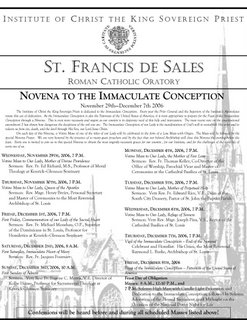
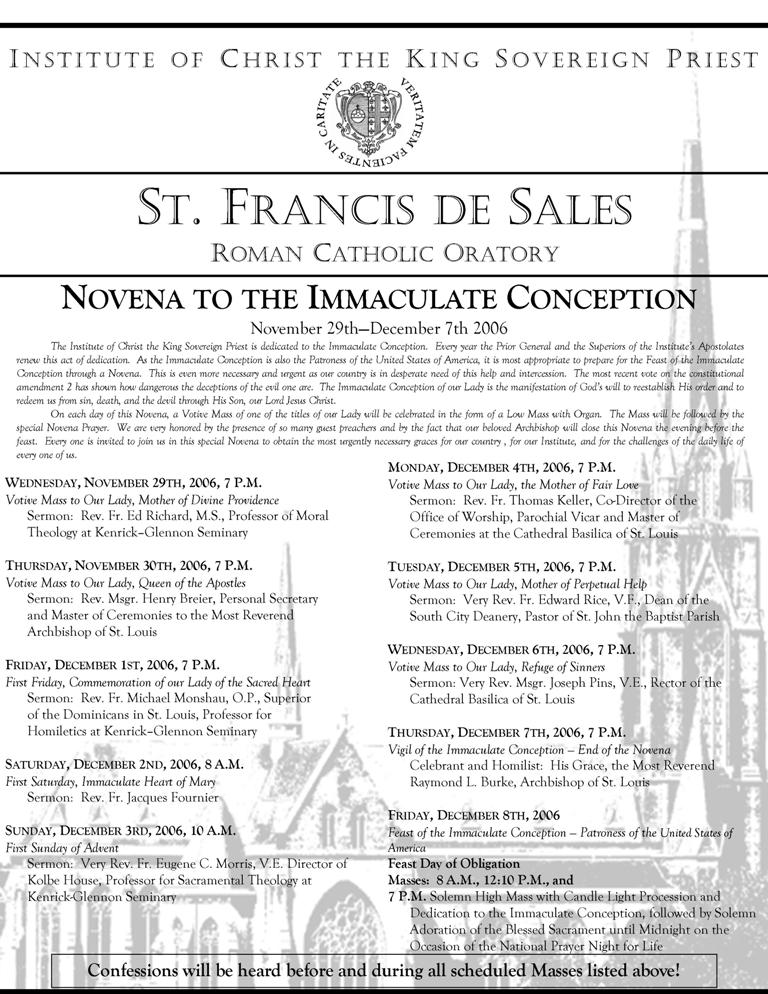
Novena to the Immaculate Conception, beginning Nov 29.
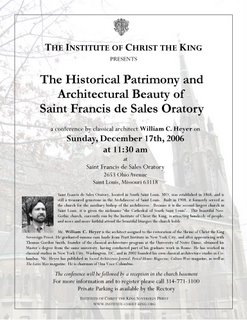
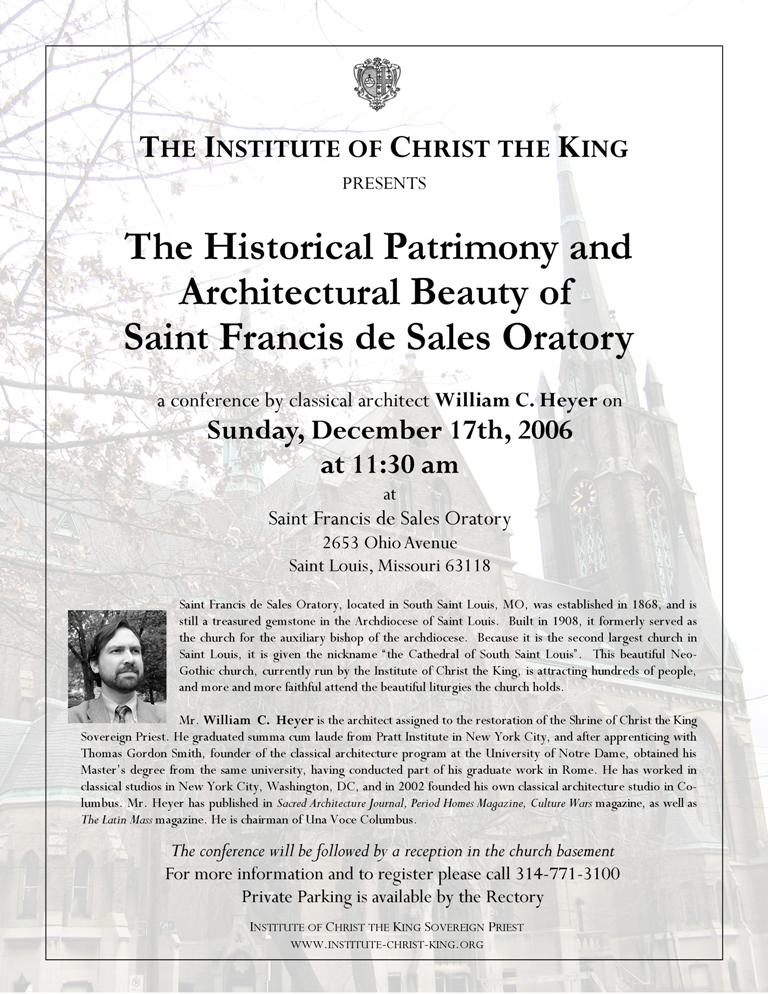
Conference on the Architecture of St Francis de Sales, Dec 17
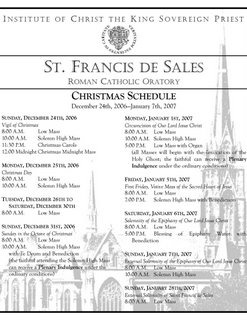
Christmas Schedule
Conference on the Architecture of St Francis de Sales, Dec 17
Christmas Schedule

Mental Prayer for November 28, The Act of Contrition (II)
Mental Prayer Meditation Helps
Presence of God
Grace I Ask: My Savior, grant that I may see more clearly what it means to offend you.
O my God, I am heartily sorry for having offended Thee. I detest all my sins because of Thy just punishments.
But most of all... even if there were no hell... and I was sure of going to heaven... yet I would hate... and detest... all my sins.
Because I have offended Thee... I, a puny creature... dares to offend... to slap the face... of my Creator... my Savior... Infinite Holiness... thinking I know what is best for me... better than He... who is Infinite Wisdom.
Who art all-good... an ocean of goodness without a shore... greater than the skies... deeper than the universe... so that every bit of goodness around us... is a mere reflection of your infinite goodness... and all for me!
And deserving of all my love... all my thanks... my prayers... my best efforts at keeping the commandments... loving God... in myself... in my friends... in my parents... in all my neighbors... because you are Love Itself... and all your creatures are manifestations of that Love.
I firmly resolve... quietly... deep down... peacefully... solidly and sincerely.
With the help of Thy grace... for without that grace I am helpless in turning to you... but with it... no matter how great the temptation... I can win... and God's grace... enough to help me conquer... will always be with me... if I cooperate... do my part.
To sin no more... the rest of my life... this year... this week... this day... without any sin.
To avoid the near occasions of sin... companions... places... things... whatever causes me to sin.
Thought for Today: Next time I say the Act of Contrition, I'll say it slowly, meaning each word.
__________________
Adapted from Mental Prayer, Challenge to the Lay Apostle
by The Queen's Work,(© 1958)
Presence of God
Grace I Ask: My Savior, grant that I may see more clearly what it means to offend you.
O my God, I am heartily sorry for having offended Thee. I detest all my sins because of Thy just punishments.
But most of all... even if there were no hell... and I was sure of going to heaven... yet I would hate... and detest... all my sins.
Because I have offended Thee... I, a puny creature... dares to offend... to slap the face... of my Creator... my Savior... Infinite Holiness... thinking I know what is best for me... better than He... who is Infinite Wisdom.
Who art all-good... an ocean of goodness without a shore... greater than the skies... deeper than the universe... so that every bit of goodness around us... is a mere reflection of your infinite goodness... and all for me!
And deserving of all my love... all my thanks... my prayers... my best efforts at keeping the commandments... loving God... in myself... in my friends... in my parents... in all my neighbors... because you are Love Itself... and all your creatures are manifestations of that Love.
I firmly resolve... quietly... deep down... peacefully... solidly and sincerely.
With the help of Thy grace... for without that grace I am helpless in turning to you... but with it... no matter how great the temptation... I can win... and God's grace... enough to help me conquer... will always be with me... if I cooperate... do my part.
To sin no more... the rest of my life... this year... this week... this day... without any sin.
To avoid the near occasions of sin... companions... places... things... whatever causes me to sin.
Thought for Today: Next time I say the Act of Contrition, I'll say it slowly, meaning each word.
__________________
Adapted from Mental Prayer, Challenge to the Lay Apostle
by The Queen's Work,(© 1958)
Dec 9 - Catholic Lecture Series with Fr Eugene Morris, Dr Kenneth Howell
(The Catolic Lecture Series is the 2nd Saturday of each month)
Date: Saturday, December 9, 2006
Time: 8:30 a.m.-12:30 p.m.
Holy Mass - 11 :30 a.m.
Where: Old St. Ferdinand Shrine
1 Rue Saint Francois
Florissant, Missouri 63031
Rev. C. Eugene Morris is the Director of Worship for Kemick-Glennon Seminary and Assistant Professor of Sacramental Theology. Fr. Morris received BA degrees from St. Louis University, Masters of Divinity and Masters of Arts in Church History from Kenrick and a Licentiate in Sacred Theology from the Pontifical Athenaeum of St. Anselm in Rome. In addition to teaching for Kenrick-Glennon Seminary and the Paul VI Institute, Fr. Morris is the Director of Liturgical Formation for the Permanent Diaconate. Fr Morris is currently working on his doctorate at the International Marian Research Institute, University of Dayton. In addition to these duties, Fr. Morris has a radio show on WRYT Catholic Radio on Sacraments, Sacramentals, and the Sacramental Life of the Church and he works with the Marian Catechists of the Archdiocese of Saint Louis.
Dr. Kenneth Howell is Director and Fellow at The John Henry Newman Institute of Catholic Thought and Adjunct Associate Professor in the Program for the Study of Religion at the University of illinois at Urbana-Champaign, where he teaches classes on the history, theology and philosophy of Catholicism. A former Presbyterian minister, he holds a Master of Divinity degree from Westminster Theological Seminary in Philadelphia and doctorates from Indiana University and Lancaster University, United Kingdom. While a seminary professor, Dr. Howell's own teaching of Sacred Scripture and the Church Fathers led him to the Catholic belief in the reality of Christ's Body in the Eucharist. He entered the Catholic Church in June of 1996.
Questions call Lu @ 714-473-7980
Date: Saturday, December 9, 2006
Time: 8:30 a.m.-12:30 p.m.
Holy Mass - 11 :30 a.m.
Where: Old St. Ferdinand Shrine
1 Rue Saint Francois
Florissant, Missouri 63031
Rev. C. Eugene Morris is the Director of Worship for Kemick-Glennon Seminary and Assistant Professor of Sacramental Theology. Fr. Morris received BA degrees from St. Louis University, Masters of Divinity and Masters of Arts in Church History from Kenrick and a Licentiate in Sacred Theology from the Pontifical Athenaeum of St. Anselm in Rome. In addition to teaching for Kenrick-Glennon Seminary and the Paul VI Institute, Fr. Morris is the Director of Liturgical Formation for the Permanent Diaconate. Fr Morris is currently working on his doctorate at the International Marian Research Institute, University of Dayton. In addition to these duties, Fr. Morris has a radio show on WRYT Catholic Radio on Sacraments, Sacramentals, and the Sacramental Life of the Church and he works with the Marian Catechists of the Archdiocese of Saint Louis.
Dr. Kenneth Howell is Director and Fellow at The John Henry Newman Institute of Catholic Thought and Adjunct Associate Professor in the Program for the Study of Religion at the University of illinois at Urbana-Champaign, where he teaches classes on the history, theology and philosophy of Catholicism. A former Presbyterian minister, he holds a Master of Divinity degree from Westminster Theological Seminary in Philadelphia and doctorates from Indiana University and Lancaster University, United Kingdom. While a seminary professor, Dr. Howell's own teaching of Sacred Scripture and the Church Fathers led him to the Catholic belief in the reality of Christ's Body in the Eucharist. He entered the Catholic Church in June of 1996.
Questions call Lu @ 714-473-7980
Pope Benedict Asks for Prayers for Trip to Turkey
VATICAN CITY, NOV 26, 2006 (VIS) - After praying the Angelus with the thousands of pilgrims gathered in St. Peter's Square, the Pope recalled how tomorrow, Tuesday, he begins his apostolic trip to Turkey where, between November 28 and December 1, he will visit Ankara, Ephesus and Istanbul.
. . .
The Holy Father concluded his remarks by asking everyone to accompany him "with prayer, that this pilgrimage may bring the fruits that God desires."
Gospel for Monday, 34th Week in Ordinary Time
From: Luke 21:1-4
The Widow's Mite
[1] He (Jesus) looked up and saw the rich putting their gifts into the treasury; [2] and He saw a poor widow put in two copper coins. [3] And He said, "Truly I tell you, this poor widow has put in more than all of them; [4] for they all contributed out of their abundance, but she out of her poverty put in all the living she had."
____________________
Commentary:
1-4. Our Lord, surrounded by His disciples, watches people putting offerings into the treasury. This was a place in the women's courtyard, where there were various collection boxes for the offerings of the faithful. Just then, something happens whose significance Jesus wants His disciples to notice: a poor widow puts in two small coins, of very little value. He describes this as the greatest offering of all, praising the generosity of giving alms for this purpose, particularly that of those people who give part of what they need. Our Lord is moved by this tiny offering because in her case it implies a big sacrifice. "The Lord does not look", St. John Chrysostom comments, "at the amount offered but at the affection with which it is offered" ("Hom. on Heb", 1). Generosity is of the essence of almsgiving. This woman teaches us that we can move God's heart if we give Him all we can, which will always amount to very little even if we give our very lives. "How little a life is to offer to God!" ([St] J. Escriva, "The Way", 42).
___________________________
Source: "The Navarre Bible: Text and Commentaries". Biblical text taken from the Revised Standard Version and New Vulgate. Commentaries made by members of the Faculty of Theology of the University of Navarre, Spain. Published by Four Courts Press, Kill Lane, Blackrock, Co. Dublin, Ireland. Reprinted with permission from Four Courts Press and Scepter Publishers, the U.S. publisher.
The Widow's Mite
[1] He (Jesus) looked up and saw the rich putting their gifts into the treasury; [2] and He saw a poor widow put in two copper coins. [3] And He said, "Truly I tell you, this poor widow has put in more than all of them; [4] for they all contributed out of their abundance, but she out of her poverty put in all the living she had."
____________________
Commentary:
1-4. Our Lord, surrounded by His disciples, watches people putting offerings into the treasury. This was a place in the women's courtyard, where there were various collection boxes for the offerings of the faithful. Just then, something happens whose significance Jesus wants His disciples to notice: a poor widow puts in two small coins, of very little value. He describes this as the greatest offering of all, praising the generosity of giving alms for this purpose, particularly that of those people who give part of what they need. Our Lord is moved by this tiny offering because in her case it implies a big sacrifice. "The Lord does not look", St. John Chrysostom comments, "at the amount offered but at the affection with which it is offered" ("Hom. on Heb", 1). Generosity is of the essence of almsgiving. This woman teaches us that we can move God's heart if we give Him all we can, which will always amount to very little even if we give our very lives. "How little a life is to offer to God!" ([St] J. Escriva, "The Way", 42).
___________________________
Source: "The Navarre Bible: Text and Commentaries". Biblical text taken from the Revised Standard Version and New Vulgate. Commentaries made by members of the Faculty of Theology of the University of Navarre, Spain. Published by Four Courts Press, Kill Lane, Blackrock, Co. Dublin, Ireland. Reprinted with permission from Four Courts Press and Scepter Publishers, the U.S. publisher.
Sunday, November 26, 2006
Mental Prayer for November 27, The Act of Contrition
Mental Prayer Meditation Helps
Presence of God
Grace I Ask: My God, whom I have offended, give me the grace to understand the deep meaning of this prayer.
O my God... my Creator... my Father in heaven... who has given me all that I have... so forgiving... coming after me when I tried to forget you... looking for me... my Good Shepherd... my Savior... helping me to rise from sin... cleansing me.
I am heartily sorry... I have done wrong... acted like a fool... disobeyed you... I am sorry... seriously... quietly... even though I may not shed tears... real sorrow... not mere shame... deep down.
For having offended Thee... I'm so small... so insignificant... who knows me? Who is my Greatest Friend? Who is always with me?... to help?... to encourage? And I have gone against you... the all-powerful... without whom I cannot lift a finger... take a breath... even exist... cannot think... cannot talk without God's help... and I dared to offend you.
I detest all my sins... that I committed today... yesterday... last week... and all the sins of my past life... the big ones... the little ones... I hate them... I wish I had never committed them.
Because of Thy just punishments... for one mortal sin... I deserve hell... eternal fire... suffering without end... and the loss of heaven... never to see thee... for whom I was made. And for one venial sin... so many graces missed... punishment in purgatory... delay in seeing you in heaven.
But most of all because I have offended Thee, Who art all-good and deserving of all my love. I firmly resolve with the help of Thy grace to sin no more and to avoid the near occasions of sin.
Thought for Today: Say the Act of Contrition carefully several times today.
__________________
Adapted from Mental Prayer, Challenge to the Lay Apostle
by The Queen's Work,(© 1958)
Presence of God
Grace I Ask: My God, whom I have offended, give me the grace to understand the deep meaning of this prayer.
O my God... my Creator... my Father in heaven... who has given me all that I have... so forgiving... coming after me when I tried to forget you... looking for me... my Good Shepherd... my Savior... helping me to rise from sin... cleansing me.
I am heartily sorry... I have done wrong... acted like a fool... disobeyed you... I am sorry... seriously... quietly... even though I may not shed tears... real sorrow... not mere shame... deep down.
For having offended Thee... I'm so small... so insignificant... who knows me? Who is my Greatest Friend? Who is always with me?... to help?... to encourage? And I have gone against you... the all-powerful... without whom I cannot lift a finger... take a breath... even exist... cannot think... cannot talk without God's help... and I dared to offend you.
I detest all my sins... that I committed today... yesterday... last week... and all the sins of my past life... the big ones... the little ones... I hate them... I wish I had never committed them.
Because of Thy just punishments... for one mortal sin... I deserve hell... eternal fire... suffering without end... and the loss of heaven... never to see thee... for whom I was made. And for one venial sin... so many graces missed... punishment in purgatory... delay in seeing you in heaven.
But most of all because I have offended Thee, Who art all-good and deserving of all my love. I firmly resolve with the help of Thy grace to sin no more and to avoid the near occasions of sin.
Thought for Today: Say the Act of Contrition carefully several times today.
__________________
Adapted from Mental Prayer, Challenge to the Lay Apostle
by The Queen's Work,(© 1958)
Gospel for Sunday, Nov 26, Solemnity: Christ the King
(34th Sunday in Ordinary Time)
From: John 18:33b-37
The Trial Before Pilate: Jesus Is King
[33b] Pilate said to Him (Jesus), "Are You the King of the Jews?" [34] Jesus answered, "Do you say this of your own accord, or did others say it to you about Me?" [35] Pilate answered, "Am I a Jew? Your own nation and the chief priests have handed You over to me; what have You done?" [36] Jesus answered, "My kingship is not of this world; if My kingship were of this world, My servants would fight, that I might not be handed over to the Jews; but My kingship is not from the world." [37] Pilate said to Him, "So You are a king?" Jesus answered, "You say that I am a king. For this I was born, and for this I have come into the world, to bear witness to the truth. Everyone who is of the truth hears My voice."
_____________________
Commentary:
33-34. There is no onus on Pilate to interfere in religious questions, but because the accusation leveled against Jesus had to do with politics and public order, he begins his interrogation naturally by examining Him on the main charge: "Are You the King of the Jews?"
By replying with another question, Jesus is not refusing to answer: He wishes to make quite clear, as He has always done, that His mission is a spiritual one. And really Pilate's was not an easy question to answer, because, to a Gentile, a king of the Jews meant simply a subverter of the Empire; whereas, to a Jewish nationalist, the King-Messiah was a politico-religious liberator who would obtain their freedom from Rome. The true character of Christ's messiahship completely transcends both these concepts--as Jesus explains to the procurator, although He realizes how enormously difficult it is for Pilate to understand what Christ's Kingship really involves.
35-36. After the miracle of the multiplication of the loaves and the fish, Jesus refused to be proclaimed king because the people were thinking in terms of an earthly kingdom (cf. John 6:15). However, Jesus did enter Jerusalem in triumph, and He did accept acclamation as King-Messiah. Now, in His passion, He acknowledges before Pilate that He is truly a King, making it clear that His kingship is not an earthly one. Thus, "those who expected the Messiah to have visible temporal power were mistaken. `The kingdom of God does not mean food and drink but righteousness and peace and joy in the Holy Spirit' (Romans 14:7). Truth and justice, peace and joy in the Holy Spirit. That is the kingdom of Christ: the divine activity which saves man and which will reach its culmination when history ends and the Lord comes from the heights of Paradise finally to judge men" ([St] J. Escriva, "Christ Is Passing By", 180).
37. This is what His kingship really is: His kingdom is "the kingdom of Truth and Life, the kingdom of Holiness and Grace, the kingdom of Justice, Love and Peace" (Preface of the Mass of Christ the King). Christ reigns over those who accept and practise the truth revealed by Him--His Father's love for the world (John 3:16; 1 John 4:9). He became man to make this truth known and to enable men to accept it. And so, those who recognize Christ's kingship and sovereignty accept His authority, and He thus reigns over them in an eternal and universal kingdom.
For its part, "the Church, looking to Christ who bears witness to the truth, must always and everywhere ask herself, and in a certain sense also the contemporary `world', how to make good emerge from man, how to liberate the dynamism of the good that is in man, in order that it may be stronger than evil, than any moral, social or other evil" (John Paul II, "General Audience", 21 February 1979).
"If we (Christians) are trying to have Christ as our king we must be consistent. We must start by giving Him our heart. Not to do that and still talk about the kingdom of Christ would be completely hollow. There would be no real Christian substance in our behavior. We would be making an outward show of a faith which simply did not exist. We would be misusing God's name to human advantage. [...]. If we let Christ reign in our soul, we will not become authoritarian. Rather we will serve everyone. How I like that word: service! To serve my king, and through Him, all those who have been redeemed by His blood. I really wish we Christians knew how to serve, for only by serving can we know and love Christ and make Him known and loved" ([St] J. Escriva, "Christ Is Passing By", 181-182.
By His death and resurrection, Jesus shows that the accusations laid against Him were based on lies: it was He who was telling the truth, not His judges and accusers, and God confirms the truth of Jesus -- the truth of His words, of His deeds, of His revelation-- by the singular miracle of His resurrection. To men Christ's kingship may seem paradoxical: He dies, yet He lives for ever; He is defeated and is crucified, yet He is victorious. "When Jesus Christ Himself appeared as a prisoner before Pilate's tribunal and was interrogated by him.. did He not answer: `For this I was born, and for this I have come into the world, to bear witness to the truth'? It was as if with these words [...] He was once more confirming what He has said earlier: `You will know the truth and the truth will make you free'. In the course of so many centuries, of so many generations, from the time of the Apostles on, is it not often Jesus Christ Himself that has made an appearance at the side of people judged for the sake of the truth? And has He not gone to death with people condemned for the sake of the truth? Does He ever cease to be the continuous spokesman and advocate for the person who lives `in spirit and truth'? (cf. John 4:23). Just as He does not cease to be it before the Father, He is it also with regard to the history of man" (John Paul II, "Redemptor Hominis", 12).
___________________________
Source: "The Navarre Bible: Text and Commentaries". Biblical text taken from the Revised Standard Version and New Vulgate. Commentaries made by members of the Faculty of Theology of the University of Navarre, Spain. Published by Four Courts Press, Kill Lane, Blackrock, Co. Dublin, Ireland. Reprinted with permission from Four Courts Press and Scepter Publishers, the U.S. publisher.
From: John 18:33b-37
The Trial Before Pilate: Jesus Is King
[33b] Pilate said to Him (Jesus), "Are You the King of the Jews?" [34] Jesus answered, "Do you say this of your own accord, or did others say it to you about Me?" [35] Pilate answered, "Am I a Jew? Your own nation and the chief priests have handed You over to me; what have You done?" [36] Jesus answered, "My kingship is not of this world; if My kingship were of this world, My servants would fight, that I might not be handed over to the Jews; but My kingship is not from the world." [37] Pilate said to Him, "So You are a king?" Jesus answered, "You say that I am a king. For this I was born, and for this I have come into the world, to bear witness to the truth. Everyone who is of the truth hears My voice."
_____________________
Commentary:
33-34. There is no onus on Pilate to interfere in religious questions, but because the accusation leveled against Jesus had to do with politics and public order, he begins his interrogation naturally by examining Him on the main charge: "Are You the King of the Jews?"
By replying with another question, Jesus is not refusing to answer: He wishes to make quite clear, as He has always done, that His mission is a spiritual one. And really Pilate's was not an easy question to answer, because, to a Gentile, a king of the Jews meant simply a subverter of the Empire; whereas, to a Jewish nationalist, the King-Messiah was a politico-religious liberator who would obtain their freedom from Rome. The true character of Christ's messiahship completely transcends both these concepts--as Jesus explains to the procurator, although He realizes how enormously difficult it is for Pilate to understand what Christ's Kingship really involves.
35-36. After the miracle of the multiplication of the loaves and the fish, Jesus refused to be proclaimed king because the people were thinking in terms of an earthly kingdom (cf. John 6:15). However, Jesus did enter Jerusalem in triumph, and He did accept acclamation as King-Messiah. Now, in His passion, He acknowledges before Pilate that He is truly a King, making it clear that His kingship is not an earthly one. Thus, "those who expected the Messiah to have visible temporal power were mistaken. `The kingdom of God does not mean food and drink but righteousness and peace and joy in the Holy Spirit' (Romans 14:7). Truth and justice, peace and joy in the Holy Spirit. That is the kingdom of Christ: the divine activity which saves man and which will reach its culmination when history ends and the Lord comes from the heights of Paradise finally to judge men" ([St] J. Escriva, "Christ Is Passing By", 180).
37. This is what His kingship really is: His kingdom is "the kingdom of Truth and Life, the kingdom of Holiness and Grace, the kingdom of Justice, Love and Peace" (Preface of the Mass of Christ the King). Christ reigns over those who accept and practise the truth revealed by Him--His Father's love for the world (John 3:16; 1 John 4:9). He became man to make this truth known and to enable men to accept it. And so, those who recognize Christ's kingship and sovereignty accept His authority, and He thus reigns over them in an eternal and universal kingdom.
For its part, "the Church, looking to Christ who bears witness to the truth, must always and everywhere ask herself, and in a certain sense also the contemporary `world', how to make good emerge from man, how to liberate the dynamism of the good that is in man, in order that it may be stronger than evil, than any moral, social or other evil" (John Paul II, "General Audience", 21 February 1979).
"If we (Christians) are trying to have Christ as our king we must be consistent. We must start by giving Him our heart. Not to do that and still talk about the kingdom of Christ would be completely hollow. There would be no real Christian substance in our behavior. We would be making an outward show of a faith which simply did not exist. We would be misusing God's name to human advantage. [...]. If we let Christ reign in our soul, we will not become authoritarian. Rather we will serve everyone. How I like that word: service! To serve my king, and through Him, all those who have been redeemed by His blood. I really wish we Christians knew how to serve, for only by serving can we know and love Christ and make Him known and loved" ([St] J. Escriva, "Christ Is Passing By", 181-182.
By His death and resurrection, Jesus shows that the accusations laid against Him were based on lies: it was He who was telling the truth, not His judges and accusers, and God confirms the truth of Jesus -- the truth of His words, of His deeds, of His revelation-- by the singular miracle of His resurrection. To men Christ's kingship may seem paradoxical: He dies, yet He lives for ever; He is defeated and is crucified, yet He is victorious. "When Jesus Christ Himself appeared as a prisoner before Pilate's tribunal and was interrogated by him.. did He not answer: `For this I was born, and for this I have come into the world, to bear witness to the truth'? It was as if with these words [...] He was once more confirming what He has said earlier: `You will know the truth and the truth will make you free'. In the course of so many centuries, of so many generations, from the time of the Apostles on, is it not often Jesus Christ Himself that has made an appearance at the side of people judged for the sake of the truth? And has He not gone to death with people condemned for the sake of the truth? Does He ever cease to be the continuous spokesman and advocate for the person who lives `in spirit and truth'? (cf. John 4:23). Just as He does not cease to be it before the Father, He is it also with regard to the history of man" (John Paul II, "Redemptor Hominis", 12).
___________________________
Source: "The Navarre Bible: Text and Commentaries". Biblical text taken from the Revised Standard Version and New Vulgate. Commentaries made by members of the Faculty of Theology of the University of Navarre, Spain. Published by Four Courts Press, Kill Lane, Blackrock, Co. Dublin, Ireland. Reprinted with permission from Four Courts Press and Scepter Publishers, the U.S. publisher.
Saturday, November 25, 2006
Mental Prayer for November 26, The Purpose of Amendment
Mental Prayer Meditation Helps
Presence of God
Grace I Ask: Strengthen my will and inflame my heart, O Lord, that I may truly amend my life.
The Idea: The shock of the news shook the social world. The vivacious leader of the smart set, the star playwright, international correspondent, editor, congresswoman - Clare Boothe Luce - had become a Catholic! But why? "The real reason I became a Catholic was to rid myself of my burden of sins."
The firm conviction that his sins are forgiven is possibly the greatest consolation a Catholic has. The only danger lies in a complacency that overlooks the necessity of being firmly resolved to sin no more - to take appropriate steps to avoid possible future falls.
When God washes away our sins in confession, He takes us back into His full friendship. Our part is then to thank Him and tell Him we propose to avoid sinning in the future. Our intention to do better is a test of our sincerity in seeking God's friendship again.
My Personal Application: Do I always thank God after confession?... and faithfully say my penance? Do I ask His help during the coming week? In my firm resolve not to sin again, do I try to discover ways of avoiding the same faults? I won't succeed in keeping my promise unless I seek His help and cooperate with it.
I Speak to God: O Lord, I firmly resolve to avoid all sin in the future. I am sincere. Give me the grace to see what I must do to avoid occasions of sin and how to resist temptations. Help me - I do want to do better!
Thought for Today: I firmly resolve....
__________________
Adapted from Mental Prayer, Challenge to the Lay Apostle
by The Queen's Work,(© 1958)
Presence of God
Grace I Ask: Strengthen my will and inflame my heart, O Lord, that I may truly amend my life.
The Idea: The shock of the news shook the social world. The vivacious leader of the smart set, the star playwright, international correspondent, editor, congresswoman - Clare Boothe Luce - had become a Catholic! But why? "The real reason I became a Catholic was to rid myself of my burden of sins."
The firm conviction that his sins are forgiven is possibly the greatest consolation a Catholic has. The only danger lies in a complacency that overlooks the necessity of being firmly resolved to sin no more - to take appropriate steps to avoid possible future falls.
When God washes away our sins in confession, He takes us back into His full friendship. Our part is then to thank Him and tell Him we propose to avoid sinning in the future. Our intention to do better is a test of our sincerity in seeking God's friendship again.
My Personal Application: Do I always thank God after confession?... and faithfully say my penance? Do I ask His help during the coming week? In my firm resolve not to sin again, do I try to discover ways of avoiding the same faults? I won't succeed in keeping my promise unless I seek His help and cooperate with it.
I Speak to God: O Lord, I firmly resolve to avoid all sin in the future. I am sincere. Give me the grace to see what I must do to avoid occasions of sin and how to resist temptations. Help me - I do want to do better!
Thought for Today: I firmly resolve....
__________________
Adapted from Mental Prayer, Challenge to the Lay Apostle
by The Queen's Work,(© 1958)
Gospel for Saturday, 33rd Week in Ordinary Time
From: Luke 20:27-40
The Resurrection of the Dead
[27] There came to Him (Jesus) some Sadducees, those who say that there is no resurrection, [28] and they asked Him a question saying, "Teacher, Moses wrote for us that if a man's brother dies, having a wife but no children, the man must take the wife and raise up children for his brother. [29] Now there were seven brothers; the first took a wife, and died without children; [30] and the second [31] and the third took her, and likewise all seven left no children and died. [32] Afterward the woman also died. [33] In the resurrection, therefore, whose wife will the woman be? For the seven had her as wife."
[34] And Jesus said to them, "The sons of this age marry and are given in marriage; [35] but those who are accounted worthy to attain to that age and to the resurrection from the dead neither marry nor are given in marriage, [36] for they cannot die any more, because they are equal to angels and are sons of God, being sons of the resurrection. [37] But that the dead are raised, even Moses showed, in the passage about the bush, where he calls the Lord the God of Abraham and the God of Isaac and the God of Jacob. [38] Now He is not God of the dead, but of the living; for all live to Him." [39] And some of scribes answered, "Teacher, You have spoken well." [40] For they no longer dared to ask Him any question.
_____________________
Commentary:
27-40. The Sadducees did not believe in the resurrection of the body or the immortality of the soul. They came along to ask Jesus a question which is apparently unanswerable. According to the Levirate law (cf. Deuteronomy 25:5ff), if a man died without issue, his brother was duty bound to marry his widow to provide his brother with descendants. The consequences of this law would seem to give rise to a ridiculous situation at the resurrection of the dead.
Our Lord replies by reaffirming that there will be a resurrection; and by explaining the properties of those who have risen again, the Sadducees' argument simply evaporates. In this world people marry in order to continue the species: that is the primary aim of marriage. After the resurrection there will be no more marriage because people will not die anymore.
Quoting Sacred Scripture (Exodus 3:2, 6) our Lord shows the grave mistake the Sadducees make, and He argues: God is not the God of the dead but of the living, that is to say, there exists a permanent relationship between God and Abraham, Isaac and Jacob, who have been dead for years. Therefore, although these just men have died as far as their bodies are concerned, they are alive, truly alive, in God--their souls are immortal--and they are awaiting the resurrection of their bodies.
See also the notes on Matthew 22:23-33 and Mark 12:18-27.
[The note on Matthew 22:23-33 states:
23-33. The Sadducees argue against belief in the resurrection of the dead on the basis of the Levirate law, a Jewish law which laid down that when a married man died without issue, one of his brothers, according to a fixed order, should marry his widow and the first son of that union be given the dead man's name. By outlining an extreme cases the Sadducees make the law and belief in resurrection look ridiculous. In His reply, Jesus shows up the frivolity of their objections and asserts the truth of the resurrection of the dead.]
[The note on Mark 12:18-27 states:
18-27. Before answering the difficulty proposed by the Sadducees, Jesus wants to identify the source of the problem--man's tendency to confine the greatness of God inside a human framework through excessivereliance on reason, not giving due weight to divine Revelation and the power of God. A person can have difficulty with the truths of faith; this is not surprising, for these truths are above human reason. But it is ridiculous to try to find contradictions in the revealed word of God; this only leads away from any solution of difficulty and may make it impossible to find one's way back to God. We need to approach Sacred Scripture, and, in general, the things of God, with the humility which faith demands. In the passage about the burning bush, which Jesus quotes to the Sadducees, God says this to Moses: "Put off your shoes from your feet, for the place on which you stand is holy ground" (Exodus 3:5).]
___________________________
Source: "The Navarre Bible: Text and Commentaries". Biblical text taken from the Revised Standard Version and New Vulgate. Commentaries made by members of the Faculty of Theology of the University of Navarre, Spain. Published by Four Courts Press, Kill Lane, Blackrock, Co. Dublin, Ireland. Reprinted with permission from Four Courts Press and Scepter Publishers, the U.S. publisher.
The Resurrection of the Dead
[27] There came to Him (Jesus) some Sadducees, those who say that there is no resurrection, [28] and they asked Him a question saying, "Teacher, Moses wrote for us that if a man's brother dies, having a wife but no children, the man must take the wife and raise up children for his brother. [29] Now there were seven brothers; the first took a wife, and died without children; [30] and the second [31] and the third took her, and likewise all seven left no children and died. [32] Afterward the woman also died. [33] In the resurrection, therefore, whose wife will the woman be? For the seven had her as wife."
[34] And Jesus said to them, "The sons of this age marry and are given in marriage; [35] but those who are accounted worthy to attain to that age and to the resurrection from the dead neither marry nor are given in marriage, [36] for they cannot die any more, because they are equal to angels and are sons of God, being sons of the resurrection. [37] But that the dead are raised, even Moses showed, in the passage about the bush, where he calls the Lord the God of Abraham and the God of Isaac and the God of Jacob. [38] Now He is not God of the dead, but of the living; for all live to Him." [39] And some of scribes answered, "Teacher, You have spoken well." [40] For they no longer dared to ask Him any question.
_____________________
Commentary:
27-40. The Sadducees did not believe in the resurrection of the body or the immortality of the soul. They came along to ask Jesus a question which is apparently unanswerable. According to the Levirate law (cf. Deuteronomy 25:5ff), if a man died without issue, his brother was duty bound to marry his widow to provide his brother with descendants. The consequences of this law would seem to give rise to a ridiculous situation at the resurrection of the dead.
Our Lord replies by reaffirming that there will be a resurrection; and by explaining the properties of those who have risen again, the Sadducees' argument simply evaporates. In this world people marry in order to continue the species: that is the primary aim of marriage. After the resurrection there will be no more marriage because people will not die anymore.
Quoting Sacred Scripture (Exodus 3:2, 6) our Lord shows the grave mistake the Sadducees make, and He argues: God is not the God of the dead but of the living, that is to say, there exists a permanent relationship between God and Abraham, Isaac and Jacob, who have been dead for years. Therefore, although these just men have died as far as their bodies are concerned, they are alive, truly alive, in God--their souls are immortal--and they are awaiting the resurrection of their bodies.
See also the notes on Matthew 22:23-33 and Mark 12:18-27.
[The note on Matthew 22:23-33 states:
23-33. The Sadducees argue against belief in the resurrection of the dead on the basis of the Levirate law, a Jewish law which laid down that when a married man died without issue, one of his brothers, according to a fixed order, should marry his widow and the first son of that union be given the dead man's name. By outlining an extreme cases the Sadducees make the law and belief in resurrection look ridiculous. In His reply, Jesus shows up the frivolity of their objections and asserts the truth of the resurrection of the dead.]
[The note on Mark 12:18-27 states:
18-27. Before answering the difficulty proposed by the Sadducees, Jesus wants to identify the source of the problem--man's tendency to confine the greatness of God inside a human framework through excessivereliance on reason, not giving due weight to divine Revelation and the power of God. A person can have difficulty with the truths of faith; this is not surprising, for these truths are above human reason. But it is ridiculous to try to find contradictions in the revealed word of God; this only leads away from any solution of difficulty and may make it impossible to find one's way back to God. We need to approach Sacred Scripture, and, in general, the things of God, with the humility which faith demands. In the passage about the burning bush, which Jesus quotes to the Sadducees, God says this to Moses: "Put off your shoes from your feet, for the place on which you stand is holy ground" (Exodus 3:5).]
___________________________
Source: "The Navarre Bible: Text and Commentaries". Biblical text taken from the Revised Standard Version and New Vulgate. Commentaries made by members of the Faculty of Theology of the University of Navarre, Spain. Published by Four Courts Press, Kill Lane, Blackrock, Co. Dublin, Ireland. Reprinted with permission from Four Courts Press and Scepter Publishers, the U.S. publisher.
Friday, November 24, 2006
Mental Prayer for November 25, Perfect Contrition
Mental Prayer Meditation Helps
Presence of God
Grace I Ask: To be sorry for my sins because of love for you, O my God.
The Idea: One day the saintly and kind Cure of Ars refused a man absolution because he was obviously not sorry for his sins. The Cure's parting words were: "Repent or you are damned!" A few minutes later the sinner returned, begging for absolution. The Cure welcomed him and asked if the thought of hell brought him back. He answered: "Not that, Father, but the great God. I am sorry for sins because they have offended God."
This kind of sorrow comes from the love of God and is called perfect contrition. It is because of God's great love and mercy that we are sorry for our sins. When we have hurt our parents, we are sorry, not because of a punishment we fear, but because of the love we have for them who are so good. So with God, in perfect contrition we sorrow over our sins out of love. The love of God and not heaven or hell is the basis of perfect contrition.
My Particular Application: Perfect contrition for my sins calls for great love of Him against whom I have sinned. Can I not be deeply sorry when I look at the crucifix and see Him suffering there? Ask God for this perfect contrition. It is not necessarily a feeling. It is a realization of my having offended an all-good God. Out of love for Him can I ever sorrow enough for my sins?
I Speak to God: When I look at Christ on the cross, my God, I know the foulness of my sins. Can I ever love you as I should for what you have done and what you are? I am sorry because I have hurt you who are worthy of my love.
Thought for Today: My God, because you are all-good, all-love, I am sorry for having offended you.
__________________
Adapted from Mental Prayer, Challenge to the Lay Apostle
by The Queen's Work,(© 1958)
Presence of God
Grace I Ask: To be sorry for my sins because of love for you, O my God.
The Idea: One day the saintly and kind Cure of Ars refused a man absolution because he was obviously not sorry for his sins. The Cure's parting words were: "Repent or you are damned!" A few minutes later the sinner returned, begging for absolution. The Cure welcomed him and asked if the thought of hell brought him back. He answered: "Not that, Father, but the great God. I am sorry for sins because they have offended God."
This kind of sorrow comes from the love of God and is called perfect contrition. It is because of God's great love and mercy that we are sorry for our sins. When we have hurt our parents, we are sorry, not because of a punishment we fear, but because of the love we have for them who are so good. So with God, in perfect contrition we sorrow over our sins out of love. The love of God and not heaven or hell is the basis of perfect contrition.
My Particular Application: Perfect contrition for my sins calls for great love of Him against whom I have sinned. Can I not be deeply sorry when I look at the crucifix and see Him suffering there? Ask God for this perfect contrition. It is not necessarily a feeling. It is a realization of my having offended an all-good God. Out of love for Him can I ever sorrow enough for my sins?
I Speak to God: When I look at Christ on the cross, my God, I know the foulness of my sins. Can I ever love you as I should for what you have done and what you are? I am sorry because I have hurt you who are worthy of my love.
Thought for Today: My God, because you are all-good, all-love, I am sorry for having offended you.
__________________
Adapted from Mental Prayer, Challenge to the Lay Apostle
by The Queen's Work,(© 1958)
Gospel for Nov 24, Memorial, St Andrew Dung-Lac, priest and martyr, & his companions, martyrs
From: Luke 19:45-48
Jesus in the Temple
[45] And He (Jesus) entered the temple and began to drive out those who sold, [46] saying to them, "It is written, `My house shall be a house of prayer'; but you have made it a den of robbers."
[47] And He was teaching daily in the temple. The chief priests and the scribes and the principal men of the people sought to destroy Him; [48] but they did not find anything they could do, for all the people hung upon His words.
_________________________
Commentary:
45-48. Jesus' indignation shows His zeal for the glory of His Father, to be recognized at this time in the temple itself. He inveighs against the traders for engaging in business which has nothing to do with divine worship (cf. Matthew 21:12; Mark 11-15). Even the priests allowed some of these abuses to go on--perhaps because they benefited from them in the form of taxes. The traders did perform services necessary for divine worship but this was vitiated by their excessive desire for gain, turning the temple into a marketplace.
"My house shall be a house of prayer": Jesus uses these words from Isaiah (56:7; cf. Jeremiah 7:11) to underline the purpose of the temple. Jesus' behavior shows the respect the Temple of Jerusalem deserved; how much more reverence should be shown our churches, where Jesus Himself is really present in the Blessed Sacrament. (cf. notes on Matthew 21:12-13; and Mark 11:15-18).
[The notes on Matthew 21:12-13 states:
12-13. Although God is present everywhere and cannot be confined within the walls of temples built by man (Acts 17:24-25), God instructed Moses to build a tabernacle where He would dwell among the Israelites (Exodus 25:40). Once the Jewish people were established in Palestine, King Solomon, also in obedience to a divine instruction, built the temple of Jerusalem (1 Kings 6-8), where people went to render public worship to God (Deuteronomy 12).
Exodus (23:15) commanded the Israelites not to enter the temple empty-handed, but to bring some victim to be sacrificed. To make this easier for people who had to travel a certain distance, a veritable market developed in the temple courtyards with animals being bought and sold for sacrificial purposes. Originally this may have made sense, but seemingly as time went on commercial gain became the dominant purpose of this buying and selling of victims; probably the priests themselves and temple servants benefited from this trade or even operated it. The net result was that the temple looked more like a livestock mart than a place for meeting God.
Moved by zeal for His Father's house (John 2:17), Jesus cannot tolerate this deplorable abuse and in holy anger He ejects everyone--to show people the respect and reverence due to the temple as a holy place. We should show much greater respect in the Christian temple--the Christian churches--where the eucharistic sacrifice is celebrated and where Jesus Christ, God and Man, is really and truly present, reserved in the tabernacle. For a Christian, proper dress, liturgical gestures and postures, genuflections and reverence to the tabernacle, etc. are expressions of the respect due to the Lord in His temple.
[The notes on Mark 11:15-18 states:
15-18. Our Lord does not abide lack of faith or piety in things to do with the worship of God. If He acts so vigorously to defend the temple of the Old Law, it indicates how we should truly conduct ourselves in the Christian temple, where He is really and truly present in the Blessed Eucharist. "Piety has its own good manners. Learn them. It's a shame to see those `pious' people who don't know how to attend Mass--even though they go daily,--nor how to bless themselves (they throw their hands about in the weirdest fashion), nor how to bend the knee before the Tabernacle (their ridiculous genuflections seem a mockery), nor how to bow their heads reverently before a picture of our Lady" ([St] J. Escriva, "The Way", 541).]
___________________________
Source: "The Navarre Bible: Text and Commentaries". Biblical text taken from the Revised Standard Version and New Vulgate. Commentaries made by members of the Faculty of Theology of the University of Navarre, Spain. Published by Four Courts Press, Kill Lane, Blackrock, Co. Dublin, Ireland. Reprinted with permission from Four Courts Press and Scepter Publishers, the U.S. publisher.
Jesus in the Temple
[45] And He (Jesus) entered the temple and began to drive out those who sold, [46] saying to them, "It is written, `My house shall be a house of prayer'; but you have made it a den of robbers."
[47] And He was teaching daily in the temple. The chief priests and the scribes and the principal men of the people sought to destroy Him; [48] but they did not find anything they could do, for all the people hung upon His words.
_________________________
Commentary:
45-48. Jesus' indignation shows His zeal for the glory of His Father, to be recognized at this time in the temple itself. He inveighs against the traders for engaging in business which has nothing to do with divine worship (cf. Matthew 21:12; Mark 11-15). Even the priests allowed some of these abuses to go on--perhaps because they benefited from them in the form of taxes. The traders did perform services necessary for divine worship but this was vitiated by their excessive desire for gain, turning the temple into a marketplace.
"My house shall be a house of prayer": Jesus uses these words from Isaiah (56:7; cf. Jeremiah 7:11) to underline the purpose of the temple. Jesus' behavior shows the respect the Temple of Jerusalem deserved; how much more reverence should be shown our churches, where Jesus Himself is really present in the Blessed Sacrament. (cf. notes on Matthew 21:12-13; and Mark 11:15-18).
[The notes on Matthew 21:12-13 states:
12-13. Although God is present everywhere and cannot be confined within the walls of temples built by man (Acts 17:24-25), God instructed Moses to build a tabernacle where He would dwell among the Israelites (Exodus 25:40). Once the Jewish people were established in Palestine, King Solomon, also in obedience to a divine instruction, built the temple of Jerusalem (1 Kings 6-8), where people went to render public worship to God (Deuteronomy 12).
Exodus (23:15) commanded the Israelites not to enter the temple empty-handed, but to bring some victim to be sacrificed. To make this easier for people who had to travel a certain distance, a veritable market developed in the temple courtyards with animals being bought and sold for sacrificial purposes. Originally this may have made sense, but seemingly as time went on commercial gain became the dominant purpose of this buying and selling of victims; probably the priests themselves and temple servants benefited from this trade or even operated it. The net result was that the temple looked more like a livestock mart than a place for meeting God.
Moved by zeal for His Father's house (John 2:17), Jesus cannot tolerate this deplorable abuse and in holy anger He ejects everyone--to show people the respect and reverence due to the temple as a holy place. We should show much greater respect in the Christian temple--the Christian churches--where the eucharistic sacrifice is celebrated and where Jesus Christ, God and Man, is really and truly present, reserved in the tabernacle. For a Christian, proper dress, liturgical gestures and postures, genuflections and reverence to the tabernacle, etc. are expressions of the respect due to the Lord in His temple.
[The notes on Mark 11:15-18 states:
15-18. Our Lord does not abide lack of faith or piety in things to do with the worship of God. If He acts so vigorously to defend the temple of the Old Law, it indicates how we should truly conduct ourselves in the Christian temple, where He is really and truly present in the Blessed Eucharist. "Piety has its own good manners. Learn them. It's a shame to see those `pious' people who don't know how to attend Mass--even though they go daily,--nor how to bless themselves (they throw their hands about in the weirdest fashion), nor how to bend the knee before the Tabernacle (their ridiculous genuflections seem a mockery), nor how to bow their heads reverently before a picture of our Lady" ([St] J. Escriva, "The Way", 541).]
___________________________
Source: "The Navarre Bible: Text and Commentaries". Biblical text taken from the Revised Standard Version and New Vulgate. Commentaries made by members of the Faculty of Theology of the University of Navarre, Spain. Published by Four Courts Press, Kill Lane, Blackrock, Co. Dublin, Ireland. Reprinted with permission from Four Courts Press and Scepter Publishers, the U.S. publisher.
Thursday, November 23, 2006
Mental Prayer for November 24, Why I Am Sorry
Mental Prayer Meditation Helps
Presence of God
Grace I Ask: To understand and have true sorrow for sin.
The Idea: In a past survey students were asked what would stop them from crime. The first answer: the disgrace to their family! Isn't something wrong here? What about God? Are crimes not sins - offenses against God?
I can never leave God out of the picture. When I go to confession, I at least have to be sorry because I stained my soul, failed in my promises to God, threw away heaven and merited hell. This is imperfect contrition. Enough for forgiveness, but... As a Christian aiming at perfection (real love and imitation of Christ), don't I want something better? Shouldn't my aim be perfect contrition? This means being sorry for my sins because they offend my all-holy, all-loving, all-merciful God.
The easiest way to reach perfect contrition is to look long and prayerfully at the crucifix. God did this for me! He loved me this much! "No greater love hath any man than to lay down his life for his friend." How good God must be in Himself! Indeed God is Love (Deus carita est)! Then I think how terrible it is that I should offend Him.
Perfect contrition is not a matter of feeling bad. There need be nothing at all emotional about it. The important thing is : do I realize that I have offended my all-loving God? Do I see how wrong this is, so that I can truly say, "This is why I am sorry"?
I Speak to God: Help me so to grow in knowledge and love of you that I will see sin for what it really is - and thus come to a deep, true sorrow for having offended you - you, who are so good, so kind and merciful and holy.
Thought for Today: I'll study sin - at the crucifix!
__________________
Adapted from Mental Prayer, Challenge to the Lay Apostle
by The Queen's Work,(© 1958)
Presence of God
Grace I Ask: To understand and have true sorrow for sin.
The Idea: In a past survey students were asked what would stop them from crime. The first answer: the disgrace to their family! Isn't something wrong here? What about God? Are crimes not sins - offenses against God?
I can never leave God out of the picture. When I go to confession, I at least have to be sorry because I stained my soul, failed in my promises to God, threw away heaven and merited hell. This is imperfect contrition. Enough for forgiveness, but... As a Christian aiming at perfection (real love and imitation of Christ), don't I want something better? Shouldn't my aim be perfect contrition? This means being sorry for my sins because they offend my all-holy, all-loving, all-merciful God.
The easiest way to reach perfect contrition is to look long and prayerfully at the crucifix. God did this for me! He loved me this much! "No greater love hath any man than to lay down his life for his friend." How good God must be in Himself! Indeed God is Love (Deus carita est)! Then I think how terrible it is that I should offend Him.
Perfect contrition is not a matter of feeling bad. There need be nothing at all emotional about it. The important thing is : do I realize that I have offended my all-loving God? Do I see how wrong this is, so that I can truly say, "This is why I am sorry"?
I Speak to God: Help me so to grow in knowledge and love of you that I will see sin for what it really is - and thus come to a deep, true sorrow for having offended you - you, who are so good, so kind and merciful and holy.
Thought for Today: I'll study sin - at the crucifix!
__________________
Adapted from Mental Prayer, Challenge to the Lay Apostle
by The Queen's Work,(© 1958)
Gospel for Thursday, Nov 23, Thanksgiving Day
Gospel for Thursday, 33rd Week in Ordinary Time, follows below (After Luke 17:11-19).
From: Luke 17:11-19
The Ten Lepers
[11] On the way to Jerusalem He (Jesus) was passing along between Samaria and Galilee. [12] And as He entered the village, He was met by ten lepers, who stood at a distance [13] and lifted up their voices and said, "Jesus, Master, have mercy on us." [14] When He saw them He said to them, "Go and show yourselves to the priests." And as they went they were cleansed. [15] Then one of them, when he saw that he was healed, turned back, praising God with a loud voice; [16] and he fell on his face at Jesus' feet, giving Him thanks. Now he was a Samaritan. [17] Then said Jesus, "Were not ten cleansed? Where are the nine? [18] Was no one found to return and give praise to God except this foreigner?" [19] And He said to him, "Rise and go your way; your faith has made you well."
________________________
Commentary:
11-19. The setting of this episode explains how a Samaritan could be in the company of Jews. There was no love lost between Jews and Samaritans (cf. John 4:9), but shared pain, in the case of these lepers, overcame racial antipathy.
The Law of Moses laid down, to prevent the spread of the disease, that lepers should live away from other people and should let it be known that they were suffering from this disease (cf. Leviticus 13:45-46). This explains why they did not come right up to Jesus and His group, but instead begged His help by shouting from a distance. Before curing them our Lord orders them to go to the priests to have their cure certified (cf. Leviticus 14:2ff), and to perform the rites laid down. The lepers' obedience is a sign of faith in Jesus' words. And, in fact, soon after setting out they are cleansed.
However, only one of them, the Samaritan, who returns praising God and showing his gratitude for the miracle, is given a much greater gift than the cure of leprosy. Jesus says as much: "Your faith has made you well" (verse 19) and praises the man's gratefulness. The Gospel records this event to teach us the value of gratefulness: "Get used to lifting your heart to God, in acts of thanksgiving, many times a day. Because He gives you this and that. Because you have been despised.
Because you haven't what you need or because you have.
"Because He made His Mother so beautiful, His Mother who is also your Mother. Because He created the sun and the moon and this animal and that plant. Because He made that man eloquent and you He left tongue-tied....
"Thank Him for everything, because everything is good" ([St] J. Escriva, "The Way", 268).
================================
Gospel for Thursday, 33rd Week in Ordinary Time
From: Luke 19:41-44
Jesus Weeps Over Jerusalem
[41] And when He (Jesus) drew near and saw the city He wept over it, [42] saying, "Would that even today you knew the things that make for peace! But now they are hid from your eyes. [43] For the days shall come upon you, when your enemies will cast a bank about you and surround you, and hem you in on every side, [44] and dash you to the ground, you and your children within you, and they will not leave one stone upon another in you; because you did not know the time of your visitation."
_____________________
Commentary:
41-44. When the procession reaches a place where there is a good view of the city, they are disconcerted by Jesus' unexpected weeping. Our Lord explains why He is weeping, by prophesying the destruction of the city which He loved so much: not one stone will remain on another, and its inhabitants will be massacred--a prophecy which was fulfilled in the year 70, when Titus razed the city and the temple was destroyed. These historical events will be a punishment for Jerusalem failing to recognize the time of its visitation, that is, for closing its gates to the salvific coming of the Redeemer. Jesus loved the Jews with a very special love: they were the first to whom the Gospel was preached (cf. Matthew 10:5-6); to them He directed His ministry (cf. Matthew 15:24); He showed His word and by His miracles that He was the Son of God and the Messiah foretold in the Scriptures. But the Jews for the most part failed to appreciate the grace the Lord was offering them; their leaders led them to the extreme of calling for Jesus to be crucified.
Jesus visits every one of us; He comes as our Savior; He teaches us through the preaching of the Church; He gives us forgiveness and grace through the sacraments. We should not reject our Lord, we should not remain indifferent to His visit.
___________________________
Source: "The Navarre Bible: Text and Commentaries". Biblical text taken from the Revised Standard Version and New Vulgate. Commentaries made by members of the Faculty of Theology of the University of Navarre, Spain. Published by Four Courts Press, Kill Lane, Blackrock, Co. Dublin, Ireland. Reprinted with permission from Four Courts Press and Scepter Publishers, the U.S. publisher.
From: Luke 17:11-19
The Ten Lepers
[11] On the way to Jerusalem He (Jesus) was passing along between Samaria and Galilee. [12] And as He entered the village, He was met by ten lepers, who stood at a distance [13] and lifted up their voices and said, "Jesus, Master, have mercy on us." [14] When He saw them He said to them, "Go and show yourselves to the priests." And as they went they were cleansed. [15] Then one of them, when he saw that he was healed, turned back, praising God with a loud voice; [16] and he fell on his face at Jesus' feet, giving Him thanks. Now he was a Samaritan. [17] Then said Jesus, "Were not ten cleansed? Where are the nine? [18] Was no one found to return and give praise to God except this foreigner?" [19] And He said to him, "Rise and go your way; your faith has made you well."
________________________
Commentary:
11-19. The setting of this episode explains how a Samaritan could be in the company of Jews. There was no love lost between Jews and Samaritans (cf. John 4:9), but shared pain, in the case of these lepers, overcame racial antipathy.
The Law of Moses laid down, to prevent the spread of the disease, that lepers should live away from other people and should let it be known that they were suffering from this disease (cf. Leviticus 13:45-46). This explains why they did not come right up to Jesus and His group, but instead begged His help by shouting from a distance. Before curing them our Lord orders them to go to the priests to have their cure certified (cf. Leviticus 14:2ff), and to perform the rites laid down. The lepers' obedience is a sign of faith in Jesus' words. And, in fact, soon after setting out they are cleansed.
However, only one of them, the Samaritan, who returns praising God and showing his gratitude for the miracle, is given a much greater gift than the cure of leprosy. Jesus says as much: "Your faith has made you well" (verse 19) and praises the man's gratefulness. The Gospel records this event to teach us the value of gratefulness: "Get used to lifting your heart to God, in acts of thanksgiving, many times a day. Because He gives you this and that. Because you have been despised.
Because you haven't what you need or because you have.
"Because He made His Mother so beautiful, His Mother who is also your Mother. Because He created the sun and the moon and this animal and that plant. Because He made that man eloquent and you He left tongue-tied....
"Thank Him for everything, because everything is good" ([St] J. Escriva, "The Way", 268).
================================
Gospel for Thursday, 33rd Week in Ordinary Time
From: Luke 19:41-44
Jesus Weeps Over Jerusalem
[41] And when He (Jesus) drew near and saw the city He wept over it, [42] saying, "Would that even today you knew the things that make for peace! But now they are hid from your eyes. [43] For the days shall come upon you, when your enemies will cast a bank about you and surround you, and hem you in on every side, [44] and dash you to the ground, you and your children within you, and they will not leave one stone upon another in you; because you did not know the time of your visitation."
_____________________
Commentary:
41-44. When the procession reaches a place where there is a good view of the city, they are disconcerted by Jesus' unexpected weeping. Our Lord explains why He is weeping, by prophesying the destruction of the city which He loved so much: not one stone will remain on another, and its inhabitants will be massacred--a prophecy which was fulfilled in the year 70, when Titus razed the city and the temple was destroyed. These historical events will be a punishment for Jerusalem failing to recognize the time of its visitation, that is, for closing its gates to the salvific coming of the Redeemer. Jesus loved the Jews with a very special love: they were the first to whom the Gospel was preached (cf. Matthew 10:5-6); to them He directed His ministry (cf. Matthew 15:24); He showed His word and by His miracles that He was the Son of God and the Messiah foretold in the Scriptures. But the Jews for the most part failed to appreciate the grace the Lord was offering them; their leaders led them to the extreme of calling for Jesus to be crucified.
Jesus visits every one of us; He comes as our Savior; He teaches us through the preaching of the Church; He gives us forgiveness and grace through the sacraments. We should not reject our Lord, we should not remain indifferent to His visit.
___________________________
Source: "The Navarre Bible: Text and Commentaries". Biblical text taken from the Revised Standard Version and New Vulgate. Commentaries made by members of the Faculty of Theology of the University of Navarre, Spain. Published by Four Courts Press, Kill Lane, Blackrock, Co. Dublin, Ireland. Reprinted with permission from Four Courts Press and Scepter Publishers, the U.S. publisher.
Wednesday, November 22, 2006
Mental Prayer for November 23, A Daily Examination of Conscience
Mental Prayer Meditation Helps
Presence of God
Grace I Ask: Help me, O Lord, to practice the daily examination of conscience faithfully.
The Idea: A wealthy businessman felt he had been neglecting his employees but saw no way of improving conditions. A priest advised him to ride the trains to work instead of driving his car. In the morning he could plan the affairs of the day; riding home in the evening, he could examine the failures and successes of that day. The results did wonders for his workers and for his own soul.
I should make for myself a similar rule and make every effort to follow this sound advice for my soul. This daily rule tells me to examine my conscience each evening so that I can see where I failed that day. Going over the various duties of the day, I check on my performances and resolve to avoid some particular fault or practice some virtue the next day. This practice, with the act of contrition afterwards, helps me go forward in the service of God and makes confession easy.
My Personal Application: Have I taken this rule seriously enough? Do I realize that the daily examination of conscience is one of the most important 'rules' of my day? Do I follow it? Do I recall the duties of the day to see where I could do better? Am I truly sorry for my failures?' Am I really honest with myself?
I Speak to God: What a help, O Lord, I have in this rule of daily examination of conscience. I thank you for this blessing. Help me to practice it more faithfully than I have been doing, that I may know myself better, and so love and serve you better.
Thought for Today: The better I know myself, the better I'll know God.
__________________
Adapted from Mental Prayer, Challenge to the Lay Apostle
by The Queen's Work,(© 1958)
Presence of God
Grace I Ask: Help me, O Lord, to practice the daily examination of conscience faithfully.
The Idea: A wealthy businessman felt he had been neglecting his employees but saw no way of improving conditions. A priest advised him to ride the trains to work instead of driving his car. In the morning he could plan the affairs of the day; riding home in the evening, he could examine the failures and successes of that day. The results did wonders for his workers and for his own soul.
I should make for myself a similar rule and make every effort to follow this sound advice for my soul. This daily rule tells me to examine my conscience each evening so that I can see where I failed that day. Going over the various duties of the day, I check on my performances and resolve to avoid some particular fault or practice some virtue the next day. This practice, with the act of contrition afterwards, helps me go forward in the service of God and makes confession easy.
My Personal Application: Have I taken this rule seriously enough? Do I realize that the daily examination of conscience is one of the most important 'rules' of my day? Do I follow it? Do I recall the duties of the day to see where I could do better? Am I truly sorry for my failures?' Am I really honest with myself?
I Speak to God: What a help, O Lord, I have in this rule of daily examination of conscience. I thank you for this blessing. Help me to practice it more faithfully than I have been doing, that I may know myself better, and so love and serve you better.
Thought for Today: The better I know myself, the better I'll know God.
__________________
Adapted from Mental Prayer, Challenge to the Lay Apostle
by The Queen's Work,(© 1958)
Preparing for Thanksgiving Day - Thank you, God!
"We give thanks to God." 1 Thessalonians, 1:2.
During the tense days of World War II many Hollywood stars, both men and women, gave generously of their time and talent to assist and to entertain our servicemen here and abroad. We know, for instance, that Elsa Lanchester, a British-born actress, frequently gave informal parties for servicemen in her Los Angeles apartment. As each of her guests was about to leave, she asked him to write his name and address in her Servicemen's Book, as she called it.
Toward the end of each party this charming lady of the screen would address her guests in a tone that showed unquestioning trust in God. She assured them: "I promise each one of you who will write his name in my book that I will pray constantly for your safe return. God will watch over you."
As the months rolled into years, a number of these soldiers, sailors, and marines returned. Many made it a point to stop and say sincerely, "Thank you, Miss Lanchester," before they took the train for home. After their departure the actress would take out her Servicemen's Book, find the names of the ones who had returned safely, and check each one by writing beneath the boy's name the words, "Thank you, God."
She wanted to thank God for each safe return. She did it thoroughly and efficiently. She wanted to be sure that thanksgiving was rendered in every case. She even wrote it down.
It would be a fine idea for everyone of us to have a book like that, a book in which we could write the countless blessings we have received, a book where we could write beside each blessing, "Thank You, God."
Such a procedure may seem prosaic and mechanical, yet it is much better than the opposite - never thanking God at all. If the plan would help us to be more grateful - let's try it. Try writing down the gifts God has bestowed on you today, yesterday, all this past year. And then say, "Thank You. God," or write it down beside each benefit for which you should be grateful. Let us make a start:
Every leaf and every star is a gift. Every kernel of corn and every shaft of wheat and every drop of rain and every blade of grass, is a gift. How can I ever thank You for it all?
Your gifts are without limit. My thankfulness must be without limit. How can I render infinite, limitless thanks?
Holy Mass is an infinite prayer and sacrifice of thanks, a limitless act of gratitude. I will offer Holy Mass; I will attend Holy Mass, especially on Thanksgiving Day. That is how I will say again and again: "Thank You, God, thank You." Amen.
__________________
Adapted from Occasional Talks
by Fr. Arthur Tonne, OFM (©1949)
During the tense days of World War II many Hollywood stars, both men and women, gave generously of their time and talent to assist and to entertain our servicemen here and abroad. We know, for instance, that Elsa Lanchester, a British-born actress, frequently gave informal parties for servicemen in her Los Angeles apartment. As each of her guests was about to leave, she asked him to write his name and address in her Servicemen's Book, as she called it.
Toward the end of each party this charming lady of the screen would address her guests in a tone that showed unquestioning trust in God. She assured them: "I promise each one of you who will write his name in my book that I will pray constantly for your safe return. God will watch over you."
As the months rolled into years, a number of these soldiers, sailors, and marines returned. Many made it a point to stop and say sincerely, "Thank you, Miss Lanchester," before they took the train for home. After their departure the actress would take out her Servicemen's Book, find the names of the ones who had returned safely, and check each one by writing beneath the boy's name the words, "Thank you, God."
She wanted to thank God for each safe return. She did it thoroughly and efficiently. She wanted to be sure that thanksgiving was rendered in every case. She even wrote it down.
It would be a fine idea for everyone of us to have a book like that, a book in which we could write the countless blessings we have received, a book where we could write beside each blessing, "Thank You, God."
Such a procedure may seem prosaic and mechanical, yet it is much better than the opposite - never thanking God at all. If the plan would help us to be more grateful - let's try it. Try writing down the gifts God has bestowed on you today, yesterday, all this past year. And then say, "Thank You. God," or write it down beside each benefit for which you should be grateful. Let us make a start:
Thank You, God, that I can see. There are thousands who cannot see. For them there is no sunrise or sunset; no autumn colors, no rainbow tinted flowers, no movies, no delights of the eye.No book or library of books is large enough to record Your blessings and Your gifts. Where can I find the pen or the power or the eloquence or the words or the endurance to thank You, God, for all Your gifts? They are without limit.
Thank You. God. that I can hear. There are thousands who cannot hear the voice of their own mother, nor the singing of the birds, nor the radio, nor the laughter of children.
Thank You. God, that I can walk. I know thousands who can't take a single step, thousands who are confined to a bed or wheel-chair, other thousands - men, both young and old, who lost their legs in war - who spend their years in helpless dependence on the wavering kindness of others.
Thank You. God, that I can work. Look at the many who can do nothing with brain or brawn or hands.
Thank You, God, that I have something to eat. Millions as good as I, maybe better, have little or nothing to eat. Thousands are dying of hunger while I sit down to a Thanksgiving feast...
Thank You, God, for my Catholic Faith, which teaches me to be thankful.
Thank You, God, for freedom to worship You as You wish to be worshipped. Thank You for our beautiful churches, our splendid schools, our comfortable Catholic homes.
Thank You, God, for the privilege of attending Holy Mass and receiving Holy Communion. Thank You for all the sacraments and for the life of grace in my soul.
Thank You, God, for the trees and thanks for the birds; thanks for a smoke and thanks for a drink; thanks for the open roads and thanks for our open churches where I can stop and visit You; thanks for that meal and thanks for that restful sleep; thanks for friends and thanks for the roof over my head; thanks for the chance to do Your work and thanks for Your generous rewards; thanks for the wine and thanks for the wheat and thanks for the Body and Blood of Your Son; thanks for the urge and chance to pray and, thanks for the pains You permit; thanks for the opportunity to learn all about You, from our Holy Father, our bishops and priests, from our faithful catechists, from our Catholic newspapers, magazines and books.
Every leaf and every star is a gift. Every kernel of corn and every shaft of wheat and every drop of rain and every blade of grass, is a gift. How can I ever thank You for it all?
Your gifts are without limit. My thankfulness must be without limit. How can I render infinite, limitless thanks?
Holy Mass is an infinite prayer and sacrifice of thanks, a limitless act of gratitude. I will offer Holy Mass; I will attend Holy Mass, especially on Thanksgiving Day. That is how I will say again and again: "Thank You, God, thank You." Amen.
__________________
Adapted from Occasional Talks
by Fr. Arthur Tonne, OFM (©1949)
Animals in the Womb...
The first remarkable close-up pictures of animals in the womb

Using an array of technology, the images reveal what until now has been a secret - exactly how animals develop in the womb. They were created by the same team who in 2004 showed how human embryos "walk in the womb".
_________________________
"Animals"? Some might be quick to point out that these animals are merely blobs of cells engaged in a violent attack against the 'potential mother'...
Most if us though, I'm certain, marvel at the gift of life and the ability of science to demonstrate for us the exquisite beauty of life, especially that human life created by God for His glory.
There are some nice pictures here.

Using an array of technology, the images reveal what until now has been a secret - exactly how animals develop in the womb. They were created by the same team who in 2004 showed how human embryos "walk in the womb".
_________________________
"Animals"? Some might be quick to point out that these animals are merely blobs of cells engaged in a violent attack against the 'potential mother'...
Most if us though, I'm certain, marvel at the gift of life and the ability of science to demonstrate for us the exquisite beauty of life, especially that human life created by God for His glory.
There are some nice pictures here.
Pittsburgh, Latin, Fidelity and Vocations
The thriving 18-year-old Pittsburgh Latin Mass community of 600 souls at historic St. Boniface Church has six men in seminary with others already ordained.Source.
. . .
Authentic Catholic teaching, a dignified clergy and a fine choir performing church music of the ages combine in a God-centered worship that even younger parishioners honor with quietly respectful attention.
. . .
Visit pittsburghlatinmass.org or, better yet, come see for yourself what inspires so many of our young men to answer God's call.
Thanksgiving Blessings 2006
From Fr John Corapi
As we in the United States approach another celebration of our holiday of Thanksgiving, we would do well to recall indeed what we have to be thankful for--everything.To be added to Fr Corapi's mailing list or to see what tapes, CDs, DVDs are available, vistit his site here.
All that we have is a gift from God. All of us, at one time or another in one way or another, have failed to live a true spirit of Thanksgiving, as well as express it with words. Whenever we feel deprived, depressed, or otherwise unhappy, a simple prayer of thanksgiving will go a long way toward healing those feelings. The fact of the matter is that we are truly blessed in so many ways. Despite all of the ups and downs locally and nationally, we still live in the best country in the world. If you don't think so, evaluate how many people are trying to get out of this country, and how many are trying to get in.
Thank God for the United States that we are privileged to live in. Thank God for the blessing of our family and each and every unique member of it--even the ones who drive you crazy. After all, they are contributing to your sanctification. They sure make us exercise virtue, don't they?
Thank God for the gifts of sight, hearing, smell, touch, and every other physical sense we have been given. Thank God for physical strength, agility, speed, and other such physical blessings. Oh, you don't have those anymore? Thanks be to God for the lack of such things. More to offer to God. After all, St. Paul says "It is when I am weak that I am strong."
Thank God for the ability to empathize with the pain and suffering of others. Thank God for the gifts of faith, hope, and charity. Thank God for the gift of our religion, for the intellect and the will to try to know, love, and serve this good God with our whole heart, mind, and strength.
In the end, as an old friend of mine used to say, "Thank God for God!"
We have alot to be thankful for. This Thanksgiving, we would all do well to pray in that spirit of thanksgiving and to live that thanksgiving to God each and every day from now on.
Happy and blessed Thanksgiving to each and every one of you.
With God's Blessing,
Fr. John Corapi
Gospel for Wednesday, 33rd Week in Ordinary Time
Memorial of Saint Cecilia, virgin and martyr
From: Luke 19:11-28
Parable of the Pounds
[11] As they heard these things, He (Jesus) proceeded to tell a parable, because He was near to Jerusalem, and because they supposed that the Kingdom of God was to appear immediately. [12] He said therefore, "A nobleman went into a far country to receive kingly power and then return. [13] Calling ten of his servants, he gave them ten pounds, and said to them, `Trade with these till I come.' [14] But his citizens hated him and sent an embassy after him saying, `We do not want this man to reign over us.' [15] When he returned, having received the kingly power, he commanded these servants, to whom he had given the money, to be called to him, that he might know what they had gained by trading. [16] The first came before him, saying, `Lord, your pound has made ten pounds more.' [17] And he said to him, `Well done, good servant! Because you have been faithful in a very little, you shall have authority over ten cities.' [18] And the second came, saying, `Lord, your pound has made five pounds.' [19] And he said to him, `And you are to be over five cities.' [20] Then another came, saying, `Lord, here is your pound, which I kept laid away in a napkin; [21] for I was afraid of you, because you are a severe man; you take up what you did not lay down, and reap what you did not sow.' [22] He said to him, `I will condemn you out of your own mouth, you wicked servant! You knew that I was a severe man, taking up what I did not lay down and reaping what I did not sow? [23] Why then did you not put my money into the bank, and at my coming I should have collected it with interest?' [24] And he said to those who stood by, `Take the pound from him, and give it to him who has the ten pounds.' [25] (And they said to him, `Lord, he has ten pounds!') [26] `I tell you, that to every one who has will more be given; but from him who has not, even what he has will be taken away. [27] But as for these enemies of mine, who did not want me to reign over them, bring them here and slay them before me.'"
The Messiah Enters the Holy City
[28] And when He had said this, He went on ahead, going up to Jerusalem.
_____________________________
Commentary:
11. The disciples had a wrong concept of the Kingdom of Heaven: they thought it was about to happen and they saw it in earthly terms: they envisaged Jesus conquering the Roman tyrant and immediately establishing the Kingdom in the holy city of Jerusalem, and that when that happened they would hold privileged positions in the Kingdom. There is always a danger of Christians failing to grasp the transcendent, supernatural character of the Kingdom of God in this world, that is, the Church, which "has but one sole purpose--that the Kingdom of God may come and the salvation of the human race may be accomplished." (Vatican II, "Gaudium Et Spes", 45).
Through this parable our Lord teaches us that, although His reign has begun, it will only be fully manifested later on. In the time left to us we should use all the resources and graces God gives us, in order to merit the reward.
13. The "mina", here translated as "pound", was worth about 35 grammes of gold. This parable is very like the parable of the talents reported in St. Matthew (cf. 25:14-30).
14. The last part of this verse, although it has a very specific context, reflects the attitude of many people who do not want to bear the sweet yoke of our Lord and who reject Him as king. "There are millions of people in the world who reject Jesus Christ in this way; or rather they reject His shadow, for they do not know Christ. They have not seen the beauty of His face; they do not realize how wonderful His teaching is. This sad state of affairs makes me want to atone to our Lord. When I hear that endless clamor--expressed more in ignoble actions than in words--I feel the need to cry out, `He must reign!' (1 Corinthians 15:25)" ([St] J. Escriva, "Christ Is Passing By", 179).
17. God counts on our fidelity in little things, and the greater our effort in this regard the greater the reward we will receive: "Because you have been `in pauca fidelis', faithful in small things, come and join in your Master's happiness. The words are Christ's. `In pauca fidelis!... Now will you neglect little things, if Heaven itself is promised to those who mind them?" ([St] J. Escriva, "The Way", 819).
24-26. God expects us to strive to put to good use the gifts we have received--and He lavishly rewards those who respond to His grace. The king in the parable is shown to be very generous towards his servants--and generous in rewarding those who managed to increase the money they were given. But he is very severe towards the lazy servant who was also the recipient of a gift from his Lord, who did not let it erode but guarded it carefully--and for this his king criticizes him: he failed to fulfill the just command the king gave him when he gave him the money: "Trade till I come." If we appreciate the treasures the Lord has given us--life, the gift of faith, grace--we will make a special effort to make them bear fruit--by fulfilling our duties, working hard and doing apostolate. "Don't let your life be barren. Be useful. Make yourself felt. Shine forth with the torch of your faith and your love. With your apostolic life, wipe out the trail of filth and slime left by the corrupt sowers of hatred. And set aflame all the ways of the earth with the fire of Christ that you bear in your heart" ([St] J. Escriva, "The Way", 1).
28. Normally in the Gospels when there is mention of going to the Holy City it is in terms of "going up" to Jerusalem (cf. Matthew 20:18; John 7:8), probably because geographically the city is located on Mount Zion. Besides, since the temple was the religious and political center, going up to Jerusalem had also a sacred meaning of ascending to the holy place, where sacrifices were offered to God.
Particularly in the Gospel of St. Luke, our Lord's whole life is seen in terms of a continuous ascent towards Jerusalem, where His self-surrender reaches its high point in the redemptive sacrifice of the Cross. Here Jesus is on the point of entering the city, conscious of the fact that His passion and death are imminent.
___________________________
Source: "The Navarre Bible: Text and Commentaries". Biblical text taken from the Revised Standard Version and New Vulgate. Commentaries made by members of the Faculty of Theology of the University of Navarre, Spain. Published by Four Courts Press, Kill Lane, Blackrock, Co. Dublin, Ireland. Reprinted with permission from Four Courts Press and Scepter Publishers, the U.S. publisher.
From: Luke 19:11-28
Parable of the Pounds
[11] As they heard these things, He (Jesus) proceeded to tell a parable, because He was near to Jerusalem, and because they supposed that the Kingdom of God was to appear immediately. [12] He said therefore, "A nobleman went into a far country to receive kingly power and then return. [13] Calling ten of his servants, he gave them ten pounds, and said to them, `Trade with these till I come.' [14] But his citizens hated him and sent an embassy after him saying, `We do not want this man to reign over us.' [15] When he returned, having received the kingly power, he commanded these servants, to whom he had given the money, to be called to him, that he might know what they had gained by trading. [16] The first came before him, saying, `Lord, your pound has made ten pounds more.' [17] And he said to him, `Well done, good servant! Because you have been faithful in a very little, you shall have authority over ten cities.' [18] And the second came, saying, `Lord, your pound has made five pounds.' [19] And he said to him, `And you are to be over five cities.' [20] Then another came, saying, `Lord, here is your pound, which I kept laid away in a napkin; [21] for I was afraid of you, because you are a severe man; you take up what you did not lay down, and reap what you did not sow.' [22] He said to him, `I will condemn you out of your own mouth, you wicked servant! You knew that I was a severe man, taking up what I did not lay down and reaping what I did not sow? [23] Why then did you not put my money into the bank, and at my coming I should have collected it with interest?' [24] And he said to those who stood by, `Take the pound from him, and give it to him who has the ten pounds.' [25] (And they said to him, `Lord, he has ten pounds!') [26] `I tell you, that to every one who has will more be given; but from him who has not, even what he has will be taken away. [27] But as for these enemies of mine, who did not want me to reign over them, bring them here and slay them before me.'"
The Messiah Enters the Holy City
[28] And when He had said this, He went on ahead, going up to Jerusalem.
_____________________________
Commentary:
11. The disciples had a wrong concept of the Kingdom of Heaven: they thought it was about to happen and they saw it in earthly terms: they envisaged Jesus conquering the Roman tyrant and immediately establishing the Kingdom in the holy city of Jerusalem, and that when that happened they would hold privileged positions in the Kingdom. There is always a danger of Christians failing to grasp the transcendent, supernatural character of the Kingdom of God in this world, that is, the Church, which "has but one sole purpose--that the Kingdom of God may come and the salvation of the human race may be accomplished." (Vatican II, "Gaudium Et Spes", 45).
Through this parable our Lord teaches us that, although His reign has begun, it will only be fully manifested later on. In the time left to us we should use all the resources and graces God gives us, in order to merit the reward.
13. The "mina", here translated as "pound", was worth about 35 grammes of gold. This parable is very like the parable of the talents reported in St. Matthew (cf. 25:14-30).
14. The last part of this verse, although it has a very specific context, reflects the attitude of many people who do not want to bear the sweet yoke of our Lord and who reject Him as king. "There are millions of people in the world who reject Jesus Christ in this way; or rather they reject His shadow, for they do not know Christ. They have not seen the beauty of His face; they do not realize how wonderful His teaching is. This sad state of affairs makes me want to atone to our Lord. When I hear that endless clamor--expressed more in ignoble actions than in words--I feel the need to cry out, `He must reign!' (1 Corinthians 15:25)" ([St] J. Escriva, "Christ Is Passing By", 179).
17. God counts on our fidelity in little things, and the greater our effort in this regard the greater the reward we will receive: "Because you have been `in pauca fidelis', faithful in small things, come and join in your Master's happiness. The words are Christ's. `In pauca fidelis!... Now will you neglect little things, if Heaven itself is promised to those who mind them?" ([St] J. Escriva, "The Way", 819).
24-26. God expects us to strive to put to good use the gifts we have received--and He lavishly rewards those who respond to His grace. The king in the parable is shown to be very generous towards his servants--and generous in rewarding those who managed to increase the money they were given. But he is very severe towards the lazy servant who was also the recipient of a gift from his Lord, who did not let it erode but guarded it carefully--and for this his king criticizes him: he failed to fulfill the just command the king gave him when he gave him the money: "Trade till I come." If we appreciate the treasures the Lord has given us--life, the gift of faith, grace--we will make a special effort to make them bear fruit--by fulfilling our duties, working hard and doing apostolate. "Don't let your life be barren. Be useful. Make yourself felt. Shine forth with the torch of your faith and your love. With your apostolic life, wipe out the trail of filth and slime left by the corrupt sowers of hatred. And set aflame all the ways of the earth with the fire of Christ that you bear in your heart" ([St] J. Escriva, "The Way", 1).
28. Normally in the Gospels when there is mention of going to the Holy City it is in terms of "going up" to Jerusalem (cf. Matthew 20:18; John 7:8), probably because geographically the city is located on Mount Zion. Besides, since the temple was the religious and political center, going up to Jerusalem had also a sacred meaning of ascending to the holy place, where sacrifices were offered to God.
Particularly in the Gospel of St. Luke, our Lord's whole life is seen in terms of a continuous ascent towards Jerusalem, where His self-surrender reaches its high point in the redemptive sacrifice of the Cross. Here Jesus is on the point of entering the city, conscious of the fact that His passion and death are imminent.
___________________________
Source: "The Navarre Bible: Text and Commentaries". Biblical text taken from the Revised Standard Version and New Vulgate. Commentaries made by members of the Faculty of Theology of the University of Navarre, Spain. Published by Four Courts Press, Kill Lane, Blackrock, Co. Dublin, Ireland. Reprinted with permission from Four Courts Press and Scepter Publishers, the U.S. publisher.
Tuesday, November 21, 2006
Wal-Mart:No Contributions for Controversial Causes
From the American Family Association
Wal-Mart Says It Will Not Make Corporate Contributions To Support Or Oppose Controversial IssuesI, for one, have no desire to send a "Thank-You" to Wal-Mart, considering its statement. It seems that there is enough ambiguity in its statement to remain skeptical. I'll wait until Wal-Mart's actions prove its truthfulness.
Send Wal-Mart a "Thank You" for its statement.
You have made a difference! Wal-Mart has announced it "will no longer make corporate contributions to support or oppose controversial issues unless they directly relate to their ability to serve their customers." AFA is pleased with this announcement.
Wal-Mart made the announcement Tuesday afternoon.
In response to Wal-Mart's statement, AFA has decided to cancel its efforts of encouraging people to not shop at Wal-Mart or Sam's Club this Friday and Saturday.
We believe that Wal-Mart will remain neutral in cultural battles.
Click here to see the Wal-Mart announcement.
Please send Wal-Mart a "Thank You" for its statement.
Mental Prayer for November 22, Examination of Conscience
Mental Prayer Meditation Helps
Presence of God
Grace I Ask: God, help me to understand the value of the examination of conscience.
The Idea: The dying man long ago gave up his faith, and now frantically wanted to be saved. "Father, I want to confess my sins, but to examine my conscience scares me terribly. Help me, Father; I don't want to go to hell." The priest explained that God did not want this examination to torture him so. Nor did God want it to block his path to eternal happiness. God has made it easy for sinners. He requires us to confess only the kind and number of mortal sins which we can remember and that is all. Extra details and exact arithmetic are not necessary.
Examining our conscience should not be a barrrier for us in our confessions. Weekly confession makes the work of recalling our sins very easy. It is good for us to confess venial sins; and especially to work on getting rid of one type at a time, for instance, faults against kindness. But only mortal sins must be confessed.
My Personal Application: Do I approach my examinations of conscience intelligently? Am I working to get rid of any habit of mortal sin? Or if I have no mortal sins, am I working systematically toward getting rid of habits of venial sin? Do I try to go to the same confessor so that I can get advice from him regularly?
I Speak to God: God, if sometimes I get confused and worried about examining my conscience, help me to do it calmly and correctly. Give me the grace to understand how valuable this practice is for knowing myself and keeping close to you.
Thought for Today: God, give me athe grace to properly form my conscience!
__________________
Adapted from Mental Prayer, Challenge to the Lay Apostle
by The Queen's Work,(© 1958)
Presence of God
Grace I Ask: God, help me to understand the value of the examination of conscience.
The Idea: The dying man long ago gave up his faith, and now frantically wanted to be saved. "Father, I want to confess my sins, but to examine my conscience scares me terribly. Help me, Father; I don't want to go to hell." The priest explained that God did not want this examination to torture him so. Nor did God want it to block his path to eternal happiness. God has made it easy for sinners. He requires us to confess only the kind and number of mortal sins which we can remember and that is all. Extra details and exact arithmetic are not necessary.
Examining our conscience should not be a barrrier for us in our confessions. Weekly confession makes the work of recalling our sins very easy. It is good for us to confess venial sins; and especially to work on getting rid of one type at a time, for instance, faults against kindness. But only mortal sins must be confessed.
My Personal Application: Do I approach my examinations of conscience intelligently? Am I working to get rid of any habit of mortal sin? Or if I have no mortal sins, am I working systematically toward getting rid of habits of venial sin? Do I try to go to the same confessor so that I can get advice from him regularly?
I Speak to God: God, if sometimes I get confused and worried about examining my conscience, help me to do it calmly and correctly. Give me the grace to understand how valuable this practice is for knowing myself and keeping close to you.
Thought for Today: God, give me athe grace to properly form my conscience!
__________________
Adapted from Mental Prayer, Challenge to the Lay Apostle
by The Queen's Work,(© 1958)
More Problems Surface at Granite City IL Abortion Mill
St. Louis, MO — The recent story about the arrest of a rapist who forced his underage victim to abort at a Granite City, IL abortion mill has struck a chord with pro-life advocate Melanie Mills, a registered nurse who has had personal tragic experiences at that same clinic.This abortuary is a festering pustule in the state of Illinois, right across the river from St Louis. How this place remains open in spite of all of its problems, is a matter that state authorities have yet to answer. One wonders if it was named "Hope Clinic" on the chance that no one would discover its many problems in carrying out its evil ends.
Melanie’s frustration at the cover-ups of abortion clinic wrong-doing and lack of interest by Illinois state authorities in enforcing the laws when it comes to abortion businesses is understandable...
Dr Edward Peters on the "pro multis" hoopla
I find the hoopla surrounding Rome's decision to translate "pro multis" as "for many" (instead of as now, "for all") in the canon of the Mass disconcerting. Are we so starved for effective exercises of ecclesiastical authority that we must greet this decision as a triumph on par with, say, the fall of the Berlin Wall?Dr Peters relates a comment by a priest who long ago, on his own 'authority', decided to celebrate Mass using the translation of "for many" rather than "for all" as it appeared in the liturgical texts. Poor misguided priest. He does exactly what many others do when changing liturgical texts on their own accord - display disregard for the hierarchical structure of the Church and manifest an attitude of disobedience (or ignorance).
Dr Peters' blog entry "Do a little wrong" can be read in its entirety here.
Bishops consecrate U.S.A. to Sorrowful and Immaculate Heart of Mary
Maybe I have been too busy or distracted to notice, but it seems little was made of this historic event...I watched much of the Mass and Consecration as it was covered by EWTN.

In an historic event, the United States of America was consecrated to the Sorrowful and Immaculate Heart of Mary by the U.S. bishops on Saturday, Nov. 11 at the Basilica of the National Shrine of the Immaculate Conception.
It was the first time the country has been consecrated specifically to the Sorrowful and Immaculate heart of Mary, according to Michael La Corte, the executive director of the World Apostolate of Fatima USA, who requested that the papal nuncio, Archbishop Pietro Sambi, celebrate the Mass of consecration.
“According to the message of Fatima the answer is not just a human approach,” La Corte said. The quest for peace also calls for a spiritual response and divine help, he said.
. . .
“When a consecration occurs it is to set aside something for a sacred purpose,” Father Mark Moretti, president of the World Apostolate of Fatima USA, told the congregation. “Through the consecration today, our nation has been set aside, and so have each one of you.” In a special way, he urged the young people to seek holiness and purity.
Gospel for Nov 21, Memorial, the Presentation of the Blessed Virgin Mary
From: Luke 19:1-10
The Conversion of Zacchaeus
[1] He (Jesus) entered Jericho and was passing through. [2] And there was a rich man named Zacchaeus; he was a chief tax collector, and rich. [3] And he sought to see who Jesus was, but could not, on account of the crowd, because he was small of stature. [4] So he ran on ahead and climbed up into a sycamore tree to see Him, for He was to pass that way. [5] And when Jesus came to the place, He looked up and said to him, "Zacchaeus, make haste and come down; for I must stay at your house today." [6] So he made haste and came down, and received Him joyfully. [7] And when they saw it they all murmured, "He has gone in to be the guest of a man who is a sinner." [8] And Zacchaeus stood and said to the Lord, "Behold, Lord, the half of my goods I give to the poor; and if I have defrauded any one of anything, I restore it fourfold." [9] And Jesus said to him, "Today salvation has come to this house, since he also is a son of Abraham. [10] For the Son of Man came to seek and save the lost."
____________________________
Commentary:
1-10. Jesus Christ is the Savior of mankind; He has healed many sick people, has raised the dead to life and, particularly, has brought forgiveness of sin and the gift of grace to those who approach Him in faith. As in the case of the sinful woman (cf. Luke 7:36-50), here He brings salvation to Zacchaeus, for the mission of the Son of Man is to save that which was lost.
Zacchaeus was a tax collector and, as such, was hated by the people, because the tax collectors were collaborators of the Roman authorities and were often guilty of abuses. The Gospel implies that this man also had things to seek forgiveness for (cf. verses 7-10). Certainly he was very keen to see Jesus (no doubt moved by grace) and he did everything he could to do so. Jesus rewards his efforts by staying as a guest in his house. Moved by our Lord's presence Zacchaeus begins to lead a new life.
The crowd begin to grumble against Jesus for showing affection to a man they consider to be an evildoer. Our Lord makes no excuses for his behavior: He explains that this is exactly why He has come--to seek out sinners. He is putting into practice the parable of the lost sheep (cf. Luke 15:4-7), which was already prophesied in Ezekiel: "I will seek the lost, and I will bring back the strayed, and I will bind up the crippled, and I will strengthen the weak" (34:16).
4. Zacchaeus wants to see Jesus, and to do so he has to go out and mix with the crowd. Like the blind man of Jericho he has to shed any kind of human respect. In our own search for God we should not let false shame or fear of ridicule prevent us from using the resources available to us to meet our Lord. "Convince yourself that there is no such thing as ridicule for whoever is doing what is best" ([Blessed] J. Escriva, "The Way", 392).
5-6. This is a very good example of the way God acts to save men. Jesus calls Zacchaeus personally, using his name, suggesting he invite Him home. The Gospel states that Zacchaeus does so promptly and joyfully. This is how we should respond when God calls us by means of grace.
8. Responding immediately to grace, Zacchaeus makes it known that he will restore fourfold anything he obtained unjustly--thereby going beyond what is laid down in the Law of Moses (cf. Exodus 21:37f). And in generous compensation he gives half his wealth to the poor. "Let the rich learn", St. Ambrose comments, "that evil does not consist in having wealth, but in not putting it to good use; for just as riches are an obstacle to evil people, they are also a means of virtue for good people" ("Expositio Evangelii Sec. Lucam, in loc."). Cf. note on Luke 16:9-11).
10. Jesus' ardent desire to seek out a sinner to save him fills us with hope of attaining eternal salvation. "He chooses a chief tax collector: who can despair when such a man obtains grace?" (St. Ambrose, "Expositio Evangelii Sec. Lucam, in loc.").
___________________________
Source: "The Navarre Bible: Text and Commentaries". Biblical text taken from the Revised Standard Version and New Vulgate. Commentaries made by members of the Faculty of Theology of the University of Navarre, Spain. Published by Four Courts Press, Kill Lane, Blackrock, Co. Dublin, Ireland. Reprinted with permission from Four Courts Press and Scepter Publishers, the U.S. publisher.
The Conversion of Zacchaeus
[1] He (Jesus) entered Jericho and was passing through. [2] And there was a rich man named Zacchaeus; he was a chief tax collector, and rich. [3] And he sought to see who Jesus was, but could not, on account of the crowd, because he was small of stature. [4] So he ran on ahead and climbed up into a sycamore tree to see Him, for He was to pass that way. [5] And when Jesus came to the place, He looked up and said to him, "Zacchaeus, make haste and come down; for I must stay at your house today." [6] So he made haste and came down, and received Him joyfully. [7] And when they saw it they all murmured, "He has gone in to be the guest of a man who is a sinner." [8] And Zacchaeus stood and said to the Lord, "Behold, Lord, the half of my goods I give to the poor; and if I have defrauded any one of anything, I restore it fourfold." [9] And Jesus said to him, "Today salvation has come to this house, since he also is a son of Abraham. [10] For the Son of Man came to seek and save the lost."
____________________________
Commentary:
1-10. Jesus Christ is the Savior of mankind; He has healed many sick people, has raised the dead to life and, particularly, has brought forgiveness of sin and the gift of grace to those who approach Him in faith. As in the case of the sinful woman (cf. Luke 7:36-50), here He brings salvation to Zacchaeus, for the mission of the Son of Man is to save that which was lost.
Zacchaeus was a tax collector and, as such, was hated by the people, because the tax collectors were collaborators of the Roman authorities and were often guilty of abuses. The Gospel implies that this man also had things to seek forgiveness for (cf. verses 7-10). Certainly he was very keen to see Jesus (no doubt moved by grace) and he did everything he could to do so. Jesus rewards his efforts by staying as a guest in his house. Moved by our Lord's presence Zacchaeus begins to lead a new life.
The crowd begin to grumble against Jesus for showing affection to a man they consider to be an evildoer. Our Lord makes no excuses for his behavior: He explains that this is exactly why He has come--to seek out sinners. He is putting into practice the parable of the lost sheep (cf. Luke 15:4-7), which was already prophesied in Ezekiel: "I will seek the lost, and I will bring back the strayed, and I will bind up the crippled, and I will strengthen the weak" (34:16).
4. Zacchaeus wants to see Jesus, and to do so he has to go out and mix with the crowd. Like the blind man of Jericho he has to shed any kind of human respect. In our own search for God we should not let false shame or fear of ridicule prevent us from using the resources available to us to meet our Lord. "Convince yourself that there is no such thing as ridicule for whoever is doing what is best" ([Blessed] J. Escriva, "The Way", 392).
5-6. This is a very good example of the way God acts to save men. Jesus calls Zacchaeus personally, using his name, suggesting he invite Him home. The Gospel states that Zacchaeus does so promptly and joyfully. This is how we should respond when God calls us by means of grace.
8. Responding immediately to grace, Zacchaeus makes it known that he will restore fourfold anything he obtained unjustly--thereby going beyond what is laid down in the Law of Moses (cf. Exodus 21:37f). And in generous compensation he gives half his wealth to the poor. "Let the rich learn", St. Ambrose comments, "that evil does not consist in having wealth, but in not putting it to good use; for just as riches are an obstacle to evil people, they are also a means of virtue for good people" ("Expositio Evangelii Sec. Lucam, in loc."). Cf. note on Luke 16:9-11).
10. Jesus' ardent desire to seek out a sinner to save him fills us with hope of attaining eternal salvation. "He chooses a chief tax collector: who can despair when such a man obtains grace?" (St. Ambrose, "Expositio Evangelii Sec. Lucam, in loc.").
___________________________
Source: "The Navarre Bible: Text and Commentaries". Biblical text taken from the Revised Standard Version and New Vulgate. Commentaries made by members of the Faculty of Theology of the University of Navarre, Spain. Published by Four Courts Press, Kill Lane, Blackrock, Co. Dublin, Ireland. Reprinted with permission from Four Courts Press and Scepter Publishers, the U.S. publisher.
Monday, November 20, 2006
Mental Prayer for November 21, Confession
Mental Prayer Meditation Helps
Presence of God
Grace I Ask: Help me to realize, my God, the great mercy you show us in confession.
The Idea: The story of the paratrooper who turned the tables on his enemies is one of courage and daring. He was captured; he was brutally insulted and tortured. His jailers left him for dead, but he escaped them. Two days later he returned alone and went out of his way to shoot every one of his torturers.
Daring, yes! But mercy, no! Three days after Christ was so cruelly crucified, He returned, not with a weapon of revenge, but with an instrument of mercy. Appearing to the Apostles the risen Christ said: "Whose sins you shall forgive, they are forgiven." Thus He instituted the sacrament of Penance and gave His priests the power to forgive sins.
My Personal Application: What is my usual attitude toward confession? Do I realize it is an instrument of God's mercy in cleansing my soul of sin? Or do I fail to regard it as God's way to bring me pardon and peace and strength against future temptation? At each confession do I kneel in faith before the priest and realize he has Christ's power to forgive sins?
I Speak to God: My God, I can never thank you enough for confession and the sacrament of Penance. I want to experience your mercy in each confession. Take from me any fear of confession I might have and replace it with a deep confidence in your mercy and love for me personally.
Thought for Today: Christ's mercy touches me in confession.
__________________
Adapted from Mental Prayer, Challenge to the Lay Apostle
by The Queen's Work,(© 1958)
Presence of God
Grace I Ask: Help me to realize, my God, the great mercy you show us in confession.
The Idea: The story of the paratrooper who turned the tables on his enemies is one of courage and daring. He was captured; he was brutally insulted and tortured. His jailers left him for dead, but he escaped them. Two days later he returned alone and went out of his way to shoot every one of his torturers.
Daring, yes! But mercy, no! Three days after Christ was so cruelly crucified, He returned, not with a weapon of revenge, but with an instrument of mercy. Appearing to the Apostles the risen Christ said: "Whose sins you shall forgive, they are forgiven." Thus He instituted the sacrament of Penance and gave His priests the power to forgive sins.
My Personal Application: What is my usual attitude toward confession? Do I realize it is an instrument of God's mercy in cleansing my soul of sin? Or do I fail to regard it as God's way to bring me pardon and peace and strength against future temptation? At each confession do I kneel in faith before the priest and realize he has Christ's power to forgive sins?
I Speak to God: My God, I can never thank you enough for confession and the sacrament of Penance. I want to experience your mercy in each confession. Take from me any fear of confession I might have and replace it with a deep confidence in your mercy and love for me personally.
Thought for Today: Christ's mercy touches me in confession.
__________________
Adapted from Mental Prayer, Challenge to the Lay Apostle
by The Queen's Work,(© 1958)
Chiesa: An Assessment of the “Purification” Underway
They are “heart-rending” crimes, an increasingly severe and demanding Benedict XVI said to the bishops of Ireland. A summary of two years of repression: what has been done, and what is left to do...
by Sandro Magister
by Sandro Magister
ROMA, November 20, 2006 – To the Irish bishops gathered before him at the Vatican at the end of October, Benedict XVI clearly said that this is a “time of purification.” It is a time of purification from the “filth” he denounced in the memorable Via Crucis at the Colosseum on Good Friday two years ago, shortly before being elected pope, a filth made up of the “many heart-rending cases of sexual abuse of minors. These are all the more tragic when the abuser is a cleric (1).”
Pope Joseph Ratzinger is very severe and demanding in this area, more so than his predecessor John Paul II. In the year and a half of his pontificate, he has not hesitated to use the lash even against churchmen held to be untouchable by the previous pope.
Along with the United States, Ireland is the country where the Church has created the greatest scandal. The archbishop of Dublin, Diarmuid Martin, 68, confirmed in an interview with “Avvenire” (2) that Benedict XVI, in receiving the Irish bishops (see photo), not only denounced the horror of abuse, but dictated to them “precise indications” on how to clean up – with sanctions that are sometimes more rigid than the ones handed down by civil tribunals.
Gospel for Monday, 33rd Week in Ordinary Time
From: Luke 18:35-43
The Cure of the Blind Man of Jericho
[35] As He (Jesus) drew near to Jericho, a blind man was sitting by the roadside begging; [36] and hearing a multitude going by, he inquired what this meant. [37] They told him, "Jesus of Nazareth is passing by." [38] And he cried, "Jesus, Son of David, have mercy on me!" [39] And those who were in front rebuked him, telling him to be silent; but he cried out all the more, "Son of David, have mercy on me!" [40] And Jesus stopped, and commanded him to be brought to Him; and when he came near, He asked him, [41] "What do you want Me to do for you?" He said, "Lord, let me receive my sight." [42] And Jesus said to him, "Receive your sight; your faith has made you well." [43] And immediately he received his sight and followed Him, glorifying God; and all the people, when they saw it, gave praise to God.
__________________________
Commentary:
35-43. The blind man of Jericho is quick to use the opportunity presented by Christ's presence. We should not neglect the Lord's graces, for we do not know whether He will offer us them again. St. Augustine described very succinctly the urgency with which we should respond to God's gift, to His passing us on the road: "`Timeo Jesum praetereuntem et non redeuntem': I fear Jesus may pass by and not come back." For, at least on some occasion, in some way, Jesus passes close to everyone.
The blind man of Jericho acclaims Jesus as the Messiah--he gives Him the messianic title of Son of David--and asks Him to meet his need, to make him see. His is an active faith; he shouts out, he persists, despite the people getting in his way. And he manages to get Jesus to hear him and call him. God wanted this episode to be recorded in the Gospel, to teach us how we should believe and how we should pray--with conviction, with urgency, with constancy, in spite of the obstacles, with simplicity, until we manage to get Jesus to listen to us.
"Lord, let me receive my sight": this simple ejaculatory prayer should be often on our lips, flowing from the depths of our heart. It is a very good prayer to use in moments of doubt and vacillation, when we cannot understand the reason behind God's plans, when the horizon of our commitment becomes clouded. It is even a good prayer for people who are sincerely trying to find God but who do not yet have the great gift of faith.
___________________________
Source: "The Navarre Bible: Text and Commentaries". Biblical text taken from the Revised Standard Version and New Vulgate. Commentaries made by members of the Faculty of Theology of the University of Navarre, Spain. Published by Four Courts Press, Kill Lane, Blackrock, Co. Dublin, Ireland. Reprinted with permission from Four Courts Press and Scepter Publishers, the U.S. publisher.
The Cure of the Blind Man of Jericho
[35] As He (Jesus) drew near to Jericho, a blind man was sitting by the roadside begging; [36] and hearing a multitude going by, he inquired what this meant. [37] They told him, "Jesus of Nazareth is passing by." [38] And he cried, "Jesus, Son of David, have mercy on me!" [39] And those who were in front rebuked him, telling him to be silent; but he cried out all the more, "Son of David, have mercy on me!" [40] And Jesus stopped, and commanded him to be brought to Him; and when he came near, He asked him, [41] "What do you want Me to do for you?" He said, "Lord, let me receive my sight." [42] And Jesus said to him, "Receive your sight; your faith has made you well." [43] And immediately he received his sight and followed Him, glorifying God; and all the people, when they saw it, gave praise to God.
__________________________
Commentary:
35-43. The blind man of Jericho is quick to use the opportunity presented by Christ's presence. We should not neglect the Lord's graces, for we do not know whether He will offer us them again. St. Augustine described very succinctly the urgency with which we should respond to God's gift, to His passing us on the road: "`Timeo Jesum praetereuntem et non redeuntem': I fear Jesus may pass by and not come back." For, at least on some occasion, in some way, Jesus passes close to everyone.
The blind man of Jericho acclaims Jesus as the Messiah--he gives Him the messianic title of Son of David--and asks Him to meet his need, to make him see. His is an active faith; he shouts out, he persists, despite the people getting in his way. And he manages to get Jesus to hear him and call him. God wanted this episode to be recorded in the Gospel, to teach us how we should believe and how we should pray--with conviction, with urgency, with constancy, in spite of the obstacles, with simplicity, until we manage to get Jesus to listen to us.
"Lord, let me receive my sight": this simple ejaculatory prayer should be often on our lips, flowing from the depths of our heart. It is a very good prayer to use in moments of doubt and vacillation, when we cannot understand the reason behind God's plans, when the horizon of our commitment becomes clouded. It is even a good prayer for people who are sincerely trying to find God but who do not yet have the great gift of faith.
___________________________
Source: "The Navarre Bible: Text and Commentaries". Biblical text taken from the Revised Standard Version and New Vulgate. Commentaries made by members of the Faculty of Theology of the University of Navarre, Spain. Published by Four Courts Press, Kill Lane, Blackrock, Co. Dublin, Ireland. Reprinted with permission from Four Courts Press and Scepter Publishers, the U.S. publisher.
Sunday, November 19, 2006
Mental Prayer for November 20, The Woman Taken in Adultery
Mental Prayer Meditation Helps
Presence of God
Grace I Ask: Lord, so imprint on my mind this picture of your mercy that, whatever happens, I may never lose heart.
Mental Picture (cf. John 8: 2-11): We are in a small courtyard of the temple of Jerusalem. Jesus sits on a bench, His followers about Him. Before Him stands a crowd of grim-faced Scribes and Pharisees... a weeping woman kneels between them... "Moses commanded us to stone such persons," say the Pharisees. "What do you say?" Jesus says: "Let him who is without sin among you be the first to cast a stone at her." The grim-faced crowd melts away. To the sorrowing woman Jesus says, "Neither will I condemn you. Go thy way, and sin no more."
My Personal Application: Sin is always a shameful thing, but sins of the flesh especially so. The by-products of such sins are so haunting; the defeat seems so complete; the way out so useless. From such an attitude these sinners have much to fear, for they may suffer the greatest defeat of all : they may give up. For them and for all sinners this story of the woman in adultery should mean everything. Could Jesus Christ be more tender, more anxious to forgive than He is here with this frightened and sorrowing woman?
I Speak to Christ: My Jesus, it is tenderness such as this that wins my heart; not a "pretend-the-sin didn't-happen" attitude, but a deep sympathy and understanding. How well you know our needs! How you put confidence into the sinner who needs it most! Give my heart the courage it needs to battle against sinful pleasure and stay loyal to you. Mary, my Mother, help me.
Thought for Today: "Go thy way and from now on, sin no more."
__________________
Adapted from Mental Prayer, Challenge to the Lay Apostle
by The Queen's Work,(© 1958)
Presence of God
Grace I Ask: Lord, so imprint on my mind this picture of your mercy that, whatever happens, I may never lose heart.
Mental Picture (cf. John 8: 2-11): We are in a small courtyard of the temple of Jerusalem. Jesus sits on a bench, His followers about Him. Before Him stands a crowd of grim-faced Scribes and Pharisees... a weeping woman kneels between them... "Moses commanded us to stone such persons," say the Pharisees. "What do you say?" Jesus says: "Let him who is without sin among you be the first to cast a stone at her." The grim-faced crowd melts away. To the sorrowing woman Jesus says, "Neither will I condemn you. Go thy way, and sin no more."
My Personal Application: Sin is always a shameful thing, but sins of the flesh especially so. The by-products of such sins are so haunting; the defeat seems so complete; the way out so useless. From such an attitude these sinners have much to fear, for they may suffer the greatest defeat of all : they may give up. For them and for all sinners this story of the woman in adultery should mean everything. Could Jesus Christ be more tender, more anxious to forgive than He is here with this frightened and sorrowing woman?
I Speak to Christ: My Jesus, it is tenderness such as this that wins my heart; not a "pretend-the-sin didn't-happen" attitude, but a deep sympathy and understanding. How well you know our needs! How you put confidence into the sinner who needs it most! Give my heart the courage it needs to battle against sinful pleasure and stay loyal to you. Mary, my Mother, help me.
Thought for Today: "Go thy way and from now on, sin no more."
__________________
Adapted from Mental Prayer, Challenge to the Lay Apostle
by The Queen's Work,(© 1958)
Gospel for the 33rd Sunday in Ordinary Time
From: Mark 13:24-32
Signs of the end of the world and the coming of the Son of man [continued]
(Jesus said to His disciples,) [24] "But in those days, after that tribulation, the sun will be darkened, and the moon will not give its light, [25] and the stars will be falling from heaven, and the powers in the heavens will be shaken. [26] And they will see the Son of Man coming in clouds with great power and glory. [27] And then He will send out the angels, and gather His elect from the four winds, from the ends of the earth to the ends of heaven.
The Time of the Destruction of Jerusalem
[28] "From the fig tree learn its lesson: as soon as its branch becomes tender and puts forth its leaves, you know that summer is near. [29] So also, when you see these things taking place you know that He is near, at the very gates. [30] Truly, I say to you, this generation will not pass away before all these things take place. [31] Heaven and earth will pass away, but My words will not pass away."
[32] "But of that day or that hour no one knows, not even the angels in Heaven, nor the Son, but only the Father."
___________________
Commentary:
24-25. It would seem that at the end of time even irrational creatures will shrink before the Supreme Judge, Jesus Christ, coming in the majesty of His glory, thus fulfilling the prophecies of the Old Testament (cf., e.g., Isaiah 13:10; 34:4; Ezekiel 32:7). Some Fathers, such as St. Jerome ("Comm. in Matthew, in loc.") and St. John Chrysostom ("Hom. on St. Matthew", 77) understand "the powers in the heavens" to mean the angels, who will be in awe at these events. This interpretation is supported by the liturgical use of describing the angels, taken together, as "virtutes caelorum" (cf. "Roman Missal", Preface of Martyrs). But many other commentators think the phrase, like the preceding words in the text, could mean "cosmic forces" or "stars of the firmament".
26-27. Christ here describes His Second Coming, at the end of time, as announced by the prophet Daniel (7:13). He discloses the deeper meaning of the words of the ancient prophet: the "one like a Son of Man", whom Daniel saw and to whom "was given dominion and glory and kingdom, that all peoples, nations and languages should serve Him," is Jesus Christ Himself, who will gather the saints around Him.
28-30. As already pointed out in the note on Mark 13:4, Jesus' disciples, following the ideas current among Jews at the time, could not conceive the destruction of Jerusalem as separate from the end of the world; and, also, there is a connection between the two events, in that the former is a prefigurement of the latter. Our Lord answers His disciples in Mark 13:20 by saying that the destruction of Jerusalem will happen in the lifetime of their generation (as in fact occurred in the year 70, at the hands of the Roman legions). For further explanation of the ruin of Jerusalem as a figure of the end of the world, cf. note on Matthew 24:32-35.
31. With this sentence our Lord adds a special solemnity to what He is saying: all this will definitely come to pass.
God has only to speak and His words come true, only He who is Lord of the Universe has all existence in His power, and Jesus has received from the Father all power over heaven and earth (cf. Matthew 11:27 and 28:18).
32. Referring to this verse, St. Augustine explains ("On the Psalms", 36:1): "Our Lord Jesus Christ was sent to be our Master, yet He declared that even the Son of Man was ignorant of that day, because it was not part of His office as Master to acquaint us with it."
Regarding the knowledge Christ had during His life on earth, see the note on Luke 2:52.
___________________________
Source: "The Navarre Bible: Text and Commentaries". Biblical text taken from the Revised Standard Version and New Vulgate. Commentaries made by members of the Faculty of Theology of the University of Navarre, Spain. Published by Four Courts Press, Kill Lane, Blackrock, Co. Dublin, Ireland. Reprinted with permission from Four Courts Press and Scepter Publishers, the U.S. publisher.
Signs of the end of the world and the coming of the Son of man [continued]
(Jesus said to His disciples,) [24] "But in those days, after that tribulation, the sun will be darkened, and the moon will not give its light, [25] and the stars will be falling from heaven, and the powers in the heavens will be shaken. [26] And they will see the Son of Man coming in clouds with great power and glory. [27] And then He will send out the angels, and gather His elect from the four winds, from the ends of the earth to the ends of heaven.
The Time of the Destruction of Jerusalem
[28] "From the fig tree learn its lesson: as soon as its branch becomes tender and puts forth its leaves, you know that summer is near. [29] So also, when you see these things taking place you know that He is near, at the very gates. [30] Truly, I say to you, this generation will not pass away before all these things take place. [31] Heaven and earth will pass away, but My words will not pass away."
[32] "But of that day or that hour no one knows, not even the angels in Heaven, nor the Son, but only the Father."
___________________
Commentary:
24-25. It would seem that at the end of time even irrational creatures will shrink before the Supreme Judge, Jesus Christ, coming in the majesty of His glory, thus fulfilling the prophecies of the Old Testament (cf., e.g., Isaiah 13:10; 34:4; Ezekiel 32:7). Some Fathers, such as St. Jerome ("Comm. in Matthew, in loc.") and St. John Chrysostom ("Hom. on St. Matthew", 77) understand "the powers in the heavens" to mean the angels, who will be in awe at these events. This interpretation is supported by the liturgical use of describing the angels, taken together, as "virtutes caelorum" (cf. "Roman Missal", Preface of Martyrs). But many other commentators think the phrase, like the preceding words in the text, could mean "cosmic forces" or "stars of the firmament".
26-27. Christ here describes His Second Coming, at the end of time, as announced by the prophet Daniel (7:13). He discloses the deeper meaning of the words of the ancient prophet: the "one like a Son of Man", whom Daniel saw and to whom "was given dominion and glory and kingdom, that all peoples, nations and languages should serve Him," is Jesus Christ Himself, who will gather the saints around Him.
28-30. As already pointed out in the note on Mark 13:4, Jesus' disciples, following the ideas current among Jews at the time, could not conceive the destruction of Jerusalem as separate from the end of the world; and, also, there is a connection between the two events, in that the former is a prefigurement of the latter. Our Lord answers His disciples in Mark 13:20 by saying that the destruction of Jerusalem will happen in the lifetime of their generation (as in fact occurred in the year 70, at the hands of the Roman legions). For further explanation of the ruin of Jerusalem as a figure of the end of the world, cf. note on Matthew 24:32-35.
31. With this sentence our Lord adds a special solemnity to what He is saying: all this will definitely come to pass.
God has only to speak and His words come true, only He who is Lord of the Universe has all existence in His power, and Jesus has received from the Father all power over heaven and earth (cf. Matthew 11:27 and 28:18).
32. Referring to this verse, St. Augustine explains ("On the Psalms", 36:1): "Our Lord Jesus Christ was sent to be our Master, yet He declared that even the Son of Man was ignorant of that day, because it was not part of His office as Master to acquaint us with it."
Regarding the knowledge Christ had during His life on earth, see the note on Luke 2:52.
___________________________
Source: "The Navarre Bible: Text and Commentaries". Biblical text taken from the Revised Standard Version and New Vulgate. Commentaries made by members of the Faculty of Theology of the University of Navarre, Spain. Published by Four Courts Press, Kill Lane, Blackrock, Co. Dublin, Ireland. Reprinted with permission from Four Courts Press and Scepter Publishers, the U.S. publisher.
Subscribe to:
Posts (Atom)