From: John 15:26-16:4a
A Hostile World (Continuation)
(Jesus said to His disciples,) [26] "But when the Counsellor comes, whom I shall send to you from the Father, even the Spirit of truth, who proceeds from the Father, He will bear witness to Me; [27] and you also are witnesses, because you have been with Me from the beginning.
The Action of the Holy Spirit
[1] "I have said all this to you to keep you from falling away. [2] They will put you out of the synagogues; indeed, the hour is coming when whoever kills you will think he is offering service to God. [3] And they will do this because they have not known the Father, nor Me. [4a] But I have said these things to you, that when their hour comes you may remember that I told you of them."
***********
Commentary:
26-27. Just before the Ascension our Lord will again charge the Apostles with the mission to bear witness to Him (cf. Acts 1:8). They have been witnesses to the public ministry, death and resurrection of Christ, which is a condition for belonging to the Apostolic College, as we see when Matthias is elected to take the place of Judas (cf. Acts 1:21-22). But the public preaching of the Twelve and the life of the Church will not start until the Holy Spirit comes.
Every Christian should be living witness to Jesus, and the Church as a whole is a permanent testimony to Him: "The mission of the Church is carried out by means of that activity through which, in obedience to Christ's command and moved by the grace and love of the Holy Spirit, the Church makes itself fully present to all men and peoples in orderto lead them to the faith, freedom and peace of Christ by the example of its life and preaching, by the sacraments and other means of grace" (Vatican II, "Ad Gentes", 5).
2-3. Fanaticism can even bring a person to think that it is permissible to commit a crime in order to serve the cause of religion--as happened with those Jews who persecuted Jesus to the point of bringing about His death, and who later persecuted the Church. Paul of Tarsus was a typical example of misguided zeal (cf. Acts 22:3-16); but once Paul realized he was wrong he changed and became one of Christ's most fervent apostles. As Jesus predicted, the Church has often experienced this sort of fanatical, diabolical hatred. At other times this false zeal, though not so obvious, takes the form of systematic and unjust opposition to the things of God. "In the moments of struggle and opposition, when perhaps `the good' fill your way with obstacles, lift up your apostolic heart: listen to Jesus as He speaks of the grain of mustard seed and of the leaven. And say to Him: `edissere nobis parabolam': explain the parable to me.'
"And you will feel the joy of contemplating the victory to come: the birds of the air lodging in the branches of your apostolate, now only in its beginnings, and the whole of the meal leavened" ([St] J. Escriva, "The Way", 695).
In these cases, as our Lord also pointed out, those who persecute God's true servants think they are serving Him: they confuse God's interest with a deformed idea of religion.
4. Here Jesus prophesies not only His own death (cf. Matthew 16:21-23) but also the persecution His disciples will suffer. He forewarns them of the contradictions they will experience so that they will not be scandalized or depressed when they do arise; in fact, difficulties will give them an opportunity to demonstrate their faith.
***************
Source: "The Navarre Bible: Text and Commentaries". Biblical text taken from the Revised Standard Version and New Vulgate. Commentaries made by members of the Faculty of Theology of the University of Navarre, Spain. Published by Four Courts Press, Kill Lane, Blackrock, Co. Dublin, Ireland.
Reprinted with permission from Four Courts Press and Scepter Publishers, the U.S. publisher.
Monday, May 02, 2005


Sunday, May 01, 2005
Why there are Mysteries in Religion
People often wonder why there are "religious truths" that we cannot understand. What purpose does a mystery serve in our relations with God? Why should there be matters in our Faith which are above our comprehension?
If we give this a bit of thought, then the reason for mysteries will be understandable.
First of all, they enable us to make an act of faith in God. If God gave us truths which we could reason out for ourselves, we should not be trusting to His truthfulness but to our intelligence. If you take from God only what you can verify, you are treating Him as you do your fellow man. Indeed, hardly as well, for you take many things from your fellow man which you do not and cannot verify.
It is a rare man who understands all matters of history, science, and government, yet most of us have faith in these things. See how we trust our lives and national honor to the leader of our country.
He frequently does not and cannot give an explanation of policies. Facts which he has and which justify his actions must be kept secret for reasons of the public welfare. Yet we have such confidence in his intelligence and integrity that we trust him. That is our act of faith in the government, in a man. Should we not trust to the integrity and intelligence of the Ruler of the world?
If, therefore, God sees fit to tell us something which we could never know by our own reason, why not accept it as an acquisition to our knowledge and be grateful for it? How many things the astronomer and chemist and historian tell us which most of us cannot reason out and yet which we accept gladly? All life may be said to be an act of faith in one another.
Why, then, should we not make an act of faith in God?
Now if there were no mysteries, we could not make an act of faith in God. A mystery is something above reason, but not against it. It is something which, though not implying a contradiction, is yet so full of difficulty that we have to exclaim: How can it be! God simply says: "It is so, trust me."
There are mysteries in our own lives, mysteries in the world about us. If you told anyone before Columbus' time that there were people on the other side of the world, they would say: "Impossible! How can it be! They would fall off, they would be head downwards!" If the law of gravitation solves the difficulty, why may not God, in His own time, solve all the mysteries? One of the joys of heaven will be that we shall understand everything.
I cannot say it too often, - God does not want us to understand Him, as much as He wants us to trust Him and freely love Him. If He sees fit to reveal certain things about Himself to us which we could never learn by ourselves, should we not thank Him? Should we also not expect God to be a mysterious Being? Nature is certainly mysterious, why should nature's God not be so?
If, then, there are revelations about the mysterious God, they must be in the nature of mysteries. A man is a mystery to himself. He does not know with complete certitude how his mind commands his body, or how he remembers things. If man is a mystery to himself, why should not Almighty God be a mystery to him?
In imparting to us, therefore, information about Himself, as in the Trinity and Incarnation and the Eucharist, we should expect mysteries. It is for that reason that our religion is called our holy Faith. It is based on faith in God. Its foundation is the veracity of God. We know that God is Truth, that if He says something it is so, and accordingly we say: "Speak, Lord, thy servant hears."
Through the Church God speaks to us. Our duty is to accept what He tells us gratefully, and, by doing as directed, to merit one day seeing face to face the Infinite God in whose light we shall be enlightened and in whose presence we shall rejoice forevermore. “Eye has not seen, nor ear heard, nor has it entered into the mind of man to conceive the things that God has prepared for them that love Him."
_______________________________
Adapted from God and Myself, An Inquiry into the True Religion,
by Martin J Scott, S.J.
If we give this a bit of thought, then the reason for mysteries will be understandable.
First of all, they enable us to make an act of faith in God. If God gave us truths which we could reason out for ourselves, we should not be trusting to His truthfulness but to our intelligence. If you take from God only what you can verify, you are treating Him as you do your fellow man. Indeed, hardly as well, for you take many things from your fellow man which you do not and cannot verify.
It is a rare man who understands all matters of history, science, and government, yet most of us have faith in these things. See how we trust our lives and national honor to the leader of our country.
He frequently does not and cannot give an explanation of policies. Facts which he has and which justify his actions must be kept secret for reasons of the public welfare. Yet we have such confidence in his intelligence and integrity that we trust him. That is our act of faith in the government, in a man. Should we not trust to the integrity and intelligence of the Ruler of the world?
If, therefore, God sees fit to tell us something which we could never know by our own reason, why not accept it as an acquisition to our knowledge and be grateful for it? How many things the astronomer and chemist and historian tell us which most of us cannot reason out and yet which we accept gladly? All life may be said to be an act of faith in one another.
Why, then, should we not make an act of faith in God?
Now if there were no mysteries, we could not make an act of faith in God. A mystery is something above reason, but not against it. It is something which, though not implying a contradiction, is yet so full of difficulty that we have to exclaim: How can it be! God simply says: "It is so, trust me."
There are mysteries in our own lives, mysteries in the world about us. If you told anyone before Columbus' time that there were people on the other side of the world, they would say: "Impossible! How can it be! They would fall off, they would be head downwards!" If the law of gravitation solves the difficulty, why may not God, in His own time, solve all the mysteries? One of the joys of heaven will be that we shall understand everything.
I cannot say it too often, - God does not want us to understand Him, as much as He wants us to trust Him and freely love Him. If He sees fit to reveal certain things about Himself to us which we could never learn by ourselves, should we not thank Him? Should we also not expect God to be a mysterious Being? Nature is certainly mysterious, why should nature's God not be so?
If, then, there are revelations about the mysterious God, they must be in the nature of mysteries. A man is a mystery to himself. He does not know with complete certitude how his mind commands his body, or how he remembers things. If man is a mystery to himself, why should not Almighty God be a mystery to him?
In imparting to us, therefore, information about Himself, as in the Trinity and Incarnation and the Eucharist, we should expect mysteries. It is for that reason that our religion is called our holy Faith. It is based on faith in God. Its foundation is the veracity of God. We know that God is Truth, that if He says something it is so, and accordingly we say: "Speak, Lord, thy servant hears."
Through the Church God speaks to us. Our duty is to accept what He tells us gratefully, and, by doing as directed, to merit one day seeing face to face the Infinite God in whose light we shall be enlightened and in whose presence we shall rejoice forevermore. “Eye has not seen, nor ear heard, nor has it entered into the mind of man to conceive the things that God has prepared for them that love Him."
_______________________________
Adapted from God and Myself, An Inquiry into the True Religion,
by Martin J Scott, S.J.
A Seminarian Recalls Cardinal Ratzinger's Simplicity
These simple incidents told me a lot about the man who recently stepped up to guide the Church. Some might call them coincidences, but I prefer to call them God-incidences, something that God allowed so that I could experience something special about the man who would be Benedict XVI.These little snippets by Brother Benjamin Cieply are well worth the read... (for May 1)
Genetic Mingling Mixes Human, Animal Cells
On a farm about six miles outside this gambling town, Jason Chamberlain looks over a flock of about 50 smelly sheep, many of them possessing partially human livers, hearts, brains and other organs.I briefly saw a news report about this facility and part of an interview with one of the scientists.
The University of Nevada-Reno researcher talks matter-of-factly about his plans to euthanize one of the pregnant sheep in a nearby lab. He can't wait to examine the effects of the human cells he had injected into the fetus' brain about two months ago.
What creatures will scientists come up with in years to come?

From Magic: The Gathering
Some Already Knew This
U.S. networks downplay pro-Pope polls, reveal liberal media bias
Washington DC, Apr. 29, 2005 (CNA) - A poll by ABC and The Washington Post demonstrated that 81 percent of U.S. Catholics approve of the selection of Pope Benedict XVI, but both media outlets downplayed these results, observed media analyst Tim Graham.
Instead, they chose to headline another one of the poll’s findings that 66 percent of Americans do not want a change in Senate filibuster rules.
The Media Research Center’s director of media analysis noted that the Post put its filibuster story on page one Tuesday, and placed the pro-Pope poll on page A-11.
Pope calls for workers' rights to be respected
VATICAN CITY (AFP) - In his first Sunday Angelus blessing, Pope Benedict XVI issued a clarion call for workers' rights to be respected, saying solidarity, justice and peace were the pillars of the human family.
"I hope that the young, especially, will not want for work, and that working conditions will be ever more respectful of the dignity of the human person," the 78-year-old pope told more than 50,000 pilgrims in St Peter's Square in an address on May Day.
A Plug: CWNews headline service at half-price!
I have no stake in CWNews, but I do find it worth the subscription price. Here is some info they sent me that I thought I would share with you:
If there's ever been a time to look for solid news coverage of Vatican affairs, this is the time!
And to make it easy for you to have that sort of coverage, CWNews is offering a half-price sale during the month of May.
In these first weeks of the pontificate of Benedict XVI, you'll want to know what's happening at the Vatican: what changes are coming in the Roman Curia, what initiatives the new Pope is taking. You'll want reliable news coverage, and accurate analysis of what it all means. And that's what you get with CWNews.com!
Now you can have a full year of CWNews coverage, with headline service every weekday, for just $15, if you take advantage of our special offer!
This offer applies to all readers. You can extend your current subscription, resume an old one, or begin receiving CWNews service for the first time. Tell your friends about it!
Please be careful to follow the directions below to take advantage of this half-price sale.
Here's what you need to do:
Go to the CWN home pageIf you're a current (or former) subscriber, log in with your username and password. If not, skip to the next step.
Click on the ad at the top of the page to begin the subscription process. Current subscribers can click on the "View Account" button to save a few steps.)
IMPORTANT! When you're prompted for payment, you'll see a box marked "promotional code" right below the space for your credit-card number. Type this-- maysale-- into that promotional-code box. You must use that code to receive the half-price discount.
That's it! You'll enjoy a full year of CWNews service, with headline news stories, opinion, and analysis, for just $15!
Please act now, before it slips your mind. And think about it: Don't you have friends who would be grateful to hear about this offer? Forward this message to them! Thanks.
______________
Catholic World News
A subsidiary of Domus Enterprises, Inc.
(c) All material copyright 2004 -- all rights reserved.
Catholic World News
For subscription information, see http://www.CWNews.com
Vatican review of seminaries to raise issue of gay priests
A Vatican evaluation of American seminaries planned three years ago in response to the clergy sex-abuse crisis is expected to move forward under Pope Benedict XVI and will likely tackle the polarizing issue of whether gays should become priests.The Church regards homosexuality as fundamentally disordered...
The appraisal will focus on conditions in the seminaries, including how instructors present church teaching on sexuality and celibacy, to look for anything that contributed to the scandal.
...
The Rev. James Martin of the Jesuit magazine America says four Vatican sources had told him that, under Pope John Paul, the Vatican was about to issue a decree placing severe restrictions or an outright ban on seminarians who acknowledge being gay, even if they are celibate.
Advancement to religious vows and ordination should be barred to those who are afflicted with evil tendencies to homosexuality or pederasty, since for them the common life and the priestly ministry would constitute serious dangers.
Sam Sinnett, national president of DignityUSA, which represents gay and lesbian Catholics, said he was worried the seminary review and new enrollment standards could result in a "witch hunt" against gays, despite their contributions in parishes and elsewhere.Dignity USA is an anti-Catholic organization and it promotes sinful behavior.
Source.
Pope makes first window appearance

ROME, Italy (AP) -- Pope Benedict XVI on Sunday made the first appearance of his papacy at the window of his apartment, telling tens of thousands of faithful and curious he was keeping up the cherished tradition of his beloved predecessor, John Paul II, who had last appeared to crowds in St. Peter's Square in silent suffering.
Link.
Gospel for the 6th Sunday of Easter
From: John 14:15-21
The Promise of the Holy Spirit
(Jesus said to His disciples,) [15] "If you love Me, you will keep My commandments. [16] And I will pray the Father, and He will give you another Counsellor, to be with you for ever. [17] even the Spirit of truth, whom the world cannot receive, because it neither sees Him nor knows Him; you know Him, for He dwells with you, and will be in you.
[18] "I will not leave you desolate; I will come to you. [19] Yet a little while, and the world will see Me no more, but you will see Me; because I live, you will live also. [20] In that day you will know that I am in My Father, and you in Me, and I in you. [21] He who has My commandments and keeps them, he it is who loves Me; and he who loves Me will be loved by My Father, and I will love him, and manifest Myself to him."
********************
Commentary:
15. Genuine love must express itself in deeds. "This indeed is love: obeying and believing in the loved one" (St. John Chrysostom, "Hom. on St. John", 74). Therefore, Jesus wants us to understand that love of God, if it is to be authentic, must be reflected in a life of generous and faithful self-giving obedient to the Will of God: he who accepts God's commandments and obeys them, he it is who loves Him (cf. John 14:21). St. John himself exhorts us in another passage not to "love in word or speech but in deed and in truth" (1 John 3:18), and he teaches us that "this is the love of God, that we keep His commandments" (1 John 5:3).
16-17. On a number of occasions the Lord promises the Apostles that He will send them the Holy Spirit (cf. 14:26; 15:36; 16:7-14; Matthew 10:20). Here He tells them that one result of His mediation with the Father will be the coming of the Paraclete. The Holy Spirit in fact does come down on the disciples after our Lord's ascension (cf. Acts 2:1-13), sent by the Father and by the Son. In promising here that through Him the father will send them the Holy Spirit, Jesus is revealing the mystery of the Blessed Trinity.
"Consoler": the Greek word sometimes anglicized as "paraclete" means etymologically "called to be beside one" to accompany, to console, protect, defend. Hence the word is translated as Consoler, Advocate, etc. Jesus speaks of the Holy Spirit as "another Consoler", because He will be given them in Christ's place as Advocate or Defender to help them, since Jesus is going to ascend to Heaven. In 1 John 2:1 Jesus Christ is described as a Paraclete: "We have an advocate with the Father, Jesus Christ, the righteous". Jesus Christ, then, also is our Advocate and Mediator in Heaven where He is with the Father (cf. Hebrews 7:25). It is now the role of the Holy Spirit to guide, protect and vivify the Church, "for there are, as we know, two factors which Christ has promised and arranged in different ways to continue His mission [...]: the apostolate and the Spirit. The apostolate is the external and objective factor, it forms the material body, so to speak, of the Church and is the source of her visible and social structures. The Holy Spirit acts internally within each person, as well as on the whole community, animating, vivifying, sanctifying" ([Pope] Paul VI, "Opening Address at the Third Session of Vatican II", 14 September 1964).
The Holy Spirit is our Consoler as we make our way in this world amid difficulties and the temptation to feel depressed. "In spite of our great limitations, we can look up to Heaven with confidence and joy: God loves us and frees us from our sins. The presence and the action of the Holy Spirit in the Church are a foretaste of eternal happiness, of the joy and peace for which we are destined by God" ([St] J. Escriva, "Christ Is Passing By", 128).
18-20. At various points in the Supper we can see the Apostles growing sad when the Lord bid them farewell (cf. John 15:16; 16:22). Jesus speaks to them with great tenderness, calling them "little children" (John 13:33) and "friends" (John 15:15), and He promises that He will not leave them alone, for He will send the Holy Spirit, and He Himself will return to be with them again. And in fact He will see them again after the Resurrection when He appears to them over a period of forty days to tell them about the Kingdom of God (cf. Acts 1:3). When He ascends into Heaven they will see Him no longer; yet Jesus still continues to be in the midst of His disciples as He promised He would (cf. Matthew 28:20), and we will see Him face to face in Heaven. "Then it shall be that we will be able to see that which we believe. For even now He is with us, and we in Him [...]; but now we know by believing, whereas then we shall know by beholding.
****************
Source: "The Navarre Bible: Text and Commentaries". Biblical text taken from the Revised Standard Version and New Vulgate. Commentaries made by members of the Faculty of Theology of the University of Navarre, Spain. Published by Four Courts Press, Kill Lane, Blackrock, Co. Dublin, Ireland.
Reprinted with permission from Four Courts Press and Scepter Publishers, the U.S. publisher.
The Promise of the Holy Spirit
(Jesus said to His disciples,) [15] "If you love Me, you will keep My commandments. [16] And I will pray the Father, and He will give you another Counsellor, to be with you for ever. [17] even the Spirit of truth, whom the world cannot receive, because it neither sees Him nor knows Him; you know Him, for He dwells with you, and will be in you.
[18] "I will not leave you desolate; I will come to you. [19] Yet a little while, and the world will see Me no more, but you will see Me; because I live, you will live also. [20] In that day you will know that I am in My Father, and you in Me, and I in you. [21] He who has My commandments and keeps them, he it is who loves Me; and he who loves Me will be loved by My Father, and I will love him, and manifest Myself to him."
********************
Commentary:
15. Genuine love must express itself in deeds. "This indeed is love: obeying and believing in the loved one" (St. John Chrysostom, "Hom. on St. John", 74). Therefore, Jesus wants us to understand that love of God, if it is to be authentic, must be reflected in a life of generous and faithful self-giving obedient to the Will of God: he who accepts God's commandments and obeys them, he it is who loves Him (cf. John 14:21). St. John himself exhorts us in another passage not to "love in word or speech but in deed and in truth" (1 John 3:18), and he teaches us that "this is the love of God, that we keep His commandments" (1 John 5:3).
16-17. On a number of occasions the Lord promises the Apostles that He will send them the Holy Spirit (cf. 14:26; 15:36; 16:7-14; Matthew 10:20). Here He tells them that one result of His mediation with the Father will be the coming of the Paraclete. The Holy Spirit in fact does come down on the disciples after our Lord's ascension (cf. Acts 2:1-13), sent by the Father and by the Son. In promising here that through Him the father will send them the Holy Spirit, Jesus is revealing the mystery of the Blessed Trinity.
"Consoler": the Greek word sometimes anglicized as "paraclete" means etymologically "called to be beside one" to accompany, to console, protect, defend. Hence the word is translated as Consoler, Advocate, etc. Jesus speaks of the Holy Spirit as "another Consoler", because He will be given them in Christ's place as Advocate or Defender to help them, since Jesus is going to ascend to Heaven. In 1 John 2:1 Jesus Christ is described as a Paraclete: "We have an advocate with the Father, Jesus Christ, the righteous". Jesus Christ, then, also is our Advocate and Mediator in Heaven where He is with the Father (cf. Hebrews 7:25). It is now the role of the Holy Spirit to guide, protect and vivify the Church, "for there are, as we know, two factors which Christ has promised and arranged in different ways to continue His mission [...]: the apostolate and the Spirit. The apostolate is the external and objective factor, it forms the material body, so to speak, of the Church and is the source of her visible and social structures. The Holy Spirit acts internally within each person, as well as on the whole community, animating, vivifying, sanctifying" ([Pope] Paul VI, "Opening Address at the Third Session of Vatican II", 14 September 1964).
The Holy Spirit is our Consoler as we make our way in this world amid difficulties and the temptation to feel depressed. "In spite of our great limitations, we can look up to Heaven with confidence and joy: God loves us and frees us from our sins. The presence and the action of the Holy Spirit in the Church are a foretaste of eternal happiness, of the joy and peace for which we are destined by God" ([St] J. Escriva, "Christ Is Passing By", 128).
18-20. At various points in the Supper we can see the Apostles growing sad when the Lord bid them farewell (cf. John 15:16; 16:22). Jesus speaks to them with great tenderness, calling them "little children" (John 13:33) and "friends" (John 15:15), and He promises that He will not leave them alone, for He will send the Holy Spirit, and He Himself will return to be with them again. And in fact He will see them again after the Resurrection when He appears to them over a period of forty days to tell them about the Kingdom of God (cf. Acts 1:3). When He ascends into Heaven they will see Him no longer; yet Jesus still continues to be in the midst of His disciples as He promised He would (cf. Matthew 28:20), and we will see Him face to face in Heaven. "Then it shall be that we will be able to see that which we believe. For even now He is with us, and we in Him [...]; but now we know by believing, whereas then we shall know by beholding.
****************
Source: "The Navarre Bible: Text and Commentaries". Biblical text taken from the Revised Standard Version and New Vulgate. Commentaries made by members of the Faculty of Theology of the University of Navarre, Spain. Published by Four Courts Press, Kill Lane, Blackrock, Co. Dublin, Ireland.
Reprinted with permission from Four Courts Press and Scepter Publishers, the U.S. publisher.
Saturday, April 30, 2005
Archbishop Burke Ordains 4 Transitional Deacons Tonight
Archbishop Raymond L. Burke was to ordain four Kenrick-Glennon seminarians to the transitional diaconate for the Archdiocese of St. Louis at 7 p.m. Saturday, April 30, at Incarnate Word Church, 13416 Olive Blvd. in Chesterfield.I recognized 3 of these four men from Kenrick from attending First Saturday Masses there. They are to be congratulated for their courage in answering the call of our Lord and following Him. Please keep these men and all of our seminarians in your prayers.
The men to be ordained are Christopher Dunlap, Christopher Martin, Nicholas Muenks and Aaron Nord. Transitional deacons are seminarians in their last year of preparation for ordination to the priesthood.
Another Article on Bishop Braxton
This story was from this past Tuesday...
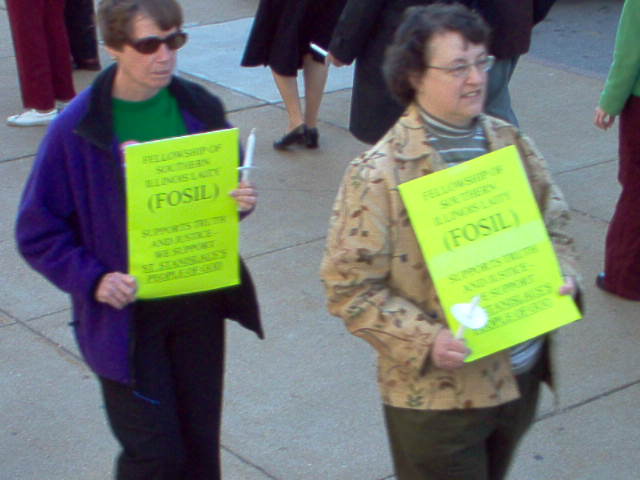
And again we hear from FOSIL (there's a good joke here, but I'll let someone else post one):
BTW, there a picture of the "fossils" at the link...
*** Updated ***
I had forgotten this, but FOSIL was represented at the recent St. Stanislaus "Candlelight Vigil" (at 11:00 AM) at the Cathedral on March 6...
Here is a picture of FOSIL representatives marching in 'solidarity' with those who are rebelling against Archbishop Burke and the Vatican:
At a daylong meeting Monday, about 65 priests from the diocese discussed the process by which Braxton was selected to replace Wilton Gregory, who left Belleville in January to become archbishop in Atlanta.And again we hear that "reactions to the appointment and the lack of process range across the spectrum from anger to acceptance."
And again we hear from FOSIL (there's a good joke here, but I'll let someone else post one):
Members of the Fellowship of Southern Illinois Laity, the group that picketed outside the bishop's official residence earlier this month to protest Braxton's request for diocesan funds to renovate the home, have questioned the appointment process, saying the Chicago Archdiocese and local church leadership were circumvented.Source.
...
"We think that many of the priests were concerned about the lack of due process and how we received a bishop," said member Anne Harter. "We had hoped that that would be on their agenda today and we just wanted to prayerfully support their efforts."
When she heard [Fr.] Margason's statement [about the consultation process], Harter said, "That's typical, everything's a secret."
BTW, there a picture of the "fossils" at the link...
*** Updated ***
I had forgotten this, but FOSIL was represented at the recent St. Stanislaus "Candlelight Vigil" (at 11:00 AM) at the Cathedral on March 6...
Here is a picture of FOSIL representatives marching in 'solidarity' with those who are rebelling against Archbishop Burke and the Vatican:
Priests Say They Weren’t Consulted on Bishop Braxton
On Valentine's Day, a dozen or so Belleville priests gathered to discuss what kind of bishop would best be suited to lead their diocese.The story states that some of the priests are "furious"...But that's not all - the Post is quick to add comments from FOSIL (Fellowship of Southern Illinois Laity), a group with ties to Call to Action and other groups espousing heresy or heterodoxy. (Sources: here, here, here, and here).
...
The members of the Presbyterial Council had been asked by Cardinal Francis George of Chicago to assess three things: the qualities they would like in their next bishop, the current state of the Belleville diocese and the future needs of the diocese.
...
The priests never got a chance to go to Chicago. A month after their meeting, Edward K. Braxton of Lake Charles, La., and a former auxiliary bishop of St. Louis, was named bishop of Belleville.
"I would hope (George) would not intentionally (mislead the priests)," said Anne Harter, a member of the Fellowship of Southern Illinois Laity, a group active in promoting lay involvement in the church. "And that leads me to believe that he was simply not consulted."The remaining article makes for interesting reading, considering: some money issues raised, that Bishop Braxton would like a priest on staff for prayer and conversation, and the possibility of his bringing in more priests from abroad doesn't seem to sit well with others in Belleville.
Article here.
Gospel for Saturday, 5th Week of Easter
From: John 15:18-21
A Hostile World
(Jesus said to His disciples,) [18] "If the world hates you, know that it has hated Me before it hated you. [19] If you were of the world, the world would love its own; but because you are not of the world, but I chose you out of the world, therefore the world hates you. [20] Remember the word that I said to you, `A servant is not greater than his master.' If they persecuted Me, they will persecute you; if they kept My word, they will keep yours also. [21] But all this they will do to you on My account, because they do not know Him who sent Me."
____________________________
Commentary:
18-19. Jesus states that there can be no compromise between Him and the world, the kingdom of sin: anyone who lives in sin abhors the light (cf. John 3:19-20). This is why Christ is persecuted, and why the Apostles will be in their turn. "The hostility of the perverse sounds like praise for our life", St. Gregory says, "because it shows that we have at least some rectitude if we are an annoyance to those who do not love God; no one can be pleasing to God and to God's enemies at the same time. He who seeks to please those who oppose God is no friend of God; and he who submits himself to the truth will fight against those who strive against truth" ("In Ezechielem Homiliae", 9).
*******
Source: "The Navarre Bible: Text and Commentaries". Biblical text taken from the Revised Standard Version and New Vulgate. Commentaries made by members of the Faculty of Theology of the University of Navarre, Spain. Published by Four Courts Press, Kill Lane, Blackrock, Co. Dublin, Ireland.
Reprinted with permission from Four Courts Press and Scepter Publishers, the U.S. publisher.
A Hostile World
(Jesus said to His disciples,) [18] "If the world hates you, know that it has hated Me before it hated you. [19] If you were of the world, the world would love its own; but because you are not of the world, but I chose you out of the world, therefore the world hates you. [20] Remember the word that I said to you, `A servant is not greater than his master.' If they persecuted Me, they will persecute you; if they kept My word, they will keep yours also. [21] But all this they will do to you on My account, because they do not know Him who sent Me."
____________________________
Commentary:
18-19. Jesus states that there can be no compromise between Him and the world, the kingdom of sin: anyone who lives in sin abhors the light (cf. John 3:19-20). This is why Christ is persecuted, and why the Apostles will be in their turn. "The hostility of the perverse sounds like praise for our life", St. Gregory says, "because it shows that we have at least some rectitude if we are an annoyance to those who do not love God; no one can be pleasing to God and to God's enemies at the same time. He who seeks to please those who oppose God is no friend of God; and he who submits himself to the truth will fight against those who strive against truth" ("In Ezechielem Homiliae", 9).
*******
Source: "The Navarre Bible: Text and Commentaries". Biblical text taken from the Revised Standard Version and New Vulgate. Commentaries made by members of the Faculty of Theology of the University of Navarre, Spain. Published by Four Courts Press, Kill Lane, Blackrock, Co. Dublin, Ireland.
Reprinted with permission from Four Courts Press and Scepter Publishers, the U.S. publisher.
Friday, April 29, 2005
Pope Benedict XVI's Papal Coat of Arms Presented...
...Characterized by Personal Elements and Novelties
Source: Zenit, for April 29
VATICAN CITY, APRIL 29, 2005 (Zenit.org).- Personal elements and novelties characterize Benedict XVI's coat of arms, unveiled in the Vatican's semiofficial newspaper.I suppose this puts to rest the various questions which had been raised. This appears to be final.
Published Thursday in the Italian edition of L'Osservatore Romano, the new coat of arms has three personal elements: a shell, the "Moor of Freising" and "St. Corbinian's bear."
There are also two novelties: the substitution of the miter instead of the tiara, and the addition of the white pallium with black crosses draped below the shield.
...
Benedict XVI decided not to include the tiara that traditionally appeared at the top of each Pope's coat of arms, and replaced it with the pointed miter.
The papal miter, represented in Benedict XVI's shield, is silver and has three gold stripes, symbolizing the Supreme Pontiff's three powers: order, jurisdiction and magisterium.
An absolute novelty in Benedict XVI's shield is the pallium, the woolen stole symbolizing a bishop's authority, and the typical liturgical insignia of the Supreme Pontiff, indicating his responsibility to be the shepherd of Christ's flock.
Source: Zenit, for April 29
Timeline of principal doctrinal decisions, documents, 1981-2005
VATICAN CITY (CNS) -- Here is a list of the principal public documents and decisions issued by the Congregation for the Doctrine of the Faith from 1981 to 2005 when Cardinal Joseph Ratzinger was prefect of the office. He was elected Pope Benedict XVI April 19.
Contact Missouri Senators to Pass SB-2
The Missouri Catholic Conference is calling on Catholics to ask their legislators to pass a Senate bill — without amendment — that would tighten the laws on abortion while strengthening alternatives to abortion services.This is part of an article from the St. Louis Review. However, the article is restricted due to a new policy thta the Review has adopted as of today. Considering the importance of this request to urge Missouri Catholics to contact their State Senators, it is disturbing to see such an article restricted to Paid Subscribers only. This policy is akin to covering the light with a basket. (Matt 5:15)
Sponsored by Sen. John Loudon, R-Ballwin, SB 2 would allow lawsuits against people who help minors evade Missouri’s parental consent laws to obtain abortions in other states. The Senate approved the bill last week by a 26-6 vote, with two absent. It now heads to the House for consideration.
Regardless of the questionable policy of the Review in this regard, the Missouri Catholic Conference has details here including how to contact your State Senator.
The "confidential" and "private" St. Louis Review article (for those who have a paid subscription) can be found here. (I still can't help but wonder why this policy was implemented - there has been no answer to my letter on the matter.)
Pope Benedict XVI: Christ’s humble servant
Our Lord has blessed us with a new shepherd for the universal Church, Pope Benedict XVI. Having enjoyed the extraordinary service of Pope John Paul II, we prayed fervently for a worthy successor to St. Peter as Vicar of Christ on earth. Cardinal Joseph Ratzinger worked intimately with our late Holy Father for practically his entire pontificate. His words at the Mass of Christian Burial for Pope John Paul II and since the time of his election make clear the profound esteem which he has for the late Holy Father and his desire to continue Pope John Paul II’s work of the new evangelization.We attended this Mass and it was a wonderful blessing to have been there...Reminiscent, in many respects, of the High Masses of old...it included Latin hymns, chant, incense, profound reverence and dignity...The procession before Mass included the Knights and Dames of the Holy Sepulchre, the Knights and Dames of Malta, seminarians, and priests and deacons of the Archdiocese. Others attending included Fr. Lenhardt of the Institute of Christ the King, Fr. Oppenheimer and seminarians from the Canons Regular of the New Jerusalem, and Fr. Jay Alvarez from Opus Dei. A number of Religious Sisters were in attendance as well. A transitional deacon arrayed in vestments matching the Archbishop's chasable, chanted the Gospel - it was done perfectly and it was a wonderful experience which rarely happens these days. Archbishop Burke gave an excellent homily.
On April 23 I offered the Holy Mass, with the participation of priests, consecrated persons and laity from throughout the archdiocese, for the intentions of Pope Benedict XVI. We cannot imagine the heaviness of the burdens of his office. We want to lighten those burdens with our prayers, our affectionate love and our obedience. The Mass offered for his intentions was the best way that the faithful of the Archdiocese of St. Louis could assist our new Holy Father at the beginning of his service as successor of St. Peter.
The Archbishop provides us with an adaptation of his homily from last Saturday evening, here.
Cardinal Pell: Benedict didn't want to be Pope
Sydney Archbishop Cardinal George Pell says Pope Benedict XVI did not want the Catholic Church's top job but was elected because he was the most qualified.More
...
"He didn't want the job. I'm quite convinced that that was genuine. He is a genuine man of the spirit ... he will clearly and consistently call up Christ, call up the loyalty within the Church and he'll do that in ways and tones that are new and interesting."
Marymount Manhattan College-Not Catholic?
The Archdiocese of New York has determined that Marymount Manhattan College—which has been under protest by the Cardinal Newman Society for inviting pro-abortion Sen. Hillary Clinton to give its commencement address and receive an honorary degree on May 20—is no longer a Catholic institution.Why did this took so long?
This is the fourth time since the late Pope John Paul II issued Ex Corde Ecclesiae, the apostolic constitution on Catholic universities, that a bishop has declared an historically Catholic college or university to be not Catholic. The three colleges previously declared no longer Catholic include Marist College in Poughkeepsie, New York, and Nazareth College and Saint John Fisher College, both in Rochester, New York.
Now what about the other universities and colleges which lay claim to being Catholic but who opposed the Church openly and defiantly?
Article source.
A Catholic Neurologist's Perspective on the Terri Schiavo Case
I have reviewed the CT scan images of Terri Schiavo’s brain, watched the video of her taken by her family members, and also reviewed some summary comments/excerpts regarding testimony given in deposition transcripts in her medical malpractice case. These again are all things I do on a very frequent basis. They are, to be frank, part of how I make my living. Having clarified the context in which I share my thoughts with you, I offer the following thoughts on this matter:This neurologist lists over 20 points of observation from which we may conclude that Terri was in pain and suffered terribly - and we may conclude further that she was murdered.
The neurologist errors, however, when he states in his conclusion:
Finally, I would advise each and every person to prepare a living will as you would a normal will so that your families might be spared the pain and anguish of having to decide what care measures you would want should a grave or terminal illness occur.As we have seen already, a "living will" is not the instrument that would have saved her or anyone else. It most likely would have been used to hasten her death.
The doctor's observations are here.
Fr. Frank Pavone describes what it was like to see Terri pushed and forced to appear at death's door at the whim of her estranged husband, a whacked-out lawyer, and incompetent judges:
Brothers and sisters to describe the way she looked as peaceful is a total distortion of what I saw. Here now was a person, who for thirteen days had no food or water. She was, as you would expect, very drawn in her appearance as opposed to when I had seen her before. Her eyes were open but they were going from one side to the next, constantly oscillating back and forth, back and forth. The look on her face (I was staring at her for three and a half-hours) I can only describe as a combination of fear and sadness … a combination of dreaded fear and sadness.Source.
Her mouth was open the whole time. It looked like it was frozen open. She was panting rapidly. It wasn't peaceful in any sense of the word. She was panting as if she had just run a hundred miles. But a shallow panting. Her brother Bobby was sitting opposite me. He was on one side of the bed I was on the other facing him. Terri's head in between us and her sister Suzanne was on my left. We sat there and we had a very intense time of prayer. And we were talking to Terri, urging her to entrust herself completely to the Savior. I assured her repeatedly of the love and prayers and concern of so many people.
Pope plans first pilgrimage to Italy
VATICAN CITY (AP) - Pope Benedict XVI will make his first pilgrimage in Italy on May 29, a day trip to a religious congress in the southern city of Bari, officials said Friday.
An Update to a Town Talk Response
When this defense of Pope John Paul II was posted on Wednesday, I evidently had missed posting the "Town Talk" piece to which it referred. So here is the offending message as it appeared two weeks ago:
Pope John Paul the anti-Christ?Source.
THIS IS GOING to come as a shock to most of the people that might read this. Read the Bible and see what Jesus says about the anti-Christ. He says he dresses as a wolf in sheep's clothing. He's going to be loved by the world and even the elect will fall for him and everybody will follow him. I've been thinking about that and I see this pope refusing to give up and go to heaven. That's what Catholics are supposed to look for when they die. They should let go and be glad to go to heaven. But this pope refuses to let go. Isn't there something wrong there? It seems to me that this pope is too much in love with the world. He loves the world and he loves the people in it. But the anti-Christ is supposed to be the same way. He's gonna be loved by everybody and everybody will follow him. Please somebody think about it. If there's a priest out there that has an answer to this, answer in the paper please.
Popemobile for Sale? Bids Top $1 Mln on EBay
IN a followup from an item from yesterday - It's not really the Popemobile, but a 1999 Volkswagon Golf reportedly once owned by Cardinal Ratzinger.
ROME (Reuters) - A second hand car once said to be registered in the name of Joseph Kardinal Ratzinger -- the new Pope Benedict - is up for sale on eBay and the sky seems to be the limit when it comes to bidding.Source.
The vehicle, a metallic gray 1999 Volkswagen Golf, went up for auction on the German site (www.ebay.de) at a minimum price of 9,900 euros ($12,790) on Wednesday and, just over 24 hours and more than 300 bids later, the price had hit one million euros ($1.3 million).
The Infallible Authority of the Church
***
This was posted, not merely as a refutation of the thinking of people like Mario Cuomo and other pseudo-Catholics, but also as a simple catechetical lesson from years ago - and the glory of this is that it is still as applicable today as it was then. Perhaps, for some, it may even be more easily understood.
******
From "The Faith of Our Fathers":
The Church has authority from God to teach regarding faith and morals; and in her teaching she is preserved from error by the special guidance of the Holy Spirit.
The prerogative of infallibility is clearly deduced from the attributes of the Church already mentioned. The Church is One, Holy, Catholic, and Apostolic. Preaching the same creed everywhere, and at all times; teaching holiness and truth, she is, of course, essentially unerring in her doctrine; for what is one, holy, or unchangeable, must be infallibly true.
That the Church was infallible in the Apostolic age, is denied by no Christian. We never question the truth of the Apostles' declarations (Gal 4:14, 1 Thess 2:13); they were, in fact, the only authority in the Church for the first century. The new Testament was not completed till the close of the first century. There is no just ground for denying to the Apostolic teachers of the nineteenth century in which we live, a prerogative clearly possessed by those of the first, especially as the divine Word nowhere intimates that this unerring guidance was to die with the Apostles. On the contrary, as the Apostles transmitted to their successors their power to preach, to baptize, to ordain, to confirm, etc., they must also have handed down to them the no less essential gift of infallibility.
God loves us as much as He loved the primitive Christians; Christ died for us as well as for them: and we have as much need of unerring teachers as they had.
It will not suffice to tell me: "We have an infallible Scripture as a substitute for an infallible apostolate of the first century," for an infallible book is of no use to me without an infallible interpreter, as the history of Protestantism too clearly demonstrates.
But besides these presumptive arguments, we have positive evidence from Scripture that the Church cannot err tn her teachings. Our blessed Lord, in constituting St. Peter Prince of His Apostles, says to him: "Thou art Peter, and upon this rock I will build My Church, and the gates of hell shall not prevail against it." (Matt 16:18) Christ makes here a solemn prediction that no error shall ever invade His Church; and if she fell into error, the gates of hell have certainly prevailed against her.
The Reformers of the sixteenth century affirm that the Church did fall into error; that the gates of hell did prevail against her; that from the sixth to the sixteenth century she was a sink of iniquity. The Book of Homilies of the church of England says that the Church "lay buried in damnable idolatry for eight hundred years and more." The personal veracity of our Saviour and of the Reformers is here at issue, for our Lord makes a statement which they contradict. Who is to be believed, Jesus or the Reformers?
If the prediction of our Saviour about the preservation of His Church from error be false, then Jesus Christ is not God, since God cannot lie. He is not even a Prophet, since He predicted falsehood. No, He is an impostor, and all Christianity is a miserable failure and a huge deception, since it rests on a false Prophet.
But if Jesus predicted the truth when He declared that the gates of hell should not prevail against His Church, - and who dare deny it? - then the Church never has, and never could have fallen from the truth; then the Catholic Church is infallible, for she alone claims that prerogative, and she is the only Church that is acknowledged to have existed from the beginning. Truly is Jesus that wise Architect mentioned in the Gospel, "who built his house upon a rock; and the rain fell, and the floods came, and the winds blew, and they beat upon that house, and it fell not, for it was founded upon a rock." (Matt 7:24, et seq)
Jesus sends forth the Apostles with plenipotentiary powers to preach the Gospel. "As the Father," He says, "hath sent Me, I also send you." (John 20:21) "Going therefore, teach all nations, teaching them to observe all things whatsoever I have commanded you." (Matt 28:19-20) "Preach the Gospel to every creature." (Mark 16:15) "You shall be witnesses unto Me in Jerusalem, and in all Judea, and Samaria, and even to the uttermost part of the earth." (Acts 1:8)
This commission evidently applies not to the Apostles only, but also to their successors, to the end of time, since it was utterly impossible for the Apostles personally to preach to the whole world.
Not only does our Lord empower His Apostles to preach the Gospel, but He commands, and under the most severe penalties, those to whom they preach to listen and obey. "Whosoever will not receive you, nor hear your words, going forth from that house or city, shake the dust from your feet. Amen, I say to you, it shall be more tolerable for the land of Sodom and Gomorrha in the day of judgment, than for that city." (Matt 10:14-15) "If he will not hear the Church, let him be to thee as the heathen and the publican." (Matt 18:17) "He that believes shall be saved; he that does not believe, shall be condemned." (Mark 16:16) "He who hears you, hears Me; he who despises you, despises Me; and he who despises Me, despises Him that sent Me." (Luke 10:16)
From these passages, we see, on the one hand, that the Apostles and their successors have received full powers to announce the Gospel; and on the other, that their hearers are obliged to listen with docility, and to obey not merely by an external compliance, but also by an internal assent of the intellect. If, therefore, the Catholic Church could preach error, would not God Himself be responsible for the error? And could not the faithful soul say to God with all reverence and truth: You have commanded me, Lord, to hear Your Church. If I am deceived by obeying her, You are the cause of my error.
But we may rest assured that an all-wise Providence who commands His Church to speak in His name, will so guide her in the path of truth that she shall never lead into error those that follow her teachings.
But as this privilege of Infallibility was a very extraordinary favor, our Saviour confers it on the rulers of His Church in language which removes all doubt from the sincere inquirer, and under circumstances which add to the majesty of His word. Shortly before His death, Jesus consoles His disciples by this promise: "I will ask the Father, and He shall give you another Paraclete, that He may abide with you forever. . . But when He, the Spirit of truth, shall come, He will teach you all truth." (John 14:10)
The following text of the same import forms the concluding words recorded of our Savior in St. Matthew's Gospel: "All power is given to Me in heaven and on earth. Go, therefore, and teach all nations, . . . teaching them to observe all things whatsoever I have commanded you. And behold, I am with you all days, even to the consummation of the world." (Matt 28)
He begins by asserting His own divine authority and mission. "All power is given," etc. That power He then delegates to His Apostles and to their successors: "Go, therefore, and teach all nations," etc. He does not instruct them to scatter Bibles all over the earth, but to teach by word of mouth. "And behold!" Our Saviour never captures the attention of His hearers by using the interjection, behold, unless when He has something unusually solemn and extraordinary to communicate. An important announcement is sure to follow this word. "Behold, I am with you." These words, "I am with you," are frequently addressed in Sacred Scripture, by the Almighty, to His Prophets and Patriarchs, and they always imply a special presence and a particular supervision of the Deity. (Ex 3:12, Jer 15:20, etc) They convey the same meaning in the present instance. Christ says equivalently, I who "am the way, the truth, and the life," will protect you from error, and will guide you in your speech. I will be with you, not merely during your natural lives, not for a just a century, but for all days, at all times, without intermission, even to the end of the world.
These words of Jesus Christ establish two important facts:
1. A promise to guard His Church from error.
2. A promise that His presence with the Church will be continuous, without any interval of absence, to the consummation of the world.
And this is also the sentiment of the Apostle of the Gentiles writing to the Ephesians: God "gave some indeed Apostles, and some Prophets, and some Evangelists, and others Pastors and Teachers, for the perfecting of the saints, for the work of the ministry, for the building up of the body of Christ, until we all meet in the unity of faith, . . . that we may no more be children, tossed to and fro, and carried about with every wind of doctrine, by the wickedness of men, in craft, by which they lie in wait to deceive." (Eph 4:11-14)
Notwithstanding these plain declarations of Scripture, some persons think it an unwarrantable assumption for the Church to claim infallibility. But mark the consequences that follow from denying it.
If your church is not infallible, it is liable to err, for there is no medium between infallibility and liability to error. If your church and her ministers are fallible in their doctrinal teachings, as they admit, they may be preaching falsehood to you, instead of truth. If so, you are in doubt whether you are listening to truth or falsehood. If you are in doubt, you can have no faith, for faith excludes doubt, and in that state you displease God, for "without faith it is impossible to please God."(Heb 11:6) Faith and infallibility must go hand in hand. The one cannot exist without the other. There can be no faith in the hearer unless there is unerring authority in the speaker - an authority founded upon such certain knowledge as precludes the possibility of falling into error on his part, and including such unquestioned veracity as to prevent his deceiving him who accepts his word.
You admit infallible certainty in the physical sciences; why should you deny it in the science of salvation? The mariner, guided by his compass, knows, amid the raging storm and the darkness of the night, that he is steering his course directly to the city of his destination; and is not an infallible guide as necessary to conduct you to the city of God in heaven? Is it not moreover a blessing and a consolation that amid the ever changing views of men, amid tbe conflict of human opinion, and the tumultuous waves of human passion, there is one voice heard above the din and uproar, crying in clear unerring tones: "Thus saith the Lord?"
It is very strange that the Catholic Church must apologize to the world for simply declaring that she speaks the truth, the whole truth, and nothing but the truth.
Children of the Catholic Church, give thanks to God for having made you members of that Communion in which you are preserved from all errors in faith, and from all illusion in the practice of virtue. You are happily strangers to those interior conflicts, to those perplexing doubts, and to that frightful uncertainty which distract the souls of those whose private judgment is their only guide. You are not, like others, drifting helplessly over the ocean of uncertainty, and "carried about by every wind of doctrine." You are not as "blind men led by blind guides." You are not like those who are in the midst of a spiritual desert intersected by various by-paths, not knowing which to pursue; but you are on that high road spoken of by the prophet Isaiah, which is so "straight a way, that fools shall not err therein." (Is 35:8) You are a part of that universal Communion which has no "High church" and "Low church;" no "New School" and "Old School," for you all belong to that School which is "ever ancient and ever new." You enjoy that profound peace and tranquillity which springs from the conscious possession of the whole truth. Well may you exclaim: "Behold how good and how pleasant it is for brethren to dwell together in unity." (Ps 132)
Give thanks, moreover, to God that you belong to a Church which has also a keen sense to detect and expose those moral shams, those pious frauds, those socialistic schemes which are so often undertaken in this country ostensibly in the name of religion and morality, but which, in reality, are subversive of morality and order, which are the offspring of fanaticism, and serve as a mask to hide the most debasing passions. Neither the advocates of free love or of false freedoms (license) find any recruits in the Catholic Church. She will never suffer her children to be ensnared by these impostures, how specious they may be.
From what has been said in the preceding paragraphs it follows that the Catholic Church cannot be reformed. I do not mean, of course, that the Pastors of the Church are personally impeccable, or not subject to sin. Every teacher in the Church, from the Pope down to the humblest Priest, is liable at any moment, like any of the faithful, to fall from grace, and to stand in need of moral reformation. We all carry "this treasure (of innocence) in earthen vessels."
My meaning is, that the Church is not susceptible of being reformed in her doctrines. The Church is the work of an Incarnate God. Like all God's works, it is perfect. It is, therefore, incapable of reform. Is it not the height of presumption for men to attempt to improve upon the work of God? Is it not ridiculous for the Luthers, the Calvins, the Knoxes, and the Henries, and a thousand lesser lights, to be offering their amendments to the Constitution of the Church, as if it were a human Institution?
Our Lord Himself has never ceased to rule personally over His Church. It is time enough for little men to take charge of the Ship when the great Captain abandons the helm.
A Protestant gentleman of very liberal education remarked to me, before the opening of the late Ecumonical Council: "I am assured, sir, by a friend, in confidence, that, at a secret Conclave of Bishops recently held in Rome, it was resolved that the Dogma of the Immaculate Conception would be reconsidered and abolished at the approaching General Council; in fact, that the definition was a mistake, and that the blunder of 1854 would be repaired in 1869." I told him, of course, that no such question could be entertained in the Council; that the doctrinal decrees of the Church were irrevocable, and that the dogma of the Immaculate Conception was defined once and forever.
If only one instance could be given in which the Church ceased to teach a doctrine of faith which had been previously held, that single instance would be the death-blow of her c1aim to infallibility. But it is a marvellous fact worthy of record, that in the whole history of the Church, from the nineteenth (now twenty-first) century to the first, no solitary example can be adduced to show that any Pope or General Council ever revoked a decree of faith or morals enacted by any preceding Pontiff or Council. Her record in the past ought to be a sufficient warrant that she will tolerate no doctrinal variations in the future.
If, as we have seen, the Church has authority from God to teach, and if she teaches nothing but the truth, is it not the duty of all Christians to hear her voice and obey her commands? She is the organ of the Holy Spirit. She is the Representative of Jesus Christ, who has said to her: "He who hears you, hears Me; he who despises you, despises Me." She is the Mistress of truth. It is the duty of the human mind to embrace truth wherever it finds it. It would, therefore, be not only an act of irreverence, but of sheer folly, to disobey the voice of this ever-truthful Mother.
If a citizen is bound to obey the laws of his country, though these laws may not in all respects be conformable to strict justice; if a child is bound by natural and divine law to obey his mother, though she may sometimes err in her judgments, how much more strictly are not we obliged to be docile to the teachings of the Catholic Church, our Mother, whose admonitions are always just, whose precepts are immutable!
"For twenty years," observed a recently converted Minister of the Protestant Church, "I fought and struggled against the Church with all the energy of my will. But when I became a Catholic, all my doubts ended, my inquiries ceased. I became as a little child, and rushed like a lisping babe into the arms of my mother." By Baptism, Christians become children of the Church, no matter who pours upon them the regenerating waters. If she is our Mother, where is our love and obedience? When the infant seeks nourishment at its mother's breast, it does not analyze its food. When it receives instructions from its mother's lips, it never doubts, but instinctively believes. When the mother stretches forth her hand, the child follows unhesitatingly. The Christian should have for his spiritual Mother all the simplicity, all the credulity, I might say, of a child, guided by the instincts of faith. "Unless you become," says our Lord, "as little children, you shall not enter into the Kingdom of Heaven." (Matt 18:3) "As new-born babes, desire the rational milk without guile; that thereby you may grow unto salvation." (1 Pet 2:2) In her nourishment there is no poison; in her doctrines there is no guile.
Adapted from The Faith of Our Fathers, (1895)
by James Cardinal Gibbons
This was posted, not merely as a refutation of the thinking of people like Mario Cuomo and other pseudo-Catholics, but also as a simple catechetical lesson from years ago - and the glory of this is that it is still as applicable today as it was then. Perhaps, for some, it may even be more easily understood.
******
From "The Faith of Our Fathers":
The Church has authority from God to teach regarding faith and morals; and in her teaching she is preserved from error by the special guidance of the Holy Spirit.
The prerogative of infallibility is clearly deduced from the attributes of the Church already mentioned. The Church is One, Holy, Catholic, and Apostolic. Preaching the same creed everywhere, and at all times; teaching holiness and truth, she is, of course, essentially unerring in her doctrine; for what is one, holy, or unchangeable, must be infallibly true.
That the Church was infallible in the Apostolic age, is denied by no Christian. We never question the truth of the Apostles' declarations (Gal 4:14, 1 Thess 2:13); they were, in fact, the only authority in the Church for the first century. The new Testament was not completed till the close of the first century. There is no just ground for denying to the Apostolic teachers of the nineteenth century in which we live, a prerogative clearly possessed by those of the first, especially as the divine Word nowhere intimates that this unerring guidance was to die with the Apostles. On the contrary, as the Apostles transmitted to their successors their power to preach, to baptize, to ordain, to confirm, etc., they must also have handed down to them the no less essential gift of infallibility.
God loves us as much as He loved the primitive Christians; Christ died for us as well as for them: and we have as much need of unerring teachers as they had.
It will not suffice to tell me: "We have an infallible Scripture as a substitute for an infallible apostolate of the first century," for an infallible book is of no use to me without an infallible interpreter, as the history of Protestantism too clearly demonstrates.
But besides these presumptive arguments, we have positive evidence from Scripture that the Church cannot err tn her teachings. Our blessed Lord, in constituting St. Peter Prince of His Apostles, says to him: "Thou art Peter, and upon this rock I will build My Church, and the gates of hell shall not prevail against it." (Matt 16:18) Christ makes here a solemn prediction that no error shall ever invade His Church; and if she fell into error, the gates of hell have certainly prevailed against her.
The Reformers of the sixteenth century affirm that the Church did fall into error; that the gates of hell did prevail against her; that from the sixth to the sixteenth century she was a sink of iniquity. The Book of Homilies of the church of England says that the Church "lay buried in damnable idolatry for eight hundred years and more." The personal veracity of our Saviour and of the Reformers is here at issue, for our Lord makes a statement which they contradict. Who is to be believed, Jesus or the Reformers?
If the prediction of our Saviour about the preservation of His Church from error be false, then Jesus Christ is not God, since God cannot lie. He is not even a Prophet, since He predicted falsehood. No, He is an impostor, and all Christianity is a miserable failure and a huge deception, since it rests on a false Prophet.
But if Jesus predicted the truth when He declared that the gates of hell should not prevail against His Church, - and who dare deny it? - then the Church never has, and never could have fallen from the truth; then the Catholic Church is infallible, for she alone claims that prerogative, and she is the only Church that is acknowledged to have existed from the beginning. Truly is Jesus that wise Architect mentioned in the Gospel, "who built his house upon a rock; and the rain fell, and the floods came, and the winds blew, and they beat upon that house, and it fell not, for it was founded upon a rock." (Matt 7:24, et seq)
Jesus sends forth the Apostles with plenipotentiary powers to preach the Gospel. "As the Father," He says, "hath sent Me, I also send you." (John 20:21) "Going therefore, teach all nations, teaching them to observe all things whatsoever I have commanded you." (Matt 28:19-20) "Preach the Gospel to every creature." (Mark 16:15) "You shall be witnesses unto Me in Jerusalem, and in all Judea, and Samaria, and even to the uttermost part of the earth." (Acts 1:8)
This commission evidently applies not to the Apostles only, but also to their successors, to the end of time, since it was utterly impossible for the Apostles personally to preach to the whole world.
Not only does our Lord empower His Apostles to preach the Gospel, but He commands, and under the most severe penalties, those to whom they preach to listen and obey. "Whosoever will not receive you, nor hear your words, going forth from that house or city, shake the dust from your feet. Amen, I say to you, it shall be more tolerable for the land of Sodom and Gomorrha in the day of judgment, than for that city." (Matt 10:14-15) "If he will not hear the Church, let him be to thee as the heathen and the publican." (Matt 18:17) "He that believes shall be saved; he that does not believe, shall be condemned." (Mark 16:16) "He who hears you, hears Me; he who despises you, despises Me; and he who despises Me, despises Him that sent Me." (Luke 10:16)
From these passages, we see, on the one hand, that the Apostles and their successors have received full powers to announce the Gospel; and on the other, that their hearers are obliged to listen with docility, and to obey not merely by an external compliance, but also by an internal assent of the intellect. If, therefore, the Catholic Church could preach error, would not God Himself be responsible for the error? And could not the faithful soul say to God with all reverence and truth: You have commanded me, Lord, to hear Your Church. If I am deceived by obeying her, You are the cause of my error.
But we may rest assured that an all-wise Providence who commands His Church to speak in His name, will so guide her in the path of truth that she shall never lead into error those that follow her teachings.
But as this privilege of Infallibility was a very extraordinary favor, our Saviour confers it on the rulers of His Church in language which removes all doubt from the sincere inquirer, and under circumstances which add to the majesty of His word. Shortly before His death, Jesus consoles His disciples by this promise: "I will ask the Father, and He shall give you another Paraclete, that He may abide with you forever. . . But when He, the Spirit of truth, shall come, He will teach you all truth." (John 14:10)
The following text of the same import forms the concluding words recorded of our Savior in St. Matthew's Gospel: "All power is given to Me in heaven and on earth. Go, therefore, and teach all nations, . . . teaching them to observe all things whatsoever I have commanded you. And behold, I am with you all days, even to the consummation of the world." (Matt 28)
He begins by asserting His own divine authority and mission. "All power is given," etc. That power He then delegates to His Apostles and to their successors: "Go, therefore, and teach all nations," etc. He does not instruct them to scatter Bibles all over the earth, but to teach by word of mouth. "And behold!" Our Saviour never captures the attention of His hearers by using the interjection, behold, unless when He has something unusually solemn and extraordinary to communicate. An important announcement is sure to follow this word. "Behold, I am with you." These words, "I am with you," are frequently addressed in Sacred Scripture, by the Almighty, to His Prophets and Patriarchs, and they always imply a special presence and a particular supervision of the Deity. (Ex 3:12, Jer 15:20, etc) They convey the same meaning in the present instance. Christ says equivalently, I who "am the way, the truth, and the life," will protect you from error, and will guide you in your speech. I will be with you, not merely during your natural lives, not for a just a century, but for all days, at all times, without intermission, even to the end of the world.
These words of Jesus Christ establish two important facts:
1. A promise to guard His Church from error.
2. A promise that His presence with the Church will be continuous, without any interval of absence, to the consummation of the world.
And this is also the sentiment of the Apostle of the Gentiles writing to the Ephesians: God "gave some indeed Apostles, and some Prophets, and some Evangelists, and others Pastors and Teachers, for the perfecting of the saints, for the work of the ministry, for the building up of the body of Christ, until we all meet in the unity of faith, . . . that we may no more be children, tossed to and fro, and carried about with every wind of doctrine, by the wickedness of men, in craft, by which they lie in wait to deceive." (Eph 4:11-14)
Notwithstanding these plain declarations of Scripture, some persons think it an unwarrantable assumption for the Church to claim infallibility. But mark the consequences that follow from denying it.
If your church is not infallible, it is liable to err, for there is no medium between infallibility and liability to error. If your church and her ministers are fallible in their doctrinal teachings, as they admit, they may be preaching falsehood to you, instead of truth. If so, you are in doubt whether you are listening to truth or falsehood. If you are in doubt, you can have no faith, for faith excludes doubt, and in that state you displease God, for "without faith it is impossible to please God."(Heb 11:6) Faith and infallibility must go hand in hand. The one cannot exist without the other. There can be no faith in the hearer unless there is unerring authority in the speaker - an authority founded upon such certain knowledge as precludes the possibility of falling into error on his part, and including such unquestioned veracity as to prevent his deceiving him who accepts his word.
You admit infallible certainty in the physical sciences; why should you deny it in the science of salvation? The mariner, guided by his compass, knows, amid the raging storm and the darkness of the night, that he is steering his course directly to the city of his destination; and is not an infallible guide as necessary to conduct you to the city of God in heaven? Is it not moreover a blessing and a consolation that amid the ever changing views of men, amid tbe conflict of human opinion, and the tumultuous waves of human passion, there is one voice heard above the din and uproar, crying in clear unerring tones: "Thus saith the Lord?"
It is very strange that the Catholic Church must apologize to the world for simply declaring that she speaks the truth, the whole truth, and nothing but the truth.
Children of the Catholic Church, give thanks to God for having made you members of that Communion in which you are preserved from all errors in faith, and from all illusion in the practice of virtue. You are happily strangers to those interior conflicts, to those perplexing doubts, and to that frightful uncertainty which distract the souls of those whose private judgment is their only guide. You are not, like others, drifting helplessly over the ocean of uncertainty, and "carried about by every wind of doctrine." You are not as "blind men led by blind guides." You are not like those who are in the midst of a spiritual desert intersected by various by-paths, not knowing which to pursue; but you are on that high road spoken of by the prophet Isaiah, which is so "straight a way, that fools shall not err therein." (Is 35:8) You are a part of that universal Communion which has no "High church" and "Low church;" no "New School" and "Old School," for you all belong to that School which is "ever ancient and ever new." You enjoy that profound peace and tranquillity which springs from the conscious possession of the whole truth. Well may you exclaim: "Behold how good and how pleasant it is for brethren to dwell together in unity." (Ps 132)
Give thanks, moreover, to God that you belong to a Church which has also a keen sense to detect and expose those moral shams, those pious frauds, those socialistic schemes which are so often undertaken in this country ostensibly in the name of religion and morality, but which, in reality, are subversive of morality and order, which are the offspring of fanaticism, and serve as a mask to hide the most debasing passions. Neither the advocates of free love or of false freedoms (license) find any recruits in the Catholic Church. She will never suffer her children to be ensnared by these impostures, how specious they may be.
From what has been said in the preceding paragraphs it follows that the Catholic Church cannot be reformed. I do not mean, of course, that the Pastors of the Church are personally impeccable, or not subject to sin. Every teacher in the Church, from the Pope down to the humblest Priest, is liable at any moment, like any of the faithful, to fall from grace, and to stand in need of moral reformation. We all carry "this treasure (of innocence) in earthen vessels."
My meaning is, that the Church is not susceptible of being reformed in her doctrines. The Church is the work of an Incarnate God. Like all God's works, it is perfect. It is, therefore, incapable of reform. Is it not the height of presumption for men to attempt to improve upon the work of God? Is it not ridiculous for the Luthers, the Calvins, the Knoxes, and the Henries, and a thousand lesser lights, to be offering their amendments to the Constitution of the Church, as if it were a human Institution?
Our Lord Himself has never ceased to rule personally over His Church. It is time enough for little men to take charge of the Ship when the great Captain abandons the helm.
A Protestant gentleman of very liberal education remarked to me, before the opening of the late Ecumonical Council: "I am assured, sir, by a friend, in confidence, that, at a secret Conclave of Bishops recently held in Rome, it was resolved that the Dogma of the Immaculate Conception would be reconsidered and abolished at the approaching General Council; in fact, that the definition was a mistake, and that the blunder of 1854 would be repaired in 1869." I told him, of course, that no such question could be entertained in the Council; that the doctrinal decrees of the Church were irrevocable, and that the dogma of the Immaculate Conception was defined once and forever.
If only one instance could be given in which the Church ceased to teach a doctrine of faith which had been previously held, that single instance would be the death-blow of her c1aim to infallibility. But it is a marvellous fact worthy of record, that in the whole history of the Church, from the nineteenth (now twenty-first) century to the first, no solitary example can be adduced to show that any Pope or General Council ever revoked a decree of faith or morals enacted by any preceding Pontiff or Council. Her record in the past ought to be a sufficient warrant that she will tolerate no doctrinal variations in the future.
If, as we have seen, the Church has authority from God to teach, and if she teaches nothing but the truth, is it not the duty of all Christians to hear her voice and obey her commands? She is the organ of the Holy Spirit. She is the Representative of Jesus Christ, who has said to her: "He who hears you, hears Me; he who despises you, despises Me." She is the Mistress of truth. It is the duty of the human mind to embrace truth wherever it finds it. It would, therefore, be not only an act of irreverence, but of sheer folly, to disobey the voice of this ever-truthful Mother.
If a citizen is bound to obey the laws of his country, though these laws may not in all respects be conformable to strict justice; if a child is bound by natural and divine law to obey his mother, though she may sometimes err in her judgments, how much more strictly are not we obliged to be docile to the teachings of the Catholic Church, our Mother, whose admonitions are always just, whose precepts are immutable!
"For twenty years," observed a recently converted Minister of the Protestant Church, "I fought and struggled against the Church with all the energy of my will. But when I became a Catholic, all my doubts ended, my inquiries ceased. I became as a little child, and rushed like a lisping babe into the arms of my mother." By Baptism, Christians become children of the Church, no matter who pours upon them the regenerating waters. If she is our Mother, where is our love and obedience? When the infant seeks nourishment at its mother's breast, it does not analyze its food. When it receives instructions from its mother's lips, it never doubts, but instinctively believes. When the mother stretches forth her hand, the child follows unhesitatingly. The Christian should have for his spiritual Mother all the simplicity, all the credulity, I might say, of a child, guided by the instincts of faith. "Unless you become," says our Lord, "as little children, you shall not enter into the Kingdom of Heaven." (Matt 18:3) "As new-born babes, desire the rational milk without guile; that thereby you may grow unto salvation." (1 Pet 2:2) In her nourishment there is no poison; in her doctrines there is no guile.
Adapted from The Faith of Our Fathers, (1895)
by James Cardinal Gibbons
Gospel for April 29,Memorial: St. Catherine of Siena, Virgin & Doctor of the Church
From: John 15:12-17
The Law of Love
[12] "This is My commandment, that you love one another as I have loved you. [13] Greater love has no man than this, that a man lay down his life for his friends. [14] You are My friends if you do what I command you. [15] No longer do I call you servants, for the servant does not know what his master is doing; but I have called you friends, for all that I have heard from My Father I have made known to you. [16] You did not choose Me, but I chose you and appointed you that you should go and bear fruit and that your fruit should abide; so that whatever you ask the Father in My name, He may give it to you. [17] This I command you, to love one another."
******************
Commentary:
12-15. Jesus insists on the "new commandment", which He Himself keeps by giving His life for us. See note on John 13:34-35.
Christ's friendship with the Christian, which our Lord expresses in a very special way in this passage, is something very evident in [St] Monsignor Escriva de Balaguer's preaching: "The life of the Christian who decides to behave in accordance with the greatness of his vocation is so to speak a prolonged echo of those words of our Lord, `No longer do I call you My servants; a servant is one who does not understand what his master is about, whereas I have made known to you all that My Father has told Me; and so I have called you My friends' (John 15:15). When we decide to be docile and follow the will of God, hitherto unimagined horizons open up before us.... `There is nothing better than to recognize that Love has made us slaves of God. From the moment we recognize this we cease being slaves and become friends, sons' ([St] J. Escriva, "Friends of God", 35).
"Sons of God, FRIENDS OF GOD.... Jesus is truly God and truly Man, He is our Brother and our Friend. If we make the effort to get to know Him well `we will share in the joy of being God's friends' ["ibid.", 300]. If we do all we can to keep Him company, from Bethlehem to Calvary, sharing His joys and sufferings, we will become worthy of entering into loving conversation with Him. As the Liturgy of the Hours sings, "calicem Domini biberunt, et amici Dei facti sunt" (they drank the chalice of the Lord and so became friends of God).
"Being His children and His friends are two inseparable realities for those who love God. We go to Him as children, carrying on a trusting dialogue that should fill the whole of our lives; and we go to Him as friends.... In the same way our divine sonship urges us to translate the overflow of our interior life into apostolic activity, just as our friendship with God leads us to place ourselves at `the service of all men. We are called to use the gifts God has given us as instruments to help others discover Christ' ["ibid.", 258]" (Monsignor A. del Portillo in his preface to [St] J. Escriva's, "Friends of God").
16. There are three ideas contained in these words of our Lord. One, that the calling which the Apostles received and which every Christian also receives does not originate in the individual's good desires but in Christ's free choice. It was not the Apostles who chose the Lord as Master, in the way someone would go about choosing a rabbi; it was Christ who chose them. The second idea is that the Apostles' mission and the mission of every Christian is to follow Christ, to seek holiness and to contribute to the spread of the Gospel. The third teaching refers to the effectiveness of prayer done in the name of Christ; which is why the Church usually ends the prayers of the liturgy with the invocation "Through Jesus Christ our Lord...".
The three ideas are all interconnected: prayer is necessary if the Christian life is to prove fruitful, for it is God who gives the growth (cf. 1 Corinthians 3:7); and the obligation to seek holiness and to be apostolic derives from the fact that it is Christ Himself who has given us this mission. "Bear in mind, son, that you are not just a soul who has joined other souls in order to do a good thing.
"That is a lot, but it's still little. You are the Apostle who is carrying out an imperative command from Christ" ([St] J. Escriva, "The Way", 942).
******************
Source: "The Navarre Bible: Text and Commentaries". Biblical text taken from the Revised Standard Version and New Vulgate. Commentaries made by members of the Faculty of Theology of the University of Navarre, Spain. Published by Four Courts Press, Kill Lane, Blackrock, Co. Dublin, Ireland.
Reprinted with permission from Four Courts Press and Scepter Publishers, the U.S. publisher.
The Law of Love
[12] "This is My commandment, that you love one another as I have loved you. [13] Greater love has no man than this, that a man lay down his life for his friends. [14] You are My friends if you do what I command you. [15] No longer do I call you servants, for the servant does not know what his master is doing; but I have called you friends, for all that I have heard from My Father I have made known to you. [16] You did not choose Me, but I chose you and appointed you that you should go and bear fruit and that your fruit should abide; so that whatever you ask the Father in My name, He may give it to you. [17] This I command you, to love one another."
******************
Commentary:
12-15. Jesus insists on the "new commandment", which He Himself keeps by giving His life for us. See note on John 13:34-35.
Christ's friendship with the Christian, which our Lord expresses in a very special way in this passage, is something very evident in [St] Monsignor Escriva de Balaguer's preaching: "The life of the Christian who decides to behave in accordance with the greatness of his vocation is so to speak a prolonged echo of those words of our Lord, `No longer do I call you My servants; a servant is one who does not understand what his master is about, whereas I have made known to you all that My Father has told Me; and so I have called you My friends' (John 15:15). When we decide to be docile and follow the will of God, hitherto unimagined horizons open up before us.... `There is nothing better than to recognize that Love has made us slaves of God. From the moment we recognize this we cease being slaves and become friends, sons' ([St] J. Escriva, "Friends of God", 35).
"Sons of God, FRIENDS OF GOD.... Jesus is truly God and truly Man, He is our Brother and our Friend. If we make the effort to get to know Him well `we will share in the joy of being God's friends' ["ibid.", 300]. If we do all we can to keep Him company, from Bethlehem to Calvary, sharing His joys and sufferings, we will become worthy of entering into loving conversation with Him. As the Liturgy of the Hours sings, "calicem Domini biberunt, et amici Dei facti sunt" (they drank the chalice of the Lord and so became friends of God).
"Being His children and His friends are two inseparable realities for those who love God. We go to Him as children, carrying on a trusting dialogue that should fill the whole of our lives; and we go to Him as friends.... In the same way our divine sonship urges us to translate the overflow of our interior life into apostolic activity, just as our friendship with God leads us to place ourselves at `the service of all men. We are called to use the gifts God has given us as instruments to help others discover Christ' ["ibid.", 258]" (Monsignor A. del Portillo in his preface to [St] J. Escriva's, "Friends of God").
16. There are three ideas contained in these words of our Lord. One, that the calling which the Apostles received and which every Christian also receives does not originate in the individual's good desires but in Christ's free choice. It was not the Apostles who chose the Lord as Master, in the way someone would go about choosing a rabbi; it was Christ who chose them. The second idea is that the Apostles' mission and the mission of every Christian is to follow Christ, to seek holiness and to contribute to the spread of the Gospel. The third teaching refers to the effectiveness of prayer done in the name of Christ; which is why the Church usually ends the prayers of the liturgy with the invocation "Through Jesus Christ our Lord...".
The three ideas are all interconnected: prayer is necessary if the Christian life is to prove fruitful, for it is God who gives the growth (cf. 1 Corinthians 3:7); and the obligation to seek holiness and to be apostolic derives from the fact that it is Christ Himself who has given us this mission. "Bear in mind, son, that you are not just a soul who has joined other souls in order to do a good thing.
"That is a lot, but it's still little. You are the Apostle who is carrying out an imperative command from Christ" ([St] J. Escriva, "The Way", 942).
******************
Source: "The Navarre Bible: Text and Commentaries". Biblical text taken from the Revised Standard Version and New Vulgate. Commentaries made by members of the Faculty of Theology of the University of Navarre, Spain. Published by Four Courts Press, Kill Lane, Blackrock, Co. Dublin, Ireland.
Reprinted with permission from Four Courts Press and Scepter Publishers, the U.S. publisher.
Thursday, April 28, 2005
Mario Cuomo, Theologian?
Infallibility has its limitsMany of the deep wounds repeatedly inflicted on the body of Christ, come from people such as the author of this article. None of us are blameless.
Many of us who cling desperately to our Catholic Church for instruction, inspiration and support prayed that a new Pope would help heal the church's serious wounds and reconnect it more surely to modern realities.
Instead, the cardinals have chosen a good and holy man who, we are told, rather than reform the status quo will reaffirm it more insistently than before.
Mario then "enlightens" those who will read his nonsense:
The current challenge of the church is twofold.Utterly clueless as a professed Catholic. I was told this same claptrap by a local priest when I asked him to clarify his denial of the perpetual viginity of Mary.
...
The second challenge is to reassess the alterable rules made for us by the male descendants of Peter who were and are humanly frail, as he was, and to readjust those rules to better serve the purpose of helping modern Catholics to live fuller and holier lives in this ever-changing world. This would include, among other things, reconsidering celibacy, women's role in the church and other contentious man-made church policies.
The church can do this without abandoning its fundamental commitment to the Gospel of Jesus, and has in fact done it in the past in changing its position on slavery, usury, salvation outside the church and divorce.
Mario Cuomo is no more a theologian than this keyboard, nor is he qualified to speak about infallibility, let alone the Catholic faith...the real question is whether Mario is actually Catholic at all. Since he is an ardent advocate of the pro-death abortion agenda, he has willingly, it seems, abandoned the Church.
Article.
Catholic Teens Attracted to Ancient Religious Practices
Juventutem Contingent to World Youth Day 2005 is Devoted to the Latin MassSource.
“Juventutem” is an international delegation of traditional Catholic youth attending World Youth Day 2005 in Germany. These young Catholics are devoted to the traditional Latin Mass, a 1500 year-old rite which has the approval of Popes John Paul II and Benedict XVI.
(PRWEB) April 28, 2005 -- Vespers? Benediction? Mass … in Latin? Many Catholics have never even heard of these things, much less ever participated in them. But for the Juventutem crowd, such ancient Roman Catholic devotions are a typical part of their ordinary day.
...
Three cardinals and six bishops will be part of Juventutem: Cardinal Francis George, Cardinal Francis Arinze, and Cardinal George Pell have agreed to either lead rosaries with the group or pray vespers and benediction. Bishops Fernando Arêas Rifan, George Alencherry, and André-Mutien Léonard; and Archbishops Wolfgang Haas, Georg Eder, and Raymond Burke will also participate.
This is really a blessing to hear. And our own Archbishop Burke, who has been extraordinairily generous in permitting the Tridentine Mass in the Archdiocese of St. Louis, will be there to help!
A brief profile and picture of each participating Cardinal and Bishop can be seen here.
More here.
Father Fessio says Pope Benedict XVI will preserve integrity of faith...
...
dashing the misguided hopes of some who wish to refashion Christ's Church into something of their own making...
There was a note at the end of the article:
dashing the misguided hopes of some who wish to refashion Christ's Church into something of their own making...
WASHINGTON (CNS) -- Pope Benedict XVI will disappoint only those Catholics who want changes that disrupt the integrity of the Catholic faith, said a U.S. priest who has spent decades making available in English the writings of Cardinal Joseph Ratzinger before the 78-year-old German was elected to the papacy April 19.More here.
There was a note at the end of the article:
Editor's Note: Readers who want more information about getting English-language books by the new pope can visit a special Web site established by Ignatius Press at: www.benedictxvibooks.com.


Downloadable Religious lectures and sermons in MP3 format
Our audio library has over 900 lectures, sermons, and theology-oriented radio programs. Content ranges from the Old Testament to modern Christian living, from St. Augustine to St. Teresa of Avila. These educational programs are published with permission from EWTN and other sources. Program speakers include: Fr. Benedict Groeschel, Fr. Thomas Dubay, Fr. Mitch Pacwa, Fr. John Hardon, and Dr. Scott Hahn, Patrick Madrid, Fr. John Corapi.Courtesy of Catholic Audio.US
All files are in MP3 format, and may be downloaded for local play from your PC or portable MP3 player. Most files are 1/2 hour in length, and use 6MB of file space. You may search our library, or learn more about how MP3 works, and how to make your own CD copies for playback.
You may download the programs from our online library. We are currently running one Limewire server, but the fastest downloads are available here.
The “Reform of the Reform” Has Already Begun
His first act was the inauguration mass of his pontificate. Benedict XVI is a pope of the great tradition of the liturgy, with the eucharist at the center. It is a tradition of liturgical texts, rituals, and music – and symbolic places.Link.
by Sandro Magister
ROMA, April 28, 2005 – On Sunday, April 24, Benedict XVI inaugurated his “Petrine ministry as bishop of Rome” in the sunlight of a Saint Peter’s Square overflowing with crowds.
But his first intention was different. He had wanted to celebrate his first solemn mass as pope, not in the square, but inside the basilica of Saint Peter. “Because there the architecture better directs the attention toward Christ, instead of the pope,” he told the masters of ceremonies on Wednesday, April 20, his first full day as the elected pope. Only the immense number of faithful who were coming induced him to change his mind and celebrate the mass outdoors.
That same day, speaking to the cardinals in the Sistine Chapel, he immediately made it clear that in the first place of his agenda for the papacy, above anything else, would be the eucharist. He defined this as “the permanent center and source of the Petrine ministry that has been entrusted to me.”
...
Accompanying the procession was the chant of the "Laudes Regiae," pure Gregorian chant from the time of Charlemagne. Benedict XVI is very demanding in this regard as well. The choir of the Sistine Chapel sang exclusively Gregorian chant and classic polyphony, all in Latin. (emphasis added)
Vatican expert explains papal heraldry
Catholic World News is now running an article on the Coat of Arms of Pope Benedict XVI...
Vatican, Apr. 28 (CWNews.com) - A Vatican expert on heraldry has offered a full explanation of the coat of arms chosen by Pope Benedict XVI.More here.
Archbishop Andrea Cordero Lanza di Montezemolo, who designed the coat of arms for the new Pontiff, explained their symbolism in an article for the Vatican newspaper L'Osservatore Romano .
Pope's Coat of Arms Article in Question?
Am astute reader comments:
I have yet to find a picture of the Pope's Coat of Arms. If someone would send a link, we could see what Carol Glatz of Catholic News Service was talking about.
*** Updated *** A small pic - Cardinal Ratzinger's Coat of Arms.
*** Updated Again ***
A better looking & updated picture of the (yet unofficial?) Coat of Arms of Pope Benedict XVI (Thanks to GFvonB for the link)

THE ARMS OF POPE BENEDICT XVI
These arms combine the bear of St. Korbinian of Freising with the Moor's Head of Munich (the Pope's former archdiocese) with the shell, a symbol of conversion, baptism and an allusion to the works of St. Augustine. The motto (not shown) is "Cooperatores Veritatis" (Co-Workers in Truth)
Apparently, there seems to be a problem with the Coat of Arms as stated in the link above:
As someone who hopes that this story is inaccurate, I take some solace from the fact that the alleged changes to the escutcheon are not part of the L-Osservatore release, but are merely CNS’ observations. Others in the Church, especially those most knowledgeable about heraldry, have made conflicting observations:A special Hat tip to GFvonB for pointing this out about a previous post.
Q: Is it correct that the Pope's new coat of arms no longer uses the triple tiara but has a mitre instead?
A: No. The Pope's coat of arms was drawn by Archbishop Andrea Cordero Lanza di Montezemolo, the former Papal Nuncio to Italy. He took some stylistic liberties like also including a pallium below the shield which is really not appropriate. In addition, his stylized form of tiara looks, indeed, like a mitre with three horizontal stripes. Nevertheless, it is indeed a triple tiara. This ornament, no longer worn, is still the heraldic symbol of papal arms just like the red hat, also no longer worn, is the heraldic symbol for a cardinal.
The Pope's heraldic artist has come up with something interesting but he is not changing the customs of heraldry.
Source: http://www.home.earthlink.net/~herald97/guyselvester/id9.html
I have yet to find a picture of the Pope's Coat of Arms. If someone would send a link, we could see what Carol Glatz of Catholic News Service was talking about.
*** Updated *** A small pic - Cardinal Ratzinger's Coat of Arms.
*** Updated Again ***
A better looking & updated picture of the (yet unofficial?) Coat of Arms of Pope Benedict XVI (Thanks to GFvonB for the link)
THE ARMS OF POPE BENEDICT XVI
These arms combine the bear of St. Korbinian of Freising with the Moor's Head of Munich (the Pope's former archdiocese) with the shell, a symbol of conversion, baptism and an allusion to the works of St. Augustine. The motto (not shown) is "Cooperatores Veritatis" (Co-Workers in Truth)
Apparently, there seems to be a problem with the Coat of Arms as stated in the link above:
The pallium is ill-placed and Catholic bishops do not ensign their arms with a mitre as per legislation laid down in 1969 by Pope Paul VI. So, these innovations are weird and unofficial.
The tiara is still the symbol in heraldry for the arms of a pope. A mitre with two keys would indicate the arms of an Anglican Bishop! I personally believe there is this lag in the Holy See displaying the arms of the pope because they are still tweaking it so that it looks less bizarre.
Pope's Car for Sale on Ebay?

Reimund Halbe shows the VW Golf car and the official documents that show the former owner, German Cardinal Joseph Ratzinger, new Pope Benedict XVI, on Thursday April 28,2005 in Olpe, western Germany. The car is on display at the ebay internet auction site with a start price of 9,999 euros (US$12,912) (AP Photo/Frank Augstein)
Adult Stem Cells Do Not Turn Cancerous Studies Suggest
HOUSTON, April 27, 2005 (LifeSiteNews.com) - Regenetech Inc., a Houston-based, adult-stem-cell company, said this week that recent scientific studies of adult stem cells expanded with its NASA-created techniques indicate the cells do not turn cancerous. Last week researchers from Spain and Denmark claimed in the journal "Cancer Research" that under certain circumstances adult stems cells can turn cancerous if allowed to multiply outside the body for a lengthy period.More.
Cardinal Ratzinger's Recent Homily on "Gaudium et Spes"
St Peter's Basilica
March 18, 2005
"Call of Justice Cannot Be Reduced to Categories of This World"
March 18, 2005
"Call of Justice Cannot Be Reduced to Categories of This World"
...More.
Classical theology, as we know, understands the virtue of justice as composed of two elements which for Christians cannot be separated; justice is the firm will to render to God what is owed to God, and to our neighbor what is owed to him; indeed, justice toward God is what we call the "virtue of religion"; justice toward other human beings is the fundamental attitude that respects the other as a person created by God.
...
And so, to be workers of this true justice, we must be workers who are being made just by contact with him who is justice itself: Jesus of Nazareth. The place of this encounter is the Church, nowhere more powerfully present than in her sacraments and liturgy. The celebration of the holy triduum, which we will enter into next week, is the triumph of God's justice over human judgments.
China detains seven priests at retreat following election of new pope
Seven priests of China's underground Roman Catholic Church have been detained for attending an unauthorized retreat following the election of the new pope, a U.S.-based monitoring group said Thursday.More.
The priests were detained early Wednesday at the retreat led by Bishop Julius Jia Zhiguo in China's northern city of Jinzhou, the Cardinal Kung Foundation said in a statement. China allows worship only in state-supervised churches that reject Vatican authority over their operations.
The Attitude of the True Believer
The inquirer into religion is urged to use all the reason God has given him to make sure that Christ is God and that He has established a divine Church. Also he is encouraged to use his reason to make certain that the Catholic Church is the one Church established by Christ. Once having settled that, it is in perfect accord with reason to accept without questioning all that this divine Church teaches.
It is no slavery of intellect to bow down before divine truth, even though many, even some professed Catholics, say otherwise. In travelling an unknown and dangerous country, a man shows wisdom in submitting to an accredited guide. Suppose someone should deride him for trusting in his guide. He would reply that such trust showed common sense. It would be foolish and possibly deadly, to disregard or dismiss the help or admonitions of his guide.
So God has given us His Church to guide us safely by the pitfalls of life, and in trusting her we show, not feebleness, but intelligence. Our attitude to the Church should therefore be like that of St. Paul, who exclaimed when Christ appeared to him on the way to Damascus: "Lord, what wilt thou have me to do?" We should go to the Church as a child to its mother, with perfect trust and love. If she tells us what principles are to guide us in life, we should receive them as from God. If she points out the way that leads to eternal life, we should follow it. If she tells us that certain things are dangerous, we should listen attentively to her. If she gives us help to strengthen us in our soul's warfare, we should welcome them as a child welcomes the encouraging help from his mother.
In a word, we should hear her words and follow her guidance as we would those of God Himself. In doing this we are merely carrying out Christ's injunction, for He said of His Church: "He who hears you, hears Me." If our Lord's words mean anything, they mean just that. That is why St. Paul called the clergy the ambassadors of Christ. When they declare the authoritative teaching of the Church, they announce the truth of God.
This constitutes the great comfort and security of faithful Catholics. They know; they do not conjecture. They have certitude, not probability. They are not searching for the light; they have it. That is why faithful Catholics are so firm, so uncompromising with the teachings of Christ and His Church.
Truth has nothing to compromise. Are we to compromise on the multiplication tables? The truths of the Catholic Church are just as certain, for the Church is God speaking to His people.
If on reading thus far you are convinced of the truth of the Catholic Church, it remains for you to accept her doctrine and to live by it. If you are not convinced of the truth of the Catholic Church, I request you to pray.
Jesus Christ, the Living Truth and the Light of the World, was rejected by some of His own people. It was not because He was not the Truth or Light, but because, as St. John says, the Light shone in the darkness and the darkness did not comprehend it. The failure to comprehend was not the fault of the Light.
Therefore, pray. Pray for light to know the truth, to enlighten the intellect and strength to follow it, the strength and courage to conform your will to the will of Christ. Many are afraid to know the truth for fear of it. It might cause a change in the manner of their life or in their prospects. So courage is needed as well as light. If you do your part, God will do His.
It strikes me that the point of view which makes people formulate their own religion or their own "doctrines" is the dominant feature of the present attitude outside the Church and in some places, even within the Church. As a consequence, they view the Church as narrow, unprogressive and even fossilized. The mariner's compass might be condemned on their view because it always points the same, yet it is this fixedness which gives it its value. Any variation in the established nature of the compass would not be progress but ruin. A navigator is not considered narrow because he holds to the compass; neither is a faithful Catholic narrow who holds to the Church. The compass is nature's provision for guiding the mariner over the trackless water, the Church is the provision of nature's God for the guidance of men over the sea of life.
The Church loves nothing so much as light. The brighter the light and the more it penetrates her every feature, the more she stands forth as the true bride of Christ. Christ not only loved the light but was the very light itself. "I the light am come into the world that whosoever believes in Me may not remain in darkness." And Isaias seeing the Church in vision exclaims, "Thou shalt no more have the sun for thy light, but the Lord shall be unto thee for an everlasting light and thy God for thy glory." Jesus Christ and His Church! The divine bridegroom and His Bride! Our Father who art in Heaven - and on earth Our Holy Mother the Church!
Adapted from God and Myself, An Inquiry into the True Religion,
by Martin J Scott, S.J.
It is no slavery of intellect to bow down before divine truth, even though many, even some professed Catholics, say otherwise. In travelling an unknown and dangerous country, a man shows wisdom in submitting to an accredited guide. Suppose someone should deride him for trusting in his guide. He would reply that such trust showed common sense. It would be foolish and possibly deadly, to disregard or dismiss the help or admonitions of his guide.
So God has given us His Church to guide us safely by the pitfalls of life, and in trusting her we show, not feebleness, but intelligence. Our attitude to the Church should therefore be like that of St. Paul, who exclaimed when Christ appeared to him on the way to Damascus: "Lord, what wilt thou have me to do?" We should go to the Church as a child to its mother, with perfect trust and love. If she tells us what principles are to guide us in life, we should receive them as from God. If she points out the way that leads to eternal life, we should follow it. If she tells us that certain things are dangerous, we should listen attentively to her. If she gives us help to strengthen us in our soul's warfare, we should welcome them as a child welcomes the encouraging help from his mother.
In a word, we should hear her words and follow her guidance as we would those of God Himself. In doing this we are merely carrying out Christ's injunction, for He said of His Church: "He who hears you, hears Me." If our Lord's words mean anything, they mean just that. That is why St. Paul called the clergy the ambassadors of Christ. When they declare the authoritative teaching of the Church, they announce the truth of God.
This constitutes the great comfort and security of faithful Catholics. They know; they do not conjecture. They have certitude, not probability. They are not searching for the light; they have it. That is why faithful Catholics are so firm, so uncompromising with the teachings of Christ and His Church.
Truth has nothing to compromise. Are we to compromise on the multiplication tables? The truths of the Catholic Church are just as certain, for the Church is God speaking to His people.
If on reading thus far you are convinced of the truth of the Catholic Church, it remains for you to accept her doctrine and to live by it. If you are not convinced of the truth of the Catholic Church, I request you to pray.
Jesus Christ, the Living Truth and the Light of the World, was rejected by some of His own people. It was not because He was not the Truth or Light, but because, as St. John says, the Light shone in the darkness and the darkness did not comprehend it. The failure to comprehend was not the fault of the Light.
Therefore, pray. Pray for light to know the truth, to enlighten the intellect and strength to follow it, the strength and courage to conform your will to the will of Christ. Many are afraid to know the truth for fear of it. It might cause a change in the manner of their life or in their prospects. So courage is needed as well as light. If you do your part, God will do His.
It strikes me that the point of view which makes people formulate their own religion or their own "doctrines" is the dominant feature of the present attitude outside the Church and in some places, even within the Church. As a consequence, they view the Church as narrow, unprogressive and even fossilized. The mariner's compass might be condemned on their view because it always points the same, yet it is this fixedness which gives it its value. Any variation in the established nature of the compass would not be progress but ruin. A navigator is not considered narrow because he holds to the compass; neither is a faithful Catholic narrow who holds to the Church. The compass is nature's provision for guiding the mariner over the trackless water, the Church is the provision of nature's God for the guidance of men over the sea of life.
The Church loves nothing so much as light. The brighter the light and the more it penetrates her every feature, the more she stands forth as the true bride of Christ. Christ not only loved the light but was the very light itself. "I the light am come into the world that whosoever believes in Me may not remain in darkness." And Isaias seeing the Church in vision exclaims, "Thou shalt no more have the sun for thy light, but the Lord shall be unto thee for an everlasting light and thy God for thy glory." Jesus Christ and His Church! The divine bridegroom and His Bride! Our Father who art in Heaven - and on earth Our Holy Mother the Church!
Adapted from God and Myself, An Inquiry into the True Religion,
by Martin J Scott, S.J.
Gospel for Thursday, 5th Week of Easter
From: John 15:9-11
The Vine and the Branches (Continuation)
(Jesus said to His disciples,) [9] "As the Father has loved Me, so have I loved you; abide in My love. [10] If you keep My commandments, you will abide in My love, just as I have kept My Father's commandments and abide in His love. [11] These things I have spoken to you, that My joy may be in you, and that your joy may be full."
*********************
Commentary:
9-11. Christ's love for Christians is a reflection of the love the Three Divine Persons have for one another and for all men: "We love, because He first loved us" (1 John 4:19).
The certainty that God loves us is the source of Christian joy (verse 11), but it is also something which calls for a fruitful response on our part, which should take the form of a fervent desire to do God's will in everything, that is, to keep His commandments, in imitation of Jesus Christ, who did the will of His Father (cf. John 4:34).
***********************
Source: "The Navarre Bible: Text and Commentaries". Biblical text taken from the Revised Standard Version and New Vulgate. Commentaries made by members of the Faculty of Theology of the University of Navarre, Spain. Published by Four Courts Press, Kill Lane, Blackrock, Co. Dublin, Ireland.
Reprinted with permission from Four Courts Press and Scepter Publishers, the U.S. publisher.
The Vine and the Branches (Continuation)
(Jesus said to His disciples,) [9] "As the Father has loved Me, so have I loved you; abide in My love. [10] If you keep My commandments, you will abide in My love, just as I have kept My Father's commandments and abide in His love. [11] These things I have spoken to you, that My joy may be in you, and that your joy may be full."
*********************
Commentary:
9-11. Christ's love for Christians is a reflection of the love the Three Divine Persons have for one another and for all men: "We love, because He first loved us" (1 John 4:19).
The certainty that God loves us is the source of Christian joy (verse 11), but it is also something which calls for a fruitful response on our part, which should take the form of a fervent desire to do God's will in everything, that is, to keep His commandments, in imitation of Jesus Christ, who did the will of His Father (cf. John 4:34).
***********************
Source: "The Navarre Bible: Text and Commentaries". Biblical text taken from the Revised Standard Version and New Vulgate. Commentaries made by members of the Faculty of Theology of the University of Navarre, Spain. Published by Four Courts Press, Kill Lane, Blackrock, Co. Dublin, Ireland.
Reprinted with permission from Four Courts Press and Scepter Publishers, the U.S. publisher.
Wednesday, April 27, 2005
Pope drops papal crown from coat of arms, adds miter, pallium
VATICAN CITY (CNS) -- The papal crown has been given the boot once again, this time no longer appearing as part of the new pope's coat of arms.
Cardinal Rigali Returns to His Liturgical Duties in Philadelphia
Philadelphia's Cardinal Justin Rigali (above, meeting with reporters on Wednesday) has celebrated his first mass since returning from Rome. But the events of Rome were still close to the surface.
...
The mass included a surprise presentation to the cardinal for his birthday, which had been spent in Rome.

Archbishop Chaput: Election of Benedict XVI ‘a moment of grace’
Pontiff knows the soul of the world depends on the Church’s faithful witnessClassic!
Moments after the Holy See announced the election of Pope Benedict XVI last week, a friend of mine quipped that “Some folks will think that God isn’t a very good listener” because He had ignored — yet again — the advice of most of the American media.
...
As one columnist bitterly observed, “the cafeteria is now closed.” Of course, for believers, it was never open.
Source.
Official Says Vatican Priest Was Informer
WARSAW, Poland - The priest in charge of caring for Polish pilgrims at the Vatican collaborated with the communist secret police in the 1980s during the reign of Polish native Pope John Paul II, an official said Wednesday.
Pope Benedict XVI Long-time Supporter of the Traditional Latin Mass
Una Voce America Rejoices Over New Pope
Pope John Paul II called for world-wide access to the traditional Latin Mass for all Catholics. Una Voce is an organization dedicated to carrying out this papal request and looks forward to working with the new Pope. As Cardinal Ratzinger, Pope Benedict XVI showed great support for the traditional Latin Mass and Una Voce.Source.
...
He has been an outspoken supporter of the work of Una Voce, an international organization devoted to promoting the traditional Mass saying “the International Una Voce Federation has played an important role in supporting the use of the 1962 edition of the Roman Missal in obedience to the directives of the Holy See. For this valuable service I express my gratitude to the members of the Federation and extend my blessing."
Pope Tells Why He Chose Name of Benedict
VATICAN CITY, APR 27, 2005 (VIS) - In his first general audience, which was held this morning in St. Peter's Square in the presence of 15,000 people, the Pope again gave thanks to God for having elected him as Peter's successor, and explained why he chose the name of Benedict.More here.
The Holy Father spoke of the feelings he was experiencing at the beginning of his ministry: "awe and gratitude to God, Who surprised me more than anyone in calling me to succeed the Apostle Peter; and interior trepidation before the greatness of the task and the responsibilities which have been entrusted to me. However, I draw serenity and joy from the certainty of God's help, that of His most Holy Mother the Virgin Mary, and of the patron saints. I also feel supported by the spiritual closeness of all the people of God whom, as I repeated last Sunday, I continue to ask to accompany me with persistent prayer."
Always pray and have hope...
Clay will switch vote, back abortion bill
*** Updated ***
Because of this first step, Rep. Clay should be thanked for doing the right thing. As a fellow Catholic and our brother in Christ, he should be encouraged, in charity and hope, to continue in his journey toward the truth. And, as always, we should keep praying that our Lord will continue to bless him and provide the enlightenment necessary to convert his will and touch his heart regarding life issues.
WASHINGTON - Saying Democrats should be more flexible on hot-button social issues, Rep. William Lacy Clay, D-St. Louis, said Tuesday he will switch his vote on a key abortion bill set for a House vote this week. The measure would make it a crime to help a minor evade a state parental notification law.More.
"I'm going to follow my church leadership and vote in favor of this bill," said Clay, who is Roman Catholic...Clay said he hears "all the time" from his priest on the issue...
*** Updated ***
Because of this first step, Rep. Clay should be thanked for doing the right thing. As a fellow Catholic and our brother in Christ, he should be encouraged, in charity and hope, to continue in his journey toward the truth. And, as always, we should keep praying that our Lord will continue to bless him and provide the enlightenment necessary to convert his will and touch his heart regarding life issues.
Landmark day for New Zealand’s gay community
After months of controversy and debate the first day when civil unions became legal passed quietly yesterday, with just a handful of gay couples arriving at registry offices.No law can legitimize an intrinsically evil and immoral act...Despite the capitulation of legislators and judges, what was illegal is still illegal and a gross violation of the natural law...
In Green Bay, 40-year-old real estate agent Steve Hay and his partner, Glenn Lewis, a 31-year-old hairdresser, had returned their completed form by mid-morning.
"I think it’s huge that we’ve been recognised in law. It gives legitimacy to something that was illegal 20 years ago," he said.
Catholic spokeswoman Lyndsay Freer said there had been no special direction to priests to preach against civil unions but emphasised they would not conduct such ceremonies.Onw would hope that a priest would not perform such a ceremony. One would also hope that such activity is loudly condemned as most serious offense against God.
Source.
Cardinal McCarrick invites pope to visit U.S.
Washington Cardinal Theodore E. McCarrick said that while in Rome, he invited Pope Benedict XVI to visit the nation's capital "someday" soon.And even on pro-death politicians who feel compelled to receive Holy Communion?
"There's never any doubt what Benedict teaches," he said. "I think he'll continue to be clear. He is so brilliant, he'll be able to speak on questions of war and peace, bioethics, globalization."
Source.
Diocese of Spokane Releases Abuse Documents
It is the most comprehensive snap-shot released publicly of the sex abuse scandal that has driven the Catholic Church in Eastern Washington into bankruptcy. On Tuesday the Spokane Diocese released a detailed list of the 140 claims of priest sex abuse.
Town Talk for April 27, in Defense of John Paul II
Defenders of the faithA couple of today's coments from the Post Dispatch Town Talk section...I skipped the last couple of weeks entries, especially the truly hateful ones...
THIS IS IN regard to "Pope John Paul, the anti-Christ": I am a Baptist and the Bible says the man looketh on the outward appearance, but the Lord looketh on the heart in Daniel 16:7 and in Matthew 7:1. The Bible says judge not that you do not judge. Read your Bible and quit criticizing that poor man. Let him rest.
A LOT OF people seem confused about the popularity of the pope. The pope represents everything Christ-like and he is the spiritual leader of the Catholic Church. When Catholics congregate they are not there to worship the pope, but the presence of Christ. When you join others in faith, you are in the presence of the Holy Spirit, which is what Christ's love is all about.
Repent, repent
SHAME AND WOE on those who put down the Catholic Church and our beloved John Paul II, who is truly a saint. Don't you have any moral ethics? Don't you realize that the pope is the personal representative of Jesus Christ, our Lord. Go back in history and you'll find it. Know that you will be prayed for so that your sins will be forgiven.
I'M CALLING IN reply to the person who called about John Paul the anti-Christ. I have a message for him. He doesn't have far to go to look for the anti-Christ. Just go to the nearest mirror and look in it and the anti-Christ will stare at you right back. I hope you print this because this really hurt me and a lot of people.
Source.
Conviction of school counselor is overturned
St. Louis' top prosecutor said Tuesday she will try to build a new case against James Beine after the Missouri Supreme Court overturned the conviction of the former school counselor who had been accused of exposing himself to three students at the city elementary school where he worked.Source.
Joyce said her office has received at least 36 complaints alleging sexual abuse by Beine, a former Roman Catholic priest, but that the statute of limitations has expired for "virtually all."
Beine, who changed his name to Mar James, was removed from the ministry in 1977, amid allegations of sexual abuse. He then formed his own church.
He and the archdiocese were sued at least eight times in the 1990s over allegations of sexual abuse. Two of the cases were settled for a combined $110,000.
Gospel for Wednesday, 5th Week of Easter
From: John 15:1-8
The Vine and the Branches
(Jesus said to His disciples,) [1] "I am the vine, and My Father is the vinedresser. [2] Every branch of mine that bears no fruit, He takes away, and every branch that does bear fruit He prunes that it may bear more fruit. [3] You are already made clean by the word which I have spoken to you. [4] Abide in Me, and I in you. As the branch cannot bear fruit by itself, unless it abides in the vine, neither can you, unless you abide in Me. [5] I am the vine, you are the branches. He who abides in Me, and I in him, he it is that bears much fruit, for apart from Me you can do nothing. [6] If a man does not abide in Me, he is cast forth as a branch and withers; and the branches are gathered, thrown into the fire and burned. [7] If you abide in Me, and My words abide in you, ask whatever you will, and it shall be done for you. [8] By this My Father is glorified, that you bear much fruit, and so prove to be My disciples."
***********************
Commentary:
1. This comparison of the chosen people with a vine was used in the Old Testament: Psalm 80 speaks of the uprooting of the vine in Egypt and its re-planting in another land; and in Isaiah's Song of the Vineyard (5:1-7) God complains that despite the care and love He has lavished on it, His vineyard has yielded only wild grapes. Jesus previously used this imagery in His parable about the murderous tenants (Matthew 21:33-43) to signify the Jew's rejection of the Son and the calling of the Gentiles. But here the comparison has a different, more personal meaning: Christ explains that He Himself is the true vine, because the old vine, the original chosen people, has been succeeded by the new vine, the Church, whose head is Christ (cf. 1 Corinthians 3:9). To be fruitful one must be joined to the new, true vine, Christ: it is no longer a matter of simply belonging to a community but of living the life of Christ, the life of grace, which is the nourishment which passes life on to the believer and enables him to yield fruits of eternal life. This image of the vine also helps understand the unity of the Church, Christ's mystical body, in which all the members are intimately united with the head and thereby are also united to one another (1 Corinthians 12:12-26; Romans 12:4-5; Ephesians 4:15-16).
2. Our Lord is describing two situations: that of those who, although they are still joined to the vine externally, yield no fruit; and that of those who do yield fruit but could yield still more. The Epistle of St. James carries the same message when it says that faith alone is not enough (James 2:17). Although it is true that faith is the beginning of salvation and that without faith we cannot please God, it is also true that a living faith must yield fruit in the form of deeds. "For in Christ Jesus neither circumcision nor uncircumcision is of any avail, but faith working through love" (Galatians 5:6). So, one can say that in order to produce fruit pleasing to God, it is not enough to have received Baptism and to profess the faith externally: a person has to share in Christ's life through grace and has to cooperate with Him in His work of redemption.
Jesus uses the same verb to refer to the pruning of the branches as He uses to refer to the cleanness of the disciples in the next verse: literally the translation should run: "He cleanses him who bears fruit so that he bear more fruit". In other words, He is making it quite clear that God is not content with half-hearted commitment, and therefore He purifies His own by means of contradictions and difficulties, which are a form of pruning, to produce more fruit. In this we can see an explanation of the purpose of suffering: "Have you not heard the Master Himself tell the parable of the vine and the branches? Here we can find consolation. He demands much of you for you are the branch that bears fruit. And He must prune you `ut fructum plus afferas": to make you bear more fruit'.
"Of course: that cutting, that pruning, hurts. But, afterwards, what richness in your fruits, what maturity in your actions" ([St] J. Escriva, "The Way", 701).
3. After washing Peter's feet Jesus had already said that His Apostles were clean, though not all of them (cf. John 13:10). Here, once more, He refers to that inner cleansing which results from accepting His teachings. "For Christ's word in the first place cleanses us from errors, by instructing us (cf. Titus 1:9) [...]; secondly, it purifies our hearts of earthly affections, filling them with desire for heavenly things [...]; finally, His word purifies us with the strength of faith, for `He cleansed their hearts by faith' (Acts 15:9)" (St. Thomas Aquinas, "Commentary on St. John, in loc.").
4-5. Our Lord draws more conclusions from the image of the vine and the branches. Now He emphasizes that anyone who is separated from Him is good for nothing, like a branch separated from the vine. "You see, the branches are full of fruit, because they share in the sap that comes from the stem. Otherwise, from the tiny buds we knew just a few months back, they could not have produced the sweet ripe fruit that gladdens the eye and make the heart rejoice. Here and there on the ground we may find some dry twigs, lying half-buried in the soil. Once they too were branches of the vine; now they lie there withered and dead, a perfect image of barrenness: `apart from Me, you can do nothing'" ([St] J. Escriva, "Friends of God", 254).
The life of union with Christ is necessarily something which goes far beyond one's private life: it has to be focused on the good of others; and if this happens, a fruitful apostolate is the result, for "apostolate, of whatever kind it be, must be an overflow of the interior life" ([St] J. Escriva, "Friends of God", 239). The Second Vatican Council, quoting this page from St. John, teaches what a Christian apostolate should be: "Christ, sent by the Father, is the source of the Church's whole apostolate. Clearly then, the fruitfulness of the apostolate of lay people depends on their living union with Christ; as the Lord Himself said: `He who abides in Me, and I in him, he it is that bears much fruit, for apart from Me you can do nothing'. This life of intimate union with Christ in the Church is maintained by the spiritual helps common to all the faithful, chiefly by the active participation in the Liturgy. Laymen should make such a use of these helps that, while meeting their human obligations in the ordinary conditions of life, they do not separate their union with Christ from their ordinary life; but through the very performance of their tasks, which are God's will for them, actually promote the growth of their union with Him" ("Apostolicam Actuositatem", 4).
6. If a person is not united to Christ by means of grace he will ultimately meet the same fate as the dead branches--fire. There is a clear parallelism with other images our Lord uses--the parables of the sound tree and the bad tree (Matthew 7:15-20), the dragnet (Matthew 13:49-50), and the invitation to the wedding (Matthew 22:11-14), etc. Here is how St. Augustine comments on this passage: "The wood of the vine is the more contemptible if it does not abide in the vine, and the more glorious if it does abide....For, being cut off it is profitable neither for the vinedresser nor for the carpenter. For one of these only is it useful--the vine or the fire. If it is not in the vine, it goes to the fire; to avoid going to the fire it must be joined to the vine" ("In Ioann. Evang."81,3)
*********************************
Source: "The Navarre Bible: Text and Commentaries". Biblical text taken from the Revised Standard Version and New Vulgate. Commentaries made by members of the Faculty of Theology of the University of Navarre, Spain. Published by Four Courts Press, Kill Lane, Blackrock, Co. Dublin, Ireland.
Reprinted with permission from Four Courts Press and Scepter Publishers, the U.S. publisher.
The Vine and the Branches
(Jesus said to His disciples,) [1] "I am the vine, and My Father is the vinedresser. [2] Every branch of mine that bears no fruit, He takes away, and every branch that does bear fruit He prunes that it may bear more fruit. [3] You are already made clean by the word which I have spoken to you. [4] Abide in Me, and I in you. As the branch cannot bear fruit by itself, unless it abides in the vine, neither can you, unless you abide in Me. [5] I am the vine, you are the branches. He who abides in Me, and I in him, he it is that bears much fruit, for apart from Me you can do nothing. [6] If a man does not abide in Me, he is cast forth as a branch and withers; and the branches are gathered, thrown into the fire and burned. [7] If you abide in Me, and My words abide in you, ask whatever you will, and it shall be done for you. [8] By this My Father is glorified, that you bear much fruit, and so prove to be My disciples."
***********************
Commentary:
1. This comparison of the chosen people with a vine was used in the Old Testament: Psalm 80 speaks of the uprooting of the vine in Egypt and its re-planting in another land; and in Isaiah's Song of the Vineyard (5:1-7) God complains that despite the care and love He has lavished on it, His vineyard has yielded only wild grapes. Jesus previously used this imagery in His parable about the murderous tenants (Matthew 21:33-43) to signify the Jew's rejection of the Son and the calling of the Gentiles. But here the comparison has a different, more personal meaning: Christ explains that He Himself is the true vine, because the old vine, the original chosen people, has been succeeded by the new vine, the Church, whose head is Christ (cf. 1 Corinthians 3:9). To be fruitful one must be joined to the new, true vine, Christ: it is no longer a matter of simply belonging to a community but of living the life of Christ, the life of grace, which is the nourishment which passes life on to the believer and enables him to yield fruits of eternal life. This image of the vine also helps understand the unity of the Church, Christ's mystical body, in which all the members are intimately united with the head and thereby are also united to one another (1 Corinthians 12:12-26; Romans 12:4-5; Ephesians 4:15-16).
2. Our Lord is describing two situations: that of those who, although they are still joined to the vine externally, yield no fruit; and that of those who do yield fruit but could yield still more. The Epistle of St. James carries the same message when it says that faith alone is not enough (James 2:17). Although it is true that faith is the beginning of salvation and that without faith we cannot please God, it is also true that a living faith must yield fruit in the form of deeds. "For in Christ Jesus neither circumcision nor uncircumcision is of any avail, but faith working through love" (Galatians 5:6). So, one can say that in order to produce fruit pleasing to God, it is not enough to have received Baptism and to profess the faith externally: a person has to share in Christ's life through grace and has to cooperate with Him in His work of redemption.
Jesus uses the same verb to refer to the pruning of the branches as He uses to refer to the cleanness of the disciples in the next verse: literally the translation should run: "He cleanses him who bears fruit so that he bear more fruit". In other words, He is making it quite clear that God is not content with half-hearted commitment, and therefore He purifies His own by means of contradictions and difficulties, which are a form of pruning, to produce more fruit. In this we can see an explanation of the purpose of suffering: "Have you not heard the Master Himself tell the parable of the vine and the branches? Here we can find consolation. He demands much of you for you are the branch that bears fruit. And He must prune you `ut fructum plus afferas": to make you bear more fruit'.
"Of course: that cutting, that pruning, hurts. But, afterwards, what richness in your fruits, what maturity in your actions" ([St] J. Escriva, "The Way", 701).
3. After washing Peter's feet Jesus had already said that His Apostles were clean, though not all of them (cf. John 13:10). Here, once more, He refers to that inner cleansing which results from accepting His teachings. "For Christ's word in the first place cleanses us from errors, by instructing us (cf. Titus 1:9) [...]; secondly, it purifies our hearts of earthly affections, filling them with desire for heavenly things [...]; finally, His word purifies us with the strength of faith, for `He cleansed their hearts by faith' (Acts 15:9)" (St. Thomas Aquinas, "Commentary on St. John, in loc.").
4-5. Our Lord draws more conclusions from the image of the vine and the branches. Now He emphasizes that anyone who is separated from Him is good for nothing, like a branch separated from the vine. "You see, the branches are full of fruit, because they share in the sap that comes from the stem. Otherwise, from the tiny buds we knew just a few months back, they could not have produced the sweet ripe fruit that gladdens the eye and make the heart rejoice. Here and there on the ground we may find some dry twigs, lying half-buried in the soil. Once they too were branches of the vine; now they lie there withered and dead, a perfect image of barrenness: `apart from Me, you can do nothing'" ([St] J. Escriva, "Friends of God", 254).
The life of union with Christ is necessarily something which goes far beyond one's private life: it has to be focused on the good of others; and if this happens, a fruitful apostolate is the result, for "apostolate, of whatever kind it be, must be an overflow of the interior life" ([St] J. Escriva, "Friends of God", 239). The Second Vatican Council, quoting this page from St. John, teaches what a Christian apostolate should be: "Christ, sent by the Father, is the source of the Church's whole apostolate. Clearly then, the fruitfulness of the apostolate of lay people depends on their living union with Christ; as the Lord Himself said: `He who abides in Me, and I in him, he it is that bears much fruit, for apart from Me you can do nothing'. This life of intimate union with Christ in the Church is maintained by the spiritual helps common to all the faithful, chiefly by the active participation in the Liturgy. Laymen should make such a use of these helps that, while meeting their human obligations in the ordinary conditions of life, they do not separate their union with Christ from their ordinary life; but through the very performance of their tasks, which are God's will for them, actually promote the growth of their union with Him" ("Apostolicam Actuositatem", 4).
6. If a person is not united to Christ by means of grace he will ultimately meet the same fate as the dead branches--fire. There is a clear parallelism with other images our Lord uses--the parables of the sound tree and the bad tree (Matthew 7:15-20), the dragnet (Matthew 13:49-50), and the invitation to the wedding (Matthew 22:11-14), etc. Here is how St. Augustine comments on this passage: "The wood of the vine is the more contemptible if it does not abide in the vine, and the more glorious if it does abide....For, being cut off it is profitable neither for the vinedresser nor for the carpenter. For one of these only is it useful--the vine or the fire. If it is not in the vine, it goes to the fire; to avoid going to the fire it must be joined to the vine" ("In Ioann. Evang."81,3)
*********************************
Source: "The Navarre Bible: Text and Commentaries". Biblical text taken from the Revised Standard Version and New Vulgate. Commentaries made by members of the Faculty of Theology of the University of Navarre, Spain. Published by Four Courts Press, Kill Lane, Blackrock, Co. Dublin, Ireland.
Reprinted with permission from Four Courts Press and Scepter Publishers, the U.S. publisher.
Dr. Peters: Much Ado About Not Much
Perhaps you’ve seen recent press stories about then-Cardinal Ratzinger's "secret letter" to all bishops in May 2001 wherein the one-time head of the Congregation for the Doctrine of the Faith, now Pope Benedict XVI, allegedly ordered black-out grade secrecy on ecclesiastical investigations of clergy sex abuse allegations. Depending on which version of the story you encounter, you might also hear that leaks of Church investigations will be punished with papal excommunication, that the Church claims secret jurisdiction over such cases for ten years, etc., etc.A Canon Lawyer's Blog: Current Issues Updated
Folks, from where I sit, it seems much ado about not much.
Subscribe to:
Posts (Atom)